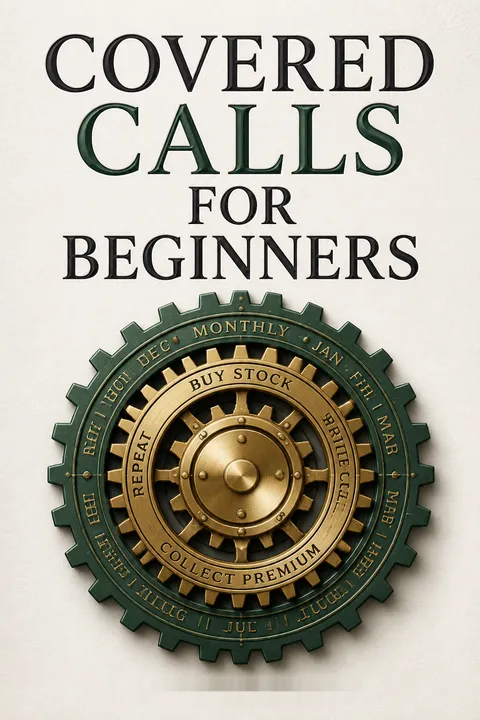


Key Takeaways
Sell calls only when you're willing to trade some upside for cash today.
The basic exchange. A covered call pairs shares you already own with a call option you sell. The buyer pays you a premium for the right to buy your shares at a set price, called the strike, before a stated expiration date. One contract usually covers 100 shares. If the stock stays below the strike, the option may expire and you keep the premium. If it rises above the strike, your shares may be sold at that price.
A concrete example. The book describes 100 Disney shares bought at $80, later worth $128, with a 30-day call at $140 sold for $59. That premium is cash received, but it is not a guaranteed monthly yield. The call trades away some upside if Disney surges past $140.
The rental analogy makes the trade intuitive: an asset can generate cash while its owner keeps holding it. But a stock is not a property with a predictable tenant payment. The premium changes with volatility, time, and the strike, while the seller accepts a binding obligation. The useful question is not whether the premium feels like income, but whether its amount fairly compensates for the upside surrendered and the work of managing the position.
A covered call adds income, not a shield against a falling stock.
The shares carry the main risk. If the stock falls, the call premium provides only a limited cushion. In the book's example, a $30 stock position earning a $1 call premium has a break-even price of $29 before costs. A steep decline can overwhelm that dollar quickly. The call does not insure the shares against losses, and owning the stock does not make its value stable.
Coverage has a precise meaning. The shares back the call, so the seller can deliver them if assigned instead of facing the potentially unlimited loss of a naked call. That makes the option leg less dangerous than an uncovered call, but the total position still bears the stock's downside. The book's claim that the strategy adds no risk is best understood as a comparison with simply owning the same shares, not as a claim that the investment is safe.
This distinction is central to sound risk communication. A strategy can avoid adding one particular hazard, such as an uncovered obligation to buy shares at any price, while leaving the largest hazard intact: owning an asset that can lose value. In insurance terms, the premium is not a protective policy. It is payment for accepting a contingent obligation, and the small cushion should not be confused with a floor under the stock.
Judge options by the investment thesis behind them, not by their scary label.
Tools inherit their users' judgment. The book recounts Thales of Miletus buying temporary rights to use olive presses before a predicted bumper harvest. The rights cost less than buying the presses and could be resold when demand rose. The story illustrates an option: a paid-for right, not an obligation, that expires on a set date. The book contrasts this with Dutch tulip speculation, where people traded rights amid rising prices and excitement rather than a grounded view of the asset.
The same instrument can serve different purposes. A call gives its buyer the right to buy shares; a put gives its buyer the right to sell them. The book invokes Benjamin Graham's distinction between investment based on reasoned principles and speculation based on weak assumptions. Options are not automatically prudent or reckless. The underlying thesis, position size, and risks matter.
The historical contrast is useful because it shifts attention from financial vocabulary to the structure of a decision. That is also a lesson in technology more broadly: a powerful tool does not supply the judgment needed to use it well. Still, a compelling story is not proof that an investor has an edge. Thales's successful prediction is memorable partly because it worked; real decisions must be assessed by the quality of their reasoning before the outcome is known.
Choose steady, liquid companies you would own without the premium.
Start with the company. For investors writing calls against stocks, the book favors established businesses with understandable operations, dependable profitability, and manageable debt. It suggests looking for more than one million shares traded daily and a debt-to-equity ratio below two, while recognizing that appropriate debt varies by industry. A dividend can add cash flow, but the book warns against chasing unusually high yields or companies paying out too much of their profits.
The ownership test matters. A suitable candidate should be a stock the investor would be comfortable holding if its price fell and the option premium did little to help. Coca-Cola, Ford, and AT&T are offered as examples of familiar, established businesses, not guaranteed winners. The book also advises avoiding speculative favorites and companies facing major near-term events that could make prices unpredictable.
This selection rule correctly puts the business ahead of the option chain. It resembles a principle from credit analysis: first ask whether the borrower or asset is sound, then judge the financing terms. Liquidity also matters because a quoted premium is less useful when trading costs or a wide bid-ask spread consume it. Yet stability is relative, not permanent. A familiar brand can still face disruption, so a company checklist cannot replace ongoing research.
Write calls in quiet markets, not ahead of a volatility lottery.
Sideways prices can suit sellers. The book argues that calls are most useful when a stock is moving sideways or rising modestly, since a sharp rally can carry it past the strike. It introduces the Choppiness Index, where higher readings suggest sideways movement, and the Average Directional Index, where readings below 25 are presented as signs of a weak trend. Bollinger Bands offer a visual clue: narrowing bands indicate a tighter recent price range, although a sharp move may follow.
Premium reflects uncertainty. Implied volatility estimates how much movement the options market expects, not which direction the stock will go. The book favors readings between 30 and 70, while warning that very high readings can signal unusual risk. It also cautions against initiating calls just before earnings or other major announcements, when prices can jump unexpectedly.
These indicators are most defensible as descriptions of recent conditions, not crystal balls. A market that has been quiet can become turbulent, and a volatility estimate can rise precisely because traders fear a large move. In this respect, the strategy resembles selling catastrophe insurance: the extra premium may look attractive until a rare event arrives. The practical value of the indicators is to prompt caution, not to certify that a stock will remain within a range.
Use delta as a rough strike guide, with 30 to 45 days as a starting window.
Strike choice sets the bargain. Delta measures how much an option's price is expected to change for a change in the stock price. The book also uses call delta as a rough proxy for the chance of finishing in the money, while noting it is not a guarantee. For investors seeking more premium, it suggests an out-of-the-money call near a 0.4 delta. Someone prioritizing keeping the shares can choose a lower delta, usually accepting less premium.
Time affects the premium. The book favors expirations around 30 to 45 days away. Options lose time value as expiration approaches, and that decay tends to accelerate within the final month. Shorter expirations allow more frequent decisions, but do not eliminate uncertainty. Delta, implied volatility, and stock price can all change, so neither the strike nor the calendar provides a reliable promise of a particular outcome.
Delta is a useful compression device: it turns several dimensions of an option into a number that helps compare possible strikes. But a proxy is not a probability guarantee. The estimate depends on a model and its assumptions, while actual stock movements can be lumpy, news-driven, and far from a smooth distribution. The 30 to 45 day window is likewise a rule of thumb, not a universal optimum. It is a starting point for comparing premiums against the amount of upside being sold.
Count capped gains as a real cost, especially in runaway rallies.
The call limits one side. If a stock rises beyond the strike, the seller generally receives the agreed sale price and keeps the premium, but gives up further gains on those shares. The book illustrates this with a stock bought at $100 and a call written at $110. If the stock reaches $190, the seller's gain is limited around the strike, while an owner without the call would still participate in the rise.
The opportunity cost is not theoretical. The book's comparison of monthly covered calls with holding the S&P 500 shows that a call-writing strategy can make money yet lag during a strong bull market. Covered calls are therefore not simply an upgrade to stock ownership. Their premiums may be more valuable during flatter periods, but those payments do not guarantee outperformance over a full market cycle.
This is the strategy's defining tradeoff, and it is easy to underweight because the premium arrives immediately while forgone gains remain hypothetical. Behavioral finance calls this a difference in salience: cash in an account feels real, while a rally beyond the strike feels like money never owned. Comparing the total position with a buy-and-hold alternative helps correct that bias. A strategy that produces frequent small wins can still disappoint if its occasional lost rallies are large.
Set exit rules before volatility tests your nerve.
Decide how to respond in advance. The book describes buying back a call to preserve shares, accepting a cost that may be offset by stock gains. It also outlines rolling, which means closing the current option and opening another with a later expiration or different strike. Rolling changes the position; it does not erase a loss or guarantee a better result.
Use rules as prompts, not laws. Two suggested heuristics are the One Percent Rule, rolling when the call's remaining extrinsic value falls below one percent of the stock price, and the Two and Twenty Rule, considering a buyback when its price falls below 20% of the original premium within two weeks. The book's Code Red rule says to consider exiting the shares when serious company-specific concerns emerge. These are management suggestions, not universally optimal instructions.
Precommitted rules can reduce impulsive decisions, much as checklists do in aviation and medicine. Their benefit depends on whether they fit the investor's objective and are applied consistently. A threshold that ignores transaction costs, taxes, liquidity, or a changed investment thesis can turn a useful shortcut into a mechanical mistake. The strongest rule here is conceptual: do not let a desire to rescue an option position keep an investor tied to a stock whose underlying case has broken.
Use LEAPs or funds only after pricing their extra risks and fees.
Lower capital is not lower risk. The Poor Man's Covered Call replaces owned shares with a long-dated, in-the-money call, often a LEAP, and sells a shorter-dated call against it. A LEAP is a long-term equity option with an expiration far in the future. This diagonal position can require less cash than buying 100 shares, but a falling stock can reduce the long option's value, and assignment of the short call can create a cash or broker problem.
Funds trade effort for cost. Covered-call funds let investors buy a managed strategy rather than manage options themselves. The book notes that some charge higher fees than index funds, and closed-end funds can trade above or below the value of their holdings. A fund may be convenient, but convenience does not ensure market outperformance or protect investors from losses.
These alternatives make the strategy more accessible, but they also add layers that can obscure the actual exposure. The long-dated option is not simply a cheaper share: it has an expiration, a premium, and sensitivity to changes in volatility. A fund delegates execution, not accountability. Before choosing either route, an investor needs to compare total costs, liquidity, and likely behavior in a sharp decline, rather than focusing only on the smaller initial cash requirement.
Build a repeatable process, then calculate after-tax returns.
Measure what you control. The book recommends process goals such as studying charts, recording trades, reviewing decisions, and starting with a small number of positions. It suggests paper trading and continuing to practice while building experience. These habits help distinguish a well-executed plan from a lucky result, which is important because even a sound position can lose money.
Taxes change the net result. In the book's U.S. tax discussion, option premiums and stock sales can receive different treatment, and some covered calls may affect holding periods or dividend tax status. The book describes qualified covered calls as generally having more than 30 days to expiration and not being deeply in the money, but the detailed rules are complex. Tax treatment depends on circumstances and can change, so consult a qualified tax professional before relying on an estimate.
Process tracking is valuable because results alone are noisy: a profitable trade can be poorly reasoned, and a loss can follow a disciplined decision. A journal makes those distinctions visible and helps prevent confidence from rising after a short winning streak. The tax section adds a broader point: investment performance is not the headline premium but the after-cost, after-tax outcome. That calculation is less glamorous than choosing a strike, but it is closer to the money an investor actually keeps.
Treat huge guaranteed returns as evidence to investigate, not believe.
Certainty is a warning sign. The book cautions against trading personalities promising rapid riches, especially those relying on extreme leverage, screenshots, or claims of secret systems. It recommends asking for independently verifiable trading records rather than accepting selected examples. A Sharpe Ratio, which compares returns with the risk taken, can provide more context than a raw gain, although no single measure proves skill.
Check the business behind the promise. The book suggests researching the service, reading its terms and refund policy, checking relevant regulatory credentials, and comparing independent reviews. It also notes that courses are not necessarily regulated like securities businesses. A persuasive story, expensive lifestyle, or anonymous testimonial is not evidence that a strategy works. The same skepticism should apply to any projected covered-call yield presented as dependable.
The scam checklist is really a lesson in evidence quality. Financial marketing often displays outcomes without showing the denominator: account size, leverage, losses, fees, or the period over which results were achieved. Reproducible records and clear risk disclosures are harder to fake than a dramatic screenshot. Even audited results cannot promise future gains, but their absence should make confidence fall, not rise. In options especially, a high premium may signal danger rather than an unusually easy opportunity.
Analysis
The book is an accessible primer organized around one practical proposition: investors who already own shares can sell calls to collect premiums. Its strongest contribution is not the promise of a particular yield, but the clear explanation of the trade's two sides. The investor receives cash now and accepts a ceiling on gains above the strike. The shares remain exposed to losses. Thales's olive-press rights and the tulip episode help frame options as neutral contracts whose consequences depend on the asset, price, and judgment behind them.
The central metaphor of rental income is memorable but incomplete. A tenant's rent does not usually expire worthless or transfer ownership of the property at a preset price. A call premium is payment for accepting a contingent obligation, and its size reflects uncertainty. Calling the strategy risk-free is therefore misleading. It can avoid the uncapped risk of a naked call, but it cannot make the underlying shares safe. The book itself recognizes that falling stock prices and surrendered rallies matter, which should temper its more enthusiastic claims. Several numerical illustrations also require restraint. Annualizing a short period's premium assumes similar opportunities recur, while projecting steady stock growth and repeated option income suppresses volatility, missed rallies, losses, taxes, and changing premiums. Delta can help compare strikes, but it is a model-based sensitivity and only an approximate guide to the chance of finishing in the money. Technical indicators describe recent price behavior; none can reliably identify the next move. Likewise, the book's suggested volatility bands, delta targets, and exit rules are heuristics, not validated guarantees.
The practical reading is conditional: consider the strategy only when ownership of the stock already makes sense, the investor accepts selling at the strike, and the premium justifies the opportunity cost. Measure performance against holding the shares, account for fees and taxes, and assess the whole portfolio rather than celebrating premium receipts alone. The book's best discipline is to treat options as tools for shaping exposure, not as a shortcut to dependable income.
Review Summary
Covered Calls for Beginners receives mostly positive reviews, with readers praising its clarity and accessibility for novice investors. Many found it informative, easy to understand, and helpful for implementing covered call strategies. Readers appreciated the current examples, tax information, and realistic approach. Some experienced traders felt it lacked specific trade examples. Overall, reviewers recommend it as an excellent starting point for those new to covered calls, highlighting its straightforward explanations and practical advice for generating passive income through options trading.
People Also Read









Glossary
Covered call
Shares paired with a sold callAn options position combining ownership of shares with a call option sold on those shares. The seller receives a premium and agrees to sell the shares at the strike price if the option is exercised. The shares cover the delivery obligation, but the position still bears stock-price losses and gives up gains above the strike.
Synthetic dividend
Cash flow from call premiumsThe book's term for premiums earned by selling calls against owned shares. It describes cash generated by an options transaction rather than a dividend paid by a company. The premium is not guaranteed to recur, does not insure the shares against a decline, and comes with the possibility that the stock will be sold at the call's strike.
Implied volatility
Expected scale of price movementA measure derived from option prices that reflects the market's expectation of how much an underlying asset may move over a period. It does not indicate whether the price is expected to rise or fall. Higher implied volatility generally makes options more expensive, increasing potential premiums for sellers while also signaling greater uncertainty.
Delta
Option price sensitivityA Greek measuring the estimated change in an option's price for a one-unit change in the underlying stock price, all else equal. Call deltas range from zero to one, while put deltas range from zero to negative one. The book also uses call delta as a rough proxy for the chance of finishing in the money, not a guarantee.
Theta
Option value lost with timeA Greek describing how an option's value is expected to change as time passes, assuming other factors remain unchanged. Options generally lose time value as expiration approaches, with decay often accelerating during the final month. This can benefit a call seller, but changes in stock price or implied volatility can offset that effect.
Choppiness Index
Indicator of sideways movementA technical indicator used to assess whether an asset's recent price action is trending or moving sideways. The book describes higher readings as indicating more sideways movement and lower readings as indicating stronger trends. It does not predict whether prices will rise or fall, and its thresholds are guides rather than certainties.
Poor Man's Covered Call
A diagonal call strategyA position that substitutes a long-dated, in-the-money call for ownership of 100 shares, then sells a shorter-dated, out-of-the-money call against it. The long option is intended to behave somewhat like stock ownership while requiring less initial cash. It is not identical to owning shares and can involve substantial losses, time decay, and assignment complications.
LEAP
Long-dated equity optionAn acronym for Long-term Equity AnticiPation, referring to an equity option with an expiration substantially farther in the future than ordinary short-term options. In the book's Poor Man's Covered Call, an in-the-money LEAP is used in place of shares. It still has an expiration date and can lose value as the stock or volatility changes.
Qualified Covered Call
Tax-defined covered callA covered call that meets specific U.S. tax requirements concerning its strike price and time to expiration. The book describes qualifying calls as generally having more than 30 days until expiration and not being deeply in the money. Tax classification can affect the holding period of the shares and the treatment of dividends, so investors should verify current rules with a tax professional.
FAQ
What's "Covered Calls for Beginners" about?
- Introduction to Covered Calls: The book introduces the concept of covered calls as a strategy to generate monthly income from stocks you already own by selling call options against them.
- Risk-Free Income Strategy: It presents covered calls as a relatively risk-free way to earn "rental income" from your stock investments, likening it to earning rent from a property.
- Comprehensive Guide: The book covers everything from the basics of options and covered calls to more advanced topics like selecting the right stocks and managing tax implications.
- Practical Approach: It aims to provide a step-by-step guide for beginners to understand and implement covered calls effectively in their investment strategy.
Why should I read "Covered Calls for Beginners"?
- Income Generation: Learn how to generate consistent monthly income from your existing stock portfolio without additional risk.
- Investment Strategy: Gain insights into a proven investment strategy used by successful investors like Warren Buffett.
- Comprehensive Coverage: The book covers both the theoretical and practical aspects of covered calls, making it suitable for beginners and those looking to refine their strategy.
- Actionable Advice: It provides actionable steps and real-world examples to help you implement covered calls effectively.
What are the key takeaways of "Covered Calls for Beginners"?
- Understanding Options: The book explains the basics of options, including call and put options, and how they can be used to generate income.
- Covered Call Strategy: It details the covered call strategy, including how to select the right stocks, strike prices, and expiry dates.
- Risk Management: Emphasizes the importance of managing risks and understanding the potential downsides of the strategy.
- Tax Implications: Provides insights into the tax implications of covered calls and how to optimize your strategy for tax efficiency.
How does the covered call strategy work according to Freeman Publications?
- Two-Legged Trade: The strategy involves holding a long position in a stock and selling a call option against it, creating a two-legged trade.
- Income from Premiums: By selling the call option, you receive a premium, which acts as income, while still holding the stock for potential capital gains.
- Risk Mitigation: The strategy is considered low-risk because the stock you own covers the call option, reducing the risk of significant losses.
- Market Conditions: It works best in stable or slightly bullish markets where the stock price is not expected to rise significantly above the strike price.
What are the benefits of using covered calls as described in "Covered Calls for Beginners"?
- Steady Income: Covered calls provide a steady stream of income through premiums received from selling call options.
- Capital Gains Potential: You still benefit from capital gains if the stock price rises, up to the strike price of the call option.
- Risk Reduction: The strategy reduces risk compared to other options strategies because you own the underlying stock.
- Cost Basis Reduction: Over time, the income from premiums can reduce the cost basis of your stock investment, increasing overall returns.
What are the risks associated with covered calls according to Freeman Publications?
- Opportunity Cost: If the stock price rises significantly above the strike price, you may miss out on potential gains as the stock is called away.
- Stock Price Decline: If the stock price falls, the premium received may not fully offset the loss in stock value.
- Management Complexity: Requires active management to monitor stock prices and option positions, which can be complex for beginners.
- Tax Implications: There are specific tax considerations that can affect the profitability of the strategy, requiring careful planning.
How does "Covered Calls for Beginners" suggest selecting the right stocks for covered calls?
- Stability and Predictability: Choose stocks that are stable and have predictable price movements, avoiding highly volatile stocks.
- Dividend Payers: Stocks that pay dividends can provide additional income, enhancing the overall return from the strategy.
- Low Debt Levels: Companies with low debt levels are generally more stable and less likely to experience significant price swings.
- Sector Considerations: Avoid cyclical sectors prone to large price fluctuations and focus on established companies with a track record of stability.
What role does implied volatility play in covered calls as explained in the book?
- Impact on Premiums: Implied volatility affects the premium received from selling call options; higher volatility generally leads to higher premiums.
- Volatility Range: The book suggests targeting stocks with implied volatility between 30% and 70% to balance premium income and risk.
- Volatility and Risk: High implied volatility can indicate potential price swings, increasing the risk of the stock being called away.
- Market Conditions: Understanding implied volatility helps in assessing market conditions and making informed decisions about strike prices and expiry dates.
How does "Covered Calls for Beginners" recommend choosing strike prices?
- Delta as a Guide: Use the delta of an option to estimate the probability of it finishing in the money, with a delta of 0.4 being a common target.
- Balancing Premium and Risk: Choose strike prices that offer a good balance between premium income and the likelihood of the stock being called away.
- Long-Term vs. Short-Term: Long-term investors may prefer lower deltas to minimize the risk of losing their stock, while short-term traders might target higher deltas for potential gains.
- Market Analysis: Consider market conditions and stock price trends when selecting strike prices to optimize returns.
What are the tax implications of covered calls as discussed in "Covered Calls for Beginners"?
- Short-Term Capital Gains: Premiums received from selling call options are treated as short-term capital gains and taxed accordingly.
- Qualified Covered Calls: Calls that are not deep in the money and have more than 30 days to expiry may qualify for different tax treatment.
- Impact on Dividends: Writing covered calls can affect the taxation of dividends, potentially impacting overall returns.
- Consult a Professional: The book advises consulting a tax professional to navigate the complexities of options taxation and optimize your strategy.
What is the "Poor Man’s Covered Call" strategy mentioned in the book?
- LEAP Substitution: This strategy involves using long-term equity anticipation securities (LEAPs) as a substitute for owning the stock.
- Lower Capital Requirement: It allows investors with limited capital to participate in covered calls by using LEAPs instead of buying 100 shares of stock.
- Diagonal Spread: The strategy involves creating a diagonal spread by buying a deep in-the-money LEAP and selling a short-term call option.
- Volatility Management: LEAPs offer advantages in managing volatility, as they are less affected by short-term price swings.
How does "Covered Calls for Beginners" suggest managing covered call positions?
- Time Decay Advantage: Use time decay to your advantage by writing options with 30-45 days to expiry, maximizing premium income.
- Exit Strategies: Implement rule-based exit strategies, such as the one percent rule or the two and twenty rule, to manage positions effectively.
- Rolling Options: Consider rolling options to new strike prices or expiry dates if market conditions change or if the stock price moves significantly.
- Monitoring and Adjustment: Regularly monitor positions and adjust strategies as needed to optimize returns and manage risks.
About the Author
Other books by Freeman Publications



Download PDF
Download EPUB
.epub digital book format is ideal for reading ebooks on phones, tablets, and e-readers.








