

Key Takeaways
Treat every share as business ownership, not a lottery ticket.
Price is not the business. A share represents part ownership in a company. Its daily price can swing on fear, excitement, or trading mechanics without a matching change in the company itself. The book points to the 2010 flash crash, when markets plunged and rapidly rebounded, as an example of prices briefly losing touch with business reality. It contrasts this noise with a cited S&P 500 average annual return of 9.69% from 1966 to 2015. That historical figure is not a promise about future returns, but it helps explain why the book favors patient ownership over attempts to predict short-term moves.
Give fundamentals time. The authors argue that long-term share prices tend to reflect business performance more than passing market moods. Holding a carefully researched investment can also reduce transaction costs and delay capital-gains taxes, depending on the investor's circumstances. Long-term holding is not a reason to ignore a failing business; it is a reason not to treat every price dip as proof that the business has failed.
The ownership frame changes the investor's central question from “What will the price do tomorrow?” to “What would make this business more valuable over time?” That shift is useful because it discourages impulsive trading and makes research relevant. Behavioral finance describes a related trap: losses often feel more urgent than equivalent gains feel rewarding, so a red number can provoke action without new information. Patience is not automatically wise, however. It only helps when the investment thesis remains sound, and when the investor can afford to wait.
Keep emergency cash outside stocks so panic cannot dictate your selling.
Separate investing from survival. The book recommends keeping three to six months of living expenses in accessible cash and excluding money needed for bills, tuition, or a home down payment from stock investments. Its rule of thumb is to invest only money that can remain untouched for at least ten years. This is not a forecast that every investment needs ten years to work. It is a buffer against being forced to sell during a downturn.
Measure risk personally. Risk is not just a label attached to an asset class or a person's age. It also depends on financial security, knowledge of the business, time available for research, and willingness to tolerate losses on paper. The authors suggest that someone uncomfortable with a 10 to 15% decline may prefer diversified funds, while an individual-stock investor should be prepared for much deeper drops.
This is a strong connection between household finance and investment behavior: liquidity can protect judgment. A cash reserve is not merely a conservative asset allocation choice; it can prevent a temporary market decline from becoming a permanent loss through a rushed sale. The advice also recognizes that risk tolerance is partly practical, not just psychological. Still, a ten-year horizon is a guide rather than a universal rule. Investors need to match the timing of their goals to suitable assets, rather than assuming that patience alone makes a risky holding appropriate.
Study the profit engine, not the fashionable industry label.
Look beneath the product. The book's Rational Process Investing approach asks investors to understand how a company actually earns money, who its customers are, and what protects its position. It defines an economic moat as an advantage that makes it harder for competitors to take a company's customers or profits. Brand, scale, patents, and network effects can all contribute. A fast-growing sector, by itself, is not evidence that every company in it will prosper.
Find the overlooked machinery. McDonald's is presented not simply as a fast-food chain but as a franchise and real-estate business. Its ownership of restaurant sites and leasing arrangements shape its economics. Starbucks is described as selling a place to meet or work as well as coffee. These examples show why familiar products can be a useful starting point for research, but not a substitute for understanding revenues, costs, competition, and management.
The emphasis on business mechanics is more durable than a list of exciting sectors. It resembles systems analysis: a company is a set of linked processes, incentives, and dependencies, not just a compelling product. Asking where profits originate can reveal hidden concentration, such as dependence on one customer or one contract. The caution is that an apparently strong moat can erode through technological or cultural change. Investors should treat competitive advantages as hypotheses to test over time, rather than permanent features simply because a company has been successful.
Diversify enough to survive mistakes, not so much you stop understanding.
Spread company-specific risk. A portfolio concentrated in one business can be damaged by a product failure, supply problem, or management error. But owning more companies does not reduce risk at a constant rate. The book cites a study in which owning 20 stocks reduced portfolio risk by an average of 29.2% compared with owning one, while expanding from 20 stocks to 1,000 reduced it by only another 0.8%. These are study-specific averages, not a guarantee for every portfolio.
Avoid diworsification. Peter Lynch's term describes adding holdings that increase complexity without meaningfully improving diversification. Buying many companies from one fashionable industry can leave an investor exposed to the same underlying risk. So can owning tiny positions in dozens of businesses that cannot be monitored. The authors give 10 to 30 individual stocks as a practical range, while noting that index funds and ETFs can provide broader exposure with less company-by-company research.
The useful insight is that diversification has both a financial dimension and an attention cost. A portfolio can look broad on paper yet remain vulnerable if its holdings depend on the same economic forces. Conversely, an investor may gain little from adding more individual names if the added research burden makes oversight superficial. Broad funds can be a rational choice, not a consolation prize. The exact number of stocks is less important than whether the portfolio's risks are genuinely varied and whether the investor can maintain a credible understanding of its holdings.
Judge businesses by earnings power, not dividends or headlines.
Separate signals from evidence. A dividend can provide income, but its presence alone does not prove that a company is stable or well managed. A struggling company may maintain payments even as profits weaken, leaving less money for investments that support future competitiveness. Conversely, the book notes that Berkshire Hathaway had not paid a dividend despite its long record of value creation. Investors should examine earnings prospects and how management uses capital, rather than treating dividends as a quality certificate.
Demand context. A low price-to-earnings ratio can mean a stock is cheap, or it can reflect weak prospects. A rising user count can hide an inability to convert users into paying customers. Analyst ratings and popular opinion can also be shaped by incentives, as the book's account of Wall Street's promotion of Amazon around its 1997 IPO illustrates. Numbers and opinions matter only when evaluated against the company's economics and competitors.
This section's central discipline is to ask what a metric actually measures. A dividend is a distribution decision, not a direct reading of business quality; a valuation ratio is a comparison tool, not a verdict. The same principle applies to media coverage, which often rewards dramatic narratives over slow-moving operating facts. Yet skepticism should not become reflexive distrust. Analysts can provide useful information, and dividends can suit particular income needs. The better rule is to examine evidence, incentives, and context before allowing any single signal to determine an investment decision.
Pay less than your value estimate to leave room for error.
Value is an estimate. The book's valuation method combines earnings per share, the price-to-earnings ratio, a projected ten-year equity growth rate, a target return, and a margin of safety. The authors use 12% as their minimum acceptable annual return for individual-stock investing, reasoning that investors seeking only market-like returns could use an index fund instead. The margin of safety means buying below an estimate of intrinsic value to allow for mistakes in assumptions or analysis.
Compare, do not worship, metrics. The book warns that valuation ratios differ across sectors and should be compared with competitors and growth prospects. Its spreadsheet is a way to organize assumptions, not to produce certainty. A projection can look precise while resting on uncertain forecasts of earnings growth, competition, or management decisions. A good company bought at an excessive price may still deliver disappointing returns, while a cheap price is not enough to rescue a deteriorating business.
The margin-of-safety idea is a practical form of epistemic humility: forecasts are fallible, so the price should reflect that. It also connects valuation to decision theory, where a choice is judged not only by its expected outcome but by how badly it can fail if assumptions prove wrong. The method's numerical structure can impose helpful discipline, but it should not create false precision. Growth rates and required returns are judgments, not facts. A robust analysis makes those assumptions visible and tests how the conclusion changes when they do.
Put available long-term capital to work instead of waiting to time dips.
Time in the market matters. Lump-sum investing means investing an available amount at once; dollar-cost averaging, as defined in the book, means deliberately dividing that existing amount into purchases over time. The authors cite a comparison using market data from 1960 to 2019 in which lump-sum investing outperformed this form of dollar-cost averaging about 80% of the time. The proposed reason is opportunity cost: cash held back misses some growth when markets rise.
Do not confuse a windfall with a paycheck. Investing new savings as they become available is different from holding back a sum already intended for investment. The book also describes a dividend reinvestment plan, or DRIP, which automatically uses dividends to buy more shares. Reinvestment can compound returns, but the investor may still owe taxes on dividends even when they are reinvested. Lump-sum investing is not a command to ignore diversification, valuation, or personal comfort with losses.
The argument clarifies a common decision error: delaying investment can feel safer because cash is visible and market risk is not. But the cited 80% result describes a historical comparison, not a law that determines what will happen next. Expected return is only one consideration; an investor who cannot tolerate an immediate decline may benefit from a paced approach that helps prevent abandoning the plan altogether. The most useful policy is one that balances opportunity cost with emotional sustainability, while distinguishing money already available from savings that arrive over time.
Sell when the business thesis breaks, not when headlines turn red.
Distinguish price from loss. An unrealized loss is a decline in the quoted value of an investment that has not been sold. The book argues that investors often mistake this temporary number for a completed loss and sell because of fear or financial news. But patience is not a reason to keep every stock indefinitely. A holding deserves review when the original reasons for owning it no longer apply.
Use business reasons to exit. The authors identify three broad grounds for selling: the investment thesis has failed, management has become untrustworthy or ineffective, or a better opportunity justifies switching. Blockbuster illustrates the cost of failing to respond to a changed business environment: it did not adapt effectively to streaming and ultimately went bankrupt. When selling at a gain, investors should also account for taxes and transaction costs; when selling at a loss, they should examine what the original analysis missed.
A disciplined sell rule prevents two opposite errors: panic selling a sound business and stubbornly defending a broken thesis. The distinction between price movement and changed fundamentals is therefore essential, but difficult to apply in real time because new information is ambiguous. The Blockbuster example is vivid precisely because the business shift became unmistakable in retrospect. A practical review should record the original reasons for buying and identify observable conditions that would invalidate them. That turns selling from an emotional reaction into an accountable decision.
Analysis
The book's most enduring contribution is behavioral rather than predictive. It argues that ordinary investors often lose not because they lack access to sophisticated data, but because short horizons, social imitation, and fear turn a share into a flashing price instead of a claim on a business. Its recurring remedy is to make investing a repeatable process: secure personal finances, understand a company's earnings engine, assess management and competitive advantages, estimate value conservatively, diversify, and review holdings against the original thesis.
That framework is coherent, but the book also contains a tension. It warns against confident market forecasts and fashionable stock tips, then presents twenty companies as candidates to hold for twenty years. The list was written in 2020 amid pandemic closures, uncertain reopening timelines, and forecasts about technologies such as 5G. Those company-specific arguments are historical artifacts, not current recommendations. The principles travel better than the selections, and even the principles require continuing scrutiny because business conditions change.
The book's valuation approach encourages useful questions, yet its chosen return target and growth estimates cannot turn uncertainty into a formula. The same caution applies to its comparisons of investing methods: historical averages describe particular periods, not guaranteed future outcomes. A sound reader should treat numerical tools as ways to expose assumptions, not as machines that certify a stock.
Its strongest practical advice is to align strategy with capacity. Investors who have neither time nor desire to study individual companies are not failing by choosing diversified funds. Those who do select stocks need sufficient liquidity, a manageable portfolio, and standards for changing their minds. The book is most persuasive when it replaces urgent prediction with patient ownership, while remaining honest that patience is useful only when the underlying business and the investor's needs still justify it.
Review Summary
The 8-Step Beginner's Guide to Value Investing receives mostly positive reviews, with readers praising its practical advice and easy-to-understand approach to long-term value investing. Many find it helpful for beginners, appreciating its insights on stock analysis and company evaluation. Some readers note its emphasis on holding stocks for extended periods and its list of recommended long-term investments. However, a few critics mention spelling errors and suggest that the book may be too basic for experienced investors.
People Also Read






Glossary
Rational Process Investing
Structured company analysisThe book's name for a repeatable approach to selecting investments. It focuses on understanding a company's business, management, competitive advantages, financial resilience, and long-term prospects, then comparing the stock's price with an estimate of value. The process is intended to replace tips, market excitement, and impulsive trading with research and explicit reasoning.
Economic moat
Durable competitive advantageA condition that helps a company defend its customers, profits, or market position against competitors. The book gives examples such as a recognized brand, economies of scale, patents, and network effects. A moat is useful only if it continues to matter as markets and technologies change; being first in a market does not, by itself, guarantee one.
Diworsification
Unhelpful portfolio expansionPeter Lynch's term, used by the book, for adding investments in ways that increase complexity or concentrated risk without meaningfully improving diversification. Examples include buying many companies from the same fashionable industry or accumulating so many small positions that an individual investor cannot follow their businesses. More holdings do not automatically mean a safer portfolio.
Margin of Safety
Discount for estimation errorThe gap between an investor's estimate of a company's intrinsic value and the price paid for its shares. The book favors buying below estimated value so that mistaken assumptions or biased forecasts are less likely to cause serious damage. The size of this cushion depends on the uncertainty of the valuation and the investor's return expectations.
Mr. Market
Personification of price swingsBenjamin Graham's fictional character, adopted in the book to represent the stock market's changing offers. Mr. Market can be optimistic or fearful from one day to the next, even when a company's business has not changed proportionally. The metaphor encourages investors to treat market prices as offers to evaluate, rather than instructions that must be followed.
Dollar-cost averaging
Staged investing of available cashIn the book's specific usage, dollar-cost averaging means dividing an existing sum of money into smaller investments made over a chosen period. This differs from investing new savings as they become available. Staging an existing sum may reduce the discomfort of investing just before a decline, but it also leaves some money uninvested while markets may rise.
Lump-sum investing
Investing available capital at onceInvesting an amount already available for investment in one go, rather than deliberately spreading it across future purchases. The book argues that this has historically outperformed staged investment more often because more capital spends more time in the market. That historical comparison does not guarantee future performance or remove the need to consider risk tolerance and diversification.
DRIP
Automatic dividend reinvestmentA dividend reinvestment plan automatically uses cash dividends to purchase additional shares of the same investment, sometimes including fractional shares. This increases the holding and can increase future dividend payments if the company continues paying them. Reinvested dividends may still be taxable, so an investor should not assume that receiving no cash means owing no tax.
Float
Premiums held before claimsIn insurance, float is money collected as premiums that an insurer holds before it must pay claims. The insurer may invest this money in the meantime. If premiums exceed claims and operating costs, the insurer can generate an underwriting profit; otherwise, investment returns on the float may still contribute to earnings, while claims remain an obligation.
FAQ
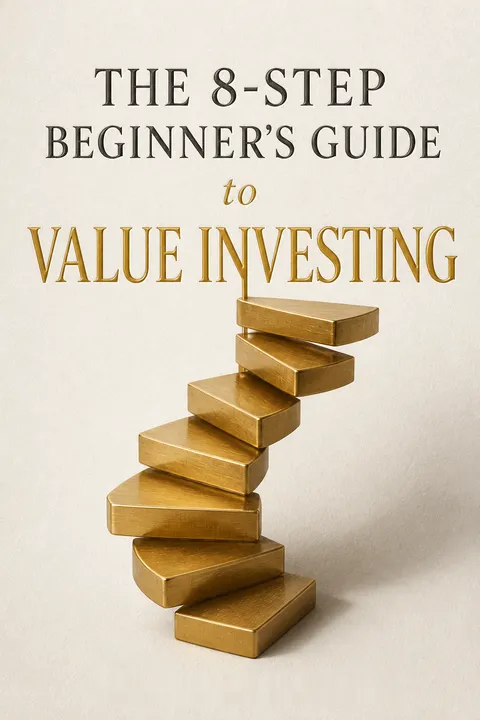
What is "The 8-Step Beginner’s Guide to Value Investing" by Freeman Publications about?
- Comprehensive Value Investing Guide: The book provides a step-by-step introduction to value investing, focusing on long-term wealth building through buying and holding quality stocks and ETFs.
- Practical Investment Framework: It introduces an 8-step process, including goal setting, rational analysis, and portfolio management, tailored for beginners.
- Stock and ETF Recommendations: The book features a curated list of 20 stocks and ETFs considered the best to buy and hold for the next 20 years.
- Educational Focus: It aims to dispel common investing myths, simplify complex concepts, and empower readers to make independent investment decisions.
Why should I read "The 8-Step Beginner’s Guide to Value Investing" by Freeman Publications?
- Beginner-Friendly Approach: The book is designed for those new to investing, breaking down intimidating concepts into easy-to-understand steps.
- Long-Term Wealth Emphasis: It advocates for proven, long-term strategies rather than risky, short-term speculation or day trading.
- Actionable Advice: Readers receive practical tools, such as a free valuation spreadsheet and specific stock recommendations, to apply the lessons immediately.
- Myth-Busting Content: The book challenges popular misconceptions about investing, helping readers avoid common pitfalls and emotional mistakes.
What are the key takeaways from "The 8-Step Beginner’s Guide to Value Investing"?
- Buy and Hold Wins: Long-term, buy-and-hold investing outperforms short-term trading and speculation for most investors.
- Rational Process Investing: Success comes from a repeatable, rational process focused on business fundamentals, not market noise or trends.
- Diversification Matters: Proper diversification (10-30 stocks) reduces risk without overwhelming the investor.
- Emotional Discipline: Mastering emotions and avoiding reactionary decisions is crucial for investment success.
What is the 8-step process for value investing recommended in "The 8-Step Beginner’s Guide to Value Investing"?
- 1. Long-Term Outlook: Adopt a buy-and-hold philosophy, focusing on multi-year horizons rather than short-term gains.
- 2. Define Investing Goals: Set clear, realistic financial goals and ensure you have a stable financial base before investing.
- 3. Understand Benefits: Recognize the tax, emotional, and compounding advantages of long-term investing.
- 4. Rational Analysis: Use a systematic approach to analyze companies, focusing on business quality and management.
- 5. Ignore Distractions: Learn what factors (like media hype, analyst consensus, and isolated numbers) do not matter in stock analysis.
- 6. Stock Selection: Apply the process to select 20 high-quality companies or ETFs to buy and hold.
- 7. Valuation: Use simple, key metrics to determine a fair price for each investment.
- 8. Efficient Buying: Choose between lump-sum investing and dollar-cost averaging, and use dividend reinvestment plans for compounding.
What is "Rational Process Investing" as described in "The 8-Step Beginner’s Guide to Value Investing"?
- Business-First Focus: Prioritize understanding the underlying business, its management, and its competitive advantages over technical analysis or market sentiment.
- Warren Buffett Test: Invest in companies you can explain simply, with honest, competent management and a clear economic moat.
- Intangible Assets Matter: Look for companies with strong brands, intellectual property, or network effects that provide lasting advantages.
- Long-Term Resilience: Favor businesses that can weather economic storms and adapt to changing environments.
How does "The 8-Step Beginner’s Guide to Value Investing" by Freeman Publications recommend analyzing and valuing stocks?
- Key Metrics: Focus on earnings per share (EPS), price-to-earnings (PE) ratio, 10-year equity growth rate, minimum acceptable rate of return, and margin of safety.
- Intrinsic Value: Calculate a fair price based on projected growth and desired returns, ensuring a margin of safety to protect against errors.
- Contextual Analysis: Always compare financial numbers within industry context and against competitors, not in isolation.
- Free Tools Provided: The book offers a free valuation spreadsheet and video course to help readers apply these methods.
What are the 20 best stocks and ETFs to buy and hold for the next 20 years according to "The 8-Step Beginner’s Guide to Value Investing"?
- Diverse Selection: The list includes companies like Disney, Amazon, McDonald's, Walmart, Coca-Cola, Starbucks, PayPal, and ETFs such as Crown Castle International and Innovative Industrial Properties.
- Sector Coverage: Recommendations span technology, consumer goods, healthcare, real estate, and financial services.
- Rationale Provided: Each pick is justified based on business model strength, management quality, economic moat, and long-term growth prospects.
- Not Just Big Names: The list also features lesser-known but high-potential companies like Sandstorm Gold, The Trade Desk, and Zuora.
What are the main benefits of long-term investing highlighted in "The 8-Step Beginner’s Guide to Value Investing"?
- Tax Efficiency: Lower capital gains taxes and greater compounding by minimizing frequent trading.
- Emotional Stability: Reduces stress and emotional decision-making by focusing on long-term outcomes.
- Passive Income: Enables accumulation of dividends and reinvestment for greater returns.
- No Need to Time the Market: Entry price matters less over decades, and there’s no pressure to chase “unicorn” stocks.
What does "The 8-Step Beginner’s Guide to Value Investing" say about diversification and portfolio management?
- Optimal Diversification: Holding 10-30 stocks balances risk reduction with manageability; owning more offers diminishing returns.
- Avoid Diworsification: Don’t over-concentrate in one sector or own too many tiny positions you can’t track.
- Supplement with Funds: Use index funds or ETFs for additional diversification, especially if you lack expertise in certain sectors.
- Regular Review: Monitor your holdings for changes in business fundamentals, not just price movements.
How does "The 8-Step Beginner’s Guide to Value Investing" by Freeman Publications address emotional investing and market psychology?
- Emotions Drive Short-Term Prices: The book explains how fear, greed, and herd mentality cause market volatility and poor decisions.
- Unrealized vs. Realized Losses: Emphasizes that losses are only real when you sell; patience is key.
- Ignore Market Noise: Advises tuning out media hype, analyst ratings, and consensus opinions that can lead to reactionary moves.
- Personal Finance Foundation: Stresses the importance of only investing money you won’t need for at least 10 years to avoid panic selling.
What are the recommended strategies for buying stocks in "The 8-Step Beginner’s Guide to Value Investing"?
- Lump-Sum Investing Preferred: Investing all available funds at once generally outperforms dollar-cost averaging over the long term.
- Dollar-Cost Averaging Use: Suitable if you receive regular income to invest, but not for holding cash on the sidelines.
- Dividend Reinvestment Plans (DRIPs): Automatically reinvest dividends to buy more shares, compounding returns without extra fees.
- Minimize Transaction Costs: Use low-commission or commission-free brokers to maximize investment efficiency.
What are the best quotes from "The 8-Step Beginner’s Guide to Value Investing" by Freeman Publications and what do they mean?
- Peter Lynch on Small Investors: “I think it's a tragedy that the small investor has been convinced by the media that they don't have a chance...if someone can sit back, and form their own opinion about a company or an industry, I think the public can do extremely well in the stock market on their own.” — Encourages individual investors to trust their own research and judgment.
- Warren Buffett’s Wisdom: “The best investment you can make is the investment in yourself.” — Highlights the importance of education and self-improvement in investing.
- On Market Madness: “I could calculate the motions of the heavenly bodies, but not the madness of the people.” — Isaac Newton’s quote, used to illustrate the unpredictability of market psychology.
- On Long-Term Focus: “In the short term the market is a voting machine but in the long term, it’s a weighing machine.” — Benjamin Graham’s classic reminder that fundamentals win over time.
- On Emotional Discipline: “Emotions are not facts.” — A core theme throughout the book, reminding readers to separate feelings from investment decisions.
About the Author
Other books by Freeman Publications



Download PDF
Download EPUB
.epub digital book format is ideal for reading ebooks on phones, tablets, and e-readers.








