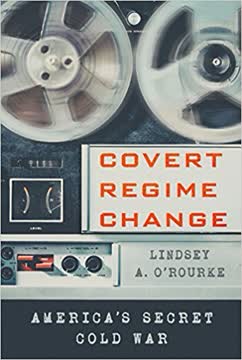
Key Takeaways
1. Regime Change: A Pervasive, Often Covert, Instrument of Statecraft
History suggests that covert regime change is a common instrument of statecraft for great powers.
A historical constant. Regime change, though often associated with recent US interventions, has a long and pervasive history in international politics, dating back centuries. States frequently resort to overthrowing foreign governments, not just through overt military invasions, but predominantly through clandestine means. This practice is far more common than publicly acknowledged warfare.
Cold War prevalence. During the Cold War (1947–1989), the United States engaged in a remarkable 70 regime change attempts. A staggering 64 of these were covert operations, compared to only 6 overt military interventions. These missions targeted a diverse array of nations, including adversaries and allies, powerful and weak, democratic and authoritarian, communist and capitalist states alike.
Beyond the Cold War. The preference for regime change persists beyond the Cold War. Every American administration since 1989 has utilized both overt and covert interventions in places like Haiti, Afghanistan, Iraq, Libya, and Syria. Understanding this enduring tool of statecraft is crucial for comprehending modern world affairs.
2. Security Interests, Not Ideology, Drive Regime Change Decisions
In simplest terms, states launch both covert and overt regime changes to increase their security and the security of their allies.
Core motivation: security. States undertake regime change primarily to enhance their national security and that of their allies, rather than for ideological reasons like spreading democracy or capitalism. This involves either neutralizing immediate military threats or bolstering their relative power against rivals. The book categorizes these security interests into three types:
- Offensive operations: Aim to overthrow a military rival or fracture an opposing alliance (e.g., US "rollback" efforts against the Soviet bloc).
- Preventive operations: Seek to maintain the status quo by stopping a state from taking actions that could pose future threats, such as joining a rival alliance or developing WMD (e.g., US "containment" efforts).
- Hegemonic operations: Designed to acquire or maintain regional dominance, ensuring political subordination of target states (e.g., US interventions in the Western Hemisphere under the Monroe Doctrine).
Irreconcilable disputes. Regime change is typically pursued when a chronic, security-based dispute cannot be resolved through other foreign policy tools like negotiation or coercion. This often occurs when the target government fears that complying with demands would jeopardize its power or fundamental interests, creating a "catch-22" situation.
Plausible alternatives. A second prerequisite for intervention is the identification of a plausible political alternative to the current government. This alternative must possess the capacity to govern and, crucially, share policy preferences aligned with the intervening state's interests. The availability of such alternatives significantly influences when and where interventions occur.
3. The Allure of Covert Action: Low Costs, High Risks, and Frequent Failure
In most cases, policymakers believe that the low potential costs of covert conduct make this option worth the higher chance of failure—particularly because they expect covert failures to remain hidden.
Cost-benefit calculation. Policymakers choose covert over overt intervention by weighing tactical and strategic factors. Covert action is overwhelmingly preferred due to its perceived lower military, economic, and reputational costs, primarily through the promise of "plausible deniability." This allows states to pursue risky or normatively unacceptable interests while deflecting blame.
Tactical dilemma. However, this cost reduction comes at a price: covert operations are inherently more prone to failure than overt ones. This is due to:
- Size-secrecy trade-off: Large-scale operations needed to overthrow powerful states are extremely difficult to organize covertly without exposure.
- Operational errors: Secrecy often leads to poor vetting, logistical ambiguity, and a lack of robust debate in planning, increasing the likelihood of mistakes.
Overwhelming preference. Despite the higher risk of failure, US leaders during the Cold War chose covert action by a 10-to-1 ratio. They believed the dramatic reduction in potential costs outweighed the increased odds of mission failure, especially if those failures remained hidden. This calculation often shifted interventions from undesirable to seemingly worthwhile.
4. Plausible Deniability: A Delusion Rarely Maintained in Practice
Although policymakers launch covert operations with the expectation that the mission’s plausible deniability will shield them from the negative repercussions of trying to topple a foreign government, in practice, this often proves more difficult than planners anticipate.
Exposure is common. The core premise of covert action—plausible deniability—is frequently undermined in practice. In over 70% of US Cold War interventions, Washington was publicly accused of meddling in the target state's domestic affairs at the time of the regime change attempt. This exposure often led to significant diplomatic and reputational damage.
"Pseudo-covert" operations. Even when an operation's cover is blown, states often maintain a "pseudo-covert" posture. This charade still offers benefits:
- Minimizes material costs compared to overt war.
- Reduces media scrutiny, keeping details from a wider public.
- Allows leaders to bypass domestic legal constraints (e.g., War Powers Act).
- Can signal restraint to adversaries, preventing further escalation.
Enemy complicity. Surprisingly, target states sometimes cooperate in maintaining the pseudo-covert charade. Reasons include:
- Attempting to infiltrate and turn double agents.
- Maximizing leverage by revealing information on their own terms.
- Avoiding exposure of their own regime's weakness to domestic rivals.
- Preventing military escalation by not publicly challenging the intervener.
5. Covert Success Favors the Weak, Not the Strategically Vital
The covert operations that easily toppled their targets also tended to be the ones that were least needed from a geostrategic perspective in that they involved overthrowing weak states with limited international po liti cal or economic influence, such as Guatemala or the Dominican Republic.
Limited short-term effectiveness. US-backed covert regime changes during the Cold War succeeded in replacing their targets only 39% of the time, significantly lower than the 66% success rate for overt interventions. This highlights the inherent limitations of clandestine operations against entrenched power.
Vulnerability factors. Covert operations were most likely to succeed against:
- Weak states: Those with limited military capabilities and international influence.
- Democracies: Surprisingly, democracies were more susceptible due to:
- Tactics like election interference being easier to conceal.
- US allies allowing easier access for agents.
- Democratic leaders often lacking "coup-proofing" mechanisms of autocrats.
- American allies: Where the US faced little domestic opposition or direct Soviet counter-intervention.
Tactical efficacy. The type of covert tactic also influenced success:
- Assassinations: 0% success rate.
- Supporting dissidents: Less than 12% success, often requiring unsustainable levels of aid.
- Sponsoring coups & election interference: Over 50% success, often by tipping already favorable domestic balances.
6. Long-Term Blowback: Covert Interventions Often Worsen Relations and Stability
In this regard, very few covert regime changes worked out as US planners intended.
Failed transformation. The core promise of regime change—to install friendly leaders and fundamentally transform interstate relations—rarely materialized. Even when successful, new leaders often faced the same domestic and international pressures as their predecessors, leading them to either defy US interests or become unpopular "puppets" vulnerable to overthrow.
Increased conflict. Covert interventions, particularly failed ones, significantly worsened relations. States targeted for covert regime change were:
- 6.7 times more likely to experience a militarized interstate dispute (MID) with the US in the decade following intervention.
- Less likely to align with the US in UN voting or foreign policy.
- More likely to align with the Soviet Union in failed cases.
Domestic destabilization. The consequences for target states were often catastrophic:
- Less democratic: Targeted states were frequently less democratic afterward.
- Civil war: The likelihood of experiencing civil war more than doubled (from 19.9% to 39.7%).
- Mass killings: The probability of state-led mass killings more than tripled (from 16.5% to 55.2%).
7. Pragmatism Over Ideals: US Leaders Prioritized Interests Over Democracy
Interestingly, US policymakers did not seem to believe that any one type of foreign government would be more likely to pursue their interests.
Strategic flexibility. Contrary to ideological theories suggesting democracies promote only democracies, US leaders were pragmatic. They supported whatever regime type—democratic or authoritarian—best served US security interests in a given context.
- Authoritarian support: In 44 out of 64 covert cases, the US backed authoritarian forces, including replacing liberal democracies with illiberal regimes in at least six instances.
- Democratic promotion: Democracy was promoted only when it aligned with US interests, often to bring pro-American parties to power or counter communist influence.
Cold War context. During the Cold War, the primary concern was containing Soviet expansion. This often meant supporting right-wing autocrats who were staunchly anti-communist, even if they had poor human rights records. Ideological rhetoric often masked a realpolitik approach.
"Communist heresy." In cases like Yugoslavia, the US even supported a communist regime (Tito's) after its split from Moscow. This was a strategic move to fracture the Soviet bloc, demonstrating that national interests could override ideological opposition when it served a larger security goal.
8. The "Rogue CIA" Narrative: Executive Oversight Was Consistently Present
As a theory of covert regime change, this explanation is unsatisfactory.
Presidential approval. The popular "rogue elephant" narrative, suggesting the CIA acted recklessly and without executive approval, is largely a myth, especially concerning regime change. While the CIA might have had autonomy in smaller covert actions, major operations like regime changes always required some form of presidential authorization.
Evolving oversight. In the early Cold War, authorizations came via general National Security Council (NSC) directives, with operational details left to the CIA. Following congressional reforms in the mid-1970s, executive and congressional oversight became much more specific and stringent.
CIA as scapegoat. The CIA often became a convenient scapegoat due to the inherent "plausible deniability" of covert actions. Presidents could disavow involvement, leaving the agency to take the blame. In many instances, CIA analysts and field agents expressed reservations about operations, only to be overruled by executive branch officials.
9. Post-Cold War: Shifting Objectives and Enduring Challenges
The end of the Cold War did not mean the end of Amer i ca’s aggressive pursuit of regime change.
New security landscape. After the Soviet Union's collapse, US regime change objectives shifted from great power rivalry to addressing threats from minor powers, particularly terrorism and nuclear proliferation. This new focus led to interventions in Afghanistan (2001) and Iraq (2003).
Unipolar advantage. The transition to a unipolar international system, with unparalleled US military dominance, lowered the perceived costs of overt intervention. This emboldened policymakers to pursue regime change with less fear of entanglement with a rival superpower, leading to a greater willingness for direct military action.
Democracy promotion's rise. With communism's decline, democracy promotion gained prominence as a US foreign policy goal. Agencies like the National Endowment for Democracy (NED) saw increased funding, aiming to foster democratic institutions. However, these efforts are often viewed by adversaries, like Russia, as illegitimate covert meddling, leading to accusations of interference in elections (e.g., 2016 US election).
10. The Enduring Temptation and Perils of Covert Regime Change
Policymakers would therefore be wise to think twice before launching such operations in the future.
Persistent allure. Despite a history of limited success and significant blowback, the temptation of covert regime change remains strong for US leaders. It offers the illusion of a "cheap" and "permanent" solution to intractable foreign policy problems, a middle ground between inaction and costly overt warfare.
Unforeseen consequences. However, the historical record consistently shows that these operations often backfire, leading to:
- Destabilized regions and prolonged conflicts.
- Increased anti-American sentiment and erosion of international trust.
- The rise of hostile regimes even more problematic than those overthrown.
- Domestic political scandals and undermining of democratic ideals at home.
A scalpel, not a chainsaw. The book concludes with a stark warning: covert action is a tool that, when used, should be wielded "like a well-honed scalpel, infrequently, and with discretion lest the blade lose its edge." The cumulative costs and unintended consequences far too often outweigh the perceived benefits, making it a policy tool that policymakers consistently overestimate.
Last updated:
Similar Books