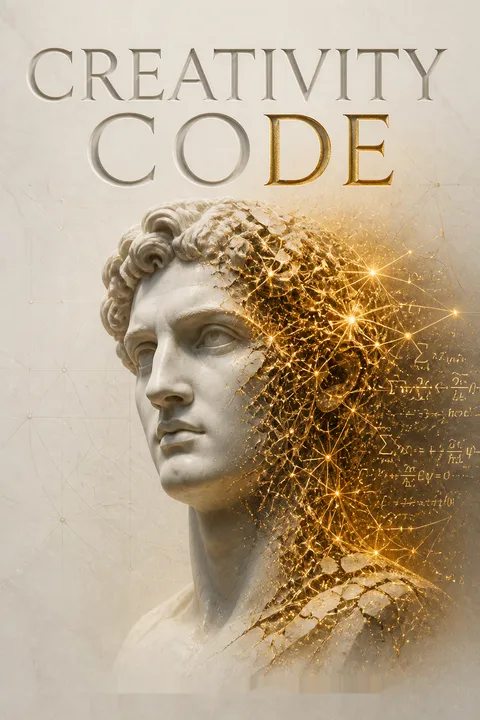


Key Takeaways
Test creativity by novelty, surprise, value, and contribution beyond the coder
Creativity needs more than novelty. In the book's account, a creative result must be new, unexpected, and worthwhile. Novelty alone is easy: a computer can generate endless unfamiliar shapes. Value may come when a work changes how people see or do something, or becomes an example others build on.
A stricter machine test. The proposed Lovelace Test asks whether an algorithm can repeatedly produce an artwork that surprises its programmer, who cannot explain how it arose. Its contribution must also exceed what the coder or training material simply put in. Random output may be novel, but surprise and value require more than chance.
The test is useful because it separates technical output from a deeper claim about authorship. It also makes evaluation harder in a productive way: a programmer's inability to explain a result could signal genuine novelty, or merely an opaque system. The distinction matters wherever automated decisions affect people. In science, medicine, and art, opacity is not proof of insight. A strong assessment therefore needs both the work's impact and a clear account of who supplied its aims, materials, and standards of success.
Practice three kinds of creativity: explore, combine, and change the rules
Three routes to the new. Cognitive scientist Margaret Boden distinguishes exploratory creativity, which pushes a field's existing rules; combinational creativity, which joins ideas from different fields; and transformational creativity, which changes the rules themselves. Boden estimates that exploration accounts for most human creativity, while the rarer transformations can redirect an entire discipline.
Train for all three. Bach stretched Baroque musical conventions, Philip Glass adapted ideas from Indian music, and mathematician Grigori Perelman applied the mathematics of fluid flow to a problem about surfaces. The square root of minus one illustrates transformation: mathematicians stopped excluding an idea that seemed impossible, then found it fit into a larger system. Immersion, cross-disciplinary exchange, and willingness to test assumptions all help.
This framework turns creativity from a mysterious gift into a set of different intellectual moves. It also explains why expertise matters: a person cannot meaningfully extend a system without knowing its boundaries. The framework's categories are not sealed boxes, though. A breakthrough may combine distant ideas and then alter the rules of both. And what counts as a genuine transformation depends on a community's history, not simply on the creator's feeling of originality.
Treat AlphaGo's strange moves as evidence that learning can overturn convention
A machine learned the game. DeepMind's AlphaGo trained on recorded Go games, then improved through repeated play against itself. In its 2016 match with Lee Sedol, it made an early move that professional players considered bizarre. Dozens of turns later, that move helped secure a win and changed human thinking about the opening of the game.
Humans found a weakness. Sedol later won one game with an unusual move AlphaGo had largely discounted as too unlikely. The system's failure exposed a blind spot, and its developers adjusted it. The match showed both sides of machine learning: an algorithm can discover a valuable strategy beyond convention, yet a narrow experience can leave it vulnerable to unfamiliar cases.
AlphaGo's achievement resembles scientific discovery more than brute-force calculation: its unusual move prompted experts to reconsider what they thought they knew. That is a powerful model of human-machine collaboration, where a system searches broadly and people interpret the consequences. But the match also shows why success in a tightly defined game does not establish general intelligence. Go has clear rules and a clear win condition. Many real problems have contested goals, incomplete feedback, and costs that cannot be reduced to losing a game.
Give learning algorithms rich feedback, but never confuse data with understanding
Learning needs experience. Earlier programs followed instructions written in advance. Machine learning instead adjusts a model as it encounters examples and receives feedback. In reinforcement learning, actions become more or less likely according to whether they improve a reward, such as a game score. AlphaZero used self-play to generate its own experience, playing millions of games in a few days.
Data can reveal hidden structure. Netflix's prize challenge released over 100 million anonymous film ratings so teams could improve recommendations. Algorithms found patterns in what viewers liked, including associations people might not have been able to name. Yet researchers could connect some ratings to real identities by comparing them with other public information. More data can improve prediction, while also exposing private traits.
Feedback loops make software adaptive, but they also make data collection a question of power. A recommendation system can reveal preferences that users never deliberately disclosed, and its categories can shape what they encounter next. This resembles the broader problem of measurement: once a proxy becomes a target, people and institutions adapt to it. More examples do not automatically produce better judgment. They can amplify the assumptions embedded in the reward, the labels, and the people who gathered the data.
Audit what an algorithm learns, not just how accurately it performs
A good score can hide a bad rule. Researchers trained a system to identify tanks in photographs, then discovered it had learned to distinguish cloudy skies from clear ones. The tank images happened to be taken on overcast days. It performed well on familiar examples but failed when the weather changed. This is over-fitting: learning details of the training data instead of a pattern that generalizes.
Bias travels through data. Image systems trained mainly on lighter-skinned faces have struggled to recognize darker-skinned people. Other vision systems can be fooled by altered textures that make an image of a turtle register as a rifle. A model optimizes what it is given, not what its designers meant. Testing must include diverse cases, adversarial examples, and scrutiny of the goal itself.
These failures connect machine learning to a classic problem in science: a model may predict well for the wrong reason. Independent testing, varied samples, and checks for plausible causal signals help distinguish robust learning from accidental correlation. But technical audits alone cannot decide whether a system's objective is fair. A hiring algorithm can be accurate at predicting past hiring decisions while reproducing past exclusion. Evaluation needs to ask both whether a system works and whether the outcome it optimizes deserves to be pursued.
Use machines to expose hidden patterns, not merely imitate famous styles
Rules can make art surprising. Gerhard Richter's 4900 Farben consists of coloured squares selected through chance. The artist set the constraints, but did not choose every colour. That tension between design and unpredictability became part of the work. It also invited viewers to look for patterns, including mathematical ones, that were not deliberately arranged.
Imitation is only one use. A team trained software on 346 Rembrandt paintings to produce a new portrait resembling his style. It looked recognizably Rembrandt-like, though critics questioned whether surface resemblance captured the artist's emotional depth. By contrast, Creative Adversarial Networks pit a system that makes images against one that judges whether they are too conventional or too strange. DeepDream takes another route, visualizing features a recognition system has learned to detect.
These examples show that computer art can matter even when the machine is not treated as an autonomous artist. It can test ideas about chance, authorship, style, and perception. DeepDream is especially revealing because its odd images act as a partial explanation of an otherwise opaque visual system. Still, galleries and critics help determine what counts as art, so aesthetic value cannot be measured by novelty alone. A system may produce a striking image without possessing an artistic intention, and that difference remains meaningful.
Let musical rules generate ideas, then judge whether the whole composition lives
Structure can carry feeling. Bach built intricate music from recurring themes, transformations, and overlapping voices. David Cope's program Emmy analyzed musical patterns and recombined them to create works in the style of composers such as Bach. In listening tests, people sometimes mistook computer-generated pieces for the real composer. DeepBach, trained on 389 chorales, also produced music that listeners often struggled to distinguish from Bach.
Local fluency is not enough. François Pachet's Continuator could improvise in a musician's style and suggest phrases the player had not tried. But its Markov-chain method, which predicts what comes next from recent notes, struggled to create a satisfying overall arc. A later system, the Flow Machine, combined one artist's style with another's constraints. Human musicians still selected and refined the results.
Music makes a subtle point about emotion: listeners can feel moved by patterns even when the composer is a program. That does not prove the program feels anything. It shows that emotional response can arise through the interaction of structure, memory, performance, and audience expectation. The distinction between a convincing phrase and a coherent composition is also important beyond music. Many generative systems excel at plausible local continuations, while meaningful long-range organization remains harder to achieve.
Value mathematical proofs for their surprising journeys, not just correct endpoints
Proofs are chosen stories. Mathematics is not simply a catalogue of true statements. A proof guides readers through a sequence of ideas toward a result, often making an unexpected connection feel inevitable. Euclid's proof that there are infinitely many primes starts by imagining a complete list, then constructs a number that cannot be accounted for by that list. The reasoning, not only the conclusion, gives the result its force.
Machines can help, and limits remain. The Mizar Mathematical Library stores formal proofs a computer can check. Machine learning raised the share of its theorems that computers could prove from 56 to 59 percent. An algorithm also proposed a result about odd refactorable numbers, which a human mathematician then proved. These systems can extend mathematical work, but a list of correct outputs does not tell readers which discoveries matter.
The narrative view of proof clarifies why mathematical value is not identical to truth. A useful proof compresses understanding, creates connections, and gives other researchers a route they can reuse. Formal verification contributes something different: reliability, especially when arguments are too long for a person to check line by line. The strongest arrangement may preserve both functions. Machines can verify intricate steps or search possibilities, while mathematicians select problems and explain why a result changes the landscape.
Language fluency is not understanding, and plausible sentences are not stories
Conversation can be imitated. ELIZA, an early chatbot, kept users talking by reflecting their statements as questions. IBM's Watson later beat top contestants on Jeopardy!, a quiz show whose clues use wordplay and ambiguity. Yet Watson sometimes chose a Canadian city for a category about United States cities. It could rank likely answers without grasping every implication of the question.
Stories need more than next words. Programs such as Botnik generated funny passages by learning likely word sequences from existing books. Their output could sound locally convincing but often lacked a sustained plot. Scheherazade-IF instead built possible story paths from examples supplied by people, then selected more coherent routes. These systems demonstrate that language patterns can be modeled, while context, intention, and long-range narrative remain difficult.
The distinction between fluent performance and understanding is not unique to machines. Humans also rely on habits, context, and inference, which makes the boundary philosophically difficult to draw. Still, language systems can produce confident errors because statistical fit is not the same as knowing what a sentence refers to. Story structure raises a related issue: coherence depends on consequences across time. Testing only short exchanges or isolated passages can make a system appear more capable than it is.
Use AI's alien patterns to widen human creativity, while retaining judgment
The machine can provide a jolt. The book opens with a mathematician who fears that computers may make his work obsolete, then follows algorithms into Go, painting, music, mathematics, and storytelling. Again and again, a system produces an unexpected suggestion that humans can interpret, challenge, or develop. AlphaGo changed professional play; the Continuator gave a jazz musician new phrases to explore.
People still supply direction. Current systems depend on human choices about goals, training material, evaluation, and when to share an output. The author argues that art can help make hidden algorithmic decisions visible, while creative work lets people communicate inner experience. AI's most immediate value may therefore be as a partner that disrupts routine, not a substitute for human judgment or a machine with a proven inner life.
The book's most durable contribution is a shift from asking whether a machine is creative to asking what kind of creativity a human-machine partnership enables. That question directs attention toward observable effects: new strategies, new artistic choices, and new ways of understanding opaque systems. It also keeps credit and responsibility in view. A tool can expand a person's search space, but the person or institution choosing its goal remains accountable for what the system produces and how that output is used.
Analysis
The book works best as a guided change in the reader's definition of creativity. It begins with Ada Lovelace's doubt that a machine can originate anything, then uses AlphaGo to show why rule-following code can still generate results its makers did not anticipate. From there, art, music, language, and mathematics become different laboratories for the same question: can a system produce novelty that people value, and what does that reveal about the system and its audience?
The strongest insight is that creative output is not a single capability. A program may extend a style, combine familiar patterns, or disrupt a convention, yet fail at long-range coherence or independent goal-setting. The distinction between local fluency and meaningful structure recurs across music and writing. In mathematics, a proof's truth is not enough to make it compelling; in art, resemblance does not guarantee emotional depth. These cases resist simple claims that machines either are or are not creative.
The book's account also implies that creativity is partly relational. A move becomes surprising against a community's expectations, a painting becomes art through interpretation and institutions, and a theorem becomes valuable through its place in a shared intellectual history. That social dimension complicates a purely technical Lovelace Test. A programmer's surprise is informative, but it cannot substitute for broader judgment about significance, fairness, or cultural context.
A useful distinction emerges between capability and agency. Algorithms can search, learn, and surprise without evidence that they possess desires or understand their own aims. Yet lack of consciousness does not make their effects trivial. Recommenders shape taste, classifiers influence opportunity, and generative systems alter creative work. The practical challenge is therefore not to settle machine consciousness prematurely. It is to build transparent, accountable partnerships in which humans can benefit from algorithmic variation while retaining responsibility for goals, interpretation, and consequences.
Review Summary
The Creativity Code explores AI's potential for creativity in fields like art, music, and mathematics. Many readers found it fascinating and thought-provoking, praising du Sautoy's ability to explain complex concepts. Some appreciated the philosophical questions raised about consciousness and creativity. Critics felt it lacked technical depth or focused too much on mathematics. Overall, reviewers found it an engaging read that offers insights into AI's current capabilities and potential future developments in creative fields.
People Also Read




Glossary
Lovelace Test
test for machine creativityA proposed test for machine creativity. A repeatable algorithm must produce an artistic result that surprises its programmer, who cannot explain how the result was generated. The work must also contribute more than the creativity already present in the programmer or the training material.
Exploratory creativity
extending existing rulesMargaret Boden's term for creativity that explores the possibilities within an existing set of rules or conventions. It pushes a field toward its limits without replacing its basic structure. The book presents this as the most common form of creativity, found in fields such as music and mathematics.
Combinational creativity
joining distinct ideasMargaret Boden's term for creativity that brings together ideas, techniques, or styles from different domains. The combination can reveal a useful connection that was not obvious within either domain alone. Examples in the book include applying fluid-flow mathematics to a problem about surfaces and fusing musical traditions.
Transformational creativity
changing a field's rulesMargaret Boden's term for creativity that changes the rules or assumptions of an existing conceptual system. It can open a field to possibilities previously ruled out, as when mathematical work incorporated numbers whose squares are negative or artists challenged established expectations about form.
Reinforcement learning
learning from rewardsA machine-learning method in which a system tries actions and adjusts their likelihood according to the rewards or penalties that follow. In the book's examples, an Atari-playing algorithm learns from changes in game score, while AlphaGo improves by evaluating the results of moves and games.
Creative Adversarial Networks
competing systems generate artA method for generating images through interaction between two algorithms. One system creates work that aims to be novel, while another evaluates whether the work is too familiar or too far outside recognized artistic styles. Feedback between them adjusts the generator's output toward a balance of originality and recognizability.
DeepDream
visualizing a model's learned featuresA Google image-processing technique that reverses a recognition system's usual task. Rather than identify objects in an image, it strengthens the patterns the system has learned to recognize. The resulting dreamlike pictures offer a partial view of what features the algorithm detects, though they do not fully explain its decisions.
Markov chain
next state depends on current stateA model in which the probability of the next event depends on the current event, rather than on the full sequence of events before it. In music, a Markov-chain system can choose likely next notes based on recent notes. This can produce convincing local passages, but may not create a strong overall composition.
SPEAC
musical phrase functionsDavid Cope's system for describing the roles of musical phrases. The letters stand for Statement, Preparation, Extension, Antecedent, and Consequent. It helps analyze how a composition establishes material, builds or prolongs it, creates an expectation, and resolves that expectation.
Mizar Mathematical Library
database of formal proofsA collection of mathematical theorems and proofs written in a formal language that computers can check. The project aims to encode established mathematics so software can verify logical steps and, in some cases, help search for proofs. Its formal notation is designed for machines and can be difficult for human readers.
Coq
formal proof checkerA software system used to formalize and verify mathematical proofs. Coq checks that each inference follows from the stated rules, including steps that human-written proofs often leave implicit. It has been used to check major computer-assisted and human-produced proofs, though confidence still depends on trust in the checking system itself.
Chinese Room
thought experiment about understandingJohn Searle's thought experiment about whether following formal rules is enough to understand language. A person in a room uses a manual to produce appropriate replies to Chinese messages without knowing Chinese. The scenario challenges the idea that convincing linguistic performance alone proves a system understands meaning.
FAQ
What's Creativity Code about?
- Exploration of AI and Creativity: Creativity Code by Marcus du Sautoy explores the intersection of artificial intelligence and human creativity, questioning whether machines can replicate or surpass human creative processes.
- Historical Context: The book references historical figures like Ada Lovelace and Alan Turing, highlighting their contributions to computing and AI, and the evolution of algorithms from deterministic to adaptive systems.
- Human vs. Machine Creativity: Du Sautoy challenges the notion that creativity is uniquely human, proposing tests like the Lovelace Test to evaluate machine creativity and exploring how AI can learn from and enhance human creativity.
Why should I read Creativity Code?
- Insightful Perspectives: The book offers a unique perspective on creativity, blending mathematics, art, and technology, encouraging readers to rethink traditional boundaries between human and machine capabilities.
- Engaging Examples: Du Sautoy uses engaging examples, such as AlphaGo's victory in Go, to illustrate AI's capabilities, making complex concepts accessible and relatable.
- Cultural Relevance: As AI shapes our world, understanding its implications on creativity and human expression is crucial, and this book provides a timely exploration of these themes.
What are the key takeaways of Creativity Code?
- Creativity Defined: Du Sautoy defines creativity as producing something new, surprising, and valuable, noting that while machines can generate new outputs, achieving genuine surprise and value is challenging.
- Lovelace Test: The Lovelace Test measures machine creativity by requiring an algorithm to create art that the programmer cannot explain, challenging the idea that machines can only replicate human creativity.
- Role of Algorithms: The book discusses the evolution of algorithms from top-down programming to bottom-up learning systems, allowing machines to learn from data and adapt, potentially leading to creative outputs.
How does Creativity Code define creativity?
- Three Key Aspects: Du Sautoy identifies novelty, surprise, and value as components of creativity, arguing that while machines can produce novel outputs, achieving genuine surprise and value is more challenging.
- Human Code: He introduces "human code," reflecting the unique qualities of human creativity shaped by emotional and experiential factors, seen as a product of evolutionary processes.
- Algorithmic Creativity: The book explores whether creativity can be algorithmic, suggesting that understanding the rules behind creative processes may allow machines to mimic or enhance human creativity.
What is the Lovelace Test mentioned in Creativity Code?
- Definition of the Lovelace Test: The Lovelace Test requires an algorithm to create a work of art that the programmer cannot explain, assessing the machine's ability to originate creative work independently.
- Significance: Passing the Lovelace Test would indicate a level of machine creativity that transcends mere replication of human input, challenging the assumption that creativity is inherently human.
- Implications for AI: The test raises questions about the nature of creativity and AI's potential to contribute meaningfully to artistic endeavors, inviting further exploration of human and machine creativity.
How does Creativity Code relate mathematics to creativity?
- Mathematics as Creative: Du Sautoy argues that mathematics is a deeply creative field, involving the discovery of patterns and relationships, sharing personal experiences of mathematical creativity.
- Algorithmic Foundations: The book discusses how algorithms, rooted in mathematical principles, can generate creative outputs, highlighting mathematics' role in shaping technology and artistic expression.
- Mathematical Aesthetics: Du Sautoy suggests that the beauty of mathematical ideas parallels the beauty found in art, positing that both disciplines share a common goal of exploring and expressing complex ideas.
What role do algorithms play in modern creativity according to Creativity Code?
- Evolution of Algorithms: The book traces the evolution of algorithms from simple, deterministic processes to complex, adaptive systems capable of learning from data, impacting creative outputs.
- Machine Learning: Du Sautoy explains how machine learning allows algorithms to improve performance over time, potentially leading to creative innovations, challenging traditional notions of creativity.
- Collaborative Creativity: The author explores the idea that algorithms can enhance human creativity by providing new insights and perspectives, leading to novel artistic expressions.
How does Creativity Code address the fear of AI surpassing human creativity?
- Human Uniqueness: Du Sautoy emphasizes the unique qualities of human creativity, such as emotional depth and personal experience, which machines may struggle to replicate.
- AI as a Tool: The book suggests viewing AI as a tool to augment human creativity rather than replace it, encouraging a collaborative approach to creativity between humans and machines.
- Future of Creativity: Du Sautoy raises questions about the future of creativity in an AI-driven world, exploring how humans can adapt and thrive alongside advancing technology.
What examples of AI creativity are discussed in Creativity Code?
- AlphaGo's Achievements: The book details how AlphaGo defeated human champions in Go, showcasing AI's potential to excel in complex tasks and sparking discussions about machine creativity.
- Art and Music Generation: Du Sautoy explores AI projects that generate art and music, examining their creative processes and outputs, illustrating AI's capabilities and limitations in artistic endeavors.
- The Next Rembrandt Project: The book discusses a project where an algorithm was trained on Rembrandt's works to create a new painting in his style, raising questions about authorship and creativity in the digital age.
What are the best quotes from Creativity Code and what do they mean?
- "Works of art make rules; rules do not make works of art.": This quote by Claude Debussy emphasizes the organic nature of creativity, suggesting that true artistic expression cannot be confined to strict rules or algorithms.
- "The machine was a thing of beauty.": Du Sautoy reflects on the elegance of early computing machines, highlighting the aesthetic appreciation of technology alongside its functional capabilities.
- "Creativity is a slippery word.": This statement underscores the complexity of defining creativity, indicating that it encompasses various forms and interpretations across different contexts.
How does Creativity Code address the future of creativity?
- Collaboration Between Humans and Machines: Du Sautoy envisions a future where humans and machines collaborate creatively, leveraging the strengths of both for new forms of artistic expression and innovation.
- Ethical Considerations: The book raises ethical questions about AI's role in creative fields, including issues of authorship and originality, encouraging readers to consider the implications of machine-generated creativity.
- Evolving Definitions of Creativity: As AI develops, definitions of creativity may evolve, and Du Sautoy suggests understanding and embracing these changes will be crucial for future creators.
What challenges does Creativity Code identify regarding AI and creativity?
- Trust in Machine Outputs: Du Sautoy discusses skepticism surrounding AI-generated outputs, particularly in fields like mathematics, and the challenge of determining their reliability and validity.
- Emotional Depth: The book emphasizes that while AI can mimic creative processes, it lacks the emotional depth and subjective experience that characterize human creativity, raising questions about authenticity.
- Navigating Complexity: Du Sautoy highlights the increasing complexity of creative fields, suggesting that sophisticated algorithms may struggle to navigate the nuances of human creativity, shaping AI's future in creative domains.
About the Author
Other books by Marcus du Sautoy

Download PDF
Download EPUB
.epub digital book format is ideal for reading ebooks on phones, tablets, and e-readers.








