

Key Takeaways
Ask what moves preserve a shape, then study how those moves combine.
Symmetry is an action. As a boy, du Sautoy was steered beyond school arithmetic by a teacher who urged him to explore what mathematics could do. A triangle gave him the first surprise: six moves preserve it, including rotations, reflections, and simply leaving it alone. Symmetry is not just a visual quality. It is a transformation that leaves an object looking unchanged. Group theory is the mathematical language for collecting such transformations and studying how they combine.
Order reveals structure. A six-armed star and a triangle can each have six symmetries, yet their moves interact differently. Rotations of the star commute, meaning their order does not matter. For the triangle, combining a reflection and a rotation in opposite orders can give different results. The interaction pattern, not the count alone, identifies the symmetry.
What's striking is the shift from asking what an object looks like to asking what changes leave it invariant. That move separates essential structure from viewpoint: a shape can be rotated, reflected, or translated without losing its identity. It is a broadly useful way to think about sameness, from classifying designs to deciding which features of a system actually matter. The caution is that counting preserved moves is only a first step. Two objects with the same number of symmetries can still have fundamentally different structures.
Notice when symmetry signals function, but separate evidence from evolutionary story.
Patterns can advertise. Du Sautoy describes flowers and bees as participants in a visual exchange. A bee with limited eyesight can detect certain symmetrical flower forms, which may help it find food; a flower benefits when the bee carries pollen. Symmetry can therefore work as a signal, not merely decoration. The book also links bodily symmetry with health and mate choice, while acknowledging that such claims arise from particular studies and examples.
Efficiency matters too. In the hive, hexagonal cells let bees store honey while using wax economically. In the nonliving world, a soap bubble settles into a sphere because that shape encloses a given volume with minimal surface area, reducing the film's energy. Symmetry can thus arise from different causes: communication in one setting, efficient construction in another.
The useful distinction here is between symmetry as a signal and symmetry as an efficient outcome. A flower's shape can influence an animal's behavior, while a bubble's form follows physical constraints; the resemblance does not mean the mechanisms are the same. This framing also keeps evolutionary claims in proportion. Symmetry may indicate health in some contexts, but it is not a universal certificate of genetic quality. The book is strongest when it shows how one visual pattern can acquire different meanings in different systems.
Recognize the same symmetry beneath patterns that look nothing alike.
Walls become mathematics. At Granada's Alhambra, Moorish artists covered walls and ceilings with repeating tile designs. Du Sautoy searches for the different ways a pattern can be moved and still match itself: sliding it, rotating it, reflecting it, or reflecting and then sliding. The last kind of motion can create a mirror-like effect without a visible mirror. The complete set of possible repeating symmetries on a flat surface is limited to 17 wallpaper groups, even though the designs themselves can vary endlessly.
Appearance can mislead. Two Alhambra patterns may look unrelated yet share the same underlying symmetry. Mathematicians express that sameness by comparing how their symmetry operations combine, rather than by comparing the tiles. This abstraction lets one classify patterns without needing to find two physically similar examples.
The Alhambra episode makes classification feel less like cataloguing pretty objects and more like discovering a grammar. The tile is the vocabulary; the permitted transformations are the rules. That distinction explains how an abstract system can unite examples that differ in color, material, or artistic intent. It also shows why a finite classification can coexist with limitless creativity: the possible structural rules are bounded, but the forms built within those rules are not.
When an equation resists a formula, study how its roots permute.
The roots have structure. Renaissance mathematicians found formulas for cubic and quartic equations, encouraging the search for a similar formula for every quintic, an equation with a fifth power. Niels Abel proved that no single formula using arithmetic and roots can solve all quintics. Évariste Galois went further: each equation has a group of root permutations, the rearrangements that preserve the relationships among its solutions. This is its Galois group.
Indivisibility blocks a solution. Galois showed that whether an equation can be solved by radicals depends on how its permutation group can be broken into simpler groups. The symmetries associated with the general quintic include an indivisible group of 60 operations, corresponding to the rotations of a dodecahedron. That structure cannot be reduced to the simpler pieces required by a radical formula. Galois died at 20; his ideas were recognized only after his papers were recovered and explained by other mathematicians.
Galois's insight turns a problem about finding answers into a problem about the relationships among answers. That is a powerful change in scale: instead of manipulating a specific formula, the mathematician identifies the structure that makes a formula possible or impossible. The story also makes communication part of mathematical discovery. A correct idea that cannot be followed is not yet a working tool for a community, and Galois's delayed recognition shows the cost of leaving a difficult argument without an interpreter.
Let elegant patterns guide conjectures, but allow one counterexample to end them.
A pattern is not a proof. The book follows du Sautoy's attempt to count groups built from simple symmetries. The PORC Conjecture proposes that, for each fixed power of a prime p, the count can be given by polynomial formulas selected according to p's remainder after division by a fixed number. Zeta functions, formulas that package mathematical data, helped him establish that some counts obey a recursive relationship, though not the explicit rule itself.
Computers can puncture beauty. Many zeta functions he examined had palindromic coefficients, so he suspected a general law. A graduate student's computer calculation produced a counterexample: the coefficients did not reverse symmetrically. The result ended a decade-long conjecture, despite the pattern's appeal. A finite string of numbers can support many plausible rules, and a striking sequence alone cannot decide which rule is true.
This is a vivid case of mathematical aesthetics doing two jobs. Beauty helps researchers notice a possible order, but it can also tempt them to protect a favored explanation. The computer's value is not that it replaces reasoning; it can efficiently search examples that expose a false universal claim. The episode also models a healthy research culture: a student's result matters because it is checked against the claim, not because it confirms the senior mathematician's intuition.
Map symmetry's indivisible building blocks, even when the proof sprawls across thousands of pages.
The Atlas charts the basics. Simple groups are the indivisible building blocks from which finite symmetry groups can be assembled. Mathematicians sought a complete catalogue, comparing it to a periodic table. The result includes familiar families, such as prime-sided rotations and even shuffles, as well as 26 sporadic groups that fit no infinite family. Conway and colleagues' Atlas of Finite Groups recorded the known terrain, including the Monster, whose order is an extraordinary 808,017,424,794,512,875,886,459,904,961,710,757,005,754,368,000,000,000.
Proof can be collective. The classification was assembled across thousands of pages and many researchers. A major missing section was eventually addressed in a 1,221-page proof. The size raises real questions about verification and whether the techniques remain teachable, but the book presents the achievement as a collective map, not a single mathematician's elegant theorem.
The classification shows that mathematical certainty need not arrive in a short, polished package. A proof can be a distributed intellectual achievement, with different researchers establishing separate regions and later work checking how they connect. Its scale is also a legitimate vulnerability: length makes independent auditing harder and can leave knowledge concentrated among specialists. The Atlas answers part of that problem by organizing results, but a catalogue is not the same as an explanation of why nature chose these particular building blocks.
Use symmetry to compress construction and protect messages from errors.
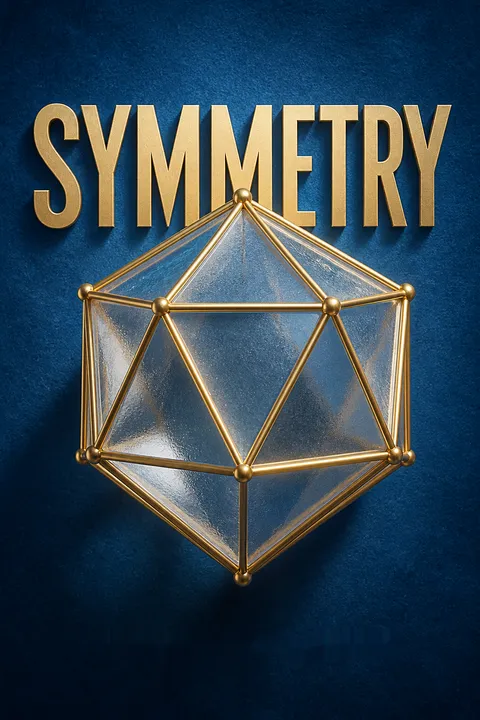
Nature reuses parts. A virus can build a shell from repeated protein pieces arranged with icosahedral symmetry. The repeated pattern makes a complex-looking enclosure possible with a relatively short set of genetic instructions. Symmetry is not only a shape; it can be a compact construction rule.
Codes add recoverable structure. The book connects this idea to error-correcting codes, which add carefully chosen redundancy so damaged digital messages can still be read. Marcel Golay's code uses strings of 24 binary digits to identify valid messages; the book describes it as able to correct three errors and detect seven. Its codewords also define special points in 24-dimensional space, whose symmetries connect to John Leech's unusually efficient sphere packing. The same mathematical structures help organize both reliable communication and geometric packing.
Compression and error correction may sound like opposites: one removes excess, the other adds it. Symmetry helps explain how they can cooperate. A repeated rule keeps construction economical, while patterned redundancy makes corrupted data recognizable. The connection is not that a virus and a communication code work identically, but that both exploit structured repetition. This is a useful reminder that mathematical ideas often travel between fields because they describe relations, not because the applications share a physical mechanism.
Give patterns enough regularity to create form, then leave room for surprise.
Music can be structured. Bach's Goldberg Variations consists of an opening aria, 30 variations, and a return to the aria. The variations are arranged in groups of three, with a canon in each group. In a canon, one musical line repeats after a delay, like a pattern translated through time. Bach also varies pitch, rhythm, and direction, making the work a journey through recurring structures rather than a simple repetition.
Too much order can flatten art. Modern composers such as Schoenberg and Xenakis used mathematical transformations to generate musical possibilities. Yet du Sautoy's composer friend warns that a perfectly automatic pattern can become predictable. Bach's playful quodlibet, which brings familiar folk tunes together, interrupts the expected cycle. Structure gives listeners something to recognize; variation and disruption keep recognition from becoming boredom.
The artistic example complicates the idea that more symmetry always means more beauty. A pattern creates expectation, and the pleasure often lies in sensing both the rule and the moment it bends. That makes symmetry a resource rather than a finished aesthetic verdict. The book also leaves open whether listeners need to hear the mathematical structure consciously. A hidden construction can shape coherence even when the audience responds only to the music.
Treat numerical coincidences as invitations to find a hidden bridge.
Two subjects unexpectedly meet. The Monster is a vast finite symmetry group, first visible through a representation requiring 196,883 dimensions. In a separate area of mathematics, the modular function has a sequence of coefficients beginning 1, 744, 196,884. John McKay noticed that 196,884 equals 1 plus 196,883. Further coefficients also matched combinations of dimensions associated with the Monster, making coincidence increasingly implausible.
Moonshine needed an explanation. Conway and Norton named the puzzling relationship Monstrous moonshine. Richard Borcherds later used a mathematical structure called a vertex operator algebra to prove the connection. The name began with numerical resemblance, but the result revealed a genuine bridge between symmetry and number theory, with links to ideas used in string theory. The numerical pattern was a clue, not the explanation itself.
What's compelling is the transition from numerical oddity to a structural account. A coincidence is not self-authenticating; the evidence becomes persuasive when many relations fit and a theory explains why they fit. This is a disciplined alternative to both credulity and dismissal. The connection also warns against turning mathematical elegance into a claim about cosmic purpose. A deep relationship between abstractions is significant on its own, even without a physical story that makes it intuitive.
Analysis
The book's central achievement is to redefine symmetry from a visual impression into a method for identifying invariance. A triangle, a tiled wall, a polynomial equation, a virus shell, and a communication code may look unrelated, yet each can be studied through the transformations that preserve its structure. Group theory supplies a grammar for those transformations. Once that grammar exists, mathematicians can distinguish objects that share a symmetry count from those that share the same internal relations, and can sometimes prove that a classification is complete.
Du Sautoy's narrative makes abstraction credible by letting it emerge from physical encounters: a childhood triangle, the Alhambra's tiles, a student discovering a counterexample, and the enormous Monster. The recurring story is not simply that mathematics finds patterns. It is that mathematical language turns pattern recognition into a testable account of how parts relate. The shift from Galois's root permutations to the classification of simple groups is the book's strongest historical arc, while the applications to viruses, music, and codes show that the language travels beyond geometry.
The book also invites a distinction between mathematical and empirical claims. A theorem about the 17 wallpaper groups is logically exact once its assumptions are fixed. Claims that symmetry reliably signals biological quality depend on context, measurement, and evidence that can change. The book sometimes places these claims close together, which can make the certainty of mathematics seem to rub off on the uncertainty of biology. Readers should preserve the difference.
Finally, the classification story exposes a tension within mathematical knowledge. Proof is a standard of certainty, yet a proof spread across thousands of pages is difficult for any one person to survey. The collaborative Atlas and later repair work show that rigor is not only a property of a finished argument; it is also a social practice of documentation, criticism, and transmission. Symmetry becomes both subject and metaphor: independent contributions combine into a larger structure whose coherence no single contributor could supply alone.
Review Summary
Symmetry receives mostly positive reviews, with readers praising du Sautoy's ability to explain complex mathematical concepts in an accessible way. Many appreciate the blend of mathematical history, personal anecdotes, and explanations of symmetry in nature. Some criticize the book's structure and occasional repetitiveness. Readers with mathematical backgrounds tend to enjoy it more, while those seeking a basic introduction to symmetry may find parts challenging. Overall, it's viewed as an engaging exploration of symmetry's role in mathematics and the natural world.
People Also Read




Glossary
group theory
study of combining transformationsThe branch of mathematics that studies sets of operations and the rules for combining them. In symmetry problems, the operations are moves that leave an object unchanged, such as rotations or reflections. Their interactions can distinguish structures that have the same number of symmetries but behave differently.
simple group
indivisible symmetry building blockA nontrivial group with no proper normal subgroup, making it a basic component in the structure of finite groups. The book describes simple groups as indivisible building blocks, analogous to prime numbers. They include infinite families, such as alternating groups, and 26 exceptional sporadic groups.
wallpaper groups
17 repeating plane symmetriesThe 17 possible symmetry types for patterns that repeat in two independent directions across a plane. A particular tiling can use rotations, reflections, translations, or glide reflections, but its underlying combination of symmetries belongs to one of these 17 classes. Many visually different designs can share the same wallpaper group.
Galois group
permutations preserving root relationsThe group of permutations of an equation's roots that preserves the algebraic relationships among them. Évariste Galois showed that the structure of this group determines whether the equation can be solved using radicals. The idea connects the algebra of equations to the mathematics of symmetry.
PORC Conjecture
polynomial counts by prime remaindersThe conjecture that, for each fixed exponent, the number of groups of order p raised to that exponent can be described by polynomial formulas, with the chosen formula depending on the remainder of the prime p modulo a fixed integer. The book explores evidence for the conjecture and an example that complicates its expected simplicity.
zeta function
function packaging mathematical dataA function constructed to collect information about a mathematical sequence or structure into a single object. Studying that object can reveal relationships that are difficult to see in the original data. Du Sautoy uses zeta functions to investigate counts of symmetry groups and patterns in their coefficients.
Leech lattice
special 24-dimensional point arrangementA highly structured arrangement of points in 24-dimensional space, associated with an exceptionally efficient packing of spheres. Its symmetries connect to the Golay error-correcting code and to several sporadic simple groups. The lattice provided John Conway with a route to discovering new symmetry groups.
Monstrous moonshine
Monster and modular function connectionThe unexpected relationship between dimensions associated with the Monster group and coefficients of the modular function. Initial numerical matches suggested the connection, while later mathematical work explained it through deeper algebraic structure. The term captures a striking bridge between finite group theory and number theory.
error-correcting code
detects or repairs corrupted messagesA method for encoding information with structured redundancy so that errors introduced during storage or transmission can be detected, and sometimes corrected. The book explains how valid codewords can be represented as points in a high-dimensional cube. Their geometric and symmetry properties help determine how reliably a message can be recovered.
FAQ
What is Symmetry: A Journey into the Patterns of Nature by Marcus du Sautoy about?
- Exploration of symmetry: The book is a journey through the concept of symmetry, tracing its presence in nature, mathematics, art, and science, and revealing how patterns shape our understanding of the world.
- Personal and historical narrative: Marcus du Sautoy weaves his own experiences with the stories of key mathematicians, connecting abstract mathematical ideas to tangible natural and cultural phenomena.
- Interdisciplinary connections: The narrative links symmetry to biology, art, architecture, music, and even psychology, showing its pervasive influence across disciplines.
Why should I read Symmetry: A Journey into the Patterns of Nature by Marcus du Sautoy?
- Accessible insight into mathematics: The book presents advanced concepts like group theory and symmetry in an engaging, understandable way, making them accessible to readers without a deep math background.
- Historical and cultural richness: It offers a rich context, connecting mathematics to human culture, history, and creativity, from ancient civilizations to modern discoveries.
- Inspiration and relevance: Readers gain an appreciation for how symmetry underlies natural phenomena, art, and technology, and are inspired by the personal stories of mathematicians.
What are the key takeaways from Symmetry: A Journey into the Patterns of Nature by Marcus du Sautoy?
- Symmetry as a universal language: Symmetry is a fundamental language that underpins the universe, connecting mathematics, nature, and human creativity.
- Group theory’s central role: The book highlights group theory as the mathematical framework for understanding and classifying symmetry.
- Interconnectedness of disciplines: Symmetry links diverse fields such as biology, art, music, physics, and information theory, revealing hidden patterns and structures.
- Human quest for understanding: The narrative emphasizes the historical and ongoing human effort to decode the patterns of nature through mathematics.
What are the most memorable quotes from Symmetry: A Journey into the Patterns of Nature by Marcus du Sautoy and what do they mean?
- On mathematical immortality: G. H. Hardy’s quote, “Archimedes will be remembered when Aeschylus is forgotten...,” highlights the enduring nature of mathematical ideas beyond language and culture.
- On mathematicians’ fate: Sophie Germain’s reflection on the “fate or spell hovering over everything that has to do with mathematics” underscores the challenges and tragedies often faced by great mathematicians.
- On the purpose of symmetry: Mao Tse-Tung’s question, “Of what use is symmetry?” prompts readers to consider the practical and philosophical significance of symmetry, which the book explores in depth.
How does Marcus du Sautoy explain the concept of symmetry in nature in Symmetry: A Journey into the Patterns of Nature?
- Symmetry as communication: The book describes symmetry as a language used by plants and animals to convey messages about genetic fitness, nutrition, and survival.
- Efficiency and stability: Symmetry is linked to natural efficiency, such as the hexagonal honeycomb minimizing material use, and to physical stability, like soap bubbles forming spheres.
- Attraction and selection: Humans and animals are genetically programmed to prefer symmetrical mates, associating symmetry with health and evolutionary fitness.
What is group theory and why is it important in Symmetry: A Journey into the Patterns of Nature by Marcus du Sautoy?
- Mathematical language of symmetry: Group theory is presented as the framework that captures the essence of symmetry, describing all possible symmetry operations that leave an object unchanged.
- Classification and distinction: It explains how group theory distinguishes between different types of symmetries and underpins the classification of symmetrical objects.
- Foundation for modern mathematics: Group theory is central to understanding patterns in mathematics, physics, chemistry, and beyond, serving as a unifying principle throughout the book.
How does Symmetry: A Journey into the Patterns of Nature by Marcus du Sautoy connect the history of solving equations to symmetry?
- From algebra to symmetry: The book traces the evolution from solving polynomial equations to realizing that their solvability is linked to the symmetry of their roots.
- Galois theory’s breakthrough: Évariste Galois’s insight connected the structure of symmetry groups to the possibility of solving equations by radicals.
- Mathematical revolution: This connection led to the understanding that certain equations, like the quintic, cannot be solved by general formulas due to the complexity of their symmetry groups.
Who was Évariste Galois and what was his contribution to symmetry, according to Marcus du Sautoy?
- Revolutionary mathematician: Galois was a young French mathematician who founded group theory and revolutionized the understanding of symmetry in equations.
- Group concept and simplicity: He introduced the idea of studying all symmetries of an object as a group and discovered the concept of simple (indivisible) groups.
- Enduring legacy: Despite a short and tragic life, Galois’s ideas underpin much of modern algebra and symmetry theory, as highlighted in the book.
What are finite simple groups and sporadic groups, and how are they explained in Symmetry: A Journey into the Patterns of Nature by Marcus du Sautoy?
- Building blocks of symmetry: Finite simple groups are the fundamental building blocks for all finite groups, classified into cyclic, alternating, Lie type, and 26 sporadic groups.
- Sporadic groups’ uniqueness: The sporadic groups, including the Monster group, are exceptional and do not fit into infinite families, making them rare and intriguing.
- Historical achievement: The classification of finite simple groups is a monumental mathematical achievement, involving decades of collaborative work and thousands of pages of proof.
What is the Monster group and what is Monstrous Moonshine, as described in Symmetry: A Journey into the Patterns of Nature by Marcus du Sautoy?
- Largest sporadic simple group: The Monster group is an enormous mathematical object with about 8×10^53 symmetries, existing in a 196,883-dimensional space.
- Moonshine connection: Monstrous Moonshine refers to the mysterious link between the Monster group and modular functions from number theory, discovered through numerical coincidences.
- Mathematical and physical impact: This connection has deep implications for algebra, number theory, and string theory, and its proof by Borcherds earned a Fields Medal.
How does Marcus du Sautoy relate symmetry to art, music, and culture in Symmetry: A Journey into the Patterns of Nature?
- Music and mathematics: The book explores how composers like Bach and Schoenberg used symmetry in musical structures, and how group theory explains these patterns.
- Art and architecture: Islamic art, especially the Alhambra’s tilings, is discussed as a manifestation of mathematical symmetry groups, with patterns corresponding to the 17 wallpaper groups.
- Cognitive and emotional resonance: Symmetry’s role in human perception, memory, and creativity is examined, highlighting its universal appeal and cultural significance.
What is the significance of the 17 wallpaper groups in Symmetry: A Journey into the Patterns of Nature by Marcus du Sautoy?
- Complete classification: The 17 wallpaper groups represent all possible two-dimensional repeating symmetry patterns, involving translations, rotations, reflections, and glide reflections.
- Historical and artistic context: The book highlights their appearance in Moorish art, especially in the Alhambra, as a pinnacle of artistic and mathematical achievement.
- Foundation for modern theory: Understanding these groups is foundational for crystallography, art, and modern symmetry theory, showing how ancient art anticipated deep mathematical truths.
About the Author
Other books by Marcus du Sautoy

Download PDF
Download EPUB
.epub digital book format is ideal for reading ebooks on phones, tablets, and e-readers.








