

Key Takeaways
Learn to test arguments instead of trusting or dismissing speakers
Reasoning needs inspection. Whyte treats faulty reasoning as a practical hazard: it helps politicians win votes, businesses win customers, and preachers win devotion. Unlike a broken car, a broken argument can sound perfectly smooth, so listeners need to learn how reasoning fails. The book works as a field guide to common fallacies, using examples from politics, religion, business, and daily life.
Cynicism is no cure. Automatically rejecting every claim from influential people is no more reliable than believing every claim. Both habits avoid the hard work of distinguishing a supported argument from a weak one. The useful question is not whether the speaker is likable or powerful, but whether the reasons offered support the conclusion.
The book’s practical strength is its focus on ordinary arguments rather than formal logic puzzles. That makes critical thinking a civic skill, not an academic ornament. Its approach also resists a common trap: treating distrust as sophistication. Still, spotting a fallacy is not the same as proving a claim false. The label should prompt closer examination of the reasoning, not replace it. A speaker can reason badly and happen to reach a true conclusion, just as a respected expert can be wrong.
Your right to hold an opinion does not make it well-founded
Two entitlements differ. The right to hold or express an opinion is a political freedom. Being entitled to an opinion in the sense of having good grounds for it is something earned through evidence and sound reasoning. Treating the first as proof of the second changes the subject rather than answering an objection.
Rights imply duties. A right is defined by the duties it places on others. A supposed right to an opinion would need to establish that others must agree, listen, or let the holder keep believing. None of those duties follows. If a friend steps into traffic without noticing an approaching car, correcting the mistake respects her interests more than leaving her undisturbed.
This distinction clarifies a real tension between open discussion and intellectual accountability. Freedom of expression protects people from coercion; it does not oblige an audience to treat every belief as equally credible. The traffic example shows why correction can be a form of care rather than aggression. The challenge is that people often experience criticism as a threat to identity, even when the critic intends to address a claim. Good debate therefore needs both permission to question beliefs and enough trust to make questioning possible.
A suspected motive cannot refute an argument's evidence
Motive is not disproof. The Motive Fallacy treats a person’s reason for holding or expressing a claim as evidence that the claim is false. Whyte’s sister illustrates the error: she assumes her parents’ reassurance about her appearance must be false because they want to comfort her. Their motive may explain the reassurance, but it does not settle whether it is accurate.
Examine the case itself. In a legal dispute, both sides’ lawyers are paid to argue for their clients. Their incentives matter, but the jury still has to assess the evidence each presents. Motives matter more directly when someone asks to be believed on testimony alone. Even then, credibility changes how much weight testimony deserves, not what the facts must be.
The distinction helps prevent debate from collapsing into amateur psychoanalysis. A financial incentive, party affiliation, or desire to comfort someone can justify checking a claim carefully, but none is a substitute for evaluating its support. The strongest version of the author’s point is not that motives never matter, but that they do not settle truth by themselves. In testimony-based situations, reliability is relevant. The key is to connect a concern about motive to a specific reason the evidence may be incomplete or misleading.
Treat popularity, grief, and celebrity as voices, not expertise
Authority has two meanings. Political authority gives someone power to decide; expertise gives someone reason to be believed about a subject. Confusing these creates the Authority Fallacy. A democratic majority can select a government without being expert on economics, and a celebrity’s political endorsement does not become informed simply because the celebrity is famous.
Experience has boundaries. The grief of a crime or accident victim deserves attention, but suffering does not automatically make someone an expert on sentencing or transport policy. A victim may know a great deal about personal experience while still being mistaken about broad policy effects. Likewise, expertise in music or physics does not automatically transfer to unrelated subjects.
This argument usefully separates respect for a person from deference to a claim. Democratic consent matters because it authorizes institutions, not because majorities are invariably correct about consequences. Lived experience can also reveal harms that distant decision-makers overlook, so it should not be dismissed as irrelevant. The distinction is between firsthand knowledge of an experience and expertise about what policy will produce. Treating those as separate forms of evidence allows testimony to inform debate without giving it unlimited authority.
Mystery and faith do not turn unsupported beliefs into knowledge
Ignorance is not evidence. Calling a claim mysterious acknowledges that it is not understood; it does not make the claim more likely to be true. The same applies to faith when it is offered in place of evidence. Whyte argues that such moves can protect beliefs from criticism without distinguishing them from any competing belief.
Weird science remains accountable. Pascal’s Wager, which recommends belief in Christianity as a safe bet against damnation, cannot choose Christianity over other religions with similar rewards and punishments. Nor does the strangeness of quantum physics license unrelated claims about healing or the supernatural. Scientific theories earn acceptance through evidence and coherence, not merely because they sound strange. Calling a principle self-evident likewise does not make it so.
The central distinction is between intellectual humility and using uncertainty as a blank cheque. Genuine mysteries can motivate careful inquiry; they do not make every proposed answer equally plausible. The same caution applies to scientific uncertainty: incomplete knowledge is not evidence for a preferred alternative. The argument is most persuasive when it asks whether a claim has support, rather than treating all religious or unfamiliar ideas as equivalent. Humility should widen the search for evidence, not suspend standards of evidence altogether.
A personal attack, stale argument, or Hitler comparison proves nothing
Silencing is not refuting. Saying an opponent could not do better, has said the same thing before, or resembles Hitler may embarrass or quiet that person. It does not establish that the argument is false. A critic’s artistic ability, for instance, does not determine whether an artwork deserves a prize. Nor does an argument become false because it is familiar or associated with a hated figure.
Separate permission from truth. On sensitive racial questions, people often treat identity as a requirement for speaking. The right to speak may be shaped by social concerns, but a speaker’s race does not determine whether a claim is accurate. Rudeness, boredom, and bad associations can affect a conversation’s tone without resolving its subject.
These tactics work because social life rewards belonging and punishes embarrassment. The book’s distinction between winning attention and winning an argument is valuable, especially in public debate where performance can eclipse substance. Yet identity and personal experience can affect what evidence someone has encountered, so they may be relevant to credibility or context. They still do not settle the conclusion. A sound response asks what the person knows, what reasons they offer, and whether those reasons withstand scrutiny.
Translate impressive language until its actual claim becomes visible
Jargon should earn its keep. Technical vocabulary can make ideas more precise when terms have stable meanings and help a field measure or test claims. Consultant language often does the opposite. A phrase about benchmarking intellectual capital and finding upward potential may simply mean that a company could make better use of employees’ knowledge.
Hedges can empty a claim. Weasel words such as could, possible, and believed to be can make statements hard to disprove while adding little information. Hooray words, such as justice or equality, invite agreement without specifying what a policy will do. Sneer quotes can also make it unclear whether a writer accepts or rejects a term. Ask for plain language, definitions, and a claim that could turn out wrong.
Translation is a useful test because it turns style into substance. If a claim loses its meaning when its jargon is removed, the vocabulary may be doing more persuasive work than explanatory work. But unfamiliar terminology is not automatically empty: specialized language can compress concepts that would otherwise require lengthy definitions. The fair test is whether the speaker can explain the term, show what it measures, and say what evidence would count against the claim.
Track definitions and implications before accepting a tidy conclusion
Words can shift mid-argument. Equivocation happens when a key term changes meaning in a way that makes an argument seem stronger than it is. A claim that Christians are virtuous might use Christian first to mean people who believe certain doctrines, then to mean only people who behave virtuously. The shift protects the claim from counterexamples without proving it.
Check the implications. Inconsistency appears when beliefs cannot all be true together. A person who says that only biblical prohibitions should become laws but rejects laws against other biblical prohibitions has weakened the principle behind the argument. The same check applies to political positions that demand both lower taxes and more spending without explaining how the gap will be funded.
This is a compact method for testing arguments: hold definitions steady, then follow the premises to their consequences. It exposes both deliberate verbal maneuvers and ordinary inconsistencies people have not noticed. The method should be applied with care, since apparent contradictions may disappear once vague terms are clarified or hidden conditions are supplied. Asking for the principle behind a position is often more productive than accusing someone of inconsistency before the relevant terms and assumptions are clear.
Expose the disputed premise instead of arguing around it
Question-begging assumes the answer. This fallacy occurs when an argument takes for granted the very point under dispute. A plea for tolerance does not answer someone who believes a practice is gravely wrong; it assumes that the practice should be tolerated. Saying drug use would increase if legalized likewise does not show it should remain illegal, unless the speaker first explains why that increase is unacceptable.
Find the deeper disagreement. Policy arguments often rest on assumptions about rights, fairness, or which institution works best. Saying that higher taxes will fund more hospital treatment does not settle whether public provision is preferable to private provision. Terms such as generous spending can also smuggle in assumptions about whether government or the taxpayer owns the money.
Question-begging explains why people can argue at length without meeting each other’s actual concerns. The useful move is to identify the premise that would make the conclusion persuasive, then ask whether both sides accept it. This does not guarantee agreement, because deep moral disagreements may lack a shared starting point. It does, however, make the disagreement more honest. Once the premise is visible, each side can argue for it instead of pretending that a slogan has settled the matter.
Compare outcomes with chance before inventing causes
Sequence is not causation. A person getting better after taking a remedy does not show that the remedy caused the recovery. Some people recover quickly without treatment. To test a causal claim, compare sufficiently similar groups, one receiving the treatment and one not, then ask whether their outcomes differ. The book applies this reasoning to homeopathy, whose alleged benefits require stronger evidence than isolated anecdotes.
Luck produces stars. In a card game where skill cannot affect the result, a few players will still have extraordinary winning streaks. The same possibility complicates judgments about successful bond traders: a run of profit may reflect skill, luck, or both. Rare events are expected across large enough groups, so surprise alone is not evidence of design, talent, or supernatural intervention.
The examples connect causal reasoning to base rates: a striking outcome matters only in comparison with what would happen otherwise. Control groups make that comparison explicit, while repeated performance can help distinguish durable skill from a lucky streak. The challenge is that real systems are rarely as clean as a card game; markets and medical outcomes involve many interacting factors. That makes careful comparison more important, not less. Anecdotes can suggest a hypothesis, but they cannot establish its cause.
Check the measure and sample before believing a shocking statistic
Numbers need context. A poverty statistic based on household income below 60 percent of the national median measures relative income, not necessarily inability to meet basic needs. It may be a useful measure for some questions, but the label poverty can mislead readers about what is being counted. Always ask how an abstract concept was measured.
Samples and scale matter. A survey of 493 readers of a drug-focused magazine cannot automatically represent young drug users generally. Another reported anorexia statistic implied roughly 14,000 deaths among young women, although the cited total for deaths from all causes was only 855; the actual anorexia deaths in the example year numbered 13. Large totals also need a denominator: a multibillion-pound gain spread across millions of people may be modest per person.
The book’s statistical examples show why arithmetic alone does not protect against misleading claims. The definition, sampling process, and scale determine what a number can support. A statistic can be calculated correctly and still answer the wrong question. Conversely, a rough measure may be useful if its limits are stated. Readers should not assume that a reputable source has chosen a sound measure or representative sample. Asking how the number was produced is part of understanding the number.
When moral stakes rise, demand more reasoning, not less
Moral conviction cannot establish facts. Whyte calls the tendency to let moral concern distort reasoning Morality Fever. A claim does not become false because racists endorse it, and a belief does not become true because it comforts its followers. Nor does the suffering of a victim make every proposed policy wise. Moral concerns may explain why an issue matters, but they do not answer empirical questions about what is true or what a policy will do.
Care requires accuracy. A speaker who sincerely wants to protect others still needs to understand the world those people inhabit. If a policy rests on a mistaken account of its effects, good intentions cannot repair the damage. The book’s closing principle is demanding: concern for people should increase the effort to find the truth, not excuse departures from it.
This is the book’s ethical argument for logic: reasoning is not coldness, because action based on false beliefs can harm the very people it aims to help. Moral urgency can also reveal neglected problems, so it should guide attention and investigation. It should not predetermine factual conclusions. The difficult balance is to take suffering seriously while remaining willing to revise beliefs about its causes and remedies. Intellectual discipline is most valuable when the consequences of error are large.
Analysis
Whyte’s central achievement is to make logic feel less like a school subject and more like consumer protection. His examples show how weak reasoning often succeeds not by proving much, but by changing the subject, obscuring a definition, or exploiting a reader’s reluctance to seem rude. The recurring practical question is simple: what exactly follows from the reasons offered?
The book is strongest when it separates social legitimacy from truth. A person may have the right to speak without having earned epistemic confidence; a majority may choose a policy without establishing that it is wise; a victim’s testimony may matter without settling a general rule. These distinctions resist both deference and reflexive contrarianism. They also help readers avoid confusing rhetorical victory with sound inference.
Its sharp polemical voice is effective, but it can sometimes make a diagnosis seem more conclusive than it is. Calling an argument question-begging or equivocal identifies a defect in its presentation, not necessarily a complete answer to the underlying issue. Some apparent contradictions dissolve when terms are clarified, and some appeals to expertise are reasonable forms of reliance when few people can independently verify specialized claims. The book’s own standard therefore requires restraint in applying its labels.
A useful extension is to treat fallacy detection as a prompt for repair. Ask what the speaker means, which evidence supports the claim, what alternative explanation fits the facts, and what observation would change the conclusion. That approach preserves the book’s insistence on truth while avoiding the performance of merely catching people out. Its deeper lesson is not that public argument is hopeless, but that better argument depends on making assumptions visible and allowing evidence to matter more than identity, certainty, or emotional comfort.
Review Summary
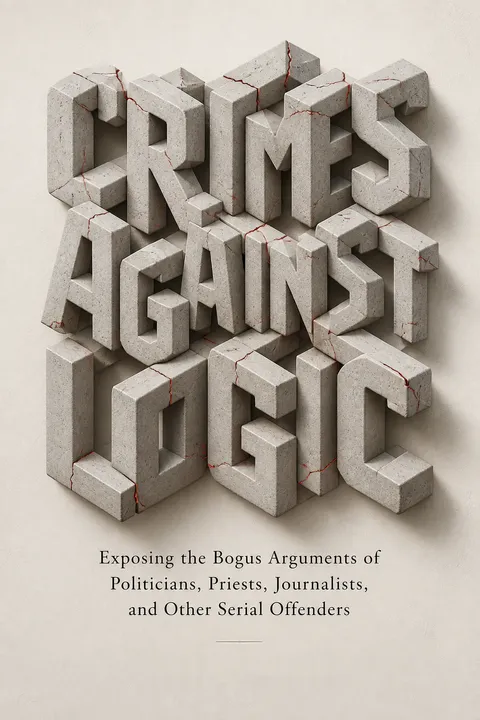
Crimes Against Logic receives mixed reviews, with an average rating of 3.67 out of 5. Readers appreciate the book's witty examination of logical fallacies and its practical examples. Many find it insightful and entertaining, praising its ability to expose flawed reasoning. However, some criticize the author's tone as condescending and pedantic. The book's treatment of religion and politics is contentious, with some readers finding it biased. Despite disagreements, most reviewers acknowledge the value of learning to identify logical errors in everyday arguments.
People Also Read





Glossary
Motive Fallacy
Motive mistaken for disproofThe error of treating a person’s interest or reason for holding a belief as proof that the belief is false. Motives may help explain a statement and may be relevant when judging testimony, but they do not replace examination of the evidence and reasoning offered for a claim.
Authority Fallacy
Power mistaken for expertiseThe error of treating someone’s power to make decisions, popularity, status, or expertise in one field as evidence that the person is right about a factual question. Expert testimony can be evidence when the expertise is relevant, but political authority and celebrity do not automatically confer knowledge.
Weasel Words
Hedges that evade commitmentWords or phrases such as could, possible, and believed to be that make a statement difficult to disprove by weakening or obscuring its claim. They can be appropriate when uncertainty is real, but they become uninformative when they replace a meaningful estimate or prediction with a claim compatible with almost any outcome.
Hooray words
Praise words without definitionWords such as justice, equality, and peace that nearly everyone approves of while disagreeing about what they require. Used without explanation, they can generate agreement without revealing a speaker’s policy or reasoning. A useful argument must specify what the value means in the case being discussed.
Equivocation
A word shifts meaningA fallacy in which an argument uses the same word in different senses, while appearing to use it consistently. The shift can conceal a gap in the reasoning or help evade a counterexample. To detect it, identify important terms and check whether each keeps the same meaning throughout the argument.
Begging the question
Assuming the disputed premiseA fallacy in which an argument assumes the point it is meant to establish. It often occurs when someone offers a reason that persuades only readers who already accept the disputed principle. The remedy is to identify the underlying assumption and argue for it directly.
Post hoc ergo propter hoc fallacy
Sequence mistaken for causeThe error of concluding that one event caused another merely because it occurred first. A recovery after taking a remedy, for example, does not by itself establish that the remedy produced the recovery. Causal claims require comparisons that show whether the outcome would differ without the proposed cause.
Sample bias
Unrepresentative sample skews resultsA statistical error that occurs when the people included in a survey or study differ systematically from the population the result is meant to describe. A self-selected group of enthusiasts, for example, may not represent ordinary members of that population. The sample’s selection process must be examined before generalizing.
Morality Fever
Moral concern distorts reasoningWhyte’s term for reasoning errors encouraged by intense moral concern. People may mistake an explanation for a refutation, treat beneficial or comforting beliefs as true, or regard the suffering of a group as proof that its members are right about policy. Moral importance calls for careful reasoning, not exemption from it.
FAQ
What's "Crimes Against Logic" about?
- Overview of the book: "Crimes Against Logic" by Jamie Whyte is a critical examination of the flawed reasoning and logical fallacies commonly found in public discourse, particularly among politicians, priests, journalists, and other influential figures.
- Purpose: The book aims to expose and dissect these logical errors to help readers recognize and resist them in everyday life.
- Structure: It is organized into chapters, each focusing on a specific type of fallacy or logical error, with real-world examples to illustrate these points.
- Target Audience: The book is intended for anyone interested in improving their critical thinking skills and becoming more discerning consumers of information.
Why should I read "Crimes Against Logic"?
- Enhance Critical Thinking: The book provides tools to identify and understand common logical fallacies, enhancing your ability to think critically and evaluate arguments.
- Practical Application: It offers practical examples from politics, media, and everyday life, making it relevant and applicable to real-world situations.
- Entertaining and Engaging: Jamie Whyte's writing style is witty and engaging, making complex logical concepts accessible and entertaining.
- Empowerment: By understanding these logical errors, readers can better protect themselves from manipulation and make more informed decisions.
What are the key takeaways of "Crimes Against Logic"?
- Common Fallacies: The book identifies and explains various logical fallacies, such as the Motive Fallacy, Authority Fallacy, and Begging the Question.
- Critical Analysis: It emphasizes the importance of questioning assumptions and analyzing arguments critically rather than accepting them at face value.
- Language and Logic: The book highlights how language can be used to obscure truth and how to see through such tactics.
- Rational Discourse: It advocates for rational discourse and the need to base arguments on evidence and sound reasoning.
What are the best quotes from "Crimes Against Logic" and what do they mean?
- "Errors in reasoning. Fallacies. Muddled thinking. Call it what you like; you know the kind of thing I mean." This quote underscores the book's focus on identifying and understanding logical errors that pervade public discourse.
- "Believing nothing is just as silly as believing everything." This highlights the danger of cynicism and gullibility, advocating for a balanced, critical approach to evaluating information.
- "The simple answer is that most people don’t notice the problem." This points to the widespread lack of awareness about logical fallacies and the importance of education in developing critical thinking skills.
- "If you start to feel during a discussion that you are not so much incorrect as insensitive, then you are probably dealing with a respectable bigot." This quote warns against being swayed by emotional manipulation rather than logical reasoning.
How does Jamie Whyte define the "Right to Your Opinion" in "Crimes Against Logic"?
- Misconception of Rights: Whyte argues that the commonly held belief in the "right to your opinion" is often misused and misunderstood.
- Irrelevance in Debate: He explains that claiming a right to an opinion does not contribute to resolving a debate, as it does not address the truth or falsity of the opinion.
- Entitlement and Evidence: The book distinguishes between political entitlement to an opinion and epistemic entitlement, which requires evidence and sound reasoning.
- Critical Examination: Whyte encourages readers to critically examine their opinions and the evidence supporting them, rather than hiding behind the notion of entitlement.
What is the "Motive Fallacy" according to "Crimes Against Logic"?
- Definition: The Motive Fallacy occurs when someone dismisses an argument by attacking the motives of the person making it, rather than addressing the argument itself.
- Irrelevance of Motives: Whyte argues that a person's motives for holding an opinion do not determine the truth of that opinion.
- Common in Politics: This fallacy is prevalent in political discourse, where opponents often speculate on each other's motives instead of engaging with the substance of their arguments.
- Spotting the Fallacy: The book provides tips for recognizing this fallacy, such as being wary of statements that include the word "just," as in "You're just saying that."
How does "Crimes Against Logic" address the "Authority Fallacy"?
- Confusion of Authority Types: The Authority Fallacy involves confusing literal authority (power to decide) with expert authority (knowledge on a subject).
- Misplaced Trust: Whyte explains that people often mistakenly trust opinions based on the speaker's authority rather than their expertise.
- Examples: The book uses examples like celebrity endorsements in politics to illustrate how authority is misused.
- Critical Evaluation: Readers are encouraged to evaluate the expertise of the source rather than accepting opinions based on authority alone.
What does Jamie Whyte mean by "Prejudice in Fancy Dress"?
- Disguised Prejudice: This concept refers to the practice of dressing up prejudices in grand or sanctimonious language to make them seem respectable.
- Mystery and Faith: Whyte discusses how appeals to mystery or faith are often used to shield prejudices from scrutiny.
- Irrelevance of Sanctimony: The book argues that sanctimonious language does not provide evidence or support for an opinion.
- Critical Awareness: Readers are urged to be aware of how language can be used to obscure the lack of evidence behind certain beliefs.
What is the "Begging the Question" fallacy in "Crimes Against Logic"?
- Definition: Begging the Question is a fallacy where the conclusion is assumed in the premises, effectively taking for granted what is in dispute.
- Examples: Whyte provides examples such as debates on tolerance and prohibition, where arguments often assume the very point being contested.
- Avoiding the Fallacy: The book advises readers to identify and challenge assumptions in arguments to avoid this fallacy.
- Importance of Clarity: Clear and logical reasoning is emphasized as essential for meaningful debate and discussion.
How does "Crimes Against Logic" explain the role of "Coincidence"?
- Misinterpretation of Events: The book discusses how people often misinterpret coincidences as meaningful or causal relationships.
- Statistical Expectation: Whyte explains that coincidences are statistically expected and do not necessarily indicate a deeper connection.
- Examples: The book uses examples like financial trading and personal anecdotes to illustrate how coincidences are often mistaken for causation.
- Rational Understanding: Readers are encouraged to adopt a rational understanding of coincidences and avoid attributing undue significance to them.
What are "Shocking Statistics" according to Jamie Whyte?
- Misleading Numbers: "Shocking Statistics" refers to the use of statistics that are either incorrect or misinterpreted to support a particular argument.
- Improper Measures: Whyte highlights how improper measures can lead to misleading conclusions, such as the misrepresentation of poverty statistics.
- Sample Bias: The book discusses how biased samples can skew results, leading to false or exaggerated claims.
- Critical Evaluation: Readers are encouraged to critically evaluate statistical claims and consider the methodology behind them.
How does "Crimes Against Logic" address "Morality Fever"?
- Moral Overheating: Morality Fever describes the tendency for moral outrage to cloud logical reasoning and lead to irrational conclusions.
- Confusion of Facts and Values: Whyte discusses how moral certainty can lead to the rejection of factual claims without proper examination.
- Examples: The book uses examples like debates on homosexuality and racial differences in IQ to illustrate how moral concerns can distort reasoning.
- Rational Discourse: The importance of maintaining rational discourse, even on morally charged issues, is emphasized to ensure sound decision-making.
Download PDF
Download EPUB
.epub digital book format is ideal for reading ebooks on phones, tablets, and e-readers.








