

Key Takeaways
Pause when urgency is doing the thinking for you
Urgency narrows judgment. Chatfield opens with an email from a friend supposedly stranded in Manila, asking for £2,450. Its emotional pressure invites an immediate transfer. Instead, he notices that the wording does not sound like his friend, searches a distinctive phrase online, and checks by text. It is a widely circulated scam, and his friend is safe at home.
Critical thinking means actively trying to understand what is happening by examining reasoning, evidence, and the thinking process itself. The practical first move is often a pause: ask who sent a message, why, what would confirm it, and whether enough is known to act. This is not suspicion for its own sake. It is a way to avoid letting emotion make a consequential choice before evidence arrives.
What's striking is that the pause is a modest intervention, not a demand for perfect rationality. In behavioral terms, it creates room between an emotional cue and an action, making verification possible. That same pause can also be costly in a genuine emergency, so the useful rule is not to delay everything. It is to match the speed of the response to the stakes and the reversibility of the decision.
Rebuild an argument in its strongest form before you attack it
Make the reasoning visible. An argument offers premises to support a conclusion. Reconstructing it means removing distracting material, stating the conclusion clearly, listing the explicit reasons, and adding assumptions the speaker relies on but leaves unstated. For instance, a claim that a teacher should not be hired because she is in a same-sex relationship depends on an unstated premise that such relationships make someone unfit to teach. Once made visible, that premise can be examined directly.
The principle of charity asks readers to interpret another person’s argument in its strongest reasonable form before judging it. This is not agreement or politeness. It prevents a straw man, an oversimplified version that is easy to dismiss. Reconstructing arguments also exposes whether premises work independently or only when joined, and whether the conclusion actually follows.
This method resembles debugging: a vague conclusion becomes easier to assess once its hidden dependencies are named. It also improves disagreement by separating a person’s claim from assumptions that may be implicit or culturally shared. Charity has limits, however. A maximally generous reconstruction should not quietly supply evidence the speaker never offered. The best reading strengthens clarity, not the case itself.
A valid argument can still be built on false premises
Logic is not truth. Deductive reasoning tests whether a conclusion follows necessarily from its premises. If every fish lives in water and a creature is a fish, the conclusion that it lives in water follows, even if the second premise is false in a particular imaginary example. Validity describes the argument’s structure, not whether its starting claims match reality. A deductive argument is sound only when it is valid and its premises are true.
Necessary and sufficient conditions help clarify this distinction. A necessary condition must be present for something to be true, but may not guarantee it. A sufficient condition does guarantee it. Confusing the two produces familiar errors: if rain means an umbrella is used, seeing an umbrella does not prove that it is raining. The umbrella could have been opened for another reason.
The separation between validity and truth is useful well beyond formal logic. It distinguishes a flaw in inference from a flaw in observation, which call for different remedies. A clean argument cannot rescue a false premise, just as accurate facts cannot rescue a broken inference. In practice, many disputes blur these levels, so asking which part is under challenge can make disagreement more precise and less theatrical.
Treat patterns as probabilities, and design samples to challenge them
Evidence rarely guarantees a trend. Inductive reasoning uses observed cases to support a broader claim, but cannot make that claim certain. One cat that dislikes strangers is weak evidence about cats generally. A larger sample helps only if it represents the population: a survey of 2,000 visitors to a coffee website cannot establish what the whole country drinks, because respondents selected themselves from a coffee-interested group.
The book also warns that a striking pattern may be coincidence. Europeans once treated every observed swan as evidence that all swans were white; one black swan overturned the generalization. Falsification means actively seeking evidence that could disprove a claim. A theory that survives serious attempts to refute it earns more confidence than one supported only by examples selected to fit.
The central discipline is to ask what the evidence could have shown if the claim were wrong. That question links sampling to experimental design: both should make alternative explanations visible rather than bury them. Larger samples reduce some kinds of noise, but size alone does not cure selection bias or poor measurement. A million unrepresentative observations can produce a very precise answer to the wrong question.
Prefer explanations that risk being disproved over stories that merely fit
Build explanations to face tests. Abductive reasoning, sometimes called inference to the best explanation, starts with observations and asks what account explains them best. A strong explanation fits the known evidence without unnecessary assumptions, then generates predictions that can be checked. Chatfield uses Newton’s proposed account of gravity to illustrate the leap from falling apples to a broader theory, while emphasizing that a theory’s value comes from its explanatory reach and testing, not from a memorable origin story.
Correlation alone does not establish causation. Two trends may move together because of a third factor, chance, or a mistaken reading of cause and effect. Researchers therefore need transparent methods, relevant comparisons, and attempts to rule out alternatives. A low p-value can indicate that results would be unusual under a chance-only model, but it does not by itself prove a favored explanation.
This is a practical account of scientific reasoning as a cycle: propose, derive consequences, test, and revise. Its strength is that it treats uncertainty as a reason to investigate rather than a reason to give up. Simplicity is a useful guide, not a truth detector. A simple explanation can be wrong if it ignores important evidence, and complex systems sometimes genuinely require several interacting causes.
Measure a source by its origin, fit, and limits, not its polish
Check what a source can show. Primary sources come directly from the subject under investigation, such as hospital records or an original historical document. Secondary sources interpret or report on that material. Neither category is automatically superior. Ask whether a source is authentic, relevant, representative, reputable, current, and independently replicated. A historical document may be authentic yet reflect only the perspective of an elite author; an accurate report may still be too old for a fast-changing field.
Reading is a planned use of limited attention. Build a broad list of possible sources, then choose a realistic shortlist for the question at hand. Skim for structure, scan for a topic, search for a specific detail, and read key sections closely. Good notes record the source, its main claim, reasoning, evidence, limitations, and questions for further investigation.
This approach treats reading as an inquiry into provenance, not a contest in accumulating citations. It also helps prevent a common mismatch: using a source that is reliable in general but irrelevant to the particular claim. The framework is demanding, so a reader should scale scrutiny to the stakes. A casual background question does not need the same verification burden as medical guidance or a major policy claim.
Separate emotional persuasion from evidence without pretending emotion is useless
Messages do more than argue. Language can report facts, express feelings, or try to change beliefs and behavior. Rhetoric is persuasion through means beyond reasoning, including emotional appeals, vivid stories, and a speaker’s perceived credibility. Aristotle’s terms offer a useful lens: ethos concerns trust in the speaker, logos the sequence of ideas, and pathos the emotional force. A message may use all three without being dishonest, but none guarantees that its claims are true.
Watch for rhetorical questions that smuggle in assumptions, jargon that obscures rather than clarifies, euphemisms that soften harm, and appeals to popularity or irrelevant authority. Emotional framing can invite compassion or create distance from a group. To assess a message, identify its audience and purpose, then separate what it asks readers to feel from what its evidence actually supports.
Emotion is not merely noise around reasoning. It can reveal which consequences matter and help people notice suffering that abstract descriptions conceal. The danger comes when emotional force substitutes for evidence or turns a complex issue into a ready-made villain story. Impartiality therefore means representing relevant facts and perspectives fairly, not pretending every side has equally strong evidence.
Judge decisions by their odds, not by lucky outcomes
A result cannot explain its own cause. Outcome bias is the tendency to judge a decision by what happened rather than by what was knowable when the decision was made. A reckless gamble may succeed by luck; a sound choice may fail despite careful reasoning. Survivorship bias compounds the problem by making successes visible while failures disappear. Studying only famous companies that survived, for example, can make ordinary traits look like a recipe for success.
Small samples also produce extremes, and an exceptional result is often followed by one closer to average, a pattern called reversion to the mean. That is why a training program tested only on the weakest students may appear effective when some would have improved anyway. Compare treatment and control groups when possible, examine failures as well as wins, and assess the strategy before knowing its outcome.
This is a corrective to storytelling instincts in business, sports, and personal life. Results are vivid, while the counterfactuals, what might have happened under another choice, remain invisible. Yet judging process alone can also become an excuse for repeated failure. The stronger standard combines both: evaluate whether the decision was reasonable with the information available, then update the strategy when outcomes reveal a pattern.
Use digital systems as tools, not as authorities or attention owners
More information is not automatically knowledge. Raw data becomes information when organized in context; knowledge requires a credible process of checking that information against the world. Even a familiar fact, such as a mountain’s height, can depend on measurement choices and competing authorities. Transparent accounts state what was checked and where uncertainty remains.
Digital platforms add their own pressures. Rankings, likes, and recommendations can turn popularity into apparent proof; personalized feeds can limit exposure to disagreement; algorithms can reproduce biases present in their training data. Search finds what is already specified, while discovery helps reveal what questions or sources were missing. Use several sources, look beyond the first results, check dates and evidence, and seek perspectives outside familiar networks. Protect attention by batching messages and limiting interruptions.
The key insight is that interfaces are not neutral windows. Their ranking and recommendation systems shape what becomes visible, while users’ clicks feed those systems in return. This does not make online knowledge impossible; it makes provenance and plurality essential. Seeking unfamiliar perspectives can broaden a search, but novelty alone is not reliability, so discovery still needs careful verification.
Write early, revise hard, and leave room for what you missed
Clear writing is revised thinking. Begin by identifying the question, the evidence needed, and the answer the work must deliver. Make notes while reading, sketch an outline, and start drafting before every uncertainty has disappeared. The first draft is material to work with, not a verdict on ability. Rewriting means checking whether each paragraph advances the argument, whether the evidence supports the claim, and whether simpler language can make the reasoning clearer.
The book’s practical discipline extends beyond writing: protect focused time, delay nonurgent replies, recognize when a project no longer deserves more investment, and admit when knowledge runs out. It also advises questioning the options presented. A forced choice between two proposals may omit a better alternative. Good thinking remains open to revision because both evidence and the frame of a question can be incomplete.
The emphasis on drafting early connects critical thought with learning by doing: writing exposes gaps that remain invisible in private reflection. Revision then becomes a form of quality control, not cosmetic polish. Still, concision should not erase necessary qualification. The goal is not the shortest possible claim, but the clearest claim that preserves the evidence’s uncertainty and complexity.
Analysis
Chatfield’s central contribution is to treat critical thinking not as a personality type, nor as a reflexive habit of distrust, but as a collection of practices for managing uncertainty. The movement from arguments to evidence, from cognitive bias to digital systems, and finally to writing makes the book’s structure consequential: a reader first learns to inspect claims, then to inspect the mind and media through which claims are received.
Its most useful tension is between speed and accuracy. Human intuition is not simply defective. It is efficient in familiar social settings, but unreliable when confronted with rare events, large populations, complex probabilities, or mediated information. The book’s practical response is strategic rather than purist: reserve deliberate attention for consequential questions, make assumptions explicit, compare sources, and test explanations against evidence that could contradict them.
The approach also reframes intellectual humility as a skill. Saying that one does not know is not a retreat from reasoning; it marks where further inquiry should begin. Likewise, changing one’s mind is not inconsistency when new evidence warrants it. That stance has civic value in an information environment where popularity, emotional impact, and repetition can masquerade as authority.
A limitation is that procedural tools cannot settle every disagreement. Evidence is selected and interpreted within institutions, unequal access to expertise, and competing values. A technically valid argument may still rest on a disputed definition of fairness or harm. Critical thinking therefore needs both analytic discipline and judgment about which questions matter, whose evidence is missing, and who bears the consequences of error. Its promise is not perfect neutrality. It is a more accountable way to form and revise beliefs.
Review Summary
Critical Thinking by Tom Chatfield is highly praised for its accessible approach to complex topics. Readers appreciate its practical exercises, clear explanations, and comprehensive coverage of critical thinking skills. Many found it useful for students and general readers alike, highlighting its insights on cognitive biases, logical reasoning, and information analysis. The book's structure and writing style received positive feedback, though some felt it could be dense or repetitive at times. Overall, it's considered a valuable resource for developing critical thinking abilities in the modern information age.
People Also Read








Glossary
Principle of charity
Reconstruct generouslyA method for interpreting another person’s argument in its strongest reasonable form before assessing it. It assumes, initially, that the speaker is trying to make a coherent case. The purpose is not to agree or to excuse weak reasoning, but to avoid attacking a distorted version and to make criticism more accurate.
Standard form
Maps premises to conclusionsA clear layout for reconstructing an argument. The conclusion is stated distinctly, while the supporting claims are listed as numbered premises above it. This format removes distracting language, reveals unstated assumptions, and makes it easier to see whether the reasoning supports the conclusion.
Deductive reasoning
Draws necessary conclusionsA form of reasoning in which a conclusion is intended to follow logically from stated premises. A valid deduction preserves truth: if its premises are true and its structure is valid, its conclusion must be true. Deduction tests logical structure, but does not establish that the premises themselves are accurate.
Inductive reasoning
Infers likely patternsA form of reasoning that uses observations or specific cases to support a broader conclusion. Its conclusions can be well supported, but never guaranteed by the observations alone. Induction is useful for estimating patterns and probabilities, provided the evidence is sufficient and the sample represents the wider group.
Abductive reasoning
Finds the best explanationReasoning from observations toward the explanation that best accounts for them. A proposed explanation should fit the available evidence and avoid unnecessary assumptions, then be tested against further observations. Abduction generates theories and hypotheses, but its conclusions remain open to revision when better evidence or explanations appear.
Falsification
Tests claims against counterevidenceAn approach to testing a claim by seeking evidence that would contradict it. A single strong counterexample can undermine a broad generalization, while many confirming examples may still fail to establish it. Falsification makes a theory more testable by specifying what evidence would count against it.
Occam’s razor
Prefers sufficient simplicityA principle for comparing explanations: when multiple accounts fit the evidence, prefer the one that explains it with fewer unnecessary assumptions. Simplicity is a guide to inquiry, not proof of truth. The simpler account must still explain all relevant evidence and remain open to testing.
Heuristic
Mental decision shortcutA practical mental shortcut that allows quick judgment without evaluating every possibility in detail. Heuristics are often useful in familiar situations, but can mislead when the setting is unfamiliar, complex, or statistically unusual. A predictable distortion produced by a heuristic is a cognitive bias.
Base rate neglect
Ignores underlying frequencyAn error in probability judgment that overlooks how common an event or category is before new evidence is considered. A positive test for a very rare condition, for example, may still be more likely to be a false positive than a true one if the test is imperfect and the condition’s base rate is extremely low.
Bayes’s theorem
Updates probability with evidenceA mathematical method for revising the probability of a claim when new evidence becomes available. It combines the prior likelihood of an event with how likely the evidence would be if the event were true. It helps prevent base rate neglect, especially when evaluating tests for rare conditions.
Prospect theory
Models perceived gains and lossesAn observation-based account of how people make choices under risk. It emphasizes that decisions depend not only on final outcomes, but also on how gains and losses are framed and felt. People tend to experience losses as more painful than equivalent gains feel beneficial, which can shape risk-taking.
Social proof
Uses others as evidenceA form of informational social influence in which people treat others’ apparent beliefs or actions as evidence for what they should believe or do. It can be useful when others have relevant information, but can also spread error when people imitate a crowd that is uncertain, mistaken, or responding to the same misleading cues.
Filter bubble
Personalized information narrowingAn information environment shaped by personalization systems that select content based on a user’s preferences, history, or predicted interests. Unlike an echo chamber formed mainly through a person’s choices, a filter bubble can be imposed by the platform without the user recognizing how much the selection limits their exposure to other perspectives.
Dunning–Kruger effect
Low skill distorts self-assessmentA pattern in which people with limited ability in a field may overestimate their competence, partly because they lack the knowledge needed to recognize their mistakes. In the research discussed by Chatfield, weaker performers’ self-assessments improved after instruction helped them understand what competent performance required.
FAQ
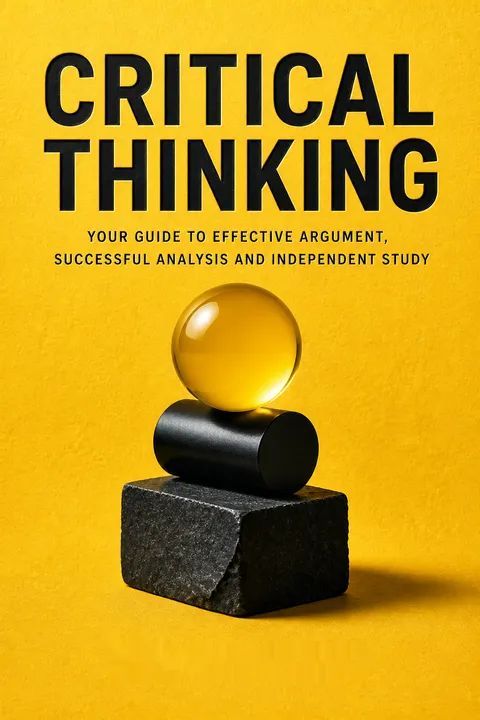
What's Critical Thinking: Your Guide to Effective Argument, Successful Analysis and Independent Study about?
- Focus on Reasoning: The book by Tom Chatfield emphasizes the importance of reasoning in understanding and constructing arguments. It guides readers through the process of critical thinking.
- Two-Part Structure: It is divided into two parts: one on becoming a reasonable thinker and the other on navigating a world filled with biases and misinformation.
- Practical Application: Chatfield provides practical tools and techniques for applying critical thinking in everyday life, academic work, and professional settings.
Why should I read Critical Thinking by Tom Chatfield?
- Enhance Analytical Skills: The book helps improve your ability to analyze arguments and evidence critically, which is essential in today’s information-rich environment.
- Combat Bias: It equips readers with strategies to recognize and overcome cognitive biases, enabling more objective decision-making.
- Develop Confidence: By learning critical thinking skills, you will become a more confident and effective communicator, able to express your ideas clearly and persuasively.
What are the key takeaways of Critical Thinking?
- Understanding Arguments: Learn to identify, reconstruct, and evaluate arguments, focusing on premises and conclusions.
- Types of Reasoning: The book discusses deductive, inductive, and abductive reasoning and their applications in forming sound arguments.
- Navigating Information: Gain insights on critically engaging with information, especially in the digital age, where misinformation is prevalent.
How does Tom Chatfield define critical thinking in Critical Thinking?
- Active Engagement: Chatfield defines it as actively seeking to understand what is really going on by evaluating information and reasoning carefully.
- Opposite of Uncritical Thinking: It contrasts with uncritical thinking, where individuals accept information at face value without questioning its validity.
- Toolkit for Reasoning: The book presents critical thinking as a toolkit of techniques that can be applied to various contexts, enhancing one’s ability to think independently.
What is the principle of charity in Critical Thinking?
- Assume Good Intent: The principle suggests assuming that others are truthful and reasonable when reconstructing their arguments.
- Strengthen Understanding: By interpreting arguments in their strongest form, you can better analyze and engage with them, leading to more productive discussions.
- Avoid Straw Man Arguments: This principle helps prevent misrepresenting an opponent's position, allowing for a fairer and more rigorous debate.
What are the different types of reasoning discussed in Critical Thinking?
- Deductive Reasoning: Involves drawing specific conclusions from general premises, ensuring that if the premises are true, the conclusion must also be true.
- Inductive Reasoning: Seeks to generalize from specific observations, allowing for conclusions that are likely but not guaranteed to be true.
- Abductive Reasoning: Aims to find the best possible explanation for a set of observations, often leading to hypotheses that can be tested.
How does Critical Thinking address cognitive biases?
- Identification of Biases: Chatfield identifies various cognitive biases, such as confirmation bias and the Dunning-Kruger effect, that impact our reasoning.
- Strategies for Mitigation: Provides strategies to counteract these biases, such as employing critical thinking techniques and being aware of emotional influences on decision-making.
- Real-World Examples: Uses real-world examples to illustrate how cognitive biases manifest in everyday situations, helping readers relate the concepts to their own experiences.
What is the difference between correlation and causation in Critical Thinking?
- Understanding Relationships: Correlation refers to a relationship between two variables, while causation implies that one variable directly affects the other.
- Avoiding Misinterpretation: The book warns against confusing correlation with causation, which can lead to faulty conclusions and reasoning.
- Importance in Research: Recognizing this distinction is crucial in research and critical analysis, as it affects how we interpret data and evidence.
What are some common fallacies discussed in Critical Thinking?
- Ad Hominem Fallacy: Occurs when an argument attacks the person making the argument rather than addressing the argument itself.
- Appeal to Popularity: Suggests that a claim is true simply because many people believe it, emphasizing that popularity does not equate to truth.
- Slippery Slope: Assumes that a small first step will inevitably lead to a chain of related events resulting in significant consequences.
What is the affect heuristic mentioned in Critical Thinking?
- Emotional Decision-Making: Refers to the tendency to rely on emotional responses when making decisions, leading to quick judgments not based on rational analysis.
- Influence of Feelings: Our feelings about a situation can heavily influence our perceptions of its risks and benefits, often overshadowing more objective assessments.
- Practical Implications: Understanding the affect heuristic can help individuals recognize when their emotions are guiding their decisions, allowing for more balanced and rational choices.
What are some practical techniques for improving critical thinking skills according to Critical Thinking?
- Self-Assessment: Encourages readers to assess their own critical thinking abilities through self-reflection and evaluation of their reasoning skills.
- Structured Argumentation: Provides a framework for reconstructing arguments in standard form, helping to clarify reasoning and identify assumptions.
- Engaging with Diverse Perspectives: Suggests actively seeking out and engaging with differing viewpoints to enhance understanding and critical analysis.
What are the best quotes from Critical Thinking and what do they mean?
- "Never trust a good story": Emphasizes the need for skepticism when encountering compelling narratives, as anecdotes can be persuasive but are not reliable evidence for broader claims.
- "Seek refutation over confirmation": Highlights the importance of challenging one's own beliefs to strengthen arguments and enhance understanding.
- "Every option you’re given can be wrong": Serves as a reminder to question the choices presented to us, encouraging critical thinking and the exploration of alternative perspectives.
Download PDF
Download EPUB
.epub digital book format is ideal for reading ebooks on phones, tablets, and e-readers.








