

Plot Summary
The Flyer Behind the Gate
After a Halloween party leaves her hungover and stranded in rural Pennsylvania, Pie Vita spots an advertisement for a live-in caretaker at Saint Mark’s Sanctuary. She has no home to return to and expects her planned stay with an old foster sister to go badly, so she follows the flyer’s directions. Her imaginary sparrow companion, Pia, warns her away, but Pie enters the grounds anyway.
A young caretaker named Grant gives her a hurried tour and leads her to a cottage that feels uncannily tailored to her tastes. He leaves her alone there, promising only that he has something to handle beyond the wall. Pie finds his silver ring outside, then sees the sanctuary’s impossible staircases and realizes the exit has vanished into fog.
Pie’s arrival is driven less by curiosity than by exhaustion. She has spent years surviving without a dependable home, so the cottage’s comfort exerts a force that the sanctuary’s warning signs cannot match. Her choice to ignore Pia also reveals a painful contradiction: she has defended the bird as real, yet resents the social cost of believing in her. The sanctuary exploits that fracture. It offers belonging in the precise form Pie has learned to want, a private room and a job, while hiding the conditions attached to both.
Grant Leaves, Pell Awakens
From the cottage window, Pie watches the young caretaker pass through a gate and emerge outside as an old man driving away. She rejects Pia’s explanation, but the exit stays locked and the sanctuary’s layout refuses ordinary geometry. When Pie runs into the fog, Pia goes limp in her hands and the world loses every landmark.
Tomas, the shirtless man from the balcony, finds Pie and leads her back by holding her hand. Inside, hooves thunder down the stairs. Pell, a horned satyr chimera, mistakes her for the reason his caretaker has escaped and hurls her across the marble hall. As Pie wakes in the apothecary, Pell declares that she is bound to his curse, while Tomas’s ability to touch her suggests the rules have already changed.
The first rupture makes Pie’s private uncertainty physically consequential. The fog resembles her habitual sense of being cut off from other people, but this time her fear has an external cause and Pia’s limp body makes denial harder to sustain. Pell’s attack, however, complicates the expected rescue fantasy: the sanctuary’s victim is also dangerous, and his anger is rooted in another caretaker’s departure. Tomas’s new ability to touch Pie hints that the curse is not a stable system. Its rules respond to her arrival before anyone understands why.
The Ring Has a Price
Pell calls Pie his slave and orders her to study the apothecary’s books, but she refuses the ring that would let her cross the sanctuary boundary. The refusal ends when a sheriff arrives to tow her Jeep. Outside the gate, no one can see Pie until she puts on the ring; afterward Sheriff Russell Roth notices her, offers a ride, and helps her reach the impound yard.
There, Pie discovers that Latin, not English, must be written on paper to pay the magical fees. Once the trick works, she buys new tires and indulges in clothes and other luxuries. Back at Saint Mark’s, Pell reveals that every purchase has been recorded as debt, leaving Pie owing more than ten thousand dollars.
The ring converts an abstract curse into a daily negotiation about agency. Pie does not accept Pell’s authority because he claims it; she acts only when losing her Jeep would strip away the one possession that still connects her to her former life. The magic-money system then turns that limited choice into a debt she did not understand. Her spending is not simply frivolity: it is the first time she has had access to comfort without calculating every dollar. The ledger makes desire measurable, and punishes her for experiencing abundance before learning its terms.
Recipes for a Curse
After Pell explains that the debt will age her if she leaves unpaid, Pie searches Grant’s notebooks for a way to read the apothecary’s Latin. Her first potion works, though an early experiment leaves her unconscious and the room in disarray.
The notes reveal that Grant hid material in other languages, including texts about breaking the curse. Pie wants a waitress job in Granite Springs so she can pay for supplies with ordinary wages, not magical credit.
Pell agrees, but recognizes Sheriff Roth’s attraction as an eros charm and warns that the sheriff may be dangerous. Pie makes a protective amulet from herbs, then Pell strengthens it with stones and a claim from the sanctuary. She leaves for her date still unsure whether the charm will protect her.
Pie’s first spellmaking is both practical and psychologically revealing. She treats alchemy as a recipe because recipes promise that a person can act without first becoming an authority. Her effort to get a job is also a bid to preserve an identity beyond the sanctuary’s debt system. Pell’s warning disrupts her hope that ordinary romance might offer an exit, yet he permits the date rather than forbidding it. Their uneasy cooperation begins when he recognizes that control will not create trust, even as he continues to set limits around her choices.
The Sheriff and the Liar
At dinner, Sheriff Roth’s eros influence overwhelms Pie despite the amulet; she imagines herself behaving with a sexual abandon that frightens her. She slips out of the restaurant and finds Grant waiting by her Jeep, young again.
He claims the books he left are useless, the debt ledger can be escaped, and he can make Pie rich if she invites him back inside. Pie refuses, sensing that his offer hides a larger scheme, then returns to Saint Mark’s convinced she may be insane. Pell does not argue abstractly.
He drives her to a working gas station and asks her to call someone from her old life. Pie reaches Jacqueline, her former foster sister, and learns that Jacqueline is thriving and would welcome a visit. The conversation anchors Pie in a real world beyond the sanctuary.
The date attacks Pie’s confidence in her own consent: her imagined behavior feels vivid enough to make her question whether it happened. Grant deepens that instability by offering wealth while denying the reality of the books and the curse. Pell’s response matters because he does not demand that she trust his explanation. He helps her test it against another person’s voice. Jacqueline’s welcome does not solve Pie’s predicament, but it restores a fact she had lost sight of: her past contains relationships and possibilities beyond the people currently controlling her world.
A Horn Polish Changes Things
Pell shows Pie the Book of Debt and explains that tending his horns can reduce what she owes. During the polish, she discovers that careful attention to his horns and back erases part of the balance, while also revealing how long Pell has gone without ordinary touch. Their teasing softens into trust, and Pie chooses to sleep in her cottage with him rather than face the distant cemetery alone.
The next day, Pell takes her into the sanctuary’s shifting upper halls, where doors open onto scenes from the past. A medieval wedding becomes a clumsy dance, then a Roman feast turns into a sexual spectacle. In a forest beyond it, both of them appear as chimeras, and Pie sees moths fly from her hand toward a temple watched by ancient gods.
The debt ritual is designed to make labor intimate, but Pie changes its meaning by choosing the form of care and attending to Pell as a person rather than a task. Pell, in turn, permits closeness without using his power to compel it. The hallway episodes loosen the boundary between service and mutual desire: Pie is no longer only a caretaker performing duties inside a fixed institution. Her changing body and moths suggest that the sanctuary is not merely showing her Pell’s history. It may also be drawing out a history within her that neither of them can yet explain.
The Dragon’s First Kiss
In a smoky room reached through the shifting halls, Pie, Pell, and Tomas play truth or dare. Pell dares Pie to kiss Tomas, whose handsome humanlike appearance is only one of several forms. Tomas admits that his true nature is a blood dragon and that he has spent centuries confined in the dungeon, using other bodies as shells.
Pie kisses him anyway, choosing affection over appearances. A bell then draws them back to the sanctuary, where Sheriff Roth has somehow entered. He recognizes the place from childhood memories his grandfather once warned him to avoid, and he draws his weapon when Tomas approaches.
Pia flies from the ceiling as moths burst from Pie’s hands, disrupting the sheriff’s shot. Tomas releases dragonfire, Pell seals the door, and Pie collapses as the sanctuary’s magic overwhelms her.
Tomas’s confession reframes his charm as an act of concealment, but Pie’s kiss separates intimacy from the body he presents. Her choice is compassionate without being naïve: she understands that Tomas is frightened of being judged and acts before he can retreat into shame. The sheriff’s arrival then turns private revelation into public danger. Pie’s moths and Tomas’s fire operate together, but neither can control the outcome. The sequence makes the sanctuary’s inhabitants a fragile community rather than a simple triangle of romantic rivals, while exposing how quickly that community can be breached.
Fire Below Saint Mark’s
Pell revives Pie in the sanctuary’s hot spring and explains that Sheriff Roth’s return is likely, so they need a stronger ward. The necessary spell requires dragon scales and bloodhorn, a plant Grant cultivated in the greenhouse.
Pie helps Pell descend into Tomas’s lair, where the blood dragon attacks with fire and burns her back as Pell extracts scales. After treating the injury, Pell explains that the spellbook they need lies in Tarq’s tomb, but only Pie can see the tomb doors and only Pell can help her cross them.
Pie enters carrying a scale treated with bloodhorn oil. Inside, the tomb opens into a modern office tower where Luciano guides her to Tarq, a powerful minotaur chimera who gives her a page of spells rather than the whole book.
The trip belowground makes Pie’s growing loyalty physical: she returns to the room she fears because Pell cannot obtain the scales alone. The dragon is not the witty Tomas she kissed, and the burn forces her to confront the cost of loving someone whose danger is real. Pell’s honesty about the tomb’s paradox gives her a meaningful role in the next step rather than treating her as a disposable assistant. Tarq’s office, by contrast, turns the sanctuary’s ancient history into something startlingly contemporary, suggesting that its magic can house entire worlds without obeying ordinary time.
Tarq’s Office in the Tomb
Tarq recognizes Pie’s connection to Pell and hands her the banishing page she needs, while warning her not to misuse the other side. She returns from the tomb transformed into a wood nymph chimera, with horns, fur, hooves, and a body that feels alien but increasingly familiar.
Outside, Grant confronts Pell and claims Pie is a magical phantom created for his own purpose. He also reveals that Pell has been made to misunderstand his place in the curse. Pell rejects Grant’s account, but Pie’s changed form makes it harder to dismiss every warning as a lie.
The pair try the page’s two ingredients, dragon scale and bloodhorn oil, only to find the spell incomplete. With Sheriff Roth and Grant approaching, Pell realizes the missing bloodhorn is in his own horns.
Tarq’s gift gives Pie only enough power to continue, not enough knowledge to feel secure. Her transformation makes the question of identity bodily rather than theoretical; she can no longer treat the sanctuary as a fantasy that belongs to someone else. Grant exploits that uncertainty by telling Pell she is unreal, an accusation aimed at the wound Pie already carries from being called delusional. Pell’s refusal to accept the claim protects their bond, but cannot settle the truth. The failed spell then turns knowledge into sacrifice: the missing ingredient is not an object they can fetch, but part of Pell himself.
The Horn and the God
Pell kneels at the chopping block and lets Pie cut off one of his horns so its fiery blood can coat the dragon scale. Grant enters before they can finish the spell and reveals himself as Saturn, an ancient god seeking Ostanes’s book and the power sealed within Saint Mark’s.
He tells Pie she is not a real person, then forces her into the memory of a childhood psychiatric ward, where adults once demanded that she deny Pia. Pie recognizes that the memory is real but rejects the conclusion Saturn wants her to draw.
She returns to the sanctuary, summons the moths from her hand, and orders Saturn out. The moths fail to hold him. Tomas erupts from the dungeon as a blood dragon, and his fire tears through the sanctuary walls while Pell and Pie stand together inside the blaze.
Saturn attacks through Pie’s oldest vulnerability, using the memory of institutional coercion to make reality itself seem like a weapon against her. The revelation does not persuade her because she has learned to distinguish a painful memory from the interpretation imposed on it. Pell’s severed horn is an act of trust with immediate physical cost, not a vague declaration of devotion. Yet neither his sacrifice nor Pie’s emerging magic is sufficient alone. Tomas’s return as a dragon turns the climax into a collective action, with the three characters’ powers converging against the god who has manipulated their isolation.
A Bullet Stops Time
The dragonfire drives Saturn from the sanctuary, leaving the halls in ruins. Sheriff Roth enters amid the destruction and raises his weapon again. Pie directs the banishing spell at him and sends him away, but the bullet he fires strikes her chest first.
Pell freezes Pie in midair to keep her alive, while the force of the spell and the damage to the sanctuary separate them into a black void. Pie’s human life begins to slip from her memory as she encounters Ostanes, the alchemist who created the sanctuary’s original chimeras.
Ostanes explains that Pie was never merely a human caretaker: her soul has another half, and the bird Pia belongs to it. Pie must decide whether to cling to the human identity she remembers or accept the monster she has become before Pell’s spell fails.
The apparent victory carries an immediate cost. Pie uses the power she has gained to protect the sanctuary, but the sheriff’s bullet makes the choice irreversible. Pell’s freezing power can postpone death, not undo it, which exposes the limits beneath his authority. Ostanes offers Pie an explanation but not an easy rescue; the decision remains hers. The revelation about Pia recasts the story’s central stigma: the companion others treated as proof of illness is not simply an error to be corrected. Pie’s self-understanding becomes the final battleground, where survival depends on refusing both imposed shame and imposed certainty.
Pell Lights the Void
Ostanes tells Pie that her human soul has died and that the monster half she has carried is the part that can continue. Pie resists, then accepts the body and identity of a wood nymph chimera, saying that this form is hers.
The woods disappear, leaving her alone in a darkness beyond even the sanctuary’s gray fog. Pell, trapped in the same void, hears her faint call. He finds his severed horn, breathes life into the fire within its blood, and uses it as a torch. Following its glow, he reaches Pie.
She feels the ground and the horns on her head again, then runs toward him through the dark. Pell’s small, improvised light becomes a route back to the forest they glimpsed together, while Pie’s acceptance gives the rescue something more than survival to carry.
Pie’s choice is not a simple rejection of her human past. She acknowledges that it mattered while refusing to let other people’s judgment define what was real about her. The distinction gives her transformation psychological weight: she is not cured of a delusion but reunited with a disowned part of herself. Pell’s torch answers the book’s recurring problem of perception. He has no grand power to command the void, so he makes a small light from the body he has sacrificed. Their reunion depends on mutual recognition, not on one character rescuing the other through force alone.
A Forest Opens Again
In the forest, Pell and Pie become children again and reach the boundary they had once feared to cross. This time they enter the clearing together. Their adult selves return as they face the burnt-orange woods, where imprisoned chimeras wait among the trees. Pie and Pell do not promise that every curse is broken; they choose to move forward without knowing what the new boundaries will demand.
The other monsters follow them through the darkness and back into Saint Mark’s Sanctuary. Their return changes the sanctuary from Pell’s lonely prison into a crowded community. Pie’s bond with Pell remains central, but the rescue also gives the other captives a chance to stand together outside their tombs.
The ending’s movement from two children to two adults turns an old memory into a revised choice. The pair do not erase the boundary that once frightened them; they cross it with knowledge of what waits beyond. Their leadership rests on companionship rather than mastery, especially because neither can promise a clean release from the curse. Bringing the other chimeras back changes the scale of the story from an intimate bargain between caretaker and monster to a collective future. The sanctuary remains dangerous and unresolved, but isolation is no longer its only organizing principle.
Epilogue
Two weeks later, Pie has settled into life as a wood nymph chimera, and the Book of Debt has vanished. Tomas can remain in his dragon chimera body, while he and Pell can briefly pass into human forms beyond the sanctuary. Pie cannot cross the boundary and has no wish to encounter Sheriff Roth again.
Pia has returned as a quiet sparrow, and the moths have disappeared. The other monsters can reach the lake, but their tombs remain sealed and Tarq is still absent. Each monster now has a different silver ring, and a changed poem above the doors hints that the sanctuary’s rules have shifted. Then Tarq appears carrying the Book of Debt, with Pie’s name on its page.
The epilogue gives the characters a provisional home without pretending their problems are solved. The monsters gain company, access to the lake, and limited movement, yet Pie remains confined and the tombs stay closed. The vanished ledger seems to release her from one system of coercion, only for Tarq to return with the same book and her name inside it. That final image makes the new peace feel conditional. The altered poem and varied rings widen the story’s horizon beyond Saturn’s defeat, suggesting that the sanctuary has not ended its conflicts so much as changed their terms.
Analysis
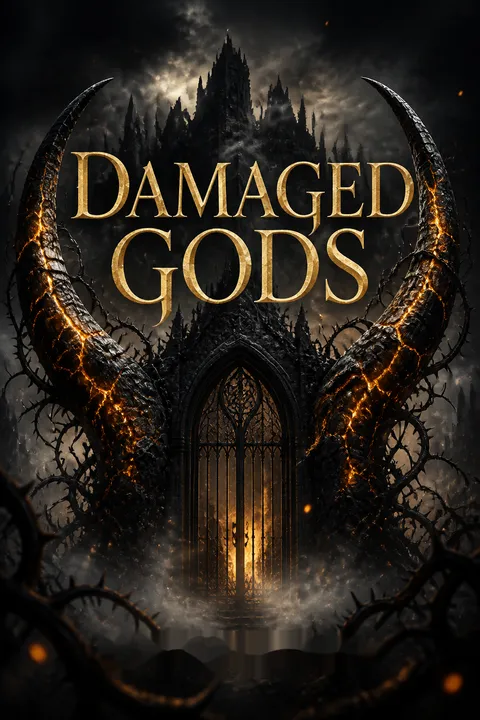
Damaged Gods builds its fantasy around an unusually intimate question: what happens when a person who has been taught to distrust her own perception enters a world that makes perception physically consequential? Pie begins by treating Pia as the source of her social exclusion, even as she relies on the bird for comfort. Saint Mark’s intensifies that conflict through fog, impossible architecture, and a curse that others explain with incompatible claims. Pie’s uncertainty is not a weakness the plot simply corrects. It is a condition others exploit, from the institutions that demanded she deny Pia to Grant and Saturn, who use competing accounts of reality to steer her choices.
The Book of Debt literalizes dependence. Food, clothing, and care become entries in an account controlled by powers Pie cannot see. Pell initially reproduces that system by calling her a slave and ordering her labor. Yet the relationship changes when his rules meet her capacity to refuse, improvise, and offer care on her own terms. His horn polishing becomes more than repayment because it exposes the deprivation beneath his pride. Their romance develops through acts of attention, not through a sudden erasure of their unequal circumstances. Pell must learn that protecting Pie is not the same as owning her, while Pie must decide whether attachment can coexist with freedom.
The novel’s transformations make identity concrete. Pie’s transition from a human-presenting caretaker to a chimera is frightening because it seems to confirm the labels once imposed on her. Her final choice does not declare that her human memories were meaningless. Instead, she stops allowing other people to define which parts of her count as real. Pia becomes the bridge between the girl who survived abandonment and the creature Ostanes made. The ending offers belonging rather than cure: Pell, Pie, and the other chimeras return to the sanctuary together, but the debt book, sealed tombs, rings, and altered poem leave their future unstable. The damaged gods may have lost a battle, yet the story insists that liberation is not the same as a finished world.
Review Summary
Damaged Gods receives mostly positive reviews, with readers praising its unique premise, intriguing world-building, and complex characters. Many enjoy the blend of mythology, magic, and romance. The story follows Pie, a human who becomes entangled in a curse at Saint Mark's Sanctuary, and her interactions with monsters like Pell and Tomas. While some readers found parts confusing or disliked the cliffhanger ending, most appreciated the humor, creativity, and slow-burn romance. The book is noted for its fresh take on paranormal romance and engaging storytelling.
People Also Read

Characters
Pie Vita
The homeless caretakerPie is a resourceful young woman who has learned to survive by moving on before anyone can reject her. Her sharp humor protects a more vulnerable need for a stable home and for someone to believe her about Pia, the sparrow only she can see. Years of being labeled unstable have taught her to conceal what she thinks and to distrust promises, especially from people who seem eager to control her. At Saint Mark’s, she initially treats magic as a practical skill she can learn from instructions, not as a new identity. Her defining strength is not fearlessness but her stubborn ability to act while afraid, whether she is bargaining for work, entering a tomb, or trying to protect someone else.
Pell
The cursed satyr chimeraPell is an ancient satyr chimera bound to Saint Mark’s Sanctuary, where he has spent millennia waiting for a way out of his curse. He is physically imposing, proud of his authority, and quick to treat caretakers as a source of labor rather than as people with their own fears. Under that defensiveness sits profound loneliness, sharpened by the loss of his friend Tarq and the departure of previous caretakers. Pell prefers predictable arrangements because hope has repeatedly left him disappointed. Pie unsettles that habit: she challenges his rules, questions the purpose of the sanctuary, and offers care without surrendering her independence. His strongest impulse is to protect what he considers his, though his growing affection forces him to confront the difference between protection and possession.
Tomas
The sanctuary’s enigmaTomas first appears as a courteous, attractive resident who seems more approachable than Pell. He helps Pie navigate the sanctuary and softens the shock of its rules, though he sometimes withholds information and shifts his loyalties according to the moment. His good looks and easy warmth mask a history of confinement and a complicated relationship with Pell. Tomas longs for companionship, but he has spent so long outside ordinary human life that even friendship can feel perilous. His humor helps him survive the sanctuary’s strangeness, while his silences suggest a darker self he has difficulty showing. Pie’s willingness to look beyond his appearance gives him an unusual chance to be known without disguise.
Grant
The departing caretakerGrant is the caretaker who has served Saint Mark’s for decades before Pie arrives. He appears composed and competent enough to manage the sanctuary’s routines, but his sudden departure leaves behind unexplained changes, coded notes, and a young woman caught in the consequences. His relationship with Pell is marked by mistrust, and his choices make him difficult to read even after he is gone. Grant represents the danger of mistaking expertise for loyalty: he knows more about the sanctuary than Pie or Pell, but knowledge alone does not establish whose interests he serves.
Pia
Pie’s sparrow companionPia is a tiny sparrow who speaks to Pie, changes form at times, and remains invisible to everyone else. She comforts Pie after years of instability and has become the closest thing Pie has to a constant friend. Her warnings often arrive before Pie is ready to listen, while her silence can signal that Pie is frightened or in danger. Because other people have treated Pia as evidence that Pie is unwell, their bond carries both tenderness and pain. Pia is a source of companionship, but also a question Pie has spent much of her life trying to answer.
Russell Roth
The magnetic sheriffRussell Roth is the sheriff of Granite Springs, a small-town lawman whose easy manners and striking presence make him immediately appealing to Pie. His warmth can become unnervingly persuasive, and his connection to the sanctuary reaches back to memories he had long forgotten. Russell takes his duties seriously and is not content to ignore an unexplained place merely because others do. His attraction to Pie complicates their interactions, while his curiosity about Saint Mark’s brings the outside world close to the sanctuary’s fragile boundary.
Tarq
Pell’s sealed friendTarq is a powerful chimera and Pell’s oldest friend, held apart from him inside a tomb. Pell remembers him as a loyal companion and continues to visit his statue, speaking as though Tarq might hear. The long separation has left their friendship suspended between memory and uncertainty. Tarq’s presence connects Pell to a life before the sanctuary became his entire world, and his tomb holds knowledge that neither Pell nor Pie can easily reach.
Ostanes
The ancient alchemistOstanes is the formidable alchemist whose work shaped the sanctuary and the creatures associated with it. Her history is entangled with the old gods and with the magic they tried to control. She is direct, perceptive, and unwilling to offer comfort in place of difficult choices. Ostanes understands the origins of the curse more fully than the people living inside it, but her knowledge does not remove their responsibility to decide what they want. Her presence links the sanctuary’s intimate conflicts to an ancient struggle over power and creation.
Jacqueline
Pie’s foster-sister tetherJacqueline is Pie’s former foster sister, the person Pie had planned to visit before the caretaker job diverted her. Their relationship has been distant for years, and Pie assumes she will be an imposition. When they reconnect by phone, Jacqueline proves glad to hear from her and offers her a place to stay, reminding Pie that she has not been forgotten.
Luciano Giordano
Tarq’s polished guideLuciano is Tarq’s well-dressed, impeccably mannered assistant inside the extraordinary world of Tarq’s tomb. He treats Pie’s arrival as unusual but not alarming, then guides her through the shifting office complex to Tarq. His calm hospitality makes the tomb feel less like a burial place and more like a functioning realm with its own rules.
Plot Devices
The sanctuary ring
Boundary and bindingThe silver ring allows Pie to cross the sanctuary boundary and makes her visible to people outside. It also binds her to the curse and enables the magical money system that records her spending as debt. Pie initially refuses to wear it, then accepts it when her Jeep is towed and she needs access to the outside world. Its later slip from her finger makes escape appear possible, forcing her to choose whether she actually wants to leave. The ring therefore turns an abstract supernatural contract into an object Pie can accept, resist, lose, and reclaim.
The Book of Debt
Makes desire measurableThe enchanted ledger records what a caretaker spends and connects repayment to tasks that please Pell. It gives the curse an everyday mechanism: groceries, clothing, and other purchases become obligations rather than simple transactions. Pell believes the system is real, Grant disputes its purpose, and Pie discovers that some forms of attention reduce the balance. Its disappearance after the sanctuary changes seems to end its authority, but Tarq’s return with the book and Pie’s name reopens the question of who controls the debt.
The shifting sanctuary
Turns history into passageSaint Mark’s is larger inside than outside. Its staircases lead to moving halls whose doors open onto scenes from different eras, and its buildings adapt to the people who enter them. The halls allow Pie and Pell to encounter a medieval wedding, a Roman feast, and a forest that seems connected to Pell’s past. The sanctuary’s architecture makes memory navigable, but it also blurs the distinction between recorded history, magic, and lived experience. Its changing rooms repeatedly offer discoveries without guaranteeing that the characters understand what they have seen.
Pia and the moths
Makes hidden identity visiblePia is Pie’s invisible talking sparrow companion, a presence Pie has long believed to be a hallucination. In moments of danger, moths emerge from Pie’s hands and act as a protective or observing swarm. Their appearance connects Pie’s private bond with Pia to the sanctuary’s older magic, though Pie initially has little control over them. The moths protect her from the sheriff’s weapon and later help her resist Saturn’s attack. Their link to Pie’s identity is one of the story’s major revelations.
Bloodhorn and dragon scales
Unlocks sealed magicThe sanctuary’s spells depend on specific materials rather than abstract wishes. Bloodhorn oil and dragon scales let Pie cross the tomb’s boundary, while Pell’s own bloodhorn proves necessary for the later confrontation. Tomas’s scales come at real risk, since he must be distracted while Pell extracts them from his dragon form. The materials tie magical progress to the bodies of the characters who live under the curse. They also expose the limits of Pie’s book learning: following a recipe is not enough when she has not identified every ingredient or its cost.
Monsters of St. Mark's Series
Download PDF
Download EPUB
.epub digital book format is ideal for reading ebooks on phones, tablets, and e-readers.








