

Key Takeaways
Read Bush and Cheney as a changing partnership, not a puppet show
Two centers of gravity. Bush chose Cheney for experience and trusted him with unusual access, but theirs was a professional relationship, not a close social friendship. Cheney shaped decisions through private meetings, loyal aides, and a command of Washington’s machinery. Bush’s Texas campaign team, Karl Rove, Karen Hughes, and Joe Allbaugh, was known as the Iron Triangle, a compact political core that guarded the president’s interests.
Access was not ownership. Bush approved the major decisions Cheney supported, but also overruled him on Iraq’s timing, diplomacy, and other issues. By the second term, Bush relied more on Condoleezza Rice and asserted himself more often. The final dispute over a pardon for Scooter Libby exposed how far the partnership had changed.
What's striking is the difference between influence and control. Cheney could shape what reached the president, yet Bush retained the authority to choose, reject, or reverse course. This resembles a common organizational problem: a trusted adviser can become powerful through access without becoming formally accountable for the final decision. The distinction matters because it avoids two easy stories, that Cheney secretly ran the presidency or that Bush's reliance on him made Cheney irrelevant. Both men exercised agency, but not equally at every point.
After 9/11, worst-case thinking became the administration's governing lens
Threat changed the frame. Before September 11, terrorism was one concern among many. In July 2001, intelligence officials warned of a likely major attack, and an August briefing memo said bin Laden was determined to strike inside the United States. The warning was short and unspecific, and Bush did not treat it as an urgent instruction. After the attacks, that ambiguity looked different.
Fear became policy. Bush stayed briefly in a Florida classroom after learning of the second plane, then spent the day moving among secure locations. Cheney ordered planes shot down if they posed a threat. Later scares involving anthrax, botulinum toxin, and possible nuclear assistance to al-Qaeda reinforced the belief that another attack could be worse. Bush and Cheney increasingly judged risks by the catastrophe they feared, not only by evidence of what was likely.
What's striking is how a change in perceived stakes can reorder every later choice. When leaders imagine a low-probability event with catastrophic consequences, ordinary caution can begin to look reckless. That logic can justify preparation, but it can also make ambiguous intelligence feel more conclusive than it is. A sound emergency system therefore needs two disciplines at once: imagine the worst, and keep asking what the evidence actually supports. The book shows how difficult that balance becomes when officials believe delay itself could be fatal.
Question intelligence hardest when it confirms a decision already wanted
Concern became conviction. Iraq was on the administration’s agenda before September 11. After the attacks, Bush asked the Pentagon to update invasion plans, while Cheney argued that even a small chance of catastrophic danger deserved a forceful response. The intelligence case grew more certain in public than the underlying evidence warranted.
Doubts lost their weight. The 2002 National Intelligence Estimate, or NIE, was an interagency assessment of Iraq’s weapons programs. It said Iraq had chemical and biological weapons and was rebuilding its nuclear program, while dissenting analysis appeared mostly in the document’s body. The aluminum tubes were disputed, the uranium claim about Niger rested on forged documents, and a source on biological weapons was unreliable. After the invasion, investigators found no stockpiles. David Kay told Congress that nearly everyone had been wrong.
The central failure is not simply that analysts made a bad prediction. It is that uncertainty was compressed as information moved from analysts to decision-makers to the public. When a policy is already favored, caveats can look like obstruction, while supporting fragments gain prominence. The book also complicates a simple accusation of deliberate fabrication: officials, intelligence agencies, foreign services, and lawmakers shared mistaken assumptions. That does not erase responsibility. It points toward a deeper safeguard: preserve dissent visibly, especially when evidence is being used to justify irreversible action.
Winning Baghdad was easier than governing the Iraq that followed
The war plan outran the peace plan. American forces toppled Saddam Hussein quickly, but planning for the aftermath lagged. Army chief Eric Shinseki warned that securing Iraq could require several hundred thousand troops; Donald Rumsfeld and Paul Wolfowitz dismissed the estimate as excessive. Bush had approved a plan to retain most of the Iraqi army and remove only the senior Baath Party elite.
The occupation broke that plan. Paul Bremer instead banned the Baath Party broadly and dissolved the entire army, putting hundreds of thousands of trained, armed men out of work. Looting spread, order collapsed, and insurgent groups exploited the vacuum. Bush largely deferred to the people running the occupation, just as he had deferred to commanders on the battlefield. The symbolic fall of Saddam’s statue and the “Mission Accomplished” display proved far easier than building a stable state.
What's striking is the mismatch between tactical competence and institutional preparation. Removing a government is a bounded military objective; replacing its security and administrative functions is a sprawling political task. The book shows how a decision intended to reassure victims of Saddam also weakened the institutions needed to keep order. This is a lesson in state capacity: a plan must account not just for what to dismantle, but for what must continue working the next morning. The concern about preserving abusive institutions was real, but so was the cost of eliminating them wholesale.
Emergency powers endure after the emergency that made them persuasive
Speed displaced process. Cheney and David Addington pushed for strong executive authority, arguing that delay could cost lives. Bush approved warrantless surveillance of some communications without ordinary court warrants and authorized secret overseas prisons for high-value detainees. The CIA called its coercive methods enhanced interrogation techniques, including waterboarding. Abu Zubaydah was waterboarded 83 times, according to the account presented in the book.
The boundaries shifted. The administration argued that detainees were not protected by the Geneva Conventions in the usual way and created military commissions. Courts later rejected parts of that approach, while Congress imposed new limits. Bush eventually accepted legislation and ordered CIA prisoners moved to Guantánamo, but the dispute over legal authority persisted. The policies were presented as temporary answers to extraordinary danger, yet they reshaped the meaning of executive power and the country’s reputation.
What's striking is how emergency measures can become institutional habits. Officials who believe they are preventing catastrophe have strong reasons to preserve tools that seem useful, while the public often sees only a partial account of how they operate. Legal review and legislative oversight can look slow in a crisis, but they also establish boundaries that protect future administrations and the people they govern. The book respects the fear driving these choices while showing their costs: secrecy damaged trust, and broad claims of authority invited courts and Congress to push back.
Sell certainty carefully, because later corrections become credibility crises
The public case hardened. In 2002, Bush and Cheney described Iraq’s weapons threat in increasingly urgent terms. The administration promoted claims about uranium from Africa, mobile biological labs, and a possible Iraq-al-Qaeda connection, even though evidence was disputed or weak. After no stockpiles were found, the gap between confident public claims and the intelligence record became a defining controversy.
The politics turned inward. The disclosure of Valerie Wilson’s CIA identity led to a special prosecutor’s investigation and the indictment of Cheney’s chief of staff, Scooter Libby, for perjury and obstruction. Bush declined to pardon Libby, though he commuted the prison sentence. The 2004 election gave Bush a narrow majority of the popular vote, but by the 2006 midterms Iraq had become a major liability and Republicans lost control of Congress.
What's striking is that credibility is a form of governing capacity. Once people suspect that evidence has been selectively presented, later accurate statements face a higher burden of proof. The story also shows why political communication is not merely decoration around policy: it shapes whether the public will sustain a costly undertaking. Yet the blame cannot be assigned to one office alone. Intelligence agencies, foreign governments, lawmakers, and news organizations all worked from assumptions that proved wrong, while the administration carried special responsibility for how it presented the case.
Pair democracy promotion with diplomacy and realistic expectations
Bush changed the emphasis. After reelection, he made spreading freedom and ending tyranny the central language of his second inaugural. He believed democratic government could make the world safer, while Cheney focused more narrowly on preventing threats to the United States. Bush elevated Rice to secretary of state and gave diplomacy more room, including renewed talks with North Korea and outreach to Iran.
Popular rule had complications. Elections in Iraq, Lebanon, and elsewhere appeared to validate Bush’s vision, but outcomes were not always aligned with American preferences. Hamas won Palestinian parliamentary elections in 2006, forcing the administration to choose between accepting a free vote and refusing to work with the winning party. Bush also resisted Cheney’s call to strike a suspected Syrian nuclear reactor, preferring more evidence and diplomacy.
The tension here is between democracy as a principle and democracy as an instrument of national security. Elections can produce governments that are hostile to American interests, so a policy that supports popular choice must accept outcomes it dislikes. The book’s strongest version of Bush’s argument is that freedom has moral value beyond immediate strategic gain. Its harder question is whether rhetoric about ending tyranny can be matched by selective alliances with autocratic partners. Diplomacy does not weaken a freedom agenda; it tests whether that agenda can survive contact with political reality.
A troop surge can change security conditions without settling political conflict
Bush reversed course. By 2006, violence in Iraq was rising, Prime Minister Maliki was weak, and the existing approach of transferring security to Iraqi forces was not working. Bush’s advisers split over whether to withdraw, wait, or add troops. After seeking new options, Bush rejected the commanders’ preferred drawdown and ordered five additional Army brigades, alongside added Marines in Anbar Province.
The strategy changed too. General David Petraeus led a counterinsurgency approach focused on protecting civilians, not simply hunting insurgents and returning to large bases. Violence fell, and Sunni groups that had fought the Americans began opposing al-Qaeda. The improvement gave Bush time to negotiate an agreement setting a withdrawal deadline. But security gains did not erase Iraq’s sectarian divisions, and the surge succeeded only as a bridge to political choices Iraqis still had to make.
The surge mattered because it joined resources to a different operational idea. More troops alone would have meant more exposure; the revised mission aimed to make daily life safer enough for political arrangements to take hold. That is a useful distinction between inputs and strategy. Still, security can create room for politics without producing reconciliation automatically. The book portrays Bush’s decision as a gamble made against military advice and public opinion, not as proof that force can resolve every political conflict. The result was meaningful, but conditional.
A disaster tests government coordination as much as presidential resolve
Katrina exposed a broken response. Hurricane Katrina devastated the Gulf Coast in August 2005, killing 1,833 people and causing about $108 billion in damage. Bush had received warnings, but his response initially appeared detached: he continued scheduled travel, flew over the flooded region, and praised FEMA chief Michael Brown before the relief effort was working. Federal, state, and local officials disputed who was in charge, while legal caution slowed the use of federal troops.
The recovery was substantial, the first response was not. Bush eventually sent active-duty troops on a humanitarian mission and pledged a large reconstruction effort. He later accepted responsibility for the response and raised the region’s poverty and racial inequality. But those broader promises largely faded as the administration returned to other crises. The episode showed how a president can express determination and still fail when agencies, authorities, and information do not connect quickly.
What's striking is the difference between command presence and operational competence. A president’s visible concern matters, but rescue depends on clear authority, functioning logistics, and accurate information reaching decision-makers. Katrina exposed the limits of relying on state and local systems when they are overwhelmed, as well as the danger of treating legal restraint as a complete answer to an urgent need. The later reconstruction commitment was large, but money could not undo the early confusion. The book’s account resists both easy blame and easy absolution.
A financial panic can force a conservative president into massive intervention
The market was failing systemically. In 2008, collapsing housing prices and risky mortgage investments threatened banks, insurers, and the broader economy. Treasury Secretary Henry Paulson warned Bush that without decisive action the crisis could become worse than the Great Depression. Bush, a believer in free enterprise, initially disliked rescuing firms that had made reckless choices.
He chose intervention anyway. The administration backed a $700 billion rescue program, the Troubled Asset Relief Program, and later provided temporary loans to General Motors and Chrysler. Bush described the auto bailout as a departure from normal free-market rules, but said the circumstances were not normal. Cheney opposed the auto rescue; Bush overruled him. The emergency response was politically unpopular and imperfect, but Bush believed allowing key institutions to collapse would do far greater damage.
The episode reveals a practical limit to ideology: markets are not isolated actors when their failures threaten the whole system. A bailout can prevent wider collapse while also rewarding risk-taking and transferring losses to the public. Those tensions make intervention neither an easy virtue nor an obvious betrayal of principle. The decision’s quality depends on what it prevents, what it costs, and whether rules change afterward. Bush’s actions show that a leader can abandon doctrine under pressure, but they also expose how little preparation existed for the crisis.
Weigh PEPFAR and school reform against Iraq’s human cost and the crash
The record holds real gains. Bush expanded No Child Left Behind, added prescription coverage to Medicare, and launched PEPFAR, a major AIDS treatment program in Africa that grew from a proposed $15 billion commitment into a larger, enduring effort. He appointed two conservative Supreme Court justices and helped safeguard the country after September 11. These achievements complicate a portrait of an administration defined only by war.
The costs were immense. Iraq’s weapons claims proved wrong, the occupation unleashed prolonged violence, and the war damaged America’s moral authority. Katrina exposed severe failures in disaster response, while the financial crisis struck at the end of Bush’s term. His relationship with Cheney ended in a bitter dispute over Libby’s pardon. The book leaves readers with neither a simple success story nor a single verdict, but a presidency whose decisions reached far beyond its years in office.
The book’s central challenge is to resist collapsing a consequential presidency into one symbol, whether the bullhorn at Ground Zero, the Mission Accomplished banner, or the financial crash. Its achievements and harms occupy different domains and cannot be neatly netted against one another. Public-health gains do not erase the human cost of Iraq; a major policy failure does not make every domestic initiative meaningless. This is a useful model for historical judgment: evaluate outcomes, intentions, institutions, and alternatives separately, then ask how their interaction reshaped the country.
Analysis
Peter Baker organizes a vast political history around a deceptively simple question: who was actually governing, Bush or Cheney? His answer is more interesting than a puppet-master story. Cheney gained influence through access, staffing, and procedural skill, but Bush remained the decision-maker. The partnership changed as Bush learned the office, the Iraq War damaged their credibility, and Condoleezza Rice became a stronger alternative source of advice. The book’s structure makes that evolution visible through recurring tests: how leaders respond to uncertainty, whether they defer to experts, and when loyalty becomes an obstacle to correction.
The narrative’s strongest analytical thread is the conversion of fear into institutional policy. September 11 made catastrophic risks feel immediate, and Cheney’s worst-case reasoning helped justify surveillance, detention, interrogation, and war. Some measures were later narrowed by courts, Congress, or the president himself. But the account suggests that emergency choices are not temporary merely because their advocates describe them that way. They alter bureaucratic habits, legal interpretations, alliances, and public trust. The Iraq story is also a study in organizational failure. Intelligence judgments, political incentives, military planning, and postwar administration all reinforced one another, while dissent was often treated as friction rather than information. Bush’s later willingness to approve the surge shows that he could reverse course, but only after years of deference and mounting losses. His refusal to withdraw when the war became unpopular was conviction; his earlier passivity was also a choice.
The book is richly reported, yet its method has limits. Many pivotal scenes depend on retrospective accounts by officials with strong reasons to defend their roles, and conflicting memories remain about key decisions. Baker usually preserves those disagreements instead of pretending the record is cleaner than it is. The result is not a final moral accounting so much as a portrait of power under pressure: sometimes decisive, sometimes insulated, and often shaped by the stories leaders tell themselves about risk, loyalty, and history.
Review Summary
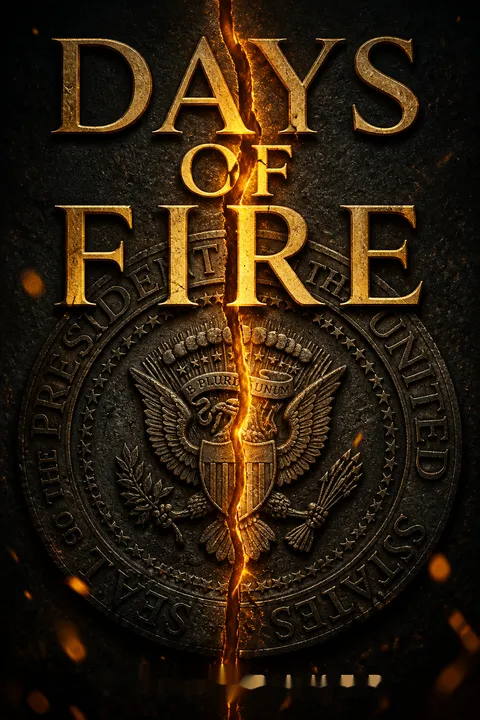
Days of Fire is widely praised as a comprehensive, balanced account of the Bush-Cheney administration. Readers appreciate Baker's fair portrayal of both men, offering new insights into their relationship and decision-making. The book challenges preconceptions, humanizing Bush while maintaining a critical eye. Reviewers note the thorough research and engaging narrative, though some find it dense at times. Many readers, regardless of political leanings, come away with a more nuanced understanding of the administration and its challenges, particularly regarding 9/11 and the Iraq War.
People Also Read
Glossary
Iron Triangle
Bush's core political teamThe nickname for George W. Bush's close Texas political advisers: Karl Rove, Karen Hughes, and Joe Allbaugh. They helped shape his campaigns and early governing operation, with Rove focused on political strategy, Hughes on communications, and Allbaugh on organization. Their tight working relationship gave Bush a trusted political center distinct from the experienced Washington figures around Cheney.
Vulcans
Bush's foreign-policy advisersThe group of foreign-policy specialists assembled by Condoleezza Rice to advise George W. Bush during his 2000 presidential campaign. The name came from a statue of the Roman god Vulcan in Birmingham, Alabama. The group included advisers with differing views on intervention, alliances, and American power, giving a foreign-policy novice access to competing expertise.
Compassionate conservatism
Conservative means, social goalsA political approach Bush used to describe pursuing goals such as reducing poverty and improving schools through conservative methods. It paired support for faith-based charities with public funds, and increased school spending with standardized testing and accountability. The phrase helped distinguish Bush from a harsher image of Republican conservatism, though critics questioned whether it represented a governing philosophy or a campaign brand.
Bush Doctrine
Preemption and democratic transformationA label used for the Bush administration's post-September 11 approach to national security. It included acting against threats before they became imminent, holding governments responsible for providing sanctuary to terrorists, and promoting democratic government as a long-term source of security. The term covered shifting policies, and the book distinguishes preventive war from preemption against an imminent attack.
National Intelligence Estimate (NIE)
Interagency intelligence assessmentA formal assessment produced by multiple U.S. intelligence agencies to present judgments on a major national-security question. The 2002 estimate on Iraq asserted that Saddam Hussein possessed chemical and biological weapons and was rebuilding a nuclear program. Its public judgments were more certain than much of the underlying evidence, while important disagreements and caveats appeared deeper in the report.
Enhanced interrogation techniques
CIA label for coercive questioningThe CIA's euphemistic term for harsh interrogation methods authorized for some terror suspects, including waterboarding, sleep deprivation, forced standing, and physical pressure. Justice Department lawyers argued that certain methods did not meet a narrow legal definition of torture. The practices became a major dispute over executive power, human rights, intelligence gathering, and America's credibility.
Extraordinary rendition
Transfer to foreign interrogatorsThe practice of seizing a suspected terrorist and transferring that person to another country for interrogation, sometimes outside ordinary legal protections. Bush administration officials used the method alongside secret detention and other counterterrorism measures. The practice became controversial because partner governments could use harsher methods and because detainees could be held without the usual transparency or judicial review.
Surge
Troop increase and strategy shiftThe 2007 change in Iraq policy that added five Army brigades and additional Marines while emphasizing protection of the population. General David Petraeus led a counterinsurgency approach that aimed to secure neighborhoods and make political progress possible, rather than simply transfer responsibility quickly to Iraqi forces. The surge improved security, but it did not itself resolve Iraq's sectarian and political divisions.
About the Author
Download PDF
Download EPUB
.epub digital book format is ideal for reading ebooks on phones, tablets, and e-readers.








