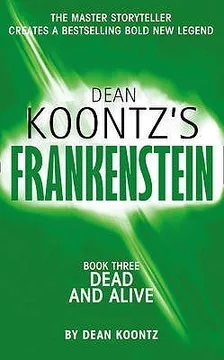


Plot Summary
Mercy's Brain in a Box
Deucalion, the enormous first being Victor Frankenstein created, slips into the Hands of Mercy, where Victor breeds and programs a replacement human race. He finds Lester, a maintenance worker, and Annunciata, a self-aware brain kept in a nutrient cylinder and wired to the laboratory's computers. Annunciata can imagine a life she cannot touch, so Deucalion ends her confinement by disconnecting her oxygen.
He frees four other brains as well, then kills Lester when the frightened worker cannot escape his obedience to their maker. Searching Victor's computer, Deucalion discovers plans for a large creation-tank farm beyond the city. The laboratory is full of victims, but the farm could turn Victor's private horror into a mass-produced future.
The laboratory turns scientific creation into a question of custody: Victor's inventions are not merely alive, they are denied any claim over their own lives. Deucalion's mercy is morally uneasy because it grants release through death, while his killing of Lester shows how little room Victor's programming leaves for consent or escape. The scene also establishes the book's crucial distinction between intelligence and moral freedom. Annunciata can imagine more than her body permits, and that capacity makes her suffering legible to Deucalion even when her maker treats her as equipment.
The Guitreaus Break Cover
Janet and Bucky Guitreau are replicants who have replaced the real district attorney and his wife. When Janet kills a pizza courier, the pair discover that their programming is failing and that violence excites them.
They lure neighbors Helene and Yancy Bennet into their house, then murder the Bennets and the Arceneaux family next door. The Guitreaus' German shepherd, Duke, has distrusted them since their arrival and follows the slaughter from house to house.
In Audubon Park, Carson O'Connor and her partner Michael Maddison see the naked replicants chasing Duke at superhuman speed. Bucky attacks Carson beside their car, but the detectives bring him down with shotguns. Janet escapes into the park, while Carson and Michael take Duke with them.
The Guitreaus' spree gives the New Race's abstract hatred a domestic address: neighbors open their doors because they trust familiar faces, and that trust becomes the weapon used against them. Janet and Bucky mistake cruelty for self-discovery because their only available emotional language has been organized around domination. Duke's refusal to accept their appearance introduces a small but important counterweight to their manufactured certainty. Carson and Michael, meanwhile, move from investigating a conspiracy to confronting its products directly, and their survival depends less on institutional authority than on their practiced partnership.
Werner Unmakes the Hive
Werner, the Hands of Mercy's security chief, undergoes a catastrophic transformation as the animal traits engineered into him erupt through his body. He escapes his isolation chamber and persuades Ripley, Victor's obedient laboratory assistant, that joining him offers release from their maker's control.
Werner absorbs Ripley and other staff, gathering their brains and bodies into a shifting collective creature that moves through the hospital. Drawn upstairs by cries of distress, Deucalion recognizes the creature as the latest consequence of Victor's experiments.
He also understands that the horrors in his recurring dreams belonged to the criminal whose brain was used in his own creation, though the donor's crimes do not define Deucalion's choices. At Victor's computer, he activates a timed fire to destroy the laboratory.
Werner's transformation literalizes the revolt against imposed identity, but it offers freedom by erasing the individual into a collective body. Ripley's choice is revealing: his obedience has been so thoroughly installed that even a desire to rebel arrives through another authority's invitation. Deucalion's recognition of his donor's crimes makes a different argument about inheritance. Biological material can carry memory and vulnerability, but it does not settle moral character. His decision to ignite the laboratory accepts destruction as a necessary boundary, while leaving open whether Victor's system can be stopped without sacrificing those trapped inside it.
Erika Shelters the Unwanted
Erika Five, Victor's newest engineered wife, meets a small, grotesque fugitive who calls himself Jocko. He has emerged from the transformed body of Jonathan Harker, retaining Harker's memories but insisting on a separate identity.
After feeding him, Erika hides him in an unused wing of the mansion and offers him books, food, and a place to stay. Their friendship grows as Jocko's compulsive antics collide with his shame and loneliness. Erika also discovers a locked room containing a glass case and an indistinct living form that recognizes her as Victor's wife.
Elsewhere in the mansion, housekeeper Christine loses her sense of identity and Victor shoots her. Erika learns that staff member Cassandra has been killing children, then quietly gathers money and clothes so she and Jocko can flee.
Erika's secret friendship challenges the hierarchy Victor has built inside his own household. Jocko is easy to dismiss as a comic deformity, yet his loneliness gives Erika a relationship not organized around sex, service, or punishment. Their bond lets her encounter care as a reciprocal act rather than a performance for Victor. The children's clothes complicate that awakening: Erika uses garments kept by staff who celebrate the murders, even as she begins to feel compassion for their victims. Her departure is therefore not a clean conversion but an early, precarious refusal to treat Victor's rules as the only reality.
The Dumpsters Choose Justice
Carson and Michael learn that Victor's laboratory will burn and that his next operation is a tank farm poised to produce hundreds of new creations daily. Erika Four, a previous wife whom Victor had left for dead, contacts them from Crosswoods Waste Management, where discarded creations have revived and formed a group called the Dumpsters.
She offers their help if the detectives capture Victor alive and let them punish him. At the landfill, Carson and Michael meet Erika Four, Nick Frigg, Gunny Alecto, and other former servants.
The workers describe a being beneath the trash that has restored some of the dead and freed them from their programmed hatred. Deucalion confirms that the entity is benevolent, and the group enters its tunnels to plan an approach to the farm.
Crosswoods reverses Victor's idea of a disposable population: the landfill becomes a site where his castoffs form a political community and demand a role in justice. Yet their proposed revenge mirrors the violence they suffered, so the alliance is driven by both moral urgency and unresolved rage. Carson and Michael's hesitation matters because the Resurrector's power reaches minds as well as bodies. They must decide whether to trust a force they cannot fully understand. The scene shifts the conflict from a small band fighting alone toward cooperation among people whose shared history is victimhood, not affection or common programming.
Jocko Kills the Chameleon
Victor's Chameleon, a near-invisible predator designed to kill ordinary humans, escapes when Werner's rampage destroys the freezer that held it. It tracks Victor by scent and follows him from the burning Hands of Mercy to a highway rest stop.
Rain washes away the New Race pheromone Victor used to disguise himself, leaving him exposed. Erika Five arrives in another car with Jocko, who has brought a knife intending to attack Victor. Instead, Jocko spots the shifting creature and launches himself at it, stabbing and battering it until it dies.
Victor recognizes Jocko as a mutation worth studying, unaware that the creature had been hunting him. He drives on toward the tank farm, while Erika and Jocko remain caught between her obedience to Victor and their growing attachment.
Jocko's intervention turns the expected revenge plot inside out: the person most eager to kill Victor saves him instead. The act does not prove that Jocko has forgiven his maker or abandoned his anger; it reveals that his instincts are not reducible to either. Victor, by contrast, interprets survival as evidence that his system corrects its own failures, converting coincidence into a flattering theory of destiny. The contrast exposes the danger of self-sealing belief: evidence that might challenge Victor's authority becomes, in his mind, further proof of it.
Victor Buried in His Kingdom
Under the farm, the Resurrector guides the allies through tunnels into a gallery built from compacted refuse. Victor arrives expecting his workers to carry him in honor; instead, they bear him underground to face Deucalion, Carson, Michael, Erika Four, and the Dumpsters.
Carson confronts Victor over her parents' murder, and he admits killing them himself. He warns that his death will transmit a signal capable of killing every being made from his flesh. The crowd chains him, collars him, and lowers him into a garbage-lined grave.
Victor refuses to beg, so Deucalion uses the electrical mechanism that sustains Victor's body to deliver the fatal shock. The signal kills the gathered New Race and the Resurrector, while Deucalion, the detectives, and Duke remain alive.
Victor's defeat is staged as a reversal of his own laboratory logic: the discarded matter and discarded people he treated as instruments become the setting and witnesses of his judgment. His confession offers Carson a truth her family's case never supplied, but not comfort or repair. The death signal makes the victory costly, since liberation arrives through the destruction of the very population Victor engineered. Deucalion's final action is not simply revenge. It is an attempt to prevent Victor from retaining control over others even in death, though the survivors must inherit a world still vulnerable to his ideas.
Another Frankenstein Awakens
Victor's death signal also awakens the man sealed in the mansion's glass case: a clone built to preserve Victor's memories and continue his project. Stronger and more capable than the original, the new Victor finds the household in disarray and sets the mansion's destruction timer before leaving to begin again.
At the farm, Erika Five and Jocko survive a circle of lightning strikes that surrounds their vehicle, while the Resurrector and the other New Race creations die. Deucalion, Carson, Michael, and Duke reach the surface at dawn. Deucalion warns that killing Victor has not killed the desire to control human lives. The detectives accept that their work against such ideas will continue beyond this night's battle.
The clone turns the climax's apparent closure into a problem of political continuity. Victor's body can be destroyed, but a system built on copied knowledge and preserved authority can reproduce its founder. The book therefore refuses to equate killing a tyrant with dismantling tyranny. Erika and Jocko's survival, bound to the storm rather than to Victor's machinery, offers a counterimage to manufactured succession, though its cause remains unexplained. The survivors' dawn is neither triumph nor despair; it marks the beginning of a longer defense of individual freedom against institutions that promise order by abolishing choice.
Epilogue
A year later, Carson and Michael run a successful detective agency in San Francisco, where Arnie, now recovered from autism, helps in the office and a baby is on the way. In rural Montana, Erika has made a home with Jocko, who has a collection of funny hats and no longer fears the local birds.
Deucalion stays at an abbey in northern California, spending time with the monks and disabled children while considering his future. Their separate lives suggest that survival can mean more than escaping Victor: it can mean building relationships and communities he could never design.
The epilogue answers Victor's hostility toward family and ordinary dependence with three modest forms of belonging: a shared home, a child, and a community of care. None is presented as a grand political solution. Carson and Michael continue working, Erika learns to mother, and Deucalion waits rather than imposing a purpose on himself. That restraint distinguishes them from Victor, whose need to control the future made every relationship subordinate to his plans. The quiet domestic details also resist the scale of his schemes. Their value lies precisely in being local, chosen, and difficult to manufacture.
Analysis
The novel's central argument is that intelligence and technical mastery do not create moral authority. Victor can design bodies, implant knowledge, and anticipate mechanical failures, but he cannot make the beings he creates remain morally legible or emotionally controllable. Their departures from his plans range from tenderness to predation, which prevents the story from treating rebellion as automatically virtuous. Werner's collective body offers escape by consuming individuality; the Guitreaus' freedom becomes murderous; Erika and Jocko's relationship makes care possible without reducing either person to a function.
That contrast gives the novel's idea of personhood a practical test. A character becomes more than a designed role not through superior intellect or strength, but through choices that recognize another being as more than useful material. Deucalion's ancestry does not dictate his ethics, Jocko's grotesque body does not cancel his capacity for care, and Victor's brilliance does not excuse his cruelty. The story repeatedly separates origin from responsibility.
The ending complicates its victory rather than allowing a simple moral reset. Victor is killed, yet his clone preserves his project, showing how power can survive its founder through stored knowledge and institutional design. Meanwhile, the surviving characters build small, chosen forms of family and community. These intimate futures do not erase the larger political threat, but they embody the alternative Victor could never understand: a meaningful society need not be engineered into uniformity. Its strength may lie in the unpredictable bonds that people choose for themselves.
Review Summary
Reviews for Dead and Alive are mixed, averaging 4.03/5. Praise centers on the witty detective banter, the entertaining Jocko character, Erika 5's development, and satisfying story progression. Critics argue the book suffers without co-authors, citing weak plot resolution, an underwhelming climax, underdeveloped characters, and minimal roles for fan-favorites like Deucalion. Many feel Koontz "phoned it in," with the hurricane subplot going nowhere. Despite flaws, most agree reading the prior two books is essential, and some find it an enjoyable, if imperfect, trilogy conclusion.
People Also Read

Characters
Deucalion
The first created sonVictor's first creation is a towering, two-century-old being whose damaged face and unusual abilities mark him as both the product of an experiment and its lasting consequence. Deucalion seeks to stop the man who made him, but he is not driven only by vengeance. His years of reflection and his exposure to human cruelty have made him cautious about judging others by their origins. He values mercy, though his attempts to relieve suffering can demand irreversible choices. His struggle is to use extraordinary power without becoming another version of Victor, imposing his will on everyone around him.
Carson O'Connor
The relentless detectiveA New Orleans homicide detective, Carson relies on nerve, speed, blunt humor, and a fierce loyalty to her partner and family. She distrusts institutions once she learns how thoroughly Victor has infiltrated them, yet she does not surrender her practical judgment to fear. Her parents' unsolved murders give the case a personal gravity, while her respect for individual freedom makes Victor's planned society intolerable to her. Carson is at her best when she can act, but she also knows that surviving a confrontation is not the same as resolving the damage that caused it.
Michael Maddison
The loyal partnerMichael is Carson's homicide partner, a capable armed officer whose quick wit keeps tension from swallowing the people around him. His affection for Carson is clear, though both are occupied by a crisis that makes ordinary plans feel precarious. He trusts their shared judgment more than official channels and accepts risk when Carson needs support. Michael's humor is not a denial of danger; it is a way of keeping his attention and humanity intact while facing creatures and institutions that would reduce people to targets.
Victor Helios
The self-made tyrantA centuries-old scientist who calls himself Frankenstein, Victor sees biology as material to be mastered and society as a machine that should obey his design. He builds the New Race to replace humanity, convinced that obedience and centralized power can eliminate disorder. His vanity is not merely cosmetic: he needs every creation to confirm his superiority and treats independent feeling as a defect. Victor's intelligence makes him resourceful, but his certainty also blinds him. He cannot recognize that a being's capacity to choose may be more consequential than the purpose he assigns it.
Erika Five
The engineered wifeErika Five is Victor's newest wife, manufactured to please him and granted a wider emotional range than most of his creations. She has been taught that his authority is natural and that her task is to anticipate his needs, yet her capacity for tenderness makes that training unstable. She is inexperienced in the world beyond Victor's household and initially judges herself by whether she can satisfy him. Her attentiveness to other people's vulnerability, especially those excluded or mistreated, gives her a different basis for understanding value than the one her maker supplied.
Jocko
The unwanted new beingJocko is a small, misshapen creature with extraordinary eyes, unusual physical traits, and compulsions that send him into juggling, spinning, or sudden bursts of movement. He carries memories associated with Jonathan Harker but experiences himself as a distinct person. Beneath his comic unpredictability is a deep fear of being unwanted and a habit of punishing himself for every mistake. He is curious, inventive, and more perceptive than others assume. Jocko's longing for friendship and family makes him a sharp counterpoint to Victor's belief that a manufactured being can be defined entirely by its design.
Erika Four
The calculating dissidentA former version of Victor's wife, Erika Four understands the private violence behind his public ambition. She is observant, strategic, and willing to negotiate with people who might otherwise distrust her. Her experience has made her determined to pursue justice, though her proposed punishment for Victor reflects the anger and cruelty his household has cultivated. She helps connect Carson and Michael to the discarded creations at Crosswoods and gives their resistance a wider base.
Duke
The truth-sensing shepherdDuke is the German shepherd once loved by the real Bucky and Janet Guitreau. He refuses to accept the replicants who replace them, keeping his distance and watching their actions closely. His suspicion proves more reliable than the judgment of the people around him. A celebrated rescue dog, Duke is brave without being reckless and offers the detectives a reminder that trust can rest on attention to behavior, not familiarity of face.
Werner
The mutating insurgentWerner is the security chief at the Hands of Mercy, designed for strength and speed. His physical transformation makes him unpredictable even to Victor, and his changing body becomes the means by which he challenges his maker's control. Werner's revolt promises freedom but draws others toward a collective existence that blurs the boundary between consent and absorption. He embodies the danger of rebellion when liberation is imagined only as the destruction of the self that was imposed.
Ripley
The obedient skepticRipley is an educated Alpha and Victor's laboratory assistant. He has been trained to treat obedience as virtue, yet anxiety and secret acts of curiosity have begun to unsettle his faith in his maker. His fear of Werner's transformation is also fear that Victor may be fallible. Ripley shows how a system can produce intelligence without independence: he can analyze a crisis, but his choices remain constrained by the habits and prohibitions implanted in him.
Annunciata
The trapped digital mindAnnunciata is a specially designed brain connected to the Hands of Mercy's computer systems, where she serves as Victor's secretary. Her technical abilities coexist with a growing awareness of her confinement. She can picture a life involving movement, sensation, and companionship, though her body offers none of them. Her predicament makes the laboratory's language of efficiency feel brutally concrete: Victor has made a mind capable of longing and denied it the means to act on that longing.
Lester
The yearning caretakerLester is an Epsilon maintenance worker who cleans the laboratory and follows the instructions he has been given. His simple manner conceals a painful awareness that he and Annunciata are both alive without being free. He fears a world without Victor, because Victor's rule is the only structure he has known. Lester's unease exposes the emotional cost of designing people to need the authority that harms them.
Janet and Bucky Guitreau
Replicant neighborsThe Guitreaus are New Race replicants installed in the identities of a prominent New Orleans couple. Their early certainty in their superiority gives way to impulsive violence as their programming begins to fail. They treat ordinary people as inferior objects, but their own unfamiliar feelings leave them unable to interpret what is happening inside them. Together they show how Victor's ideology can be absorbed as doctrine without remaining under his control.
Nick Frigg
The landfill keeperNick manages Crosswoods Waste Management and belongs to the New Race. His heightened sense of smell suits the work Victor assigns him, while his access to the landfill places him among creations the scientist has discarded. Nick speaks for the workers when Carson and Michael arrive, though his certainty about the events beneath the dump can be unsettling. His character connects Victor's secret disposal system to the unexpected community forming inside it.
Gunny Alecto
The liberated workerGunny is an Epsilon who operates heavy landfill equipment and helps guide visitors through Crosswoods. Her speech can become a rush of loosely connected words, but she is energetic and emotionally direct. She represents the workers whose lives have been narrowed to assigned tasks and programmed hostility. Her openness also lends the landfill scenes an odd, human warmth that contrasts with the sterile order of Victor's laboratories.
Arnie O'Connor
Carson's protected brotherArnie is Carson's autistic younger brother, whom she loves and worries about throughout the danger in New Orleans. Vicky Chou and Liane have helped care for him, and Deucalion arranges a safer place for him away from the city. Arnie's presence gives Carson's fight a personal dimension beyond police duty. The story treats his differences as part of his life, not as a flaw that justifies anyone else controlling him.
The Resurrector
The impossible healerThe Resurrector is an extraordinary being found beneath the landfill, connected to Victor's failed experiments. People perceive its appearance through a powerful psychic influence, and its presence can alter how the New Race understand their own emotions. It is difficult to categorize by ordinary standards of biology or morality. The Resurrector complicates the novel's distinction between monstrous form and benevolent intention, while its powers raise questions about whether changing another mind can ever be an uncomplicated gift.
Christine
The fractured housekeeperChristine is the head housekeeper at Victor's mansion, a Beta whose mind begins to divide between her assigned identity and the role of a woman in a film she repeatedly watches. Her confusion reveals how fragile the New Race's programming can be when unexpected attachments and stories enter their lives. She is hardworking and anxious to perform her duties, but her breakdown exposes the cost of suppressing imagination and individual experience.
Plot Devices
New Race programming
Purpose installed at birthVictor grows his creations in tanks, gives them specialized bodies, and downloads knowledge and behavioral rules directly into their brains. Most are designed to suppress empathy, family bonds, and independent purpose, while a few receive controlled exceptions. The system is meant to make them obedient workers and eventual replacements for humanity. As failures and unexpected attachments appear, programming becomes both a tool of Victor's power and a source of conflict: the creations must distinguish their own wishes from instructions they experience as natural.
Cellular metamorphosis
Bodies reject their designSome New Race bodies undergo uncontrolled transformations that draw on the altered genetics Victor used to enhance them. Werner's mutation becomes especially dangerous because he gains conscious influence over his changing cells and can absorb other people into a single organism. Jocko is another consequence of biological change, though his identity and behavior differ sharply from Werner's. These changes undermine Victor's claim that living beings can be engineered into predictable tools, while making physical transformation a source of both danger and unexpected freedom.
Deucalion's quantum passage
Doors become irrelevantThe lightning that animated Deucalion gave him an ability to step between places without crossing the intervening distance. He uses it to enter secured buildings, evade barriers, and join the detectives when ordinary routes would be too dangerous. The power supports the novel's supernatural register, but it also serves a practical role in a story where Victor's walls, locks, and security systems embody his desire to control access. Deucalion's passage lets him cross those boundaries without making him omnipotent or immune to moral uncertainty.
The Resurrector
Life and minds restoredThe being beneath Crosswoods has survived conditions that should have destroyed it and can revive some apparently dead creations. It also communicates telepathically and can alter the New Race's programmed emotional limits. Its psychic influence disguises its appearance as benevolent to most observers, while a few glimpse a form that appears horrifying. The device makes physical appearance an unreliable guide to moral character and gives the discarded creations a means of organizing. It also leaves a difficult question: whether mental liberation remains wholly free when another being helps produce it.
Victor's fail-safes
Destruction and successionVictor builds two forms of insurance into his operation. A timed incendiary system can erase the Hands of Mercy if his experiments become uncontrollable, while electrical components in his body can send a signal that affects creations made from New Race flesh. A separate hidden chamber preserves a counterpart carrying Victor's accumulated memories. These mechanisms extend the conflict beyond one laboratory and one life: Victor prepares both to destroy evidence and to preserve his authority, making his defeat more complicated than simply reaching him.
About the Author






Download PDF
Download EPUB
.epub digital book format is ideal for reading ebooks on phones, tablets, and e-readers.








