

Key Takeaways
The Calvinism dispute is about who makes faith possible, not whether faith matters
The real dividing line. James White argues that salvation is God's work from beginning to end: people must believe, but God's grace first makes saving faith possible. Dave Hunt agrees that salvation is a gift, yet argues that people can respond to God's offer without being regenerated first. Their disagreement is not whether Christians believe, but whether faith is a response enabled by prior divine action or a human response that precedes new birth.
Two accounts of grace. White calls the first view monergism, salvation brought about by God alone. Hunt defends synergism, a view in which God's work and the person's response both matter. The book tests these competing accounts against Scripture, especially passages about God's choice, human sin, Christ's death, and the call to believe.
What's striking is how much turns on the meaning of agency. Both authors affirm grace, faith, and human responsibility, but arrange them differently in the causal story of conversion. This resembles a recurring philosophical question: can an action be genuinely one's own if another power makes it possible? The debate benefits from separating that question from the simpler issue of whether belief is necessary. It also shows why shared religious vocabulary can conceal a deep disagreement: saying that salvation is a gift does not settle how the gift is received.
Hold God's rule and human accountability in the same frame
One event, two intentions. White argues that God's sovereignty and human responsibility can coexist. He calls this compatibilism: God's purposes govern events, while people remain accountable for acting from their own intentions. Joseph's brothers meant harm when they sold him, White notes, while the biblical story also presents God as using that act to preserve lives. He makes a similar case from Assyria's attack on Israel and the crucifixion of Jesus.
The rival explanation. Hunt accepts that God can restrain or redirect evil, but denies that this means God decrees sinful intentions. He reads these stories as examples of God using human choices without causing them. The disagreement is therefore not over whether God acts in history, but how divine purpose relates to the human source of evil.
Compatibilism is a framework for describing how divine control and human accountability might fit together, not a shortcut that makes the tension disappear. The key question is whether responsibility rests on acting voluntarily from one's desires, or also requires that the person could have chosen otherwise. The Joseph example makes the distinction vivid, but it does not by itself settle the metaphysics. Careful readers should notice how both accounts preserve some truths while assigning different meanings to freedom, causation, and blame.
Ask whether sin makes faith impossible, not merely difficult
The meaning of spiritual death. White reads biblical descriptions of people as dead in sin, enslaved to sin, and unable to please God as evidence that fallen people cannot produce saving faith without God's renewing work. He points especially to Romans 8, 1 Corinthians 2, and Jesus' statement in John 6 that no one can come to him unless the Father draws that person.
The meaning of responsibility. Hunt argues that these passages describe resistance and unwillingness, not an incapacity to believe. He points to biblical commands to seek God, repent, and come to Christ, along with examples of people turning from wrongdoing. He also warns against treating spiritual death as though it were physical death. The two sides disagree over what inability means and what a command implies about capacity.
This distinction between inability and unwillingness matters far beyond theology: moral philosophy also asks whether people are responsible when their motives or capacities are constrained. The book's scriptural examples invite close attention to context and vocabulary, but neither the metaphor of death nor a command to believe automatically answers every question about capacity. A command can express duty without proving ability, while a description of inability can be interpreted in more than one way. The strongest reading has to account for both kinds of passage.
Read election passages for their subjects, sequence, and context
Who is chosen, and for what? White reads Ephesians 1 and Romans 8-9 as teaching that God chose particular people for salvation before they existed, not simply a plan that people later choose to enter. He also cites Acts 13:48, where Gentile believers are described as appointed to eternal life, and 2 Thessalonians 2:13, which speaks of God's choice for salvation.
What Hunt sees instead. Hunt argues that election often concerns the blessings or service of people who already believe, and that God's foreknowledge means he knew who would respond in faith. He reads Romans 9 partly through its discussion of Israel and the nations. Their dispute shows why a verse cannot be interpreted by its keywords alone: its grammar, surrounding argument, and the book's larger account of salvation all matter.
The debate illustrates a basic interpretive discipline: identify the grammatical subject, the action, and the stated outcome before importing a system-wide conclusion. Yet context operates at several levels, from the sentence to the whole biblical canon, and interpreters can disagree about which level governs. White stresses continuity among passages about election; Hunt stresses passages inviting all people to believe. Neither concern is dispensable. The interpretive challenge is to explain the apparent friction without treating the less convenient texts as exceptions by default.
In John 6, the order of divine giving and human believing matters
A sequence White emphasizes. In John 6, Jesus says that those given to him by the Father will come, that he will keep them, and that no one can come unless drawn by the Father. White treats these statements as one connected account: divine giving and drawing result in faith and final salvation. He sees the passage as explaining why some listeners believe and others leave.
A response Hunt emphasizes. Hunt points to the same chapter's repeated calls to come, believe, eat, and drink. These images, he argues, present a real human response to an offer made broadly, not merely the outcome of an unseen selection. The debate turns on whether the chapter's human invitations explain how salvation is received or whether they follow God's prior work in the hearer.
This close reading is valuable because it keeps interpretation anchored in a single sustained argument rather than assembling isolated proof texts. Still, counting how often a passage mentions divine action or human response cannot decide which action is causally prior. A narrative can emphasize both without spelling out a complete theory of conversion. Readers should ask what each sentence contributes to Jesus' explanation of belief and unbelief, then test whether their interpretation makes sense of the entire exchange.
Decide whether the cross secures salvation or makes salvation available
An accomplished rescue. White argues that Christ's death actually redeems the people for whom it was intended. He draws on Hebrews' description of Christ obtaining redemption, Jesus' promise to save his people, and the connection between Christ's intercession and those who are saved. On this account, the cross does not merely make salvation possible; it accomplishes its purpose.
A provision for all. Hunt argues that Christ died for everyone and that people receive salvation by believing. He appeals to passages about the world, the many, and the whole human race, as well as Old Testament sacrifices offered for Israel even though many Israelites later rejected God. The dispute concerns both the scope of Christ's death and what substitution means if some for whom Christ died are ultimately lost.
The central conceptual distinction is between a provision that is sufficient for all and an act intended to secure the rescue of particular people. Each account faces a different explanatory burden. An effective, particular atonement must explain the breadth of biblical invitations; a universal provision must explain how substitution relates to those who remain condemned. Neither question is answered merely by repeating that Christ died for sinners. Defining intention, accomplishment, and application separately makes the disagreement clearer and less dependent on emotionally charged labels.
Define God's love before using it to judge either theology
Love as a moral test. Hunt argues that God's love for humanity means he genuinely desires everyone's salvation. He finds it morally incoherent to say that God could save people but chooses their eternal punishment, especially while commanding Christians to love enemies and care for others.
Love with different purposes. White answers that love need not be identical toward every person. He distinguishes God's general kindness from the saving love shown to the church and argues that mercy is free, while judgment is deserved. Both authors appeal to God's character, but they define love differently: for Hunt, its universal saving intention is central; for White, God's differentiated love can coexist with justice and particular redemption.
The exchange exposes a semantic problem often hidden by the phrase God is love. Love can mean benevolence, covenant loyalty, sacrificial action, or a commitment to rescue, and those meanings do not automatically entail the same claims. Hunt's moral intuition gives universal invitations real force; White's distinction prevents love from being reduced to identical treatment. The needed nuance is not to dismiss either as sentiment or abstraction, but to ask which meaning fits each passage and whether the theology uses that meaning consistently.
Ground assurance in Christ's promise without ignoring the life faith produces
Promise or evidence? Hunt locates assurance primarily in believing God's promise of eternal life through Christ, not in measuring personal performance. He worries that making perseverance or good works evidence of election can create doubt, since no person can be certain that their conduct is good enough.
Faith that endures. White argues that perseverance does not earn salvation; it is evidence that God has saved a person. He points to biblical warnings about temporary or false belief and to passages that call Christians to examine themselves. The disagreement is about how assurance works: whether confidence rests chiefly on the promise believed, or also on the continuing pattern of faith and life that the promise is said to produce.
This is a pastoral question as much as a doctrinal one. Assurance based only on introspection can become fragile, but assurance detached from any account of changed life can make self-deception difficult to confront. The two concerns can be held together by distinguishing the ground of salvation from evidence about its presence. The book's dispute shows why that distinction needs careful explanation: Hunt fears that evidence becomes a hidden wage, while White insists that evidence is not the source of acceptance.
Use church history to inform interpretation, never to substitute for it
The argument from history. Hunt challenges Calvinism by examining Calvin's influence from Augustine, his defense of infant baptism, and his role in Geneva, including the persecution of religious opponents. He argues that a theologian's life and teachings should affect how readers assess the system associated with him.
The argument from Scripture. White replies that Calvin's conduct and errors do not decide whether a doctrine is biblical. He rejects some of Calvin's views himself and insists that Scripture, not a historical figure, is the final test. The book's format sharpens this methodological conflict: both authors claim to read the Bible faithfully, yet each accuses the other of allowing prior commitments to dictate what the text can mean.
Historical context can reveal how doctrines were shaped, what their advocates intended, and how beliefs translated into institutions. But a theologian's conduct cannot by itself prove or disprove a textual interpretation. Conversely, appealing to Scripture alone does not eliminate inherited assumptions; readers still bring traditions to the text. The most productive approach is twofold: investigate the historical record fairly, then evaluate doctrinal claims through explicit argument rather than guilt by association or reputation.
Analysis
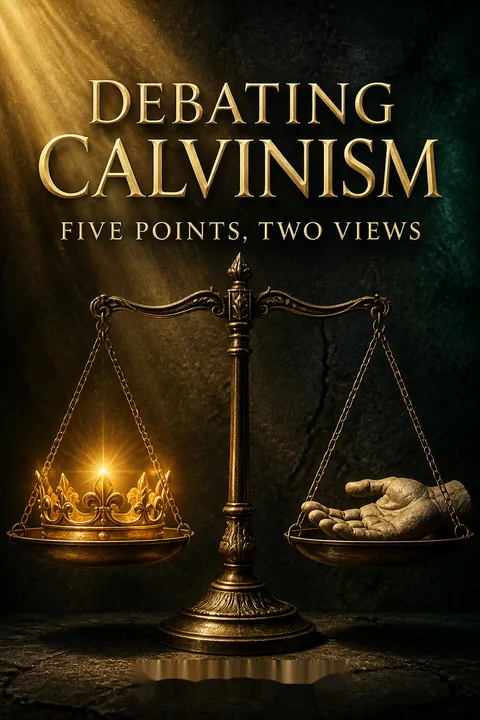
Debating Calvinism is less a tidy survey of five doctrines than a prolonged contest over the rules of interpretation. James White and Dave Hunt both claim Scripture as their authority, yet they disagree about how individual passages should be read alongside the Bible's broader claims. White gives priority to sequences and grammatical links in texts such as John 6 and Romans 8, reading them as a coherent account of God's effective action. Hunt gives priority to the many invitations and commands addressed to human beings, arguing that these make a genuinely available response essential. Each sees the other's method as allowing tradition to overrule the text.
Their deepest disagreement is causal. White's account places the decisive cause of faith in God's renewing grace, while Hunt places the decisive response in a human will enabled, but not compelled, by God. That difference shapes everything downstream: the meaning of election, the scope of the atonement, the character of divine love, and the basis of assurance. The debate is most useful when these questions are separated rather than bundled under the label Calvinism. A reader can ask, for example, whether a passage concerns the purpose of the cross, its universal sufficiency, or its application to believers. Those are related claims, not synonyms. The book's polemical format is both a strength and a weakness. Repeated responses let readers see arguments tested, and the two authors make the stakes unusually clear. But the exchange often shifts from interpretation to accusations of ignorance, inconsistency, or bad faith. Those attacks can obscure the actual exegetical dispute. The historical controversy over Calvin's conduct likewise matters for understanding the tradition, but it cannot settle the biblical question on its own.
The most durable lesson is methodological: do not confuse a conclusion with the evidence offered for it. Track a passage's context, distinguish related theological terms, and ask what each view must explain. This debate does not make the disagreement disappear. It gives readers a sharper map of why thoughtful Christians reach opposing accounts of grace and responsibility.
Review Summary
Debating Calvinism receives mixed reviews, with an average rating of 3.36/5. Many readers find James White's arguments stronger and more coherent, while criticizing Dave Hunt's repetitive and often irrelevant points. The debate is seen as unbalanced, with White presenting better exegesis and Hunt relying on emotional appeals. Some readers appreciate White's explanations of Calvinism but find the overall tone divisive and uncharitable. The book is considered informative for those new to the topic but disappointing for those seeking a balanced, scholarly debate.
People Also Read








Glossary
Monergism
God alone effects salvationThe view that God alone brings about salvation, including the renewal that enables a person to believe. In White's account, human beings genuinely believe, but their faith follows God's prior work of grace rather than supplying a contribution that completes an otherwise insufficient divine effort.
Synergism
God and human response cooperateThe view that salvation involves both God's gracious work and a human response that is not itself irresistibly produced by God. Hunt argues that people do not earn salvation by believing, but must freely receive or reject the salvation God offers.
Compatibilism
Sovereignty and responsibility coexistThe account that God's sovereign purposes and human responsibility can both be true. In White's presentation, people act according to their own intentions and remain accountable, even when their actions also serve God's purpose. Hunt rejects this explanation when it implies that God decrees sinful intentions.
Effectual calling
A call that brings faithIn Reformed theology, God's inward call that effectively brings a chosen person into relationship with Christ. It is distinguished from the outward preaching of the gospel, which is heard by many. White connects this call to the people who are justified and ultimately glorified.
Unconditional election
God chooses without foreseen meritThe teaching that God's choice of people for salvation rests on God's own purpose and grace, not on a quality, work, or foreseen act of faith in those chosen. Hunt disputes this reading, arguing that election often concerns blessings or service and is related to God's foreknowledge of belief.
Particular redemption
Christ secures salvation for the electThe Reformed teaching that Christ's death was intended to redeem a particular people and actually secures their salvation. White contrasts this with the view that Christ's death makes salvation available to everyone, with its saving benefit received through faith. The disagreement concerns the scope and accomplishment of the atonement.
Regeneration
God gives spiritual lifeThe theological term for God's act of giving spiritual life to a person. White argues that regeneration precedes and enables saving faith. Hunt argues that the new birth occurs through believing the gospel. Their dispute depends partly on how regeneration relates to salvation, faith, and the biblical language of spiritual death.
Perseverance of the saints
Believers endure by God's keepingThe teaching that those whom God has truly saved continue in faith and are finally brought to salvation. White presents continued faith as the result and evidence of God's saving work, not a way to earn acceptance. Hunt objects that treating conduct as evidence can make assurance depend on uncertain self-assessment.
Sola scriptura
Scripture as final authorityThe Reformation principle that Scripture is the final authority for Christian teaching. White argues that believers must continually test inherited traditions against the whole Bible. Hunt also appeals to Scripture as the standard, while arguing that White's readings conflict with the Bible's broad invitations to believe and repent.
Golden chain of redemption
Linked stages of God's saving workWhite's name for the sequence in Romans 8:29-30 in which God foreknows, predestines, calls, justifies, and glorifies the same people. He treats the unbroken sequence as evidence that salvation is God's effective work. Hunt disputes White's interpretation of foreknowledge and the passage's application to election.
About the Author
Other books by Dave Hunt
Download PDF
Download EPUB
.epub digital book format is ideal for reading ebooks on phones, tablets, and e-readers.








