

Key Takeaways
Expect disruption in bursts, and reinvent the business before the old model breaks.
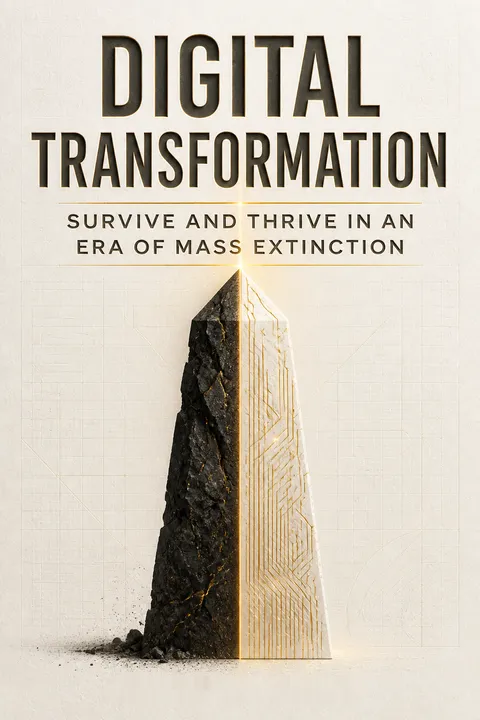
Change arrives in bursts. Thomas Siebel uses punctuated equilibrium, a theory of evolution in which long periods of relative stability are interrupted by rapid change, to explain why industries can suddenly lose established leaders and produce new kinds of companies. The book points to the disappearance of once-dominant phone makers Nokia and BlackBerry after smartphones changed what customers expected. It also cites a 2019-era estimate that 52 percent of Fortune 500 companies had been acquired, merged, or gone bankrupt since 2000.
Adaptation must reach the core. Simply moving existing tasks online resembles a minor adjustment, not a change in what the business can do. Blockbuster had an opportunity to partner with Netflix, but held to its existing model while Netflix moved from DVD delivery to streaming. The lesson is not that every incumbent must become a technology company. It is that leaders need to question whether their current offering still solves the customer’s underlying problem.
The evolutionary analogy makes a useful strategic point: stability can hide accumulating vulnerability until a change in the environment makes old strengths less useful. But corporations are not species. They can acquire capabilities, change leaders, and deliberately abandon profitable routines, so extinction is not a law of nature. The analogy works best as a prompt to notice when a business model depends on assumptions that technology or customer behavior is altering. It works less well as a prediction that every industry change will be sudden or irreversible.
Digital transformation means redesigning the core, not putting old workflows online.
Digitizing is not transforming. The book separates two earlier waves from the current one. Personal computers automated work such as calculations and word processing; the internet moved activities such as travel booking and retail online. Both made existing processes faster, but often preserved their basic logic. Siebel calls the deeper shift digital transformation: rebuilding important capabilities and business processes around the combined use of cloud computing, big data, artificial intelligence, and the internet of things.
Change the competitive engine. A bank website may make account information easier to reach, while a data-driven lender may alter how loans are assessed and delivered. The difference is not the shininess of the interface, but a change in the core value offered. The book argues that transformation can change how companies produce, sell, and support products, and may create business models that did not previously exist.
This distinction helps expose a common category error: a new channel is not necessarily a new capability. It also directs attention toward the parts of a company that customers value, rather than the IT department’s project list. Yet the boundary between support work and competitive core is not fixed. A smoother customer service process can become a real differentiator when trust or speed matters. The practical test is whether a digital investment changes customer value, operating economics, or the organization’s ability to respond, rather than merely replacing paper with screens.
Join complete, contextual data to predict what isolated systems miss.
Completeness changes the question. Siebel’s account of big data emphasizes more than sheer size. Cloud storage and scale-out computing make it possible to analyze much more of a relevant dataset instead of relying only on small samples. Big data also spans different forms and speeds, from structured records to images, text, and frequent sensor readings. The book describes one manufacturer facing 50 petabytes of information fragmented across 5,000 systems, a situation in which merely collecting files does not make them useful.
Context creates value. An oil-field reading becomes more informative when linked with equipment history, weather, maintenance records, and location. A utility used publicly available restaurant information, including opening hours, to help identify energy consumption that looked anomalous. Data need to be connected to a business question and interpreted in context. Siebel also warns that fragmented, poorly managed data can turn a promised data lake into a data swamp.
The move from sampling toward broader datasets can reveal patterns that small samples conceal, particularly in complex operations where signals interact. But completeness is not the same as truth. Missing records, inconsistent definitions, and biased historical decisions can all survive at scale, and more data can make a misleading pattern look more convincing. Data integration is therefore a social and organizational task as much as a technical one: someone must decide what counts as an event, which records belong together, and whose knowledge can challenge the resulting interpretation.
Use AI for narrow predictions, then improve it with real-world feedback.
Prediction is the practical use. In the book, artificial intelligence means software that can learn or solve tasks associated with human intelligence. Machine learning, a branch of AI, finds patterns in examples rather than following only hand-written rules. A model trained on labeled engine histories, for example, can estimate whether an engine is likely to fail. Deep learning can learn useful features from complex inputs such as images, though it usually needs substantial data and computing power. This is specialized task performance, not general human-like intelligence.
Models need a working loop. A production system has to gather and prepare data, define outcomes, train a model, put its predictions into an actual workflow, and monitor and retrain it as conditions change. The book describes a bank using multiple data sources to identify corporate customers at risk of leaving, with an estimated annual value of about $1 billion. The prediction matters only if account managers can respond in time and learn from what happens.
The emphasis on specific tasks makes AI less mystical and more managerial: the useful question is what decision a model improves, and what happens after its recommendation. This resembles a feedback-control system, where an estimate is valuable only when it informs an action and the result can be observed. Prediction alone does not establish why a customer leaves or whether an intervention works. A sound deployment therefore evaluates both model accuracy and the consequences of acting on its output, including the cases where a human should override it.
Connect equipment so real-time data can change physical operations.
The physical world becomes computable. The internet of things, or IoT, connects devices that can send and receive data. As computing moves into equipment and sensors, information can be gathered and acted on close to where it is produced, as well as analyzed in the cloud. In the electric grid, smart meters and other sensors make it possible to monitor conditions far more frequently than manual meter readings allowed. Enel operated more than 40 million smart meters, which generated over five billion readings a day, according to the book.
Turn signals into action. Enel’s use of AI on grid data was projected to yield more than €600 million in annual economic value. In manufacturing and aviation, connected equipment can support maintenance before a failure, rather than service on a fixed schedule. The result can be fewer outages, less idle inventory, and better use of assets. IoT can also change products themselves, as connected machines are monitored, updated, and serviced throughout their use.
Connecting sensors to operational decisions is a deeper shift than adding another dashboard: it allows information to affect machinery, logistics, and service while events are unfolding. The network effect can make a system more informative as its devices and data become connected, but it does not guarantee that value rises automatically with every new sensor. Poorly chosen measurements create cost and noise, and connected controls expand the consequences of malfunction or attack. The strongest deployments pair a clear operating decision with the minimum reliable data needed to improve it.
Use the cloud's elastic economics without surrendering portability or control.
Computing becomes a utility. Cloud computing gives organizations access to shared computing and storage resources that can be provisioned as needed, usually with charges tied to usage. Virtualization lets multiple workloads use the same physical hardware, reducing the need for each organization to maintain capacity for its own peak demand. The cloud also offers different service levels: infrastructure to manage, platforms for building software, and complete applications delivered online.
Flexibility requires choices. Public clouds can expand quickly; private and hybrid arrangements can keep some resources under an organization’s control. Siebel argues that cloud economics lower barriers to experimenting with data-intensive applications. Yet he also stresses the risk of vendor lock-in, especially when an application depends on provider-specific tools. A multi-cloud strategy or model that separates an application from its underlying services can preserve options, although portability is not effortless.
The cloud changes the timing and allocation of investment: teams can test ideas without buying a data center sized for a hypothetical peak. That flexibility can support experimentation, but it can also make spending less visible because costs arrive as ongoing usage rather than a single purchase. Portability is similarly a tradeoff, not a free feature. A system designed to use every provider’s unique service may gain performance or convenience while becoming harder to move. Leaders should decide which dependencies are strategic and which are merely convenient.
Make the CEO accountable for measurable transformation, not just technology spending.
Leadership must cross silos. Because digital transformation can change core processes across an organization, Siebel argues that it cannot be delegated to IT alone. The CEO should align the senior team, appoint a chief digital officer with authority and budget, and establish a cross-functional Center of Excellence where technical and business teams can build capabilities together.
Start with value, not plumbing. The book’s 10-point CEO Action Plan emphasizes setting a strategic direction while beginning practical projects, communicating a roadmap, choosing capable partners, changing the culture, and continually training leaders and employees. It advises selecting use cases with measurable economic or social benefits and delivering results in months rather than allowing broad data-integration projects to consume years. The CEO is expected to review progress directly, and to stop projects that cannot demonstrate a credible path to value.
Top-level sponsorship matters because a predictive maintenance model can change who schedules work, how staff are evaluated, and which department pays for a repair. Those conflicts rarely resolve through technical design alone. The book’s emphasis on executive ownership is strongest when paired with accountability for frontline outcomes, not only deadlines and budgets. Its preference for quick returns also needs care: a short project horizon can prevent waste, but organizations still need foundational investments whose benefits are shared across teams and take longer to measure.
Prove value with operational outcomes, not impressive pilot counts.
Measure changes in the work. The book’s enterprise cases illustrate how transformation can be tied to concrete operating results. A John Deere application for a product line with more than 40,000 parts was projected to reduce parts inventory by 25 to 35 percent. At 3M, AI tools were used to improve delivery promises and flag invoices likely to generate customer complaints; the company projected more than $1 billion in annual savings and reduced working capital. These cases connect data and models to decisions about inventory, orders, and customer service.
Scale what earns its place. Enel applied AI to prioritize electricity-theft inspections and doubled the average energy recovered per inspection. The U.S. Air Force’s predictive-maintenance work improved aircraft availability by 40 percent in an initial project. Siebel’s point is to define a business objective first, test whether the application changes it, and expand only when results justify the effort.
These examples are memorable because they name operational outcomes instead of celebrating software installation. They also suggest a useful discipline: judge a model by whether it improves the decision and the process, not by whether it runs. Still, the cases are selected successes drawn from the author’s professional environment, not a representative sample of all deployments. Their estimates should be treated as evidence that value is possible, not a guarantee of equivalent results elsewhere. Independent measurement and a clear before-and-after baseline make the lesson more transferable.
Prepare workers for AI-enabled jobs instead of assuming automation takes care of itself.
Automation changes the skill mix. Siebel acknowledges that AI and IoT can displace work even as they create new roles. The book cites a 2017 forecast that AI could create 2.3 million jobs and eliminate 1.8 million by 2020; this was a projection, not a settled outcome. It argues that people will need training in technical skills and in abilities that complement automated systems, such as problem-solving, teamwork, and creativity. It also highlights “translators,” people who can connect business needs with the work of data scientists and engineers.
Redesign the work. Employees may need to respond to algorithmic recommendations, provide feedback, or take on tasks that machines do not perform. That transition requires management, education, and incentives, not just software. The book urges companies to keep retraining their workforces and asks governments and schools to make education more flexible as the skills demanded by the economy change.
The focus on reskilling recognizes that productivity gains do not automatically become broadly shared gains. Whether automation complements or replaces a worker depends partly on how a task is redesigned, who receives training, and how the organization distributes the benefits. Education alone cannot solve every displacement problem, especially when new jobs are geographically or economically inaccessible to those losing old ones. Still, treating workers as participants in implementation, rather than obstacles to adoption, can improve both the system’s quality and the legitimacy of change.
Treat cybersecurity and AI leadership as national infrastructure, not side projects.
Digital capability carries strategic risk. Siebel argues that AI affects more than company competition: it also shapes military readiness and national security. The book describes the U.S. and China as competitors for AI leadership, and warns that cyberattacks on connected infrastructure could disrupt essential services such as electricity, communications, and transport. Connecting more devices can improve monitoring and control, but it also creates more points that need protection.
Build resilience alongside capability. The U.S. Air Force predictive-maintenance project used aircraft and maintenance data to identify likely failures, improving availability in its initial deployment. The same principle of using data to anticipate problems applies to infrastructure protection, but defensive systems must be designed for failure, attack, and recovery. Siebel calls for public and private coordination, investment in technical talent, and attention to the security of critical systems.
The book makes a persuasive case that digital infrastructure is now part of physical security: a compromised control system can affect more than data on a screen. Its national-competition framing conveys urgency, but an arms-race narrative can crowd out equally important questions about oversight, privacy, and the safe use of automated decisions. Security should therefore be treated as a design property and a governance responsibility, not simply as a race to deploy more AI. Resilience includes the ability to detect failure, contain harm, and restore essential services.
Analysis
Digital Transformation is a business argument built around a historical analogy. Siebel begins with Daniel Bell’s prediction that information would become the central resource of a post-industrial society, then frames the current convergence of cloud computing, big data, AI, and IoT as a disruptive burst comparable to a biological punctuation. This structure gives a broad technical subject a memorable narrative: companies face an altered environment, some adapt, and new forms of enterprise emerge.
The book’s most useful distinction is between digitizing existing activity and transforming the operating core. That distinction helps executives resist the temptation to count software purchases as progress. Its strongest practical contribution is the insistence that predictive systems must be connected to workflows, accountable leaders, and measurable outcomes. The cases make this tangible: maintenance, inventory, energy theft, and customer retention are not abstract AI demonstrations but decisions with economic consequences.
The argument is also shaped by its author’s position as a technology entrepreneur whose company supplies enterprise AI software. This perspective supplies detailed examples and a strong bias toward organizational action, but it also means recommendations about platforms and implementation should be read as informed advocacy rather than neutral procurement doctrine. The book’s warnings against do-it-yourself systems are valuable where complexity is real, yet the reader should still ask which capabilities must be owned internally, which vendors create dependency, and how results will be independently verified.
A second tension lies between urgency and uncertainty. The book treats transformation as existential and often forecasts very large economic gains. Such urgency can break institutional complacency, but projections are not guarantees, and technological capability does not by itself resolve labor displacement, bias, privacy, or security. The enduring lesson is therefore not to chase every tool or prediction. It is to build the organizational capacity to test useful applications, learn from outcomes, and revise strategy as technology and conditions change. In that sense, transformation is less a destination than a disciplined ability to adapt.
Review Summary
Digital Transformation receives mixed reviews, with ratings ranging from 1 to 5 stars. Positive reviews praise the book for providing a comprehensive overview of digital transformation technologies and their impact on businesses. Critics argue that the content is repetitive, lacks depth, and offers little new information for those already familiar with the subject. Some readers find the book informative and insightful, while others consider it too general and boring. The book is recommended for CEOs and business leaders new to digital transformation concepts but may not be as valuable for tech-savvy readers.
People Also Read






Glossary
Punctuated equilibrium
Evolution in abrupt burstsA theory of evolutionary change in which species remain relatively stable for long periods, interrupted by comparatively rapid periods of change. Siebel applies the idea by analogy to business: technological shifts can destabilize established industries, eliminate some incumbents, and enable new kinds of companies to emerge.
Digital transformation
Technology-led core reinventionThe fundamental redesign of an organization’s important processes, capabilities, or business model using the combined potential of cloud computing, big data, artificial intelligence, and the internet of things. In the book, it is distinct from simply transferring existing work to digital tools or moving systems online.
Big data
Large, varied, fast dataData that organizations can capture, store, combine, and analyze across large volumes, high arrival speeds, and varied formats. Siebel emphasizes that its significance is not size alone: broader access to relevant data can reduce dependence on small samples and support AI applications, provided the information is integrated and contextualized.
Elastic cloud
On-demand computing capacityA cloud computing model in which storage and computing resources can expand or contract with demand, often with customers paying according to use. The model reduces the need to purchase and maintain enough in-house hardware for peak workloads, while making large-scale computing more accessible to organizations of different sizes.
Internet of Things (IoT)
Networked physical devicesA system of connected devices that can collect, transmit, and sometimes act on data. In Siebel’s account, IoT is more than remote sensing: as computing and communication become embedded in equipment, organizations can monitor physical operations, analyze conditions, and make or support timely operational decisions.
Machine learning
Learning patterns from dataA branch of artificial intelligence in which algorithms learn patterns from examples and experience rather than relying only on explicitly written rules. A trained model can use those patterns to classify new information, forecast outcomes, or identify anomalies. Its usefulness depends on appropriate data, evaluation, and connection to a real decision or process.
Model-driven architecture
Models simplify software developmentA software architecture that represents an application through higher-level models rather than requiring developers to manage every underlying data connection, service, and infrastructure detail directly. Siebel presents it as a way to reduce the complexity of building enterprise AI and IoT applications and to make applications less dependent on a particular cloud provider.
Data moat
Data-based competitive advantageA durable advantage created when an organization has substantial, relevant data that improves its ability to build predictive applications and generate useful insights. Siebel argues that incumbents may have an advantage because of their existing customer bases and operational histories, if they can integrate and use those data effectively.
Center of Excellence (CoE)
Cross-functional transformation hubA team or organizational unit that brings together technical and business expertise to develop, coordinate, and spread digital capabilities. In the book, a CoE can include software engineers, data scientists, business analysts, and operational leaders who help set priorities, build applications, and support adoption across business units.
CEO Action Plan for Digital Transformation
Ten leadership success factorsSiebel’s set of ten principles for executive-led transformation. It calls for an aligned senior team, an empowered chief digital officer, incremental projects with measurable value, a strategic roadmap, carefully chosen partners, an innovation culture, and continual education for both leadership and the wider workforce.
FAQ
What's Digital Transformation: Survive and Thrive in an Era of Mass Extinction about?
- Focus on Digital Transformation: The book explores how organizations can navigate the challenges and opportunities presented by digital transformation, driven by technologies like cloud computing, big data, AI, and IoT.
- Existential Threat and Opportunity: It emphasizes that digital transformation poses a significant threat to traditional business models while offering unique opportunities for innovation and growth.
- CEO Leadership Required: Thomas M. Siebel argues that successful digital transformation must be driven from the top down, requiring the mandate and leadership of CEOs and senior executives.
Why should I read Digital Transformation by Thomas M. Siebel?
- Essential for Leaders: This book is crucial for CEOs and decision-makers who need to understand the implications of digital transformation on their organizations and industries.
- Real-World Examples: Siebel provides case studies from companies like 3M and Caterpillar, illustrating successful digital transformation initiatives.
- Actionable Insights: The book offers a CEO Action Plan with concrete steps for leaders to begin their digital transformation journey.
What are the key takeaways of Digital Transformation?
- Convergence of Technologies: The book highlights the confluence of cloud computing, big data, AI, and IoT as drivers of digital transformation.
- Survival of the Fittest: Organizations that fail to adapt risk extinction, with a statistic indicating that 40% of companies today may not survive the next decade.
- Importance of Data: Big data is emphasized as a critical resource for driving innovation and improving decision-making.
What is digital transformation according to Thomas M. Siebel?
- Intersection of Technologies: Siebel defines digital transformation as arising from the intersection of cloud computing, big data, IoT, and AI.
- Not Just IT Upgrades: He emphasizes that digital transformation involves fundamentally changing how organizations operate and deliver value.
- Economic Value Creation: The goal is to leverage these technologies to create economic value, agility, and speed in business operations.
What is the 10-point CEO Action Plan in Digital Transformation?
- Senior Leadership Engagement: The plan starts with engaging the senior CXO team to drive digital transformation.
- Incremental Wins: It encourages achieving quick wins to demonstrate value and build momentum for larger initiatives.
- Strategic Vision and Roadmap: Emphasizes the need for a clear strategic vision and a detailed roadmap to guide the transformation process.
How does Digital Transformation address the role of AI and IoT?
- AI and IoT as Drivers: The book identifies AI and IoT as key technologies driving digital transformation, optimizing operations and enhancing customer experiences.
- Integration of Technologies: Discusses how these technologies can be integrated into existing business processes to unlock new value and efficiencies.
- Future of Business: Argues that the convergence of AI and IoT will fundamentally change business operations, leading to new models and opportunities.
What challenges do organizations face in digital transformation according to Digital Transformation?
- Data Integration Complexity: Organizations struggle with integrating data from multiple legacy systems, hindering effective big data leverage.
- Cultural Resistance: Resistance to change within organizations, as employees and management may hesitate to adopt new technologies and processes.
- Skill Gaps: A shortage of skilled professionals in data science and AI presents a significant challenge for implementing digital transformation initiatives.
What does Thomas M. Siebel mean by "data moats" in Digital Transformation?
- Definition of Data Moats: Data moats refer to the competitive advantage achieved by effectively utilizing vast amounts of data.
- Exponential Value of Data: As organizations scale their data usage, the value derived increases exponentially, making it difficult for competitors to catch up.
- Protection Against Competition: By building data moats, companies create barriers to entry for new competitors, securing their market position.
What are some examples of successful digital transformation in Digital Transformation?
- ENGIE's Digital Transformation: Highlights ENGIE's efforts to leverage digital technologies to optimize energy production and improve customer engagement.
- Enel's Smart Grid Initiative: Enel's deployment of smart meters and predictive maintenance applications is presented as a case study in effective digital transformation.
- Caterpillar's Data Hub: Caterpillar's creation of an Enterprise Data Hub to manage its connected assets demonstrates how industrial companies can harness data for operational improvements.
What is the significance of leadership in Digital Transformation?
- CEO's Role: Emphasizes that the CEO must actively drive digital transformation, rather than delegating it to IT departments.
- C-Suite Alignment: Successful transformation requires alignment and commitment from the entire C-suite to ensure all business functions work towards common goals.
- Creating a Culture of Innovation: Leaders must foster a culture that encourages experimentation and innovation to adapt to the fast-paced digital landscape.
How does Thomas M. Siebel relate digital transformation to historical events in Digital Transformation?
- Punctuated Equilibrium: Draws parallels between digital transformation and the concept of punctuated equilibrium in evolutionary biology, suggesting rapid adaptation is necessary for survival.
- Historical Context: Provides historical examples of technological disruptions, such as the Industrial Revolution, to illustrate how significant changes can lead to both extinction and new opportunities.
- Lessons from the Past: Encourages leaders to learn from historical patterns of change to better navigate the current digital landscape.
What future trends does Digital Transformation predict?
- Increased AI Adoption: Predicts that AI will become increasingly integrated into business processes, driving efficiency and innovation across industries.
- Evolving Business Models: Organizations will need to rethink their business models to leverage digital technologies effectively and remain competitive.
- Global Competition: Warns that countries and companies failing to embrace digital transformation will fall behind in the global economy, emphasizing proactive adaptation.
Download PDF
Download EPUB
.epub digital book format is ideal for reading ebooks on phones, tablets, and e-readers.








