

Key Takeaways
Use global trend lines, not headlines, to judge whether life is improving.
Look beyond the news cycle. Steven Pinker argues that progress should be assessed with long-term evidence, not the incidents that dominate daily reporting. A plane crash is news; a gradual decline in deaths from disease is much less likely to be. That imbalance can make the world feel more dangerous than it is.
His examples include global life expectancy rising from about 30 years 150 years ago to about 70, and extreme poverty falling from roughly 85 percent of people two centuries ago to 10 percent. In 1820, about 17 percent of people had basic education; by the debate, the figure was 82 percent. These measures do not describe a perfect world, but they show a broad improvement in material conditions.
What's striking is that the debate treats pessimism partly as a measurement problem. A vivid event is psychologically easier to recall than a slow-moving improvement, so intuition is a poor substitute for a timeline. Yet choosing indicators also involves judgment: life expectancy and income matter enormously, but they cannot alone describe safety, dignity, or the distribution of gains. The strongest use of data is not to silence concern, but to make concern more discriminating. Trend lines can correct a distorted sense of the past while leaving room to ask what they omit.
Treat progress as a direction, not a promise of paradise.
The future is the real dispute. Pinker and Matt Ridley argue that gains in health, literacy, peace, and prosperity give reason to expect further improvement. They do not claim that disease, war, or unhappiness will disappear. Alain de Botton counters that no level of education, wealth, or medicine can make human beings perfect or immortal. Malcolm Gladwell accepts many past improvements but says they do not settle whether the future will be better overall.
The audience began with 71 percent supporting the resolution that humanity's best days lie ahead. After the debate, support rose to 73 percent. That small shift records the contest's outcome, not proof that either forecast is correct. The central question is whether progress-driving forces are durable enough to outweigh new dangers and stubborn human limits.
The motion quietly combines two different tasks: describing past change and predicting future welfare. The first can be tested against historical data; the second requires assumptions about institutions, technology, and shocks that have not yet occurred. De Botton also presses on the meaning of better, asking whether material security counts as progress if grief and dissatisfaction remain. A useful reading keeps both questions visible. Improvements can be real without guaranteeing a favorable future, and an imperfect future can still be better than a harsher past.
Let ideas cross borders; innovation is humanity's renewable resource.
Progress has a mechanism. Ridley locates progress not in a guaranteed law of history, but in the recombination of ideas. When people exchange knowledge, existing solutions can be adapted into new ones. The internet expands that exchange beyond the traditional centers of research, bringing more people into the work of invention.
His example is Hon Lik, a Chinese inventor who combined chemistry and electronics to create the e-cigarette. Ridley presented it as a new tool that helped millions of smokers quit. He also pointed to improved agricultural yields: the same amount of food could be grown using 68 percent less land than 50 years earlier. Innovation, in this account, is not only dazzling machinery. It includes practical changes that improve health or free land for nature.
Ridley's account resembles evolutionary change: variation creates possibilities, exchange spreads them, and useful adaptations can be retained. The emphasis on recombination helps explain why progress need not depend on a lone genius or a central plan. But more connections do not guarantee better ideas, and an invention's benefits depend on who can access it and how it is used. The debate's strongest version of this claim is therefore conditional: wider participation increases the pool of possible solutions, while institutions still have to test, distribute, and govern them.
Connectivity can distribute food and knowledge, but also danger.
Links can buffer shocks. Ridley argues that trade makes communities less vulnerable to local crop failure. He recalled a famine in 1690s France that killed a large share of the population while nearby Britain had better harvests. In a connected food system, shortages can be offset by supplies from elsewhere, though this does not eliminate every risk.
Gladwell stresses the other side of connection. Mobile phones let ordinary Africans communicate and conduct business, but can also help armed groups coordinate. He imagines cyberattacks disrupting power or vehicles, and warns that fast global links can help a dangerous disease spread. The same infrastructure can therefore reduce familiar risks and create unfamiliar ones. Connectivity is neither a simple safeguard nor a simple threat; its effects depend on what travels through it and how systems respond.
This exchange exposes a useful distinction between resilience and fragility. Networks can provide alternative routes when one supplier or region fails, but tightly coupled systems can also transmit disruptions quickly. The relevant question is not whether connection is good or bad in general. It is whether a system has backups, limits on cascading failures, and a way to detect trouble early. The debate does not quantify the balance, and the examples are not equivalent in scale. Still, it identifies a crucial design task: preserve the benefits of exchange while preventing one failure from becoming everyone else's emergency.
Count catastrophic tail risks alongside ordinary gains.
Rare events can dominate. Gladwell argues that progress can change the shape of danger rather than simply reduce it. His stark example is the 1983 Petrov incident: a Soviet officer received a false computer warning that American missiles were incoming. He judged it a malfunction and did not trigger retaliation. A modern warning system had created a danger that earlier societies could not face in the same form.
Gladwell also points out that reducing nuclear arsenals by 80 percent does not make the remaining weapons harmless. Pinker replies that nuclear use has been avoided for decades and that many threats are less likely than frightening scenarios suggest. The unresolved issue is how to compare frequent, limited harms with rare events capable of immense damage, especially when their probabilities are difficult to estimate.
This is a problem of risk distribution, not merely risk totals. Average indicators can improve while a small chance of catastrophe remains consequential. Decision theory offers a reason to examine both probability and severity, though severity alone cannot establish that a threat is likely. Gladwell's challenge is strongest as a demand for explicit risk assessment, not as evidence that modern life is worse overall. Pinker's reply is strongest when it asks whether the feared event is plausible and what can reduce its odds. Both questions belong in serious forecasting.
Rising incomes ease deprivation, but cannot abolish comparison or grief.
Material gains have limits. De Botton uses Switzerland to challenge the idea that solving poverty, disease, conflict, and ignorance produces paradise. Even in a prosperous, peaceful country with strong education and health care, people still experience anxiety, loss, and dissatisfaction. His concern is not that poverty reduction is pointless, but that external improvements cannot eliminate every inner difficulty.
He invokes the Easterlin Paradox, a contested claim about how income gains relate to happiness. De Botton emphasizes comparison and the persistent desire for more, even among the wealthy. Pinker disputes the pessimistic reading, arguing that income and happiness do correlate across countries and individuals. Their disagreement shows why aggregate measures need care: lower extreme poverty is a major gain, but it does not measure every dimension of a life.
The exchange is most productive when it resists a false choice between material welfare and emotional life. A child surviving a preventable disease is not made less important because adults still feel envy or grief. At the same time, subjective well-being cannot be inferred from income alone, and social comparison can shape how people experience their circumstances. The debate leaves the relationship between prosperity and happiness contested. Its lasting lesson is methodological: track objective conditions and lived experience separately, rather than asking either one to stand in for the whole human condition.
Design institutions for flawed people, not perfect citizens.
Human nature resists utopia. De Botton calls his stance pessimistic realism: accepting that people remain vulnerable, irrational, and imperfect, while still trying to improve their lives. He uses the phrase faulty walnut for the mind's stubborn impulses, which education alone cannot reliably remove. In his view, expecting perfection breeds entitlement and anger when ordinary disappointments arrive.
His alternative is modesty, sympathy, and humor. Tragedy reminds societies that they remain vulnerable; humor recognizes the gap between hopes and reality. These are not arguments for giving up on medicine, education, or better laws. They are warnings against treating any advance as a final cure for human conflict, mortality, or unhappiness.
This insight connects naturally to safety engineering, where robust systems are designed with human error in mind rather than assuming flawless operators. Applied to politics, the principle favors institutions that limit the damage of impulsive decisions and make correction possible. De Botton's caution is valuable because visions of perfect societies can excuse coercion in the name of an ideal. Its limit is that emphasis on permanent flaws can also become an excuse for tolerating preventable suffering. Humility works best when it restrains grandiosity without shrinking ambition.
Make hope a reason to act, not a forecast to trust.
Progress requires participation. Pinker rejects the idea that history improves automatically. He argues that gains came from people identifying problems and applying ingenuity, and that fatalism can discourage the work needed to sustain them. Ridley likewise presents optimism as grounded in evidence and possibility, not a claim that everything is already fine.
De Botton also argues for facing danger, though he frames clear-eyed pessimism as a source of readiness rather than despair. The post-debate commentator Ali Wyne sees a practical tension: abandoning hope makes it harder to confront shared problems, but human ingenuity does not erase the destruction people can cause. The most useful stance is neither complacency nor doom. It treats progress as something people can extend, interrupt, or redirect.
Hope can function as motivation, but it becomes hazardous when mistaken for a probability estimate. Conversely, pessimism can prompt preparation, but it can also make action feel futile. A disciplined version of optimism names a desired outcome, identifies the mechanisms that could produce it, and checks whether those mechanisms are actually working. This turns mood into a revisable strategy. The debate's strongest common ground is practical: neither reassuring statistics nor frightening scenarios are sufficient on their own; responsible action depends on evidence, institutional capacity, and willingness to correct course.
Ask who gains, what costs accrue, and which risks migrate.
Averages can hide the bill. Gladwell asks whether solving one problem can create another, and whether the new harm is smaller or larger than the original. The post-debate commentary gives a concrete example: industrialization helped reduce poverty in China and India, while also polluting air, soil, and water, with consequences that may unfold over generations.
That does not cancel the gains from rising incomes, just as the gains do not erase environmental costs. It changes the accounting. A broad average can conceal who receives the benefits, who bears the harm, and whether today's improvement transfers risk to another place or time. Evaluating progress therefore requires more than counting improvements. It requires tracing consequences and making the trade-offs visible.
This is a strong corrective to both triumphalism and blanket pessimism. Benefits and costs often fall on different populations, and short reporting windows can miss delayed damage. A useful assessment therefore separates distribution, duration, and reversibility: who benefits now, who bears costs later, and whether repair is possible. The debate offers no single formula for combining those dimensions, and pretending otherwise would create false precision. But making the questions explicit improves public judgment, because it prevents aggregate success from becoming a convenient way to overlook concentrated losses.
Analysis
The debate is less a contest between optimism and pessimism than a disagreement about what counts as progress and what evidence can support a forecast. Pinker and Ridley make the strongest case when they insist that historical baselines matter. Longer lives, lower extreme poverty, and wider education are not cosmetic changes, and a news cycle organized around sudden misfortune can hide gradual improvement. De Botton is right that those measures do not exhaust human welfare. Gladwell is right that a favorable trend does not settle the net effect of technologies that generate both benefits and new hazards.
The central logical gap lies between observed improvement and predicted improvement. Past trends establish that progress has occurred, not that it must continue. Ridley offers a mechanism, the circulation and recombination of ideas, while Pinker points to accumulated knowledge and problem-solving capacity. These are reasons to expect further gains, but their force depends on institutions, incentives, and human choices. The opposing side identifies possible catastrophic disruptions, yet vivid scenarios alone cannot show that future risk outweighs past improvement. Forecasting demands both mechanisms and credible estimates of likelihood.
The debate also mixes distinct time horizons. A preventable death today is immediate and concrete; climate damage, nuclear escalation, or a novel epidemic may be less frequent but vastly broader. A single score for human progress risks flattening these differences. A better mental model is a dashboard: track health, material security, freedom, subjective well-being, environmental costs, and catastrophic risks separately, then ask how they interact and who bears them.
The resulting conclusion is conditional rather than celebratory. Humanity's best days can lie ahead if accumulated knowledge is used to improve lives and control the dangers that knowledge also creates. That is not a law of history, nor a promise of perfection. It is a possibility with a price of continued attention, competent institutions, and a willingness to revise confident predictions when evidence changes.
Review Summary
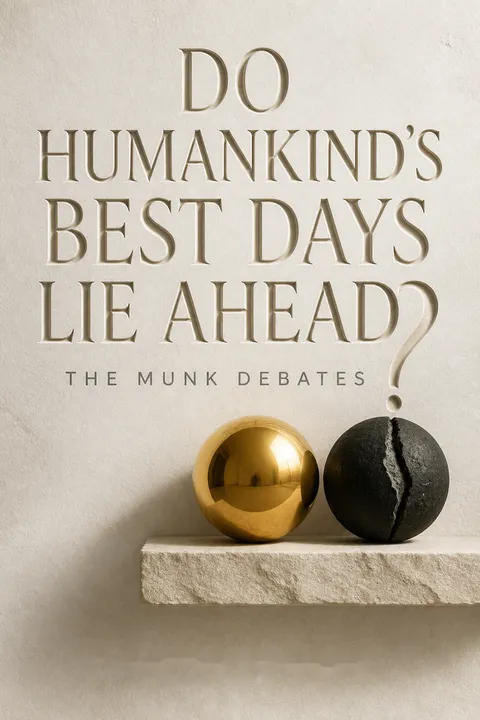
Do Humankind's Best Days Lie Ahead? transcribes a 2015 debate between optimists Steven Pinker and Matt Ridley versus skeptics Alain de Botton and Malcolm Gladwell. Reviews are mixed (3.34/5), with many noting the debate felt mismatched and lacked depth. Readers appreciated Pinker and Ridley's data-driven arguments about measurable progress in health, wealth, and peace, but criticized de Botton's weak philosophical stance and failure to effectively counter scientific claims. Several reviewers noted the teams talked past each other, with scientists citing statistics while philosophers raised existential concerns. Many suggested watching the YouTube video instead, calling the written format disappointing and the debate superficial.
People Also Read


Glossary
pessimistic realism
Realism about human limitsAlain de Botton's term for facing persistent human flaws, vulnerability, and disappointment without concluding that improvement is pointless. It rejects the expectation of a perfect society or a flawless self, and treats modesty, sympathy, humor, and readiness for setbacks as supports for living well.
spontaneous order
Unplanned social coordinationMatt Ridley's term for useful patterns that emerge from many people interacting without a single planner directing the outcome. He applies it to social and technological change, where ideas and practices spread, combine, and create arrangements that no individual designed in full.
Easterlin Paradox
Income and happiness puzzleA disputed interpretation of research on income and happiness. It is commonly associated with the observation that, although richer people or countries may report greater happiness at a given time, rising income within a society does not always produce a matching rise in average reported happiness. De Botton invokes comparison and unmet desire; Pinker contests the pessimistic interpretation.
faulty walnut
De Botton's flawed-mind metaphorAlain de Botton's humorous name for the human mind, which he sees as prone to destructive impulses, irrationality, poor judgment, and resistance to instruction. The metaphor supports his argument that education and prosperity can improve conditions without making people perfectly wise, kind, or content.
reconfiguration of risk
Risks change shapeMalcolm Gladwell's framing of technological change as shifting rather than simply eliminating danger. A tool or connected system may reduce familiar, frequent hazards while enabling less familiar threats that spread farther or cause greater damage. The idea demands comparison between old and new risks, not a simple count of improvements.
ascending sawtooth
Progress with setbacksSteven Pinker's image for a long-term pattern of improvement interrupted by temporary reversals. It rejects the idea that every day or year must be better than the one before. Financial crises, conflicts, or other setbacks can occur while broad measures of human well-being continue to rise over longer periods.
About the Author
Other books by Steven Pinker


Download PDF
Download EPUB
.epub digital book format is ideal for reading ebooks on phones, tablets, and e-readers.








