

Key Takeaways
Treat rationality as a toolkit for goals, not a fixed trait
Reason is practical. Rationality is the use of knowledge to pursue goals, whether discovering what is true or choosing what to do. It is not a permanent badge that some people possess and others lack. The San hunters of southern Africa show why: tracking animals requires interpreting faint footprints, estimating how recently they were made, and inferring which species can be run down in the current season. Their skill is rational because it fits the world they face. This is ecological rationality, reasoning suited to a particular environment and its available information.
Modern problems need extensions. The same mind that reasons well from tracks can stumble over abstract probability, statistics, or exponential growth. Rationality therefore includes both everyday judgment and learned tools that extend it, such as logic, data, and probability.
The hunter example shifts the question from whether humans are rational to whether a particular reasoning tool fits the task. That distinction resembles engineering: a tool can be excellent within its design conditions and unreliable outside them. It also cautions against equating test performance with intelligence. Yet ecological fit is not enough when modern decisions affect strangers or unfold across large populations. Intuition evolved for familiar, immediate problems, while public health and climate policy involve distant consequences and statistical patterns. The case for education is not that ordinary judgment is worthless, but that its operating range is limited.
Pause over the first answer, then test its logic and premises
Intuition can answer the wrong question. In the Cognitive Reflection Test, a phone and case cost $110 together, and the phone costs $100 more than the case. The tempting answer is that the case costs $10. Checking the arithmetic reveals the answer is $5. The error often reflects an unexamined first impression, not an inability to calculate. A pause gives slower, deliberate reasoning time to check it.
Context changes performance. In the abstract Wason selection task, people must check which cards could disprove an if-then rule, and only about one in ten choose correctly. When the same logical structure concerns checking whether postal letters have the required stamp, people do much better. Logic tests validity, meaning whether conclusions follow from premises. Soundness also requires true premises. A valid argument built on a false assumption can still mislead.
The contrast between abstract cards and familiar rules suggests that reasoning depends partly on how a problem is represented, not just on raw mental horsepower. Externalizing a calculation or spelling out premises can make hidden assumptions inspectable, much as a written proof lets another person locate an error. The practical challenge is that real arguments rarely arrive as tidy syllogisms. They mix facts, implications, and unstated assumptions. Checking the premise that carries the most weight is often more useful than memorizing a long catalogue of fallacy names.
Count possibilities before trusting vivid stories about chance
Probability is not physical destiny. In the Monty Hall game, a contestant picks one of three doors, then the host opens a different door to reveal a goat. Switching wins two times out of three, while staying wins one time out of three. The host's choice matters because he knows where the car is and deliberately reveals a goat. The new information changes the contestant's odds, even though it does not move the car.
Stories distort the count. People also rate a detailed scenario as more likely than a simpler event contained within it. This conjunction fallacy appears in forecasts that add a vivid cause to a general possibility. But adding conditions can only make an event less probable. Comparing the possible outcomes, or imagining a large set of cases, helps counter the pull of an imaginable narrative.
Vividness is useful for understanding a possibility but poor as a measure of its frequency. The distinction is important in journalism and personal risk assessment, where memorable cases can crowd out quiet denominators. The Monty Hall puzzle adds another subtlety: evidence is informative partly because of how it was selected. A clue produced by an informed agent differs from an event that occurred independently. Probability estimates therefore need a model of the information source, not merely a count of visible options.
Update beliefs with both diagnostic evidence and prior odds
Evidence needs a baseline. Bayesian reasoning is a method for revising belief in a hypothesis after seeing evidence. It combines the prior, or plausibility before the new evidence, with how likely that evidence would be if the hypothesis were true. The result is the posterior, belief after considering the evidence. A test result alone does not determine the answer.
Rare conditions create many false alarms. Suppose a disease affects 1 percent of a population, a test detects 90 percent of cases, and 9 percent of healthy people also test positive. Out of 1,000 people, about 10 have the disease; 9 of them test positive. About 89 healthy people also test positive. So only 9 of roughly 98 positive results indicate disease, about 9 percent. Presenting counts this way makes the base rate harder to overlook. The relevant reference group still matters, since a population-wide rate may not fit a particular patient.
This framework offers a disciplined middle ground between gullibility and reflexive skepticism. New evidence should matter, but its force depends on how unusual it would be without the proposed explanation. Natural frequencies make the calculation cognitively concrete and help prevent a striking test result from eclipsing the much larger pool of healthy people. The remaining difficulty is selecting the right comparison group. A prior based on a broad population can mislead when age, history, or context changes the underlying rate, so judgment remains necessary even when the arithmetic is clear.
Choose with your future self and competing goals in view
Rational choice is about consistency. Expected utility is the value of each possible outcome multiplied by its probability, then combined across outcomes. It does not define a person's values or require selfishness. If someone values generosity, family, or honesty, those can all count in the decision. The framework asks whether choices fit those values consistently.
Time can bend judgment. People often prefer a smaller immediate reward over a larger delayed one, then reverse their preference as the temptation approaches. This is myopic discounting. Odyssean self-control means arranging constraints in advance so a future impulse cannot undo a considered choice. The book's example is automatic retirement saving: money is set aside before it can be casually spent. Such precommitment can help, but delaying gratification is not always best. The future is uncertain, and present enjoyment has real value too.
The account treats self-control as a design problem rather than a contest of personal toughness. That insight has practical reach: defaults, automatic transfers, and advance commitments reduce the number of moments when an impulsive choice must be resisted. But the method depends on knowing which future preference deserves protection. A commitment can preserve a thoughtful plan, or lock someone into an outdated one. Good precommitment should therefore be difficult to reverse in a moment of temptation, but revisable when circumstances genuinely change.
Set decision thresholds by the costs of misses and false alarms
Evidence is noisy. Signal Detection Theory describes decisions about whether an imperfect observation reflects something real or merely noise. A radiologist, for example, may see a mark that could indicate cancer or a harmless cyst. Saying yes can produce a hit or a false alarm; saying no can produce a correct rejection or a miss. Lowering the threshold catches more real cases but also flags more harmless ones.
The costs determine the cutoff. A decision should reflect both the likelihood of the signal and the consequences of each error. In a courtroom, a high standard for conviction reflects the severe cost of punishing an innocent person. Moving the threshold cannot eliminate error; improving the quality of evidence can reduce both kinds. The same distinction clarifies statistical significance: a result below p < .05 does not mean there is less than a 5 percent chance the hypothesis is false. It limits one type of false alarm under a specific statistical model.
This framework clarifies why debates about screening, criminal justice, and scientific findings are often disagreements about error costs as much as evidence. Naming both false alarms and misses forces decision-makers to acknowledge what a policy sacrifices. The strongest response is often better measurement, since a more sensitive test can reduce errors without simply shifting the burden from one group to another. Still, the costs assigned to errors are ethical judgments, not facts supplied by a formula. A numerical threshold can discipline a value choice, but cannot make the choice neutral.
Map incentives, because rational individuals can create collective disasters
Other people's choices change the calculation. Game theory studies decisions whose outcomes depend on what others do. In the Prisoner's Dilemma, two partners in a crime are questioned separately. Each can betray the other for a personal advantage, but if both betray, both receive a worse outcome than if both had stayed silent. Defection is individually tempting, yet mutual cooperation would leave the pair better off.
Rules can change the game. Repeated dealings make trust and retaliation possible: a person can cooperate first, then respond to a partner's behavior. Enforceable agreements and penalties also change the payoffs. The Tragedy of the Commons extends the logic to shared resources. Each driver benefits from taking a car, but when everyone does, traffic worsens for all. Carbon emissions follow a similar pattern. Collective gains often require institutions that make cooperation credible and free riding costly.
Game theory shows why appeals to personal virtue often fail in problems built around strategic incentives. A person who sacrifices alone may bear a real cost while others enjoy the benefit, so exhortation cannot reliably solve a coordination problem. Rules, monitoring, and credible enforcement can make cooperation individually sensible as well as socially valuable. The framework also warns against assuming every conflict is a Prisoner's Dilemma. Some situations reward coordination, while others involve genuine competition. Identifying the structure matters before prescribing cooperation or punishment.
Use counterfactuals to separate causes from correlated clues
Ask what would differ without the supposed cause. A correlation means two variables vary together; it does not show which caused which. A leader who noticed that people with strong teeth chew bones could mistakenly conclude that bones strengthen teeth. Perhaps strong teeth make chewing possible, or a third factor affects both. Causation asks whether the outcome would change if the suspected cause were absent.
Experiments approximate that comparison. A randomized controlled trial assigns similar participants by chance to receive a treatment or a comparison condition, reducing the risk that preexisting differences explain the result. When random assignment is impossible, researchers use designs such as regression discontinuity or carefully chosen comparisons. Even then, causal claims need caution: effects can have several interacting causes, and extreme outcomes often move closer to average on their own. That regression to the mean can make an ineffective intervention appear successful.
Counterfactual thinking turns a slogan into a research question: compared with what would have happened otherwise? Random assignment is powerful because it makes the comparison group a plausible stand-in for that unseen alternative. Yet a clean estimate in one setting does not automatically generalize to another population or institution. Causal analysis therefore has two jobs: identify whether an intervention made a difference in the studied conditions, and judge whether those conditions resemble the decision now at hand. The second task is often less mechanical than the first.
Ask whether a belief seeks truth or serves group identity
Reasoning can serve belonging. Motivated reasoning is the selective use of arguments and evidence to protect a preferred conclusion. The myside bias describes the tendency to assess claims more favorably when they support one's political or cultural group. A person may scrutinize an inconvenient statistic while accepting a congenial one with little checking, even when numeracy is high.
Beliefs also occupy different zones. In a reality mindset, beliefs concern matters that can be tested against everyday consequences. A mythology mindset treats distant or hard-to-test claims more like stories that express identity, solidarity, or moral purpose. This helps explain why people may repeat a conspiracy theory without acting as if it were literally true. It does not make the claim harmless: when myth-like beliefs guide public health or government decisions, their consequences enter the testable world. Evidence-based discussion benefits from disagreement among people who share an interest in getting the facts right.
The distinction between truth-seeking and identity signaling explains why simply supplying more facts can fail to change a belief. In some social settings, a claim functions as a badge of loyalty, so abandoning it carries a relational cost. That diagnosis can guide better conversations: reduce the threat to belonging while keeping claims open to scrutiny. There is a limit, however. Calling a belief mythological can become a convenient way to dismiss another group's concerns. The label should describe how a claim is used, not substitute for testing whether it is true.
Build institutions that reward correction, evidence, and impartiality
No individual is reliable enough alone. Rationality becomes stronger when people and institutions expose one another's errors. Science uses replication and peer review; courts use opposing arguments; journalism uses editing and fact-checking. These systems work best when disagreement is allowed and claims face shared standards rather than the authority of a single person or faction.
Reason has changed material and moral life. The book links advances in sanitation, vaccination, agriculture, and energy to accumulating knowledge applied through institutions. Global life expectancy rose from a historical level near 30 years to more than 70, while extreme poverty fell from roughly 90 percent of humanity to below 9 percent. Moral arguments also helped expose contradictions in persecution, slavery, and the denial of rights. Progress is not automatic, and reasoning alone does not produce it; evidence must be joined to goals such as human welfare and impartial treatment.
The institutional argument is stronger than a simple appeal to educate individuals: even skilled reasoners have blind spots, so durable error correction matters more than heroic intelligence. A useful institution makes criticism possible, records outcomes, and changes course when evidence shifts. The history of progress supports the value of that approach, though attributing large social changes to rationality alone would oversimplify them. Political struggle, economic capacity, and collective action also shape which ideas gain force. Reason is most effective as a public method, not a substitute for democratic legitimacy.
Analysis
The book's central move is to treat rationality as both a normative standard and a situated human capacity. That avoids two easy stories: people are naturally wise, or people are hopelessly irrational. The San tracking example grounds reasoning in practical adaptation; the later chapters show why this competence does not automatically transfer to abstract probability, institutional risk, or partisan debate. Rationality is less a single faculty than a collection of operations whose performance depends on representation, incentives, goals, and feedback.
The most powerful synthesis is that individual and collective rationality can diverge. A person may sensibly protect status, avoid a costly sacrifice, or trust a vivid story, while the resulting group behavior produces worse outcomes. This connects cognitive psychology to economics and political institutions: errors are not always defects in calculation. Sometimes they are stable responses to local incentives. That explains why advice to think harder is insufficient when the surrounding system rewards certainty, outrage, or free riding.
The framework also has a normative hinge. Rationality helps choose means and test beliefs, but it cannot determine every ultimate goal. Pinker addresses this through impartiality, arguing that reasoned exchange among social beings gives moral claims a basis beyond private taste. That is suggestive rather than a complete derivation of morality. People can reason coherently from different values, and institutions must decide whose costs count. The book's strongest answer is procedural: expose assumptions, compare evidence, make tradeoffs visible, and allow criticism to correct decisions.
Its optimism about progress is most persuasive when read as conditional, not inevitable. Better knowledge can improve welfare when communities preserve discoveries, correct mistakes, and apply them toward humane ends. The same tools can also serve factional power. Rationality therefore matters not because calculation guarantees virtue, but because transparent reasoning lets people identify when their beliefs, incentives, and stated values conflict. The most practical lesson is collective: design environments where accuracy is rewarded and revision is not treated as surrender.
Review Summary
Rationality receives mixed reviews. Many praise Pinker's exploration of logic, probability, and cognitive biases, finding it enlightening and timely. Critics argue the book is dense, repetitive, and occasionally oversimplified. Some appreciate Pinker's analysis of current societal irrationality, while others find his approach too rigid. The book's structure and examples are generally well-received, though some find the content challenging. Pinker's writing style and humor divide readers. Overall, the book is seen as a valuable contribution to understanding rationality, despite its limitations.
People Also Read








Glossary
Ecological rationality
Reasoning fit to contextA form of reasoning suited to the goals, information, and conditions of a particular environment. Practical expertise, such as interpreting animal tracks, can be rational without formal schooling. Its limits appear when people apply intuitions formed in familiar settings to problems requiring unfamiliar tools, such as statistical data or abstract probability.
Cognitive Reflection Test
A test of checking intuitionA short set of problems designed to reveal whether a person accepts an appealing first answer or pauses to check it. Its questions often have simple solutions that conflict with intuitive responses. Performance reflects more than mathematical skill: patience and willingness to think twice also matter.
Wason selection task
A test of conditional logicA reasoning problem that asks which items must be examined to determine whether an if-then rule has been violated. In its abstract form, people often check examples that could confirm the rule and overlook cases that could falsify it. Familiar rules involving duties or precautions can make the same logical structure easier to solve.
Bayesian reasoning
Updating belief with evidenceA method for revising confidence in a hypothesis by combining its prior plausibility with the diagnostic strength of new evidence. The updated belief is the posterior probability. The method explains why a positive test for a rare condition may still indicate that the condition is unlikely, especially when false positives are common.
Availability heuristic
Estimating likelihood by recallA mental shortcut in which people judge how common or likely something is by how easily examples come to mind. Recall often tracks frequency, so the shortcut can work in familiar settings. It misleads when vivid, recent, or emotionally charged events are easier to remember than more common but less dramatic ones.
Expected utility
Probability-weighted outcome valueThe combined value of an option's possible outcomes, with each outcome weighted by its probability. Utility represents how desirable an outcome is to the decision maker, not necessarily its monetary worth. The framework describes choices consistent with a person's preferences; it does not require those preferences to be selfish.
Odyssean self-control
Precommitting against temptationA strategy in which a person makes an advance commitment that restricts a future choice likely to be distorted by immediate temptation. Automatic saving is an example: money is transferred before it can be spent impulsively. The technique manages self-control by changing the choice environment rather than relying entirely on willpower.
Prospect theory
A model of risky choiceA descriptive account of how people evaluate uncertain outcomes. It proposes that choices depend on perceived gains and losses relative to a reference point, that losses tend to weigh more heavily than equivalent gains, and that people distort probabilities. The theory helps explain why equivalent options can attract different choices when framed differently.
Signal Detection Theory
Deciding amid noisy evidenceA framework for deciding whether an imperfect observation reflects a real signal or background noise. It distinguishes hits, misses, false alarms, and correct rejections. Decision makers set a threshold according to the probabilities and costs of these outcomes; better measurement can reduce both misses and false alarms.
Nash equilibrium
Stable strategic choicesA situation in a game where each participant's choice is the best available response to the choices of the others. No participant can improve their outcome by changing strategy alone. Such an equilibrium can be stable even when the result is poor for everyone, as in mutual defection in a Prisoner's Dilemma.
Regression to the mean
Extreme results move toward averageA statistical tendency for an unusually high or low observation to be followed by a less extreme one when repeated measurements are imperfectly correlated. It does not imply that a population is becoming uniform. Ignoring the effect can make ordinary rebounds after exceptional outcomes look like evidence that an intervention worked.
Myside bias
Favoring one's own sideThe tendency to evaluate arguments, evidence, and even logical conclusions more favorably when they support one's political, cultural, or social group. It can affect people who are numerate and otherwise skilled at reasoning. The bias often reflects social incentives, because expressing group loyalty can matter more locally than accuracy.
Reality mindset
Treating claims as testableAn approach to belief in which claims are treated as descriptions of a real world that can be true or false, and are assessed against evidence and consequences. It is especially necessary for decisions about familiar objects, people, and practical matters. The book argues that extending this approach to distant or abstract claims requires learned habits and institutions.
Mythology mindset
Beliefs as shared narrativesAn approach in which claims about remote, inaccessible, or untestable matters function as stories that provide entertainment, identity, solidarity, or moral purpose. Such claims may not guide everyday action as literal facts do. They become dangerous when narrative beliefs cross into practical decisions about health, politics, or public safety.
FAQ
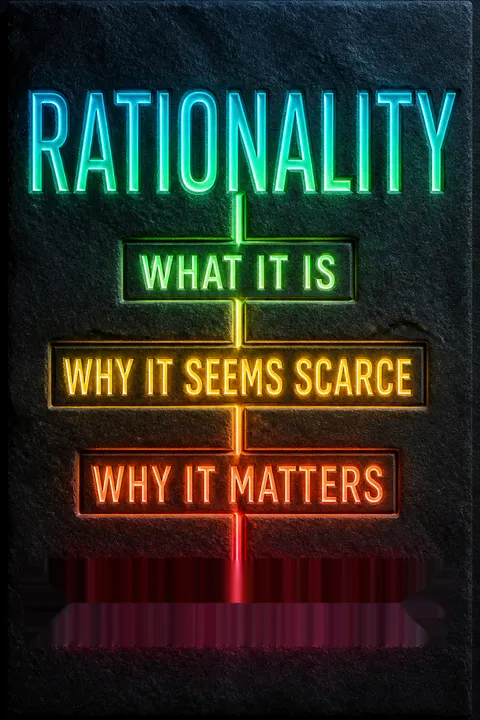
What's Rationality: What It Is, Why It Seems Scarce, Why It Matters about?
- Exploration of Rationality: Steven Pinker examines the nature of rationality and its apparent scarcity in modern society, despite our cognitive capabilities.
- Cognitive Tools: The book argues that rationality is a set of cognitive tools, not an innate power, essential for making better decisions.
- Human Fallibility: Pinker highlights cognitive biases and fallacies that lead people astray, aiming to equip readers with tools to improve reasoning.
Why should I read Rationality by Steven Pinker?
- Timely Relevance: In an era of misinformation, understanding rationality helps discern truth from falsehood.
- Educational Value: The book serves as a guide to critical thinking, covering concepts like Bayesian reasoning and signal detection theory.
- Engaging Style: Pinker’s accessible writing and use of real-world examples make complex ideas understandable and engaging.
What are the key takeaways of Rationality by Steven Pinker?
- Rationality as a Goal: Pinker posits that rationality should guide our thoughts and actions to address contemporary challenges.
- Cognitive Biases: Understanding biases like confirmation bias and the availability heuristic is crucial for improving reasoning.
- Importance of Community: Rationality often emerges from collaborative reasoning, where engaging with others helps refine thinking.
What is Bayesian reasoning as discussed in Rationality?
- Definition of Bayesian Reasoning: It involves updating beliefs based on new evidence, calculating the probability of a hypothesis given the data.
- Components of Bayes' Theorem: Includes prior probability, likelihood, and marginal probability, providing a structured decision-making approach.
- Practical Applications: Used in scenarios like medical diagnosis, it helps make informed decisions in uncertain situations.
How does Rationality by Steven Pinker address cognitive biases?
- Identification of Common Biases: Pinker identifies biases like confirmation bias and availability heuristic that affect reasoning.
- Strategies to Mitigate Biases: Offers practical advice on recognizing and counteracting biases to improve rational thinking.
- Impact on Society: Discusses how biases affect societal issues, emphasizing the need for awareness to foster rational discourse.
What role does game theory play in Rationality by Steven Pinker?
- Understanding Strategic Interactions: Game theory analyzes situations where decisions depend on others' choices, explaining social dynamics.
- Key Concepts: Concepts like the Prisoner’s Dilemma illustrate how rational choices can lead to suboptimal outcomes.
- Real-World Applications: Applied to economics and politics, it helps understand strategic considerations influencing behavior.
How does Rationality explain the relationship between emotion and reason?
- Conflict Between Emotion and Reason: Emotions can interfere with rational decision-making, leading to irrational choices.
- Role of Emotional Intelligence: Emphasizes the need for emotional intelligence alongside rational thinking for better decision-making.
- Balancing Both Aspects: Advocates for balancing emotional responses with rational analysis for sound decisions.
What is signal detection theory, and how is it relevant in Rationality?
- Definition of Signal Detection Theory: A framework for distinguishing true signals from noise in uncertain situations.
- Application in Decision-Making: Helps set criteria for decisions, weighing costs of false alarms against risks of misses.
- Real-World Examples: Used in medical diagnoses and radar detection, it aids in navigating complex choices effectively.
What are some common cognitive biases mentioned in Rationality?
- Confirmation Bias: Leads individuals to seek information confirming existing beliefs, distorting reality.
- Availability Heuristic: Judging event probability based on ease of recall, leading to risk misperceptions.
- Base-Rate Neglect: Ignoring underlying probabilities, focusing on specific information, affecting decision interpretation.
How does Rationality by Steven Pinker define the relationship between logic and reasoning?
- Logic as a Tool: Describes logic as a formal system for deriving conclusions, essential for clear reasoning.
- Fallacies in Logic: Discusses formal and informal fallacies like affirming the consequent, crucial for effective argumentation.
- Critical Thinking: Advocates for applying logical principles in everyday life, emphasizing questioning assumptions.
How does Rationality relate to moral progress?
- Connection Between Rationality and Morality: Rationality allows critical evaluation of ethical principles, aiding moral progress.
- Historical Examples: Rational arguments have driven moral advancements like abolition of slavery and women's rights.
- Future Implications: Continued moral progress depends on applying rationality to contemporary issues for justice and equality.
What are the best quotes from Rationality and what do they mean?
- "Rationality ought to be the lodestar...": Emphasizes rational thinking as a guiding principle in life.
- "Extraordinary claims require extraordinary evidence.": Highlights the need for strong evidence when evaluating significant assertions.
- "Rationality is a public good.": Suggests that rational thinking benefits society, leading to better collective decision-making.
About the Author
Other books by Steven Pinker







Download PDF
Download EPUB
.epub digital book format is ideal for reading ebooks on phones, tablets, and e-readers.








