

Key Takeaways
Stop treating Earth as scenery; civilization has become a geological force
A new planetary role. The Anthropocene is the proposed name for an era in which human activity has become a force shaping Earth’s geology, climate, and living systems. From orbit, the recent spread of city lights, roads, and altered landscapes is unmistakable. Since measurements began in 1958, atmospheric carbon dioxide has risen by nearly 30 percent, alongside changes to oceans, rivers, forests, and species. The question is not only when this era began, but what it means to live inside it.
Impact is not control. Humanity can alter planetary systems without having the shared awareness or institutions needed to steer those changes. A driver may choose a destination, while millions of separate trips reshape a city. At planetary scale, local choices accumulate into consequences no single person intended.
The shift in scale is powerful because it turns environmental change from a collection of distant problems into a question of collective agency. Earth system science already works this way: atmosphere, oceans, living things, and human infrastructure are modeled as interacting parts rather than separate subjects. Yet the word humanity can blur unequal causes and unequal exposure. A planetary account is most useful when paired with an account of who benefits from carbon-intensive systems, who has the power to change them, and who bears the costs.
Study other planets to see Earth's climate as contingent, not guaranteed
Worlds as comparisons. Before spacecraft visited Venus and Mars, both were imagined as near-Earth landscapes. Measurements overturned those hopes. Venus is an overheated world with an atmosphere almost entirely made of carbon dioxide, while Mars lost much of its atmosphere and became cold and dry. Their divergent histories show that a planet's climate can shift into radically different states.
Earth has buffers. The young Sun was much dimmer than it is today, yet ancient Earth had liquid water. A long-running carbon cycle helps explain how: volcanic activity releases carbon dioxide, while rain-driven weathering removes it from the air and stores it in rock. This natural thermostat has helped stabilize Earth's climate, but its slow response cannot keep pace with a sudden industrial surge in emissions.
Comparative planetology gives climate science a kind of natural experiment. Venus makes greenhouse feedbacks vivid, and Mars shows how a planet's size and lost atmosphere can constrain its future. But three neighboring worlds are not a universal rulebook. Their histories differ in ways scientists do not fully understand, including why Venus lacks Earth's plate tectonics. The comparison therefore does two jobs: it clarifies known mechanisms and warns against false confidence about outcomes that depend on a planet's particular history.
Recognize that life helps construct the planet it depends on
A living world. The Gaia hypothesis describes how life and Earth's nonliving systems interact to create a partly self-regulating planetary system. It does not require Earth to be a conscious organism. James Lovelock proposed looking for life by detecting the chemical disturbances it causes, rather than searching only for familiar organisms. Earth's oxygen-rich atmosphere is one such disturbance: without ongoing biological production, oxygen would react away and the air would become very different.
Life changes the stage. Photosynthetic microbes transformed the atmosphere, helping create an ozone shield that made land more hospitable. Their oxygen also poisoned many earlier organisms and contributed to severe climate disruption. Life has altered minerals, soils, and elemental cycles as well. The biosphere is not simply a passenger on Earth; it has helped make Earth's conditions what they are.
This view resembles modern ecological and systems thinking, where organisms shape the environments that then shape their survival. It also complicates the familiar story of evolution as organisms adapting to a passive setting. The caution is that self-regulation does not automatically mean harmony or purpose. The Great Oxygenation Event was devastating for many organisms, even as it opened new evolutionary possibilities. Gaia is most scientifically useful as a way to study feedback among life and planetary processes, not as a claim that Earth always protects life.
Distinguish inadvertent planetary disruption from deliberate planetary stewardship
Four routes to change. Grinspoon groups planetary upheavals by the role of life and mind. First-kind changes are physical shocks, such as asteroid impacts. Second-kind changes arise from biology, as when oxygen-producing microbes transformed the atmosphere. Third-kind changes occur when people use technology for local purposes but unintentionally alter the whole planet. Fourth-kind changes are planetary-scale actions taken with forethought and awareness of their consequences.
The human mismatch. Industrial society has produced global effects without global self-control. The actions that drive emissions, land conversion, and pollution are often chosen locally, while their costs spread across borders and generations. This is the Anthropocene dilemma: technological reach has grown faster than humanity's ability to perceive and govern its cumulative effects. Awareness is necessary for deliberate action, but it does not by itself create effective coordination.
The four-part scheme makes a useful distinction between the intention behind an action and the scale of its consequences. A factory can be built for immediate economic reasons while contributing to planetary warming that nobody explicitly chose. That difference matters for responsibility and policy. Still, the framework should not imply that all inadvertent change is politically neutral. Institutions, laws, and business decisions shape which technologies spread and whose interests they serve. The shift from accidental to deliberate outcomes therefore involves power and governance, not awareness alone.
Treat ozone recovery as evidence that global correction can work
A warning from Venus. Research into chlorine chemistry in Venus's atmosphere helped scientists understand how chlorofluorocarbons, or CFCs, could destroy ozone high above Earth. CFCs had seemed safe because they did not react much in the lower atmosphere. In the stratosphere, ultraviolet light breaks them apart and releases chlorine, which damages the ozone layer that shields life from harmful radiation.
Cooperation made a difference. After the ozone hole was observed, governments adopted international agreements to phase out CFCs, and emissions leveled off. Recovery is slow because the chemicals persist in the atmosphere, but the damage stopped worsening. The case shows that scientific monitoring, public pressure, substitutes, and regulation can change global behavior. It is not a perfect model for climate policy: carbon emissions are more deeply embedded in energy systems, and greenhouse gases also acidify the oceans.
The ozone case is a rare but important demonstration that environmental agreements can work even when the problem crosses national borders. It also illustrates how basic research can reveal risks nobody set out to create. The comparison with climate change should remain careful. CFCs came from a narrower set of products and had available substitutes, while fossil fuels power much of modern life and their costs are distributed unevenly. The lesson is not that every planetary problem has an easy treaty solution, but that technical alternatives and institutions can reinforce one another.
Combine efficient technology with restraint, and protect room for wildness
Choose interventions by risk. Grinspoon argues that humanity cannot simply withdraw its influence from Earth. Even reducing emissions is a conscious planetary intervention. The near-term priority is to stop adding greenhouse gases, shift energy sources, and protect or restore forests. More intrusive proposals, such as injecting reflective particles into the stratosphere, might cool the planet but could disrupt rainfall and would not stop ocean acidification. Large-scale ocean fertilization also risks unpredictable ecological effects.
Reject the false choice. Ecomodernists emphasize technology, efficient agriculture, and concentrated cities as ways to reduce pressure on land. Traditional conservationists emphasize limits and the intrinsic value of wild places. Grinspoon sees a needed synthesis: use technology to reduce harm, while preserving ecosystems and recognizing that a finite planet cannot absorb unlimited waste.
This synthesis is stronger than either technological confidence or a simple call to retreat. Efficiency can reduce the land and energy required to meet human needs, while protected wild areas preserve ecological functions and values that cannot be priced easily. The difficult question is who decides which landscapes change and which remain protected. Efficiency gains can also encourage greater consumption if total use is not constrained. Good planetary policy therefore needs both innovation and limits, along with transparent decisions about costs, benefits, and participation.
Judge technological intelligence by its ability to endure
Longevity changes the search. The Drake equation organizes questions about how many civilizations might exist, including how long they remain detectable. A civilization that broadcasts for only a few centuries could be easy to miss across cosmic distances. Grinspoon's continuity criterion proposes that technological intelligence must persist long enough to manage its own survival; a brief burst of cleverness is not enough to count as lasting planetary intelligence.
Growth is not maturity. The Kardashev scale classifies civilizations by how much energy they use, from planetary to stellar and galactic scales. Grinspoon questions the assumption that advanced societies must keep expanding. A civilization that endlessly increases its population and resource use may undermine its own future. Long-lived intelligence might instead mean learning to stabilize, conserve, and act across generations. These ideas are speculative, but they turn the search for extraterrestrial life into a question about the kind of society humanity might become.
The argument usefully separates technical capability from durable intelligence. A society can build powerful tools while remaining unable to coordinate their use over time. This connects to resilience research, which studies whether institutions can absorb shocks, learn, and adapt without losing essential functions. The continuity criterion is also a proposed standard, not an established definition of intelligence. A civilization could survive for reasons unrelated to wisdom, and a brief-lived one could still produce remarkable knowledge. Its strongest use is as a challenge to equating energy consumption with progress.
Aim for Terra Sapiens: make planetary power answer to planetary knowledge
A wiser Earth. Terra Sapiens means Wise Earth: a future in which human technology is integrated with a deep understanding of planetary systems, rather than deployed without regard for their limits. The idea is aspirational, not a prediction. Earth-monitoring satellites, climate models, and global communications give people new ways to observe planetary change, but information alone does not guarantee a coordinated response.
Learn to speak collectively. The debate over sending messages to extraterrestrial civilizations raises a practical question: who has the authority to speak for Earth? Grinspoon argues that such choices deserve broad discussion because they affect people beyond the scientists or institutions making them. The same challenge applies to climate and planetary engineering. A global perspective must not erase unequal responsibility, but it can help build shared institutions and long-term plans.
Terra Sapiens is compelling as a civic aspiration because it links planetary knowledge to collective responsibility. The noosphere, a sphere of connected human thought and communication, is not automatically a wise mind: networks can spread misinformation and amplify conflict as readily as they share evidence. Nor does a single global voice solve questions of representation. The concept becomes more credible when global coordination is built from accountable institutions, public participation, and attention to unequal exposure, rather than assuming that humanity already acts as one coherent agent.
Analysis
The book's central achievement is to join planetary science with a problem usually treated as political or ethical: what happens when a species becomes capable of changing its world faster than it can govern itself? Comparisons with Venus, Mars, and Earth's own deep history make the human moment legible as a planetary transition, not merely a collection of environmental issues. The account also resists two easy answers. Humans are neither harmless passengers on a stable Earth nor omnipotent engineers capable of fixing every consequence.
Its most useful distinction is between inadvertent global effects and deliberate planetary action. This makes the Anthropocene a question of agency and feedback: can a species detect the consequences of its actions and alter its behavior at the scale where those consequences occur? The ozone agreements show that coordinated correction is possible, while the difficulty of climate action shows that possibility is not proof of sufficiency. The analogy between Earth and a self-regulating organism invites systems thinking, but should not be mistaken for evidence of planetary intention.
A serious tension runs through the hopeful vision. The book speaks of humanity as a collective actor, yet responsibility and vulnerability are distributed unevenly. A global response that ignores those differences could reproduce the very power imbalances that helped create the problem. Conversely, rejecting any shared human agency makes coordinated responses harder to imagine. The more defensible position is layered: retain the planetary view while tracing responsibility through particular institutions, industries, and histories.
The book's optimism is best read as a strategy rather than a forecast. It does not establish that civilization will reach a mature Anthropocene or a Sapiezoic future. It argues that fatalism is not a substitute for evidence, and that foresight can change outcomes. Its lasting challenge is practical: build institutions capable of learning from planetary data, acting across borders, respecting ecological limits, and maintaining commitments beyond a single political cycle. Wisdom here is not a feeling of mastery. It is the capacity to revise collective behavior before the costs become irreversible.
Review Summary
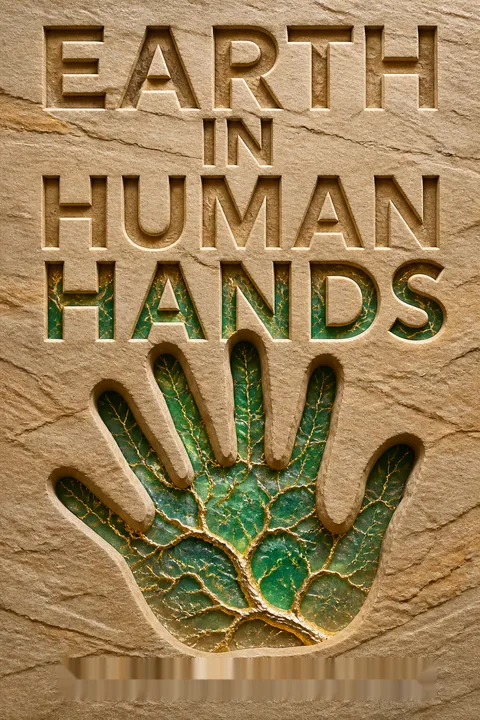
Earth in Human Hands explores humanity's impact on Earth from an astrobiological perspective. Grinspoon presents an optimistic view of our ability to address climate change and become planetary stewards. Readers appreciate the book's broad scope, covering topics like extraterrestrial life and geoengineering. Many find the writing engaging and thought-provoking, though some criticize its length and repetitiveness. The author's personal anecdotes and connections to Carl Sagan add interest for some but detract for others. Overall, reviewers praise the book's unique perspective and hopeful message about humanity's future.
People Also Read








Glossary
Anthropocene
Human-shaped geological eraA proposed geological epoch marked by the substantial influence of human activity on Earth's systems. The term encompasses changes to climate, land, oceans, biodiversity, and material cycles. Its formal status and start date are debated, but its wider use highlights the growing entanglement of human history with biological and geological history.
Gaia hypothesis
Life and planet co-regulateThe view associated with James Lovelock and Lynn Margulis that life interacts with Earth's physical and chemical systems in ways that can help maintain conditions suitable for life. It is not necessarily a claim that Earth is conscious or intentionally pursuing balance. Its enduring value is as a perspective for studying connections between organisms and planetary processes.
Great Acceleration
Rapid postwar human impactsThe sharp increase, beginning around 1950, in many measures of human activity and its effects on Earth's natural systems. Population, transportation, energy use, and industrial production rose rapidly, alongside indicators such as atmospheric pollution, resource extraction, and habitat loss. The pattern is used as evidence that human influence intensified markedly after the Second World War.
Planetary changes of the fourth kind
Deliberate planetary-scale changeGrinspoon's category for changes to a planet resulting from informed, purposeful actions by a technological species that understands its planetary effects. It contrasts with random physical disruption, biological change, and inadvertent technological change. Examples include coordinated efforts to reduce pollution or protect the climate, although deliberate action can still produce unintended consequences.
Terra Sapiens
A wiser managed EarthGrinspoon's name for an aspirational future in which human intelligence and technology operate with a deep understanding of Earth's systems. It describes a world where planetary influence is deliberate, informed, and compatible with long-term biological and human flourishing. The term is a goal for collective development, not a prediction that such a future is assured.
noösphere
Planetary sphere of thoughtA term developed in early twentieth-century thought, especially associated with Vladimir Vernadsky and Pierre Teilhard de Chardin, for the realm of human thought and collective activity influencing Earth. Grinspoon uses it to describe the growing planetary reach of knowledge, communication, science, and technology, while treating its emergence as a process rather than a completed global mind.
Continuity criterion
Intelligence that can persistGrinspoon's proposed standard for technological intelligence: a civilization must be capable of surviving for a meaningful duration, rather than displaying only brief technical brilliance. Longevity matters both as a measure of self-management and because short-lived civilizations are difficult to detect across interstellar distances. It is a suggested framework, not a settled scientific definition.
Drake equation
Framework for estimating civilizationsAn equation proposed by astronomer Frank Drake to organize the factors that affect the number of detectable technological civilizations in the galaxy. These include star formation, planets, life, intelligence, communication, and civilization longevity. Its purpose is not to deliver a certain answer, but to make assumptions explicit and structure discussion as evidence improves.
Kardashev scale
Civilizations ranked by energyA classification system proposed by Nikolai Kardashev that groups technological civilizations by the amount of energy they can use. Type I refers to planetary-scale resources, Type II to a star's energy, and Type III to energy across a galaxy. Grinspoon questions whether greater energy use should be treated as inevitable evidence of greater intelligence or maturity.
Homogenocene
Human-driven biological mixingA proposed name for the period in which human travel, trade, agriculture, and settlement have mixed species that were once geographically separated. Transport networks help organisms move across former barriers, sometimes allowing invasive species to spread and displace local ones. The term emphasizes humanity's role in reshaping the geography and composition of biological communities.
anti-greenhouse effect
Atmospheric haze that coolsA climate effect in which atmospheric particles or haze block incoming visible sunlight while allowing more infrared heat to escape. It has been studied on Saturn's moon Titan and is also relevant to dust clouds, volcanic eruptions, and proposals to reflect sunlight from Earth. Its cooling potential does not resolve other consequences, including ocean acidification.
Download PDF
Download EPUB
.epub digital book format is ideal for reading ebooks on phones, tablets, and e-readers.








