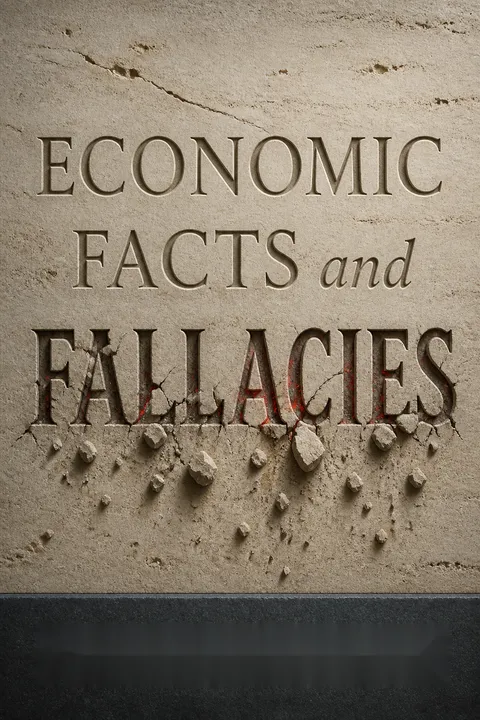


Key Takeaways
Treat attractive economic claims as hypotheses with missing variables
Five traps recur. Sowell groups common reasoning errors into five patterns. The zero-sum fallacy assumes one person’s gain must be another’s loss. The fallacy of composition treats what benefits one part as a benefit to the whole. The post hoc fallacy mistakes what happened afterward for what was caused by what came before. The chess-pieces fallacy assumes planners can rearrange people without changing their behavior. The open-ended fallacy demands more of a good thing without asking what it costs or replaces.
Follow the consequences. These errors can make a proposal sound humane or efficient while leaving out incentives, trade-offs, and people affected indirectly. Sowell’s practical test is to ask what is missing from the story, who bears the cost, and whether the evidence supports the claimed cause.
The framework’s strength is diagnostic: it turns vague skepticism into questions about mechanisms, comparison groups, and omitted costs. That resembles good causal analysis, which asks what would have happened without the policy, not merely what followed it. The limitation is that naming a fallacy does not prove a policy wrong. A claim can be zero-sum in one respect and beneficial in another, or have costs that are justified by benefits. The labels are best used to open an investigation, not to close one.
Voluntary exchange can create gains, while restrictions erase possible deals
Both sides expect value. Sowell argues that voluntary exchanges usually occur because each party expects to be better off than without the deal. If government changes the permitted terms to help one side, some mutually acceptable transactions may disappear. The policy can benefit people who keep their existing arrangement while excluding others who would have accepted a different bargain.
Rent control illustrates the trade-off. Sowell describes how capped rents can help current tenants but discourage building and maintenance. He cites Egypt, where rent controls introduced in 1960 were followed by reduced investment and a lasting housing shortage. The general point is not that every regulation has the same result, but that a protected price can alter supply as well as affordability.
The useful distinction is between making an existing deal cheaper and increasing access to the good itself. A price cap may help tenants who secure apartments while making availability worse for people searching later. Yet voluntary agreement alone does not settle whether a transaction is fair, informed, or free of coercion. The relevant policy question is therefore broader than whether regulation changes incentives: it must also weigh bargaining power, access, and the harms that regulation is meant to prevent.
Build city policy around actual travel and housing supply
Restrictions reshape access. Sowell argues that housing costs often rise when rules sharply limit where, how, or how much builders can build. He contrasts Houston, where building was less restricted, with places such as San Francisco, where land-use controls constrained supply and prices became far higher. Limiting roads or housing can also move costs elsewhere, through longer commutes, overcrowding, or fewer options for newcomers.
Prices can change traffic. Singapore’s congestion charges gave drivers a reason to travel at different times, take alternate routes, or use buses. The book reports that average daytime traffic speeds rose from roughly 15 to 20 kilometers per hour to 26 to 32 after charges were introduced, even as the city grew and car numbers tripled. The lesson is to examine how people respond, not just how a plan looks on paper.
This chapter’s strongest move is to connect urban form to ordinary choices: where people can afford to live, reach work, and shop. It treats congestion as a problem of both limited road capacity and the incentives created by unpriced access. Still, a city is not only a collection of private trips. Pollution, safety, and shared spaces create costs that prices may not capture automatically. A sound plan needs to compare those costs with the real alternatives, rather than assume either cars or centralized planning are inherently superior.
Track people over time, not just income brackets
Categories are not people. A snapshot of income groups can make the poor seem permanently poor and the rich permanently rich, even when many people move between brackets. Treasury data discussed in the book found that people who began in the bottom fifth in 1996 had average incomes 91 percent higher by 2005. More than half of those initially in the top 1 percent had left that bracket by 2005.
Definitions change the picture. Household income can fall behind per-person income when household size shrinks. Statistics may also omit benefits, transfers, or compensation such as health insurance. Sowell argues that a reader should check what is counted, whether the unit is a household or an individual, and whether the same people are being followed over time.
This is a powerful lesson in measurement: a trend among income brackets is not necessarily a trend in the lives of the people who occupied them. The distinction resembles the difference between repeated cross-sections and longitudinal data, which answer different questions. Mobility, however, does not make inequality irrelevant. A person can move upward while still facing hardship, and a changing average can conceal persistent barriers for particular groups. Sound analysis needs both the movement between categories and the conditions people experience within them.
Treat the gender pay gap as a question, not a verdict
Averages combine different work paths. The book argues that men and women have often differed in occupation, hours, employment continuity, and family responsibilities, all of which affect earnings. It recounts that women’s representation in professional education declined from earlier twentieth-century highs before rising again alongside later marriage and childbearing patterns. Sowell presents these shifts as evidence that employer discrimination alone cannot explain changes in women’s careers.
Compare like with like. Gross annual pay differences are not the same as unequal pay for the same work. The book cites studies in which gaps narrowed substantially after accounting for factors such as hours, specialty, and work history. It also notes that career interruptions can carry lasting costs when skills become outdated or promotions depend on continuous experience.
The central analytical point is sound: an average pay gap cannot identify its cause by itself. But describing career patterns as choices does not establish that they are unconstrained. Care responsibilities, workplace schedules, and expected treatment can shape the options people consider realistic. Conversely, a remaining statistical difference after adjustment is not automatically proof of discrimination, because unmeasured factors may remain. The most informative analysis separates pay for comparable work from the upstream conditions that influence which work people enter and how long they can remain.
Test racial explanations against history and comparable cases
Disparity is a starting point. Sowell emphasizes that racial and ethnic groups can differ in age, family structure, education, and work experience, so raw income comparisons do not isolate discrimination. He also argues that the timing of change matters: the book reports that the share of Black families below the poverty line fell from 87 percent in 1940 to 47 percent in 1960, before the major civil-rights laws of the 1960s.
History complicates simple stories. The book distinguishes prejudice, an attitude, from discrimination, an action with potential economic costs. It also argues that discrimination can occur in schooling and institutions before a person enters the labor market. Its historical examples challenge claims that progress or setbacks can be attributed to one law, one decade, or one cause.
This approach rightly warns against treating group averages as causal explanations. Historical sequence and comparisons across groups can expose simplistic accounts, but timing alone cannot tell which forces produced a change. Nor does showing that groups differ on relevant measures establish that unequal treatment is absent: those measures may themselves reflect earlier exclusion or unequal opportunity. A careful account distinguishes individual bias, institutional rules, accumulated disadvantage, and current decisions. That broader causal map is more demanding than either assuming discrimination explains every gap or dismissing it because some variables differ.
Follow university incentives, not its nonprofit label
Good intentions do not remove self-interest. Sowell describes universities where faculty influence governance, research prestige can outrank undergraduate teaching, and trustees may lack the time or expertise to monitor daily decisions. He argues that tenure, public subsidies, and endowments can weaken pressure to control costs. The incentives may reward research output, campus amenities, or administrative expansion even when those priorities do not improve students’ education.
Inputs can hide outcomes. Accreditation and rankings often emphasize resources such as library holdings or student-faculty ratios rather than what students learn. The book contrasts this with job-focused colleges that operate with fewer amenities and lower costs. Its larger point is that nonprofit status does not guarantee efficiency: examine who makes decisions, who pays, and what results are measured.
The chapter offers a useful institutional lens: organizations respond to the rewards and constraints facing their members, not only to their public mission. Its attention to measurement is especially relevant when rankings count visible inputs more easily than learning. Yet market discipline is not a complete answer either. Students often cannot judge educational quality before buying it, and education has goals beyond immediate earnings. Better accountability would need credible measures of learning and access without mistaking a simple metric for the whole purpose of a university.
Development depends on institutions that turn assets into productive capacity
Resources do not automatically become prosperity. Sowell points to countries with abundant oil or minerals that remain poorer than places with fewer natural assets. He argues that geography, history, culture, and access to outside knowledge all influence development, while dependable law and property rights help people invest, borrow, and build businesses.
Transfers cannot substitute for capability. The book questions whether foreign aid reliably produces growth when donor agencies measure success by money disbursed and recipient governments may lack incentives to use it productively. It describes a World Bank-funded shoe factory in Tanzania that operated far below capacity because equipment failed, parts were scarce, and the design did not suit local conditions. By contrast, it credits internal reforms and greater openness with helping places such as China and Singapore grow.
The important distinction is between possessing assets and having systems that let people combine, finance, and maintain them. Property rights and predictable rules can make small ventures scalable by helping entrepreneurs access money beyond family networks. Still, institutions are not detached from history: colonial rule, international power, conflict, and external market conditions can shape what domestic reform is possible. Aid should not be presumed effective, but failed aid alone does not show that external constraints are unimportant. The argument is strongest when it traces the mechanism in each case.
Put a visible price on every open-ended promise
Every good thing competes for resources. Sowell calls it the open-ended fallacy to advocate unlimited health, safety, or open space without considering what the commitment costs or displaces. More protection may be valuable, but no society can devote all its resources to eliminating one risk while also funding every other priority.
Name the trade-off. The book applies this reasoning to land-use policies. It notes that less than 5 percent of US land was developed at the time of writing, yet some communities sought to preserve still more land from construction. Such restrictions can protect scenery for existing residents while making housing scarcer and more expensive for others. The test is not whether the goal sounds desirable, but whether its additional benefits justify its costs and who bears them.
This is a strong antidote to policies that treat a worthy objective as if it had no opportunity cost. Explicit limits force advocates to compare marginal benefits, the added value of the next increment, with the resources and freedoms it consumes. But some costs are difficult to price, including environmental damage or risks imposed on people outside a transaction. A complete accounting therefore needs more than a market price: it needs to identify external effects, uncertainty, and who has little voice in the decision.
Analysis
Economic Facts and Fallacies is best read as a manual for interrogating public claims, not as a neutral catalogue of settled conclusions. Its recurring method is to move from an emotionally persuasive statement to its hidden definitions, incentives, counterfactuals, and affected parties. That method is genuinely valuable. Debates about housing, gender, race, income, universities, and development often mistake a correlation for a cause or a statistical category for a stable population. Sowell repeatedly asks the reader to inspect the denominator and follow the consequences beyond the immediate beneficiary.
The book’s own arguments also need that discipline. Its cases often assemble evidence to challenge a prevailing interpretation, but evidence against one explanation does not by itself establish the preferred alternative. A policy may have costs and still produce net benefits; a market transaction may be voluntary while occurring under unequal bargaining power; a measured difference may reflect both current decisions and inherited constraints. These are not reasons to discard the book’s skepticism. They are reasons to apply it symmetrically.
A useful modern reading separates three questions: what outcome occurred, what mechanism plausibly produced it, and what value judgment should guide a response. The book is strongest on the first two when it exposes distorted comparisons, such as household versus individual income or current categories versus the same people over time. It is more contestable when the available evidence cannot cleanly distinguish policy effects from broader historical forces. Its lesson is not that government action is always harmful or markets always self-correct. It is that neither good intentions nor a compelling statistic can replace causal reasoning, and that every intervention should be judged against a specified alternative, including the people and costs that are easiest to overlook.
Review Summary
Economic Facts and Fallacies challenges common economic misconceptions across various domains. Sowell's arguments are well-researched and thought-provoking, though some readers find his conservative bias evident. The book covers topics like urban planning, gender pay gaps, income inequality, and third-world development. Many reviewers praise Sowell's ability to present complex ideas clearly and challenge conventional wisdom. While some disagree with his conclusions, most appreciate the book's depth and its encouragement of critical thinking about economic issues.
People Also Read






Glossary
zero-sum fallacy
Assuming gains require lossesThe mistaken assumption that economic gains for one person or group must come at another’s expense. Sowell contrasts this with voluntary exchanges, in which each party expects to benefit, and argues that policies restricting acceptable terms can prevent mutually beneficial transactions.
fallacy of composition
Part mistaken for wholeThe error of assuming that what is true or beneficial for one person, group, or locality must also be true or beneficial for society overall. A policy may help a selected group while merely shifting resources or costs from other people or places.
post hoc fallacy
Sequence mistaken for causeThe error of concluding that one event caused another simply because it occurred first. Sowell argues that a causal claim requires evidence about the mechanism and alternative explanations, not just a striking sequence. His examples include attributing a later economic downturn to an earlier stock market crash.
chess-pieces fallacy
People treated as controllable piecesThe assumption that planners can rearrange people to achieve a social goal as if people had no independent preferences, plans, or ability to respond. Sowell argues that people change their behavior when rules change, and that repeated social experiments can create uncertainty and unintended consequences.
open-ended fallacy
Good pursued without limitThe practice of demanding unlimited increases in desirable things, such as safety, health, or open space, without specifying a stopping point or accounting for alternative uses of resources. The fallacy ignores that additional benefits have costs and that resources cannot be devoted to every goal without limit.
fallacy of changing composition
Changing groups mistaken for same peopleThe error of comparing statistical categories across time as though the people or countries inside them stayed the same. If individuals move between income brackets, or nations move between prosperity rankings, changes in the categories do not necessarily describe what happened to the original members.
sorting device
Shortcut for judging uncertain casesA visible or readily available characteristic used to make decisions when learning the full details of each individual is costly. Sowell applies the term to choices by employers, lenders, and others. A sorting device may be inaccurate or unfair to individuals, even when the decision-maker does not hold personal hostility toward the group.
joint products
Outputs sharing the same resourcesGoods or services produced together using many of the same inputs, making it difficult to assign each output a separate share of the total cost. Sowell uses universities as an example: faculty, laboratories, and libraries can support both teaching and research, so claims about the exact cost of educating each student depend on how those shared expenses are allocated.
FAQ
What's Economic Facts and Fallacies about?
- Exploration of Economic Beliefs: Thomas Sowell examines widely held economic beliefs, subjecting them to scrutiny against hard facts. He reveals that many beliefs are based on fallacies that can harm economic policies and people's well-being.
- Debunking Fallacies: The book identifies prevalent economic fallacies, such as the zero-sum fallacy and the fallacy of composition, explaining how these misconceptions lead to misguided policies.
- Real-World Implications: Sowell emphasizes the importance of understanding these fallacies for developing sound economic policies that improve living standards and economic opportunities.
Why should I read Economic Facts and Fallacies?
- Critical Thinking Development: The book encourages readers to think critically about economic policies and assumptions, challenging them to question commonly accepted beliefs.
- Practical Insights: Sowell provides insights into how economic fallacies lead to real-world consequences, making it relevant for policymakers, students, and anyone interested in economics.
- Broad Applicability: The concepts are applicable to economics and various social and political issues, making it valuable for a wide audience.
What are the key takeaways of Economic Facts and Fallacies?
- Fallacies Have Consequences: Economic fallacies can lead to harmful policies affecting millions. Understanding these fallacies is essential for informed decision-making.
- Importance of Evidence: Sowell stresses relying on hard evidence rather than emotional appeals or popular opinion when forming economic policies for better societal outcomes.
- Interconnectedness of Economics and Society: Economic principles are intertwined with social issues, emphasizing the need for a comprehensive understanding of these relationships.
What are the best quotes from Economic Facts and Fallacies and what do they mean?
- "Facts are stubborn things...": This quote underscores the importance of objective truth in economic discussions, reminding us that beliefs cannot change the reality of facts and evidence.
- "Never underestimate the difficulty of changing false beliefs by facts.": It highlights the challenge of altering entrenched misconceptions, even when presented with clear evidence.
- "There is no free lunch.": This phrase encapsulates the idea that every choice has a cost, cautioning against policies that promise benefits without acknowledging their costs.
What is the zero-sum fallacy discussed in Economic Facts and Fallacies?
- Definition: The zero-sum fallacy is the belief that economic transactions are a zero-sum game, where one party's gain is another's loss.
- Real-World Examples: Sowell illustrates this fallacy with examples like rent control, where policies intended to help tenants can lead to housing shortages and worse conditions for everyone.
- Policy Implications: Understanding the zero-sum fallacy is crucial for creating effective economic strategies that promote growth and prosperity for all parties involved.
What is the fallacy of composition in Economic Facts and Fallacies?
- Understanding the Fallacy: The fallacy of composition is the erroneous belief that what is true for a part is also true for the whole.
- Illustrative Examples: Sowell provides examples where local policies aimed at attracting businesses may result in negative outcomes for the overall economy.
- Policy Recommendations: Recognizing this fallacy can help policymakers avoid decisions that benefit specific groups at the expense of the larger community.
How does Economic Facts and Fallacies address male-female economic differences?
- Historical Context: Sowell discusses how historical factors, such as differences in education and job experience, contribute to income disparities between men and women.
- Impact of Parenthood: The book highlights that motherhood often leads to career interruptions for women, affecting their earning potential.
- Comparative Analysis: Sowell presents data showing that never-married men and women with similar qualifications often earn equally, suggesting disparities are influenced by life choices.
How does Economic Facts and Fallacies explain the rising costs of college education?
- Tuition vs. Costs: Sowell distinguishes between tuition prices and actual costs, noting that many institutions inflate costs through unnecessary expenditures.
- Government Subsidies: The book discusses how government financial aid can encourage colleges to raise tuition, creating a cycle of increasing expenses.
- Inefficiencies in Non-Profit Institutions: Sowell argues that the non-profit nature of colleges allows for inefficiencies, leading to excessive spending on amenities.
How does Economic Facts and Fallacies address income inequality?
- Challenging Narratives: Sowell argues that the narrative of growing income inequality is often based on misleading statistics.
- Income Mobility: The book emphasizes that many individuals move between income brackets over their lifetimes, illustrating that poverty is not necessarily permanent.
- Misinterpretation of Data: Sowell highlights that income statistics often fail to account for factors like household size and demographic changes.
What are the fallacies related to race discussed in Economic Facts and Fallacies?
- Racial Disparities Misunderstood: Sowell argues that racial disparities in income and education are often misinterpreted as evidence of systemic discrimination.
- Cultural Factors: The book discusses how cultural values and behaviors impact economic outcomes for different racial groups.
- Historical Context: Sowell provides historical context, arguing that many problems attributed to racism have deeper roots in cultural and social dynamics.
How does Economic Facts and Fallacies explain the role of education in economic outcomes?
- Education vs. Outcomes: Sowell argues that simply having a degree does not guarantee economic success, emphasizing the importance of education quality.
- Quality of Education: The book stresses the importance of the quality of education received, rather than just the quantity.
- Misleading Statistics: Sowell critiques the use of statistics that compare educational attainment without considering the context of the individuals involved.
What are the economic implications of government policies discussed in Economic Facts and Fallacies?
- Government Intervention Critique: Sowell critiques government interventions that aim to address economic disparities, arguing they often lead to unintended consequences.
- Subsidies and Inefficiencies: The book discusses how government subsidies can create inefficiencies in sectors like education and housing.
- Long-Term Consequences: Sowell warns that short-term government solutions can have long-term negative effects on economic growth and individual initiative.
About the Author
Other books by Thomas Sowellm


Download PDF
Download EPUB
.epub digital book format is ideal for reading ebooks on phones, tablets, and e-readers.








