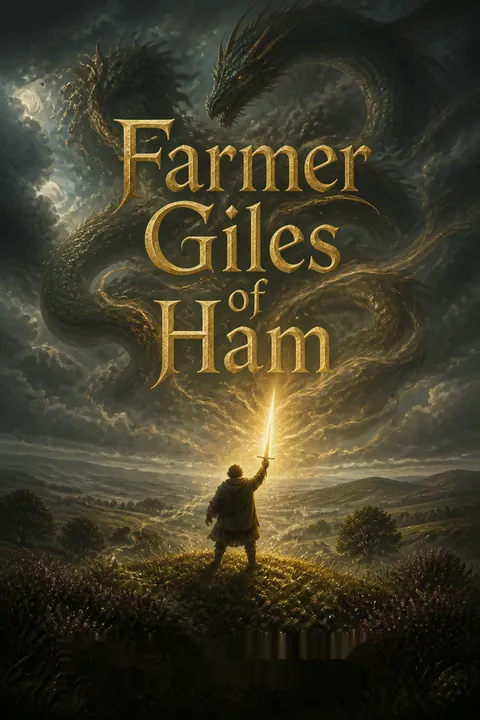


Plot Summary
A Farmer Fires Blind
Ham's quiet years revolve around harvests, markets, and Giles's wish to be left alone. One summer night, a wandering giant loses his way and tramples fields, breaks hedges, and crushes Galathea, Giles's favorite cow.
Garm, the dog, sees the destruction and races home, where his alarm finally rouses his master. Giles stuffs his seldom-used blunderbuss with nails, crockery, stones, and other scrap, then fires blindly as the giant's face looms over the hill. A nail and pottery strike the giant.
Mistaking the pain for fierce insects, he retreats toward the mountains. The blast knocks Giles down, but the villagers see the giant turn away and crown the farmer their hero. Their cheers turn an accident into a reputation that soon travels beyond Ham.
Giles's first public triumph depends on a collision between private motive and public interpretation. He acts to protect property, not to defend a community, and succeeds through a weapon he barely trusts rather than through deliberate skill. Garm's alarm and the villagers' cheering then enlarge the event into a story of courage. That transformation matters: reputation arrives before Giles has chosen any heroic identity, making later expectations a pressure imposed from outside. The comic mismatch between the giant's scale and the farmer's improvised ammunition also establishes the tale's governing logic: power can be misread, and luck becomes consequential when other people decide what it means.
A Sword From the King
Months later, the King rewards Giles with a formal letter and an old family sword, pleased by the story of the giant's retreat. Giles enjoys his new standing, while Garm is quietly spared punishment for his nightly wanderings.
The giant, meanwhile, tells his mountain relations about rich eastern pasture and the scarcity of armed men. As winter leaves the dragons hungry, Chrysophylax Dives, a wealthy but cautious dragon, takes the boast as an invitation and raids the Middle Kingdom. Garm encounters him and returns terrified; Giles dismisses the warning because the dragon is still far away.
Reports of burned farms and dead villagers, including Oakley's parson, soon make the danger impossible to ignore. The King's knights postpone action through Christmas festivities and a tournament, while Chrysophylax advances toward Ham.
The sword is presented as a token of royal courtesy, not as an answer to a coming crisis, while the King's delay exposes the gap between ceremonial authority and practical protection. Chrysophylax's invasion grows from hearsay: the giant's careless account turns a distant country into an imagined storehouse of undefended food. Giles, too, misjudges distance as safety, repeating the court's habit of postponement on a smaller scale. His comfort depends on treating danger as someone else's problem. The dragon's approach converts the old fame into a burden, because the villagers now have reason to expect the farmer to act as the hero they have already invented.
Tailbiter Leaves Its Sheath
When Chrysophylax reaches neighboring Oakley, Ham's people gather at Giles's house and press him to stop the dragon. He gives them excuses about farm work, his lame mare, and the lack of armor, then hides the King's sword rather than face what the request might cost.
The parson of Ham stays behind and examines it. He recognizes Caudimordax, known in village stories as Tailbiter, a legendary blade that will not remain sheathed near a dragon. The discovery changes the villagers' hope into insistence.
Ham's blacksmith and miller help stitch scavenged steel rings onto Giles's leather clothes, making rough mail, while a cobbler covers an old helmet. Giles finally rides out with Tailbiter, Garm, and his grey mare, concealing the armor beneath his cloak and hat.
The villagers' pressure turns an accidental reputation into a form of social obligation. Giles resists not because he lacks concern, but because he understands the ordinary costs of leaving a farm and fears the extraordinary cost of meeting a dragon. Tailbiter gives the crowd a material reason to hope, yet it also lets them mistake a tool's legendary capacity for its owner's readiness. The makeshift armor reflects the same practical world that produced the blunderbuss: no polished heroic apparatus appears, only salvaged materials and reluctant labor. Giles's disguise is revealing. He accepts the task, but still tries to approach it on terms that preserve caution rather than spectacle.
The First Dragon Bargain
Giles searches the scorched country with Garm and the mare, then finds Chrysophylax lying across a road. Garm bolts, the mare throws Giles into a ditch, and the sword falls from his hand. When he retrieves it, Tailbiter flashes toward the dragon and makes Chrysophylax stop his attack. Giles identifies himself as a farmer rather than the knight the dragon assumes, then orders him to leave.
Tailbiter strikes the joint of Chrysophylax's wing, grounding him. Giles and the mare chase him through lanes and fields until he collapses in Ham. Faced with the villagers, the dragon offers payment for the damage and the dead. After hard bargaining, he swears to return with his treasure by a named feast day, and the people let him go.
This encounter reverses the expected relationship between heroic weapon and heroic wielder. Tailbiter supplies the decisive threat, but Giles's plain identity and bargaining instincts shape what follows. Rather than kill the dragon, he makes Chrysophylax answer for material damage, turning a monster's defeat into a negotiation over compensation. The villagers' inexperience makes the agreement fragile: they treat solemn oaths as reliable evidence of intention, while the dragon treats them as a temporary escape route. Giles's success is real but incomplete. He has learned that his luck can give him leverage, not that the danger has ended, and his community's relief rests on a promise made by an untrustworthy debtor.
The King Claims the Hoard
Four days after Chrysophylax leaves, the King arrives in Ham and declares that the dragon's wealth belongs to the Crown. He waits in Giles's pasture for the promised return, feeding his retinue on the village's supplies.
When the appointed day passes without the dragon, the King departs angry and shortens the villagers' promised payment. A royal order then commands Giles to join the knights on a renewed hunt, treating his earlier success as proof that he can help them punish the dragon. Giles cannot refuse the summons.
The Ham parson advises him to take a long rope, though Giles does not understand why. At court, the knights are already mounted and leave almost immediately, giving the exhausted farmer barely time to eat before he follows them into the western hills.
The King's arrival reframes the villagers' agreement as a contest over ownership. He claims the treasure through rank, although the dragon's debt arose from harm to ordinary people, and his promises to Ham are secured only by paper claims on a strained treasury. Giles is caught between two forms of authority: the King's command and his own obligation to the people who trusted him. The expedition further exposes the court's dependence on appearances. The knights accept Giles as useful but do not treat him as an equal, while the parson's practical warning anticipates that the farmer's judgment will matter more than the group's formal order. Giles leaves not as a willing courtier, but as a man compelled into a dangerous task.
Knights Flee the Mountain
The knights ride noisily into the Wild Hills, alerting every dragon in the mountains. Near Chrysophylax's cave, the King's force is scattered by the dragon's sudden attack; several knights die, and the rest flee on their horses. Giles remains beside his grey mare.
Chrysophylax recognizes Tailbiter and checks his assault, giving Giles room to demand the overdue payment. He leads the dragon to his cave and insists that he bring out the hoard. Chrysophylax returns repeatedly with gold, silver, and jewels, hoping to keep the rest, but Giles presses for more.
At last the dragon offers to transport the treasure and help protect it in exchange for retaining part of his wealth. Giles accepts, ropes down the dragon's wings, and makes him carry the loaded chests.
The expedition strips away the court's theatrical version of courage. The knights arrive with rank, equipment, and songs, yet their noise warns the enemy and their horses carry them out of danger. Giles survives by staying near the patient mare and using the weapon the dragon already fears. Crucially, he does not pursue absolute victory. He bargains until Chrysophylax yields enough treasure, then accepts a workable settlement that leaves the dragon alive and gives Giles a means to move the hoard. This is neither pure mercy nor simple greed. It is practical risk management by a farmer who has learned that controlling the terms can matter more than destroying an opponent.
The Bridge Changes Kings
On the journey home, Giles hires the scattered servants and ponies, then recruits more young men as the procession draws crowds and cheers. The capital has meanwhile ordered mourning for the knights believed lost, so Giles's return with Chrysophylax alive astonishes the realm.
He turns toward Ham instead of reporting to the King. After failed summonses, the furious King rides there with soldiers to seize Giles and reclaim Tailbiter. Giles waits on the bridge with the sword, while Garm lies nearby and Chrysophylax hides beneath the riverbank.
When the King's men advance, the dragon releases a cloud of steam and threatens them from the fog. His claw strikes the King's horse, scattering the soldiers. Left alone, the King cannot force Giles to surrender the sword or treasure, and rides away.
The bridge makes a political conflict visible as a physical boundary. The King approaches with the apparatus of command, but his force depends on subordinates who have already seen what the dragon can do. Chrysophylax's steam turns the King's own certainty into confusion, while Giles's refusal to fight keeps the encounter from becoming a conventional duel. He does not defeat the monarchy by claiming superior virtue; he simply makes coercion too costly and refuses to comply. The moment exposes the difference between legal possession and effective power. The treasure, the sword, the dragon, and the crowd's loyalty give Giles leverage that the King's titles cannot immediately cancel.
Ham Becomes a Kingdom
The King's authority fades around Ham, where people increasingly recognize Giles as their ruler. With Chrysophylax's wealth, Giles builds a great hall, gathers armed men, and establishes the Wormwardens, an order whose emblem is a dragon.
He rewards the Ham parson, the blacksmith, and even the miller, though the old rivals receive different measures of favor. As his power grows, Giles makes milling a royal monopoly and forbids unpleasant predictions, turning earlier village irritations into laws of state. His wife Agatha manages the household accounts.
Ham becomes the center of the Little Kingdom, and later place-names preserve the history of Giles and the dragon. His rise converts a local emergency into a durable political order, but the new realm carries the farmer's habits, loyalties, and grudges into its institutions.
The resolution refuses to treat successful rule as a simple moral reward. Giles's wealth protects his neighbors and funds institutions, but sovereignty also gives him power to formalize personal preferences as law. The blacksmith's gloomy predictions and the miller's trade become targets of policy, so the old village's comic antagonisms survive inside the new state. The Wormwardens turn an emergency alliance into civic identity, binding military authority to the dragon whose threat first made Giles famous. His kingdom is neither an abstract ideal nor a clean break from Ham. It is a magnified household, generous to familiar people and still capable of punishing them. The story's political humor rests on that continuity.
Epilogue
After Giles has ruled securely for some years, he allows Chrysophylax to return to the mountains under a pact of mutual non-aggression. The dragon's wings have grown clumsy during captivity, but he reaches his cave and drives out a young dragon that has moved in.
Once his pride has recovered, Chrysophylax seeks the giant whose boast first sent dragons toward the lowlands. The giant has never understood the old encounter: he still thinks the nail and pottery came from biting insects.
The Envoy closes the chain of cause and consequence by returning to the giant who began it, but it does not restore the original situation. Chrysophylax leaves Ham alive and wealthy, carrying a grudging respect for the farmer who once had him at sword point. The giant, by contrast, remains trapped in his original misreading, unable to distinguish a weapon from an insect. That contrast sharpens the tale's interest in interpretation: people act on what they think happened, and those explanations can reshape kingdoms. The dragon's release also softens the triumph without undoing it. Giles's power rests on negotiated restraint as much as on victory.
Analysis
Farmer Giles of Ham turns the machinery of heroic fantasy into a study of how reputation, property, and authority are made. Giles does not begin with a vocation to protect the realm. He wants his land left alone, and his first victory is an accident. Yet villagers convert that accident into a public identity, and the identity then creates obligations: Ham expects him to confront the dragon, the King expects him to serve royal policy, and the dragon learns to treat him as a dangerous negotiator. Each group projects a different meaning onto Giles, while he gradually discovers that other people's beliefs can be used as leverage.
The story's humor depends on mismatched scales. A giant mistakes a nail for an insect, a court postpones a dragon hunt for festivities, and a farmer with salvaged armor becomes more effective than a trained company of knights. These reversals are comic, but they also test what counts as competence. The knights possess status and equipment yet fail when the dragon arrives; Giles survives by observation, persistence, and a willingness to bargain rather than by mastering a prescribed heroic code.
The treasure dispute gives the tale a political argument. The King treats wealth as his by right, while Ham sees it as payment for damage suffered locally. Giles ultimately refuses both submission and a clean return to ordinary life. His new realm protects the community, but it also preserves his personal grudges in law. The resulting kingdom is deliberately imperfect: public good and private advantage coexist. By tracing place-names and institutions to this comic history, the tale suggests that political origins are often less noble than later memory makes them, yet the stories people tell can still build durable forms of belonging.
Review Summary
Farmer Giles of Ham is a delightful, humorous tale by Tolkien that appeals to both children and adults. It follows the adventures of an unlikely hero who faces giants and dragons. Readers praise Tolkien's wit, clever wordplay, and satirical take on medieval legends. While some find it less epic than his more famous works, many appreciate its charm and accessibility. The story's themes of bravery, greed, and unexpected heroism resonate with readers. Overall, it's considered a fun, light-hearted read that showcases Tolkien's storytelling prowess.
Characters
Farmer Giles of Ham
Reluctant village heroGiles is a comfortable, practical farmer who prefers his fields and familiar routines to the unsettled world beyond Ham. He values property, dislikes being hurried, and tends to treat grand titles and heroic expectations with suspicion. Yet he is not simply timid: when danger reaches what he considers his responsibility, he can improvise, hold his ground, and bargain with unusual persistence. His red beard and blunt manner make him an unlikely fit for the polished image of a courtly champion. Giles's psychology is rooted in a tension between self-preservation and pride. He wants to be left alone, but he also resents being pushed around, whether by a dragon, a village crowd, or a king.
Chrysophylax Dives
Cautious imperial dragonChrysophylax is a rich, ancient dragon whose appetite often outruns his courage. He is armored, clever, and skilled at finding loopholes, preferring easy prey and favorable terms to a fair fight. His imperial lineage gives him a strong sense of status, but it does not make him fearless. He reads other creatures for weakness and uses flattery, delay, and negotiation when force looks dangerous. That mixture of vanity and calculation makes him more than a simple beast to be slain: he can bargain, deceive, and recognize a worthy opponent, even when he dislikes the recognition. His relationship with Giles turns on their shared pragmatism, though each measures advantage by a very different standard.
Garm
Alarm-barking farm dogGarm is Giles's talkative dog, proud of his master yet easily frightened by danger. He wanders farther than he is permitted, chases scents, and becomes an unwilling messenger when he encounters threats the villagers have not seen. Garm's fear does not erase his loyalty: he repeatedly runs home to alert Giles, even when he expects punishment. His boasting also helps turn private events into public legend, since he presents his master's actions in the most favorable light. Garm offers a comic contrast to Giles's gruffness, but his warnings have real consequences.
Agatha
Practical farm wifeAgatha is Giles's wife, a no-nonsense presence in a household governed by his habits and her practical judgment. She doubts the dog's warnings and has little patience for unnecessary alarm, but she can also recognize when Giles is making an excuse rather than a decision. Her grounded responses keep the farmer's self-importance in check. Agatha is not drawn toward public glory; her concerns are domestic, concrete, and attentive to the work that still needs doing. That perspective gives the story a counterweight to the villagers' excitement and the King's ceremony.
The Parson of Ham
Learned village adviserThe parson of Ham is a book-learned priest whose curiosity allows him to recognize meanings that practical villagers overlook. He studies old writing, listens closely to local concerns, and tries to guide Giles without pretending that courage alone solves every problem. Unlike the King's officials, he remains connected to the community's immediate needs. His advice is often more perceptive than the farmer's impatience suggests, though he cannot make Giles follow it without resistance. The parson combines scholarship with local responsibility, giving him a role as interpreter between old knowledge and present danger.
The King
Ceremonial rulerThe King of the Middle Kingdom is conscious of rank, royal property, and the appearance of authority. He can reward a subject when a story pleases him, but he also expects obedience and regards valuable resources as belonging to the Crown. His court's elaborate customs and delays make him seem distant from the people exposed to danger. Beneath the ceremony, he is attentive to money and reputation, and quick to anger when either escapes his control. He represents a political order that assumes titles should settle questions of ownership and command.
The Grey Mare
Steadfast travel companionGiles's grey mare is patient, perceptive, and less impressed by danger than the people around her. She carries him through the countryside and into the hills, and her steadiness matters when others panic. Her reactions are practical rather than heroic: she hesitates when the road is unsafe, but she also recognizes that fleeing a flying dragon may be more dangerous than holding position. The mare's quiet judgment repeatedly contrasts with Giles's bluster and Garm's fear. She remains an animal companion, not a magical helper, and the story's humor often comes from the gap between what she understands and what Giles assumes.
The Miller
Ambitious village rivalThe miller is Giles's persistent rival, quick with a pointed remark and eager to test the limits of the farmer's reputation. He helps push the village toward action, though some of his interest comes from wanting to see Giles in an awkward position. Their rivalry gives Ham's communal pressure a personal edge.
The Blacksmith
Gloomy village craftsmanThe blacksmith is known for predicting trouble and taking satisfaction when events prove him right. He is reluctant to make armor until the villagers press him, but his craft helps prepare Giles for the road. His caution and pessimism make him a comic counterpoint to the village's growing confidence.
The Giant
Lost mountain wandererThe unnamed giant is enormous, near-sighted, deaf, and careless about the damage his movements cause. He is not deliberately malicious so much as oblivious to the scale of his own actions. His limited understanding turns an encounter with a farmer's improvised weapon into a story he later tells incorrectly, with consequences far beyond his own journey.
Plot Devices
The Blunderbuss
Accidental first victoryGiles's short, wide-mouthed gun is an intimidating object that he rarely uses and scarcely knows how to handle. He packs it with whatever scrap is available, including stones, broken pottery, wire, and nails. When the giant threatens his farm, Giles fires in panic rather than through careful aim. The odd ammunition injures the giant just enough to make him retreat, and the villagers interpret the retreat as proof of deliberate bravery. The weapon therefore does more than stop an immediate danger: it creates the public reputation that later makes the village expect Giles to confront a dragon.
Tailbiter
Dragon-warning swordThe King gives Giles an old sword whose history and powers are not recognized at first. The Ham parson identifies it as Caudimordax, known in village tradition as Tailbiter, a blade associated with a celebrated dragon-slayer. It cannot remain sheathed when a dragon is near, and in Giles's hand it frightens Chrysophylax and can strike through the dragon's defenses. Tailbiter supplies force that Giles does not possess physically, but the farmer's choices still determine how that force is used. Its presence repeatedly changes what the dragon and the King believe they can demand from him.
Giles's Reputation
Fame becomes obligationThe villagers first make Giles a hero after seeing the giant retreat, although his success depended largely on chance. That story spreads to the King and establishes him as a man who can deal with threats. When Chrysophylax approaches Ham, the community treats its own legend as a promise Giles must fulfill. His fame becomes useful leverage, but it also narrows his freedom: neighbors, courtiers, and eventually rulers make claims on his time and actions. The device links a comic misunderstanding to the story's political movement, since public belief in Giles's competence becomes a source of authority stronger than royal praise.
The Dragon's Oath
Promise creates a trapAfter Chrysophylax is driven into Ham, the villagers bargain for compensation and release him in exchange for a sworn return with his wealth. The promise gives the people temporary hope and lets the dragon escape immediate danger, but it is based on their assumption that solemn words bind him. When he fails to return, the missed deadline becomes the reason Giles is sent on a royal expedition. Later, Giles uses the unpaid debt as grounds to demand the treasure himself. The oath thus carries the plot from village negotiation into the mountains, while exposing the difference between a binding agreement and a trustworthy promise.
About the Author
Other books by J.R.R. Tolkien




Download PDF
Download EPUB
.epub digital book format is ideal for reading ebooks on phones, tablets, and e-readers.








