

Plot Summary
Prologue
Before Tuor’s journey, Morgoth has already darkened Middle-earth and stolen the Silmarils, jewels made from the light of the Two Trees. The Noldor leave Valinor to pursue him, and their violence at the Haven of the Swans brings a curse of division and misfortune.
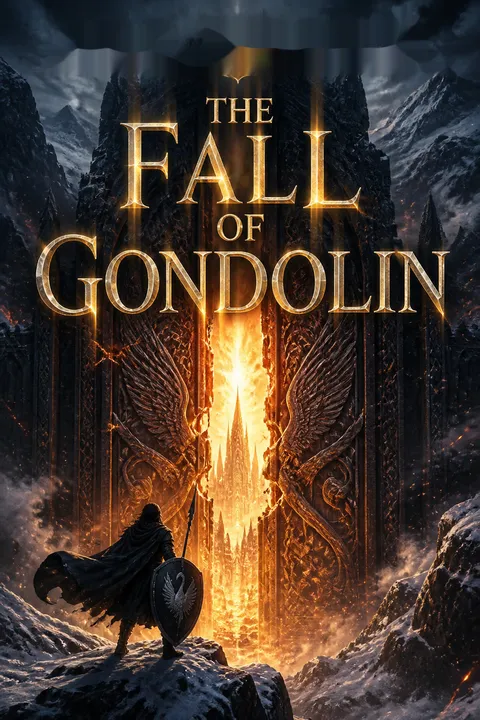
In Middle-earth, Turgon builds Gondolin, a beautiful city concealed behind encircling mountains. This volume presents the tale in several stages: an early version tells the city’s fall in full, while a later retelling expands Tuor’s journey but breaks off as he reaches Gondolin.
The story begins inside a history already damaged by pride, grievance, and punishment. The Noldor’s pursuit of Morgoth is understandable, but their attack on the Teleri makes their cause morally compromised before Tuor appears. Gondolin grows from that compromised inheritance: its people preserve beauty and skill, yet their refuge depends on withdrawal from the suffering beyond its walls. The book’s successive versions sharpen this tension in different ways. Its final, unfinished account gives the journey to the city a weight that the earlier tale assigns to the city’s destruction, making arrival itself feel like a threshold the narrative cannot cross.
Tuor Leaves the Grey Land
Tuor is the son of Huor, who fell in the Battle of Unnumbered Tears, and Rían, who went searching for her husband and never returned. Grey-elves raise Tuor in Hithlum, where Morgoth’s human allies oppress the remaining Elves and the House of Hador. At sixteen, Tuor joins the Elves’ attempt to flee south, but enemy forces scatter them and take him prisoner.
After three years enslaved to Lorgan, an Easterling chief, Tuor kills his guards during a forest work detail and escapes into the hills. He lives as an outlaw, still searching for the secret Gate of the Noldor that his foster-father, Annael, had told him could lead toward Turgon.
Tuor’s first freedom is not a return to safety. Each refuge exposes another form of captivity: Hithlum is ruled by occupiers, the Elves’ flight is broken, and the hills offer only solitary survival. His search for Turgon gives his hardship direction, but it also distinguishes him from a conventional avenger. Although he has reason to attack the Easterlings, he spends his outlaw years trying to find a hidden passage and a larger purpose. His identity is inherited through loss, yet his next choice is not dictated by revenge.
Through the Gate of Noldor
At last, Tuor follows a stream from the hills to a stone arch where its waters disappear. Two Noldorin Elves, Gelmir and Arminas, emerge from the passage and recognize him as a descendant of Hador. They explain that the arch is the Gate of the Noldor, then guide him down the underground riverway before turning back on their own urgent errand.
Tuor climbs from the gorge to the coast, where the sight of the Great Sea awakens a longing he has never known. He travels through Nevrast and reaches the abandoned house of Vinyamar, once Turgon’s dwelling. Swans lead him to its doors, where he finds armor and a shield marked with a white wing.
The gate converts Tuor’s search from a test of persistence into a meeting with a history larger than his own. The Elves identify his lineage, but they do not simply escort him to his goal; their departure leaves him responsible for continuing alone. His first sight of the Sea also gives the mission an emotional countercurrent. Tuor is drawn toward an open horizon even as the path ahead leads inland, toward a concealed kingdom. The swan-marked armor links his human inheritance to Turgon’s abandoned home before Tuor knows what that connection will require.
Ulmo's Charge at Vinyamar
As a violent storm rises, Ulmo, Lord of Waters, appears from the sea. He tells Tuor to take the armor prepared for him and carry a warning to Turgon: Gondolin must prepare for Morgoth, either by joining the coming struggle or by escaping toward the Sea. Ulmo gives Tuor a protecting cloak and teaches him what he needs to know, but the god also warns that his counsel has been ignored before.
When the storm passes, the last mariner from Turgon’s failed voyage west, Voronwë, lies cast ashore. Tuor recognizes him as the promised guide. Voronwë agrees to lead him inland, though he would rather return to the coast and leave the dangers of the North behind.
Ulmo’s appearance makes divine guidance concrete without making it easy. He supplies Tuor with a cloak, a mission, and a guide, but cannot force Turgon to listen or remove the danger from the road. Voronwë’s rescue brings a second kind of reluctance into the story: he has already lost years at sea and has reason to choose rest over another journey. Tuor’s authority therefore comes less from command than from accepting responsibility. The god’s power opens a route, while mortal and Elven choices determine whether that route matters.
Seven Gates, One Hidden City
Tuor and Voronwë travel east through a hostile winter, evade Orc patrols, and find the pool of Ivrin ruined by the passage of a dragon. There they briefly see a black-clad wanderer, Túrin, grieving over the destruction, but the cousins do not recognize one another. Pressing on, they cross Sirion and enter the hidden approach to Gondolin, where the guards initially treat them as intruders.
In the later version of the story, their route climbs through the Orfalch Echor, a ravine defended by seven gates, each built and guarded differently. At the final gate, Tuor’s armor proves his connection to Turgon’s old dwelling. The surviving manuscript ends as the city appears before him.
The winter journey makes Tuor’s mission physically costly and places it within the wider collapse of Beleriand. The ruined pool and the passing of Túrin show that disaster is already advancing beyond the walls of Gondolin, even though Tuor and Voronwë cannot yet understand the full pattern. The seven gates turn secrecy into architecture: protection is not a single barrier but a carefully ordered system of tests. In the final version, the manuscript stops at the moment Tuor sees the city, so the earlier complete tale must carry the story beyond this threshold.
Turgon Rejects the Warning
In the complete early account, Tuor stands before Turgon and delivers Ulmo’s warning. He urges the king to gather his people for war against Morgoth; if Turgon will not fight, he should send the Gondolindrim down Sirion and seek help in the West. Turgon refuses both courses. Years of isolation have made the city seem secure, while earlier messengers sent toward Valinor have vanished at sea.
The king believes that abandoning Gondolin would squander generations of labor and expose his people to greater danger. Tuor stays, weary from his journey and welcomed by the city, though he understands that the warning has gone unanswered. Turgon makes him a favored member of the royal household.
Turgon’s refusal grows from a recognizable conflict between stewardship and possession. He sees the city as both a refuge for his people and the achievement of generations, so evacuation feels like surrendering what his rule was meant to protect. Yet his attention narrows around the walls and the things they contain. Tuor’s warning asks Turgon to accept risk in order to protect lives beyond the city, not merely its buildings. The refusal establishes the central failure of Gondolin: a defense can become a reason to delay action until the conditions it was built to withstand have changed.
Idril Chooses the Stranger
Tuor learns the crafts and lore of Gondolin, grows close to Voronwë, and becomes valued by Turgon for his courage and judgment. He also falls in love with Idril, the king’s daughter, who returns his affection. Their marriage delights much of the city, but angers Meglin, Turgon’s nephew, who had sought Idril’s hand and wanted influence at court.
Tuor and Idril make their home on the southern wall, away from the crowded streets. Their son, Eärendel, is born, bringing joy to Turgon and the people. Meglin’s resentment deepens as the child becomes another bond between Tuor and the royal family, while Idril’s unease about her cousin grows.
Tuor’s acceptance into Gondolin is not simply a reward for surviving the wilderness. It gives him a family and a place in a society that had been closed to outsiders, but it also makes his interests inseparable from the city’s fate. Idril’s choice unsettles a hierarchy Meglin hoped to enter through marriage and political access. The birth of Eärendel increases both hope and vulnerability: the family now has a child whose safety depends on the same walls that Tuor once urged Turgon to leave. Private attachment and public danger begin to occupy the same household.
Idril's Tunnel, Meglin's Treason
Idril fears that Meglin’s knowledge of Gondolin could reach Morgoth, so she persuades Tuor to dig a concealed passage beneath the city toward the southern mountains. She also asks him to place trusted warriors under his own emblem and keep watch on Meglin. In the early tale, Morgoth’s spies have already discovered the hidden vale; when Orcs capture Meglin, he supplies details about its walls, gates, weapons, and defenses.
Later tellings make his betrayal the means by which Morgoth learns the city’s location. Morgoth promises him power and Idril, then sends him back under a spell of fear. As years pass, the city relaxes its watch, but Idril presses Tuor to finish the tunnel and prepare the people who might need it.
Idril’s foresight is valuable because it becomes practical work rather than private dread. The tunnel translates her fear into a route that can carry people, and her insistence on secrecy recognizes how information itself can breach a wall. The book’s changing accounts of Meglin’s treason alter the mechanics of the plot, but not its human core: his ambition makes Gondolin’s inner relationships part of its vulnerability. Meanwhile, the city’s confidence grows as the external threat seems to recede. Idril and Tuor prepare for danger while their king interprets its apparent absence as proof that the danger has passed.
Summer Dawn Turns Red
On the night Gondolin keeps its silent vigil before the Gates of Summer, a red glow appears over the northern mountains. Watchers report Morgoth’s approaching host, which includes Orcs, Balrogs, and great machines shaped like iron and bronze serpents that carry fire. Turgon calls his captains to council.
Tuor argues for a swift attack before the monsters reach the city, but Meglin urges the king to rely on Gondolin’s formidable walls and preserve its treasures. Salgant supports him out of fear. Turgon orders the people to hold the fortress. The fire-serpents climb the plain, their heat makes the city’s springs smoke, and the defenders watch the northern gate buckle beneath the iron machines.
The attack arrives during a ceremony that has long made the city’s confidence feel orderly and communal. Its timing turns ritual into exposure: the people are gathered and looking east for summer when the threat comes from the north. Turgon’s decision repeats his earlier refusal, but now it has an immediate cost. He chooses the familiar strength of the walls over Tuor’s risky proposal to move before the enemy surrounds them. Meglin’s advice is especially effective because it speaks to Turgon’s attachment to Gondolin’s beauty. The defense begins compromised by the same pride that built it.
Hammers Against Iron Dragons
The northern gate falls when the iron serpents pile their weight against it, allowing Orcs to pour into Gondolin. Rog leads the Hammer of Wrath, joined by Galdor’s people of the Tree, in a fierce counterattack. Their smiths strike at the Balrogs and kill many, a feat that shocks Morgoth’s host, but the enemy surrounds them and destroys the battalion.
Elsewhere, Duilin of the Swallow falls from the wall, and the defenders lose ground as fire spreads across rooftops and gardens. The Orcs seize the northern streets and force survivors toward the city’s center. The warriors’ courage inflicts heavy losses, but it cannot replace the people and positions Gondolin has already lost.
Rog’s counterattack shows that Gondolin’s skill and courage remain real even as its strategy fails. The city does not fall because its defenders are secretly weak; they fight effectively and even overturn assumptions about what Elves can do to Balrogs. But individual prowess cannot compensate for an enemy able to replenish its assault and attack from multiple directions. The destruction of the Hammer of Wrath also represents a loss of craft, not only manpower. Gondolin’s military defeat begins to consume the very knowledge and labor that once made it an extraordinary place.
The King's Tower Burns
Tuor and Ecthelion rally the Fountain warriors and drive the Orcs back, but fire-drakes break through the walls and cut the defenders off. Ecthelion, wounded and exhausted, attacks Gothmog, lord of the Balrogs, and brings him down into the king’s fountain, where both perish. The brief opening lets Turgon’s household reclaim part of the square, but the fountain boils away and the remaining defenders are overwhelmed by heat and smoke.
Turgon admits that his refusal to heed Ulmo has brought ruin, yet he will not leave his city. Tuor gathers women, children, and surviving fighters and leads them south toward Idril’s passage. Behind them, the king’s tower collapses in flames, killing Turgon and ending Gondolin’s rule.
The climax separates personal courage from political wisdom. Ecthelion’s victory over Gothmog is extraordinary, but it cannot restore the city or save the king’s household. Turgon recognizes the consequence of his choice only when there is no longer a meaningful chance to reverse it. His final refusal to leave Gondolin can be read as loyalty, pride, or both; the story does not let those motives cancel one another. Tuor, by contrast, defines leadership through the living people he can still move to safety, even when that means abandoning the king and the city.
Flight Beneath the Plain
Idril has already sent Eärendel ahead with guards, then stayed behind to gather women and children from the burning city. Tuor finds her near the route to the southern wall and moves the survivors into the hidden tunnel. The passage is unfinished and still close enough to the surface for the dragons’ heat to reach it.
Falling stones crush some fugitives; smoke and darkness slow the rest. When they emerge beyond the plain, Eärendel is missing. Tuor spots him among a small group pursued by Orcs riding wolves and charges with fifty men. They drive off the attackers, and Tuor returns his son to Idril. The survivors continue toward the mountains with the city blazing behind them.
The escape route is a fragile countermeasure, not a miraculous undoing of the siege. Idril’s foresight gives the people a chance, but the tunnel’s unfinished state makes that chance dangerous and costly. The sequence also shifts Tuor’s attention from the king’s fate to the immediate protection of his family and the displaced crowd. Eärendel’s recovery briefly restores the family’s unity, though it cannot restore their home. Survival here depends on practical decisions made before disaster, followed by strenuous improvisation once those plans prove incomplete.
Glorfindel Holds the Cleft
Tuor leads the exhausted refugees toward Cristhorn, a high pass with a narrow path between a sheer cliff and a deep ravine. Morgoth’s watchers ambush them from both ends, and rocks fall from above. Thorondor’s eagles attack the Orcs on the heights, helping the front of the company advance. A Balrog then breaks through toward the women and wounded.
Glorfindel, lord of the Golden Flower, fights it on a rock above the path. He kills the demon, but the two fall into the abyss together. Thorondor retrieves Glorfindel’s body, and the refugees bury him before moving on. His stand breaks the attack long enough for Tuor’s people to escape the pass.
The pass compresses the fall of Gondolin into a final, precarious test: the refugees have escaped the city, but their survival still depends on exposed terrain and a single defender’s choice. Glorfindel’s victory is inseparable from his death, so the story refuses to treat heroism as a cost-free substitute for a failed defense. Thorondor’s intervention also matters because it is limited and timely, not omnipotent. The people get through, but only by carrying grief with them. Their freedom begins as a damaged remnant rather than a triumphant return.
Sirion Keeps the Remnant
The refugees wander for more than a year through hostile lands, suffering hunger, cold, and Orc attacks before following a stream back to Sirion. They find the old escape route burned and fear that other fugitives have been captured. In the Land of Willows, the wounded recover and the mourners hold a festival for the dead.
The survivors eventually move to the Mouths of Sirion, where they build a new life beside the Sea. Eärendel grows among them, while Tuor’s old longing for the water returns. A later account says that Tuor builds a ship and sails west with Idril; the earlier tale ends with Eärendel still young among the people who have lost Gondolin.
The survivors’ settlement offers care without pretending to repair what was destroyed. The Land of Willows allows bodies to heal, but the exiles who remember loved ones still enslaved cannot share fully in its consolation. Their move to Sirion makes the Sea both a home and an unresolved summons. The book’s different accounts preserve that tension: the early tale closes with Eärendel’s childhood and Tuor’s story waning, while a later continuation sends Tuor and Idril west. In either telling, refuge does not erase loss; it gives the displaced a place from which another journey can begin.
Elwing Takes the Silmaril
In the later continuation, Eärendel becomes lord of the people at Sirion and marries Elwing, daughter of Dior. Their home holds a Silmaril once won from Morgoth by Beren and Lúthien. The surviving sons of Fëanor demand the jewel, but Elwing and the people refuse to surrender it while Eärendel is away.
The demand ends in another battle between Elves: the havens are destroyed, and Elwing’s sons, Elrond and Elros, are taken captive. Rather than let the Silmaril fall into enemy hands, Elwing leaps into the sea with it. Ulmo changes her into a white bird, and she finds Eärendel’s ship, where she returns to her own form. The couple grieve for Sirion and their missing children.
The attack on Sirion shows how the old violence keeps reproducing itself after Gondolin’s fall. The Silmaril is a source of hope and healing to the people who possess it, yet its inherited claim draws the sons of Fëanor into another assault on kin. Elwing’s leap makes her choice both desperate and protective: she risks herself rather than let the jewel become another instrument of possession. Her reunion with Eärendel does not undo the destruction or resolve their fear for their children. The refuge built by survivors has become vulnerable to a conflict carried forward from an earlier generation.
Eärendel Carries the Appeal
With Elwing beside him and the Silmaril shining on his brow, Eärendel sails west to ask the Valar for help on behalf of Elves and Men. He reaches Valinor, where Fionwë leads a host against Morgoth. In the Great Battle, the Valar’s forces destroy Morgoth’s armies, and Eärendel slays Ancalagon, the greatest of the dragons.
Morgoth is captured and cast beyond the world. The war breaks Beleriand, changing its lands and rivers beyond recognition. The sons of Fëanor seize the remaining Silmarils, but the jewels burn them, and they lose what they pursued. Eärendel is set in the heavens with a Silmaril as a guiding star, while the survivors of the Elder Days face a changed world.
The appeal succeeds where Gondolin’s isolation failed: Eärendel carries the plight of both Elves and Men beyond the boundaries they could not cross alone. His voyage turns the Sea-longing inherited from Tuor into political action, making travel the means by which a divided world finally receives aid. Victory, however, is not restoration. Beleriand is shattered, and the Silmarils continue to punish possessive claims even after Morgoth’s defeat. The ending therefore resists a simple return to the world before the catastrophe. Hope survives, but it takes the form of a light in the sky over a remade landscape.
Analysis
Gondolin’s fall is driven by a contradiction built into the city itself. Its concealment protects a people who have survived catastrophe, and its beauty gives them a reason to remain. But the same refuge narrows their attention until preservation becomes confused with safety. Turgon’s refusal of Ulmo’s counsel is therefore not a simple failure of courage. He is trying to protect a real community and the work it has made, yet treats the walls as if they could settle a political and military problem indefinitely. When Morgoth arrives with new weapons, the city’s strength is genuine but no longer sufficient.
Tuor and Idril offer different forms of perception. Tuor sees the danger of isolation because he arrives from outside it; Idril notices the danger within the household and turns foreboding into a tunnel, a guard, and a plan. Neither can persuade Turgon to change course. Their success is narrower and more human: they preserve a remnant. The narrative gives survival no clean triumph. The escape costs lives, the mountain pass claims Glorfindel, and the refugees must carry grief into their next home.
The book’s layered composition complicates that emotional movement. The youthful, complete tale gives the siege and escape vivid scope, while later summaries compress those events into a larger history of the Elder Days. The final retelling, by contrast, elaborates Tuor’s approach to Gondolin and stops at the moment he sees it. That unfinished threshold makes the city feel both achieved and unreachable. The later continuation carries its consequences outward: the survivors at Sirion inherit the old conflicts, and Eärendel turns Tuor’s sea-longing into an appeal that finally brings help. The story’s hope is not that beauty can be preserved untouched, but that what survives its destruction may still carry a message beyond the walls that failed.
Review Summary
The Fall of Gondolin is a posthumously published work by J.R.R. Tolkien, compiled by his son Christopher. It tells the story of the hidden Elven city's destruction by Morgoth's forces. Readers appreciate the expanded narrative and Alan Lee's illustrations but note the repetitive nature of multiple drafts. The book is recommended for dedicated Tolkien fans familiar with The Silmarillion, offering insights into Middle-earth's history and the author's creative process. Some reviewers express bittersweet feelings, acknowledging this as the final installment of Tolkien's legendarium.
People Also Read
Characters
Tuor
Sea-led mortal messengerTuor is the son of Huor and Rían, raised among Grey-elves after the ruin of his family and homeland. Tall, resourceful, and skilled with harp and weapons, he has a solitary streak but is not indifferent to other people’s suffering. His search for Turgon begins in a desire to escape oppression, then becomes a mission shaped by Ulmo’s guidance. Tuor’s attachment to the Sea coexists with his commitment to Idril and their child, making him a figure pulled between the open horizon and the responsibilities of home. He carries human courage into an Elven kingdom, where his outsider’s perspective allows him to see risks that its rulers have learned to ignore.
Idril
Foresighted princessIdril is Turgon’s daughter, known for her intelligence, independence, and unusual sensitivity to the motives of others. She loves Tuor and sees in him not merely a stranger but a person capable of acting beyond Gondolin’s settled assumptions. Her foresight does not give her certainty about every danger; instead, it makes her attentive to warning signs that others dismiss. Idril combines affection with practical judgment, urging preparations that can protect her family and the wider community. Her position as princess gives her access to power, but she must use counsel and trust rather than command to influence decisions in a court that often favors its own confidence.
Voronwë
Faithful Elven guideVoronwë is a Noldorin Elf and mariner whose long sea voyage leaves him weary of danger and deeply attached to the shore. Ulmo draws him into Tuor’s mission after he survives a storm, making him the bridge between a human messenger and Gondolin’s hidden people. Voronwë is cautious, knowledgeable, and loyal, though his caution comes from experience rather than timidity. His bond with Tuor develops through shared hardship and mutual reliance. As a guide, he knows the paths and customs that Tuor cannot, but he does not control the outcome of the mission. His character gives the journey a second perspective, one shaped by exile and homesickness.
Turgon
King behind the wallsTurgon is the founder and king of Gondolin, a ruler whose devotion to his people is inseparable from pride in the city they have built. He has spent generations making Gondolin beautiful, disciplined, and difficult to find. Those achievements make him protective, but also encourage him to mistake concealment for lasting safety. Turgon trusts established defenses and the counsel of those close to him, even when new warnings challenge his judgment. His daughter Idril and the messenger Tuor both urge him to think beyond the city’s walls. Turgon’s central tension is between preserving a cherished refuge and recognizing when preservation requires abandoning it.
Meglin
Ambitious royal nephewMeglin is the son of Eöl and Isfin, and the nephew of King Turgon. A skilled miner and a politically astute member of the court, he wants influence and a place close to the royal family. His desire for Idril gives his ambitions a personal focus, while Tuor’s welcome into Gondolin unsettles the position Meglin believes he should occupy. He is guarded, proud, and capable of presenting self-interest as sensible advice. His closeness to the king grants him unusual access to the city’s decisions and its secrets, making his private resentments consequential in a society built on trust.
Ulmo
Lord of WatersUlmo is the Vala who governs waters and receives tidings through rivers, springs, and the Sea. Unlike powers who remain distant from Middle-earth, he continues to care about the Elves and Men suffering under Morgoth. He guides Tuor through signs, visions, and direct intervention, yet his influence cannot compel Turgon or cancel the consequences of human and Elven decisions. Ulmo’s relationship with Tuor is one of purpose rather than simple protection: he chooses a mortal messenger because Tuor can carry a hope the powerful have overlooked. His sea imagery also gives the tale its counterpoint to Gondolin’s enclosed, mountain-ringed world.
Morgoth
Enemy of the Elder DaysMorgoth is the chief enemy of the Elves and Men in this age, a power who seeks dominion through force, deception, and the corruption of loyalties. He commands Orcs and Balrogs and develops monstrous weapons capable of overcoming defenses that ordinary armies cannot breach. Morgoth is patient enough to gather knowledge before striking, and he exploits the ambitions and fears of others rather than relying on strength alone. His war against Gondolin is part of a wider effort to extinguish resistance across Middle-earth. He functions as both an external threat and a pressure that exposes divisions within the communities opposing him.
Eärendel
Child of two kindredsEärendel is the son of Tuor and Idril, born into a union between a mortal Man and an Elven princess. His parents associate him with both the strength of Men and the beauty and wisdom of the Elves, while Tuor’s sea-longing is also present in him. As a child, he is lively and observant, capable of bringing moments of humor into an otherwise fearful household. His birth gives Gondolin a future beyond its old divisions, though his life is shaped by the dangers confronting both his family and the wider peoples of Beleriand.
Glorfindel
Golden Flower captainGlorfindel is the noble and courageous leader of Gondolin’s House of the Golden Flower. He is admired for his bearing and his skill in battle, but his importance rests less on splendor than on his willingness to protect others when the defense becomes desperate. His house belongs to the city’s elaborate order of kindreds, each with its own emblem and military role. Glorfindel’s presence links Gondolin’s ceremonial beauty to the practical courage required to defend it.
Ecthelion
Lord of the FountainEcthelion leads Gondolin’s House of the Fountain, whose members are known for their silver arms and musical traditions. He is a disciplined commander with a reputation for courage, and his bearing reflects the refined culture of the city. When the fighting reaches Gondolin’s inner defenses, he becomes a crucial ally to Tuor. Ecthelion’s character brings together artistry and martial ability, showing that the city’s beauty is embodied in people who are also trained to defend it.
Thorondor
King of the EaglesThorondor rules the Eagles who watch the mountains around Gondolin. His people oppose Morgoth and keep a vigilant eye on the high passes, providing a rare source of aid beyond the city’s own guards. Thorondor is powerful, but his intervention depends on what his Eagles can see and reach. He represents a relationship with the wider world that Gondolin’s isolation cannot entirely sever.
Annael
Tuor's Grey-elf foster-fatherAnnael is a Grey-elf of Mithrim who helps raise Tuor after the destruction of the House of Hador. He teaches Tuor about the oppression of their people and tells him of a hidden route associated with Turgon. Annael’s guidance gives Tuor a goal beyond mere survival, while his caution reflects the vulnerability of the small community he protects.
Huor
Tuor's warrior fatherHuor is a Man of the House of Hador and the brother of Húrin. His reputation and friendship with the Elves shape the inheritance Tuor carries into Gondolin. Huor’s connection to Turgon gives Tuor a claim to be heard, while his courage in the wars against Morgoth becomes part of the family history that guides his son.
Rían
Tuor's devoted motherRían is Huor’s wife and Tuor’s mother. Her loyalty to her husband and concern for her infant son frame Tuor’s beginnings in a world shaped by war and separation. She entrusts Tuor’s care to the Grey-elves, hoping he will have a life and purpose beyond the immediate ruin around him.
Gelmir
Noldorin pathfinderGelmir is a Noldorin Elf who encounters Tuor at the hidden Gate of the Noldor. He recognizes Tuor’s lineage and helps him enter the underground passage. His brief guidance turns Tuor’s long search into a real path forward.
Arminas
Noldorin wayfarerArminas accompanies Gelmir on an urgent journey through Beleriand. He helps Tuor understand that the rock arch he has found is the Gate of the Noldor, then continues onward with Gelmir. His brief appearance connects Tuor’s private quest to the wider movement of events.
Túrin
Grieving kinsmanTúrin is the son of Húrin and Tuor’s cousin. Tuor and Voronwë glimpse him near the ruined pool of Ivrin, where he grieves for people and places lost in the war. The cousins pass without recognizing their relationship, a brief encounter that places their separate journeys in the same landscape of devastation.
Gothmog
Balrog war-captainGothmog commands Morgoth’s Balrogs and directs the assault on Gondolin. He is a fearsome battlefield leader whose presence turns the siege into a direct threat to the city’s strongest defenders. His authority among Morgoth’s forces makes him a central figure in the attack.
Elwing
Heir of the SilmarilElwing is the daughter of Dior and a descendant of Beren and Lúthien. She joins her life to Eärendel’s and becomes part of the community gathered at the Mouths of Sirion. The Silmaril in her keeping connects the survivors’ fragile refuge to older conflicts among the Elves. Elwing is resolute and deeply protective of her family and people.
Círdan
Shipwright of the HavensCírdan is the Elven shipwright who builds vessels for Turgon’s attempts to reach the West. His ships carry the hope of contact beyond Middle-earth, though the perilous sea prevents most from returning. Círdan’s work connects Gondolin’s hidden history to the wider coastlands.
Plot Devices
Ulmo's water-signs
Guidance through the watersUlmo communicates through rivers, springs, storms, and the Sea, using water both as a messenger and as a route through hostile territory. Tuor follows the underground river from Mithrim, receives Ulmo’s commission at Vinyamar, and depends on the god’s protection during the journey toward Gondolin. The device makes divine influence tangible without removing human choice: water can lead Tuor to the city, but it cannot make Turgon accept the warning. Its changing strength also signals how Morgoth’s influence is spreading across the land.
The Seven Gates
A city made into a trialIn the final version of Tuor’s journey, the Orfalch Echor approaches Gondolin through a ravine guarded by seven gates. Their distinct materials, shapes, and armed defenders turn the passage into a visible measure of the city’s wealth and vigilance. Tuor must pass this sequence before he can stand before the hidden kingdom. The gates also reveal the limit of Gondolin’s strategy: elaborate defenses can control entry, but they cannot guarantee that the city will remain safe from betrayal or a newly devised assault.
The Swan-wing arms
A sign of Tuor's callingAt Vinyamar, Tuor finds armor and a shield bearing a white swan-wing, equipment prepared for the messenger who would come to Turgon. The arms make his connection to the hidden king visible and give the guards grounds to recognize him. In the earlier account, Tuor’s swan emblem is also associated with his own people and with his sea-longing. The device therefore links ancestry, recognition, and destiny, while keeping the proof physical: Tuor arrives not only with a claim but with an object the city can identify.
Idril's secret passage
An escape prepared in secretIdril’s fear that Meglin may expose Gondolin leads her to persuade Tuor to dig a hidden tunnel from their home toward a distant mountain pass. The route is unfinished when the attack begins, and its existence is kept from most of the city. It becomes the alternative to the older Way of Escape, whose outer end is compromised in the early tale. The passage embodies foresight as labor: Idril cannot prevent the siege, but her preparation gives Tuor a way to lead families out when Gondolin’s walls fail.
The Silmaril
A jewel carrying old claimsThe Silmaril treasured at Sirion carries the light of the Two Trees and the history of Beren and Lúthien’s struggle against Morgoth. To Elwing and her people, it represents healing and hope; to the sons of Fëanor, it remains a jewel they believe they are bound to reclaim. Its presence draws the later conflict to the havens and helps motivate Eärendel’s voyage west. Across the story’s continuation, the Silmaril shifts from inherited treasure to a beacon that makes a plea for help visible beyond Middle-earth.
About the Author
Other books by J.R.R. Tolkien


Download PDF
Download EPUB
.epub digital book format is ideal for reading ebooks on phones, tablets, and e-readers.








