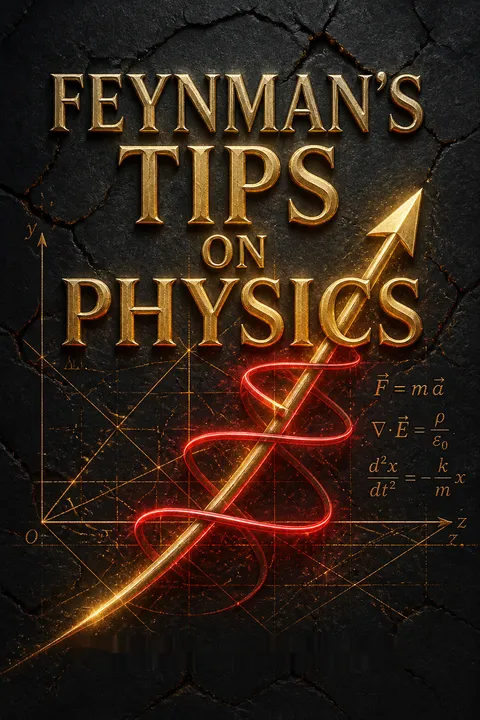


Key Takeaways
Feynman’s physics advice begins when the lecture ends: work problems yourself
Learning needs room to wander. This supplement grew from three review lectures that Feynman gave after students had encountered a new, ambitious physics course. His advice was not simply to replay the lectures. Students who were not completely lost should choose a question that puzzled or interested them, then investigate it independently. The book restores those reviews, adds a lecture on practical rotational dynamics, and supplies selected exercises because the original lectures offered few worked problems or practice questions.
The goal is understanding. Feynman’s course connected introductory mechanics to atoms, modern physics, and engineering. That breadth excited some students but left others unsure what mattered most. The review lectures respond by showing how to use the mathematics, physical laws, and examples to solve unfamiliar problems.
The advice treats learning as active investigation rather than the collection of polished explanations. That distinction matters: a lecture can make an idea feel clear without making it retrievable or usable. The book’s exercises and reconstructed reviews address that gap by asking readers to produce reasoning, not merely recognize it. The approach does ask learners to tolerate uncertainty, which can feel like abandonment without a teacher or a clear starting point. A useful balance is to begin with a genuine question, then use examples and feedback to keep independent exploration from becoming aimless.
Rebuild forgotten formulas from the relationships you still understand
Use knowledge as a network. Feynman calls this process “triangulation”: recovering an unknown or forgotten result by combining facts and relationships that remain known. Rather than treating physics as a list of formulas, picture its ideas as connected. If one piece is missing, neighboring principles can constrain what belongs there.
The point is discovery, too. A student might forget the exact force needed in a machine, yet recover it from the geometry, force balance, and a known weight. The same habit supports new work: physicists infer what they have not seen by linking observations to established laws. Memorization still helps, but it cannot scale to every formula. Understanding the connections makes both recall and invention possible.
This model makes expertise less mysterious. Knowledge is not only a stock of stored answers; it is also the ability to constrain an answer from multiple directions. The machine example shows how physical relationships can serve as error checks, while the broader claim explains why a connected understanding is more durable than isolated recall. There is a limit: reconstruction depends on having enough accurate surrounding knowledge. A beginner may not yet possess those connections, so direct instruction and repeated practice remain necessary scaffolds, not inferior substitutes.
Automate the algebra so your attention stays on the physical question
Make routine work reliable. Feynman argues that algebra, differentiation, and simple integration should become fast enough not to interrupt physical reasoning. He recommends repeated practice with common derivatives and integrals, much as arithmetic is practiced until it no longer consumes attention. Vector components also need to become familiar: a force can be resolved into perpendicular directions, and the components of a sum are the sums of the corresponding components.
Separate tool from insight. A calculation error can obscure a sound physical idea, while fluent manipulation alone cannot explain what a result means. Feynman therefore distinguishes the mechanics of calculation from the harder task of deciding which quantities belong in a problem. Practice supports that judgment; it does not replace it.
The principle is a form of cognitive budgeting: attention spent on preventable algebra mistakes is unavailable for modeling the situation. The book is unusually frank that some mathematical fluency comes from repetitive drills, not inspiration. Yet speed is not the only goal. A fast calculation can produce a confidently wrong answer if the setup is flawed. The strongest routine therefore pairs fluency with checks on units, signs, and physical plausibility, keeping computation efficient without allowing it to impersonate understanding.
Read every equation as a claim about specific objects and conditions
Name the system first. An equation such as force equals the time rate of change of momentum only becomes physically meaningful when the objects are identified. Feynman stresses that force means the total force acting on a particular particle, and momentum belongs to that particle, with its mass and velocity. Conservation laws likewise describe totals for a defined collection of particles, such as the momentum or energy before and after a collision.
Respect the limits. At low speeds, relativistic momentum reduces approximately to mass times velocity, and the force law can take the familiar form involving mass and acceleration. Kinetic energy alone, however, may not be conserved in collisions between everyday objects because energy can become internal motion, such as heat. The conditions are part of the law, not fine print.
This is a defense against equations becoming decorative symbols. Naming the system and its conditions turns a formula into a testable statement, and it exposes the difference between a fundamental relation and a useful approximation. The collision example is especially valuable because everyday intuition can make energy seem to vanish when it has merely changed form. The discipline also prevents overgeneralization: a compact law is powerful precisely because its scope can be stated, not because it applies indiscriminately.
Imagine the real mechanism before deciding which equations to use
Give the symbols a physical scene. Feynman’s two-rod machine supports a weight while one end rolls along the floor. In the first attempt at finding the horizontal push, he accounts for the force from only one rod and gets the wrong answer. Reconsidering the actual forces reveals that both rods support the weight, so the vertical load is shared before geometry determines the horizontal push.
Use ordinary experience carefully. To explain why a three-legged table is unstable when pushed between its legs, Feynman asks students to picture a real table rather than begin with equations. The same intuition suggests that a shallow, leaning ladder needs a stronger horizontal restraint. Such physical checks help identify what a mathematical model represents and whether its result makes sense.
The examples show that intuition is not a rival to mathematics; it helps specify the problem mathematics should solve. A diagram can reveal an omitted force more quickly than another page of algebra. Still, familiar objects are imperfect guides: ideal rods, frictionless pivots, and simplified tables differ from real hardware. Physical imagination is most useful when treated as a source of hypotheses and checks, then tested against the model’s assumptions rather than accepted as proof.
Solve a problem twice when the first answer feels too easy
Let methods check each other. For the moving two-rod machine, Feynman first finds the weight’s acceleration and traces the resulting force to the roller. He then solves the problem through energy: calculate how the system’s kinetic and potential energy change, and relate that rate of change to the input force and speed. The approaches use different reasoning, so agreement is a stronger check than repeating the same calculation.
Mistakes are part of the method. Feynman recounts getting signs, powers, and numerical substitutions wrong while working through the example. He checks each result against the geometry and motion, and compares the independent solution with the first. There is no uniquely correct route to a problem, but some routes make errors easier to find.
Independent methods function like diagnostic tests: when they disagree, the disagreement points toward an assumption, sign, or calculation that deserves attention. This is more informative than simply checking the arithmetic again in the same way. The method also guards against a subtle failure of expertise, where fluency makes an answer feel inevitable. Multiple approaches take time, so they need not be used for every routine exercise. They are especially useful when a result is surprising, consequential, or difficult to visualize.
Estimate the scale first, then spend effort on exactness
Begin with the shape of the answer. In the Rutherford scattering example, a fast charged particle passes a nucleus and is deflected by its electric force. Before doing an exact integration, Feynman estimates the force’s size and how long it acts. This rough reasoning shows how the deflection depends on charge, speed, mass, and closest distance. A more careful calculation supplies the missing numerical factor. Rutherford used measured deflections to infer that positive charge was concentrated in a nucleus far smaller than the atom.
Arithmetic can rescue analysis. For a rocket ejecting fuel, Feynman approximates the changing mass in small steps and adds the resulting velocity changes. With the rocket’s mass falling from 10 units to 1, the rough result is about 2.3 times exhaust speed, close to the logarithmic calculation.
Approximation is not a concession to carelessness. It identifies which quantities control a result before precision is spent, and it can expose whether a proposed explanation has the right scale. Rutherford’s example also shows how a rough model can guide a decisive experiment. The danger is that an estimate can be mistaken for a final answer. Feynman’s sequence is more disciplined: make the simplifying assumptions visible, check the trend, and refine when the question requires numerical accuracy.
Use conservation laws to infer motion you cannot observe directly
Follow what remains constant. A body moving at escape speed does not need to travel straight outward to escape. Feynman combines conservation of energy with Kepler’s equal-area law, which relates orbital speeds at different distances, to show that escape depends on having enough speed, not on pointing in one special direction. The resulting path can be understood through the changing balance of speed and gravitational potential energy.
Infer invisible particles too. In a pion decay example, a muon and an unseen, nearly massless particle emerge in opposite directions. The measured muon energy gives its momentum; conservation of momentum fixes the unseen particle’s momentum, and its energy follows. Adding the two energies reveals the original pion’s mass. A law about totals turns missing information into a solvable quantity.
Conservation laws are especially effective when direct observation is incomplete. They do not describe every detail of a process, but they sharply restrict what can be possible. In the pion example, the invisible particle is not guessed into existence from appearance alone; its properties are constrained by the visible track and the system’s total momentum and energy. This is a general strength of indirect measurement. It also depends on a sound account of what belongs in the system and whether outside forces or unmeasured energy transfers can be neglected.
Make imperfect instruments precise through feedback and regular correction
Measure the correction required. A spinning gyroscope resists changes in its orientation, but bearing friction makes it drift. In improved instruments, the gyro is floated in oil to reduce the load on delicate bearings. Sensors detect tiny motion, and a feedback system applies a counter-torque; the required correction itself becomes a measure of the disturbance. Feynman’s account emphasizes making imperfections measurable and calibrating their effects, rather than expecting a mechanically perfect device.
Small errors accumulate. In inertial navigation, gyroscopes hold a platform’s orientation while accelerometers measure motion. Integrating acceleration twice estimates position, so a small bias grows into a large position error. The system must be checked against reliable references, including gravity or a gyrocompass, rather than trusted to run indefinitely without correction.
The instrument design offers a practical version of the book’s broader problem-solving ethic: do not merely hope an error is absent; identify how it enters, measure it, and build a correction loop. Feedback turns a tiny deviation into useful information. The same logic applies to navigation, where errors compound because position is inferred through repeated integration. The system’s sophistication is therefore not just in its sensors, but in its calibration and reference points.
Track angular momentum to connect gyroscopes, planets, and quantum physics
One conserved quantity travels far. A gyroscope’s response depends on angular momentum, and the same concept helps explain Earth’s slow precession, caused by its slight bulge, and the wobble called nutation. Feynman also points to the solar system, where the planets hold about 95 percent of its angular momentum, despite the Sun containing most of its mass. The distribution remains a puzzle about how rotating matter formed.
The scale changes, the principle persists. In quantum mechanics, angular momentum is still conserved, but its allowed values along an axis occur in discrete steps related to Planck’s constant. Classical spinning and quantum angular momentum are not identical pictures. Their connection shows why rotational mechanics is useful beyond machines, while the differences warn against stretching a familiar analogy too far.
This closing view captures the book’s ambition: introductory mechanics should open onto astronomy and quantum theory, not remain a collection of pulley exercises. Conservation provides a bridge between those subjects, while each subject gives the bridge a different physical meaning. The solar system example also shows that a familiar law can frame a mystery without solving it. A unifying principle is not a universal explanation; it is a way to ask sharper questions across very different scales.
Analysis
This book is both a problem-solving supplement and a record of an unusually ambitious teaching experiment. Its central achievement is not a new collection of laws, but a shift in what counts as knowing physics. Equations are useful only when the learner can identify their objects, assumptions, and limits, then connect them to a plausible physical picture. The recurring cycle is concrete: imagine the system, choose relevant laws, calculate, check the result against the situation, and try another route when doubt remains.
That cycle explains why the book includes stories of errors and false starts. The instructor is not presented as a flawless calculator; he makes mistakes, notices them, and uses independent reasoning to locate them. This is a more valuable model of expertise than effortless performance. It also helps explain the book’s tension. Feynman wanted lectures rich enough to interest advanced students while still serving beginners. That ambition created memorable connections, but some students struggled to distinguish essential material from illuminating detours. The supplement responds with reviews and exercises, though it does not make the original course a conventional, step-by-step textbook.
The strongest modern reading is to treat physical intuition as a disciplined model-building skill, not a mysterious gift. Intuition proposes what should happen; calculation tests it; conservation laws and alternative solutions constrain it. But intuition can inherit mistakes from everyday experience, and equations can conceal mistakes behind polished notation. The book is at its best when neither is trusted alone. Its examples, from a rolling machine to submarine navigation, show how reliable understanding grows through reciprocal checks between mathematics and the world. Readers seeking a complete, orderly introduction may need a more structured companion. Readers willing to work through problems will find a powerful way to think with physics.
Review Summary
Feynman's Tips on Physics receives mixed reviews, with an overall rating of 4.23/5. Many readers appreciate Feynman's unique approach and insight, finding the book helpful for understanding physics concepts. Some praise the historical context and problem-solving techniques presented. However, others criticize the misleading title and limited practical tips. The book is seen as a companion to Feynman's lectures rather than a standalone guide. Readers value Feynman's teaching style and humor, but some find the content too basic or confusing for beginners.
People Also Read










Glossary
triangulation
Reconstructing knowledge from connectionsA problem-solving method for recovering a forgotten or unknown result from related facts and principles that remain available. Rather than relying on a stored formula, the solver uses connected relationships to constrain the answer. Feynman presents it both as a way to retrieve knowledge and as a model for discovering new results.
line integral
Accumulated field along a pathAn integral that adds the contribution of a vector field along a specified curve. The path is divided into small displacements, and the field at each segment is combined with that displacement through a dot product. For a force field, the result represents the work done along that path.
conservative force
Path-independent workA force is conservative when the work it does in moving an object between two points depends only on the endpoints, not on the route taken. Equivalently, its work around a closed path is zero. Such forces can be associated with potential energy, allowing changes in kinetic and potential energy to balance.
inertial guidance
Navigation by measured motionA navigation method that estimates a vehicle’s changing orientation and position using gyroscopes and accelerometers. Gyroscopes maintain a stable reference direction; accelerometers measure acceleration, which is integrated to estimate velocity and position. Because measurement errors accumulate, the system requires careful calibration and periodic correction.
one-degree-of-freedom gyroscope
Gyroscope sensing one rotation axisA gyroscope arranged so its wheel can respond around one output axis while rotation of the supporting vehicle occurs around an input axis. The resulting motion or torque provides a measure of the vehicle’s rotation. In precision instruments, sensors and feedback can detect and counter tiny movement.
stable platform
Orientation reference for navigationA platform kept fixed in orientation while the vehicle carrying it turns. Gyroscopes detect changes in orientation, and feedback mechanisms counter those changes. Accelerometers mounted on the platform can then measure acceleration along known directions, supporting calculations of the vehicle’s motion and position.
principal axes
Special axes of rotational inertiaThree mutually perpendicular axes through a rigid body’s center of mass for which angular momentum components align with the corresponding angular velocity components. Each axis has an associated principal moment of inertia. Describing rotation along these axes helps explain why a body’s angular momentum need not point in the same direction as its angular velocity.
FAQ
What's "Tips on Physics" by Richard P. Feynman about?
- Supplement to Lectures: "Tips on Physics" is a problem-solving supplement to "The Feynman Lectures on Physics," designed to enhance understanding through practical exercises and insights.
- Focus on Problem-Solving: It emphasizes problem-solving techniques and provides additional exercises to help students apply the concepts learned in the lectures.
- Interviews and Memoirs: The book includes interviews with Feynman and his colleagues, offering personal insights into the creation of the lectures and Feynman's teaching philosophy.
- Historical Context: It provides historical context and anecdotes about the development of the lectures and the educational environment at Caltech.
Why should I read "Tips on Physics" by Richard P. Feynman?
- Enhance Understanding: It offers a deeper understanding of physics concepts through practical exercises and problem-solving strategies.
- Learn from a Master: Gain insights from one of the most brilliant physicists and educators, Richard Feynman, known for his unique teaching style.
- Supplementary Material: It serves as a valuable supplement to "The Feynman Lectures on Physics," providing additional context and exercises.
- Inspiration and Motivation: The book includes motivational stories and advice for students, helping them navigate the challenges of learning physics.
What are the key takeaways of "Tips on Physics"?
- Problem-Solving Techniques: The book emphasizes the importance of developing strong problem-solving skills in physics.
- Understanding Over Memorization: Feynman advocates for understanding the interrelationships of nature rather than rote memorization of formulas.
- Practical Applications: It highlights the practical applications of physics concepts in real-world scenarios, such as inertial guidance systems.
- Continuous Learning: Encourages students to explore and understand physics through examples and exercises, fostering a lifelong learning mindset.
What are the best quotes from "Tips on Physics" and what do they mean?
- "It is impossible to teach satisfactorily." This quote reflects Feynman's belief that teaching is a complex and evolving challenge, emphasizing the need for continuous improvement in educational methods.
- "The joy of learning physics, simply for the pleasure of it, became my highest priority." This quote from Michael A. Gottlieb highlights the intrinsic motivation and passion for learning that Feynman inspired in his students.
- "You have to have a certain feeling for the real situation!" Feynman stresses the importance of intuition and understanding the physical reality behind mathematical equations.
- "The real utility of physicists...is not to talk about what’s already known, but to do something new." This quote underscores the value of innovation and discovery in the field of physics.
How does "Tips on Physics" enhance problem-solving skills?
- Practical Exercises: The book provides a variety of exercises that challenge students to apply physics concepts in different scenarios.
- Step-by-Step Solutions: It offers detailed solutions and explanations, helping students understand the reasoning behind each step.
- Diverse Problems: The exercises cover a wide range of topics, from basic mechanics to advanced concepts, ensuring comprehensive skill development.
- Encouragement of Intuition: Feynman encourages students to develop intuition and a deeper understanding of the physical world, beyond just solving equations.
What is the significance of the interviews included in "Tips on Physics"?
- Personal Insights: The interviews provide personal insights into Feynman's teaching philosophy and the development of the lectures.
- Historical Context: They offer historical context about the educational environment at Caltech and the challenges faced in creating the lectures.
- Collaborative Effort: Highlight the collaborative effort between Feynman, Leighton, and Sands in producing the lectures and supplementary materials.
- Inspirational Stories: The interviews include inspirational stories and anecdotes that motivate students and educators alike.
How does "Tips on Physics" address the challenges of learning physics?
- Emotional Challenges: Feynman acknowledges the emotional challenges students face, such as feeling below average, and offers advice on overcoming them.
- Practical Advice: Provides practical advice on how to approach learning physics, emphasizing understanding and intuition over memorization.
- Encouragement of Exploration: Encourages students to explore topics that interest them, fostering a sense of curiosity and engagement.
- Supportive Environment: Highlights the importance of a supportive educational environment and the role of collaboration among students and educators.
What are some practical applications of physics discussed in "Tips on Physics"?
- Inertial Guidance Systems: The book explains the principles behind inertial guidance systems, used in submarines and aircraft.
- Gyroscopes: Discusses the use of gyroscopes in navigation and stabilization, illustrating the practical application of rotational dynamics.
- Rocket Propulsion: Covers the fundamental equations of rocket propulsion and the challenges of designing efficient propulsion systems.
- Satellite Motion: Explores the physics of satellite motion and the calculations involved in determining escape velocity and orbital dynamics.
How does "Tips on Physics" relate to "The Feynman Lectures on Physics"?
- Supplementary Material: It serves as a supplementary material to the lectures, providing additional exercises and insights.
- Problem-Solving Focus: While the lectures cover theoretical concepts, "Tips on Physics" focuses on practical problem-solving techniques.
- Historical Context: Offers historical context and personal anecdotes related to the creation of the lectures.
- Enhanced Understanding: Aims to enhance students' understanding of the lectures by providing practical applications and exercises.
What teaching principles does Richard P. Feynman emphasize in "Tips on Physics"?
- Understanding Over Memorization: Feynman emphasizes the importance of understanding concepts rather than memorizing formulas.
- Intuition and Exploration: Encourages students to develop intuition and explore topics that interest them.
- Practical Problem-Solving: Focuses on practical problem-solving techniques and real-world applications of physics concepts.
- Continuous Improvement: Advocates for continuous improvement in teaching methods and adapting to students' needs.
How does "Tips on Physics" address the emotional challenges faced by students?
- Acknowledgment of Challenges: Feynman acknowledges the emotional challenges students face, such as feeling below average.
- Rational Perspective: Offers a rational perspective on these challenges, emphasizing that being below average at Caltech is still exceptional.
- Encouragement and Support: Provides encouragement and support, advising students to focus on their strengths and interests.
- Long-Term Perspective: Emphasizes the long-term benefits of persevering through challenges and the value of a Caltech education.
What are some advanced topics covered in "Tips on Physics"?
- Rotational Dynamics: The book delves into advanced topics in rotational dynamics, including gyroscopes and inertial guidance systems.
- Relativistic Physics: Covers concepts related to relativistic energy and momentum, providing a deeper understanding of modern physics.
- Quantum Mechanics: Discusses the role of angular momentum in quantum mechanics and its significance in atomic physics.
- Astronomical Applications: Explores the application of physics concepts in astronomy, such as the motion of satellites and the formation of nebulae.
About the Author
Other books by Richard P. Feynman




Download PDF
Download EPUB
.epub digital book format is ideal for reading ebooks on phones, tablets, and e-readers.








