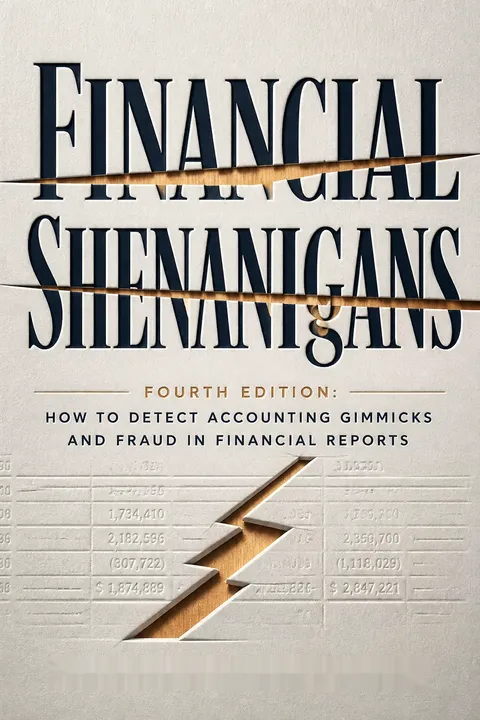


Key Takeaways
Treat every reported result as a claim, not a diagnosis
Numbers can conceal illness. Financial shenanigans are management actions that mislead investors about a company’s performance or financial health. The accounts may exaggerate earnings, cash generation, or balance-sheet strength while the underlying business weakens. The book sorts the tactics into earnings manipulation, cash-flow classification, misleading performance or health metrics, and acquisition accounting. Its opening warning comes from Qwest: CEO Joe Nacchio made meeting targets an overriding priority, and the company ultimately reported $2.5 billion of phantom earnings. Its share price fell 97 percent in the 18 months after his speech.
Cross-check the statements. The income statement, balance sheet, and cash-flow statement are connected. A suspicious revenue jump may leave receivables swelling; costs moved out of earnings may appear as assets or investing cash outflows. A red flag is a reason to investigate, not proof of fraud.
What's useful here is the shift from reading accounts as settled facts to treating them as a linked set of claims. That resembles systems diagnosis: one sensor can fail, but conflicting readings across several sensors reveal a problem. The approach also discourages overconfidence in a single ratio or headline. A caveat matters: legitimate business changes can create unusual accounting patterns, too. The purpose of skepticism is not to label every anomaly misconduct, but to demand an explanation that fits the economics and the evidence.
Revenue is credible only when delivery, acceptance, and payment are credible
A signature is not a sale. Revenue should reflect a completed economic exchange, not merely a contract signed near quarter-end. Warning signs include recording sales before the seller has fulfilled its obligations, before a buyer accepts the product, or when the customer may not pay. Bill-and-hold deals, shipments to inaccessible warehouses, consignment stock, generous return rights, and unusually long payment terms can all make a reported sale less final than it appears.
Check the cash trail. Computer Associates kept its books open beyond the normal month-end and was charged with recognizing more than $3.3 billion of revenue too early. Ulvac changed to percentage-of-completion accounting, which recognizes revenue as estimated project work progresses. Without that policy change, its 2010 sales would have fallen 21 percent, rather than appearing nearly stable. Rising days' sales outstanding, or DSO, can signal that recorded sales are outrunning collections.
Revenue recognition is fundamentally a question of control and risk: has the seller actually delivered what the customer bought, and does the customer bear the consequences of owning it? This economic framing is more durable than memorizing accounting rules, which vary across arrangements and can change over time. At the same time, a rising DSO is not a verdict. Fast growth, seasonal billing, or a shift in customer mix may also slow collections. The stronger signal comes from a pattern: policy changes, unusual terms, and deteriorating collections occurring together.
Trace costs across periods; assets can be expenses wearing disguises
Capitalization postpones the bill. A cost can be recorded as an asset when it is expected to create future benefits, then expensed as those benefits are used. Trouble begins when ordinary current costs are parked on the balance sheet, useful lives are stretched, or assets that have lost value are not written down. WorldCom capitalized network access fees that should have been operating expenses, inflating both profit and operating cash flow. AOL capitalized customer-acquisition costs and later extended their amortization period, delaying the earnings impact.
Reserves move profits, too. Companies can understate expenses by using optimistic estimates for bad debts, warranties, pensions, or inventory obsolescence. They can also create excess reserves and release them when results need a lift. The reverse trick is a large early write-off that clears costs from future periods. Repeated restructuring charges deserve scrutiny: recurring costs do not become exceptional simply because management gives them a special label.
The key analytical move is to follow a cost rather than accept its current label. An expense shifted into an asset does not vanish; it changes when and where investors see it. That is a powerful way to connect accrual accounting with cash spending. Estimates complicate the judgment, since useful lives and loss reserves genuinely require forecasts. The right test is not whether management made an estimate, but whether assumptions, disclosures, and later outcomes remain consistent. A persistent mismatch can reveal systematic optimism.
Cash flow can be staged by moving transactions between statement sections
Cash has a geography. The cash-flow statement separates operating, investing, and financing activity. A company can make operating performance look stronger by presenting a borrowing as an operating receipt or shifting a normal operating payment into investing or financing. Delphi treated a $200 million short-term loan secured by inventory as a sale, boosting operating cash flow. WorldCom moved line-cost payments into investing activities, contributing to an $8.6 billion overstatement of operating cash flow across 2000 and 2001.
Inspect the underlying deal. Selling receivables can bring future collections forward and temporarily raise operating cash flow. If the seller still bears the credit risk, however, the transaction may be economically closer to borrowing. Compare cash from operations with free cash flow, generally cash from operations less capital expenditures, and investigate sudden swings or new cash-flow line items.
The lesson is that cash is objective, but its classification is not always self-explanatory. The same payment may look like an operating cost, an investment, or financing, depending on the arrangement and reporting rules. This makes cash-flow analysis a study of transaction design, not merely a search for a supposedly pure number. Comparisons across companies require care because accounting choices may differ. Investors should preserve the underlying economics in their analysis, even when reported classifications comply with the rules.
Working-capital boosts are borrowed time, not durable growth
Timing can flatter cash generation. A company may temporarily raise operating cash flow by paying suppliers more slowly, collecting from customers earlier, or running down inventory. Home Depot’s operating cash flow rose from $2.8 billion to nearly $6 billion in 2001, helped by stretching payables from 22 to 34 days and reducing inventory per store. The cash benefit could not be repeated indefinitely; the following year, operating cash flow fell to $4.8 billion.
Separate improvement from acceleration. Customer prepayments can have the same effect. Tesla’s refundable Model 3 deposits accounted for $350 million, or 88 percent, of its reported 2016 operating-cash-flow improvement. The deposits were real cash, but they represented money drawn forward from future customers, not proof that the core business had stopped consuming cash. Check changes in receivables, inventory, and payables, and read management’s explanation of cash-flow drivers.
This is a stock-versus-flow distinction: a one-time change in the level of payables or deposits boosts cash once, while sustainable cash generation depends on repeatedly earning more than the business consumes. The distinction is especially valuable because legitimate cash management can resemble manipulation in its short-term effect. The practical question is not simply whether a company improved working capital, but whether it can keep doing so without damaging supplier relationships, relying on advance payments, or starving inventory. A favorable quarter may conceal a cash-flow pull-forward.
Rebuild management metrics before trusting the headline
Definitions shape the story. Measures such as same-store sales, backlog, EBITDA, and adjusted earnings often lack a common definition. Management can change which stores count, include cancelable orders in backlog, or exclude costs that recur in ordinary operations. A metric called cash earnings is not necessarily cash flow; EBITDA omits interest, taxes, depreciation, and amortization, but it does not account for working-capital needs or capital spending.
Compare with audited results. Valeant reported $9.6 billion of cash earnings for 2013 to 2016 while recording $2.7 billion in GAAP net losses. That enormous gap deserved more attention than the flattering measure. Balance-sheet indicators need the same scrutiny: rising receivables alongside falling DSO may reflect sold or reclassified receivables, while a declining loan-loss reserve amid worsening delinquencies can hide risk. Recalculate key measures consistently and reconcile them to the statements.
A metric is a model: it selects some features of a business and leaves others out. The useful question is therefore not whether a measure is GAAP or non-GAAP, but what economic question it answers and what it excludes. A carefully defined non-GAAP measure can improve comparability when unusual events distort reported earnings. Yet exclusions become suspect when they remove persistent costs or when the company changes the calculation opportunistically. Consistency, reconciliation, and comparison with cash requirements help distinguish clarification from salesmanship.
Acquisitions can make growth look organic and cash look stronger
M&A changes the measuring stick. Acquirers can report a target’s revenue after closing, while many acquisition costs and working-capital outflows appear outside operating cash flow. The combined company may therefore seem to grow faster and generate more operating cash than an organic grower, even before synergies arrive. Tyco bought more than 700 companies from 1999 to 2002. Its operating cash flow looked strong, but free cash flow after acquisitions was negative each year described in the book.
Check what changed hands. Compare reported growth with pro forma results and the legacy business. Study target performance immediately before closing, deal-related reserves, and unusual post-close revenue. Salix, acquired by Valeant, reported just $13 million of sales in the fourth quarter of 2014, then became part of a business reporting much stronger sales after closing. Such shifts may have explanations, but they demand investigation, especially when the target has recently restated results or disclosed weak controls.
Acquisitions create a real comparability problem, not merely an opportunity for fraud. The acquired company’s customers, inventory, and receivables arrive with the deal, while some costs of building those assets occurred before the buyer owned them. That can inflate apparent operating cash generation even when accounting is applied correctly. The discipline is to account for the purchase price and integration costs alongside post-close cash flows. Organic growth and acquisition growth answer different questions; combining them into one headline obscures risk and strategy.
Follow changes, incentives, and buried disclosures before trusting reassurance
Ask why now. The forensic mindset described in the book combines skepticism, curiosity, and humility. Look for changes in accounting policies, estimates, metrics, executives, auditors, and payment terms, then ask why the change occurred at that moment. Read footnotes, risk factors, and the management discussion of liquidity, not just earnings releases. A new disclosure may be buried, but its appearance can signal that a material issue has changed.
Treat culture as evidence. Weak boards, dependent auditors, concentrated executive power, and compensation tied to aggressive targets can make financial games more likely. Hertz initially suggested its restatement would reduce pretax profit by only $28 million; the eventual reduction was $349 million. Early assurances during an accounting review should therefore be treated cautiously. Accounting errors matter, but the deeper investment question is what they reveal about the business that the original numbers obscured.
The method resembles investigative journalism: establish a baseline, notice departures, verify claims against primary documents, and distinguish evidence from inference. Incentives and governance add context to numerical anomalies, helping explain why a particular reporting choice might benefit management. Still, cultural warning signs are probabilistic, not conclusive. A forceful CEO or complex business is not proof of misconduct. Their value is in guiding scrutiny toward the places where independent verification, clearer disclosure, and stronger cross-checks are most needed.
Analysis
The book’s deepest contribution is a change in the investor’s unit of analysis. Instead of asking whether reported earnings are high or low, it asks how a number was produced, what assumptions support it, and where the same economic event appears elsewhere in the accounts. Revenue, expenses, cash flows, and operating metrics become interdependent evidence rather than separate scorecards.
That approach matters because accounting is not merely arithmetic. It is a system for assigning transactions to categories and periods. Management discretion can affect both dimensions without changing the underlying business: a sale can be recognized before cash collection, an expense can be stored as an asset, or a payment can migrate from operations to investing. Acquisition accounting can produce similar distortions even without misconduct, so intent cannot be inferred from an unusual result alone.
The book’s cases also make incentives concrete. A target tied to quarterly earnings, share price, or an adjusted metric can shape behavior throughout an organization. Weak oversight increases the opportunity, while repeated success in meeting targets can normalize increasingly aggressive choices. This is why the strongest analysis joins accounting evidence to governance, compensation, and corporate culture.
A practical synthesis is to build three views of a company: reported performance, cash and balance-sheet consequences, and normalized economics after removing timing shifts, unusual classifications, and acquisition effects. Then compare those views over time and against the company’s own past explanations. A mismatch is not a conviction; it is a question to resolve. The framework is powerful precisely when skepticism remains disciplined. It guards against being charmed by polished metrics without treating every estimate, policy change, or acquisition as evidence of fraud.
Review Summary
Financial Shenanigans is widely praised as an essential guide for investors and financial professionals. Readers appreciate its detailed explanations of accounting tricks and real-world examples of corporate fraud. The book is commended for its accessible writing style and practical advice on detecting financial irregularities. Many reviewers consider it a must-read for anyone involved in financial analysis or investing. While some found it challenging without prior accounting knowledge, most agree it offers valuable insights into corporate financial reporting and potential red flags.
People Also Read









Glossary
Financial shenanigans
Misleading financial reportingActions by management that distort investors’ understanding of a company’s performance or economic health. The reported figures may overstate earnings, operating cash flow, or balance-sheet strength, or make results appear smoother or more predictable. The term covers both violations of accounting rules and misleading uses of discretion within reporting.
Earnings Manipulation Shenanigans
Distorting profit timingA group of practices that misrepresent sustainable earnings by changing when revenue, gains, expenses, or losses are recorded. Tactics include recognizing revenue too early, inventing revenue, hiding expenses, shifting current income into future periods, and pulling future expenses into the present.
Cash Flow Shenanigans
Distorting operating cashPractices that make cash flow from operations appear stronger or more sustainable than the underlying business supports. Common methods include classifying financing inflows as operating cash, shifting operating outflows into investing or financing, and boosting cash flow temporarily through working-capital changes.
Key Metric Shenanigans
Manipulating performance indicatorsMisleading presentation or calculation of company-specific measures outside standard financial statements. Examples include changing same-store-sales definitions, presenting adjusted earnings that exclude recurring costs, or altering balance-sheet metrics to conceal deteriorating collections, inventory quality, loan performance, or liquidity.
Acquisition Accounting Shenanigans
Using deals to distort resultsPractices that exploit acquisitions or disposals to overstate revenue, earnings, cash flow, or operating metrics. Deal structures and accounting rules can also create distortions without deliberate misconduct, so investors must separate ordinary acquisition effects from choices that obscure the economics of a transaction.
Percentage-of-completion accounting
Recognizing project progressA method for recognizing revenue and related costs over the life of a long-term contract, based on estimates of how much work has been completed. Because reported results depend on estimates of progress and total project costs, revisions to those estimates can materially change current-period revenue and profit.
Days' sales outstanding
Receivables relative to salesA measure estimating how long revenue remains uncollected, generally calculated by dividing ending receivables by revenue and multiplying by the number of days in the period. A rising measure can signal slower customer payment or aggressive revenue recognition. Sold or reclassified receivables can make the reported figure look artificially favorable.
Days' sales of inventory
Inventory relative to costsA measure relating inventory on hand to the cost of inventory sold over a period. It helps investors assess whether inventory is accumulating faster than business activity warrants. A sharp increase may indicate weaker demand, future markdowns, or a need for write-offs, although seasonal stocking and growth plans can also explain changes.
Days payable outstanding
Time taken to pay suppliersA measure of how long a company takes to pay its suppliers, generally assessed relative to its cost of goods sold. A rising figure can temporarily increase operating cash flow because cash remains in the business longer. The benefit is not indefinitely repeatable and may indicate pressure on supplier relationships.
Boomerang transactions
Reciprocal customer-supplier dealsArrangements in which two companies buy from each other, often in similar amounts or at similar times. Such transactions may have little net economic effect but can make reported revenue or operating cash flow appear larger if incoming cash is classified as operating and outgoing cash is classified elsewhere.
Cookie jar reserves
Excess reserves saved for laterReserves set too high in one period and released in a later period to reduce expenses or recognize income when results need support. Reserves may relate to restructuring, warranties, or other estimated obligations. Their use can shift profits between periods and make results appear smoother than business performance warrants.
Forensic mindset
Evidence-led financial skepticismAn investigative approach to financial reports that combines skepticism, curiosity, and humility. It emphasizes noticing changes, asking why they occurred when they did, comparing related statements and disclosures, considering management incentives and oversight, and treating anomalies as leads to investigate rather than proof of wrongdoing.
FAQ
What's Financial Shenanigans by Howard M. Schilit about?
- Focus on Deceptive Practices: The book explores various accounting tricks and manipulations that companies use to mislead investors about their financial health.
- Real-World Examples: It includes case studies of well-known companies like Enron and WorldCom to illustrate the consequences of financial manipulation.
- Investor Education: The primary goal is to educate investors on detecting these shenanigans to make informed investment decisions and protect their wealth.
Why should I read Financial Shenanigans by Howard M. Schilit?
- Protect Your Investments: Understanding the techniques outlined can help identify red flags in financial statements, avoiding investments in deceptive companies.
- Enhance Financial Literacy: It serves as a valuable resource for improving knowledge of accounting and financial reporting, accessible to both novice and experienced investors.
- Timely Insights: Given the prevalence of financial fraud, the insights are crucial for navigating today’s investment landscape.
What are the key takeaways of Financial Shenanigans by Howard M. Schilit?
- Types of Shenanigans: The book categorizes financial shenanigans into earnings manipulation, cash flow manipulation, and key metric distortions.
- Importance of Scrutiny: Investors are encouraged to scrutinize financial statements closely, looking for inconsistencies between reported earnings and cash flow.
- Historical Context: Understanding past frauds can help investors recognize similar patterns in the future.
What are some common techniques of earnings manipulation discussed in Financial Shenanigans?
- Recording Revenue Too Soon: Companies may recognize revenue before fulfilling obligations, misleading investors about actual sales performance.
- Shifting Expenses: Management might delay recognizing expenses to inflate current profits, creating a misleading picture of financial health.
- One-Time Gains: Companies may boost income by reporting one-time gains from asset sales, distorting true operating performance.
How does Financial Shenanigans define cash flow shenanigans?
- Manipulating Cash Flow Reporting: Techniques include shifting financing cash inflows to the operating section of the cash flow statement.
- Unsustainable Activities: Boosting cash flow through unsustainable activities, like selling receivables early, can create a false sense of liquidity.
- Importance of Cash Flow Analysis: Investors should analyze cash flow statements to get a clearer picture of a company’s financial health.
What are some warning signs of financial shenanigans mentioned in Financial Shenanigans?
- Inconsistent Financial Metrics: A significant discrepancy between net income and cash flow from operations can indicate potential manipulation.
- Unusual Changes in Reserves: Sudden changes in reserves for bad debts or inventory can signal expense manipulation.
- Aggressive Accounting Policies: Frequent changes in accounting policies may obscure true financial performance.
What are some notable case studies in Financial Shenanigans by Howard M. Schilit?
- Enron: Used complex financial structures to hide debt and inflate profits, leading to its collapse.
- WorldCom: Capitalized ordinary line costs to inflate earnings, contributing to a major accounting scandal.
- Waste Management: Inflated earnings through improper accounting practices, highlighting the need for vigilance in financial reporting.
What are the best quotes from Financial Shenanigans and what do they mean?
- “The most important thing we do is meet our numbers.”: Highlights the pressure on executives to deliver positive results, often leading to unethical practices.
- “In the long run, however, trouble awaits managements that paper over operating problems with accounting maneuvers.”: Warns that accounting tricks may provide temporary relief but lead to greater issues.
- “What has been will be again.”: Reflects the cyclical nature of corporate fraud, reminding investors to remain vigilant.
How can I detect financial shenanigans in a company's financial statements according to Financial Shenanigans?
- Analyze Cash Flow Statements: Compare cash flow from operations with net income to identify discrepancies.
- Scrutinize Accounting Policies: Pay attention to changes in accounting policies, especially related to revenue recognition.
- Monitor Reserves and Allowances: Keep an eye on reserves for bad debts and inventory obsolescence for sudden changes.
What is the forensic mindset discussed in Financial Shenanigans?
- Critical Thinking Approach: Involves approaching financial statements with skepticism and questioning the validity of reported figures.
- Attention to Detail: Focus on details within financial reports, including footnotes and disclosures, to uncover inconsistencies.
- Understanding Management Incentives: Recognize the motivations behind management’s decisions to anticipate potential manipulations.
How does Financial Shenanigans suggest investors should approach corporate disclosures?
- Read Everything: Thoroughly read all sections of financial reports, including footnotes and management discussions.
- Look for Changes: Pay attention to changes in accounting policies or disclosures, as these can signal potential issues.
- Question Management's Assumptions: Be skeptical of management's explanations and seek independent verification when possible.
How can I apply the lessons from Financial Shenanigans to my investing strategy?
- Conduct Thorough Research: Analyze financial statements in detail, looking for signs of manipulation or inconsistencies.
- Focus on Cash Flow: Prioritize cash flow metrics over net income when evaluating a company's financial health.
- Stay Informed: Keep up with industry news and trends to understand the broader context of a company's performance.
Download PDF
Download EPUB
.epub digital book format is ideal for reading ebooks on phones, tablets, and e-readers.








