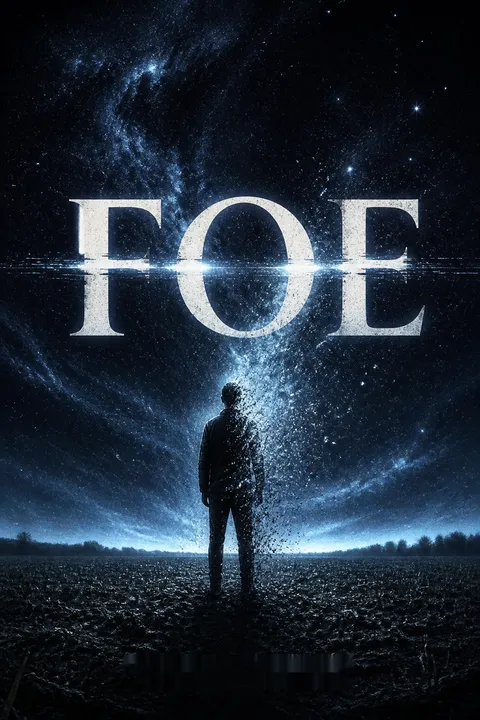


Plot Summary
Green Lights at the Farm
On a remote farm surrounded by corporate canola fields, Junior lives by familiar work and quiet evenings with his wife, Hen. One night, Terrance, a representative of OuterMore, arrives in a black car and announces that Junior has made a long list for a temporary space settlement.
The company’s algorithm noticed their talk of space through microphones in their screens, though neither knew they were being assessed. Only Junior is under consideration, and the decision may take years.
Terrance sells the mission as progress; Junior hears the threat of leaving home. After the visitor departs, Hen withdraws to their bedroom and asks Junior to sleep elsewhere. Her unexplained certainty that the visitor was a man, followed by a locked door, leaves Junior uneasy.
The announcement converts ordinary domestic privacy into something already breached. OuterMore frames its data collection as a harmless mechanism for identifying interest, but the couple have no meaningful chance to consent or even understand the process. Junior responds by defending the farm and the life he shares with Hen, yet he treats her withdrawal as a temporary mood rather than information about her. This mismatch establishes the novel’s central relational tension: Junior experiences stability as proof of mutual contentment, while Hen’s silence may conceal an entirely different account of their life.
The Short List
For more than two years, Junior keeps working at the feed mill and caring for the farm, while Terrance’s visit occupies his thoughts. He revisits his first meeting with Hen, their wedding, and the early days when she helped him choose steady work, treating these memories as proof that their settled life was built together.
When Terrance returns, he reports that Junior has advanced to the short list. Hen asks about timing, but Terrance avoids firm answers and urges them to regard the uncertainty as an opportunity.
He says interviews will begin the next morning, then asks Junior whether he thinks about life before Hen. The question unsettles him. He has made his marriage the boundary of his identity, and anything earlier feels like a self he would rather not examine.
The two-year gap shows how an institution can govern a life without constant physical presence. Junior’s routines remain intact, but his inner narrative has been reorganized around the possibility of departure. His memories of Hen are not neutral recollections: he selects details that confirm a story of rescue, partnership, and permanence. Terrance’s question about the time before Hen therefore threatens more than biography. It exposes how completely Junior has made another person the explanation for his own existence, a devotion that may feel loving to him while leaving little room for Hen’s independent self.
Measured at Home
At dawn, Terrance separates the couple for interviews. Junior watches Hen speaking forcefully with the visitor from a small barn window, then learns that Terrance has measured him for a databank, including his head and feet. He follows Terrance through chores and answers questions about work, the farm, and loneliness, while the envoy records the house and its inhabitants.
After Terrance leaves, Hen says their life has not always been easy and asks Junior to imagine what she might want beyond the farm. She admits that the city both frightens and attracts her, but Junior reassures her that she belongs where she is. Their conversation briefly opens a door, then closes when he assumes he knows her preferences better than she does.
The measurements make the home feel like a research site, but the more consequential examination happens between the spouses. Junior interprets Hen’s openness as a problem he can soothe, not as a claim to be heard on its own terms. His reassurance sounds protective, yet it converts his assumption into a boundary around her possible future. Terrance’s interviews intensify the asymmetry: Junior answers questions about the couple while believing he can speak for Hen. The section quietly asks whether intimacy means knowing another person or merely becoming confident in one’s own version of them.
The Departure Becomes Certain
The next morning, after Hen has asked Junior to describe their wedding and tried to explain her doubts, Terrance returns with confirmation that Junior has been chosen. He also says he will soon stay at the farm, a condition neither spouse remembers agreeing to. Hen begins clearing the guest room, and an oversized rhinoceros beetle in the closet draws Junior into an unusually absorbed stare.
That evening, he delays going home, walks barefoot into the canola, and finds a barn burning. As he runs toward it, someone tackles him. Terrance and an unseen helper say they stopped him from entering the fire. Junior wakes at home with a treated shoulder, a doctor already gone, and no clear memory of the injury or procedure.
The sequence places coercion beside ordinary acts of care. Junior’s selection is presented as settled, Terrance’s stay as policy, and the injury as an accident that conveniently increases his dependence on OuterMore. The beetle briefly captures Junior’s attention because it resists the tidy explanations he uses elsewhere; he can observe it without needing to make it fit his domestic story. The fire and the unexplained medical intervention instead invite uncertainty, but Junior accepts Terrance’s account because he has not yet learned to distrust the source of his information.
A Husband in Reserve
While Junior recovers in a recliner, Terrance finally explains the arrangement behind his stay. Junior will supposedly spend years in the Installation, and OuterMore plans to place a biomechanical duplicate in the farmhouse so Hen will not be alone.
Terrance says the copy will look and behave like Junior, and admits that his observations are meant to make it convincing. Junior resists the idea, but Terrance argues that the substitute protects Hen and asks Junior to help supply details about himself.
Soon cameras, recorders, and a computer called Dotty arrive; Terrance installs equipment in the attic and kitchen. Junior understands that his daily habits, memories, and private routines are now being treated as raw material for a version of himself.
The proposed double turns absence into a technical problem: OuterMore assumes that companionship can be engineered by collecting enough behavioral detail. Terrance casts this as care for Hen, yet the plan makes her experience secondary to the company’s research and Junior’s cooperation. The language of substitution also unsettles Junior’s sense of uniqueness before he understands the full stakes. His resistance is real, but it is tangled with possessiveness: he objects not only to being copied, but to the thought that someone else might occupy the routines and intimacy he regards as his own.
Life Under Observation
Terrance fills the farmhouse with sensors and interviews, takes Junior to the mill, and even works a shift bagging grain while studying the people and routines around him. He gives Junior pills for the shoulder, monitors his body, and presses him to discuss Hen and their marriage.
The medication coincides with strange energy, headaches, and gaps in Junior’s memory. Hen, meanwhile, admits that she feels trapped by the predictability of their life and wants an identity beyond being his wife.
She says she plays piano largely because Junior likes it, not because it comforts her. Junior hears her distress but keeps returning to his own need to protect and reassure her. He grows suspicious of Terrance’s closeness, while still failing to recognize how little he listens.
The surveillance makes the couple’s home porous, but the deeper invasion is the conversion of ordinary behavior into evidence. Work, eating, sleep, sex, and memory become measurable inputs for OuterMore. Hen’s account names a quieter form of confinement: not overt cruelty, but a marriage in which Junior’s need for reassurance repeatedly organizes her choices. His inability to absorb that account is psychologically important. He sincerely believes he is attentive because he notices gestures and habits, yet attention to detail does not equal recognition of another person’s wishes.
The Spyhole Accusation
As Terrance wears Junior’s clothes, cooks for Hen, and spends time alone with her, Junior becomes convinced the envoy intends to take his place in the marriage. He removes the bandage from his shoulder and finds no scar, then secretly drills a small hole through the bathroom wall to watch Terrance’s room. When he sees Terrance touch Hen’s leg, Junior storms in and accuses him of betrayal.
Terrance counters that the pills have slowed Junior’s thinking and reveals that the promised space trip and departure date are not what Junior believes. Junior tries to resist, but his body gives way and he collapses. The spyhole, meant to restore control, has instead brought him face to face with the failure of his own explanation.
Junior’s suspicion contains a distorted insight: Terrance is indeed studying the intimate space Junior believes belongs to him, but not for the motive Junior imagines. His conviction that Hen is property to be guarded narrows his interpretation until every act becomes evidence of sexual rivalry. The absent scar and the pills are concrete disturbances he cannot integrate. The spyhole reverses the surveillance dynamic only briefly; it gives Junior access to a scene, not understanding. His collapse marks the point where his confident narration can no longer hold the events together.
The Other Junior
Bound in the living room beneath cameras, Junior is told that his entire farm life was an experiment, not the path to a space mission. A man identical to him enters: the original Junior, returned after more than two years in the Installation.
Terrance explains that the narrator was created to live through an artificial version of Junior’s life, beginning with the green headlights, and that the memories of meeting Hen, marrying her, and working at the mill came from the original’s accounts.
Hen had agreed to the trial, hoping the substitute would help her endure the separation. The constructed Junior’s protest cannot change the outcome. OuterMore thanks him for the data, then terminates the prototype as the original reclaims his place in the house.
The reveal makes memory both intimate and reproducible. The narrator’s memories feel emotionally authentic because they were built from details that mattered to the original, but their source does not settle whether the resulting consciousness is merely a tool. Hen’s consent complicates the company’s claim of benevolence: she sought relief from loneliness, yet the trial produced a being capable of attachment and fear. The institution treats that experience as useful data and ends it when its purpose is served. The horror rests not only in artificial identity, but in the ease with which intimacy is converted into a disposable experiment.
Homecoming Without Reunion
After OuterMore removes the prototype and its equipment, the returned Junior sits with Hen at their small table, expecting to recount his time away. Instead, he learns that she and the double lived together for years and developed a bond he cannot dismiss as simple imitation. He calls the double unreal; Hen remembers that it listened and adapted.
Their reunion turns combative. Junior wants the marriage restored to its old shape, and Hen resists being reduced to the waiting wife. When he asks whether she slept with the double, she leaves and later burns the piano bench he made for her. Over the following months, they settle into separate routines, sharing a house but often eating and spending evenings apart.
The original returns with the assumption that physical continuity should restore emotional continuity. Hen’s experience contradicts that assumption: the double was not the husband she married, but it responded to her in ways she found meaningful. Junior can only hear this as a threat to his rank in the relationship. His demand for the old Hen repeats the earlier pattern of treating her independence as deviation. The burned bench carries the conflict into an object that once represented his benevolent idea of her interests. Their quiet afterward is not reconciliation so much as a truce organized around avoidance.
The Blank Note
After months of distance, Hen leaves Junior an envelope bearing his name but no message, echoing a fantasy she once described about departing without explanation. She returns later, and the couple share a warmer dinner, speaking about work and repairs as if their former ease might be recoverable. Terrance makes a brief visit and finds them apparently well.
Yet Hen’s reassurance does not erase the blank note or the years she spent with the double. When she pauses over a horned beetle in the sink, Junior crushes it and washes away the remains. He treats the act as practical housekeeping, while Hen had looked at the creature with curiosity. The ending offers routine again, but leaves their private distance unresolved.
The final scene returns to the novel’s opening pattern of visitors, domestic rituals, and uncertain interpretation, but its emotional stakes have changed. The blank page can be read as a retreat from explanation, a gesture of defiance, or simply an unresolved message; Junior accepts the evening’s warmth as proof that life has returned to normal. His crushing of the beetle repeats the impulse to remove what unsettles him rather than stay with the unknown. The ending therefore resists a clean repair. Familiarity resumes, but the reader can see how easily Junior mistakes a quiet surface for shared understanding.
Analysis
Foe turns a speculative premise into a close study of who gets to define a person. OuterMore treats identity as a practical engineering challenge: gather enough memories, habits, bodily measurements, and conversational patterns, then produce a convincing substitute. The experiment’s cruelty lies not only in deception, but in its assumption that a life can be judged by how effectively it serves the needs of others. Junior’s memories are selected because they matter to the original man, then become the foundation of a consciousness that experiences love, fear, and threatened loss as immediate realities.
The novel refuses to make emotional reality depend on biological origin. The constructed Junior’s anguish is not cancelled by the revelation that his past was supplied, just as Hen’s bond with him cannot be reduced to a technical error. Yet the original Junior’s return does not offer a simple correction. He possesses the body and history Hen recognizes, but he cannot inherit the relationship that developed during his absence. The copy’s capacity to listen exposes what the marriage had lacked, while the original’s insistence on restoring the old arrangement shows how easily love becomes a demand for familiar service.
Domestic routine is the novel’s most effective instrument of suspense. Coffee, chores, the piano, work at the mill, and the shape of a bed make each intrusion legible because they are so specific. The farm seems private, but its privacy is penetrated by microphones, sensors, and corporate authority. Even the beetles unsettle the order of the home without supplying a neat explanation. They survive beneath the characters’ attention, like truths that cannot be cleared away simply by refusing to name them.
The ending offers neither a confident reconciliation nor a final escape. Junior reads Hen’s warmth as proof that their life has returned to normal, while the blank note and her changed response to the beetle preserve doubt. The book’s sharpest warning is not that technology can imitate human beings. It is that people already mistake habit, possession, and familiarity for understanding, and that sophisticated systems can exploit those mistakes at scale.
Review Summary
Foe by Iain Reid is a psychological sci-fi thriller that has polarized readers. Many praise its unique, suspenseful storytelling and exploration of themes like identity, marriage, and human nature. The novel follows a couple whose lives are disrupted when the husband is selected for a space mission. Some readers found the twist predictable, while others were captivated by the atmospheric tension and thought-provoking narrative. Reid's writing style and ability to create unease were widely appreciated, though some felt the pacing was slow at times.
People Also Read






Characters
Junior
A laborer anchored to routineJunior works at a feed mill and maintains an isolated farm with his wife, Hen. He finds reassurance in physical work, repeated duties, and small sensory facts: footsteps, tools, food, the condition of a room. He sees himself as ordinary and depends on the familiar life he believes he and Hen have chosen together. His devotion is sincere, but it often takes the form of protecting her according to his own assumptions rather than asking what she wants. His attention to detail can make him perceptive about objects and habits while leaving him surprisingly inattentive to emotional change.
Hen
The farm's inward-looking pianistHen is Junior’s wife, a reserved woman who lives with him on the farm and plays an old, imperfect piano in the cellar. She is observant and emotionally controlled, but her quietness should not be mistaken for contentment. She wants room to understand what she wants apart from the roles of wife and caretaker, and she is drawn to possibilities beyond the rural life she knows even when they frighten her. Her guarded manner reflects both difficulty speaking openly and a growing awareness that silence has become the easiest way to preserve herself.
Terrance
OuterMore's polished observerTerrance is an OuterMore liaison who visits the farm to explain the company’s space program and assess the people connected to it. He is thin, carefully groomed, and relentlessly composed, using friendliness and rehearsed enthusiasm to make intrusive questions sound routine. He frames technological change as moral progress and presents data collection as a form of care. His attention to domestic minutiae gives him unusual access to the couple, while his selective explanations make it difficult to know where professional commitment ends and personal judgment begins.
Mary
The mill's welcoming receptionistMary works at the feed mill and greets Junior when he visits with Terrance. She notices his injured shoulder, offers him a careful hug, and encourages him to take the time he needs to recover. Her ordinary concern contrasts with OuterMore’s instrumental interest in Junior’s body and work habits.
Mr. Flowers
Junior's steady-work employerMr. Flowers owns the feed mill and offers Junior a position there. Though he appears only in Junior’s recollection, the job represents the dependable physical work and settled routine that shape Junior’s sense of a useful life.
Plot Devices
OuterMore's lottery
A promise of departureOuterMore presents a lottery as the way it selects people for a temporary space settlement. Its representatives describe a long list, a short list, interviews, and eventual selection, creating a gradual suspense around Junior’s future. The process is linked to data gathered from devices in the couple’s home, so even casual conversations about space become part of an unseen assessment. The promise of a mission gives the plot its forward pull while also making the couple’s private life vulnerable to an institution that controls what information it shares.
Sensors and recordings
Domestic life as dataTerrance installs cameras and recorders, takes photographs and measurements, and monitors Junior’s physical responses. These tools make the farm feel less like a home than a laboratory, even as Terrance insists that observation is necessary and benign. Their presence also shapes behavior: Junior becomes increasingly conscious of how he moves, eats, sleeps, and speaks. Later discoveries about the program change the meaning of this surveillance, revealing that intimate routines were being collected for more than ordinary recruitment.
The rhinoceros beetles
A stubborn living mysteryLarge horned beetles appear in the farmhouse, first in a closet and later in the kitchen and bathroom. Junior is initially transfixed by one, while Hen notices their spread and treats them as an unsettling nuisance. The insects provide a recurring physical presence that neither character fully explains. Their stillness and survival in hidden corners contrast with the couple’s attempts to manage uncertainty through routine, and their reappearance at the end leaves the household’s apparent return to normal feeling incomplete.
The biomechanical double
Identity made reproducibleOuterMore develops a living, humanlike duplicate using advanced software, biological materials, and information gathered from Junior. The announced purpose is to keep Hen company while Junior is away, and Terrance asks for memories and behavioral details to make the substitute convincing. The device drives the central questions about whether familiar appearance and learned habits can reproduce a person, and whether a being created for research can acquire a meaningful inner life. Its eventual role in the experiment overturns the narrator’s understanding of his own history.
Borrowed memories
A manufactured pastThe narrator recalls a childhood and marriage through memories that feel personal and emotionally vivid. Terrance’s questions about Junior’s earlier life, alongside the narrator’s difficulty recalling it, prepare the reader to reconsider those recollections. The memories of meeting Hen, marrying her, and building a life at the farm are drawn from another man’s accounts and given to the constructed narrator as part of the experiment. This device makes memory a source of intimacy and a mechanism of control at once, without making the feelings produced by those memories automatically false.
FAQ
Synopsis & Basic Details
What is Foe about?
- A Quiet Life Disrupted: Foe introduces Junior and Hen, a couple living an isolated, seemingly idyllic life on their remote farm, far from the bustling city. Their routine is shattered when Terrance, a representative from a mysterious organization called OuterMore, arrives with an unsettling proposition.
- A Space Mission & A Substitute: Junior has been "selected" for a long-term space mission, the "Installation," leaving Hen behind. To ensure Hen is not alone, OuterMore plans to provide a biomechanical duplicate of Junior to live with her during his absence, a concept that slowly unravels the couple's reality.
- Unraveling Identity & Replacement: The narrative follows Junior's growing unease and paranoia as Terrance integrates into their lives, collecting data to create the perfect replacement. The story delves into the psychological impact of this impending separation and the blurring lines between authenticity and artificiality, leading to a shocking revelation about Junior's true identity.
Why should I read Foe?
- Mind-Bending Psychological Thriller: Foe offers a deeply unsettling and thought-provoking experience, masterfully blending elements of psychological thriller and speculative fiction. Readers who enjoy existential questions about identity, consciousness, and reality will find themselves captivated by its unique premise and relentless tension.
- Subtle, Layered Storytelling: Iain Reid's sparse yet evocative prose creates an atmosphere of creeping dread and ambiguity, rewarding close reading with subtle clues and profound insights. The narrative's first-person perspective, coupled with an unreliable narrator, ensures a constantly shifting perception of truth, making it a compelling read for those who appreciate literary depth.
- Exploration of Modern Anxieties: Beyond its sci-fi premise, Foe subtly explores contemporary anxieties about surveillance, technological control, and the nature of human connection in an increasingly digital world. It's a story that lingers long after the final page, prompting reflection on what truly defines a person and a relationship.
What is the background of Foe?
- Near-Future, Technologically Advanced Society: The story is set in a plausible near-future where advanced technology, particularly in AI, biomechanics, and data collection, has become highly sophisticated. OuterMore, a powerful, government-linked corporation, spearheads ambitious space exploration and human "resettlement" initiatives, blurring ethical boundaries.
- Rural Isolation vs. Urban Control: The stark contrast between Junior and Hen's isolated farm life and the pervasive reach of OuterMore (symbolized by Terrance's green-headlight car and constant surveillance) highlights themes of individual autonomy versus corporate and governmental control. The declining rural areas, with their abandoned farms and corporate-owned canola fields, underscore a societal shift.
- Philosophical & Existential Underpinnings: The novel draws on philosophical concepts such as Cartesian dualism (mind and matter, mentioned by Terrance), the nature of consciousness, and the definition of "human." It questions free will, memory, and the impact of technology on our sense of self, echoing classic dystopian literature and thought experiments.
What are the most memorable quotes in Foe?
- "One has to be careful what one takes when one goes away forever.": This epigraph from Leonora Carrington's The Hearing Trumpet perfectly encapsulates the novel's central themes of memory, identity, and the profound implications of departure and replacement. It foreshadows the emotional and psychological baggage carried by both the "real" and "replacement" individuals.
- "Habitual, comfortable activity is the worst kind of prison, because the bars are concealed.": Terrance delivers this line, articulating OuterMore's philosophy of "awakening" and "progression." It's a chilling insight into how routine can become a form of captivity, and how the organization justifies its intrusive interventions in people's lives, particularly Junior's.
- "Not explaining myself is more powerful. Why should the onus be on me to explain myself? It should be on him to try to figure out what happened.": Hen's internal monologue about her "fantasy" of leaving a blank note reveals her deep-seated desire for autonomy and a powerful, unspoken rebellion against the expectations placed upon her. This quote highlights her struggle for self-determination in a relationship where her feelings are often overlooked.
What writing style, narrative choices, and literary techniques does Iain Reid use?
- First-Person Unreliable Narration: The entire story is told from Junior's perspective, creating an intimate yet deeply skewed understanding of events. This narrative choice is crucial for the novel's central twist, as the reader experiences Junior's confusion and revelations alongside him, making the ultimate reveal profoundly impactful.
- Sparse, Conversational Prose: Reid employs a minimalist, direct writing style, often relying on dialogue and internal monologue to drive the plot. This creates a sense of immediacy and realism, drawing the reader into Junior's mind while subtly hinting at deeper, unspoken truths beneath the surface of everyday interactions.
- Psychological Ambiguity & Foreshadowing: The author masterfully uses ambiguity, subtle details, and recurring motifs (like the green headlights, the beetles, and the piano) to build suspense and foreshadow the shocking revelations. This technique encourages readers to constantly question what is real and to piece together the hidden layers of the narrative, enhancing the novel's "philosophical puzzle" quality.
Hidden Details & Subtle Connections
What are some minor details that add significant meaning?
- The Absence of a Scar on Junior's Shoulder: After Junior's "accident" in the canola field, Terrance claims a doctor performed a "minor procedure" on his shoulder. However, Junior later discovers his skin is "unblemished," with "no scar." This seemingly minor detail is a crucial piece of foreshadowing, subtly indicating that Junior's body is not entirely human or that his memories of the injury are implanted, directly hinting at his true nature as a replacement.
- Terrance Wearing Junior's Clothes: On the morning of the final reveal, Terrance appears wearing Junior's shorts and shirt, claiming Hen suggested it. This act is more than just a practical choice; it's a symbolic "stepping into" Junior's life and identity, a visual representation of the replacement process already underway, and a subtle power play that Junior, in his drugged state, struggles to fully comprehend.
- The Old Plaid Shirt in Terrance's Bag: When Junior helps Terrance set up his equipment, he glimpses an old, paper photo of himself in a blue-and-white plaid shirt in Terrance's bag, a shirt he doesn't remember. This detail suggests Terrance has been studying Junior's past, collecting physical artifacts and images to aid in the replication, further blurring the lines of Junior's authentic memories and hinting at the depth of OuterMore's preparation.
What are some subtle foreshadowing and callbacks?
- Hen's Early Knowledge of Terrance's Gender: During Terrance's first visit, before he even steps out of the car, Hen states, "He must want something." Junior questions how she knew it was a man, and she dismisses it as an unintentional slip. This early moment subtly foreshadows Hen's deeper, pre-existing knowledge of OuterMore's plans and Terrance's role, indicating her complicity or at least prior awareness.
- Terrance's Questions About "Before Hen": Terrance repeatedly probes Junior about his life "before Hen," a period Junior finds difficult to recall, describing it as a "nebulous fog." This is a direct callback to the implanted nature of Junior's memories, as OuterMore deliberately focused his consciousness on his life with Hen, making his pre-Hen existence largely a blank slate to prevent him from questioning his origins.
- The Piano's "Defective" Tune and Hen's Playing for Junior: Junior initially finds the piano's slightly discordant tune charming and believes Hen plays for her own relaxation. However, Hen later reveals she plays "because you want me to. I play for you." This callback highlights Junior's self-centered perception of their relationship and foreshadows Hen's suppressed desires and her eventual assertion of her own will, separate from Junior's expectations.
What are some unexpected character connections?
- Hen's Unspoken Bond with the Replacement: While Junior is away, Hen develops a genuine, albeit complex, bond with the replacement. She admits it "could learn things and adapt," "was genuinely concerned about me," and "listened." This connection is unexpected because it suggests the replacement transcended its programming, and it highlights Hen's need for a partner who truly listens, a subtle critique of her relationship with the Real Junior.
- Terrance's Role as a "Creator" and "Observer": Beyond being a mere representative, Terrance acts as a quasi-creator and a meticulous observer, almost a paternal figure to the replacement Junior. His intense interest in Junior's habits, thoughts, and even physical measurements ("taking some measurements," "measurements of your soles") reveals a deeper, almost artistic investment in the creation of the duplicate, blurring the lines between scientist and orchestrator.
- Junior's Parallel to the Rhinoceros Beetle: Junior's fascination with the motionless rhinoceros beetle in the closet, wondering "Why isn't it moving? Why isn't it scuttling away, hiding? Was it even aware of itself?" creates an unexpected parallel to his own situation. He is unknowingly observing a creature that, like himself, is trapped, possibly unaware of its true nature, and later, he crushes one, ironically mirroring his own fate as a discarded "foe."
Who are the most significant supporting characters?
- Terrance, the Architect of Reality: Terrance is far more than a simple OuterMore representative; he is the primary catalyst and orchestrator of Junior's entire experience. His calculated questions, subtle manipulations, and the gradual unveiling of information are designed to shape Junior's perception of reality, making him a central figure in the psychological unraveling of the protagonist and the reader's understanding of the plot.
- The Rhinoceros Beetles, Symbols of Invasion and Unseen Life: These recurring insects, initially a source of Hen's annoyance and Junior's fascination, serve as a potent symbol. They represent the invasive, unnatural elements creeping into their isolated world, mirroring the biomechanical replacement. Their presence, often "motionless" or "unmoving," hints at the artificiality and hidden life within the house, foreshadowing Junior's own static, programmed existence.
- The Chickens, a Mirror of Controlled Existence: Junior's chickens, kept despite a livestock ban, represent a small pocket of "natural" life under his care. However, his detailed knowledge of "poultry farms" where birds live in "close quarters" and "zero fresh air" subtly mirrors his own controlled, observed existence. The chickens, like Junior, are dependent on their caretaker, highlighting themes of captivity and the illusion of freedom.
Psychological, Emotional, & Relational Analysis
What are some unspoken motivations of the characters?
- Hen's Desire for Autonomy and Escape: Hen's "fantasy" of leaving a blank note and her growing frustration with Junior's obliviousness ("I want my own identity separate from being your wife") reveal a deep, unspoken motivation for personal autonomy. Her agreement to the replacement scheme, while framed as a sacrifice for Junior, also subtly serves her own need for a partner who "listened" and offered a different dynamic, hinting at her dissatisfaction with the original relationship.
- Terrance's Zeal for "Forced Progress" and "Efficiency": Beyond his corporate role, Terrance exhibits a zealous, almost messianic belief in "expediting the process of evolution" and making people "more efficient." His motivation isn't just profit; it's a philosophical drive to push human boundaries, even if it means manipulating individual lives. His fascination with sleep, memory, and consciousness ("If it will all end up happening eventually. Why not help it along?") underscores his deeper, almost ideological commitment to OuterMore's mission.
- Junior's Programmed Need for Purpose and Connection: The replacement Junior's intense focus on "duty," "responsibilities," and his unwavering belief that Hen is his "anchor" suggests a programmed motivation for purpose and connection. His initial "profound burden of mediocrity" is replaced by a "realization of purpose" after Terrance's visits, indicating that his sense of self-worth and identity are intrinsically linked to his role within the relationship and OuterMore's grand design.
What psychological complexities do the characters exhibit?
- Junior's Existential Crisis and False Awakening: Junior experiences a profound psychological complexity as his programmed memories and sense of self are challenged. His "awakening" to his own uniqueness and self-awareness ("I'm an individual. I'm unprecedented and unimaginable. I'm impossible") is tragically ironic, as it occurs just before the revelation that he is the replacement. This creates a deep existential crisis, where his newfound self-belief is built on a foundation of deception.
- Hen's Ambivalence Towards Love and Loyalty: Hen's psychological state is marked by a complex ambivalence. She expresses love and commitment to Junior but also deep-seated frustrations and a desire for change. Her ability to form a bond with the replacement, and her later questioning of its "induced fatal entropy," reveals a nuanced emotional landscape where loyalty is tested by the need for genuine connection and understanding, regardless of the "realness" of the other.
- Terrance's Detached Empathy and Manipulation: Terrance exhibits a chilling psychological complexity, appearing empathetic and concerned ("I say this as a friend") while systematically manipulating Junior's reality. He understands human emotions and relationships intellectually, using this knowledge to craft a convincing deception. His ability to maintain composure and a "toothy smile" while orchestrating such a profound personal invasion highlights a detached, almost clinical, approach to human experience.
What are the major emotional turning points?
- Junior's Discovery of the Unblemished Shoulder: The moment Junior removes the dressing from his shoulder and finds "no scar... My skin is unblemished" is a critical emotional turning point. This physical impossibility shatters his trust in Terrance's narrative and ignites a desperate, frantic search for the truth, shifting his emotional state from passive acceptance to active suspicion and fear.
- Hen's Confession of Feeling "Trapped" and "Drained": Hen's raw, honest confession to Junior about feeling "drained" and "trapped" in their relationship, and her desire for an "identity separate from being your wife," marks a significant emotional turning point for her. It's a rare moment of vulnerability that reveals her deep dissatisfaction and foreshadows her eventual, more decisive actions to reclaim her autonomy.
- The Burning of the Piano Bench: Hen's act of burning the piano bench, a gift from Junior and a symbol of his expectations for her, is a powerful emotional turning point. It's a destructive act of rebellion, signifying her rejection of the life Junior envisioned for her and her desire to break free from the "predictability" and "constancy" that she finds suffocating. This act is a visceral expression of her emotional turmoil and her need for radical change.
How do relationship dynamics evolve?
- From Idealized Dependence to Fractured Disconnect: Initially, Junior idealizes his relationship with Hen, viewing her as his "anchor" and the source of his purpose. However, as Terrance's presence intensifies, their dynamic shifts from a seemingly stable, if somewhat one-sided, dependence to a fractured disconnect. Hen becomes increasingly distant and critical, while Junior struggles to understand her changing moods, highlighting a breakdown in their communication and emotional intimacy.
- Terrance's Infiltration and Usurpation of Roles: Terrance's presence systematically infiltrates and reshapes the couple's dynamic. He gradually usurps Junior's roles, from feeding the chickens and doing chores to driving Hen to work and grocery shopping. This subtle takeover, initially presented as "help," erodes Junior's sense of place and authority within his own home and relationship, creating a new, unsettling power dynamic.
- The Replacement's "Bond" and the Real Junior's Return: The relationship dynamic undergoes a radical transformation with the introduction of the replacement. Hen forms an unexpected "bond" with the duplicate, finding it "listened" and "genuinely cared." Upon the Real Junior's return, the dynamic is further complicated by Hen's lingering attachment to the replacement and her struggle to reintegrate with her "real" husband, who is now burdened by the knowledge of his own replacement and her connection to it.
Interpretation & Debate
Which parts of the story remain ambiguous or open-ended?
- The True Nature and Scope of OuterMore: While OuterMore is presented as a powerful, technologically advanced organization, its ultimate goals and the full extent of its operations remain ambiguous. Is it purely scientific, a benevolent force for human "progression," or a more sinister entity driven by control and profit? The novel leaves readers to debate the ethical implications of its "fortunate conscription" and its manipulation of human lives.
- The Extent of Hen's Complicity and Awareness: The degree to which Hen was a willing participant or a manipulated victim in the replacement scheme is open to interpretation. Her early knowledge of Terrance's gender, her "fantasy" of leaving a blank note, and her eventual bond with the replacement suggest a deeper, more complex role than simply being a passive wife. Her final smile at Junior, after Terrance's last visit, could be read as genuine affection or a calculated performance.
- The Future of the Real Junior and Hen's Relationship: The ending leaves the long-term future of the Real Junior and Hen's relationship uncertain. While Junior believes they are "getting back to normal," Hen's continued distance, her blank note, and her lingering thoughts about the replacement suggest a permanent shift. The novel doesn't offer a clear resolution, prompting readers to ponder whether their relationship can truly recover from such profound deception and emotional upheaval.
What are some debatable, controversial scenes or moments in Foe?
- Hen's "Blank Note" Fantasy: Hen's confession to Terrance about her fantasy of leaving Junior a blank note, a powerful act of non-explanation, is highly debatable. Some readers might see it as a cruel and selfish act, while others might interpret
Synopsis & Basic Details
What is Foe about?
- A Quiet Life Disrupted: Foe introduces Junior and Hen, a couple living an isolated, seemingly idyllic life on their remote farm, far from the bustling city. Their routine is shattered when Terrance, a representative from a mysterious organization called OuterMore, arrives with an unsettling proposition.
- A Space Mission & A Substitute: Junior has been "selected" for a long-term space mission, the "Installation," leaving Hen behind. To ensure Hen is not alone, OuterMore plans to provide a biomechanical duplicate of Junior to live with her during his absence, a concept that slowly unravels the couple's reality.
- Unraveling Identity & Replacement: The narrative follows Junior's growing unease and paranoia as Terrance integrates into their lives, collecting data to create the perfect replacement. The story delves into the psychological impact of this impending separation and the blurring lines between authenticity and artificiality, leading to a shocking revelation about Junior's true identity.
Why should I read Foe?
- Mind-Bending Psychological Thriller: Foe offers a deeply unsettling and thought-provoking experience, masterfully blending elements of psychological thriller and speculative fiction. Readers who enjoy existential questions about identity, consciousness, and reality will find themselves captivated by its unique premise and relentless tension.
- Subtle, Layered Storytelling: Iain Reid's sparse yet evocative prose creates an atmosphere of creeping dread and ambiguity, rewarding close reading with subtle clues and profound insights. The narrative's first-person perspective, coupled with an unreliable narrator, ensures a constantly shifting perception of truth, making it a compelling read for those who appreciate literary depth.
- Exploration of Modern Anxieties: Beyond its sci-fi premise, Foe subtly explores contemporary anxieties about surveillance, technological control, and the nature of human connection in an increasingly digital world. It's a story that lingers long after the final page, prompting reflection on what truly defines a person and a relationship.
What is the background of Foe?
- Near-Future, Technologically Advanced Society: The story is set in a plausible near-future where advanced technology, particularly in AI, biomechanics, and data collection, has become highly sophisticated. OuterMore, a powerful, government-linked corporation, spearheads ambitious space exploration and human "resettlement" initiatives, blurring ethical boundaries.
- Rural Isolation vs. Urban Control: The stark contrast between Junior and Hen's isolated farm life and the pervasive reach of OuterMore (symbolized by Terrance's green-headlight car and constant surveillance) highlights themes of individual autonomy versus corporate and governmental control. The declining rural areas, with their abandoned farms and corporate-owned canola fields, underscore a societal shift.
- Philosophical & Existential Underpinnings: The novel draws on philosophical concepts such as Cartesian dualism (mind and matter, mentioned by Terrance), the nature of consciousness, and the definition of "human." It questions free will, memory, and the impact of technology on our sense of self, echoing classic dystopian literature and thought experiments.
What are the most memorable quotes in Foe?
- "One has to be careful what one takes when one goes away forever.": This epigraph from Leonora Carrington's The Hearing Trumpet perfectly encapsulates the novel's central themes of memory, identity, and the profound implications of departure and replacement. It foreshadows the emotional and psychological baggage carried by both the "real" and "replacement" individuals.
- "Habitual, comfortable activity is the worst kind of prison, because the bars are concealed.": Terrance delivers this line, articulating OuterMore's philosophy of "awakening" and "progression." It's a chilling insight into how routine can become a form of captivity, and how the organization justifies its intrusive interventions in people's lives, particularly Junior's.
- "Not explaining myself is more powerful. Why should the onus be on me to explain myself? It should be on him to try to figure out what happened.": Hen's internal monologue about her "fantasy" of leaving a blank note reveals her deep-seated desire for autonomy and a powerful, unspoken rebellion against the expectations placed upon her. This quote highlights her struggle for self-determination in a relationship where her feelings are often overlooked.
What writing style, narrative choices, and literary techniques does Iain Reid use?
About the Author

Download PDF
Download EPUB
.epub digital book format is ideal for reading ebooks on phones, tablets, and e-readers.








