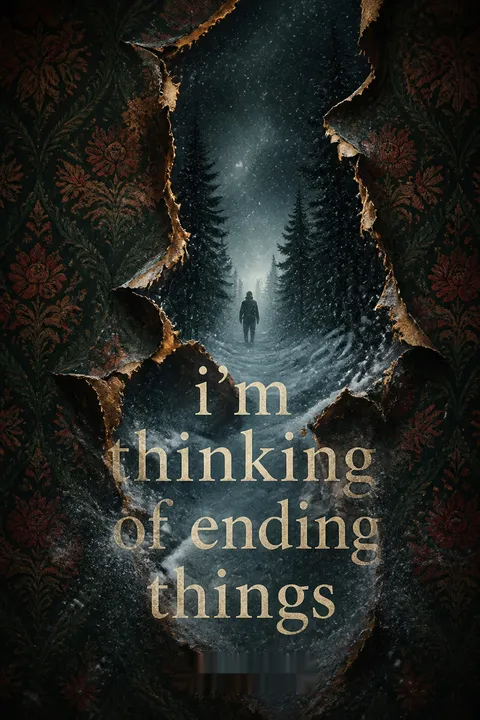


Plot Summary
Seven Weeks to Goodbye
On a winter drive to meet Jake’s parents,3 his girlfriend1 privately considers ending their seven-week relationship. She has not told her own family that Jake2 exists, and the visit feels more like a farewell than a beginning. She remembers meeting him at a campus trivia night, where his shy intelligence drew her in and a note with his number brought them together.
Their quick closeness has not settled her doubts: she studies his habits, wonders whether affection can survive ordinary life, and cannot bring herself to explain any of this to him. Jake,2 meanwhile, treats the trip as a step forward. As empty fields slide past the car windows, she keeps her decision to herself and tries to understand what she feels.
The story begins with a private decision that the relationship’s other participant cannot see. This mismatch establishes the novel’s central tension between thought and action: the narrator treats unspoken doubt as more truthful than the couple’s visible intimacy. Her silence is not simple cruelty. She is trying to avoid making a consequential choice before she can explain it, yet withholding the doubt deprives Jake of any chance to answer it. The trip therefore becomes an experiment she conducts alone, despite being ostensibly about meeting his family. The rural road gives that experiment a physical direction while her private reasoning keeps circling.
Calls From Her Own Number
The calls began the night she met Jake.2 First came a wrong number; then the same caller5 rang from her own phone number, often in the middle of the night. He left seven identical, mournful messages about fear and a question that needed answering. When one message adds that he knows her hands, skin, hair, and nail-biting, she finally answers and demands that he stop.
The caller5 insists that she was the one who called him. She hangs up, shaken by the reversal. The messages recall an old childhood memory: a tall man standing outside her bedroom window, watching until she closes her eyes. Now, as Jake2 drives, she keeps the caller5 secret and replays the saved message.
The caller’s strange insistence turns an ordinary device of modern intimacy, the phone, into a breach between self and stranger. His use of her number suggests that the threat may not come from outside her at all, though she cannot yet interpret that possibility. The childhood watcher gives the present fear a history, but the memory itself is uncertain, changing shape with each recollection. That instability matters: the narrator’s mind is both witness and editor. By hiding the calls from Jake, she reinforces the isolation that makes the caller’s message feel increasingly authoritative.
Doug’s Rainy Lesson
To pass the drive, the narrator1 tells Jake2 about Doug,8 a shy driving instructor who once waited out a storm with her in a parking lot. He read from a book, offered her a strange candy, and described a lonely student who believed she was an extraordinary kisser. The narrator1 recounts a version that leaves Jake thinking she kissed Doug at the lesson’s end.
Jake2 connects the story to his belief that memory changes whenever it is retold. Privately, she corrects the ending: she never kissed Doug. She returned to the car only to show him the candy wrapper’s printed verse, then ran home. During her story, the caller5 rings again, but she pretends it is a friend.
This story within the story gives the novel a small, concrete test of its larger concern with memory. The narrator’s account is not merely inaccurate; it is shaped to provoke Jake and then withheld from correction. The omitted truth, a brief exchange over a candy wrapper, is less dramatic but more revealing of the connection she actually had with Doug. Jake’s theory that memories become stories sounds perceptive, yet it also permits him to accept a false version too easily. The episode asks whether intimacy depends on facts, interpretations, or the willingness to correct one another.
Frozen Sheep at the Barn
At the end of the drive, Jake2 delays entering the house and takes his girlfriend1 through the farm in the dark. In the barn, she sees sheep lying still, then two dead lambs stacked against the wall. Jake2 explains that they may be burned in a spring bonfire. He also describes how his father4 found two old pigs infested with maggots after leaving them unchecked for days, and had to put them down.
In the henhouse, a chicken eats an uncollected egg. The animals turn her abstract thoughts about endings into physical evidence: living creatures can appear calm while suffering, and care sometimes means making an irreversible choice. She follows Jake2 back toward the house, cold and hungry.
The farm’s animals give the narrator’s private meditations on commitment and death an unsentimental material form. The dead lambs resemble the living ones closely enough to unsettle easy distinctions, while the pigs reveal suffering that was hidden at a distance. Jake describes the farm’s decisions as practical necessities, but his account also exposes the cost of inattention. This matters to the narrator, who is accustomed to analyzing relationships before acting. The farm suggests that waiting is not always neutral: bodies deteriorate, conditions worsen, and an eventual choice may arrive after avoidable suffering.
A Dinner That Repeats
Jake’s parents3 greet their guest in a house that is tidy but dated, with old country music and stern black-and-white photographs. At dinner, his mother3 describes tinnitus, whispers, and paralysis during sleep, while calls from the narrator’s phone interrupt the meal.
Jake’s parents3 urge her to answer, and Jake2 grows silent. His mother3 proposes a game: the guest imitates Jake,2 then Jake2 imitates her with unnerving precision. When the landline rings, his mother3 returns with a wrong-number explanation and again suggests checking the phone.
The narrator’s1 appetite disappears. After dinner, Jake’s mother3 gives her a folded painting meant to be a portrait of Jake,2 then presses her to stay overnight. The narrator1 leaves with the gift and mounting unease.
The dinner makes family resemblance feel less like comfort than rehearsal. The parents’ ailments echo the narrator’s fear and sleeplessness, while the repeated wrong-number calls bring her hidden secret into the room without making it discussable. The impersonation game is the meal’s sharpest disturbance: each person can reproduce the other’s gestures, yet accurate imitation does not produce understanding. Jake’s silence leaves his girlfriend alone inside a scene that should have introduced her to his family. His mother’s insistence that the visit matters suggests a history the guest cannot yet read.
The Basement Portraits
While Jake’s parents3 clear the table, the narrator1 wanders into the basement Jake2 had dismissed as an empty hole. A fan turns beside a painting of a long-limbed figure and a child; nearby drawings repeat the room with different versions of the same figures. Upstairs, she finds close-up photographs of body parts in an envelope and a photograph of a blond woman11 with an unknown man behind her.
Jake’s father4 catches her in the bedroom and says Jake2 needs her, then explains away his wife’s3 strange behavior as stress and hearing problems. Before the couple leaves, Jake’s mother3 gives the narrator1 a painting of Jake.2 Her tenderness makes the guest feel wanted, but the house’s buried images leave her unsure what she has been welcomed into.
The house is presented as an archive whose rooms contradict the explanations offered about them. Jake calls the basement empty, but it contains repeated images of a child and an uncanny adult; his bedroom likewise holds intimate photographs and traces of other lives. The father’s reassurance may be compassionate, yet it also directs the narrator away from questions rather than answering them. The painting gift concentrates this uncertainty: it is offered as affection, but its contents remain concealed. The domestic setting becomes less a stable account of Jake’s origins than a collection of partial, possibly conflicting representations.
The Brother’s Borrowed Life
On the return drive, the narrator1 asks about the man in the photograph. Jake2 identifies him as his brother10 and describes a once-promising academic who left the lab because social contact became unbearable. According to Jake,2 his brother10 later followed him, wore his clothes, and made demands Jake2 could not meet, forcing Jake2 to cut him off.
The account casts new light on the parents’3 anxiety and the father’s4 gratitude toward the narrator.1 Jake2 also admits that his mother3 pulls out her hair and that her condition has worsened. His speed rises as he speaks, and the narrator1 notices how much his family’s distress resembles the isolation she has sensed in him. He reaches across and touches her hand.
Jake’s account of his brother supplies a narrative explanation for the family’s strained atmosphere, but its neatness is itself worth noticing. The brother bears the visible symptoms of isolation, while Jake occupies the role of the capable observer who has already done what he could. That division lets Jake speak about loneliness at a safe remove. The narrator’s compassion grows as she hears the account, complicating her intention to end the relationship. At the same time, the accelerating car converts disclosure into physical risk. Emotional honesty arrives, but it does not yet create a shared understanding of what either person needs.
The Dairy Queen Warning
Jake2 stops at a nearly empty Dairy Queen, where a thin worker with a rash7 prepares the narrator’s1 nondairy lemonade. The worker7 says she is frightened for the narrator1 and warns that she should not go, then retreats before explaining. Jake2 appears not to notice. He takes a back road to a rural high school so he can dispose of their cups.
After returning from behind the building, he insists that a worker must be inside, then shuts off the car. While they kiss, he spots a man watching through a window and becomes furious. The narrator1 sees no one, but Jake2 refuses to leave until he confronts him. He takes the car keys and walks into the snow toward the school, leaving her alone.
The worker’s warning is the story’s clearest direct opportunity for the narrator to interrupt the journey, but its vagueness gives her no firm evidence to act on. Jake’s insistence that a watcher is present turns the school into a destination rather than a harmless detour. The narrator’s earlier habit of keeping doubts private now has practical consequences: she does not know how to challenge his certainty without provoking him. The scene also reverses their ordinary roles. Jake, usually restrained and intellectual, acts impulsively; the narrator, usually self-questioning, must decide whether to trust her own perception.
The Custodian’s Room
When Jake2 does not return, the narrator1 leaves the car and follows his tracks around the school. Through a window she sees a tall worker in a mask and yellow gloves,6 moving strangely with a mop. She enters through an unlocked side door and finds a small custodial room filled with photographs of an unsmiling man.
A child’s blue, polka-dot shirt lies on the desk, marked with the same stain she remembers from her own childhood clothes. She plays an old camera recording: it shows the school, then the black pickup outside, with someone in the cab who resembles Jake.2 Before she can escape, the entrance is chained from within. A handwritten message asks what is happening in the school.
The shirt collapses the distance between the narrator’s present danger and her childhood, making the school feel less like an unfamiliar place than a room assembled from memory. The camera appears to offer objective evidence, but its blurred image only intensifies uncertainty about who is watching whom. The chained door changes the situation from investigation to confinement. Each clue seems to confirm that a person is pursuing her, yet the evidence remains entangled with her own past. The novel makes perception consequential without making it securely reliable.
The Hallway That Loops
Unable to leave, the narrator1 moves through dark halls, hiding behind a bench as the same country song plays repeatedly over the school speakers. She remembers a childhood encounter with Ms. Veal, whose frightening questions taught her that other people’s thoughts remain unknowable. Later she finds fresh paint on an art-room floor, including a message that seems to anticipate what she had planned with Jake.2
The masked worker’s6 footsteps draw closer. She notices blood from her nose, missing hair, and bitten nails, while Jake’s2 shoes and clothes appear abandoned near the showers. The school’s rooms repeat until escape seems impossible. Her thoughts fracture between the missing boyfriend,2 the watching figure, and the fear that she is alone.
The school’s repetition turns architecture into a model of rumination: each corridor offers another route that returns the narrator to the same fear. The song’s loop and the childhood memory of Ms. Veal do not explain the danger so much as deepen the narrator’s conviction that no one can know what another person intends. Her physical symptoms make that conviction bodily. The painted message seems to read her thoughts, erasing the distinction between an external pursuer and an internal voice. Terror here does not arrive as a single shock; it accumulates until interpretation itself becomes part of the trap.
Jake Behind the Mask
The narrator’s1 perspective slips into a collective voice, and the figures separate no longer: the girlfriend,1 the worker,6 and Jake2 belong to one consciousness. The woman Jake has been driving with1 is not a real partner but a life he has written around a woman he once met at trivia. He wanted to give her his number, failed, and never saw her again.
The school custodian6 is Jake,2 who has worked alone for decades; his parents3 are long dead, and the brother’s10 story has disguised his own collapse. In a closet, Jake2 faces himself in the mask and gloves. He bends a wire hanger and uses it to inflict fatal wounds on his neck. The imagined companion1 makes the choice with him, but Jake2 dies alone.
The revelation does not simply label earlier events as fantasy. It shows how Jake’s imagined relationship gave shape to a connection he could not initiate in life, while also making the fantasy carry his fear, tenderness, and self-accusation. The narrator’s split perspective lets him experience both the wish to be accompanied and the knowledge that no other person is present. The disguise of the custodian turns self-surveillance into a pursuer. His death is therefore neither a solved mystery nor a romantic escape; it is the catastrophic endpoint of isolation narrated as if it could be shared.
Epilogue
After Jake’s2 body is found in a small closet at the school, investigators discuss his long silence, his notebooks, and the story left near him. One person tries to determine whether the pages explain why he died.
The account is difficult to separate into fact and invention: Jake2 appears inside it, but the telling shifts among identities and perspectives. Rather than settle on a single interpretation, the final exchange leaves the manuscript in the investigators’ hands and invites them to begin at the end.
The closing frame returns the novel from Jake’s elaborate inner world to the ordinary, inadequate language of an investigation. The people discussing the pages want a cause that can be extracted and stated plainly, but the story resists that demand. Its fictional companion is not evidence of a separate relationship, yet the loneliness expressed through her is not thereby unreal. The ending asks what a written account can disclose about a death when its author has transformed himself into several characters. The investigators’ uncertainty mirrors the reader’s, while their practical instruction to start at the end echoes the book’s circular structure.
Analysis
I’m Thinking of Ending Things builds suspense by making interpretation itself unstable. The narrator1 watches Jake’s2 habits, reads family photographs, remembers childhood scenes, and studies strange calls, but none of those observations yields secure knowledge. Her central belief, that private thoughts are more truthful than actions, gives the book its psychological engine. Thoughts cannot be checked by another person, so they can feel absolute while also becoming a sealed room.
The road trip gives that inwardness a plot. Every mile carries the narrator1 toward Jake’s family3 and then toward the school, while the decreasing number of other people makes her dependence on Jake2 more complete. The farm’s dead animals introduce the material fact of suffering; the school turns that fact into confinement. Repeated songs, messages, and images make experience feel less like a sequence of new events than a loop tightening around one mind.
The revelation reframes the apparent romance as Jake’s2 imagined attempt to repair a missed connection. At the pub, he wanted to give a woman his number but could not. The fantasy of a perceptive girlfriend1 lets him imagine being known, argued with, and accompanied, while dividing his own fear into figures he can encounter. This is not presented as proof that intellectual insight cures loneliness. Jake2 can discuss empathy, memory, and connection fluently, yet cannot cross the ordinary social threshold that might have made connection possible.
The ending resists a tidy moral. The imagined woman1 gives Jake2 a form of companionship, but she cannot become another person who might interrupt his decision. His death is both the outcome of prolonged isolation and an action that the narrative stages as shared. The final investigators inherit pages that cannot cleanly separate confession from invention. The book’s hardest question is not whether the story is true in every detail, but what kind of truth a lonely person can construct when no one else is there to answer.
Review Summary
I'm Thinking of Ending Things polarized readers with its unsettling psychological horror and ambiguous ending. Many praised Reid's atmospheric writing and creeping dread, while others found it confusing or pretentious. The story follows a woman on a road trip with her boyfriend, contemplating ending their relationship. As strange events unfold, the narrative becomes increasingly surreal and disorienting. Some readers loved the mind-bending twist, while others felt frustrated by the obtuse storytelling. The book provoked strong reactions, with most finding it either brilliant or deeply unsatisfying.
People Also Read







Characters
The narrator
The doubtful new girlfriendThe unnamed narrator is observant, intellectually curious, and prone to turning small gestures into evidence about the future of a relationship. She is attracted to Jake’s2 mind and tenderness, yet worries that attraction alone cannot make a shared life sustainable. Her habit of withholding difficult thoughts leaves her emotionally isolated even when she is physically close to him. She notices details others might dismiss, including changes in clothing, expressions, and the cadence of repeated calls. That sensitivity can help her detect unease, but it also feeds uncertainty when observations do not fit a clear explanation. Her voice combines dry humor, compassion, and persistent self-interrogation.
Jake
The reserved farm-raised scholarJake is a tall, shy scientist whose learning and unusual habits attract the narrator1. He prefers conversation to texting, likes books and obscure facts, and often answers emotional questions through philosophy or scientific explanation. His reserve is not a lack of feeling: he remembers small requests, wraps medicine carefully, and shows affection in quiet ways. Yet he can be inattentive to what others are experiencing, and his intellectual fluency does not guarantee ease with intimacy. The contrast between his gentleness and his moments of intensity makes him hard for the narrator1 to read. His attachment to the farm, family history, and solitary work shapes how he understands himself.
Jake’s mother
The smiling, troubled hostJake’s mother welcomes the narrator1 warmly and seems eager for her to stay, but her behavior is unsettling: she smiles almost constantly, changes dresses during dinner, and speaks about tinnitus, whispers, and disrupted sleep. Her tenderness is visible in the hug and the portrait she gives her guest. She appears fragile, yet she is also an active host, steering the meal toward a game and pressing for connection. The narrator1 cannot tell how much of her behavior comes from illness, stress, habit, or the family’s private history.
Jake’s father
The guarded family caretakerJake’s father is reserved and practical, dressed for work in a worn farmhouse. He looks after his wife3, offers explanations when the narrator1 is unsettled, and speaks with affection about Jake’s2 need for companionship. His concern can feel reassuring, but his accounts also close down questions instead of clarifying them. He embodies the family’s effort to manage distress through routine and understatement.
The Caller
The voice from her phoneAn unidentified caller leaves repeated messages from the narrator’s1 own number. His strained voice sounds sad rather than openly threatening, and his fixed words grow more disturbing when he claims knowledge of her body and habits. He refuses ordinary conversation, making the phone a one-way channel for fear. The narrator’s1 inability to locate him or explain the shared number gives him an unsettling presence.
The custodian
The masked night workerThe narrator1 encounters a tall, masked figure in work clothes moving through the rural school after hours. He carries cleaning equipment, wears yellow gloves, and appears at windows and in shadowed corridors. His stillness and obscured face make his intentions difficult to read. The figure draws on the narrator’s1 fear of being watched and becomes the focus of her search for Jake2.
The Dairy Queen worker
The frightened young witnessA thin, anxious employee with a visible rash prepares the narrator’s1 lemonade while her coworkers laugh nearby. She quietly expresses fear for the narrator1 and urges her not to leave with Jake2, then disappears before she can explain. Her warning is brief but gives the couple’s journey its clearest moment of outside intervention.
Doug
The shy driving instructorDoug teaches the teenage narrator1 to drive and spends a rain-delayed lesson discussing books, experience, loneliness, and the puzzles people must solve for themselves. Shy and awkward, he offers her an unusual candy and treats conversation as part of the lesson. His brief appearance becomes a story the narrator later reshapes while talking with Jake2.
Ms. Veal
The unnerving family friendMs. Veal is an older acquaintance of the narrator’s1 mother who visits to collect saved bacon fat. During a private moment with the sick child, she asks unsettling questions about goodness, belonging, and the narrator’s1 place in her family. The encounter becomes an early source of the narrator’s1 fear that people’s private intentions can never be fully known.
Jake’s brother
The isolated siblingJake2 describes his brother as a gifted but deeply isolated academic who could not manage workplace social demands. In Jake’s2 account, the brother later follows him and wears his clothes, straining the family and forcing distance between the siblings. Though absent from the trip, he gives Jake2 a way to discuss loneliness and family trouble.
Steph
The former girlfriend in photographsSteph is a musician Jake2 dated briefly after high school. The narrator1 sees her in a photograph in Jake’s2 old bedroom and asks about the man standing behind her. The image becomes part of her effort to understand Jake’s2 past and the family relationships he has not mentioned.
Plot Devices
The Caller’s messages
A voice that loops inwardThe caller’s5 late-night messages repeat nearly word for word, while their apparent source is the narrator’s1 own number. Their pattern makes a private disturbance feel external, then turns the caller’s5 insistence that she initiated contact into a destabilizing reversal. His references to her habits make the threat seem intimate without identifying a conventional motive. The calls also recur during moments when the narrator1 could tell Jake2 the truth, so the device links suspense to her concealment and isolation.
Stories inside the drive
Memory as shifting evidenceThe narrator1 recalls childhood encounters, a driving lesson8, and earlier moments with Jake2 while the car moves toward the farm. These embedded accounts interrupt the present and make events feel available for interpretation rather than settled fact. The driving lesson8 is especially important because the narrator1 tells Jake2 an altered version and later supplies the missing truth internally. The shifting stories train the reader to question whether remembered experience, imagined possibility, and present observation can be kept cleanly separate.
The country road
A journey narrowing toward dangerThe road trip begins as a familiar relationship milestone, a visit to a boyfriend’s2 family, but its isolated landscape steadily removes ordinary alternatives. Sparse traffic, darkness, weather, and increasingly obscure roads make the narrator1 dependent on Jake’s2 choices. The detour to the high school converts the journey into confinement. Because the car is both intimate and mobile, it supports the couple’s philosophical exchanges while also carrying the narrator1 farther from help.
The farm and school
Two landscapes of isolationThe farm’s dead animals, worn rooms, and buried drawings prepare the reader for the school’s empty halls, hidden custodial room, and looping corridors. Both places hold evidence that looks ordinary from a distance but becomes disturbing on close inspection. The farm’s stories concern care, neglect, and death; the school turns those concerns into a physical maze. Together, they create a sequence in which familiar institutions and domestic spaces become difficult to trust.
The found manuscript
A frame that refuses certaintyBrief conversations among people discussing the school death appear between the narrator’s1 scenes, then return after the ending to describe the pages found near the body. These fragments establish that the central account is a written narrative whose relation to fact is disputed. The investigators seek a clear explanation, but the manuscript contains overlapping identities and an author who appears inside his own story. Its frame does not solve the mystery so much as show how a person’s final account can remain difficult to interpret.
About the Author
Download PDF
Download EPUB
.epub digital book format is ideal for reading ebooks on phones, tablets, and e-readers.








