


Plot Summary
Chade Finds the Hermit
FitzChivalry Farseer, living under the name Tom Badgerlock, has made a quiet home with his wolf, Nighteyes, and foster son Hap. Chade, his old mentor and the Queen’s councillor, arrives with news of the court and of Fitz’s daughter Nettle, whom Burrich and Molly are raising as their own. He asks Fitz to return to Buckkeep and teach Prince Dutiful the Skill, with Nettle as a possible student.
Fitz refuses. The magic still torments him like an addiction, and he fears drawing another generation into its dangers. Chade leaves without pressing him further, but the visit unsettles the peace Fitz thought he had earned. His familiar cottage begins to feel less like refuge than confinement.
Chade’s visit turns retirement into a choice Fitz must actively defend. His refusal is not simple fear of court or reluctance to work. He knows the Skill’s pleasure can become an appetite that consumes judgment, and he will not disguise that danger as a royal birthright. Yet the news of Nettle exposes the cost of his self-protection: he has preserved her safety by remaining absent from her life. Chade’s tactful departure leaves Fitz with no command to resist, only the sharper pressure of affection and unfinished responsibility.
A Minstrel's Hidden Marriage
When Hap returns from Springfest, his sullen silence gives way to the reason for it: Starling, Fitz’s longtime lover, is married to a young nobleman named Dewin. Hap had watched them together and feared that Fitz had knowingly taught him one moral rule while living by another.
Fitz confronts Starling, who argues that her husband’s ignorance makes the affair harmless and resents Fitz for ending it. Their quarrel reveals how differently they understood their intermittent intimacy.
Starling had also carried Chade’s news about Fitz and Nettle back to Buckkeep, though she had not told Fitz how closely she reported on him. Hap describes a Witted woman stoned by a village mob, then apparently rescued by a sudden flock of crows. The old hatred of the Wit is rising again.
The betrayal hurts Fitz less because Starling has another lover than because she has made his solitude part of an arrangement he never understood. He refuses to treat Dewin’s ignorance as consent, even when Starling frames secrecy as kindness. Hap’s involvement gives the decision an ethical consequence beyond romance: Fitz has taught the boy to trust what he says. The account of the stoning widens the private rupture into a public danger. Witted people are not merely mocked; they are being killed, while retaliatory legends and rumors harden both sides into camps.
The Charm and the Road
At market, Hap meets Jinna, a practical hedge-witch whose stolen charm had supposedly protected his purse by diverting the thief. She later gives Fitz a garden charm and, after sensing his fear, a second charm meant to make strangers regard him more kindly.
Their trade is interrupted when neighbor Baylor accuses Fitz and Hap of stealing missing piglets, then blames Witted people when others join his suspicion. Fitz swallows his anger rather than expose himself.
Hap admits he may be a Red Ship orphan and asks who his father was; Fitz tells him that his choices, not his birth, will shape him. Unable to afford the apprenticeship Hap wants, Fitz lets him travel for harvest work and earn the fee. A Skill-dream of a boy hunting with a cat follows.
This section makes inherited identity a practical problem. Hap’s unknown father could determine how others treat him, but Fitz gives him a standard based on conduct rather than lineage. Meanwhile, Fitz’s restraint in the market shows the danger of being Witted in a culture where accusation can become permission for violence. Jinna’s charms offer help without demanding confession, a contrast to the coercive magic gathering around the royal family. When Hap leaves, Fitz loses his daily purpose just as the Skill-dream hints that another young life is already brushing against his own.
The Fool Comes Home
The Fool arrives at Fitz’s cottage transformed in appearance, now golden-haired, wealthy, and traveling as the noble Lord Golden. Their reunion restores a closeness that years apart had not erased. He explains that he is a White Prophet and Fitz his Catalyst, the person whose choices can redirect history. Fitz resists the old role, but his bond with Nighteyes is tested before he can settle the question.
The aging wolf chokes on a fish and suffers a failing heart. Fitz enters the wolf’s body through the mingled pull of Wit and Skill, repairs the damaged heart, then cannot find his way back. The Fool risks his own limited Skill-link to draw Fitz into his body again, leaving both men shaken and more tightly connected.
The reunion restores belonging, but it also exposes the cost of being needed. The Fool’s prophecy makes Fitz’s survival sound like a tool of history; Nighteyes’ crisis makes that abstraction bodily and immediate. Fitz’s healing succeeds because he can enter another life, yet the same intimacy nearly traps him there. The Fool saves him through trust and improvisation rather than mastery. Their exchange complicates the idea that love simply grants access: each can help the other, but either can also cross a boundary the other cannot easily recover.
The Lives He Left
At the Fool’s urging, Fitz recounts the years after Verity’s victory. He and Nighteyes learned Old Blood customs among forest-dwelling families, though Fitz resisted their judgment of his bond with the wolf and hid that he was the supposedly dead Farseer bastard. He then wandered for years before settling near Forge.
On a later journey, he used the Skill to find Molly, Burrich, and their children, saw them living as a family, and chose not to approach them. He also explains that Verity used Fitz’s body to conceive Dutiful with Kettricken while Fitz’s own mind was elsewhere. The revelation makes Dutiful Fitz’s son by blood, though Verity is his father in every public and emotional sense. Fitz has never met him.
Fitz’s history is not a clean escape from duty. He repeatedly chooses distance to prevent his presence from damaging other people’s lives, but that protection also leaves him without a claim on those he loves. His refusal to reclaim Molly and Nettle respects the family they built, while the truth about Dutiful creates a more difficult inheritance: Fitz is responsible for a child he never chose to know. The Old Blood community offers belonging, yet its rules also threaten to define Fitz from outside. His past has not vanished; it has merely become harder to see.
Hap Comes Back Empty
Hap returns from the harvest with little money and a blunt account of being hired last, paid poorly, and treated as an unwanted stranger. He still wants to become a cabinetmaker, but the master he admires requires an apprenticeship fee Fitz cannot afford. Fitz finally accepts that isolation has not prepared the boy for the wider world.
He promises to borrow from Chade, who can arrange a place with Gindast, then prepares to go to Buckkeep. A deaf-mute messenger arrives with a sealed note bearing Fitz’s old Farseer emblem. Chade’s message says family business is urgent. Fitz packs Verity’s sword and assassin’s tools, leaves Hap with instructions to follow Jinna, and rides out with the messenger.
Hap’s failure is not a personal flaw but the consequence of a world organized around local ties and paid access to skill. Fitz recognizes that a loving home has protected the boy while also leaving him unprepared to earn a place elsewhere. His promise to borrow money marks a shift from guarding Hap against the world to helping him enter it. The coded summons then binds this private obligation to the larger Farseer crisis. Fitz leaves not because he has stopped fearing the court, but because his promise to Hap has made asking for help unavoidable.
A Prince Gone Missing
Fitz returns to Buckkeep disguised as Lord Golden’s servant, Tom Badgerlock, and uses the keep’s hidden passages to meet Chade. The old councillor reveals that Prince Dutiful has been missing for nearly a week, just before an Outislander delegation is due to formalize his betrothal. Queen Kettricken has kept the disappearance secret to prevent panic and political opportunism.
She welcomes Fitz privately, then admits her fear that her son may be dead or in danger. Fitz learns that the prince may have been taken because he is rumored to possess the Wit. He agrees to search, but asks the Queen to keep the news concealed for two more days. A public hunt for Dutiful could help his enemies more than his family.
Fitz’s return puts him between the intimate knowledge of a friend and the public function of a royal servant. Kettricken’s restraint is not indifference; she is trying to preserve a fragile political order while fearing for her son. Fitz’s insistence on secrecy reflects his old training in reading consequences before acting. The crisis also exposes the kingdom’s contradictions: a Queen can outlaw killing Witted people, yet a rumor about her own heir could destabilize the throne. Dutiful’s absence is therefore both a family emergency and a constitutional threat.
A Dream Points North
Chade’s Skill scrolls offer little immediate help: their language is archaic, his understanding incomplete, and Fitz’s first attempts to reach Dutiful bring pain rather than a clear answer. Chade refuses him elfbark because it might further blunt his Skill.
Fitz also learns that a noblewoman, Lady Bresinga, gave Dutiful the hunting cat that now seems central to his disappearance. The prince’s rooms show careful order but no farewell note. Then Fitz dreams himself into the boy’s night hunt, following a mysterious woman and cat near Galeton.
He wakes with the place-name fixed in his mind. At Jinna’s shop, he also discovers that the hedge-witch’s kindness charm can make people more receptive, a small tool for entering a court where he must remain unnoticed.
Fitz’s talent returns not as a controlled instrument but as a porousness he cannot reliably distinguish from dreaming. The clue to Galeton arrives through another person’s experience, making the Skill feel less like power than involuntary intimacy. Chade’s decision to withhold elfbark forces Fitz to endure the cost of reaching, even as it gives him a chance to act. The charm offers a different kind of influence, openly crafted and limited, but it unsettles Fitz because it alters how others receive him. Both forms of access raise the same question: when does connection become manipulation?
Galeton’s Hunting Gift
Lord Golden, Fitz, and Queen’s Huntswoman Laurel travel to Galeton under cover of a bird-hunting visit to Lady Bresinga. At dinner, Golden draws out the household’s expertise in hunting cats and learns that Dutiful’s rare mistcat must have been taken young and trained for one master. Lady Bresinga and her son Civil evade questions about who found it.
Laurel later inspects the cattery and finds signs that Dutiful and his cat stayed there. The clues suggest the Bresingas helped him leave Buckkeep, though they may be acting from a political cause rather than simple hospitality. Golden’s polished attention wins their welcome, while Fitz watches as a servant and studies who reacts when the Prince is mentioned.
The hunting discussion turns a social performance into an investigation. Golden’s charm is not merely vanity; it gives him a reason to ask questions without appearing to interrogate his hosts. Fitz, meanwhile, reads omissions and reactions, the habits Chade taught him before he understood their cost. The mistcat is presented as a prestigious hunting companion, but its exclusive bond with one master makes the gift politically consequential. The Bresingas’ silence matters precisely because no single clue proves guilt. Fitz must act on patterns while resisting the temptation to treat suspicion as certainty.
Nighteyes Is Wounded
A dream leads Fitz to the hills near Galeton, where he finds Nighteyes badly clawed and learns that the Prince has been carried off on horseback with his cat and an unknown companion. The wolf survived the attack but cannot keep pace with the riders. Fitz returns to the hunt and pretends he has merely fetched a missing feather case.
Lord Golden creates a scandal at dinner by kissing Civil Bresinga’s hand, humiliating the young man and disrupting the family’s plans for him and Sydel Grayling. The next morning, Golden uses the resulting offense to leave Galekeep without arousing suspicion. Fitz, Golden, and Laurel follow the riders north, while Nighteyes tracks them separately.
The attack changes the pursuit from a discreet search into a race against organized opponents. Nighteyes’ injuries make Fitz confront the wolf’s age, but the immediate danger leaves no space to protect him by retreating. Golden’s outrageous courtship is a calculated distraction: he spends his reputation to create an exit. Its cost is not abstract, since Civil and Sydel are drawn into a real social injury. The scene also reveals the limits of Fitz’s control. He can interpret tracks and dreams, but he cannot keep his oldest companion out of harm’s way.
The Piebald Prince Inn
On the road north, the travelers stop at an inn whose sign depicts the old Piebald Prince divided into quarters. Nighteyes warns Fitz that blood has been spilled nearby. Outside the village, Fitz and Laurel find a burned killing site: a man had been hanged, dismembered, and burned, a punishment inflicted on an accused Old Blood.
Laurel learns that the Prince’s party passed through and that one companion was left behind while the others escaped a mob. The villagers plan to pursue them again at dawn. Fitz and Lord Golden leave that night, riding hard through the dark to get ahead of the hunters. The persecution is no longer rumor; it is the road their quarry must cross.
The inn’s sign turns folklore into an active social script: the crowd has inherited a method of killing and treats it as justice. The burned remains make the Piebalds’ fear of exposure comprehensible without making their retaliation harmless. Fitz sees that both sides are organizing around injury, each interpreting violence as proof that further violence is necessary. His decision to leave at night rejects the comfortable pace of ordinary travel. The pursuit is now shaped not only by Dutiful’s wishes but by the threat of a public culture eager to turn suspicion into spectacle.
The Arrow in Laurel
The pursuers catch up in the hills, and an archer shoots Laurel through the shoulder before Fitz can reach the trees. Fitz brings the young attacker down with Nighteyes’ help and binds him for questioning. In a storm shelter, Fitz threatens to beat information from him, reverting to the methods learned in Chade’s service.
Nighteyes begs him to stop; the Fool sees how close Fitz is to repeating the cruelty once inflicted on him. The prisoner then identifies Fitz as Witted in front of Laurel. Rather than risk capture as an Old Blood man, Laurel frees the archer during the night and leaves with him. Fitz and Lord Golden wake to find both gone and must choose which trail to follow.
Fitz’s near-violence is a confrontation with the machinery that shaped him. He can explain torture as a practical means of saving the Prince, but Nighteyes recognizes that the act would also reproduce the shame Fitz endured. The archer’s disclosure makes secrecy another form of danger: Laurel’s allegiance to the Queen cannot erase her fear of the same persecution that threatens Fitz. Her decision to flee is not simply treachery or rescue. It exposes how political loyalties fracture when a person’s survival depends on concealing what they are.
Dutiful on the Cliff
After Laurel and the archer vanish, Fitz and Lord Golden follow the Prince’s trail through rain and broken country. They find the Piebalds on a narrow ledge, where crowded horses leave little room to turn. Fitz charges in, knocks one rider from the path, and fights through the others as cats and horses panic.
He sees Dutiful clearly for the first time and recognizes his own childhood face in the boy. Dutiful attacks him with a sword and his cat launches at him, but Fitz disarms the Prince and escapes with him on Myblack. Lord Golden gets away behind them. Dutiful soon regains enough composure to insist that he must return to the woman he believes he loves.
The rescue is not a clean recovery of a passive heir. Dutiful fights because he believes Fitz is separating him from the only relationship that has made him feel chosen. Fitz’s recognition of his own face complicates the task at the exact moment when hesitation could cost them their lives. His action is physically successful but emotionally incomplete: he has taken the Prince’s body away from the Piebalds without winning the boy’s trust. The narrow ledge makes that distinction visible. Every attempt to move one person forward pushes another toward the drop.
The Woman in the Bond
As the three riders flee, Dutiful explains that his cat led him to a mysterious woman whose thoughts he shares through the Wit. He believes she is a free forest-dweller and that becoming completely one with the cat will bring them together. Fitz suspects the bond is dangerously uneven. During the night, he enters Dutiful’s Skill-dream and discovers a woman’s consciousness moving through the cat and probing the Prince’s body.
Nighteyes recognizes the truth Fitz cannot yet name: the woman is dead and has remained inside her animal instead of separating from it. She has promised Dutiful love while training him to surrender his own boundaries. When Fitz is detected, the Piebalds learn their location and close in.
Dutiful’s fantasy is powerful because it answers a real deprivation: he wants intimacy without rank, a companion who chooses him for himself. The woman’s manipulation works through that longing rather than through force alone. The dream makes the danger legible as an invasion of bodily and mental boundaries, but Fitz’s own access is also ethically fraught. He learns the truth by entering the Prince’s private experience without permission. The scene refuses an easy contrast between protective knowledge and violation. Fitz may be right about the threat, yet the way he knows it resembles the very trespass he condemns.
The Pillar Takes Two
With Piebald riders surrounding them near an Elderling standing stone, Fitz faces a choice the Fool and Nighteyes cannot make for him. The wolf refuses to abandon him, and the Fool stays to fight, but both urge Fitz to preserve Dutiful and the Farseer line. Fitz grips the Prince and enters the pillar, promising that he will return.
They emerge in the sea off a black-sand shore, far from Buckkeep. The pillar disappears beneath the tide, and Fitz cannot reach either friend through the Wit or Skill. Dutiful is still vulnerable to the woman’s pull. Fitz has saved the heir’s body at the cost of leaving the two people who have been his home.
The crossing makes prophecy concrete as an unbearable allocation of lives. Fitz does not choose between good and evil, but between obligations that cannot all be honored at once. His promise to return lets him act, though it does not make the abandonment less real. The pillar converts physical distance into moral distance: once the sea closes over it, he cannot verify whether the sacrifice worked. Saving the royal line may preserve a future, but the book refuses to present that future as a sufficient repayment for the friends left behind.
The Treasure Beach
On the isolated shore, Fitz struggles to keep Dutiful warm and alive while the boy loses himself in the Skill. Fitz follows him into its current and nearly gives up his own identity, until a vast, affectionate presence gathers him back. He later finds strange stone feathers on the beach. When Dutiful recovers, the two discover objects displayed in alcoves along the cliff.
Dutiful picks up a small gold figure, summoning a monstrous keeper that demands the treasure be returned. Fitz and the Prince flee into the water and touch a different face of the submerged pillar. It carries them to an abandoned Elderling city, then back toward the shore. The rapid passages leave Dutiful weakened, but they escape the keeper and regain the trail to Buck.
The beach makes wonder materially dangerous. The treasures are beautiful, but ownership is governed by rules the stranded travelers cannot know, and the keeper treats curiosity as theft. More perilous is the Skill itself. Fitz nearly dissolves into the same current that has swallowed Dutiful, and his rescue depends on a presence he cannot command or explain. The sequence distinguishes escape from understanding: the pillar can move them across impossible distances, but each use exacts a cognitive cost. Fitz’s protection of Dutiful increasingly means preserving his capacity to choose, not merely keeping him physically alive.
Laudwine's Last Bargain
Back near the standing stone, the Piebalds surround Fitz and Dutiful. Their leader, Laudwine, admits that he used promises of justice to draw the Prince in; he intends for his dead twin Peladine to take Dutiful’s body. Fitz bargains for the Fool and Nighteyes to be released, pretending he will help return the Prince to court.
Before Laudwine can complete the transfer, Peladine’s cat attacks Fitz and silently begs him to kill her. Dutiful tries to stop him, but Fitz stabs the mistcat. The cat dies, ending Peladine’s hold. Laudwine loses an arm in the ensuing fight, and Fitz and Dutiful are nearly overwhelmed until Laurel returns with Deerkin and other Old Blood elders. Their intervention breaks the mob and frees the captives.
The climax turns on rival definitions of consent and kinship. Laudwine calls bodily possession justice for a persecuted people, while Peladine’s cat asks to be released from a bond imposed on her. Dutiful’s love is real, but it cannot make the woman’s control legitimate. Fitz’s violence is therefore both rescue and irreversible harm: he kills the animal the Prince loves to prevent the woman from taking the Prince’s body. The Old Blood elders’ arrival matters because it offers a political alternative to Laudwine’s coercion. Opposition to persecution need not reproduce the domination it resists.
Nighteyes Leaves the Pack
The rescued Fool and Nighteyes are alive, but the wolf is gravely injured and exhausted. As the group rests, Fitz instinctively tries to pour strength into him through the Skill. Nighteyes rejects the healing, warning Fitz that he will sever their bond if Fitz tries to spend his life for him again.
The next morning, Fitz dreams himself running with the wolf, then wakes to discover that Nighteyes has died quietly beside him. Fitz burns the wolf’s body and cuts his own hair into the pyre. Deerkin’s elders explain their opposition to Laudwine and agree to press for protection of the Old Blood, while Lord Golden prepares to return the Prince to Buckkeep. Fitz carries grief back with him, not a restored bond.
Nighteyes’ death is not a punishment for Fitz’s earlier choice, nor a failure that can be repaired by stronger magic. The wolf refuses to let love become permission for Fitz to consume another life. His final boundary preserves his own dignity, even as it leaves Fitz with a loss no practical rescue can undo. The funeral makes grief communal but not transferable: the elders can help the living, and the Fool can remain beside Fitz, yet neither can replace the wolf’s particular way of inhabiting the world with him.
Home Without a Wolf
The party reaches Buckkeep before Dutiful’s formal betrothal, and Fitz waits outside the castle while Chade secretly escorts the Prince back in. He later returns to Lord Golden’s rooms and meets Chade, who accepts that Fitz’s first loyalty is now to Dutiful rather than to him. Fitz agrees to teach the Prince the Skill, and the Fool offers to serve him as he once served Verity and Shrewd.
Before going to Jinna’s home, Fitz refuses to treat Hap’s late-night courtship as a new duty to control; he lets the boy enjoy being young, even if he arrives tired for work. Jinna welcomes Fitz and her cat settles on his lap. The final comfort is modest, but it is chosen rather than imposed.
The resolution does not restore Fitz’s former life. He returns to the court under an alias, accepts responsibility for Dutiful, and remains separated from Nettle and Molly. What changes is the form of his consent: he chooses to teach rather than being maneuvered into service, and he allows Hap a freedom he was denied. Jinna’s welcome and the cat’s insistent company cannot replace Nighteyes, but they prevent grief from becoming absolute isolation. Fitz’s next life begins not as a return to who he was, but as a narrower, more deliberate promise.
Epilogue
Fitz reflects that he once tried to write a definitive history of the Six Duchies and explain his own life through careful records. He believed that fixing events on paper would reveal their causes and make the past coherent.
Later, he finds his scrolls destroyed and scattered in wet fragments. The past, he realizes, cannot be preserved as a finished object: each new experience changes what earlier events mean. His account ends with that uncertainty, not with a settled explanation of the life he has just lived.
The epilogue questions the authority of the very narrative Fitz has been constructing. His records preserve facts, but they cannot freeze meaning; later knowledge rearranges what once seemed trivial or decisive. The destroyed scrolls make that limit physical, while the novel itself has repeatedly shown how incomplete accounts distort motives: Fitz misreads Starling, Chade, Dutiful, and even his own capacity for trust. The ending does not discard history. It asks readers to treat it as provisional, shaped by who survives to remember and what they learn afterward.
Analysis
Fool’s Errand makes the problem of loyalty concrete by placing Fitz between people who all have legitimate claims on him. Chade needs a teacher and operative; Kettricken needs her heir returned; Hap needs a future beyond the cottage; the Fool needs his Catalyst; Nighteyes needs Fitz to respect the wolf’s independent life. Dutiful, meanwhile, is not simply a kidnapped prince but a lonely young person whose hunger for an unguarded bond makes him susceptible to coercion. The novel’s magic systems sharpen this ethical tension. The Wit is intimate because it joins different kinds of life, while the Skill can cross minds and distort the boundary between help and control. Neither magic is automatically virtuous. The crucial distinction is whether the people involved can consent, refuse, and remain themselves.
The political conflict repeats that question on a larger scale. The Six Duchies condemns the Wit while benefiting from Farseer power; the Piebalds answer persecution with a movement that risks reproducing domination. Their demand for safety is just, but Laudwine’s plan treats Dutiful’s body as political territory. Fitz’s own history makes him both an instrument of royal power and a victim of it, so he cannot rescue the Prince without recognizing his resemblance to those who once used him. His choice to teach Dutiful and to let Hap grow less controlled offers a tentative alternative: care that does not require possession. Nighteyes’ death prevents that insight from becoming a comforting formula. Love can deepen life, but it cannot abolish mortality, and no prophecy can make sacrifice painless.
Review Summary
Fool's Errand is a highly praised continuation of Fitz's story, set 15 years after the Farseer trilogy. Readers love Hobb's character development, emotional depth, and beautiful prose. The book's slow pace allows for deep exploration of themes like grief, duty, and identity. Many find it heartbreaking yet captivating, with Fitz's relationships with Nighteyes and the Fool being highlights. Some criticize the slow start, but most agree it's a masterful return to Fitz's world, setting up an promising trilogy.
People Also Read








Characters
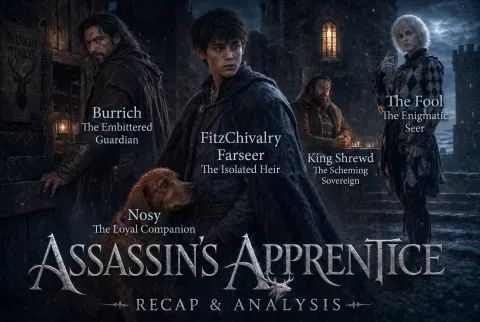
FitzChivalry Farseer
The reluctant royal servantA royal bastard raised at Buckkeep, Fitz now lives quietly as Tom Badgerlock, an herbalist and foster father. He is skilled in the Wit and the Skill, but distrusts both his own power and the institutions that claim a right to use it. His first instinct is often to endure pain privately rather than ask for help, a habit born from years of service, secrecy, and betrayal. He values loyalty, yet his loyalties can pull in incompatible directions: toward the Farseers, the people he loves, and the life he has made outside the court. His sharpness and dry humor conceal a profound need for companionship.
The Fool, Lord Golden
The golden prophetFitz’s oldest friend is a White Prophet who travels under the polished identity of Lord Golden. Once the sharp-tongued jester of Buckkeep, he now uses wealth, beauty, and performance as tools for moving through the court. He believes history can be redirected, and sees Fitz as essential to that work, but his prophetic purpose does not spare him guilt over the dangers he draws his friend into. Beneath his elaborate roles is a person capable of deep tenderness, loneliness, and self-sacrifice. His bond with Fitz depends on a rare trust that neither man finds easy to name.
Nighteyes
Fitz's wolf-brotherNighteyes is Fitz’s Wit-bonded wolf and closest companion. He is observant, wry, fiercely independent, and far more attentive to human motives than he likes to admit. Their bond gives Fitz access to the wolf’s senses and shares thought between them, but it is not ownership: Nighteyes insists on privacy, respect, and the right to make his own choices. He often sees through Fitz’s self-deception, especially when fear disguises itself as protection. His pack loyalty is expressed through action, practical judgment, and a teasing affection that has endured across years of danger.
Prince Dutiful
The isolated Farseer heirDutiful is the young heir to the Six Duchies and son of Queen Kettricken. Raised under the weight of public expectation, he is disciplined, private, and determined to do things perfectly. His rank makes ordinary friendship difficult: every companion can be interpreted as a political choice, and every personal desire risks becoming a matter of state. He is curious about the world beyond court and hungry for an intimacy that does not depend on his title. That combination leaves him vulnerable to anyone who offers belonging while appearing to ask nothing in return.
Chade Fallstar
The Queen's hidden councillorChade is Fitz’s former mentor in the art of quiet service: poisons, observation, disguise, and political inference. He has survived several Farseer reigns by making himself indispensable, and now advises Queen Kettricken while training a new apprentice. Age has begun to complicate his confidence, though he resists admitting it. His affection for Fitz is genuine, but he often expresses it through tests, bargains, or attempts to direct events. He believes preparation can prevent catastrophe, even when his knowledge is incomplete. With Fitz, his deepest struggle is not whether he cares, but whether he can trust care without turning it into control.
Queen Kettricken
The Mountain-born rulerKettricken came from the Mountain Kingdom to marry Verity as part of a political alliance and became a respected ruler in the Six Duchies. Her Mountain upbringing teaches her that a sovereign exists to serve the people, yet governing Buck requires compromises that trouble her. She is disciplined, compassionate, and politically courageous, but her love for Dutiful can unsettle the steadiness she shows in public. She seeks peace through alliances, including a proposed marriage with the Out Islands, while trying to limit the harm those arrangements can cause.
Hap
Fitz's foster sonHap is a foundling Fitz raised in an isolated cottage. Curious, practical, and eager to become a craftsman, he has outgrown the safe routine that once suited him. He wants to make his own way, but his lack of money and social connections exposes how difficult that will be. His honesty can be painful, particularly when he tells Fitz what others would conceal. Hap’s affection for both Fitz and Nighteyes gives the household its human warmth, while his growing independence forces Fitz to reconsider what it means to care for someone.
Starling Birdsong
The court's restless minstrelStarling is a celebrated minstrel and longtime companion of Fitz. Her quick wit, social confidence, and talent for storytelling let her move among nobles, traders, and political agents with unusual ease. She enjoys the freedom her profession gives her and is often candid about wanting comfort and pleasure. Yet her frankness can become self-protection, and she sometimes assumes that others should accept arrangements that suit her. She has a genuine history with Fitz, though they do not attach the same meaning to their years together.
Jinna
The candid hedge-witchJinna is a traveling hedge-witch whose craft combines practical herbal knowledge with charms she tunes to the people who use them. Warm, capable, and socially perceptive, she makes room for others without demanding that they explain themselves. Her encounters with Fitz begin in trade and hospitality, but she recognizes his loneliness and the danger attached to his secret. She regards magic as a condition one must learn to live with, not a reason to despise someone. Her easy welcome offers a kind of human connection Fitz has not known how to seek.
Laurel
Kettricken's HuntswomanLaurel serves Queen Kettricken as a skilled huntswoman and tracker. She is direct, observant, and accustomed to judging people by what they do rather than the status they claim. Her childhood among Old Blood relatives left her feeling excluded from a magic she could not share, which gives her views on the Wit an uneasy complexity. She is loyal to the Queen, but her loyalty does not make her unquestioning. Laurel can act decisively when she believes a life is at stake, and she carries both family ties and political obligations into the same difficult choices.
Burrich
The father Fitz left behindBurrich raised Fitz as a boy and taught him discipline through work, care for animals, and a stern sense of responsibility. A gifted horseman and stablemaster, he regards the Wit with fear because he has seen how a bond can overwhelm a young person. His strictness is rooted in protection, though Fitz often experienced it as rejection. Burrich’s loyalty is practical rather than eloquent: he shelters those who need him and builds a life through steady labor. His relationship with Fitz remains important even across years of separation.
Molly
Fitz's first great loveMolly grew up in Buckkeep Town and shared a deep attachment with Fitz before his apparent death. Independent and capable, she builds a household through work and care for her children. Her life is shaped by choices made in the absence of the man she once loved, and she does not exist merely as a memory in Fitz’s story. The distance between them reflects the consequences of secrecy and survival: love can remain real even when the lives that once held it have moved in different directions.
Nettle
Fitz's unseen daughterNettle is the daughter Fitz has never met, raised by Molly and Burrich among a lively household of brothers. She is described as stubborn, sharp-minded, and drawn to horses, hawks, and weapons rather than the domestic skills her mother would prefer. Chade’s reports suggest a young person who resists being shaped by other people’s expectations. Though absent from Fitz’s daily life, she represents both the family he chose not to disrupt and the future he fears he may still affect.
Verity Farseer
The absent kingVerity was Fitz’s uncle, king, and first true teacher of the Skill. He carried the burden of defending the Six Duchies during the Red Ship War and made severe choices in service of the kingdom. Fitz remembers him as both a ruler and a beloved mentor, a man whose strength could inspire loyalty while leaving others to bear painful consequences. Verity’s legacy shapes the Farseer succession and continues to influence Fitz’s sense of duty, even when the king himself is beyond reach.
Laudwine
The Piebalds' hardline leaderLaudwine leads a faction of Old Blood people who call themselves Piebalds. Charismatic and politically forceful, he turns generations of persecution into a demand for power and revenge. He can speak persuasively about justice, especially to young people who have watched their families suffer, but his vision permits coercion when it serves the cause. His grievance is personal as well as political, and he treats that history as a warrant to reshape other people’s lives.
Peladine
An Old Blood figurePeladine is connected to the Piebald movement and to the story of Dutiful’s unusual hunting companion. Her history is known unevenly, through what other people believe and repeat. She is absent from ordinary court life, yet her name carries emotional and political force among those who claim the Old Blood. The gap between reputation and reality makes her a source of uncertainty for Fitz and the Prince.
Deerkin
A cautious Old Blood cousinDeerkin is a young Old Blood man who becomes involved with Laudwine’s cause alongside his brother Arno. He is motivated by anger at persecution and by a longing to see his people live openly, but he is not entirely comfortable with every method used in that struggle. His family connection to Laurel complicates the political divide, reminding both sides that kinship persists beneath accusations and factions.
Arno
Deerkin's devoted brotherArno is Deerkin’s brother and a young man without the Wit who nevertheless identifies with the Old Blood. His loyalty to his family and community is stronger than his fear of danger. He becomes an example of how persecution can draw even those without the magic into its consequences.
Lady Bresinga
A Galeton power brokerLady Bresinga presides over a prosperous household known for its hunting cats. Socially ambitious and adept at hosting, she welcomes Lord Golden as a valuable guest and carefully manages her family’s place in court society. Her responses to questions about Dutiful are guarded, making her household an important center of Fitz’s investigation.
Civil Bresinga
The proud young heirCivil is Lady Bresinga’s son, close in age to Hap and raised amid the privileges of a noble household. He is strongly attached to his family’s social expectations and reacts poorly when Lord Golden disrupts the future arranged for him and Sydel Grayling. His pride makes him an easy target for Golden’s theatrical provocations.
Sydel Grayling
The eager young noblewomanSydel is the daughter of Lord and Lady Grayling, with an expected match to Civil Bresinga. She is curious, impressionable, and drawn to Lord Golden’s beauty and attention. Her parents’ hopes for her future place her between personal fascination and family strategy.
Miskya
Jinna's welcoming nieceMiskya is Jinna’s niece, a young woman who helps run the hedge-witch’s home and welcomes Hap when he arrives in Buckkeep Town. She is generous with hospitality and quick to reassure Fitz that his son will be safe in her family’s care.
Elliania
The Out Islands NarcheskaElliania is the young Narcheska from the Out Islands, brought to Buckkeep as Dutiful’s intended bride. She is spirited and curious, showing little interest in hiding from the storm during her arrival. Her presence represents a political alliance between peoples with a long history of trade, conflict, and intermarriage.
Plot Devices
The Wit
A bond across speciesThe Wit lets a person share thoughts and senses with an animal, but the bond is mutual and can become dangerously unequal. Fitz’s connection with Nighteyes gives them companionship, hunting skill, and a shared way of reading the living world. Dutiful’s inexperienced bond with his hunting cat becomes central to his disappearance and vulnerability. The magic also shapes the social conflict: fear of Witted people fuels executions, while secrecy isolates those who possess it. The novel treats the Wit as neither a simple gift nor a simple curse; its meaning depends on consent, instruction, and the respect each partner gives the other.
The Skill
A current between mindsThe Skill is a mental magic associated with the Farseer line. It can connect people across distance, carry memories and dreams, and in trained hands influence or heal. Fitz’s neglected talent returns as a painful, addictive force, while his untrained dream-link with Dutiful supplies clues and later lets him search for the Prince. Because the magic can blur boundaries between selves, it can also expose private thoughts or leave an inexperienced user lost in its flow. Its recurring cost prevents it from functioning as an effortless solution to the plot.
White Prophet and Catalyst
Prophecy redirected by choiceThe Fool believes that each age produces a White Prophet who can redirect history, and a Catalyst whose actions make that redirection possible. He identifies Fitz as his Catalyst because Fitz’s survival and choices have already changed the Farseer line. This belief gives the Fool a reason to seek Fitz out and shapes the risks he asks him to take. The device does not provide a clear map of events; prophecy arrives in fragments and competing possibilities. Its pressure comes from the question of whether serving a better future justifies spending another person’s life.
Elderling Pillars
A gate through distanceBlack standing stones marked with carved signs can transport people between distant places. Their inscriptions identify destinations, but a traveler who cannot read them may emerge somewhere unexpected. Fitz knows enough to risk one when ordinary escape is impossible, yet passage through a pillar can disorient and endanger the mind, especially when more than one person travels together. The stones also connect the present crisis to the vanished Elderling world and to Fitz’s earlier experiences with Verity. They provide a physical route out of danger while creating fresh uncertainty about where the travelers will land.
Jinna's Charms
Small magic, social leverageJinna makes charms from beads, rods, herbs, and symbols, tuning some of them to the person who will use them. One is intended to make others more favorably disposed toward Fitz, an effect he finds unsettling but uses when he must move through unfamiliar company. Another charm protects his garden. The objects contrast with the Skill and Wit: their workings are modest, material, and tied to the hedge-witch’s craft rather than royal blood or animal bonds. They also offer a plot function, giving Fitz a small advantage while reminding him that even kindly influence can complicate consent.
FAQ
Basic Details
What is Fool's Errand about?
- Fitz's Peaceful Exile Ends: The story centers on FitzChivalry Farseer, living under an assumed name in quiet self-exile for fifteen years, believed dead by most. His solitude is shattered when his former mentor, Chade, and his old friend, the Fool (now Lord Golden), seek him out.
- Quest for the Missing Prince: Fitz is drawn back into the affairs of the Six Duchies when Prince Dutiful, the young heir to the throne, vanishes just before a crucial betrothal ceremony. Fitz, possessing unique magical skills (Wit and Skill), is deemed the only one capable of finding him.
- Navigating Court Intrigue & Old Magic: The narrative follows Fitz's reluctant return to Buckkeep, his adoption of a new identity as Lord Golden's servant, and his journey to locate the Prince, uncovering layers of political conspiracy involving the resurgence of the Wit and a mysterious group called the Piebalds.
Why should I read Fool's Errand?
- Deep Character Exploration: The book offers an intimate look into Fitz's internal struggles, his attempts to reconcile his past as a royal assassin and Witted one with his desire for a simple life, and the profound impact of his relationships, particularly with the Fool and Nighteyes.
- Rich World-Building & Magic System: Robin Hobb expands upon the intricate world of the Six Duchies, delving deeper into the nature and history of the Skill and the Wit, exploring the cultural prejudices surrounding magic, and introducing new elements like the memory stone and Elderling artifacts.
- Emotional Depth and Subtle Plotting: Beyond the central quest, the novel excels in its emotional resonance, exploring themes of loneliness, sacrifice, identity, and the burden of destiny through subtle interactions, layered dialogue, and a narrative style that prioritizes internal reflection alongside external action.
What is the background of Fool's Errand?
- Post-Red Ship War Era: The story is set fifteen years after the events of the Farseer Trilogy, following the devastating Red Ship War and the Forging. The Six Duchies are in a period of rebuilding and political stabilization under Queen Kettricken.
- Resurgence of Wit Persecution: Despite Queen Kettricken's efforts to protect Witted folk, old prejudices and fears are resurfacing, fueled by mysterious incidents and the emergence of the Piebalds, a group asserting Witted rights through confrontational means.
- Political Alliances and Succession: The Farseer throne, now held by Kettricken as Regent for her son Prince Dutiful, seeks to secure its future through strategic alliances, notably a betrothal between Dutiful and an Out Islands Narcheska, highlighting the ongoing complex relationship between the Six Duchies and their former enemies.
What are the most memorable quotes in Fool's Errand?
- "Is time the wheel that turns, or the track it leaves behind?": This opening line, presented as Kelstar's riddle, immediately establishes a central theme of the novel: the nature of time, memory, and whether we are driven by the present moment or defined by the past's indelible marks. It sets the stage for Fitz's reflection on his own history and perceived stagnation.
- "Death is always less painful and easier than life! ... Death is what you get when there are no choices left to make.": Spoken by the Fool, this quote encapsulates a core philosophical debate in the book about the value of life despite suffering. It challenges Fitz's inclination towards passive existence and underscores the Fool's belief in the necessity of choice and action, even when difficult, to shape destiny.
- "You are my new beginning.": The Fool's declaration to Fitz reveals the depth of his reliance on Fitz as his Catalyst. It signifies that Fitz's survival and presence are not just personally important to the Fool, but are the essential element for the Fool to fulfill his own prophetic purpose and steer the world towards a better future.
What writing style, narrative choices, and literary techniques does Robin Hobb use?
- First-Person Introspective Narrative: The story is told from Fitz's first-person perspective, offering deep access to his thoughts, feelings, and internal conflicts. This choice emphasizes his isolation and allows for extensive psychological analysis, making the reader privy to his doubts, regrets, and subtle observations.
- Layered Foreshadowing and Symbolism: Hobb employs subtle foreshadowing through dreams, seemingly casual dialogue, and environmental descriptions (e.g., the encroaching forest, the changing town, the memory stone). Recurring symbols like scars, hands, and animals (wolf, cat, birds) are used to represent identity, connection, and the cost of magic.
- Pacing and Emotional Resonance: The narrative often shifts between periods of quiet reflection and intense action. Hobb builds emotional tension through Fitz's internal monologue and carefully crafted interactions, allowing moments of profound connection or devastating loss to land with significant impact, often contrasting the mundane details of daily life with the extraordinary circumstances of his destiny.
Hidden Details & Subtle Connections
What are some minor details that add significant meaning?
- Jinna's Charm Against Predators: The hedge-witch's gift, initially presented as a simple garden charm, later proves to be a powerful ward against Witted creatures. Its effect on the mistcat and its ability to deter the Piebalds reveal a deeper, perhaps instinctual, layer to hedge-magic and its connection to the natural world, contrasting with the more intellectual Skill and Wit.
- The Fool's Bruised Hands: After pulling Fitz back from the Skill-trance at Galeton, the Fool's hands are bruised. This seemingly small detail highlights the physical cost of using the Skill, even for someone not inherently Skilled, and underscores the depth of the Fool's effort and sacrifice in saving Fitz, reinforcing their intertwined fates.
- The Black Stone's Pervasiveness: The recurring appearance of the black, silver-veined memory stone – in the Skill-pillars, the Elderling city ruins, the Galeton inn, and the Buckkeep Witness Stones – subtly links disparate locations and historical periods. It suggests a deeper, ancient connection across the Six Duchies related to the Elderlings and Skill magic, hinting at a history and power structure far older than the Farseer line.
What are some subtle foreshadowing and callbacks?
- Chade's Skill Experiments: Chade's early mention of experimenting with Skill-enhancing herbs from the scrolls foreshadows his later reliance on them and his potential vulnerability, hinting that his pursuit of Skill knowledge might come at a cost, mirroring Fitz's own struggles with the magic.
- The Piebald Prince Song: Starling's recounting of the song about the Piebald Prince and his Witted followers, and the brutal method of his demise, foreshadows the danger Prince Dutiful faces due to his Wit and the extreme measures taken against Witted individuals, setting a grim precedent for the conflict to come.
- Fitz's Dream of the Marketplace: Fitz's recollection of his Skill-dream at the Skill-pillar crossroads, where he saw the Fool as a woman in a marketplace, subtly foreshadows the Fool's later transformation into Lord Golden and his comfort in public life, while also hinting at the existence of other realities or timelines accessible through the pillars.
What are some unexpected character connections?
- Laurel's Old Blood Kinship: Laurel, the Queen's Huntswoman, is revealed to have Old Blood family connections near Galeton, specifically to Deerkin. This unexpected link places her in a complex position, torn between her loyalty to the Queen and her blood ties to the Witted community, adding depth to her character and motivations.
- The Prince's Connection to Fitz's Past: Prince Dutiful's Skill-dreams, which mirror events from Fitz's life (hunting with Nighteyes, being warmed by the wolf), reveal a deep, unconscious Skill-bond between them. This connection, unknown to Fitz until Chade reveals it, underscores their shared Farseer heritage and the potential for Fitz to mentor the Prince.
- Jinna's Charm and the Fool's Glamour: Jinna's hedge-witch charm, intended to make people well-disposed towards Fitz, and the Fool's ability to project a captivating glamour as Lord Golden, are presented as different forms of influencing perception. Their shared effect on others, particularly Laurel and Sydel, subtly links these seemingly disparate magical practices and highlights the theme of appearance versus reality.
Who are the most significant supporting characters?
- The Fool (Lord Golden): Beyond his role as Fitz's friend and the White Prophet, his transformation into Lord Golden and his adept performance of this persona are crucial. This new identity allows him access to court circles and provides the cover for their mission, while his struggle with the persona reveals his own vulnerabilities and the sacrifices he makes for his destiny.
- Chade Fallstar: As Fitz's former mentor and the Queen's Councillor, Chade represents the enduring call of duty and the Farseer legacy. His aging, his reliance on Skill-enhancing herbs, and his desperate concern for Prince Dutiful reveal his vulnerability and the heavy burden he carries, highlighting the changing dynamics of power and reliance.
- Laurel: The Queen's Huntswoman is more than just a guide. Her loyalty, her unexpected Old Blood connections, her bluntness, and her eventual decision to help Deerkin gather support against Laudwine demonstrate her moral compass and agency, making her a key player in the resolution of the conflict with the Piebalds.
- Prince Dutiful: As the catalyst for the plot, Dutiful's character arc from a naive, lonely prince seeking belonging to a young man confronting harsh truths about his magic and his identity is central. His vulnerability to manipulation and his eventual acceptance of his Farseer duty, influenced by Fitz, drive the narrative forward.
Psychological, Emotional, & Relational Analysis
What are some unspoken motivations of the characters?
- Fitz's Need for Connection: While Fitz claims to desire solitude, his deep-seated need for connection, stemming from his isolated upbringing and past losses, is an unspoken driver. His immediate attachment to Hap, his reliance on Starling's visits, and his profound relief at the Fool's return reveal that his self-imposed exile is as much a defense against further pain as a genuine preference for loneliness.
- Chade's Desire for Legacy: Beyond his duty to the Farseer throne, Chade's eagerness to teach Prince Dutiful the Skill and his hope that Fitz will return to mentor him are subtly motivated by a desire to see the Skill tradition continue and to ensure the Farseer line's strength endures beyond his own lifetime, a legacy he feels responsible for.
- Laurel's Search for Acceptance: Laurel's willingness to help her Old Blood cousins, despite her earlier disdain for their magic, is subtly motivated by a longing for acceptance within a family she felt excluded from as a child. Her actions are driven by a desire to bridge the gap between her two worlds and prove her worth to her kin.
What psychological complexities do the characters exhibit?
- Fitz's Trauma and Dissociation: Fitz exhibits deep psychological complexity stemming from past trauma, particularly his torture and near-death experience. His tendency to compartmentalize his identities (Fitz, Tom Badgerlock), his struggle with Skill-induced pain and dissociation, and his difficulty forming trusting relationships are direct consequences of his past, explored through his internal monologue and reactions to stress.
- The Fool's Performance and Vulnerability: The Fool's creation and maintenance of the Lord Golden persona reveal a complex interplay between performance and authenticity. While seemingly effortless, his need for Fitz's validation and his moments of vulnerability when the facade cracks (e.g., after the kiss with Civil, after the Skill-trance) show the psychological toll of constantly performing a role and the deep need for genuine connection beneath the artifice.
- Prince Dutiful's Identity Crisis: Dutiful's struggle with his identity as both a Prince and a Witted individual, coupled with his desperate loneliness, makes him psychologically vulnerable to manipulation. His idealization of the woman-cat and his willingness to abandon his duty for perceived love highlight the psychological impact of isolation and the search for belonging.
What are the major emotional turning points?
- The Fool's Return: The arrival of the Fool, transformed into Lord Golden, is a major emotional turning point for Fitz. It shatters his carefully constructed peace, forces him to confront his lingering attachments to his past, and reignites the sense of destiny he had tried to bury, setting the stage for his reluctant return to action.
- Nighteyes' Near-Death and Recovery: Nighteyes' heart attack and Fitz's desperate use of magic to save him mark a critical emotional turning point in their bond. It forces them to confront the wolf's mortality and the depth of their interdependence, leading to a period of emotional distance and eventual, painful acceptance of their intertwined fates.
- Fitz's Confrontation with Dutiful: The physical and emotional confrontation between Fitz and Prince Dutiful on the beach, culminating in Fitz's forceful Skill-command, is a pivotal emotional turning point. It reveals the depth of Fitz's desperation, the Prince's vulnerability, and establishes a new, complex dynamic between them, shifting from pursuer and pursued to potential mentor and student.
How do relationship dynamics evolve?
- Fitz and the Fool: Their relationship evolves from a bond of shared secrets and mutual reliance forged in youth to a partnership of equals, albeit with shifting roles (master/servant, prophet/catalyst). The Fool's transformation and Fitz's established life challenge their old dynamic, but their deep affection and understanding ultimately reaffirm their unique connection, even as new tensions arise from their differing approaches and the Fool's manipulations.
- Fitz and Prince Dutiful: Their relationship transforms dramatically from that of a hidden protector/protected heir to a direct, confrontational dynamic during the pursuit. After Fitz's forceful intervention, it shifts again towards a tentative mentor/student relationship, built on a foundation of shared magic, vulnerability, and a complex mix of resentment and dawning respect.
- Fitz and Laurel: Their initial dynamic as master and servant is complicated by Laurel's status as the Queen's confidante and her unexpected Old Blood kinship. Her growing awareness of Fitz's true nature and her own moral choices create a dynamic of cautious alliance, marked by moments of blunt honesty and unspoken understanding, ultimately leading to a degree of mutual respect despite their differences.
- Fitz and Nighteyes: Their bond, already deep, is tested by Nighteyes' aging and Fitz's intrusion during the heart attack. The wolf's resentment and subsequent withdrawal create emotional distance. However, facing external threats and the inevitability of death ultimately strengthens their connection, leading to a poignant acceptance of their shared fate and a deeper appreciation for their time together.
Interpretation & Debate
Which parts of the story remain ambiguous or open-ended?
- The Full Nature of the Woman-Cat Bond: While Fitz deduces that a dead woman's consciousness inhabits the mistcat, the exact mechanism of this bond, how it differs from a living Wit-bond, and the extent of the woman's control over both the cat and the Prince remain somewhat ambiguous. The narrative hints at it being unnatural and parasitic, but the full implications of such a bond are left open to interpretation.
- The Extent of the Piebalds' Organization and Goals: The Piebalds are presented as a faction with a clear agenda (claiming the Prince, asserting Witted rights), but their full network, the depth of their planning, and the ultimate goals of leaders like Laudwine and the woman-cat are not fully revealed. Their motivations are complex, ranging from genuine desire for acceptance to ruthless ambition and vengeance, leaving their future actions and true power open to debate.
- The Long-Term Effects of Fitz's Skill-Commands: Fitz uses the Skill to impose commands on Regal and later Prince Dutiful ("Don't fight me"). The narrative questions the ethics and permanence of such actions. The long-term psychological and magical effects of these forceful imprints on the Prince's mind and his Skill/Wit abilities are left open-ended, hinting at potential future consequences.
What are some debatable, controversial scenes or moments in Fool's Errand?
- Fitz's Torture of the Archer: Fitz's decision to physically and psychologically torment the captured Piebald archer to gain information is a highly controversial moment. It forces readers to confront the dark side of Fitz's past and the moral compromises he is willing to make for his mission, sparking debate about whether his actions are justified by the urgency of the situation or represent a descent into brutality.
- The Woman-Cat's Sacrifice: The mistcat's decision to provoke Fitz into killing her, seemingly to free the Prince from the woman's influence, is debatable. Was it truly the cat's will, or the woman's final, desperate act of manipulation or sacrifice? The ambiguity surrounding her motives and the nature of her bond with the cat makes this a complex and potentially controversial moment regarding agency and the ethics of magical bonds.
- Fitz's Decision to Leave the Fool and Nighteyes: Fitz's choice to escape through the Skill-pillar with Prince Dutiful, leaving the Fool and Nighteyes to face the Piebalds, is a moment of intense emotional conflict and potential controversy. While framed as a necessary sacrifice for the greater good (saving the Farseer line and Nettle), it forces Fitz to abandon his closest companions, raising questions about the limits of duty and the personal cost of his destiny.
Fool's Errand Ending Explained: How It Ends & What It Means
- Prince Dutiful is Rescued and Returned: Fitz successfully brings Prince Dutiful back to Buckkeep Castle just in time for his betrothal ceremony. Their escape is facilitated by the sacrifice of the mistcat (killed by Fitz) and the intervention of other Old Blood elders who arrive to confront Laudwine's Piebalds, allowing Fitz and the Prince to flee through a Skill-pillar.
- Loss and New Beginnings: The ending is marked by profound loss, most significantly the death of Nighteyes, who sacrifices himself fighting the Piebalds alongside the Fool. The Fool is also left behind, his fate uncertain but implied to be grim. Despite this devastation, the ending signifies a new beginning for Fitz, as he accepts his role as mentor to Prince Dutiful, promising to teach him the Skill and Wit, and finds a tentative place for himself at Buckkeep.
- Meaning: Duty, Sacrifice, and Identity: The ending underscores the central themes of duty and sacrifice. [
The Tawny Man Series


About the Author


Download PDF
Download EPUB
.epub digital book format is ideal for reading ebooks on phones, tablets, and e-readers.








