


Plot Summary
Prologue
Years after the events he records, Fitz writes to give pain a purpose and keep his own memories from dissolving. He recalls dying in Regal's dungeon, being poisoned, and buried beneath the snow. Lady Patience washed and buried his battered body, believing him dead.
Later, Burrich and Chade dug him out and used Nighteyes, the wolf bonded to Fitz, to bring his human soul back. The rescue restored his body but not the years he lost, or the life his friends continued without him. Writing becomes his way to face what happened, including the question he cannot settle: whether those who raised him saved his life or claimed it for their own.
The frame makes survival costly before the adventure begins. Fitz is alive, but he describes resurrection as an interruption rather than a clean second chance: his body bears Regal's violence, his memory holds a missing year, and the people who chose to revive him did so from loyalty that could not include his consent. Writing gives him a task, but it also forces him to revisit the choices he would rather bury. The prologue establishes the book's central tension between being loved and being used, and between remembering pain and letting pain decide what the self becomes.
A Wolf in a Man's Skin
In a shepherd's hut, Burrich keeps Fitz indoors, feeds him carefully, and gives him small tasks while Fitz thinks mostly in the wolf's immediate needs. Nighteyes waits outside, and Chade visits in disguise, hoping to find signs that the man they rescued is returning.
Memories arrive as fragments: a woman named Patience, the name Molly, the dungeon, King Shrewd. The breakthrough comes when Chade and Burrich use brandy to coax Fitz into speaking of Verity. He finally remembers that Verity lives, and that the king is calling him. Fitz is himself again, but the recovered past brings grief and guilt with it, not relief.
Fitz's return to personhood is neither a miracle cure nor a triumph of will. Burrich must rebuild him through ordinary routines, while Chade's experiment reveals how fragile the boundary is between memory and coercion. The wolf's presence has kept Fitz alive, but it has also offered a refuge from human pain. Recovering his name means recovering his obligations and losses at the same time. The scene frames identity as a relationship: Fitz returns because others call for him, but he must eventually decide what their claims on him mean.
The Parting That Cuts
Chade tells Fitz that Verity may still be alive, but Fitz resists returning to the life of a king's tool. He lashes Burrich with old resentments, accusing him of shaping his life through duty, and wounds Chade by challenging his authority as well. Burrich explains that he will leave to help a woman in need, while Chade refuses to share his plans.
Their departure leaves Fitz alone with the freedom he demanded. The next morning Burrich leaves him clothes, money, and a belt before walking away. Fitz chooses not to follow or apologize. He decides to travel to Tradeford and kill Regal, believing revenge is the only purpose left that is his own.
Fitz's anger is not simply rebellion against authority. It is an attempt to reclaim agency after a life in which kings, mentors, and loved ones repeatedly decided what he should sacrifice. But he can imagine freedom only as a negative space, defined by the people he rejects. Revenge gives that emptiness a target. His cruelty to Burrich exposes the cost of confusing self-determination with severing attachment: he escapes dependence, but also the relationships that might help him become more than the injuries done to him.
Verity Calls Back
Chade learns that Fitz once said Verity was alive, and urges him to reach the king through the Skill. Fitz resists until he finally opens his mind and finds Verity exhausted in the Mountains. He lends him strength, then hears that Verity is still pursuing the Elderlings, the legendary allies who might defend the Six Duchies from the Red-Ships.
Fitz now knows the call is real. He prepares for Tradeford anyway, gathering poisons, herbs, and a disguise, but his plan begins to change. Meanwhile, news from a traveling minstrel shows that Regal has abandoned the coast, while Lady Patience sells her own possessions to defend its people.
This is the first decisive split between Fitz's stated aim and his deeper loyalty. Revenge still feels like a personal act of justice, but contact with Verity makes the kingdom's danger immediate and specific. The exchange also establishes that the Skill is both communication and vulnerability: Fitz can strengthen his king, but opening himself risks exposure to enemies. Patience's unseen work offers a counterpoint to Regal's abandonment. Where he treats the coast as expendable, she turns private wealth into practical protection for people who have no other defense.
The Road Takes Witnesses
Fitz travels along the Buck River with Harper Josh and his daughters, Honey and Piper, after they ask him to protect them from Forged ones. When attackers strike, Fitz freezes at first, then fights after Nighteyes is wounded and the women are threatened. He kills the raiders and tends the injured, but Honey condemns his moment of hesitation.
Later, Fitz rescues the drunken Black Rolf from soldiers and meets Rolf's bonded bear, Hilda, and Holly, who explain that Witted people belong to an old tradition, not a shameful curse. They warn that Forged ones are drawn to the bond's power. Fitz refuses their offer of training and continues toward Regal.
The fight forces Fitz to confront the difference between being capable of violence and being able to act when fear returns. His courage comes back only when Nighteyes is endangered, revealing how thoroughly their lives are joined. Rolf's household then reframes the Wit: what Buckkeep treated as contamination is, elsewhere, a culture with its own teachings and obligations. Fitz's refusal to stay shows that he is still organized around a single urgent purpose. The offer of wisdom cannot yet compete with revenge, even when ignorance is making the road more dangerous.
The Wolf Chooses His Pack
When Nighteyes hears a wild pack calling, he leaves Fitz to discover whether he can belong among wolves. Fitz continues alone, resisting the urge to summon him, while Skill-dreams pull him into Red-Ship raids and make distant suffering impossible to ignore. Nighteyes eventually returns, having run with the pack but declined its hierarchy.
He also shares Verity's summons: the king's call has bound them both. They resume the journey together, now more conscious that they are companions rather than master and animal. Fitz's growing respect for Nighteyes changes the terms of their bond, even as the Skill's call limits their freedom.
Nighteyes's departure tests the bond more honestly than any battle could. Fitz must allow his companion a life that is not simply an extension of his own, and the wolf's return is meaningful because it is not commanded. Their reunion also complicates that freedom: Verity's Skill-call has reached through Fitz and attached Nighteyes to a human duty he never chose. The episode makes loyalty feel both intimate and ethically fraught. Love can deepen a bond, but it can also transmit obligations across it without permission.
Tradeford's Failed Assassination
Fitz reaches Tradeford and infiltrates Regal's elegant estate during a lavish ball. He poisons Regal's possessions and kills two guards who were involved in his dungeon beating, but Skillmaster Will detects him. Will's illusions turn the estate into a maze and trap Fitz with armed guards.
Fitz cuts himself with his poisoned knife rather than endure another imprisonment. Verity blasts the coterie with Skill and commands Fitz to flee. Fitz escapes on Arrow, a horse he once knew, but Hands sees him and recoils in fear of his supposed Wit-magic. Fitz leaves the horse outside the city and continues on foot, still alive and still unable to reach Verity.
The failed assassination strips away Fitz's fantasy that revenge will restore control. He can enter Regal's house, but Will can alter what Fitz sees and make the building itself an instrument of domination. Verity's intervention saves him, yet also intensifies the summons that now governs his route. Hands's fearful rejection is especially painful because it turns shared history into evidence against Fitz. The rescue therefore gives him survival without belonging. Each escape carries him closer to Verity and farther from the ordinary life he had imagined reclaiming.
A Daughter He Cannot Reach
Working under the name Tom, Fitz joins a caravan driving sheep toward Blue Lake. During a Skill-dream he sees Molly in labor, with Burrich helping deliver a healthy girl. Fitz understands that Molly left because she was carrying his child, not because she had chosen another lover.
He immediately tries to turn back, imagining a home with Molly and their daughter, but Verity's command pulls him toward the Mountains so strongly that he cannot take the road home. He continues with the caravan, planning a future with the child as he walks. When Starling reveals that Regal's men are offering a reward for him, Fitz knows even his disguise is failing.
The birth changes Fitz's understanding of Molly's departure, but knowledge arrives too late to become action. He can see the family he wants, yet Verity's command makes the choice to return feel physically impossible. This is a sharper form of coercion than an order from a king: the Skill has entered Fitz's own will and made disobedience nearly unthinkable. His imagined future with his daughter keeps him moving, but it also becomes another promise he cannot yet fulfill. Hope here is both sustenance and a source of pain.
Bolt's Poisoned Patrol
At a hiring fair, Fitz takes work with a sheep caravan bound for Blue Lake. Tassin recognizes his scars and alerts Captain Bolt, the guard who once beat him in Regal's dungeon. Bolt captures and shackles him, intending to return him alive for the King's Circle.
Fitz has already treated his knife with poison, and the guards fall sick one by one during the march. Bolt finally tries to kill him himself. Fitz strikes him with the chain and uses the Wit to overwhelm him. He frees himself, finds his earring and supplies among the dead, and leaves the surviving young guard behind, unable to save him.
Fitz's escape depends on a skill he once wielded for the crown, but it no longer feels like honorable service. Poison, deception, and the death of an inexperienced guard leave him alive while deepening his guilt. Bolt's capture also makes the old trauma physical again: Fitz must endure chains and blows without becoming the helpless prisoner he remembers. His survival is hard-won, but it does not restore his confidence. It teaches him instead that competence can protect him while still leaving moral damage in its wake.
The River Takes Nighteyes
At Blue Lake, minstrel Starling guides Fitz to Nik Holdfast, a smuggler willing to carry them across the swollen river and into the Mountains. During the crossing, Nik's men attack Fitz, hoping to trade him to Regal's captain. Nighteyes knocks one attacker into the water, but a weakened railing breaks and the wolf is swept away.
Fitz fights the men and is captured on the far bank. Nik claims their bargain was fulfilled, but Regal's soldiers seize him and the pilgrims too. Bound and taken toward Moonseye, Fitz reaches Nighteyes through the Wit and guides him to shelter, knowing the wolf may die of cold.
The river crossing makes betrayal and separation one event: Nik treats Fitz as cargo, while Nighteyes risks his own life to resist. Fitz's bond lets him follow the wolf's struggle through the water, but cannot immediately rescue him. This exposes the danger of their closeness without diminishing its value. Nik's promise proves to have limits, and the lawful soldiers who capture the party are no more trustworthy than the smugglers. The river becomes a boundary between dependence and survival, with Fitz forced to trust Nighteyes beyond his sight.
Moonseye Burns Behind Them
Burl imprisons Fitz in Moonseye while the captured smugglers and pilgrims are held nearby. A night raid frees the others, and Starling and Kettle later reach Fitz as fires consume the town. Kettle brings the key; Starling helps him escape.
As they flee with a stolen wagon, Fitz learns the Holdfast smugglers burned Moonseye in revenge for soldiers who betrayed their deal and abused their captives. Fitz leaves Starling and Kettle on safer horses to draw pursuit away from them. In the mountains, Regal's trackers find him and shoot an arrow into his back. Nighteyes drives off the hounds and drags him to shelter.
Moonseye's destruction is not clean heroism. The Holdfasts retaliate against the guards who violated their bargain, but their vengeance also consumes a town and its ordinary inhabitants. Fitz's escape depends on a chain of compromised loyalties: Starling risks herself, Kettle acts, and smugglers avenge their own. When Fitz separates from the women, he repeats the self-sacrifice that has defined his life, though this time he chooses to draw danger toward himself. The arrow makes the cost immediate, while Nighteyes's rescue turns the bond into literal survival.
The Fool Names His Purpose
Fitz reaches Jhaampe near death and is carried into the Fool's home, where the Fool and a healer save him. Their reunion restores the Fool's belief that he is the White Prophet, destined to work history's changes with Fitz, whom he calls the Catalyst.
He reveals that Kettricken's child was stillborn, and that Chade hopes to claim Fitz's daughter as the Farseer heir. Fitz lies, denying that the girl is his, to keep her from being taken from Molly. When Chade and Kettricken confront him, he admits Verity lives and agrees to seek him, but refuses to surrender his daughter willingly.
The Fool's revelation enlarges the quest from dynastic rescue to an attempt to alter history itself, but the prophecy does not make Fitz feel chosen. It makes him feel more tightly bound. The dead heir leaves a political vacuum, and Chade's plan to fill it with Nettle turns Fitz's private hope into a public resource. His lie is not merely self-protection: it preserves Molly's right to raise her child, at the cost of trust with the people he needs. Love, duty, and political necessity now demand incompatible loyalties.
The Road That Calls
Kettricken leads Fitz, the Fool, Starling, Kettle, and Nighteyes into the Mountains to find Verity. On an ancient road made with Skill, Fitz grows distracted by ghostly impressions of people who once traveled it and nearly walks over a broken edge. Nighteyes and the others pull him back.
The road leads them to a ruined city where Fitz sees its former inhabitants and finds a map Verity made, revealing his next route. He returns to the present with a copy of the map. The journey also exposes Kettle's unusual knowledge of Skill history and the Fool's growing physical change, while Fitz becomes increasingly vulnerable to the road's pull.
The road turns magic into infrastructure: a remnant built to ease travel now exerts a force its makers understood better than Fitz does. Its danger is not an enemy's attack but an attractive confusion that erases the distinction between memory, desire, and present reality. The ruined city extends that problem, letting Fitz witness the past without being able to join it. His map is a practical reward, but the larger cost is his growing susceptibility. Knowledge does not arrive as mastery; it arrives as exposure.
Kettle's Buried Coterie
When Regal's coterie reaches the quarry, Kettle reveals that she was once Kestrel, a member of Queen Diligence's coterie more than two centuries earlier. In jealousy, she killed her sister and fellow Skill-user Gull, and her surviving companions burned her ability to reach the Skill before exiling her.
Fitz helps her confront the guilt that has kept her isolated. Kettle's Skill returns, and she agrees to help Verity complete the dragon. At the same time, Will and Regal attack through the Skill, using the Fool as a path toward Fitz. Fitz and Nighteyes break the intrusion, but the enemy learns how vulnerable their bond remains.
Kettle's history reveals that Skill can make intimacy a weapon and punishment a life sentence. Her exile was not only imposed by the coterie; shame became an inner wall she kept rebuilding. Fitz can help her reopen that wall because he recognizes how guilt can disguise itself as moral judgment. Yet the same openness carries risk: the coterie's attack exploits connection rather than brute force. The episode binds healing and danger together, making trust necessary but never safe.
Verity's Dragon Needs More
At the quarry, Verity has nearly finished a dragon he is carving from black stone, but he has also put his memories and strength into it. Kettle joins him, restoring her Skill and adding what she can. The dragon remains inert. Verity explains that it needs more life than the two of them can give, while Regal's forces close in and the coterie's attack leaves the Fool weakened.
Fitz offers himself as the missing life, but Verity refuses to take him. The choice leaves Fitz waiting beside the unfinished creature, aware that his king may sacrifice everything and that the dragon's awakening could demand a price no one can undo.
The dragon is not a weapon assembled from neutral materials. It is made from memory, identity, and accumulated lives, so its power cannot be separated from its cost. Verity's refusal to take Fitz's life preserves a boundary that the king's duty might otherwise erase. Yet his own sacrifice is already underway. The scene recasts the quest's central question: not whether the Six Duchies can be saved, but who is allowed to decide what must be spent to save them. Fitz's offer repeats the pattern he has tried to escape.
The Dragon Takes Flight
Regal's coterie comes through the pillars with soldiers, and Will attacks Fitz through the Skill. Verity's dragon is still unfinished, but when the Fool wounds Girl-on-a-Dragon while trying to free her, her blood wakes her. Nighteyes kills Burl, and the dragon rises, carrying the Fool away.
Verity's completed dragon then awakens through the lives and memories he and Kettle have given it. It flies for Buck, where it destroys the Red-Ships threatening the coast. Regal's army arrives too late to stop it. He later returns the crown to Kettricken, publicly pledges loyalty to the Farseer heir, and claims a sudden change of heart.
The climax resolves the immediate military crisis through an act that is neither pure victory nor simple resurrection. The dragons are awakened through living sacrifice, and the world receives its defenders at a cost that cannot be reversed. The Fool's accidental role in freeing the first dragon links prophecy to improvisation: the necessary event arrives through a mistake made under pressure. Regal's later reversal is deliberately unsettling. The kingdom gains a public peace, but the reader has seen how easily Regal's will can be bent and how little that resemblance to repentance can be trusted.
The Scribe's Chosen Life
Years after the quest, Fitz lives in a remote cottage with Nighteyes and a boy Starling brought him. He writes histories and memories, while the wolf sleeps by the hearth. Molly has married Burrich, and they are raising Nettle alongside children of their own. Fitz does not return to claim a place in their household; he accepts the distance, though he continues to wonder about them.
The Fool has disappeared from court life, and Chade serves openly as Kettricken's adviser. Fitz remains physically scarred and vulnerable to the Skill, but writing gives him work he can choose. His life is smaller than the one he once imagined, yet it is finally his to inhabit.
The epilogue refuses the conventional reward of reunion. Fitz's love for Molly and Nettle does not vanish, but neither does it grant him possession of them. He accepts that the family has continued without him, and builds a life around writing, friendship, and the wolf who chose to return. The final image answers the prologue's problem of purpose: he cannot recover the years or undo every sacrifice, but he can decide what to do with the memories he has. Authorship becomes a modest form of agency, not a cure.
Epilogue
Years later, Fitz lives in a cottage near the coast, writing with Nighteyes beside the hearth and a boy Starling has brought to him under his care. Molly and Burrich are married and raising Nettle with their own children. Fitz has not gone back to claim the life he once imagined with them.
He knows the girl is safe, but keeps his distance rather than expose her to the danger attached to his name. Chade works openly for Kettricken, and Starling's songs carry news of the restored kingdom. Fitz still suffers from pain and the lure of the Skill, but writing gives his days a purpose he chose himself.
The ending is emotionally honest because it does not confuse survival with restoration. Fitz's daughter is alive and loved, but he cannot simply step into her family after years of absence and danger. His restraint protects Nettle, yet it also leaves him with grief he cannot resolve by action. The cottage, the wolf, and the boy offer companionship without pretending to replace Molly or the child he lost to circumstance. Writing becomes a chosen practice rather than a royal assignment. Fitz's modest life is not triumph over fate, but a limited, hard-won form of authorship within it.
Analysis
Assassin's Quest asks what remains of a person when nearly every important relationship becomes an obligation. Fitz is repeatedly told that he is needed: by Burrich, Chade, Verity, the Fool, and eventually a kingdom. Even love can become another claim on him. His deepest struggle is not whether to sacrifice himself, but whether sacrifice is the only language in which he knows how to belong.
The book complicates the familiar fantasy idea that power is inherently heroic. The Skill can defend a coast or invade a mind; the Wit can sustain a mutual bond or expose its participants to danger. The dragons are not convenient weapons but repositories of lives and memory. Their power comes at a cost that cannot be neatly separated from the people who give it. Kettle's return to the Skill and Verity's transformation make rescue inseparable from loss.
Fitz's relationship with Nighteyes offers a countermodel to hierarchy. They correct, depend on, and choose one another without claiming ownership. Their bond does not erase difference: the wolf wants a pack, and Fitz wants a human family. The novel makes their shared life meaningful precisely because each remains capable of wanting something the other cannot provide.
The ending refuses to reward Fitz with the home he imagined. Molly, Burrich, and Nettle continue their lives without him, while Fitz finds purpose in writing and in the companionship of Nighteyes. That is not a clean victory over fate. It is a smaller but real act of authorship: choosing a life that does not pretend to repair every wound. The book's hardest lesson is that loyalty may require sacrifice, but sacrifice alone does not prove love, and those who are loved still deserve the right to choose what is given.
Review Summary
Assassin's Quest receives mixed reviews. Some praise Hobb's world-building, character development, and prose, particularly enjoying Fitz's relationships with Nighteyes and the Fool. Others criticize the slow pacing, repetitive plot, and unsatisfying ending. Many readers found the book too long and felt it could have been shorter. Despite disappointment with this final installment, many still consider the Farseer Trilogy worthwhile overall. Some readers express frustration with Fitz's character development and decision-making, while others appreciate his struggles and growth.
People Also Read






Characters
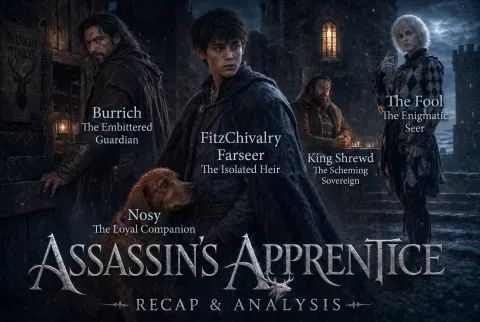
FitzChivalry Farseer
The wounded royal catalystFitz is the illegitimate son of Prince Chivalry, trained by Burrich in animal care and by Chade in assassination. He is bound to Nighteyes through the Wit and to the Farseer family through blood, service, and the Skill. He wants intimacy and an ordinary life, but repeatedly places duty ahead of both. His intelligence is practical and perceptive, yet trauma can narrow his choices to flight, anger, or self-sacrifice. Fitz's central conflict is not whether he can serve, but whether a life spent being useful to others can still belong to him.
Nighteyes
Fitz's wolf-bonded equalNighteyes is the wolf Fitz rescued and bonded with, becoming his closest companion and a second center of perception. He is blunt, playful, proud, and attentive to the immediate facts of hunger, danger, and pack. His wolf instincts often expose the evasions in Fitz's human reasoning, while his loyalty is freely chosen rather than obedience to a master. As he matures, Nighteyes seeks contact with wild wolves and a life beyond Fitz, even as their shared bond keeps drawing them together.
Verity Farseer
The missing kingVerity is Fitz's uncle, King Shrewd's elder surviving son, and the ruler whose Skill has been spent defending the coast. He is practical, stubborn, and willing to exhaust himself for the kingdom, but he is also a man with private tenderness, particularly toward Kettricken and Fitz. His long absence leaves others guessing at his fate and carrying responsibilities he once bore. Verity's deep sense of duty can inspire loyalty, but it can also draw people into sacrifices they did not fully choose.
The Fool
The prophetic court companionThe Fool is Fitz's closest human friend, a pale, sharp-witted court companion whose strange appearance and theatrical humor conceal keen observation. He understands how stories and expectations shape people, and he often provokes Fitz into seeing what he would rather avoid. His attachment to Fitz is profound, though he is not always able to explain it in ordinary terms. The Fool seeks purpose through prophecy, yet his uncertainty about what events mean makes him less a master of the future than a witness trying to interpret it.
Kettricken
The Sacrifice QueenKettricken is Verity's Mountain-born wife and Queen of the Six Duchies. Raised to understand leadership as service and sacrifice, she is disciplined, compassionate, and capable of commanding others without relying on royal privilege. She carries grief privately and expects herself to endure it for the sake of her people. Her loyalty to Verity is joined to political responsibility, making her both a loving partner and a leader who must weigh individual wishes against collective survival.
Burrich
The steadfast animal keeperBurrich raised Fitz after Chivalry entrusted the boy to his care. A former soldier and gifted handler of horses and hounds, he is disciplined, taciturn, and uncomfortable with the Wit. His affection tends to arrive as food, shelter, instruction, and protection rather than easy speech. Burrich understands how to train without cruelty and how to keep going through loss, though his loyalty to others can leave little room for a life of his own.
Chade Fallstar
The crown's hidden adviserChade is King Shrewd's secret adviser and Fitz's mentor in the quiet work of poison, observation, and political survival. He is resourceful, patient, and deeply loyal to the Farseer line, but his belief that he knows what is best can make him manipulative even toward those he loves. Chade's world is built on secrets, a habit that gives him power and isolates him from ordinary intimacy. His bond with Fitz combines paternal affection with the demands of an office that never truly ends.
Molly
The candlemaker Fitz lovesMolly is a candlemaker from Buckkeep Town and Fitz's childhood friend and beloved. Practical, proud, and skilled at making a living with her hands, she wants more than promises from a man whose loyalties are repeatedly claimed by the crown. Her history with an abusive father has left her alert to control disguised as care. Molly's strength does not make her invulnerable; she wants tenderness and security, but refuses to wait indefinitely for someone who cannot make room for her.
Starling Birdsong
The minstrel seeking a songStarling is a traveling minstrel whose ambition is to witness a history-making event and secure a lasting place among her profession. Clever, observant, and socially bold, she recognizes Fitz's identity before he admits it and chooses to follow him. Her skill with stories can make people visible, but it can also turn private pain into material. Starling wants independence and a future beyond endless travel, and her wish to be remembered sometimes conflicts with the loyalties she develops along the way.
Kettle, also known as Kestrel
The exiled Skill adeptKettle is an elderly, sharp-tongued traveler who seeks the White Prophet and carries a lifetime of reading, languages, and old teachings. She is self-reliant, guarded, and unwilling to be treated as fragile simply because of her age. Her knowledge of the Skill exceeds what her companions initially suspect, but she does not give information freely. Kettle's insistence on choice and self-command comes from a past she has never made easy to discuss.
Regal Farseer
The usurping prince-kingRegal is the younger son of King Shrewd, a cultivated and vain prince who prizes luxury, status, and control. He treats the coastal war as an inconvenience and regards people as pieces to be moved or discarded. Regal's ambition is not simply to hold a crown; he wants the power and recognition he believes his brothers have denied him. His reliance on the Skill and on those who serve him makes his rule dangerous, while his inability to distinguish respect from fear narrows the loyalty he can inspire.
Will
Regal's SkillmasterWill is the strongest surviving member of Galen's coterie and the chief Skill threat facing Fitz. Patient and subtle, he prefers to enter a mind by quiet manipulation rather than open force. He uses illusion, surveillance, and pain to serve Regal, and has learned to exploit weaknesses in Fitz's training. Will's confidence rests on being difficult to detect, but his control depends on a system of coercion that keeps even his allies uneasy.
Lady Patience
Buckkeep's defiant defenderPatience is Chivalry's widow and a former Queen-in-Waiting, known for eccentric habits, sharp speech, and a deep attachment to those under her care. When Regal abandons the coast, she turns neglected guards into a working defense force, selling her own possessions to aid villages and sailors. She rarely exercises power through formal authority. Instead, she builds loyalty by asking people to help where help is needed, and by sharing the labor herself.
Tassin
The exploited apprenticeTassin is a young puppeteer's apprentice whose family sold her years of labor after rejecting her preferred marriage. She resents the trade she has been forced to learn and looks for money, escape, and leverage wherever she can find them. Her sharpness toward Fitz reflects both genuine suspicion and the vulnerability of someone with little power over her own future. Tassin is neither merely a villain nor a helpless victim; she acts opportunistically because nearly every choice available to her has been chosen by someone else.
Burl
The coterie's complacent enforcerBurl is a former member of Galen's coterie who has become comfortable in Regal's service. Once a capable worker, he now values rank, ease, and the privileges his Skill can secure. His loyalty is shaped by training and ambition, yet he is not as powerful or self-assured as Will. Burl shows how political service can turn an ordinary desire for comfort into participation in coercion.
Carrod
The decorated court coterie memberCarrod is one of Galen's surviving Skill-users, now attached to Regal's court. He dresses with more display than substance and protects his status through rivalry, complaint, and self-justification. His history with Fitz makes him a personal threat as well as a political one. Carrod's polished manners do not conceal the insecurity beneath them; he fears losing favor and responds to danger by defending his place in the hierarchy.
Black Rolf
The bear-bonded elderBlack Rolf is an Old Blood man bonded to Hilda, a brown bear. He lives outside the social respectability of the Six Duchies and speaks openly about the tradition that Fitz was taught to fear. Rolf is hospitable but direct, and he sees the Wit as a relationship that requires mutual respect rather than control. His warning about the dangers of the bond gives Fitz a way to understand the people and animals he has long treated as familiar but not fully known.
Holly
Rolf's hawk-bonded partnerHolly shares Rolf's Old Blood household and is bonded to the hawk Sleet. Quiet and watchful, she notices more than she says, and she offers aid without insisting that Fitz accept her guidance. Her manner contrasts with Rolf's bluntness: she acts from care, but respects the limits others place on their own choices.
Nettle
Fitz and Molly's daughterNettle is the daughter of Fitz and Molly, known to Fitz first through the Skill and then through the people who care for her. Her name comes from the herb Molly gathers, a fitting marker of the practical, self-reliant life her mother hopes to build. Nettle matters to the story not as a political symbol but as a child whose safety and ordinary future become the measure against which adults test their claims of duty.
Prince Chivalry
Fitz's absent fatherChivalry is the eldest son of King Shrewd and Fitz's father. He abdicated rather than let his illegitimate child disrupt the succession, then entrusted the boy to Burrich. Though Fitz never knew him well, Chivalry's choices and example shape the loyalties of Burrich and the Farseer household.
Plot Devices
The Wit
A bond across speciesThe Wit lets Fitz sense and share awareness with animals, most deeply with Nighteyes. It allows the wolf and man to hunt, warn, and comfort one another, but it is not simple command: each has a will of his own. The bond also exposes Fitz to animal needs and perceptions, and can draw the attention of Forged ones. Its changing closeness tracks Fitz's movement between human duty and a less divided, more immediate life.
The Skill
A dangerous mental currentThe Skill links minds across distance, allows strength to be shared, and can be used to influence or attack another person's thoughts. It gives Fitz access to Verity and to distant events, but it can also exhaust, addict, or overwhelm those who use it. Galen's training has damaged Fitz's control, while Regal's coterie exploits that weakness. The Skill is both a communication system and a political weapon, which makes every attempt to reach a loved one potentially dangerous.
Elfbark
Borrowed strength, lasting costElfbark tea temporarily steadies Fitz after intense Skilling and helps him push through exhaustion. He uses it as a practical remedy, but the herb's stimulation masks the body's need for rest and can leave the user depleted and despondent. Kettle warns that it also dulls the mind and can obstruct Skill use. The drug therefore works as both a tool and a temptation: Fitz can keep moving, but never without paying for the borrowed energy.
The Skill Road
A path that pulls mindsAn ancient road and its black-stone guideposts were shaped by Skill. They offer rapid travel between marked places, but pull Skill-sensitive people toward ghostly memories of the road's past. Fitz nearly loses himself in those impressions, and the coterie uses the same network to pursue him. The road is not merely a route; it is an old magical system whose power remains active long after its builders have vanished.
The Stone Dragons
Lives given shape and flightThe ancient dragons are living beings held in shaped stone, connected to the Skill and to memories of the people who made them. Verity carves a new dragon and gives it his strength and history, while Kettle joins him. The dragon cannot rise on craft alone; it needs life, and its awakening draws on the people linked to it. The dragons turn the war's balance, but their creation forces every companion to confront what survival will cost.
FAQ
Synopsis & Basic Details
What is Assassin's Quest about?
- Fitz's perilous journey: The story follows FitzChivalry Farseer, presumed dead after surviving torture and execution attempts by his uncle, Prince Regal. Haunted by his past and driven by vengeance, Fitz embarks on a long, arduous journey from the Coastal Duchies inland.
- Quest for vengeance and king: Initially focused on assassinating Regal, Fitz's path is complicated by the discovery that his king, Verity, is still alive but lost on a quest for the legendary Elderlings in the distant Mountain Kingdom. Fitz feels compelled to find and aid his king.
- Survival, magic, and identity: Accompanied by his Wit-bonded wolf Nighteyes, Fitz navigates physical dangers, encounters allies and enemies, and grapples with his fragmented identity, shaped by his past as a royal bastard, assassin, and Wit user, all while the Six Duchies face destruction from the Red-Ship Raiders.
Why should I read Assassin's Quest?
- Deep character exploration: The novel offers an intensely personal look into Fitz's psychological and emotional struggles, his complex relationships, and his journey of self-discovery after profound trauma. Readers connect deeply with his internal conflicts.
- Rich world-building and magic systems: Robin Hobb expands upon the intricate world of the Six Duchies and the Mountain Kingdom, delving deeper into the nature of the Skill and the Wit, and introducing ancient, mysterious elements like the Skill road and the Elderlings.
- Epic conclusion to a saga: As the final book in the Farseer Trilogy, it provides a powerful and often heartbreaking resolution to Fitz's initial story arc, tying together plot threads and character fates in a memorable and impactful way.
What is the background of Assassin's Quest?
- Kingdom in turmoil: The Six Duchies are under relentless attack by the Red-Ship Raiders, who not only plunder but also "Forge" their captives, turning them into mindless, violent creatures. Prince Regal has usurped the throne, abandoning the coastal regions to their fate.
- Royal lineage and magic: The Farseer royal family traditionally possesses the Skill, a mind magic. Fitz, a royal bastard, also possesses the Wit, a bond with animals, which is feared and despised by most. The conflict between these magics and their users is central.
- Ancient alliances and quests: King Verity has left his kingdom to seek the legendary Elderlings, ancient allies who once helped the Six Duchies against similar raiders, based on an old map found in Buckkeep's library, adding a layer of historical and mythological depth.
What are the most memorable quotes in Assassin's Quest?
- "I awake every morning with ink on my hands.": This opening line of the prologue immediately establishes Fitz's new life as a chronicler, hinting at his past pain and his attempt to find purpose through writing, setting a reflective tone for the entire book.
- "A living is not a life.": Burrich's blunt statement to Fitz encapsulates a core theme of duty versus personal happiness, challenging Fitz's desire to simply survive and urging him to find a purpose beyond mere existence.
- "You will live to love again.": Kettle's poignant words to Fitz, though initially rejected, offer a glimmer of hope amidst his despair and foreshadow the possibility of future healing and connection despite his profound losses.
What writing style, narrative choices, and literary techniques does Robin Hobb use?
- First-person perspective: The story is told entirely from Fitz's point of view, offering intimate access to his thoughts, feelings, and internal conflicts, creating a strong sense of empathy and immediacy for the reader.
- Introspective and emotional prose: Hobb's writing is characterized by its deep dive into the characters' psychological states, using vivid descriptions of emotions, physical sensations (especially pain and the effects of magic), and internal monologues to build a rich inner world for Fitz.
- Subtle foreshadowing and thematic layering: Hobb weaves in hints of future events, character connections, and thematic resonances through seemingly minor details, dialogue subtext, and symbolic imagery, rewarding attentive readers with deeper layers of meaning upon rereading.
Hidden Details & Subtle Connections
What are some minor details that add significant meaning?
- Burrich's earring's true significance: The silver earring given by Burrich, initially seen as a simple token, is later revealed by the jeweler in Landing to be a rare Butran Clan freeman's earring from Chalced. This detail subtly hints at Burrich's own past as a former slave or someone connected to the slave trade, adding depth to his character and his understanding of freedom.
- The Fool's changing eye color: While initially described as having colorless eyes, Fitz notes in Jhaampe that the Fool's eyes are now yellow, like a cat's, especially in firelight. This seemingly minor physical change is a subtle visual cue of the Fool's ongoing transformation and his increasing connection to the "White" aspect of his lineage and destiny as the White Prophet.
- The Skill road's physical effects: Beyond its mental pull, the Skill road physically affects objects and beings. Fitz notes how the fallen log on the road rotted only where it touched the surface, and how animals avoid it. This detail suggests the road is not just a magical conduit but actively manipulates physical reality, hinting at the immense power of its ancient creators.
What are some subtle foreshadowing and callbacks?
- The Chalced slave tale: The prologue includes a Chalced slave tale about a girl Wit-bonded to a bear who dies and is gravebirthed by her bond-beast. This directly foreshadows Fitz's own death and resurrection facilitated by Burrich and Nighteyes, highlighting the ancient roots and power of the Wit bond.
- Patience's "Ivy Runners": The description of Lady Patience's network of messengers, the "Ivy Runners," subtly foreshadows her growing influence and strategic mind. Her use of ivy as a symbol, known for its ability to overcome even the strongest walls, hints at her eventual success in undermining Regal's authority in Buckkeep.
- The Fool's "Rooster Crown" dream: The Fool's vision of a woman in a "rooster crown" in the Skill-city, initially dismissed as a strange dream, is a direct foreshadowing of the Salt's Coterie dragon, which has a woman's head adorned with a rooster-like crest, hinting at the dragon's true nature and the Fool's connection to it.
What are some unexpected character connections?
- Kettle's Skill-bond to Verity: The revelation that Kettle, the seemingly ordinary old pilgrim, is a powerful, ancient Skill user (Kestrel of Queen Diligence's coterie) and can Skill-link with Verity is a major, unexpected connection. It reveals her true purpose on the quest and her deep history within the Farseer Skill tradition, linking her directly to the royal line's magic.
- Burrich's connection to Molly and Nettle: Fitz's Skill-dreams reveal that Burrich is not only protecting Molly but has formed a deep, loving bond with her and Fitz's daughter, Nettle. This unexpected development shows the evolution of their relationships beyond Fitz's presence and highlights Burrich's enduring loyalty and capacity for love.
- Starling's link to Fitz's past: Starling's revelation that her brother was a guard at Antler Island Tower and that Fitz saved his life during the raid creates a personal connection between them, explaining her initial interest in him and adding a layer of depth to her character beyond her ambition for a song.
Who are the most significant supporting characters?
- Nighteyes: More than a pet, Nighteyes is Fitz's constant companion and emotional anchor. Their Wit-bond is central to Fitz's survival and identity. Nighteyes' wolf perspective often provides clarity and challenges Fitz's human struggles, making him indispensable to Fitz's journey.
- The Fool: As the White Prophet, the Fool is intrinsically linked to Fitz's destiny as the Catalyst. His enigmatic nature, unwavering loyalty, and unique understanding of fate and prophecy guide Fitz and provide crucial insights, even as his own transformation unfolds.
- Kettle: Initially appearing as a minor character, Kettle's true identity as an ancient Skill user and former coterie member makes her vital. Her knowledge of the Skill, the Skill road, and the dragons is essential to the quest's success, and her personal history adds a profound layer to the narrative's exploration of magic and sacrifice.
Psychological, Emotional, & Relational Analysis
What are some unspoken motivations of the characters?
- Fitz's need for validation: Beyond vengeance, Fitz's initial drive to kill Regal is fueled by a deep-seated need to prove his worth and efficacy after his perceived failures at Buckkeep and the humiliation of his torture. His internal monologue often circles back to his perceived inadequacies.
- Burrich's desire for family: Burrich's dedication to protecting Molly and Nettle, and his eventual proposal, are driven by a deep longing for the family life he sacrificed for Chivalry and Fitz. His actions reveal a man seeking to build a life for himself after years of selfless service.
- Kettricken's need for hope: Kettricken's relentless pursuit of Verity, even when faced with overwhelming evidence of his death, is fueled by a desperate need for hope in the face of profound loss (her husband, her child, her kingdom). Her actions are less about logic and more about clinging to the possibility of a better future.
What psychological complexities do the characters exhibit?
- Fitz's trauma and dissociation: Fitz exhibits clear signs of trauma from his dungeon experience, including nightmares, physical tremors, and periods of dissociation where he struggles to maintain his human identity and consciousness, sometimes preferring the simpler existence of a wolf.
- The Fool's identity crisis: The Fool grapples with his identity as the White Prophet, especially after believing Fitz, the Catalyst, is dead. His struggle to reconcile his prophetic destiny with the apparent failure of events leads to periods of despair and a questioning of his own sanity and purpose.
- Verity's fragmentation: Verity's immersion in the Skill and his subsequent carving of the dragon lead to a fragmentation of his consciousness. He struggles to maintain his human identity, his memories, and his connection to his loved ones, highlighting the psychological cost of wielding immense magical power.
What are the major emotional turning points?
- Fitz's return to self: The moment Fitz fully recalls his past and accepts responsibility for his perceived failures ("I did.") marks a major emotional turning point, moving him from a state of amnesia and animalistic existence back to his human consciousness and the weight of his past.
- Molly's defiance: Molly's decision to stand against Regal's men using her Wit-bees to protect Nettle and Burrich, and her subsequent confession of love for Burrich, represent a powerful emotional turning point for her character, demonstrating her strength, resilience, and capacity for new love after loss.
- Kettricken's grief and acceptance: Kettricken's raw, unrestrained weeping after Verity's initial inability to fully recognize her marks a crucial emotional release. Her subsequent decision to accept his condition and help him carve the dragon, despite her pain, shows her profound love and resilience.
How do relationship dynamics evolve?
- Fitz and Burrich: Their relationship evolves from one of master and apprentice/ward to a complex bond of mutual respect and love, strained by Fitz's perceived betrayal and Burrich's hidden actions, but ultimately rooted in deep affection and shared history.
- Fitz and the Fool: Their bond deepens from one of enigmatic guide and confused student to a profound friendship based on mutual understanding, shared destiny, and unwavering loyalty, culminating in a Skill-bond that mirrors Fitz's Wit-bond with Nighteyes.
- Fitz and Molly: Their relationship, initially defined by Fitz's duty to his king and his inability to fully commit, is tragically severed by his presumed death. The revelation of their child adds a new layer of complexity and pain, highlighting the enduring consequences of Fitz's choices and secrets.
Interpretation & Debate
Which parts of the story remain ambiguous or open-ended?
- The nature of the Skill road and pillars: While described as "Skill-wrought" and capable of transporting Skilled individuals, the exact mechanism of the Skill road and pillars remains somewhat mysterious. Their origin, full capabilities, and the reason for their abandonment are not fully explained.
- The fate of the other dragons: After the dragons rise and fly off to fight the Red-Ships, their ultimate fate is left somewhat open. While they cleanse the Six Duchies and the Outislands, it's unclear if they return to the Stone Garden or what becomes of them afterward, beyond the legends.
- The Fool's ultimate destiny: While the Fool is identified as the White Prophet and linked to Fitz as the Catalyst, his personal destiny beyond the immediate quest remains ambiguous. His physical transformation, his connection to Girl-on-a-Dragon, and his final whereabouts are left open to interpretation.
What are some debatable, controversial scenes or moments in Assassin's Quest?
- Fitz's decision not to return to Molly: Fitz's choice to remain "dead" to Molly and Nettle, even after knowing they are alive and safe with Burrich, is highly debatable. Readers may question the necessity and morality of this decision, weighing his perceived duty against his personal happiness and the potential pain caused to Molly.
- Verity's sacrifice and transformation: While presented as heroic, Verity's decision to become a dragon can be debated. Was it truly the only way to save the Six Duchies? Was the cost (losing his human identity, his relationship with Kettricken) worth the outcome? Some might argue it was a tragic waste of a good man.
- Kettle's actions and motivations: Kettle's role in unlocking her Skill and helping Verity, and her past actions (killing her sister, her exile), are complex and open to interpretation. Was she truly acting for the greater good, or was her desire to regain her Skill and escape her isolation a primary motivation? Her methods are certainly debatable.
Assassin's Quest Ending Explained: How It Ends & What It Means
- Verity's Sacrifice and the Dragons' Rise: At the quarry, Verity and Kettle pour their lives and Skill into the stone dragon, quickening it. Verity becomes the dragon, embodying his memories and will. Other dragons in the Stone Garden are awakened by the spilled life and Wit, rising to cleanse the Six Duchies and Outislands of Raiders. This signifies the ultimate sacrifice of self for the kingdom's survival and the return of ancient magic to the world.
- Regal's Downfall and the New Reign: Regal is driven mad by Fitz's Skill-imprinted loyalty and dies a bizarre death, ensuring Kettricken and her son, Prince Dutiful (Verity's true heir), can rule. Fitz's final act against Regal secures the Farseer line's future, albeit through unconventional means, highlighting the lasting impact of Fitz's actions on the political landscape.
- Fitz's Choice and Legacy: Fitz chooses to remain "dead" to his past life, including Molly and Nettle, believing it is safest for them and that his presence would only bring them pain and danger. He lives a solitary life with Nighteyes, chronicling his experiences. This ending emphasizes themes of sacrifice, identity, and the enduring consequences of choices, suggesting that while Fitz saved his kingdom, he could not save himself from a life of isolation, finding solace only in his bond with his wolf and the act of writing his own history.
The Farseer Trilogy Series

About the Author



Download PDF
Download EPUB
.epub digital book format is ideal for reading ebooks on phones, tablets, and e-readers.








