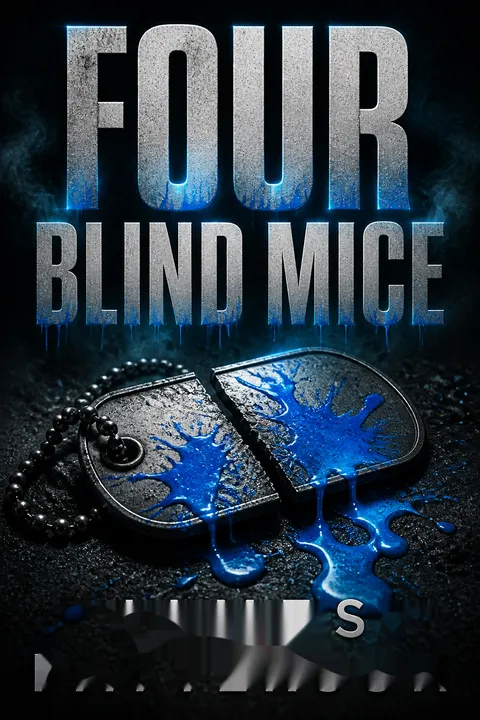


Plot Summary
Prologue
At Sergeant Ellis Cooper’s murder trial in North Carolina, prosecutor Marc Sherman lays out a seemingly airtight case: Cooper’s fingerprints, DNA, knife, and incriminating photographs. Cooper insists he is innocent, then attacks Sherman in the courtroom, making the jury’s quick guilty verdict seem inevitable.
Three men watch the conviction from the gallery. Thomas Starkey, Brownley Harris, and Warren Griffin know they committed the murders and framed Cooper. As they celebrate, their old military code name, the Three Blind Mice, points toward a crime far larger than one execution.
The opening gives readers knowledge Alex Cross lacks, turning the investigation into a test of how institutions manufacture certainty. The evidence is not merely mistaken; it has been arranged to tell a persuasive story, while Cooper’s courtroom outburst makes him look more guilty. The killers’ calm celebration places professional violence beside ordinary appetite and camaraderie. That contrast matters: the danger is not a visibly monstrous outsider, but men whose discipline and public respectability help conceal what they do.
Sampson Calls in a Favor
Alex Cross plans to leave the Washington police force, take time for his children, and decide whether to join the FBI or work as a psychologist. His partner and closest friend, John Sampson, interrupts breakfast with Nana and the children to ask him to investigate Ellis Cooper, an old Army companion facing execution for three murders.
Sampson trusts Cooper’s character, while Cross remembers that Cooper once threatened an officer who was torturing a prisoner in Vietnam. Nana insists Cross make the case his last assignment, and he promises. On the drive to North Carolina, Sampson explains how the Army’s order and rules gave Cooper a sense of fairness that he valued. Their shared respect sends Cross toward a case he intended to avoid.
Cross’s retirement plan gives the case a personal cost before the investigation begins: helping Sampson means postponing a life he has deliberately started to imagine. Sampson’s appeal rests not on evidence but on intimate knowledge, which is powerful and dangerous in equal measure. His loyalty may help Cross see past a prosecution’s polished certainty, but it may also bias him. Cooper’s intervention in Vietnam supplies a moral memory that challenges the image of him as a sadistic killer. The investigation begins, then, as both professional inquiry and a test of what friendship can responsibly ask.
A Witness Beyond the Window
At Fort Bragg, Cross and Sampson hear that Cooper had bullied some trainees, but the accounts do not establish murder. Captain Donald Jacobs, the Army investigator, shows them photographs of the victims arranged and painted blue, along with evidence that appears to tie Cooper to the scene. The details trouble Cross because the crime looks deliberately staged.
A ten-year-old boy, Ronald Hodge, then repeats a neglected account: he saw three men in the Jackson yard, one carrying a camera. Cross and Sampson also find signs that Cooper’s apartment was broken into, and an FBI contact uncovers a rental-car scam involving a false identity. Each discovery raises a practical question: why did the original investigators leave these leads unexplored?
The evidence against Cooper is powerful partly because it is theatrical. The bodies’ arrangement and the photographs turn a crime scene into a constructed image, one that invites jurors to accept a narrative before asking who authored it. Ronald’s testimony offers a competing perspective, but his age and disability make it easy for officials to dismiss him. The break-in and false rental identity matter because they restore agency to an unknown third party. Cross’s method is not to declare Cooper innocent on instinct; it is to notice that the investigation has treated troubling inconsistencies as inconveniences rather than questions.
The Base Closes Ranks
A frightened woman tells Cross that she was with Cooper on the night of the murders, but refuses to risk her marriage and family by testifying. Cooper later denies being with her, leaving Cross unsure why his friend would conceal a possible alibi.
Tori Sanders then explains that Cooper visited her home before going out drinking, though he came to see her husband, not her. The Army’s senior officers remain convinced of Cooper’s guilt, and General Stephen Bowen angrily orders the detectives away.
In Fayetteville, soldiers provoke a bar fight that lands Cross and Sampson in jail; Captain Jacobs meets them afterward and urges them to leave town. The pressure makes their investigation feel less like a search for truth than an effort to stop one.
Institutional resistance intensifies the mystery while complicating the detectives’ trust in their own side. Cooper’s denial of the woman’s account could reflect shame, protection, or manipulation; Cross cannot responsibly choose among those explanations yet. Tori’s account gives the alibi a firmer shape but remains insufficient to overturn a conviction. Meanwhile, the bar fight and jail treatment show how authority can obstruct without openly banning inquiry. The Army does not need to silence Cross in public if it can isolate him, discredit him, and make continued work feel dangerous. Its loyalty to the verdict becomes its own evidence of institutional self-protection.
Cooper’s Last Witness
A message from someone calling himself Foot Soldier draws Cross’s attention to two earlier cases: Army men convicted of murders despite possible alibis, planted weapons, and clean records. Cross and Sampson still cannot make the Army reconsider Cooper’s case.
General Shelly Borislow acknowledges irregularities but says the institution believes Cooper guilty. His execution date arrives, and the detectives visit him on death watch before witnessing the lethal injection. Cooper maintains his innocence and tells Sampson that someone wanted him dead.
Sampson leaves the prison devastated and furious, convinced they have watched an innocent friend be killed. Cross does not yet know whether Cooper’s final insistence is truth or another concealed piece of his life, but the execution turns the investigation into a pursuit of whoever arranged it.
The execution transforms uncertainty into irreversible loss. Cross and Sampson have found reasons to doubt the case, but not enough institutional leverage to stop the state from acting. Cooper’s calm at the end contrasts with his earlier courtroom violence, preventing his behavior from serving as a simple measure of guilt. Sampson experiences the execution as personal failure because his loyalty promised more than he could deliver. Cross’s response is different: he converts grief into a wider inquiry. The question is no longer only whether Cooper killed three women, but whether other convictions share a hidden design.
More Soldiers, Same Pattern
Cross investigates other military murder convictions and finds recurring features: decorated soldiers, suspiciously convenient weapons, and evidence that may have been planted.
In Arizona, James Etra’s widow says a missing service revolver reappeared in their home after her husband was accused of killing two enlisted men; Cross also finds a straw doll and a watchful eye among Etra’s belongings, matching objects from Cooper’s apartment. Sampson travels to New Jersey to interview Billie Houston, whose husband Laurence was executed for a soldier’s murder.
Billie describes his arrest at home and insists he was innocent. As she and Sampson discuss their losses, he begins to feel drawn to her. Their separate interviews turn isolated tragedies into a pattern, with Vietnam and the Army’s past looming behind it.
The repeated convictions create a pattern without yet proving a conspiracy. Each widow offers intimate knowledge that official evidence excluded, while the recurring objects suggest someone has entered these families’ private spaces and left a message. Sampson’s growing attachment to Billie is not separate from the investigation: both have lost men they trusted to an institution that insists its judgment was sound. His empathy makes him a better listener, but it also raises the emotional stakes of every new discovery. The story asks whether remembrance can correct an official record, especially when the people most able to testify have been dismissed or silenced.
A Home Between Cases
While the investigation continues, Cross invites California detective Jamilla Hughes to Washington. She meets his family, wins over Nana and the children, and gradually becomes more than a colleague he misses.
Their first visit together leads to a relationship built on warmth and candor, though distance and demanding police work remain real obstacles. At home, Nana begins suffering chest pain and shortness of breath but initially hides how worried she is. Cross encounters Dr. Kayla Coles when his son Damon rushes him to help Ramon, a friend who has overdosed on ecstasy.
Kayla helps treat the boy and later identifies Nana’s irregular heartbeat as atrial fibrillation. These events remind Cross that his family needs his attention even as the case keeps pulling him away.
The domestic plot makes Cross’s investigation compete with, rather than replace, ordinary care. He wants to protect his family, yet he often notices a loved one’s vulnerability only after a crisis forces it into view. Nana’s concealed symptoms and Ramon’s overdose both expose the limits of Cross’s professional competence at home: he can diagnose danger, but he cannot control every outcome. Jamilla offers companionship without asking him to abandon his work, while also making his emotional life less solitary. Kayla’s neighborhood medical practice extends the novel’s concern with institutions into a practical alternative: care becomes trustworthy when it is accessible and personal.
West Point Turns Deadly
After two hikers are murdered on the Appalachian Trail and their bodies marked with red paint, Cross and Sampson recognize the pattern from Cooper’s case. They question Reece Tate, a former Army colonel and minister accused of the killings, who insists he is innocent. At West Point, Colonel Robert Bennett and his wife are found dead in what the Army calls a murder-suicide.
Their friend, Colonel Owen Handler, agrees to speak privately with Cross and Sampson about Vietnam and the Army’s silence. On the drive to dinner, a car pursues them and fires into their vehicle. Cross escapes the attack, but Handler is shot and dies. The assault confirms that their questions threaten someone with both military knowledge and the means to kill.
The new cases widen the investigation from a possible frame-up to a campaign that can generate fresh victims whenever investigators approach its history. Red paint links the hikers to the earlier blue-painted bodies, making color a clue rather than mere decoration. Tate’s accusation echoes Cooper’s, but his admission that he once abused his wife warns Cross that innocence in one case does not erase wrongdoing elsewhere. Handler’s death turns the gray wall of military silence into an active danger. Information is no longer simply withheld; people who might explain the past are being removed before they can speak.
Vietnam’s Buried Record
Cross follows Foot Soldier’s prompts to the Army Court of Criminal Appeals, where officials continue to defend Cooper’s conviction, then to a Vietnamese prison to interview Tran Van Luu, a former Kit Carson scout serving time for gang murders.
Luu offers little, but his history points toward the An Lao Valley. At the Vietnamese Embassy, translator Thi Nguyen helps Cross uncover records of organized attacks on villages, civilian deaths, and bodies painted in red, white, and blue.
The documents name a Ranger assassination team called the Three Blind Mice: Thomas Starkey, Brownley Harris, and Warren Griffin. FBI records connect the men to other professional killings. Cross and Sampson realize that the current murders may be the delayed continuation of violence concealed during the war.
The archival turn changes the scale of the story: the present crimes are not merely linked by a clever murderer, but rooted in violence that official records were designed to omit. Luu’s partial answers and the embassy documents make historical recovery a form of forensic work. The color pattern connects the bodies in the United States to the villages in Vietnam, while the codename gives the investigators a concrete lead. Yet identification is not explanation. Knowing who carried out the killings still leaves open who directed them, what happened in An Lao, and whether revenge is correcting an injustice or reproducing it.
Picnic Among the Killers
Cross and Sampson travel to Rocky Mount, where Starkey, Harris, and Griffin work for a gun manufacturer and are treated as respectable former soldiers. The detectives watch them at a company picnic, then follow Starkey to his immaculate home and search his locked den, finding pornography but no decisive proof. The three men confront them outside and issue a warning.
Back in Washington, two gunmen fire at Cross outside his house while he carries his baby; he shields the child and returns fire, but cannot identify the attackers. With help from FBI director Ron Burns, Cross places a tracking device on Starkey’s Suburban. Before dawn, he and Sampson follow the vehicle south, hoping its destination will reveal the larger operation.
The picnic stages the central discomfort of the case: the suspected killers do not stand apart from civic life but participate in its rituals, surrounded by families and coworkers. Their genial public presence makes suspicion harder to sustain and easier to dismiss. The search of Starkey’s home yields evidence of private cruelty but not enough to justify a conviction, exposing the gap between moral certainty and legal proof. The attack on Cross’s family collapses that distance. Violence now reaches the domestic space he has been trying to protect, making the pursuit both investigative and personal.
Gunfire at the Cabin
The tracking device leads Cross and Sampson to the Three Blind Mice’s cabin in Georgia, where Marc Sherman, the prosecutor who convicted Cooper, is meeting with Starkey’s group. The detectives listen as Sherman discusses money and the killers’ work, confirming his connection to the operation.
When violence erupts inside, Harris stabs Sherman and the two Asian women present flee; the killers shoot the women as they escape. Cross and Sampson enter, but the three veterans vanish into the woods.
Sampson is shot while trying to reach one of the women. Alone and pinned down, Cross uses the terrain to ambush Harris and kill him. Griffin and Starkey close in, only for the supposedly dead Sampson to reappear and shoot them. Sampson survives, badly wounded.
The cabin brings the investigators into the killers’ own theatre, where war stories, money, and violence have been folded into a private culture of impunity. Sherman’s presence shows that the injustice did not happen through military error alone; a civilian prosecutor helped make the frame-up stick. Cross’s ambush reverses the hunters’ usual advantage, but the victory is not clean. The murdered women and Sampson’s wounds make clear that stopping the killers does not undo what they have done. Sampson’s return also transforms the emotional climax: Cross’s temporary belief that he has lost his closest friend becomes a second chance neither man can take for granted.
The Foot Soldier’s Truth
At the supermax prison in Colorado, Cross confronts Luu, who finally admits he is Foot Soldier and that he selected the targets. Luu says the American soldiers convicted in the recent cases were not all innocent: Cooper, Tate, Laurence Houston, James Etra, Robert Bennett, and Abraham Richter had committed atrocities in Vietnam.
Starkey, Harris, and Griffin had been among the worst, which is why Luu used them to hunt the others. Luu witnessed Cooper rape and kill a Vietnamese girl, and says his own family was later found murdered, their bodies painted blue. He had reported the village killings to Owen Handler, who failed to stop them. Luu built his revenge around the unburied dead and calls his murders a settling of accounts.
Luu’s revelation destroys the comforting division between innocent victims and guilty killers. Cooper’s execution remains unjust in its process and in the crimes attributed to him, yet his innocence was never the truth Sampson needed it to be. Luu’s grievance is grounded in real atrocities and institutional evasion, but his response turns accountability into private execution. His ritual symbols give the dead a place in the present, while also making revenge feel like justice to its author. The novel refuses an easy moral repair: exposure can clarify responsibility without restoring the people who were killed or making the avenger trustworthy.
The Fourth Mouse
Luu tells Cross that a fourth person may have directed the old violence, so Cross returns to West Point and confronts General Mark Hutchinson. Cross has found that Army records were altered to conceal the An Lao operations.
He accuses Hutchinson of commanding the village campaign, sending Starkey’s team to contain its aftermath, and later ordering Handler’s murder to protect his career. Hutchinson refuses to answer publicly, then has two officers abduct Cross, handcuff him, strip him, and paint his body as they prepare to kill him.
Gunmen from Luu’s Ghost Shadows arrive, shoot the captors, and free Cross. They leave him alive but torture Hutchinson and his men. The next day, the FBI reports three dead West Point officers; Cross identifies the cost of the cover-up.
The final confrontation makes institutional responsibility concrete in Hutchinson, whose authority connected the original operations to their later concealment. Cross’s evidence is stronger than suspicion alone because altered records, Handler’s death, and the pattern of killings converge on a command structure. Yet the rescue does not restore lawful justice. Luu’s followers repeat the language of terror and vengeance against those they consider guilty, leaving Cross alive as a witness but not as an agent of the outcome. The episode forces him to face a bitter distinction: uncovering the truth can end a cover-up, but it cannot guarantee that justice will follow.
A Saturday Still Waiting
After the Georgia firefight, Sampson recuperates with Billie on the New Jersey shore, and Cross leans on Jamilla while he recovers from the violence. Nana undergoes a catheter procedure for atrial fibrillation and comes through safely, giving Cross a reason to reconsider how much of his life he has spent chasing danger.
The Army case is not entirely resolved: Luu remains imprisoned, and the identity behind Handler’s killing is uncertain. Cross nonetheless accepts FBI director Ron Burns’s offer to join the Bureau.
In the epilogue, Sampson marries Billie at a joyful outdoor wedding. Cross catches the falling garter as Jamilla, Nana, Dr. Coles, and Burns watch, surrounded by family and friends who make the future feel less like another case to solve.
The resolution does not pretend that professional success cancels grief or that every question has an answer. Cross chooses a new job after seeing how his work has exposed his family to danger, but he does not simply renounce the impulse to investigate. Nana’s recovery and Sampson’s marriage give him models of continuity that are built through care, not conquest. The wedding’s garter turns the case’s ending toward possibility without promising certainty: Cross’s future with Jamilla remains open, as does the unresolved shadow around Luu and Handler. The final movement is from solitary vigilance toward a life shared with other people.
Epilogue
Sampson and Billie marry in a garden ceremony attended by their friends, family, and Cross’s children. Cross celebrates the couple in a toast, then joins Jamilla and Nana as the wedding party gathers for the garter toss.
The garter lands on his finger, drawing laughter from the crowd and a knowing smile from Jamilla. FBI director Burns waits nearby with a folder, but Cross has no intention of spending the wedding reading casework. For once, his attention belongs to the people beside him.
The wedding gives Sampson’s long guardedness a concrete counterimage: he is now publicly joined to someone who knows his grief and welcomes his tenderness. Cross’s accidental catch of the garter shifts the closing joke toward his own romantic future without forcing a declaration about what he and Jamilla will become. Burns’s folder keeps the professional world within sight, but Cross’s refusal to open it marks a modest act of choice. The ending does not erase the unresolved crimes; it shows that intimacy and celebration can still claim time beside them.
Analysis
Four Blind Mice builds its thriller plot around a conflict between evidence and authority. Cooper’s conviction appears secure because physical evidence, courtroom performance, and military confidence reinforce one another. Cross’s investigation shows how each can fail when the chain that produces evidence is compromised. The neglected witness, the unexplored break-in, and the repeated convictions matter not because any single clue solves the case, but because they reveal a system that has stopped asking inconvenient questions.
The book’s moral structure grows less comfortable as the investigation expands. Cross and Sampson begin by defending Cooper as a friend and a probable innocent man. Luu’s account overturns that belief without making the prosecution’s conduct just. Cooper may have committed wartime atrocities, yet the state still executes him on a fabricated murder case. Luu’s revenge answers official silence with private violence, repeating the logic that the dead can be honored by inflicting new suffering. His pain is real; his authority to punish is not made legitimate by it.
The military setting sharpens the problem of obedience. Discipline can produce courage, competence, and solidarity, as Sampson’s experience of the Army suggests. It can also make concealment efficient when a command treats loyalty as protection from scrutiny. Starkey’s team and Hutchinson’s command represent different forms of that same danger: one acts for money and pleasure, the other safeguards institutional power. The novel does not equate every soldier with the perpetrators; it asks what happens when organizations protect reputation instead of investigating their own.
Against this history, domestic life is not an escape from the plot but a measure of what the plot endangers. Cross must care for his children and Nana, while Sampson learns to trust Billie and Cross cautiously makes room for Jamilla. The marbles give this tension a practical shape: time with loved ones is finite, not a reward to claim after every case is solved. The ending offers no complete repair for the dead, but it does let its survivors choose connection over permanent vigilance.
Review Summary
Four Blind Mice receives mixed but generally positive reviews, averaging 4.06/5. Readers praise Patterson's fast-paced storytelling, short chapters, and the compelling dynamic between Alex Cross and John Sampson as they investigate military corruption linked to Vietnam War crimes. Many enjoy the action and suspense, while critics note weak romantic subplots, implausible action sequences, and shallow character development. Fans of the series appreciate the personal storylines involving Nana Mama and Sampson's growth, though some feel the ending is rushed.
Characters
Alex Cross
The relentless detectiveA Washington homicide detective and trained psychologist, Alex is also a devoted father to Damon, Jannie, and young Alex, and a grandson raised by Nana. He reads people closely, but his empathy does not make him immune to overwork or the pull of a difficult case. He is considering leaving police work when Sampson asks him to investigate Cooper’s conviction, and his decision reveals how strongly friendship and responsibility shape his choices. Alex wants to protect his family while continuing to confront violence, a tension that makes his professional courage inseparable from his personal limits.
John Sampson
Cross’s steadfast partnerA tall Washington detective, Sampson has been Alex Cross’s closest friend since childhood. Nana helped raise him when his own home offered little safety, and he regards her as family. His loyalty to Ellis Cooper comes from their shared Army service and from Cooper’s influence on him as a young soldier. Sampson is physically formidable but emotionally guarded, shaped by parents who failed to provide dependable care. He is more comfortable acting than discussing vulnerability, yet his bond with Cross and his connection to Billie reveal a deep capacity for tenderness and trust.
Nana Cross
The family’s anchorAlex’s grandmother raised him and helped raise Sampson, filling their home with food, discipline, humor, and fierce loyalty. Nana has an independent streak that makes her reluctant to admit when she needs help. She is sharp about people and willing to challenge Alex when his work threatens to swallow his family life. Her relationship with him is affectionate but never sentimental for long; she uses teasing and practical advice to keep him grounded. To the children, she is a daily source of order and warmth, and to Sampson she is one of the few adults who made him feel securely loved.
Jamilla Hughes
The California detectiveA homicide inspector from California, Jamilla first became close to Alex while they worked together on an earlier investigation. She is direct, competent, and protective of her privacy, traits that make her both a natural partner in police work and a cautious participant in romance. Her affection for Alex grows through conversation and shared time rather than through professional admiration alone. She is committed to her own work and life, so the distance between California and Washington poses a real question for both of them. Her toughness coexists with a vulnerability she does not readily display.
Ellis Cooper
The condemned sergeantA decorated Army sergeant and Sampson’s old friend, Cooper has spent decades in military service and is known for strictness, discipline, and a strong belief in rules. Sampson remembers him as fair beneath his hard exterior, while the murder case presents him as a brutal killer. Cooper’s pride and guardedness affect what he is willing to tell the detectives, complicating their effort to assess his claims. He is a central figure in the investigation because both his reputation and the evidence against him carry unusual weight.
Thomas Starkey
The commanding veteranA former Army Ranger officer, Starkey leads a close-knit group of veterans and maintains an outwardly respectable life in North Carolina. He is organized, self-possessed, and accustomed to having others follow his decisions. His authority comes not only from rank but from a practiced ability to manage a group and control a situation. The contrast between his public ease and his military habits makes him a difficult person for outsiders to read. He represents the way discipline and leadership can serve very different purposes depending on the conscience behind them.
Brownley Harris
The calculating secondA former Army Ranger and Starkey’s longtime second-in-command, Harris is physically fit, socially confident, and comfortable operating within a team. He is more intellectual and reflective than Warren Griffin, though his education does not restrain his appetite for risk. His place in the trio depends on loyalty to Starkey and familiarity with their shared past. Harris’s easy manner can make him seem approachable, an unsettling quality in someone shaped by a culture that treats violence as part of the work.
Warren Griffin
The impulsive RangerThe youngest of Starkey’s former Ranger circle, Griffin remains known as the Kid despite being middle-aged. He is lanky, quick to laugh, and eager for Starkey’s approval. In the group, he often supplies energy and physical confidence, but his need to be included can make him reckless. The gap between his jocular manner and his military training is central to how others underestimate him. He reflects the danger of turning youthful dependence into lifelong obedience to a leader.
Tran Van Luu
The imprisoned scoutA Vietnamese former Kit Carson scout, Luu survived wartime displacement and later built a life in the United States within a Vietnamese gang community. He speaks several languages and approaches experience through a philosophical, culturally specific understanding of memory, ritual, and the dead. His calm manner can conceal a hard view of violence, formed by what he witnessed and endured. Luu becomes important because his past overlaps with the military history Cross is investigating, though he does not readily share what he knows.
Mark Hutchinson
West Point’s commandantA senior Army officer and commandant at West Point, Hutchinson carries the authority of a career built around service, hierarchy, and institutional reputation. He is accustomed to controlling access and expects outsiders to respect military boundaries. His position places him near the unresolved history Cross is probing, making his response to scrutiny consequential. The polished certainty of his public role contrasts with the discomfort that arises when investigators ask about the past.
Owen Handler
The guarded professorA West Point political science professor and Vietnam veteran, Handler is a friend of Robert and Barbara Bennett. He knows that the Army’s internal culture can discourage scrutiny and agrees to speak with Cross away from the academy. His caution suggests a man who has carried difficult knowledge for years, though it is unclear how much he is prepared to reveal. Handler’s education and military experience make him a bridge between the investigation’s present-day murders and its older history.
Billie Houston
The grieving nurseA nurse who specializes in adult trauma, Billie lost her husband Laurence after he was convicted of a soldier’s murder. She believes he was wrongly accused but speaks about him with measured care rather than easy certainty. She is observant, warm, and capable of drawing Sampson into conversation without pressuring him. Her life includes work, grown children, and a close connection to the New Jersey shore. Billie’s patience and practical compassion make her a natural counterweight to Sampson’s guardedness.
Reece Tate
The accused ministerA retired Army colonel and Baptist minister, Tate is arrested after a double murder on the Appalachian Trail. He is formal and anxious in custody, struggling to understand why the police have connected him to the killings. He also admits to a troubled marriage and past violence, complicating the simple picture of an entirely blameless man. Tate’s presence forces Cross to separate a person’s moral history from the specific evidence in a criminal case.
James Etra
The convicted colonelA former lieutenant colonel, Etra was convicted of killing two enlisted men, a crime his wife believes he did not commit. His military precision and orderly habits shape the account of his missing revolver and the evidence later found in his home. Etra is absent from the active investigation, yet his case offers Cross another chance to test the pattern of suspicious convictions. His story gives the growing inquiry a human cost beyond Cooper.
Laurence Houston
Billie’s executed husbandLaurence was a soldier and family man whose murder conviction ended in execution. Billie remembers him as a loving husband and responsible father, and Sampson takes her account seriously because Cooper’s case has made him question similar convictions. Laurence rarely discussed his wartime experiences, leaving his family with unanswered questions about what he carried home. His silence links private trauma to the larger investigation’s buried history.
Marc Sherman
The confident prosecutorThe Cumberland County district attorney who prosecuted Cooper, Sherman presents the case with confidence and relies on evidence that appears decisive to the jury. He understands how a courtroom audience responds to a coherent story and uses that skill to secure a conviction. His role places him at the intersection of law and public certainty, where the appearance of proof can matter more than the possibility that evidence was manipulated.
Kayla Coles
The neighborhood doctorA physician who helps organize affordable care in Southeast Washington, Kayla makes house calls and treats patients where they live. She meets Alex when she responds to Ramon’s overdose, then becomes involved in Nana’s medical care. Her confidence is paired with a practical respect for patients’ choices, including Nana’s independence. Kayla represents a form of authority built through access, listening, and continued presence rather than distance or command.
Donald Jacobs
The Army investigatorA captain in the Army’s Criminal Investigation Division, Jacobs worked on Cooper’s case and testified against him. He is cordial when Cross and Sampson first meet him, but his confidence in the conviction makes him resistant to their questions. Jacobs represents the official investigation Cross must scrutinize, while leaving open whether he is protecting the institution, his own work, or simply his understanding of the evidence.
Ronald Hodge
The overlooked witnessA ten-year-old boy with spina bifida, Ronald uses a wheelchair and spends much of his time at a computer. He says he saw three men in the Jackson yard on the night of the murders, including one with a camera. Police did not treat his observation as important, leaving him frustrated and frightened. His persistence demonstrates how a witness’s age or disability can affect whether adults take his account seriously.
Damon Cross
Alex’s watchful sonAlex’s twelve-year-old son, Damon is a student, singer, and basketball player who is close to his siblings and Nana. He shows compassion when he seeks help for his friend Ramon after an overdose, even though he fears the consequences of getting involved. Damon’s choices reveal a boy learning that loyalty sometimes means asking adults for help rather than trying to manage danger alone.
Plot Devices
The blue-painted victims
A crime scene becomes a signatureBlue paint on the victims in the Fort Bragg murders first seems like an inexplicable flourish that helps make Cooper appear monstrous. As Cross finds similar cases and learns about the violence in Vietnam, the colors acquire a larger history. The paint links present-day deaths to wartime atrocities and to a deliberate practice of marking the dead. It functions as evidence, a taunt, and a memorial, while its meaning shifts as the investigation moves from police procedure to historical reckoning.
The planted evidence pattern
Convictions hide repeated interferenceAcross several military murder cases, weapons, fingerprints, and DNA appear to make convictions conclusive, while possible alibis and witnesses receive little attention. Cross compares the cases and notices repeated signs that evidence may have been planted. The pattern gives him a way to connect Cooper’s case to convictions in other states, but it also warns him that familiar forensic evidence can be manipulated. The device drives the procedural plot by making the investigators question not only who committed a murder, but who controlled the investigation and its record.
The straw doll and eye
A ritual leaves a warningCross finds a straw doll and an amulet shaped like a watchful eye in Cooper’s apartment, then encounters matching objects in another convicted soldier’s belongings and at Billie Houston’s home. Their presence suggests that someone has entered private spaces and left a message connected to Vietnam. The objects invite several interpretations: keepsakes, calling cards, or ritual reminders of the dead. Luu later explains the straw doll’s association with murdered people whose spirits have not been properly laid to rest, turning a strange clue into an expression of revenge.
Foot Soldier’s messages
An unseen guide redirects CrossEmails and a fax signed Foot Soldier give Cross information about other military convictions and steer him toward people and records he might otherwise miss. The messages are useful but deliberately incomplete, making the sender both a source and a possible threat. Their clues lead Cross toward West Point, the Vietnamese Embassy, and the history of the An Lao Valley. The device keeps the inquiry moving while reinforcing its central caution: information can be accurate and still be part of someone else’s plan.
Altered Army records
The past is hidden on paperOfficial military files do not show that key officers and Rangers served together in the An Lao Valley, even as witnesses and Vietnamese records point to their involvement. Cross recognizes that the gaps are not ordinary administrative mess; the records have been altered to conceal operations and command responsibility. Comparing sources from the Army, FBI, and Vietnamese Embassy allows him to reconstruct what the official account erased. The records turn bureaucracy into both obstacle and evidence, exposing how institutions can preserve authority by deciding what future investigators are permitted to know.
Alex Cross Series Series











About the Author
Other books by James Patterson



Download PDF
Download EPUB
.epub digital book format is ideal for reading ebooks on phones, tablets, and e-readers.








