

Key Takeaways
Choose social rules without knowing which life you will inherit
Begin with the moral problem. John Rawls’s experience of war, the Holocaust, and the devastation of Hiroshima sharpened a question that shaped his philosophy: how can people build a just society without relying on shared religion or beliefs about the good life? His answer starts from the idea that society’s rules are human choices, not natural facts. Those rules shape people’s rights, opportunities, and ambitions.
Imagine choosing blindly. In the original position, people select society’s basic rules without knowing their own wealth, race, religion, gender, or abilities. This veil of ignorance blocks self-serving arguments: no one can safely design rules for a group they assume they belong to. The aim is a society whose terms remain defensible from any position within it.
The thought experiment is powerful because it turns fairness into a test of institutional design, not a guess about whether individual people are kind. Its blindfold is not meant to erase identity from real life. It asks whether rules can be justified to people whose identities and interests differ. That distinction matters: equal treatment can still preserve unequal starting conditions. The framework also depends on what counts as relevant knowledge and which risks people fear most, so it guides public reasoning without mechanically producing one uncontested answer.
Protect political and personal freedom, not every market privilege
Safeguard the freedoms citizens need. Rawls’s basic liberties principle protects freedom of conscience, expression, association, bodily integrity, and equal political participation. It also protects the rule of law, which makes the other liberties secure. These freedoms take priority over economic goals: growth cannot justify stripping a minority of rights or bypassing democratic government.
Distinguish freedom from privilege. The right to choose an occupation and control personal possessions matters to living freely. But unlimited rights to accumulate wealth, avoid taxation, or run a business without regulation are not automatically basic liberties. Political disputes should be justified through public reason: shared political values such as fairness and equal citizenship, rather than religious or moral doctrines that fellow citizens may not accept.
This distinction challenges a common rhetorical shortcut: treating any restriction on property or business as an attack on freedom itself. It also avoids the opposite mistake of treating liberty as an obstacle to equality. In political theory, rights are often understood as protections that make agency possible. Rawls’s account asks which protections people actually need to choose and pursue a life. Its practical strength is flexibility, though disagreements over what counts as essential freedom still require democratic judgment.
Make equal political rights matter as much as they exist on paper
Formal votes are not enough. Political equality means more than giving everyone a ballot. Citizens also need a fair chance to understand public choices and influence debate. In a study of 1,779 proposed US policy changes, researchers found that average citizens had almost no independent influence when their preferences differed from those of wealthy citizens and interest groups.
Repair democracy’s channels. Chandler favors proportional representation, which more closely matches seats to votes; low donation caps and democracy vouchers, which give citizens equal funding power; stronger public-interest journalism; and local participatory budgeting. In Porto Alegre, Brazil, residents help direct part of the city budget. Randomly selected citizens’ assemblies can also help people deliberate on complex issues, while elected representatives retain governing responsibility.
The chapter treats democracy as an information and influence system, not merely a method for counting preferences. That insight connects political design to the practical conditions of deliberation: people need time, credible information, and institutions that carry their views to decision-makers. Vouchers and assemblies could broaden participation, but procedures alone cannot guarantee attention or trust. Their legitimacy depends on transparent rules, representative access, and real authority. The aim is not to make every citizen a full-time politician, but to prevent wealth from buying a systematically louder voice.
Give children equal starts by changing the institutions around them
Open doors and level the ground. Formal equality of opportunity bans discrimination, but fair equality of opportunity also asks whether children can develop the skills needed to compete. In the UK and US, parental earnings advantages are passed on to children at roughly a 50 percent rate. The gap appears early: by age five, school readiness differs by about nineteen months in the UK and twenty-two months in the US between richer and poorer children.
Build opportunity early. Chandler supports high-quality early education, extra resources for disadvantaged schools, integrated comprehensive schooling, and broad access to vocational and university study. He argues that fee-paying schools let affluent families buy enduring advantages. Finland’s move away from tuition-charging schools shows that a more equal system need not sacrifice educational quality.
The key shift is from judging opportunity by whether a competition is formally open to asking who arrives prepared to compete. Developmental research makes early childhood a particularly important point of intervention, while school funding and admissions shape the advantages that accumulate afterward. Yet equal opportunity cannot mean erasing every difference between families. The book recognizes that parenting and family life are valuable freedoms. A fair policy must therefore limit purchased advantages without turning family relationships into a state-managed equality project.
Permit inequality only when it improves the least advantaged's prospects
Reject both extremes. The difference principle allows economic inequalities only when they improve the life chances of the least advantaged. It rejects perfect equality if incentives would make everyone poorer, but it also rejects growth as a sufficient excuse for leaving the bottom behind. The relevant question is not whether an inequality rewards merit: natural talent, effort, and the market value of a skill are all shaped partly by luck.
Look beyond paychecks. The least advantaged are not simply people who happen to have the lowest income today. Justice concerns their longer-term prospects and the distribution of income, economic power, and opportunities for self-respect. A welfare state that redistributes income after the fact cannot, by itself, address who controls workplaces or who gets meaningful work.
This principle reframes economic policy as a question of justification: can the people with the weakest prospects accept the rules as reciprocal, rather than as charity from the fortunate? It also exposes the limits of meritocratic language, which can turn outcomes shaped by inherited advantage into supposed proof of deserved success. The challenge is empirical as well as moral. Policymakers must estimate which inequalities actually improve lower-income prospects, and those estimates can be uncertain or contested. The principle supplies a standard, not a ready-made tax rate.
Treat ecological limits as part of justice between generations
Include the future in fairness. The just savings principle says each generation should preserve the conditions needed for a just society to endure. Those conditions include institutions and material resources, but also clean air, stable climate, and functioning ecosystems. Chandler notes that human consumption already uses resources at a pace estimated to require 1.6 Earths.
Make limits governable. A sustainable economy needs enforceable environmental goals, not only voluntary consumer choices. The UK’s Climate Change Act offers one model: binding emissions budgets, expert monitoring, and a route for citizens to challenge government failure. Carbon pricing can help, but it must be paired with public investment and support for workers and communities affected by the transition, such as a dividend funded by carbon-tax revenue.
The intergenerational frame makes environmental protection more than a preference for wilderness or a technical question about energy. It treats ecological stability as infrastructure that future people have a claim to inherit. That is a compelling way to bring environmental policy into theories of justice, which often focus on distribution among people alive today. Still, national frameworks cannot settle how costs should be shared across countries. A fair domestic transition is necessary, but climate responsibilities also cross borders and require principles beyond the book’s central focus.
Guarantee income security without humiliating people through benefit tests
Make security a foundation. Chandler argues for a universal basic income, a regular cash payment to every citizen, whether employed or not. Unlike many means-tested benefits, it would not require recipients to prove poverty or satisfy work conditions. The case is about dignity and bargaining power as well as money: people could refuse degrading work, leave abusive relationships, or take time to retrain.
Take reciprocity seriously. Critics worry that unconditional payments let some people live off others’ work. Trials of negative income taxes, a related form of guaranteed income, found only modest reductions in paid work, averaging two to four weeks of full-time employment a year. A poverty-level basic income could have a net additional cost of roughly 10 to 15 percent of GDP after existing benefits are replaced, so a gradual or partial design may be more feasible.
The case for unconditional support is strongest when social policy is judged by whether it protects agency, not only whether it targets cash efficiently. A predictable income can improve workers’ ability to negotiate and reduce the stigma built into surveillance-heavy systems. Yet cash cannot replace public services, disability support, or care infrastructure. Nor does a payment settle what society owes people who contribute through unpaid care. The book’s own emphasis on reciprocity makes the design question real: security should expand freedom without pretending that every need can be met by one universal transfer.
Spread earning power and ownership before relying on redistribution
Shape market outcomes upstream. Predistribution means changing institutions so that market incomes and assets are less unequal before taxes and benefits are applied. The book contrasts the US and Denmark: average pretax income for the poorest half is about $21,000 in the US and $29,000 in Denmark, despite similar overall income per person. Training, minimum wages, sector-wide bargaining, and stronger unions can raise earnings directly.
Share the wealth stock. Chandler proposes options such as a universal inheritance or a citizens’ wealth fund, which would invest public money in assets and pay citizens an equal dividend. Alaska’s Permanent Fund offers a small-scale precedent, distributing part of the income from public resource wealth to residents. These policies require capable institutions and substantial revenue, but they aim to disperse ownership rather than rely on transfers alone.
Predistribution highlights that markets do not produce a fixed, politically neutral distribution. Rules about education, bargaining, competition, and ownership shape who receives income in the first place. This makes the approach attractive both as a justice project and as a way to reduce dependence on after-the-fact compensation. The comparison between countries is suggestive, not proof that one policy can simply be copied into another context. Institutions work as packages, and a wealth fund raises difficult questions about governance, investment risk, and democratic accountability.
Give workers decision rights where they spend their working lives
Treat workplaces as political institutions. In most companies, shareholders choose the board and workers have little formal influence over decisions that shape their jobs. Co-management gives workers representation on company boards and creates works councils that negotiate or decide some workplace conditions. In Germany, employees receive a share of board seats, with equal representation in some large firms.
Share power without abolishing markets. Research reviewed in the book finds that co-management generally improves working conditions and reduces inequality within firms, with little or no average harm to company performance. Worker cooperatives go further by giving employees control and a share of profits. They remain uncommon partly because workers struggle to raise start-up capital, so cooperative banks, federations, and supported employee buyouts could help them grow.
Workplace democracy extends democratic values into an institution that governs a large part of adult life. The proposal also connects power to job quality: people affected by decisions gain a channel to shape them, rather than relying entirely on the option to quit. Evidence that existing co-management systems do not generally damage performance weakens a familiar objection, though those results cannot guarantee identical effects under broader reforms. Good design matters: worker representation needs time, information, protection from retaliation, and clear rules for resolving deadlock.
Analysis
Chandler’s central achievement is to make Rawls useful as a public framework rather than a museum piece in political philosophy. The argument begins with a simple test of fairness, then follows its consequences across constitutional rights, elections, schools, markets, climate policy, and corporate governance. This breadth is also the book’s main difficulty: the principles are abstract, while the policy proposals depend on local institutions, budgets, and empirical judgments. The answer is not a single blueprint but a way to ask consistent questions about who benefits, who bears risk, and whether citizens can accept the rules as equals.
The framework is especially strong where familiar political categories obscure choices. It separates personal liberty from absolute property rights, equality of opportunity from meritocratic entitlement, and markets from market fundamentalism. It also joins material resources to voice and dignity, making the workplace part of economic justice rather than a private zone outside democratic concern. Its account of reciprocity helps bridge individual contribution and collective support without treating the poor as objects of charity.
Important tensions remain. Domestic justice is the focus, but supply chains, migration, and climate burdens cross national borders. The model also gives paid work a central role in agency and self-respect, while recognizing that disability and unpaid care do not fit neatly within its economic principles. Finally, the original position helps justify institutions but cannot explain how people with power will permit them to change. Chandler acknowledges the need for political organizing, yet the argument’s greatest practical test is whether citizens can build durable coalitions around reforms whose costs and benefits are uneven. The book offers a destination and a language for debate; political strategy and institutional experimentation must do the remaining work.
Review Summary
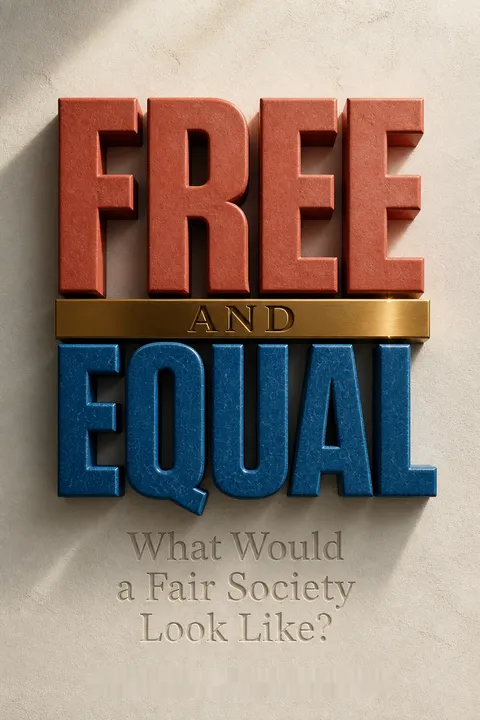
Free and Equal by Daniel Chandler presents John Rawls' political philosophy and its applications to contemporary issues. Readers appreciate Chandler's accessible explanation of Rawls' ideas and their potential for creating a fairer society. The book is divided into two parts: an exposition of Rawls' principles and policy proposals based on these ideas. While some find the policy section less detailed, many praise the book's thought-provoking analysis and its attempt to bridge philosophy and practical politics. Critics note that implementing these ideas may be challenging within existing political structures.
People Also Read






Glossary
original position
Fairness thought experimentA hypothetical situation in which people choose the basic rules of society without knowing their own class, race, gender, religion, talents, or place in the social order. Because no one can tailor the rules to a known personal advantage, the thought experiment tests whether proposed principles could be accepted as fair from any position.
basic liberties principle
Equal essential freedomsRawls’s first principle of justice. It guarantees each person an equal set of fundamental personal, political, and procedural liberties, including conscience, expression, association, bodily integrity, voting, and legal protection. These liberties may be limited to protect the same basic freedoms for others, but they cannot be sacrificed merely to increase economic growth.
fair equality of opportunity
Equal chances to developThe requirement that people with similar abilities and motivation have similar prospects regardless of social class, race, or gender. It goes beyond banning discrimination: institutions must also give children a genuinely fair chance to develop their talents and compete for education, jobs, and positions of authority.
difference principle
Inequality for shared benefitThe principle that social and economic inequalities are justified only when they improve the prospects of the least advantaged. It does not demand identical outcomes. It asks society to arrange income, wealth, authority, and opportunities so that those with the weakest life prospects benefit as much as possible.
just savings principle
Protect justice across generationsRawls’s principle for justice between generations. Each generation must preserve the resources and conditions needed to sustain a just society over time. In Chandler’s application, this includes not only physical and institutional resources but also stable climate, healthy ecosystems, and the natural systems on which human life depends.
public reason
Shared political justificationA standard for debating fundamental political questions using political values that citizens with different moral and religious beliefs can reasonably share. It does not prohibit religious or personal arguments in public life. It asks that laws and constitutional essentials also be justified through common political principles such as freedom, fairness, and equal citizenship.
predistribution
Fairer market outcomes firstAn approach to inequality that changes the institutions shaping market incomes and ownership before taxes and transfers are applied. Policies can include education and training, minimum wages, collective bargaining, and broader ownership of assets. It complements redistribution rather than replacing it.
co-management
Workers share company controlA system in which workers share formal decision-making authority with owners. Common arrangements include worker representatives on company boards and works councils with defined rights to information, consultation, or joint decisions about working conditions. It gives employees institutional influence without necessarily transferring all ownership to workers.
FAQ
What's Free and Equal: What Would a Fair Society Look Like? about?
- Exploring Fairness: Free and Equal by Daniel Chandler examines what a fair society would look like, focusing on political equality, economic justice, and social structures.
- Rawls' Influence: The book draws heavily on John Rawls's principles of justice, particularly the basic liberties principle and the difference principle.
- Contemporary Issues: Chandler connects these philosophical ideas to current social issues, such as inequality, healthcare access, and democratic participation.
Why should I read Free and Equal?
- Timely and Relevant: The book addresses pressing issues like inequality and the erosion of democratic values, making it highly relevant for today's readers.
- Philosophical Framework: It provides a philosophical framework for understanding justice and fairness, helping readers navigate complex social and political issues.
- Practical Solutions: Chandler offers practical solutions and a bold agenda for reform, making it a guide for those interested in social change.
What are the key takeaways of Free and Equal?
- Justice as Fairness: Emphasizes Rawls' principles, advocating for equal rights and maximizing benefits for the least advantaged.
- Role of Institutions: Discusses the importance of political and economic institutions in shaping a fair society, arguing they are products of human choices.
- Need for Civic Engagement: Stresses the importance of civic education and public reason in fostering a democratic culture that respects diverse beliefs.
What are the best quotes from Free and Equal and what do they mean?
- "Justice is the first virtue...": Highlights the foundational role of justice in organizing society, suggesting systems must be evaluated based on fairness.
- "There is no natural or neutral...": Emphasizes that societal structures are human-made and can be changed, encouraging reform.
- "A map of the world...": Underscores the importance of envisioning a better society to inspire real change and progress.
How does Free and Equal address the issue of inequality?
- Structural Inequality Focus: Emphasizes that inequality is deeply rooted in societal structures, including economic and political institutions.
- Proposed Reforms: Advocates for reforms to redistribute power and resources more equitably, ensuring fair chances for success.
- Role of the State: Argues for a proactive state role in addressing inequalities, rather than relying solely on market forces.
What is the "original position" in Free and Equal?
- Thought Experiment: A hypothetical scenario proposed by Rawls where individuals choose principles of justice without knowledge of personal circumstances.
- Veil of Ignorance: Individuals operate behind a "veil of ignorance," ensuring impartiality in choosing fair principles.
- Foundation for Justice: Aims to identify principles that all citizens can accept as fair, forming the basis for a just society.
What are Rawls' two principles of justice in Free and Equal?
- Basic Liberties Principle: Asserts equal claim to a fully adequate scheme of equal basic rights and liberties for all.
- Difference Principle: States that inequalities are justified only if they benefit the least advantaged, promoting fairness and equality of opportunity.
- Interconnectedness: Together, these principles provide a framework for evaluating and designing social institutions prioritizing freedom and equality.
How does Free and Equal propose to improve democracy?
- Political Equality: Argues democracy must be grounded in political equality, ensuring equal rights and opportunities for all citizens.
- Engagement and Deliberation: Calls for greater civic engagement and deliberation, encouraging active participation in shaping political institutions.
- Reforming Institutions: Suggests redesigning democratic institutions to better reflect principles of justice and fairness.
What role does civic education play in Free and Equal?
- Foundation for Democracy: Civic education is crucial for preparing citizens to participate effectively in democracy, fostering understanding of rights and responsibilities.
- Promoting Political Virtues: Education should cultivate virtues like reasonableness, tolerance, and respect, essential for a functioning democracy.
- Engagement with Society: Encourages educational systems to promote active participation in civic life, bridging divides and building inclusivity.
What is the proposed universal basic income (UBI) in Free and Equal?
- Definition of UBI: Described as a regular cash payment to every citizen, ensuring everyone can meet basic needs.
- Benefits of UBI: Eliminates welfare stigma, provides financial security, and empowers choices about work and life.
- Economic Implications: Could stimulate the economy by increasing consumer spending and providing a safety net for precarious employment.
How does Free and Equal address the challenges of free speech?
- Basic Liberty: Asserts free speech as a basic liberty essential for democratic engagement, especially in political and moral discussions.
- Limits of Free Speech: Acknowledges circumstances where free speech can be limited, such as preventing violence or harassment.
- Balancing Rights: Advocates for a balanced approach respecting individual rights while protecting the community from harmful speech.
How does Free and Equal suggest we can combat climate change?
- Legal Framework for Sustainability: Calls for a legal framework setting ecological limits, like a Sustainable Economy Act.
- Investment in Green Technologies: Emphasizes significant public investment in renewable energy and sustainable practices for a low-carbon economy.
- Collective Action Required: Stresses that addressing climate change requires collective mobilization and a cultural shift towards sustainability.
Download PDF
Download EPUB
.epub digital book format is ideal for reading ebooks on phones, tablets, and e-readers.








