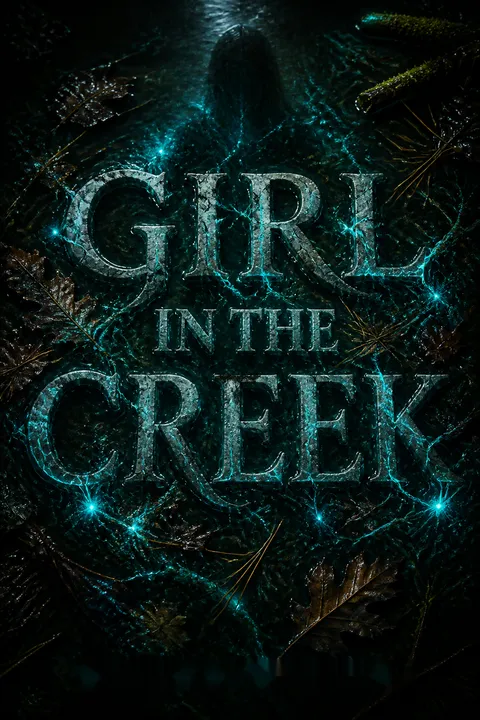


Plot Summary
The Creek Receives a Body
Deep in an abandoned mine, a strange force drives a changed coyote to drag a bound young woman into the creek. The woman stops breathing, but something begins threading into her injured ankle. The coyote’s mate is then killed by human hunters, and the pain ripples through the forest’s connected life.
Days later, Erin Harper arrives in Faraday, Oregon, to write a travel feature and investigate why people, including her brother Bryan, have vanished nearby. At a picnic area she sees a missing poster for brewery waitress Elena Lopez, then steps on bloody animal tissue. A postcard Bryan once sent from Faraday reveals a distant figure watching its subject, giving Erin a first unsettling reason to distrust the town’s ordinary explanations.
The opening makes the forest an active participant before Erin can interpret it. The coyote obeys an influence it cannot understand, while the dead girl’s body becomes a site of change rather than a solved crime. That ecological perspective shifts the horror away from a single human villain and toward a network with its own priorities. Erin’s arrival supplies the counterpoint: she approaches Faraday through journalism and grief, hoping evidence can repair the uncertainty left by Bryan’s disappearance. The postcard and the injured body alike turn looking into a dangerous act. What seems like observation may already be a form of contact.
Faraday’s Missing Faces
At the brewery, Erin meets Hari, her podcast partner, and the visiting friends he brought: Matt, Matt’s fiancée Kayla, and Kayla’s sister Madison. Local outfitter Dahlia MacIntosh recognizes Erin as a travel writer, while Jordan McCall, a hometown arborist and online nature guide, welcomes the chance to discuss Faraday.
The friendliness fractures when Nick Steadman corners Dahlia and ignores her refusal until Kayla intervenes. Over dinner, Jordan and Dahlia reveal that other young women have disappeared, including another brewery waitress whose car was found abandoned.
Dahlia invites the group to hot springs after dark. Erin agrees, drawn by the new evidence and by a gathering of people who seem to understand both the town’s roughness and its appeal.
The brewery gathers the novel’s competing forms of knowledge in one room: Erin’s reporting, Hari’s case research, Jordan’s local memory, and Dahlia’s practical familiarity with the river. Yet the group’s first vivid lesson is bodily rather than informational. Nick’s unwanted grip makes Dahlia shrink, and Kayla’s intervention changes the balance without requiring anyone to explain the town’s gendered power structure. The missing waitress badge at the server’s chest turns a casual meal into evidence that disappearance has entered daily life. Erin is attracted to the group’s warmth, but her impulse to investigate is also sharpened by the way Faraday’s residents have normalized what outsiders might call a pattern.
Moonlit Trespass Turns Bloody
Dahlia leads the group to Vanderpoel Hot Springs, where cannabis and warm water loosen Erin’s reserve and draw her closer to Madison. They continue to the abandoned Lumberjack Hotel, once owned by the Vanderpoels, and explore its ruined bakery before following Jordan toward the overgrown pool.
In a patched pool house, they find blood across a makeshift worktable, a butchered coyote pelt, animal remains, and a heap that glimmers with unnatural colors. The scene suggests that someone has been killing wildlife there, but the strange light cannot be explained as ordinary decay.
A noise in the woods sends the friends running. At the trailhead, they discover a smear of blood on Dahlia’s car, leaving their first adventure with evidence of danger rather than a harmless ghost story.
The night begins as an experiment in intimacy. Erin’s attraction to Madison, her grief for Bryan, and the group’s stories about family and belonging surface because the hot spring makes the outing feel temporarily safe. The pool house then converts that openness into vulnerability: the friends have crossed onto private land, lost the cover of daylight, and entered a place where violence has been hidden in plain sight. The coyote pelt ties the animal killings to the forest’s opening disturbance, while the luminous material suggests that the butchered remains are part of a process rather than mere trophies. The blood on Dahlia’s car gives the threat a human scale, even as its source remains uncertain.
Bryan in Dahlia’s Album
The next morning, Erin finds Bryan in a page of Dahlia’s trip photographs. Dahlia remembers him kayaking on the Clackamas five years earlier, shortly before he disappeared, and says his kayak remained at her dock. The detail unsettles the official account of suicide that Erin’s parents accepted.
Deputy Duvall reports that the pool house appears to have been burned deliberately, though enough evidence remains to implicate poachers. While searching online for other missing people, Erin learns how often families of color have been left without answers.
Later she spots a small wooden carving in mushroom hunter Ray Hendrix’s basket. Its style matches the unsettling work of Scott Vanderpoel, Olivia’s missing son, so Erin asks Jordan to take her to Hillier, where Ray found it.
Bryan’s photograph changes Erin’s investigation from a search for general patterns into a challenge to the story her family has been told. The kayak matters because it places her brother in a life he chose and an activity he loved, making the conclusion of suicide feel less secure without proving an alternative. Meanwhile, the disparities in missing-person investigations give Erin’s personal wound a public dimension. The carving supplies a material link between two disappearances and makes art function as evidence, not decoration. Erin’s choice to follow it alone with Jordan also exposes a growing flaw in her method: she is learning to trust instinct, but she has not yet learned how to distinguish a promising clue from a dangerous invitation.
Elena Beneath the Mill
At Hillier, the abandoned mining settlement, Erin and Jordan find Elena’s body caught near the old mill wheel. Her condition confirms that the missing waitress has been in the creek for days. A flash of blue moves across the water, and the pair hide among the ruins as someone fires at them, identifying Jordan by name.
They escape through steep, overgrown terrain and reach a logging crew, who bring them back to town. Deputy Duvall takes their statements but treats the suspected shooting and Elena’s death as separate matters, while Erin notices unusual speckling on the deputy’s raincoat that resembles residue from the woods.
At the brewery, Erin finally tells Dahlia that Bryan was her brother. Dahlia recognizes his name and shares that she searched for him after he vanished.
Finding Elena gives Erin what she has been seeking in the worst possible form: confirmation that a missing person’s case concerns a real body, not simply an unresolved file. Her determination to look closely is an act of witness, but it also places her and Jordan in the sights of whoever is guarding Hillier. The shots make local knowledge essential to survival, while Duvall’s cautious response shows how institutional procedure can feel indistinguishable from disbelief to a frightened witness. Erin’s confession to Dahlia creates a different kind of evidence: another person remembers Bryan as alive, present, and loved. That testimony cannot explain his fate, but it breaks the isolation in which Erin has carried her grief.
Olivia Opens the Mine
After Erin admits her real reason for coming, Dahlia embraces her and Olivia Vanderpoel invites her to examine Scott’s art. Olivia describes her son as a gifted, solitary artist who loved the Northwest landscape and disappeared nearly a decade earlier.
Erin notices a small carved figure resembling one found near Hillier, and Olivia reveals that she has sometimes seen a man in the woods wearing Scott’s blue fleece. She also recalls finding a crude carving left outside, evidence that someone may still be near the house.
Olivia then explains that her father, mining magnate Mitch Vanderpoel, searched McIntyre Ridge for traces of the 1907 meteor strike. His unregistered excavations included hidden mine passages, giving Erin a possible physical explanation for how people could disappear without leaving a trail.
Olivia’s house makes family history tangible through the paintings and carvings Scott left behind. Her preservation of his work resists the pressure to convert an unresolved disappearance into a completed loss, a refusal Erin recognizes from her own attachment to Bryan’s postcard. But Olivia’s account also unsettles the town’s polished self-image: the Vanderpoel fortune is tied to extraction, hidden property boundaries, and a mine that may have altered the land. Her father’s search for meteor material reframes the forest as a place where private ambition and ecological consequence have been layered together. Scott’s possible sightings offer hope, but the evidence remains ambiguous, so Erin’s empathy must coexist with the risk of projecting her own wishes onto Olivia’s.
The Map Reaches Steadman
Hari’s research finds more missing Latinx residents, while Erin and the group map likely poaching territory around the Steadman property. Madison decides the investigation is too dangerous and leaves, warning Erin that caution cannot make armed men safe.
The others choose to continue: Matt offers his computer skills, Kayla insists on helping, and Dahlia wants the missing-person flyers to lead somewhere. Before they can search far, they learn that Bill Steadman has been found dead at home and his sons Nick and Howie are missing.
The discovery intensifies suspicion because Erin and Jordan had seen the brothers near Elena’s body. Rather than storming the property, the team divides its work: Hari and Matt pursue records while Erin seeks local knowledge from Ray Hendrix.
Madison’s departure is not cowardice but an ethical challenge to the group’s excitement. She sees that solidarity can become a way of volunteering other people for danger, especially when the investigation is partly Erin’s personal mission. The friends who stay must therefore make a more deliberate choice: Matt contributes skills, Kayla commits from experience with abuse, and Dahlia acts from fatigue with a town that keeps losing people. Bill’s death and his sons’ disappearance offer a tempting explanation, but Erin resists treating suspicion as proof. The map is a tool for disciplined inquiry, yet its circle also shows how quickly an investigation can turn an entire community into a suspect landscape.
Scott Returns in Blue
At Ray Hendrix’s remote home, Erin finds a tall man in a blue fleece who identifies himself as Scott Vanderpoel. He recognizes Erin from the guesthouse and from Hillier, but refuses to approach, insisting that it is unsafe.
Scott warns her against Ray, whom he considers more dangerous, then flees into the trees before she can ask what has kept him from his mother. Erin returns to town and shares a café with Deputy Duvall.
When another deputy reports that Elena’s fingerprints appeared at the Steadman home, Erin realizes that the supposedly dead woman may have been there after her death. The clue overturns the simple idea of a body dumped in the creek and makes the mine, the Steadmans, and the forest’s strange residue part of one escalating mystery.
Scott’s appearance gives Olivia’s hope a face, but not the reunion she longs for. He is physically present and still unreachable, which makes his warning more unsettling than a straightforward explanation would be. Erin responds by pursuing him, repeating the same pattern that has brought her close to danger: another person’s fear becomes a reason to press closer. The fingerprint report creates a more radical rupture. Evidence normally secures identity and timeline; here, it suggests that the body’s physical state and its movements no longer obey familiar rules. The story’s mystery shifts from asking who killed Elena to asking what Elena has become and what kind of system can move her.
The Bakery Hostage
When Kayla and Dahlia head toward the old hotel to investigate fresh tracks, Erin and Matt follow as backup. Howie Steadman appears with a rifle and knocks Matt down when Matt charges him. At the ruined bakery, Erin finds Kayla and Dahlia already captured, both injured and tied up. Nick is feverish, his face marked by swollen wounds, and Howie tends to him with anxious care.
The brothers’ behavior does not fit the composed poachers Erin imagined. She searches for something sharp and finds a jagged tin can near the fire pit, then tries to saw through her restraints while Nick sleeps. Above them, Scott appears through a gap in the roof but signals her to stay quiet. The captives remain trapped as the brothers’ illness worsens.
The capture transforms the investigation from a group effort into a survival problem. Erin’s earlier tendency to treat danger as research material now has immediate consequences: Matt is injured, Kayla and Dahlia have been held longer, and no one can call for help. The brothers’ vulnerability complicates the image of uncomplicated villains. Howie’s care for Nick and Nick’s visible illness suggest that something is happening to them beyond ordinary criminal panic, though neither detail absolves their actions. Erin’s improvised use of a can is a small but important shift from observation to agency. Scott’s silent appearance offers help while withholding explanation, repeating the novel’s uneasy pattern of rescue entangled with manipulation.
A Sinkhole Takes the Bakery
Matt works free of his bonds, but Nick attacks him and smashes his head against the bakery’s industrial mixer. Kayla’s restraints give way as she fights Nick, and white threads emerge from both their bodies. The floor opens beneath the struggle, swallowing the bakery and leaving Erin to flee through the woods.
She runs into Howie, who has escaped, then helps Jordan restrain him before he slips away again near Olivia’s property. Erin and Olivia enter a mine passage to reach the collapsed building.
Inside the cavern, Erin finds Matt dead and Dahlia barely conscious, with fungal threads moving beneath her skin. Jordan reaches them, but Dahlia’s body tears apart as the growth spreads. Erin and Jordan leave with Olivia, carrying the knowledge that the threat can invade the living.
The collapse makes the buried landscape literal: the ruined bakery was built above a chamber that had been hidden beneath the hotel grounds. Matt’s death and Dahlia’s transformation strip away the assumption that courage or fitness will protect the group. Kayla’s sudden strength is frightening precisely because the force inside her uses a human capacity for resistance as raw material. Dahlia’s warning that something is moving within her gives Erin a new obligation: rescue cannot mean touching or transporting someone without understanding the cost. Jordan’s grief for his oldest friend is not resolved by escape. The survivors leave the cavern with a changed definition of help, one that must include distance and restraint.
Ray’s Hidden Trophy
After escaping the creek, Elena follows her memories to the man who picked her up, Ray Hendrix. She reaches Bill Steadman’s house and later confronts Craig Martin, a mechanic with a record for sexual assault.
Meanwhile, Erin, Jordan, and Olivia find Craig’s body at home, his eyes removed and strange growth spreading through the rooms. At Ray’s house, Erin spots a Cazadero Brewing polo shirt stiff with dried residue beneath his bathtub. It links the former deputy to Elena’s disappearance, but the group leaves without taking it, and Ray watches them go without his usual friendliness.
Hari, who went to interview Elena’s sister and follow a lead, is missing. Erin’s team now has a likely killer, a spreading fungal presence, and no idea where their closest ally has gone.
The shirt beneath Ray’s bathtub is a modest object with enormous evidentiary weight. Unlike the glowing threads, it belongs to a recognizable human crime: a victim’s work clothing hidden by someone with local access and authority. The discovery comes too late to secure it, exposing the cost of Erin’s earlier trust in Ray and the investigative team’s lack of safeguards. Elena’s pursuit gives the story’s victim agency, but her memories are fractured and increasingly mixed with the force inhabiting her body. Hari’s absence leaves Erin without her closest intellectual and emotional partner. The plot now places institutional failure, predatory violence, and nonhuman transformation in the same frame without pretending they are equivalent harms.
Kayla Turns on the Strangeness
At the infested Steadman house, a transformed black Lab attacks Erin and Jordan. Kayla arrives with strange strength and tears the growth from the dog, but her glowing eyes and altered body show that she is no longer simply herself. Scott appears and helps Erin reach a bedroom where Hari has been absorbed into the fungal mass.
In the wrecked rooms, Elena confronts Kayla, and Erin’s pain helps the two women share memories of Ray. Through the forest’s animals, Kayla and Elena learn that Ray has been killed. Elena, overwhelmed by what has happened to her, asks for release; Kayla kills her. Erin and Jordan flee as the damaged house begins to collapse, carrying the knowledge that a second, distinct fungal force has changed the first.
This confrontation makes intimacy both the means of understanding and a route for infection. Erin’s wound lets her feel Elena’s pain, and that shared sensation reveals a memory the police never uncovered. Yet recognition does not restore Elena’s autonomy or undo the violence that shaped her last moments. Kayla’s final act can be read as mercy, but it is also a decision made within a body commandeered by forces the group cannot reliably distinguish. The scene refuses a clean moral division between human intention and fungal influence. Erin can hear familiar people inside altered bodies, but hearing them does not guarantee that she can save them.
Haven Holds Bryan
Erin, Jordan, and Olivia conclude that the oldest fungal network may be centered in the meteor crater Mitch Vanderpoel searched for. Erin’s wrist has been marked by Elena’s altered growth, so Scott eventually takes her toward the underground colony.
Along the tunnel, Erin senses the minds of animals and people held in the network, then recognizes Bryan among them. He is alive, his consciousness connected to the forest, but his body is embedded in fungus and cannot return to ordinary life.
Erin sees how the network offers him connection and relief even as it confines him. Jordan follows the dropped candy wrappers and reaches an opening above the chamber. He pours gasoline and sends a burning torch into the colony; Erin pushes Kayla and Scott into the flames as the network’s pain floods her.
Finding Bryan fulfills Erin’s deepest hope while denying its simplest form. He is not dead, but neither is he recoverable as the brother she remembers. His pleasure in the network is real, yet it exists inside a system that has taken his body and treats consciousness as a resource. The encounter forces Erin to confront the seductive side of the Strangeness: it can answer loneliness and ecological despair by dissolving the boundary between self and world. Jordan’s intervention prevents the discovery from becoming surrender. The fire is both destruction and release, an attempt to stop the network from extending its promise to more vulnerable minds.
The Forest Goes Quiet
Jordan reaches Erin in the burning chamber and smothers the flames enough to carry her out. The fungal network collapses, and reports from the surrounding forest describe animals and plants dying or behaving strangely as its connections fail.
Search teams uncover the bodies of missing hikers, including Bryan, while Ray’s body is never found; evidence at his home links him to several murdered young women. Erin recovers under Olivia’s care but carries scars and nightmares.
She tells Madison, who has also lost Kayla, a softened version of Kayla’s final role, preserving the memory of her as a protector. Deputy Duvall asks Erin to remain and help watch Faraday. Erin declines, choosing to build a life beyond the town, though she promises to return.
The ending offers evidence and grief, not restoration. Recovering Bryan’s body closes the state’s missing-person file but cannot undo the years Erin spent imagining his fate. The destruction of the network stops its immediate spread, while the forest’s damage makes clear that eradication has consequences for the other lives bound into it. Erin’s refusal to stay in Faraday is not a retreat from responsibility; it is a refusal to make trauma her permanent vocation. Her selective account of Kayla’s end shows how survivors manage unbearable knowledge for one another. Madison and Erin begin from shared loss, but their connection also points toward a future not defined solely by the dead.
Analysis
Girl in the Creek makes disappearance both a criminal mystery and an ecological crisis. Erin arrives hoping to establish what happened to Bryan, but her inquiry discovers that Faraday has made many absences ordinary, especially when the missing are poor or people of color. The book does not treat these failures as a mere backdrop to supernatural horror. Ray’s concealment of evidence belongs to recognizable human predation; the Strangeness is a different order of threat, one that can imitate care by offering connection while erasing the person it claims to include.
That distinction complicates the novel’s strongest temptation. Bryan experiences the fungal network as relief from isolation and despair, and Scott believes its attention is more generous than humanity’s. Their choices are emotionally legible because the human world has failed them. Yet the network’s apparent compassion is inseparable from its appetite for bodies and minds. The book asks whether belonging remains benevolent when one party controls the terms, and whether ecological interconnection can be celebrated without ignoring the individual lives caught inside it.
Erin’s development is not a simple conversion from grief to closure. She begins by turning pain into research, believing that the right evidence might make loss intelligible. She ends with facts she wanted but cannot use to restore Bryan, and with knowledge that some forms of rescue require destroying the conditions that keep a loved one present. Her decision to leave Faraday recognizes a boundary between responsibility and self-erasure. The survivors’ scars, grief, and selective memories resist a neat victory. Fire stops the network’s expansion, but the damage to the forest and to Erin’s community remains. The ending locates hope not in repair without cost, but in choosing relationships among the living while carrying what cannot be repaired.
Review Summary
People Also Read


Characters
Erin Harper
Grief-driven field reporterErin is an Oregon travel writer who joins Hari’s true-crime work and comes to Faraday carrying five years of unresolved grief over her brother Bryan’s disappearance. She is observant, self-deprecating, and practiced at reading people through the small details of their behavior, skills shaped by years of retail work and reporting. Her first instinct is to convert distress into notes and evidence, which gives her persistence but can also pull her into danger before she has a plan. Erin is drawn to the natural world through memories of Bryan, even as the woods around Faraday unsettle her. Her central drive is to learn what happened to her brother without letting private grief eclipse the other families searching for missing loved ones.
Bryan Harper
Missing botanist brotherBryan is Erin’s older brother, a botanist and former Forest Service employee whose love of native plants shaped her own attention to the outdoors. He was gentle, environmentally committed, and deeply troubled by damage to the natural world. As children, he helped care for Erin when their mother was emotionally absent, making him not only a sibling but a source of safety and practical guidance. His disappearance left Erin with a family’s worth of unanswered questions and a strong resistance to the official conclusion that he chose to die. In the story’s present, memories of his kindness influence Erin’s relationships and her understanding of why people seek refuge in nature.
Hari
Podcasting research partnerHari is Erin’s close friend and collaborator on a true-crime podcast. A photographer, careful researcher, and sharp listener, he first approaches the Faraday investigation through records of missing people and gaps in official attention. His humor makes tense rooms easier to inhabit, while his commitment to reporting on marginalized victims gives the project moral urgency. Hari is openly gay with Erin but has not told his parents, and their expectations remain a source of private pressure. He believes Erin has investigative instincts she undervalues, and their partnership balances his research discipline with her ability to notice telling details. His loyalty to the work and to Erin makes him willing to take risks he has not fully anticipated.
Olivia Vanderpoel
Vanderpoel family matriarchOlivia runs Faraday’s chamber of commerce and owns the guesthouse where Erin stays. She is a formidable businesswoman whose family history reaches into the town’s mines, mills, and development, yet she is also a mother living with the unresolved disappearance of her son Scott. Her careful hospitality, cultivated clothes, and formidable sense of responsibility coexist with private loneliness. Olivia knows the difference between maintaining a public image and protecting what matters, and she can turn from gracious host to decisive local authority in an instant. Her attachment to Scott is neither sentimental denial nor simple resignation; she continues to preserve his work and watch the woods because uncertainty has never become proof of loss.
Scott Vanderpoel
Artist lost to the woodsScott is Olivia’s son, an artist whose paintings and carvings draw on the forms and legends of the Pacific Northwest. As a child and young man, he was solitary and felt out of step with the people around him, finding greater understanding in art and the forest. His work is visually arresting but disquieting, filled with exaggerated bodies, mouths, and figures that suggest a private encounter with something others cannot see. Scott’s mother continues to search for him, and the possibility of his return shapes her choices. He represents a person whose hunger for belonging and recognition makes the boundary between chosen refuge and dangerous surrender difficult to see.
Dahlia MacIntosh
River outfitter and guideDahlia owns Wy’east Wonders, an outdoor guiding business, and knows the river country surrounding Faraday intimately. A practical, generous host, she makes space for newcomers through trips, food, and local stories. Her long friendship with Jordan began when they were awkward teenagers who found kinship in music and shared outsider status. Dahlia’s relationship with Nick Steadman is more complicated than her easy confidence suggests; his presence can make her feel diminished until someone intervenes. She is invested in Faraday’s outdoor economy but does not confuse tourism with the town’s whole identity. Her routine encounters with missing-person flyers have made the disappearances personal even before Erin arrives.
Jordan McCall
Local historian outdoorsmanJordan is a Faraday native, arborist, and outdoor-history enthusiast who shares local knowledge through social media and hopes to publish a guidebook. His curiosity about old roads, mills, and mining ruins makes him a useful companion to Erin, while his modesty about his education reveals how readily he assumes that expertise belongs to someone else. He has a long, affectionate friendship with Dahlia and retains feelings he has not resolved. Jordan is more capable in the woods than his reserved manner initially suggests, and he is willing to use what he knows when others are in danger. His attachment to Faraday is grounded in people and place, not in the town’s flattering tourist image.
Kayla
Protective nonprofit advocateKayla is Madison’s older sister, Matt’s fiancée, and a nonprofit professional who helps women leave abusive relationships. A trained martial artist, she is decisive when someone is being threatened and does not wait for permission to intervene. Her protectiveness is tied to childhood experience with an abusive father, giving her work both professional purpose and personal intensity. Kayla is confident in the outdoors and quickly takes the Faraday investigation seriously, particularly when the Steadman brothers enter the picture. She tends to move from suspicion to action faster than Erin, which can be a strength in an emergency but also risks treating incomplete evidence as certainty.
Madison
Parks-minded younger sisterMadison is Kayla’s younger sister, a Portland parks employee who works on public spaces for children and studies public administration. A bookish person who grew into outdoor life through school and work, she is warm, observant, and unafraid to say when a plan has become reckless. She is attracted to Erin and hopes their short time together might become something more. Madison’s concern for Erin is not simply romantic caution; she has seen how danger can become normalized by people who feel responsible for saving everyone. Her perspective gives the group a necessary counterweight to the momentum of the investigation.
Elena Lopez
Missing brewery waitressElena is a nineteen-year-old waitress at Cazadero Brewing whose disappearance has unsettled the people who knew her. Her bright photograph appears on local missing-person posters, and her absence links the present investigation to a longer history of young women vanishing around Faraday. She is a daughter with family ties and a working life, not merely a case file or clue. The details of her disappearance matter because they reveal how quickly a vulnerable person can be reduced to rumor when institutions lack urgency. Erin’s determination to identify what happened to Elena grows from recognizing that the families searching for her deserve the same seriousness Erin wants for Bryan.
Ray Hendrix
Mushroom hunter and localRay is an older mushroom hunter and former sheriff’s deputy who knows the roads, old settlements, and seasonal growth of the Faraday region. He is genial in conversation and willing to share practical knowledge, which makes him seem like a reassuring guide for Erin’s research. His history gives him a connection to both law enforcement and the woods beyond town. Ray has spent decades paying attention to fungi and to the mining landscape, and his recollections occasionally lead Erin toward important places. His apparent kindness and local expertise make him difficult to read, especially in a community where trust is built through familiarity.
Claire Duvall
Overworked county deputyClaire Duvall is a Faraday deputy who handles initial reports, secures scenes, and tries to work within the limits of a small local station. Dahlia considers her dependable, and she treats the missing residents as people rather than statistics. Her workload is heavy, her resources limited, and her authority often constrained by investigators arriving from elsewhere. Claire can be skeptical of Erin’s conclusions without being indifferent to the victims. That tension makes her an important picture of local public service: conscientious, imperfect, and responsible for problems larger than the office’s capacity.
Matt
Fast-running software developerMatt is Hari’s former college roommate, Kayla’s fiancé, and a successful software developer who also runs demanding trail races. His polished confidence can make him seem effortlessly capable, but he is thoughtful about his friends and offers practical help when the investigation becomes dangerous. Matt is interested in environmental problems despite having chosen a lucrative technology career, and he is willing to use his technical skills in support of the group. His relationship with Kayla is affectionate and openly playful. He often brings a pragmatic perspective to plans that are otherwise driven by anger, loyalty, or grief.
Nick Steadman
Local power broker’s sonNick is one of Bill Steadman’s adult sons and carries the confidence of someone accustomed to local influence. He behaves aggressively toward Dahlia and treats her refusal as an obstacle rather than a boundary, while other residents describe the brothers as habitual harassers. His presence unsettles people who have had to navigate Faraday’s informal power structures. Nick is associated with the family’s automotive business and extensive property, giving him access to remote parts of the forest. His relationship with his brother Howie is close but tense, shaped by their shared history and their dependence on their father.
Howie Steadman
Nick’s wary brotherHowie is Nick’s brother and another son of Bill Steadman. He is quieter than Nick but still part of a family whose name carries weight in Faraday. His behavior around Nick suggests a complicated mix of loyalty, fear, and responsibility, and he often seems to manage his brother’s moods rather than challenge them. Howie knows the back roads and properties surrounding town, including routes ordinary visitors would not find. His knowledge makes him relevant to Erin’s investigation, while his connection to the Steadman family places him inside the town’s uneasy balance of influence and suspicion.
Craig Martin
Steadman shop mechanicCraig works as a mechanic for Steadman Automotive and is known to the local men who gather around the business. Hari finds a criminal conviction in his background while researching the pattern of missing young women. Craig’s connections make him a plausible person of interest, though Erin has limited direct knowledge of him at first. His small home and ordinary routines offer a contrast to the forest’s remote hiding places, illustrating how threats in Faraday may sit close to everyday life.
Annie
Sister still searchingAnnie is a local woman whose sister Melissa disappeared. When Erin sees her trying to remove Elena’s poster, Annie’s grief makes clear that Faraday’s missing-person cases have accumulated into a community wound. She does not know Erin, but her pain forces Erin to recognize that a flyer can represent years of waiting, not just a lead for a story.
Cletus
One-eared black LabradorCletus is the black Labrador associated with the Steadman household. His presence brings a familiar, domestic warmth into a story where the forest and abandoned buildings feel increasingly hostile. The dog’s instincts and companionship help the humans read danger, and his simple need for care becomes a reminder that living creatures remain individuals even when larger forces try to turn them into instruments.
Plot Devices
The Strangeness
A network beneath the forestThe Strangeness is an ancient fungal intelligence threaded through the forest’s animals, plants, and soil. It shares perception among its connected organisms and can alter bodies it colonizes, though its control is not absolute. Its influence first appears through the changed coyote, luminous matter, and the movements of Elena’s body. Later, the network’s capacity to use human minds and bodies turns the missing-person mystery into a struggle over autonomy, belonging, and survival. The device links ecological scale to intimate horror: the same network that makes the forest perceptible as a whole can also treat an individual life as useful material.
Bryan’s Postcard
A clue hidden in memoryThe postcard Bryan sent from Faraday is one of Erin’s few surviving objects from the period before his disappearance. Its image first appears sentimental, but magnification reveals a watcher standing across the water. The card draws Erin back to Faraday and shows how a private keepsake can become evidence without losing its emotional meaning. It also establishes a visual motif of watching: Erin studies the town, while unseen presences may already be studying her. The postcard is not a complete explanation of Bryan’s fate, but it turns memory into a reason to investigate rather than merely mourn.
Missing-person posters
A pattern on public wallsPosters for Elena Lopez and other missing residents recur across Faraday, the brewery, visitor center, and local businesses. They make absence visible in places where daily life continues, while the uneven attention given to victims raises Erin’s concern about whose disappearances receive serious investigation. The posters connect individual families and expose the scale of the problem before Erin understands its cause. Annie’s attachment to her sister’s flyer shows that removing one is not a clerical act; it can reopen years of grief. As a plot device, the posters turn the town’s background into a growing record of unanswered cases.
The Vanderpoel mines
A hidden route undergroundThe mines and tunnels dug under the Vanderpoel properties create a physical geography of concealed history. Mitch Vanderpoel’s search for material connected to the 1907 meteor strike explains why he explored remote passages, while old entrances and unstable ground allow the characters to reach spaces absent from ordinary maps. The tunnels first appear as hazards and trespass sites, then become a route into the source of the forest’s strange growth. Their presence also links the town’s wealth to extraction and environmental damage. The landscape is not merely a setting around the mystery; it contains the mechanism by which the mystery has remained hidden.
Elena’s altered growth
A second force inside the firstThe unfamiliar threads and spores associated with Elena differ from the older Strangeness. Her body’s changed growth can resist the established network and carry memories in ways that disrupt its control. This distinction becomes crucial when Erin and Kayla encounter Elena, because the conflict is not simply humans against one fungus. Elena’s altered state is connected to her death and trauma, and its presence both threatens the network and complicates any attempt to save her. The device gives the climax a biological and moral uncertainty: an apparent weapon is also a damaged person whose pain can be recognized but not undone.
Download PDF
Download EPUB
.epub digital book format is ideal for reading ebooks on phones, tablets, and e-readers.








