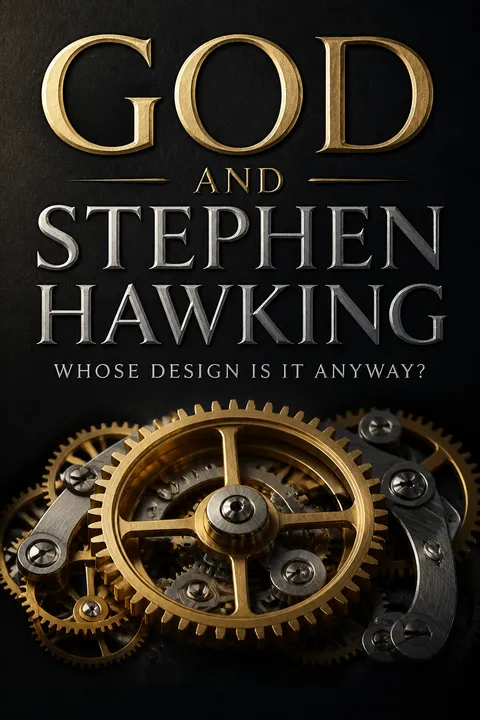


Key Takeaways
Treat Hawking's atheism as philosophy, not a result delivered by physics
Separate method from worldview. Physics investigates how the universe behaves. Claims that science has made God unnecessary go further: they interpret scientific findings through a philosophical view of reality. Lennox notes that accomplished scientists can share expertise yet disagree about God. Francis Collins, a Christian, led the Human Genome Project after Jim Watson, an atheist, had led it. Their difference, Lennox argues, is not settled by their scientific credentials alone.
Notice the hidden assumptions. Hawking calls philosophy obsolete, then makes claims about reality, existence, and what science can know, all philosophical questions. Lennox calls the belief that science alone delivers knowledge scientism. He also challenges the idea that God is merely a temporary explanation for whatever science has not yet explained. Removing nature gods from scientific inquiry does not, by itself, disprove a Creator of nature.
The useful distinction is between scientific results and the worldview used to interpret them. A measurement can constrain several philosophical positions without selecting one automatically. This avoids two familiar errors: treating religious belief as a scientific finding, and treating atheism as science's official verdict. Yet identifying a claim as philosophical does not make it weak, or make its opposite true. The next question is whether its reasoning is sound and whether it fits the evidence. Lennox is strongest when he asks readers to inspect assumptions, rather than treating either scientific prestige or religious conviction as a substitute for argument.
A law can describe what happens without making anything happen
Distinguish rule from cause. A law of nature summarizes regularities and helps predict what will happen under specified conditions. Newton's laws describe motion; they do not push a pool ball across a table. Someone must strike the ball, and there must already be a ball and a table. Lennox uses this distinction to question claims that laws of physics created the universe. A mathematical description of gravity is not automatically the cause of gravity, matter, or the universe's existence.
A useful analogy. Arithmetic explains why two deposits of £1,000 total £2,000, but arithmetic does not deposit the money. Likewise, a law may explain the pattern of an event without supplying the things that participate in it. The book's argument depends on separating a law's predictive role from the deeper question of what makes a physical world exist.
This distinction prevents an abstract description from quietly becoming a creative agent. It also clarifies why an explanation can be excellent at prediction yet incomplete as an account of origins. Still, the claim that laws never cause anything depends partly on what counts as a law. Some philosophers treat laws as descriptions; others regard them as expressing real governing relations or powers. The analogy therefore exposes a question, rather than settling every account of physical law. A careful reader should ask which meaning is intended before deciding whether a cosmological theory explains existence, describes it, or both.
Ask what "nothing" means before accepting a universe-from-nothing claim
Two meanings, one word. Lennox challenges Hawking's claim that gravity allows the universe to create itself from nothing. In philosophical usage, nothing means non-being. In physics, the word can refer to a vacuum or another physical state, which is not literally nothing. If gravity, a quantum state, or physical laws already exist, the explanation has begun with something.
Check the logic, too. Saying that the universe creates itself appears to presuppose the universe in order to explain its existence. Lennox argues that this is circular. He also asks whether a law that describes a universe can explain why that law exists. His criticism is aimed at the language and logic of the explanation, not at the scientific investigation of the early universe. The crucial test is whether a theory explains an origin or simply gives an unfamiliar name to its starting point.
The argument usefully forces a distinction between a physical vacuum and absolute nonexistence. Popular accounts can blur that distinction, making a technical proposal sound like creation from sheer nothingness. But the critique should not assume that every physicist uses the word nothing in the philosophical sense. A cosmological model might describe an early state or the limits of ordinary time without claiming that a universe literally caused itself. The remaining issue is substantial: describing a prior or boundary state does not necessarily answer why there is any reality at all. Clear definitions sharpen that question without predetermining its answer.
Separate physics' account of how the universe works from why it exists
Different questions need not compete. Lennox compares the universe to a jet engine. Physics can describe how the engine operates, while an account of its invention explains why it exists. The two explanations do not cancel each other. The book also draws on Aristotle's four kinds of explanation: what something is made of, its form or design, the agent that brings it about, and its purpose.
Apply the distinction carefully. Hawking presents physical laws as an alternative to a divine agent. Lennox argues that this mistakes a description of regularities for an explanation of ultimate existence. On his view, God is not a gap-filler invoked only where physics has failed, but the Creator and sustainer of both the known and unknown parts of nature. That makes God and physics answers at different explanatory levels, rather than rival answers to the same scientific question.
The engine analogy makes explanatory pluralism intuitive: knowing how a device works does not reveal who designed it or why it was built. In philosophy of science, this resembles the distinction between mechanism and purpose, or between proximate and ultimate explanation. But the analogy also has limits. Human-made engines have known designers, while a universe is not an artifact encountered alongside other universes with identifiable makers. The analogy establishes that different explanatory levels can coexist; it does not by itself establish that the universe has a divine maker. That further inference needs its own evidence and argument.
Fine-tuning raises a real question, but multiverses do not settle it
Why this universe? Hawking acknowledges that the universe's physical constants and laws appear finely adjusted for the possibility of life. The multiverse proposal offers one response: if many universes have different properties, observers will find themselves in one compatible with observers. Lennox argues that this possibility does not eliminate the design question. It does not show that a Creator could not make many universes, nor does it explain why the multiverse-generating system exists.
Separate proposal from evidence. The book focuses on M-theory, a speculative framework that, if correct, allows for an enormous range of possible universes, including 10^500 solutions. Lennox notes that in 2010 it was not a completed, observationally confirmed theory. A theory that permits many possible worlds is not, by that fact alone, a mechanism that produces them. The multiverse may relocate the question of explanation rather than remove it.
The multiverse answer draws strength from a selection effect: observers can only observe conditions compatible with their existence. That insight can weaken the surprise of finding a life-permitting universe, but it does not alone explain the distribution of possible universes or the system that generates them. Conversely, pointing to those unresolved questions does not establish design. The comparison between a single Creator and an immense ensemble depends on what each hypothesis explains and how independently it can be assessed. Lennox is right that multiverse reasoning does not logically exclude God; the further question is whether it improves the overall explanatory account.
A mathematical model can map a world without creating one
A simulated world needs a setup. Conway's Game of Life is a mathematical system of squares, each either alive or dead, that change according to simple rules. Some starting patterns vanish; others move or reproduce. Lennox points out that the rules do not create those patterns from nothing. A person must choose an initial arrangement, and a computer must implement the system.
Representation is not existence. Hawking uses models to discuss reality and calls his approach model-dependent realism: physical theories are models linked to observations, and their success is judged by how well they fit those observations. Lennox challenges the idea that a model's usefulness makes questions about independent reality pointless. A model may accurately describe possible behavior, but it does not automatically explain why there is a physical world for the model to represent.
The Game of Life is a crisp illustration of the difference between rules, initial conditions, and the system that realizes them. It also suggests a broader lesson: simulations inherit structure and information from their design and implementation. But the analogy cannot prove that the cosmos has the same kind of external designer as a computer simulation. Its value is narrower and stronger: complexity emerging under rules is not identical to rules creating a reality from nothing. The debate over model-dependent realism also matters beyond cosmology, because scientific models can be highly reliable without every feature of a model corresponding literally to reality.
Keep rational thought in the picture when explaining minds as matter
Explanation can undermine itself. Hawking and biologist Francis Crick describe human beings in strongly physical terms, as systems made of particles or neural activity. Lennox asks what follows if thoughts are only physical events: could an argument be judged true or false, or would it merely be something a brain produces? He sees a tension when a theory uses reasoning to argue that reason is only an impersonal by-product.
Do not confuse dependence with dismissal. The book also points to DNA as information-rich, comparing its molecular sequence to an immense text. Lennox treats rationality and intelligibility as clues to an intelligent source, not just as biological facts. His claim is that explaining the brain's physical operations does not automatically explain the validity of reasoning, the experience of beauty, or moral judgment.
The strongest version of Lennox's challenge concerns the difference between why a belief occurs and whether it is justified. A neural account can explain the causal production of a thought without deciding whether its reasoning is valid. That means physical explanation need not erase rational evaluation. The reverse caution also matters: the existence of rational capacities does not, by itself, demonstrate a divine source. The argument becomes clearer when it asks what a complete account of thought must include, rather than treating neuroscience and rational explanation as mutually exclusive.
Assess miracles as historical claims, not automatic violations of natural law
Regularity is not impossibility. Scientific laws describe patterns under specified conditions. Lennox argues that a miracle need not mean nature's regularities have been disproved; it may mean that an agent has changed the conditions. His analogy is a thief taking money from a drawer: arithmetic still correctly describes the deposits and remainder, even though an intervening action explains the loss.
Then examine the evidence. The book treats the resurrection of Jesus as a historical claim, not as a natural event that science should reproduce. It notes that ancient people also knew dead bodies did not ordinarily return to life, and that early Christian testimony centered on claims of eyewitnesses. Lennox argues that science alone cannot rule out a singular event. Whether the resurrection occurred must therefore be considered through historical evidence, alongside the prior question of whether a miracle is possible.
This framing separates two questions often collapsed into one: whether a miracle is conceptually possible, and whether a particular miracle happened. Regularities support strong expectations, but an expectation is not a logical proof that exceptions are impossible. At the same time, showing that a miracle is not ruled out by a scientific law does not establish its occurrence. Historical testimony, alternative explanations, and standards of evidence still matter, especially for a claim as consequential as resurrection. The book's distinction opens the inquiry; it does not complete the historical case within its brief treatment.
Analysis
Lennox's book is a focused reply to a particular rhetorical move: presenting atheism as the conclusion of physics rather than as a philosophical interpretation of physics. Its most durable contribution is methodological. It asks readers to distinguish evidence about how nature behaves from claims about why nature exists, to define terms such as nothing, and to notice when a scientific model is asked to perform work beyond prediction and description.
The case is strongest when it identifies category errors. A mathematical law is not obviously the same kind of explanation as an agent's purpose, and the success of physical models does not alone answer every metaphysical question. The book is also right that methodological naturalism, the practice of seeking natural explanations in science, should not be casually equated with metaphysical naturalism, the belief that nothing beyond nature exists.
Yet exposing an inference as incomplete does not establish the author's preferred alternative. The fact that a physical law does not create matter in the everyday sense does not prove that a personal Creator is the correct ultimate explanation. Likewise, the multiverse's speculative status in the book's 2010 context is a reason for caution, not a decisive refutation. The engine analogy establishes that explanations can coexist, but it does not show that a universe must have a designer in the same way a manufactured engine does.
The book is also an advocate's brief, not a neutral survey. It scrutinizes Hawking's assumptions while giving relatively little space to the strongest naturalist responses or to detailed historical evaluation of the resurrection. Its most useful lesson is therefore not that one side has won, but that the debate cannot be settled by scientific prestige or by declaring philosophy irrelevant. Readers should separate empirical findings, conceptual claims, and worldview conclusions, then evaluate each on its own merits. This makes room for both serious science and serious religious argument without pretending that either automatically supplies the other's answers.
Review Summary
God and Stephen Hawking receives mixed reviews, with many praising Lennox's clear arguments against Hawking's claims about God's non-existence. Supporters appreciate Lennox's mathematical background and logical approach, while critics argue his arguments are weak and rely too heavily on Christian apologetics. Some reviewers find the book concise and accessible, while others feel it lacks depth. Overall, readers' opinions largely align with their existing beliefs, with Christians generally praising the book and atheists dismissing it.
People Also Read






Glossary
Scientism
Science as sole authorityScientism is the view that science is the only reliable route to knowledge, or that every meaningful question must ultimately be answered by science. Lennox uses the term to distinguish confidence in scientific methods from a broader philosophical claim about the limits of knowledge. The claim itself is philosophical, not a result established by a scientific experiment.
God of the Gaps
God as a temporary explanationThe God of the Gaps is a conception of God as an explanation for phenomena that science has not yet explained. On this view, scientific discoveries shrink the gaps and progressively displace God. Lennox rejects this as an inadequate account of classical monotheism, which understands God as Creator and sustainer of the whole universe, including the parts science explains.
M-theory
A candidate unified frameworkM-theory is a proposed framework in theoretical physics associated with supersymmetry, gravity, and additional dimensions. In the book, Hawking presents it as a candidate for a unified theory and links it to a vast range of possible universes. Lennox stresses that, at the time of writing, it was speculative and not established by observational evidence.
Model-dependent realism
Reality described through modelsModel-dependent realism is Hawking's view that people understand the physical world through models, often mathematical ones, connected to observations by rules. Rather than asking whether a model is reality itself, the approach emphasizes whether it agrees with observation. Lennox challenges the implication that this makes questions about an objective world beyond our models pointless.
Inference to the best explanation
Choosing the strongest explanationInference to the best explanation, also called abductive inference in the book, reasons from observed evidence to the hypothesis that best accounts for it. It is especially important for singular past events that cannot be repeated, such as the origin of the universe. Unlike repeated experimental testing, it can leave several competing explanations consistent with the evidence.
Poirot Principle
Evidence can fit rival explanationsThe Poirot Principle is Lennox's informal name for the situation in which more than one hypothesis can explain an observed outcome. Like a detective story with several plausible suspects, cosmological evidence may fit multiple accounts of the past. The principle cautions against treating evidence that is consistent with one theory as proof that the theory is uniquely correct.
Fine-tuning
Life-permitting physical conditionsFine-tuning refers to the apparent narrowness of the physical laws and constants that allow a life-supporting universe. The book presents this as evidence raising the question of why the universe has its particular properties. A designer and a multiverse are discussed as possible interpretations, but the observation itself does not by itself decide between them.
Conway's Game of Life
Rules-based cellular simulationConway's Game of Life is a mathematical system consisting of a grid of cells, each in one of two states, that change according to simple rules across discrete steps. Some starting patterns disappear, while others move or reproduce. Lennox uses it to distinguish rules from initial conditions and from the computer system that implements the model.
About the Author
Other books by John C. Lennox


Download PDF
Download EPUB
.epub digital book format is ideal for reading ebooks on phones, tablets, and e-readers.








