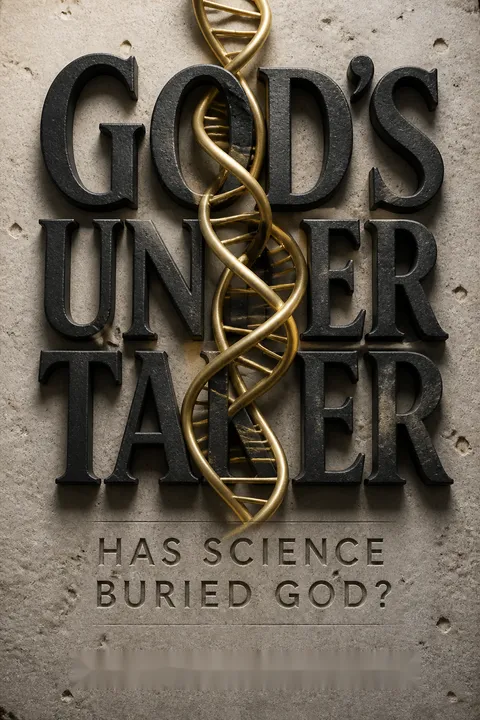


Key Takeaways
Science has not buried God; the deeper contest is naturalism versus theism
Name the real dispute. Lennox argues that scientific methods do not, by themselves, establish whether nature is all that exists. That is a philosophical commitment called naturalism, set against theism, which holds that the universe depends on a Creator. The book notes that scientists hold both views. A 1996 survey, repeating a narrowly worded 1916 poll, found similar proportions of respondents who affirmed belief in a God who answers prayer and personal immortality. The poll cannot settle the truth of either worldview, but it challenges the claim that scientific progress has simply erased religious belief.
Faith is not one thing. Lennox rejects the idea that Christian faith necessarily means belief without evidence. He presents it instead as trust informed by evidence, while acknowledging that some religious people take anti-scientific positions.
The distinction between scientific practice and metaphysical interpretation is valuable because a method cannot automatically settle questions it was not designed to test. But scientists’ private convictions are not evidence that science favors either worldview. The survey’s wording also matters: belief in a prayer-answering God and personal immortality is narrower than belief in a creator or some form of theism. The strongest lesson is methodological humility. A person should ask whether a claim is a scientific finding, a philosophical inference, or a personal conviction before treating it as the voice of science.
Treat famous science versus religion stories as evidence, not as verdicts
Galileo’s case was layered. Galileo believed in God and the Bible, yet argued that observation should outweigh assumptions inherited from Aristotle. His telescope challenged the accepted picture of the heavens. Some church authorities eventually used their power against him, but he also faced resistance from secular scholars committed to Aristotelian ideas. The episode shows real institutional conflict, but not a simple fight between science and faith.
The Oxford legend is shaky. The famous 1860 encounter between Bishop Samuel Wilberforce and T. H. Huxley is often retold as an ignorant cleric defeated by a scientist. Lennox cites evidence that Wilberforce had reviewed Darwin’s book on scientific grounds, and that contemporary reports did not describe a clear triumph for Huxley. Later retellings served broader struggles over who should hold authority in public life.
Historical myths are persuasive because they turn complicated disputes into moral fables with obvious heroes and villains. Lennox usefully restores context, especially the role of institutions and inherited assumptions. Yet debunking the simple conflict story should not create an equally simple harmony story. Galileo was still silenced by church authority, and religious commitments can shape how evidence is handled. The more durable lesson is to examine each dispute at several levels: the evidence, the intellectual framework, and the power relationships surrounding the debate.
Let scientific explanations answer how without pretending they settle every why
Methods have boundaries. Science investigates patterns, mechanisms, and causes within the natural world. Lennox uses a cake to distinguish those questions from purpose: experts could describe its ingredients and chemistry without knowing why it was baked. The baker, not further chemical analysis, can disclose that reason. This does not make science weak; it means different questions need different kinds of evidence.
Beware scientism. Scientism is the claim that science alone can deliver all knowledge. Lennox argues that this claim is not itself a scientific result. It also leaves out questions about meaning, beauty, and moral obligation. Science relies on assumptions too, including trust that nature will behave regularly enough for observations to guide predictions. Such trust is not the same as blind belief, but it cannot be proved by one more experiment without relying on it already.
The cake example clarifies the difference between describing a process and identifying an agent’s purpose. That distinction appears across fields: a forensic account of how a document was altered is not the same as evidence about who altered it. Still, purpose is not always sealed off from empirical inquiry. Archaeology, history, and behavioral science can test claims about intentions by examining traces and testimony. The useful boundary is not between scientific facts and all other knowledge, but between questions that require different evidence and standards of justification.
Read cosmic fine-tuning as evidence to interpret, not a proof that ends debate
A habitable cosmos needs conditions. Lennox points to the order of the universe, its mathematical intelligibility, and the delicate values of physical constants. He cites estimates that changing the balance between electromagnetic and gravitational forces by roughly one part in 10^40 would leave a radically different universe, with no suitable mix of stars. The book also describes the Big Bang evidence as consistent with a universe that began, while noting that cosmological models remain open to revision.
Observation is not its own explanation. The anthropic principle says, in its weak form, that the universe we observe must permit observers to exist. Lennox argues that this identifies a condition, not its cause. He weighs design against proposals such as a multiverse, while noting that the latter also carries speculative assumptions.
Fine-tuning arguments focus attention on a genuine explanatory question: why do the conditions we observe fall within a life-permitting range? Their force depends on how the relevant probabilities are defined and what alternatives are available. A multiverse could make our observation less surprising, but its explanatory value depends on evidence and a workable account of the other universes. Design is also an inference, not a direct measurement of a designer. The argument is most productive when it opens a comparison of explanations rather than claiming that one calculation settles metaphysics.
Evolution can explain change without logically settling whether creation has a purpose
Separate the claims. Lennox distinguishes microevolution, changes within populations such as shifts in finch beak sizes or bacterial resistance, from macroevolution, large-scale changes in biological forms and lineages. He accepts that selection acts on variation, but questions whether those processes alone explain every major innovation. He also stresses that natural selection sorts existing variations; it does not, by itself, explain where life first came from.
A mechanism is not a worldview. The book challenges the claim that evolution necessarily implies atheism. A believer could regard evolutionary processes as the means through which creation unfolds. Lennox also discusses disputes over the fossil record, the origin of biological novelty, and whether observed small-scale changes justify every claim made about life’s full history. These are presented as contested scientific questions, not as settled proof of design.
The logical distinction is important: a scientific account of biological change does not alone establish that reality has no purpose. At the same time, the book’s critique of evolutionary theory should not be mistaken for a rejection of the broad evidence for common ancestry and evolution, which is central to modern biology. The sharper question is which mechanisms explain particular transitions, and how confidently. Keeping those questions separate prevents a familiar confusion: using the scientific success of evolution to claim atheism, or using unresolved details to claim that evolution as a whole has failed.
Separate life's origin from evolution's account of what happens after life exists
Evolution needs something to evolve. Natural selection presupposes organisms, or at least systems that reproduce and vary. The origin of life is a different problem: how non-living chemistry first produced a system capable of heredity and replication. Lennox describes the Miller experiment, which produced amino acids from a simulated early atmosphere, then notes that later views of the atmosphere raised questions about whether those experimental conditions matched the early Earth.
The cell is interdependent. DNA stores instructions for proteins, but proteins help copy and interpret DNA. RNA helps carry and use genetic instructions. The book argues that this mutual dependence makes simple origin stories difficult, and describes proposals involving self-organizing chemical cycles as unresolved. Its central point is that researchers did not yet know how life began. Lennox treats that uncertainty as a reason to investigate, not as a substitute for investigation.
This distinction prevents a major category error. Evidence that populations evolve does not automatically explain the first replicating system, while uncertainty about abiogenesis does not undo evidence for evolution after life exists. The interdependence of cellular components poses a serious origin question, but present-day complexity does not by itself reveal the historical sequence by which simpler precursors may have arisen. A strong explanation needs plausible intermediate stages and evidence that they could function. The book is right to distinguish open research questions from confident claims; it is less persuasive when uncertainty itself is treated as positive evidence for a particular answer.
An information-rich signal supports design only if alternatives are fairly tested
DNA carries ordered instructions. The book distinguishes the measurable quantity of a symbol sequence from its meaning. A DNA strand can be counted as a string of four chemical letters; interpreting what its genes do adds a semantic dimension. Lennox argues that the ordered, functional information in DNA resembles information produced by minds and therefore points to intelligent causation.
The monkey example has a catch. Richard Dawkins’s computer simulation repeatedly generates letters, compares them with a target phrase, and preserves matches. Lennox argues that the target and comparison mechanism supply the very information the simulation appears to produce. This is a useful criticism of that particular analogy. It does not, by itself, prove that biological evolution works in the same way as the simulation, or that every natural process is incapable of producing new biological information.
The distinction between a string of symbols and meaningful information is philosophically important, and the target-phrase critique identifies a real limitation in Dawkins’s illustration. But an analogy’s failure is not equivalent to the failure of the scientific theory it was meant to illuminate. Biological evolution does not consult a future target phrase; selection acts on differences in reproductive success in existing populations. The central question is therefore comparative: which processes can generate and preserve functional biological novelty, and what evidence supports each account? Design becomes explanatory only when it makes the observations clearer than its competitors.
Natural laws describe ordinary patterns; they do not alone rule out a creator
A law is not a lock. Lennox challenges David Hume’s claim that a miracle violates the laws of nature. A scientific law describes regularities and helps predict what happens under specified conditions. If someone catches a falling apple, the law of gravity has not been disproved; an additional cause has changed what happened. In the same way, a creator could act without making the regular patterns of nature meaningless.
Possibility is not proof. Lennox argues that past regularity cannot logically establish that no exception has ever occurred. But showing that a miracle is possible does not show that one happened. The claim must still be assessed through historical testimony and evidence. The book uses the resurrection as its clearest example, while insisting that the ancient world understood that dead people do not ordinarily return to life.
The distinction between a law’s description and a prohibition is useful: physical laws do not operate like rules that compel an agent to behave. Yet Hume’s broader concern is not answered merely by pointing out that exceptions are logically conceivable. Extraordinary historical claims need evidence strong enough to overcome ordinary expectations, and witnesses can be mistaken or deceptive. Nor does a creator’s possible action establish that any particular religious account is true. The sound approach separates three questions: whether miracles are possible, whether evidence supports a specific event, and what that event would mean.
Use reason to assess claims of revelation, even when science cannot test them
Purpose requires another source. Lennox concludes that science can investigate the universe’s structure without determining why it exists or what human life is for. In his cake comparison, the ingredients do not reveal the baker’s intention; the baker must explain it. He argues that if the universe has a personal Creator, revelation could provide knowledge unavailable from studying physical processes alone.
The Christian answer is specific. The book turns to Logos, the Christian concept of the divine Word, and identifies Jesus as God’s self-expression within human history. This is not a result derived from physics or biology. It is a theological and historical claim that must be examined through other forms of reasoning and evidence. Lennox’s conclusion is that science may point toward a creator, while Christian revelation addresses the purpose science cannot establish.
The move from a possible creator to the Christian claim about Jesus is a substantial change in the kind of argument being made. Cosmology may raise questions about why a universe exists, but it cannot identify a particular revelation without additional historical and interpretive work. Lennox is right that reason does not stop functioning when a claim lies beyond laboratory testing. It must still evaluate sources, coherence, and competing interpretations. This keeps the book’s conclusion intellectually open: science can inform a worldview, but it cannot stand in for the full argument that worldview requires.
Analysis
Lennox’s central achievement is to separate questions that public debate often collapses: whether science can explain a mechanism, whether naturalism is true, whether evolution entails atheism, and whether a particular religious revelation is credible. That sorting gives the book its strongest contribution. Scientific practice can be methodologically natural without requiring the metaphysical conclusion that nature is all that exists. Likewise, accepting evolutionary change does not logically dictate a view about ultimate purpose.
The book is most persuasive when it exposes category mistakes, such as treating a description of a mechanism as an answer to why the mechanism exists, or treating a scientific law as a rule that could prevent an agent from acting. Its historical corrections also show how institutional authority and philosophical assumptions shape the stories told about science and religion.
Its weaker move is to treat explanatory gaps in origin-of-life research or evolutionary theory as if they substantially favor intelligent design before the alternatives have been compared in equal detail. An unresolved problem is not automatically evidence for a preferred solution. The critique of Dawkins’s target-phrase simulation, for example, identifies hidden design in that model, but a flawed analogy cannot carry the burden of disproving biological evolution. Modern biology offers extensive evidence for common ancestry and natural selection, while the origin of life remains a distinct research problem. Those propositions can coexist without contradiction.
The book is best read as a case against scientism and against the claim that atheism is a scientific conclusion, rather than as a conclusive scientific demonstration of Christianity. Its most durable invitation is to classify claims carefully, distinguish evidence from interpretation, and apply comparable standards to naturalistic and theistic explanations. The final theological step, from a possible creator to the Christian Logos, requires historical and philosophical arguments beyond the reach of cosmology alone.
Review Summary
God's Undertaker by John Lennox examines the relationship between science and faith, arguing that they are compatible rather than contradictory. Reviewers praise Lennox's logical arguments, scientific knowledge, and clear writing style. Many found the book thought-provoking and a strong defense of theism against atheist claims. Critics argue some arguments are flawed or outdated. The cosmology section received particular praise, while the evolution discussion was more controversial. Overall, most readers found it an engaging and intellectually stimulating exploration of science and religion.
People Also Read








Glossary
Naturalism
Nature is all that existsA philosophical worldview that treats nature as the complete system of reality, with no transcendent or supernatural realm. In Lennox’s account, naturalism is distinct from scientific methods themselves, even though some thinkers identify the two. It can include different views about matter, mind, and consciousness while denying a Creator outside nature.
Scientism
Science alone yields knowledgeThe position that scientific inquiry is the sole reliable route to truth or knowledge, and can in principle answer every meaningful question. Lennox argues that this position exceeds what science can establish, since the claim itself is philosophical rather than a scientific finding and questions of value or purpose do not reduce straightforwardly to laboratory investigation.
Methodological naturalism
Natural causes as a ruleA ground rule for scientific inquiry that seeks explanations in observable, testable natural causes. It is a method of conducting research, not necessarily a declaration that nothing supernatural exists. Lennox questions whether this rule should define science in every context, especially when investigating unique events or the origins of the natural order.
Anthropic principle
Observers require a habitable universeThe observation that the universe humans can observe must have conditions compatible with the existence of observers. The weak form emphasizes this selection condition. Lennox argues that it does not explain why life-permitting conditions exist; it describes what must be true for observers to be present, leaving their origin and explanation open.
Irreducible complexity
Interacting parts required for functionA term Michael Behe uses for a system made of interacting parts where removing one part prevents the system from performing its basic function. Lennox discusses it as a challenge to explanations based on a gradual sequence of functional improvements. Whether a biological system meets the definition, and what that implies about its history, remain matters of argument.
Specified complexity
Complexity with meaningful structureA form of complexity associated in the book with sequences that are both highly unlikely as random arrangements and organized according to a recognizable pattern, such as meaningful language or biological coding. Lennox argues that DNA exhibits this combination and that intelligence is the best-known source of such information. The inference depends on comparing competing explanations.
Algorithmic information theory
Information measured by shortest programA mathematical approach to information that measures the complexity of a sequence by the length of the shortest program capable of generating it. Repetitive sequences can be compressed into short instructions, while random-looking sequences may resist compression. Lennox uses this framework to distinguish simple order from complex sequences, then applies it to arguments about biological information.
God of the gaps
God invoked to cover ignoranceA criticism of arguments that attribute a phenomenon to God simply because current science cannot explain it. Lennox accepts that this can be intellectually lazy, but distinguishes it from arguments that infer agency from what is known about a phenomenon, such as information-rich structures. Critics can still dispute whether those cases genuinely rule out natural explanations.
Logos
The divine Word or reasonA Greek term meaning word or reason, used in Christian theology for the divine Word associated with creation and, in the Gospel of John, identified with Jesus. Lennox uses Logos to connect the intelligibility and information-rich character of the universe with a personal Creator. This theological claim goes beyond what scientific measurements alone can establish.
FAQ
What's God's Undertaker: Has Science Buried God? about?
- Exploration of Science and Faith: The book delves into the relationship between science and religion, questioning whether scientific progress has made belief in God obsolete.
- Arguments for Theism: John C. Lennox argues that science and faith can coexist, and that scientific inquiry can enhance understanding of divine creation.
- Critique of Atheism: The author critiques atheistic views, particularly those of Richard Dawkins, suggesting they misrepresent the relationship between science and belief in God.
Why should I read God's Undertaker?
- Thought-Provoking Content: The book challenges readers to consider fundamental questions about existence, purpose, and the universe.
- Balanced Perspective: Lennox, a mathematician and Christian, offers a perspective that combines scientific reasoning with theological insights.
- Engagement with Current Debates: It addresses contemporary debates on science and religion, making it relevant for both academic and casual discussions.
What are the key takeaways of God's Undertaker?
- Science and Faith Compatibility: Lennox argues that science and faith are not inherently in conflict and can enrich each other.
- Fine-Tuning Argument: The book presents the universe's fine-tuning as evidence for intelligent design, suggesting a Creator.
- Critique of Reductionism: Lennox critiques reductionist views that explain complex phenomena solely through physical processes.
What are the best quotes from God's Undertaker and what do they mean?
- “The universe is not self-explanatory.”: This suggests that the universe's existence requires an explanation beyond itself, implying a Creator.
- “The only watchmaker in nature is the blind forces of physics.”: Lennox critiques the idea that natural processes alone account for life's complexity, advocating for intelligent design.
- “The impression of design is overwhelming.”: This reflects the belief that the universe's intricate order suggests intentional creation.
How does [Author] address the relationship between science and religion in God's Undertaker?
- Historical Context: Lennox highlights how early scientists were often motivated by their belief in God, showing faith's role in scientific development.
- Philosophical Underpinnings: He argues that the universe's rational intelligibility is best explained by a rational Creator.
- Contemporary Relevance: The book discusses modern scientific discoveries and their implications for theistic belief.
What is the fine-tuning argument presented in God's Undertaker?
- Definition of Fine-Tuning: The argument posits that the universe's constants are precisely calibrated for life, suggesting design.
- Examples of Precision: Lennox cites examples like nuclear forces and carbon formation to illustrate life's improbability by chance.
- Implications for Design: He concludes that life's precision points to a Creator who designed the universe with purpose.
How does [Author] critique atheistic perspectives in God's Undertaker?
- Misrepresentation of Faith: Lennox argues that atheists often mischaracterize religious belief as blind faith, ignoring the evidence supporting theism.
- Philosophical Assumptions: He highlights the materialistic worldview driving atheistic arguments, which dismisses the divine.
- Call for Open Dialogue: Lennox advocates for respectful dialogue between believers and non-believers on existence and purpose.
What is the main argument against Darwinian evolution in God's Undertaker?
- Fossil Record Evidence: Lennox argues that the fossil record lacks sufficient evidence for macroevolution, citing sudden species appearances.
- Punctuated Equilibrium Theory: He discusses this theory, which challenges gradual evolution by suggesting rapid changes followed by stability.
- Irreducible Complexity: The concept argues that certain biological systems cannot be explained by gradual evolutionary processes alone.
How does God's Undertaker address the origin of life?
- Complexity of Life: Lennox emphasizes the complexity of even the simplest cells, arguing against random processes as their source.
- Information Theory: He suggests that DNA's information points to an intelligent designer.
- Challenges to Naturalistic Explanations: The book critiques naturalistic theories, asserting they fail to explain life's origin from non-life.
What is the significance of DNA in God's Undertaker?
- Information Encoding: Lennox highlights DNA as a complex information system, not just a chemical structure.
- Intelligent Design Implication: He argues that DNA's complexity implies an intelligent source.
- Comparison to Human Language: The author compares DNA to language, suggesting both require an intelligent author.
How does God's Undertaker relate to the concept of fine-tuning in the universe?
- Fine-Tuning Argument: Lennox argues that the universe's precise physical constants suggest a purposeful creator.
- Implications for Existence: The specific conditions necessary for life point to intentional design.
- Integration of Science and Theology: Understanding fine-tuning can enhance appreciation of science and theology's relationship.
How does God's Undertaker conclude regarding the relationship between science and God?
- Science as a Tool: Lennox concludes that science is valuable for understanding the universe but doesn't answer existential questions.
- Evidence for God: He argues that scientific evidence points towards a creator.
- Call for Open-Mindedness: The book urges open-mindedness in discussions of science and faith, considering scientific discoveries' implications for understanding God.
About the Author
Other books by John C. Lennox

Download PDF
Download EPUB
.epub digital book format is ideal for reading ebooks on phones, tablets, and e-readers.








