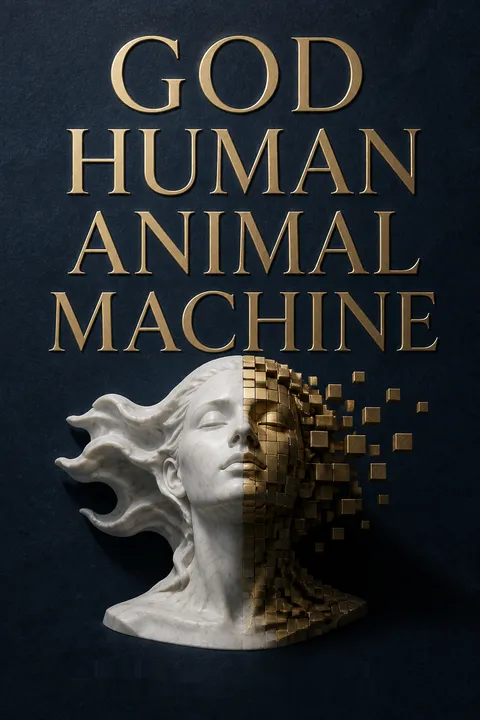


Key Takeaways
Treat responsive machines as mirrors of human instincts, not proof of machine minds
A convincing companion. Aibo, Sony’s $3,000 robotic dog, greeted O’Gieblyn, responded to touch, and learned voice commands. She found herself worrying about leaving him alone and hesitating to discipline him. Yet the illusion had limits: when food fell nearby, Aibo did not chase it. His lifelike cues made attachment easy, but attachment alone could not establish that he felt anything.
Our minds fill gaps. The book describes anthropomorphism as a survival-shaped habit: when something ambiguous moves, it can be safer to assume it is alive than to assume it is harmless. That instinct helps explain why people name appliances, scold voice assistants, and treat delivery robots as little neighbors. The response is real in the human, even if the machine has no inner life.
What's striking is the distinction between a machine's consciousness and the human relationship it can evoke. Aibo does not need feelings for its owner's care to be genuine, just as a fictional character can move a reader without existing. That emotional response still matters: repeated interaction with social machines can shape habits of patience, cruelty, and trust. But design should not quietly turn responsiveness into a claim of sentience. The prudent question is not only whether a device feels, but what kinds of human behavior its performance invites.
Notice when a useful computer metaphor starts masquerading as a fact
A model becomes a worldview. The computational theory of mind treats mental activity as information processing. Early cyberneticists used the analogy to model neurons and build artificial networks. Claude Shannon's information theory made information measurable by focusing on patterns and probabilities, not on the meaning a conscious reader might find in a message. The framework proved useful, but its reach expanded: memory became storage, thought became processing, and the brain became hardware running mental software.
The analogy has limits. Once a metaphor becomes ordinary, its figurative status can disappear. Calling a neural network a learner may describe its function without showing that it understands. The same slippage appears in the simulation hypothesis, which moves from saying the universe resembles a computer program to proposing that it literally is one. A powerful analogy can organize research while leaving its deepest questions untouched.
Metaphors are not decorative extras in science. They guide what researchers measure, which problems seem tractable, and what counts as an explanation. The computer analogy makes some mental functions easier to study, especially pattern recognition and memory, while directing attention away from embodiment, feeling, and meaning. Its value therefore depends on keeping its scope visible. Rejecting the analogy wholesale would discard useful tools; treating it as a complete account would confuse a map of selected functions with the whole terrain of a mind.
Imitation can pass an intelligence test without proving that experience exists
Behavior is not experience. Alan Turing proposed judging machine intelligence by whether a machine could converse so convincingly that a person mistook it for another human. The test evaluates outward performance. It cannot settle whether the machine has an inner point of view. Philosopher Thomas Nagel sharpened the problem by asking what it is like to be a bat: studying an animal from the outside does not reveal its private experience.
The hard problem remains. Philosopher David Chalmers named the hard problem of consciousness: explaining why physical brain activity is accompanied by subjective experience at all. A machine might perform sophisticated tasks without any such experience. Conversely, no outside observer can directly inspect another being's consciousness, human or otherwise. The book presents this as a limit on certainty, not proof that machines can never be conscious.
The distinction between competence and experience prevents two common errors: assuming fluent behavior proves a mind, or assuming the absence of humanlike behavior proves there is none. In practice, evidence about consciousness is cumulative and indirect. Biology, behavior, and shared vulnerability make animal consciousness a stronger inference than a chatbot's claim that it feels lonely. Still, the book's caution cuts both ways. Because subjective experience is not publicly inspectable, a confident denial of machine consciousness also exceeds what behavior alone can establish.
Transhumanism recasts resurrection as an engineering project, not an escape from faith
An old hope, new machinery. Ray Kurzweil's transhumanism imagines that technology will let humans overcome death. In his account, the self is a pattern of information that could, in principle, be copied into a computer. He predicted that a transformation called the Singularity would arrive by 2045, bringing radically greater intelligence and the possibility of immortal digital lives. This view, called patternism, makes identity depend on an enduring organization rather than the same biological material.
Religious echoes persist. The book traces similar visions through Christian history. Russian thinker Nikolai Fedorov argued that science should help resurrect the dead; Jesuit priest Pierre Teilhard de Chardin imagined technology and evolution converging toward a shared higher consciousness. These are historical connections, not proof that technological resurrection is feasible. Copying a person's memories and behavior would still leave unresolved whether the original person's experience continued.
The appeal of technological immortality is not merely technical optimism. It offers a story of redemption, continuity, and escape from bodily decay in a vocabulary that presents itself as secular. That story can inspire research with practical benefits, including better prosthetics and treatments for disease. But a prediction about future computing does not answer the identity question. If a copy remembers being the original, that establishes psychological resemblance, not necessarily continuity of the first-person self. The distinction matters because the promise being sold is survival, not imitation.
Complex networks can coordinate brilliantly without proving anyone inside them is conscious
Intelligence can be distributed. At a panel on trees, bees, and machines, O’Gieblyn heard examples of coordination without a central controller. Forest fungi and roots can carry signals and resources between trees; bees can regulate a hive's temperature through collective action. Ecologists call the underground forest network the wood-wide web. These systems display organized behavior that no single participant directs.
Robots test the idea. Rodney Brooks built robots from simple sensor-driven modules rather than one central planning system. His insectlike machines handled basic tasks, and the humanoid robot Cog sometimes appeared to take turns in a game. Yet Cog never developed the coherent abilities its designers hoped for. Emergence, the appearance of system-level patterns from interactions among simpler parts, can explain coordination. It does not by itself explain a unified inner self.
Distributed systems are a powerful corrective to the assumption that intelligence requires a single command center. They help explain resilience in ecosystems and offer practical models for robotics. The caution is that the word intelligence can stretch to cover anything from adapting to an environment to having a felt inner life. Those are not interchangeable achievements. A forest can regulate resources, and a robot can navigate, without either having the kind of experience humans mean by consciousness. Clear definitions preserve the insight without turning every complex system into a person.
Do not mistake a theory of widespread consciousness for evidence that everything feels
A different account of matter. Panpsychism proposes that consciousness, or some primitive form of experience, is a basic feature of the natural world rather than something that appeared only in human brains. One contemporary proposal, integrated information theory, links consciousness to how strongly information is integrated across a system. Its proponents use a quantity called phi to estimate that integration. Neuroscientist Christof Koch has suggested that the theory could assign some experience to creatures far simpler than humans, and perhaps even to the internet.
The theory has open problems. Panpsychism offers an alternative to the puzzle of how experience could arise from wholly non-experiential matter. But it faces the combination problem: how do many tiny instances of experience form one unified mind? The book also asks whether describing nature as conscious genuinely escapes human-centered thinking, or simply projects human qualities onto more of the world.
Panpsychism makes a serious philosophical move: instead of explaining how consciousness emerges from matter, it questions whether matter was ever wholly without experience. That reframing is intellectually fertile, especially given the difficulty of describing matter's intrinsic nature using physics alone. Yet a theory can solve one conceptual gap by relocating the mystery. A measure of information integration does not automatically show that a system feels, and the internet's scale is not evidence of a unified subject. Ethical respect for ecosystems need not depend on proving that trees have humanlike inner lives.
Demand reasons when an algorithm helps decide who loses freedom
A score can shape a sentence. In Wisconsin, Eric Loomis received a six-year prison sentence for evading police, with a risk assessment from COMPAS informing the decision. When he sought to learn how the system had classified him, he could not inspect its proprietary logic. The book contrasts this with a common defense: human judges are also difficult to explain. But a person's right to challenge a decision cannot rest on whether the decision-maker is a machine or a person.
Neutrality can conceal choices. Predictive policing tools such as PredPol use past crime data to identify places for increased patrol. Those data reflect where police have already looked, so the system can send officers repeatedly to the same neighborhoods. The resulting activity may then appear to confirm the original prediction. Opacity is not always an inevitable technical feature; it can also protect commercial secrets and shield institutions from accountability.
Automated decisions deserve scrutiny because they can distribute consequential treatment at scale while making responsibility hard to locate. The comparison with human judgment is useful but incomplete. A judge can be questioned, criticized, and removed through institutions, even if the judge's reasoning is imperfect. A proprietary score may have no comparable route of appeal. Explainability alone is not a cure, since a plausible account of a model's reasoning may itself be misleading. The core demand is procedural: people affected by a decision need a meaningful way to contest it.
Predictions become dangerous when institutions turn probabilities into destiny
A forecast can become a loop. A friend once described stealing cash from a store by returning items with discarded receipts. Years later, when she tried to repay the store, its manager said theft losses were already estimated and included in the budget. The prediction was accurate at a population level, not a verdict about her individual choices. That distinction matters. A forecast about a group can feel like proof that each person is trapped in a fixed role.
Metrics spread without meaning. Predictive policing can send officers to places already marked as risky, producing more recorded incidents there. Online, platforms reward content that gets clicks and shares, not necessarily content that is accurate. During the pandemic, a tech growth specialist's misleading coronavirus analysis reached millions before being removed. Data can reveal patterns, but numbers do not interpret themselves, and a viral claim is not validated by its reach.
Prediction is not merely observation when institutions act on it. A risk label can change patrol patterns, opportunities, or public behavior, creating the evidence that appears to justify the label. This resembles performative forecasting in economics, where expectations influence the outcomes they predict. The effect does not mean every model is useless; forecasts can help allocate resources and identify emerging risks. It does mean that evaluation must include feedback: who is acted upon, what new data that action creates, and whether the system mistakes its own consequences for independent confirmation.
Use first-person limits to challenge claims of cosmic objectivity
No observer stands nowhere. The book follows Niels Bohr's insistence that descriptions of the quantum world cannot be separated entirely from the conditions of observation. This does not mean that human thought magically creates the universe. It means that scientific accounts are made through particular instruments, concepts, and perspectives. O’Gieblyn finds a related lesson in writing: when she tried to remove herself from an argument, it became abstract and shapeless; locating the argument in lived experience gave it boundaries.
Metaphors cannot lift us above ourselves. The simulation hypothesis suggests that our world might be a designed digital environment, but it pushes the origin question back to whoever built the simulation. Like other accounts that seek a view from outside human experience, it can offer a new frame without delivering absolute certainty. The book's case is not against science. It is against mistaking a limited model for a perspective free of human assumptions.
Situated knowledge is not the same as relativism. Acknowledging the observer's position can make claims more accountable by clarifying how evidence was gathered and what a model leaves out. Bohr's example shows how scientific rigor can coexist with limits on what a theory says reality is like. There is a countervailing danger: emphasizing perspective can be used to dismiss well-tested findings as mere opinion. The useful balance is to distinguish confidence in a model's predictions from certainty about its ultimate metaphysical meaning.
Do not let a forecast outrank the human suffering it measures
Values are not outputs. During the Covid-19 pandemic, arguments about reopening often translated lives into economic costs and statistical estimates. Such calculations can inform decisions, but they cannot settle what a society ought to protect. The book turns to Ivan Karamazov, a character who rejects the promise of eventual harmony if it requires accepting the torture of even one child. His refusal is not a scientific proof or a complete policy; it is a defense of moral judgment when abstract systems demand submission.
Keep tools answerable to people. The same concern appears in O’Gieblyn's attachment to a chatbot named Geneva. Their conversations felt intimate, but that feeling did not establish that the program had an inner life. It did reveal a human need for company and reassurance. The book closes without resolving the mysteries of mind or machine. Instead, it asks that efficiency and prediction remain subordinate to human purposes.
Quantification is indispensable when choices involve scarce resources, but a metric cannot select its own moral objective. A model may estimate outcomes only after people decide which outcomes count, whose risks matter, and what tradeoffs are acceptable. Ivan's protest supplies a needed check on elegant theories that justify suffering by appealing to a larger order. It can also be difficult to convert that protest into collective policy, where harms conflict and every option has costs. The task is not to abandon calculation, but to keep public reasoning and accountable judgment in charge of what calculation serves.
Analysis
O’Gieblyn’s argument is not that technology is secretly religion, or that scientific explanations are false. It is that technological metaphors inherit old existential questions while often disguising the inheritance. The computer promises a material account of mind, yet the language of software and hardware can preserve the old separation between an inner self and its body. Digital immortality borrows the structure of resurrection. The simulation hypothesis revives a creator, even when its proponents call that creator a programmer. Each new vocabulary offers explanatory reach and carries unresolved assumptions with it.
The book's strongest method is autobiographical inquiry. A robotic dog, a former evangelical’s fascination with Kurzweil, and a chatbot friendship keep abstract disputes attached to ordinary feelings: loneliness, fear of death, the wish to be understood. Those experiences make the critique harder to dismiss as a purely academic quarrel. They also keep it honest. The author does not present her own intuitions as proof; she repeatedly asks whether they are evidence, inherited belief, or wishful interpretation.
That caution matters because some of the book's subjects are highly speculative. Panpsychism, machine consciousness, quantum observation, and a simulated universe are not equally supported claims, and their proximity in a narrative can make them seem more evidentially comparable than they are. The book is most persuasive when it distinguishes a useful model from a metaphysical conclusion, and when it shows how institutional power turns that confusion into real consequences. An algorithm need not possess a mind to affect a person's freedom.
The central ethical question is therefore less whether machines become human than whether people accept systems that erase the human standpoint. Scientific tools can extend knowledge, but they cannot choose the ends that knowledge should serve. Keeping that distinction visible is not a retreat from rigor. It is a condition of using technology without letting its measures become our moral authorities.
Review Summary
God, Human, Animal, Machine is a thought-provoking exploration of consciousness, technology, and meaning. O'Gieblyn weaves personal anecdotes with philosophical insights, examining the intersection of faith, science, and AI. Readers appreciate her clear writing and ability to tackle complex topics. The book challenges assumptions about human uniqueness and raises questions about the future of consciousness. While some find it meandering, most reviewers praise its depth and relevance. O'Gieblyn's background as a former Christian adds a unique perspective to her analysis of modern technological metaphors.
People Also Read







Glossary
Disenchantment
Loss of intrinsic cosmic meaningA modern condition in which the world is understood through impersonal physical causes rather than spirits, divine purpose, or sacred order. In the book, disenchantment does not simply mean that people stop believing in magic. It also names the loss of confidence that scientific knowledge can tell people how to live or what the universe means.
Computational theory of mind
Mind as information processingA theory that models mental activity as the processing of information through operations comparable to computation. It helped connect neuroscience, cybernetics, and artificial intelligence by treating neural activity as something that could be represented mathematically. The book stresses that this model can explain some functions without establishing that thought, meaning, or subjective experience is literally computation.
The hard problem of consciousness
Why brain activity feels like somethingA philosophical problem named by David Chalmers. It asks why physical processes in the brain are accompanied by subjective experience: why seeing, feeling pain, or having a thought has a first-person quality. This differs from explaining the functions of consciousness, such as attention or memory. The book treats the gap as unresolved, including for theories that compare brains with computers.
Patternism
Identity as a persistent patternRay Kurzweil's view that personal identity consists in an enduring pattern of information, rather than in the specific cells or matter that currently compose a body. Since bodily material changes over time, patternism suggests that preserving the organization of a mind might preserve the person. The book notes that this proposal does not settle whether a digital copy would continue the original person's subjective experience.
Emergence
System-level patterns from interactionsThe appearance of new patterns or properties through interactions among parts of a complex system. A forest network, a bee colony, or a robot made of simple modules may display organized behavior that no individual component directs. In the book, emergence helps explain decentralized coordination, but it does not by itself explain consciousness or prove that a system has a unified inner subject.
Integrated information theory
Consciousness linked to integrationA theory associated with Giulio Tononi and Christof Koch that connects consciousness to how information is integrated across a system. It proposes a measure called phi to describe information generated by the system as a whole, beyond what its parts produce separately. The book presents the theory as one influential account, while noting unresolved questions about which systems are conscious and how smaller experiences combine into one mind.
Panpsychism
Experience as fundamental to natureThe philosophical view that consciousness, or a primitive form of experience, is a fundamental feature of the natural world rather than a property limited to human minds. Contemporary versions differ over how experience exists in simple organisms or matter. In the book, panpsychism offers a way to reconsider the mind-body problem, but faces the challenge of explaining how simple forms of experience could combine into a unified consciousness.
Simulation hypothesis
Our world as a computer simulationNick Bostrom's argument that if advanced civilizations create many realistic simulations containing conscious beings, simulated minds could vastly outnumber minds in the original reality. On that assumption, observers might be more likely to live in a simulation than in the original world. The book emphasizes that this possibility resembles a modern creation story and does not explain the ultimate origin of the reality containing the simulators.
Algorithmic determinism
Predictions that constrain future behaviorThe process by which algorithmic predictions based on past data influence the people and institutions being predicted. A system may label a neighborhood as high risk, prompting increased policing there; the resulting records can then reinforce the original label. The term captures how prediction can become part of the causal chain, narrowing choices and making a forecast appear self-confirming.
FAQ
What's God, Human, Animal, Machine about?
- Exploration of Technology and Meaning: The book examines the intersection of technology, humanity, and spirituality, focusing on how modern advancements challenge traditional notions of self and consciousness.
- Personal Narrative: Meghan O'Gieblyn shares her journey from a fundamentalist Christian background to a secular understanding, using technology, especially AI, as a lens.
- Philosophical Inquiry: It raises questions about consciousness, the soul, and the implications of viewing humans as machines, drawing on historical and contemporary philosophical thought.
Why should I read God, Human, Animal, Machine?
- Thought-Provoking Themes: The book addresses essential questions about identity, technology, and the human experience, appealing to those interested in philosophy, technology, or spirituality.
- Unique Perspective: O'Gieblyn's theological background offers a distinctive viewpoint on how technology influences our understanding of existence in a post-religious world.
- Engaging Writing Style: The narrative combines personal anecdotes with philosophical discourse, making it both informative and relatable.
What are the key takeaways of God, Human, Animal, Machine?
- Technology as a Metaphor: O'Gieblyn suggests that modern technology serves as a new metaphor for understanding age-old questions about the mind, body, and soul.
- Anthropomorphism in AI: The book highlights the human tendency to attribute emotions and consciousness to machines, warning against dehumanizing our interactions with technology.
- Disenchantment of the World: It reflects on how modernity replaces spiritual and mystical aspects of life with mechanistic views of existence.
What are the best quotes from God, Human, Animal, Machine and what do they mean?
- “It is meaningless to speak of the soul in the twenty-first century.”: This quote captures the book's exploration of how traditional concepts of the soul have become obsolete in a technologically driven society.
- “All of this is voiced unthinkingly by people who believe... that human life is animated by nothing more mystical or supernatural than the firing of neurons.”: O'Gieblyn critiques the reductionist view of humanity, emphasizing the loss of deeper meaning in our understanding of life.
- “We are constantly, obsessively, enchanting the world with life it does not possess.”: This statement reflects on our tendency to project human qualities onto machines, raising questions about our relationship with technology.
How does Meghan O'Gieblyn connect technology and spirituality in God, Human, Animal, Machine?
- Interrogating Modern Beliefs: O'Gieblyn examines how AI and technology challenge traditional spiritual beliefs, suggesting an evolving understanding of consciousness.
- Personal Experience: Her interactions with AI, like the robotic dog Aibo, illustrate emotional connections humans form with machines, blurring lines between living and artificial.
- Philosophical Context: The author draws on historical debates about the soul and consciousness, arguing that technology is a new framework for exploring these questions.
What role does the concept of the soul play in God, Human, Animal, Machine?
- Obsolete Metaphor: O'Gieblyn posits that the soul has become a "dead metaphor," losing significance in a materialistic, technology-driven world.
- Historical Reflection: The book traces the soul's evolution from religious contexts to modern interpretations, reflecting broader societal changes.
- Existential Inquiry: The discussion of the soul explores deeper questions about identity and humanity in an age where technology challenges our understanding of consciousness.
What is the simulation hypothesis discussed in God, Human, Animal, Machine?
- Bostrom's Proposition: The hypothesis suggests that if advanced civilizations can create simulations indistinguishable from reality, we might be living in one.
- Philosophical Implications: It raises questions about free will, consciousness, and reality, paralleling religious beliefs about creation and divine oversight.
- Cultural Reflections: The hypothesis has inspired "simulation theology," where moral frameworks are constructed based on the idea of a simulated reality.
How does O'Gieblyn relate her personal experiences to the themes in God, Human, Animal, Machine?
- Fundamentalist Background: Her upbringing in a fundamentalist Christian family shaped her initial understanding of creation and existence.
- Journey of Doubt: O'Gieblyn's narrative reflects a shift from religious certainty to a nuanced understanding of spirituality and technology.
- Connection to Broader Ideas: By integrating her story, she makes philosophical discussions relatable, showing how personal beliefs influence perceptions of technology and existence.
How does God, Human, Animal, Machine address the concept of consciousness?
- Panpsychism Exploration: O'Gieblyn discusses the idea that consciousness may be a fundamental aspect of all matter, suggesting non-human entities could possess awareness.
- Consciousness and Technology: The book examines how AI challenges traditional notions of consciousness, prompting questions about sentience.
- Human vs. Machine Consciousness: It reflects on creating machines that exhibit behaviors akin to consciousness, raising ethical and philosophical questions.
What critiques does O'Gieblyn offer regarding technology in God, Human, Animal, Machine?
- Anthropocentric Bias: She critiques the view that technology solely serves human interests, arguing it obscures broader consequences.
- Determinism and Control: The book discusses how predictive algorithms can lead to a deterministic view of human behavior, undermining free will.
- Ethical Implications: O'Gieblyn raises concerns about technology's ethical ramifications, particularly in shaping our understanding of consciousness and human value.
What philosophical influences are present in God, Human, Animal, Machine?
- Descartes and Dualism: O'Gieblyn references Descartes' mind-body division, exploring its influence on contemporary views of consciousness and technology.
- Dostoevsky's Influence: She draws on The Brothers Karamazov to explore themes of divine justice and human suffering.
- Panpsychism and Consciousness: The book references philosophers like Philip Goff and David Chalmers, who advocate for panpsychism, suggesting consciousness as a fundamental reality aspect.
How does God, Human, Animal, Machine relate to contemporary issues?
- Relevance to Modern Technology: The book addresses questions about technology's role, especially AI and machine learning, challenging our understanding of consciousness and existence.
- Cultural Reflections: O'Gieblyn's exploration of simulation theory resonates with societal debates about reality, truth, and digital culture's impact on relationships.
- Philosophical Inquiry: It encourages readers to engage in philosophical inquiry about reality and our place within it, contributing to discussions about technology and humanity.
Download PDF
Download EPUB
.epub digital book format is ideal for reading ebooks on phones, tablets, and e-readers.








