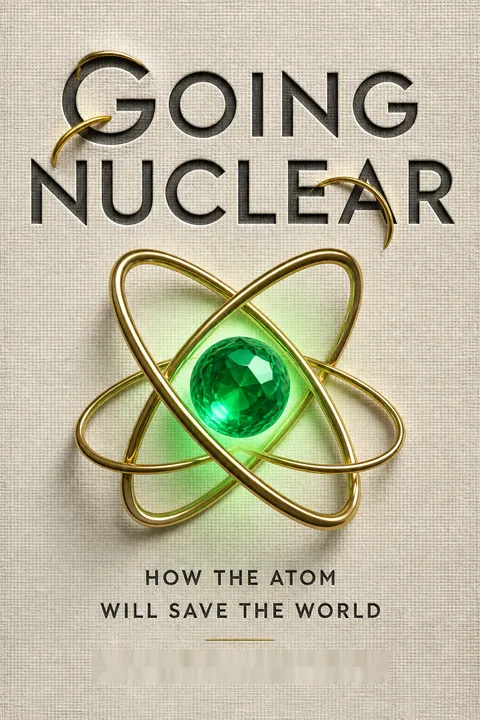


Key Takeaways
Build around controlled fission when clean energy must be abundant and dependable
A different kind of fire. Nuclear fission releases energy when a heavy atom, such as uranium-235, splits after absorbing a neutron. More neutrons escape, potentially setting off a chain reaction. In a power reactor, control rods absorb neutrons and regulate that reaction; a bomb instead drives an uncontrolled reaction to release energy as fast as possible. Shared physics does not make the two technologies equivalent.
Tiny fuel, huge output. In 1942, Enrico Fermi’s Chicago Pile-1 became the first reactor to sustain a controlled chain reaction. It produced little power, but proved the principle. The book argues that uranium’s extraordinary energy density makes fission a practical source of steady electricity, with far less fuel and direct pollution than fossil combustion.
The fire analogy makes the central distinction memorable: the same physical process can be governed toward radically different ends. It also points to the real question, which is not whether a technology has risks, but whether its operating system can control them. That question applies to aviation, chemical plants, and other complex infrastructure. The analogy has limits, however. Safe operation depends on maintenance, regulation, staffing, and institutional competence, not merely on the design of the reactor. A convincing case for nuclear power therefore needs both the physics and the governance.
Decarbonize heat, transport, and industry, not electricity alone
Electricity is only part. The book distinguishes electricity from total energy use. In its OECD comparison, an average person uses about 8 megawatt-hours of electricity but 46 megawatt-hours of energy each year. Buildings need heat, vehicles burn liquid fuels, and industries such as steelmaking rely on fossil fuels both for heat and as chemical ingredients.
Change the energy system. Electrification means replacing equipment that burns fuel with equipment that runs on electricity, such as electric vehicles and heat pumps. It only cuts emissions when the electricity itself is low-carbon. For uses that are harder to electrify, the book discusses hydrogen made by splitting water with clean electricity. That could supply ingredients or heat for steel and fertilizer production, though clean hydrogen remains scarce.
This whole-system view prevents a common accounting error: treating clean electricity as synonymous with a decarbonized economy. The distinction is useful in policy and household choices alike. An electric car charged on a fossil-heavy grid is not emission-free simply because its tailpipe is. At the same time, hydrogen should be reserved for applications where direct electrification is difficult, since each conversion of energy loses some of it. The book’s strongest implication is practical: climate plans must match specific technologies to specific jobs, rather than assume one clean-power statistic represents the whole transition.
Judge renewables by delivered electricity, not installed capacity
Capacity is not output. A power source’s capacity factor is the share of its theoretical maximum output that it actually generates over time. In 2023, the UK had 30 gigawatts of wind capacity but averaged 9.4 gigawatts of generation, a capacity factor of about 31 percent. Wind output varies with weather; solar output varies with daylight and season.
Backups have costs. The book argues that grids need reliable generation or storage when wind and solar output falls. It notes that pumped hydro and batteries currently cannot cover prolonged shortfalls at national scale, while turning surplus electricity into hydrogen and back loses much of the original energy. This does not make renewables useless, but it does mean their contribution must be assessed alongside backup, storage, and transmission needs.
The distinction between capacity and generation is a valuable antidote to headline-friendly comparisons. A grid must meet demand hour by hour, not merely accumulate impressive nameplate totals. Yet the book’s categorical claims about wind and solar risk understating the range of possible grid designs, including mixes of generation, storage, interconnection, and demand management. The relevant question is not whether one source can do everything, but what combination delivers reliability at acceptable cost and emissions. That system-level standard should be applied equally to nuclear, renewables, and fossil backup.
Compare whole-system costs and footprints before calling any power green
Every source leaves traces. Electricity sources require land, mining, construction, transport, and waste management. The book compares their lifecycle emissions, meaning the emissions produced across building, operating, and dismantling a system. It gives nuclear electricity a median lifecycle intensity of about 12 grams of carbon dioxide per kilowatt-hour, far below coal and gas.
Green labels can mislead. The author also contrasts nuclear’s compact land use with the larger footprints of wind and solar infrastructure, and describes the minerals required for panels, turbines, and batteries. Biomass receives particular scrutiny: burning wood releases carbon immediately, while regrowth may take decades or longer. The book’s example, the Drax power station, burns imported wood yet its emissions are not counted in the UK’s carbon budget under the accounting rules it describes.
The lifecycle lens is essential because a technology’s visible operating phase can conceal the burdens of its supply chain. It also exposes how accounting conventions can shape public perception, as the biomass example illustrates. Still, land use, mineral demand, and carbon intensity are different measures of environmental impact, not interchangeable scores. Their importance varies by place: a land-constrained region may value compact generation more, while a region with strong renewable resources may weigh other factors. A rigorous comparison should show those tradeoffs clearly rather than collapse them into a single winner.
Treat spent fuel as a managed inventory, not one undifferentiated hazard
Most waste is not spent fuel. Nuclear waste includes materials with very different radioactivity and volumes. The book reports that high-level waste is only about 0.1 percent of global waste by volume but contains roughly 95 percent of its radioactivity. Spent fuel also contains usable uranium and plutonium, alongside fission products that become less radioactive over time.
Two management paths. Finland’s Onkalo repository is designed to seal spent fuel deep underground in copper canisters, clay, and stable bedrock. France instead separates uranium and plutonium for reuse, while immobilizing fission products in glass. The book also describes breeder reactors, which can use otherwise underused uranium and transuranic elements to make more fuel. Such reactors could reduce waste burdens, but they require substantial technical and industrial development.
Breaking the waste category into distinct materials helps replace a vague fear with specific engineering questions: how much, how radioactive, for how long, and what containment is appropriate? Finland’s repository and France’s recycling program illustrate that disposal and reuse are policy choices as well as technical ones. Recycling is not a universal cure: it adds infrastructure and does not eliminate all waste. Likewise, geological disposal depends on long-term institutional and site confidence. The comparison is most useful when it invites transparent choices about stewardship, rather than implying that one pathway makes the problem disappear.
Assess radiation by dose and consequence, not by the trefoil symbol
Exposure has a scale. The sievert measures radiation’s biological effect. The book gives the global average natural background dose as about 2.4 millisieverts per year, much of it from radon, rocks, and cosmic rays. It describes the linear no-threshold model, which assumes that cancer risk rises in proportion to dose, even at very low levels. The author stresses that evidence at low doses is uncertain, though high doses are clearly dangerous.
Accidents include indirect harm. The book recounts Chernobyl’s flawed reactor design and rule-breaking operators, then Fukushima’s loss of cooling after a tsunami overwhelmed backup power. It reports no detected public radiation health effects from Fukushima, while evacuation and prolonged displacement caused serious harm. The wider lesson is to distinguish radiation exposure from the psychological and social consequences of how authorities respond.
Dose comparisons can make an invisible hazard more intelligible, and the attention to evacuation, stigma, and mental health broadens safety beyond radiation biology. However, uncertainty at low doses should not be confused with proof of zero risk. Nor should estimates of accident deaths be treated as settled when long-term effects are difficult to measure. Good risk communication must avoid both extremes: treating every exposure as catastrophic and dismissing uncertainty because observed harm is hard to detect. The book’s insistence on proportion is strongest when paired with humility about what the data can establish.
Use radioactivity to diagnose tumors, improve crops, and suppress dangerous pests
Radiation can be precisely useful. In a PET scan, physicians give a patient a radioactive sugar that cancer cells tend to absorb. Detectors track gamma rays produced when emitted positrons meet electrons, helping locate tumors. The book also describes lutetium-177 attached to a molecule that seeks prostate cancer cells, delivering radiation where it is needed, and alpha-emitting treatments designed to damage tumors over very short distances.
Beyond hospitals. Radiation has also helped create crop varieties with traits such as higher yields or disease resistance. In pest control, the sterile insect technique uses radiation to sterilize mass-reared insects. Released sterile males mate with wild females, reducing the population’s ability to reproduce. The book recounts its successful use against screwworms, which infest livestock and wildlife, and describes efforts to apply related methods to other pests.
These examples reveal a broader pattern: radiation is not only an energy source but a tool for measurement, targeted treatment, and biological control. In each case, success depends on directing the effect precisely, whether toward a tumor, a crop lineage, or a pest population. That precision also sets limits. Medical isotopes can be difficult to supply reliably, and crop mutation breeding requires testing to identify useful traits among many unhelpful changes. The applications are compelling not because radiation is inherently benign, but because careful targeting can turn a potent physical process into a practical benefit.
Pair peaceful nuclear expansion with serious safeguards and arms reduction
Civil and military uses share materials. The same broad knowledge of uranium enrichment, plutonium, and reactors can serve electricity production or weapons programs. The book describes the Treaty on the Non-Proliferation of Nuclear Weapons, which combines limits on weapons spread with support for peaceful nuclear technology and an obligation to pursue disarmament.
Conversion can reduce danger. In the Megatons to Megawatts program, Russia diluted weapons-grade uranium into reactor fuel, which the United States used to generate electricity. Between 1993 and 2013, that fuel supplied about 10 percent of US electricity, according to the book. International inspections and nuclear forensics help track material and investigate suspicious activity. The author argues that access to peaceful nuclear technology and credible non-proliferation safeguards must advance together.
The book avoids the comforting fiction that civil nuclear technology and weapons are wholly separate. That candor matters: legitimate power programs can create materials and expertise relevant to weapons, so safeguards are part of the energy system, not an afterthought. The conversion program offers a striking example of arms control producing a public benefit. Yet inspection cannot remove geopolitical competition or guarantee compliance in every case. International fuel services and verification can reduce incentives and opportunities, but their legitimacy depends on fair access and consistent standards for both nuclear and non-nuclear states.
Use nuclear batteries when sunlight cannot power the journey
Space demands dependable power. Voyager 1 and Voyager 2 traveled to the outer planets without solar panels because sunlight there is too weak. Their nuclear batteries converted heat from plutonium-238 decay into electricity. That steady supply supported instruments and communication over journeys lasting decades. Similar batteries have powered missions to Mars and other distant destinations.
A new fuel may come from old stockpiles. Plutonium-238 is scarce, but the book describes research into using americium-241, which forms as plutonium-241 in spent fuel decays. The author points to a UK effort to recover americium for space applications. Larger nuclear reactors could also support human bases where long nights or weak sunlight make solar power unreliable, while nuclear propulsion could shorten some deep-space journeys.
Space exploration makes the value of energy density unusually vivid: a small, long-lived power source can enable scientific work where repair crews and resupply are impossible. The proposed reuse of americium also connects waste management to technological innovation. But possibilities should be kept distinct from demonstrated capabilities. Radioisotope batteries are established, while some future reactor and propulsion concepts remain development projects. That distinction strengthens rather than weakens the case for research: it shows where experience exists and where engineering, safety, and cost questions still need answers.
Treat nuclear expansion as an institution-building project, not a reactor purchase
A fleet is built through repetition. France built 54 similar reactors over 25 years after choosing a standard design and resisting changes that would delay each unit. The book contrasts that experience with more recent projects that ran late and over budget, and with China and South Korea, which have continued building reactors on shorter timelines. Small modular reactors are presented as a possible way to manufacture standardized units in factories, though widespread commercial deployment has not yet been achieved.
Capability is accumulated. Building quickly requires trained workers, suppliers, regulators, financing, and public trust, not just a design. The book’s larger argument is that energy abundance supports living standards, and that environmental protection need not require accepting scarcity. Its closing challenge is to replace despair and appeals to what feels “natural” with tested technologies and responsible long-term planning.
The institutional lesson is more durable than any single reactor forecast. Standardization preserves learning across projects, while stop-start construction erodes expertise and raises costs. This is a familiar problem in infrastructure: the capability to build efficiently is itself an asset that must be maintained. The appeal to optimism is valuable when it motivates work rather than denying constraints. Nuclear programs still require credible plans for financing, waste, safety, and consultation with communities. Treating those obligations as part of the technology makes the case for expansion more realistic and more persuasive.
Analysis
Going Nuclear is both a science primer and a sustained argument for nuclear power. Its narrative begins with atoms in a laboratory, follows the discovery of fission into the first controlled reactor, and then widens toward climate policy, waste, medicine, weapons, and space. That structure is effective because it gives the reader a tangible chain of cause and effect: nuclear physics is not an abstraction, but a set of processes humans can control and apply.
The book’s central contribution is its insistence that energy policy be judged across the whole system. Electricity generation alone cannot decarbonize buildings, transport, and industry. Installed capacity is not delivered power. A low operating-emissions figure does not reveal the mining, land, storage, and backup required by a technology. These distinctions are useful well beyond nuclear debates because they challenge clean-sounding labels and encourage comparable accounting.
The argument is strongest when it explains mechanisms and shows how choices have consequences. The controlled chain reaction, the different categories of radioactive waste, the contrast between Chernobyl and Fukushima, and the medical uses of isotopes all make complex science legible. Its weaker moments arise when a case for nuclear becomes a case against renewables in general. The author’s own evidence supports a more conditional conclusion: wind and solar can contribute, but their value depends on resource quality, grid design, storage, and what reliable generation is available. Similarly, cost comparisons are sensitive to assumptions about financing, construction delays, lifetimes, and system boundaries.
A reader should therefore retain both the thesis and the method. Nuclear power offers dense, low-carbon, dependable energy and an unusually broad scientific toolkit. But deciding how much to build is an empirical and institutional task, not a contest of slogans. The book is most persuasive when it turns enthusiasm into questions that can be tested: what service is needed, what impacts follow across the lifecycle, and which institutions can deliver the technology safely and competently?
Review Summary
Going Nuclear receives high praise for its accessible explanation of nuclear science and compelling argument for nuclear energy as a solution to climate change. Readers appreciate Gregory's engaging writing style, humor, and optimism. The book challenges misconceptions about nuclear power and explores its potential applications beyond electricity generation. While some reviewers note occasional density in technical content and a strong pro-nuclear stance, most find the book thought-provoking and informative. It is lauded for its ability to make complex topics understandable and inspire hope for a sustainable future.
People Also Read







Glossary
k-value
neutron multiplication measureThe k-value is the average number of neutrons from one fission that cause another fission. If k is below 1, the chain reaction dwindles. At 1, it sustains itself at a steady level. Above 1, it grows. Reactor operators regulate neutron behavior to control the reaction and produce power safely.
capacity factor
actual versus potential outputCapacity factor compares the electricity a power source actually generates over a period with the maximum it could have generated if operating at full capacity continuously. It helps distinguish installed capacity from delivered energy. Weather-dependent sources have variable capacity factors, while nuclear plants generally achieve high values, apart from maintenance and other outages.
linear no-threshold model
dose-based risk modelThe linear no-threshold model assumes that radiation-related cancer risk increases in direct proportion to dose, with no dose so small that it carries zero risk. It underpins many radiation protection rules. The book describes strong evidence of harm at high doses but emphasizes that data at low doses are inconclusive.
mixed oxide fuel
recycled uranium-plutonium fuelMixed oxide fuel, or MOX, combines plutonium recovered from spent nuclear fuel with uranium oxide. It can be used in some water-moderated reactors to generate electricity from plutonium that would otherwise be stored or disposed of. France is the leading user described in the book, where MOX supplies part of nuclear generation.
breeder reactor
reactor that makes fuelA breeder reactor uses surplus neutrons to convert fertile isotopes, such as uranium-238 or thorium-232, into fissile material that can sustain fission. If it creates more usable fissile fuel than it consumes, it breeds fuel. The concept could greatly extend nuclear fuel resources, but commercial deployment remains limited.
radiophobia
irrational fear of radiationRadiophobia is the book’s term for an outsized fear of radiation that can persist even when exposure is low and evidence of harm is absent or uncertain. The author connects it to public responses after nuclear accidents, arguing that fear, stigma, and disruptive protective measures can cause serious psychological and social consequences.
sterile insect technique
pest control through infertile insectsThe sterile insect technique raises large numbers of pest insects, sterilizes them with radiation, and releases them into the wild. Because sterile males mate without producing viable offspring, repeated releases can suppress or eliminate a population. The book describes its use against screwworms and its potential for controlling other pests without broad insecticide use.
Download PDF
Download EPUB
.epub digital book format is ideal for reading ebooks on phones, tablets, and e-readers.








