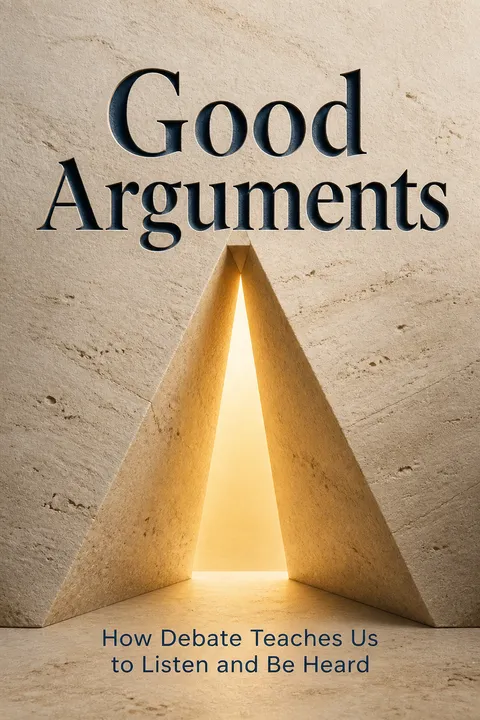


Key Takeaways
Treat disagreement as a way to be heard, not merely a fight.
Silence has a cost. After moving from South Korea to Australia as a child, Bo Seo found that struggling to speak English made everyday conflicts feel dangerous. He gradually learned to agree, apologize, and stay quiet. Debate changed the terms: speakers received equal time, listeners had to remain silent, and a neutral judge assessed the arguments rather than the debaters’ identities. For the first time, Seo felt that people might actually hear him.
A better outcome matters. The book’s central claim is that disagreement should leave people better off than if they had avoided it. That might mean finding a solution, understanding an opponent, or discovering what one believes. It does not mean every disagreement should continue indefinitely.
The childhood story makes voice a matter of access, not just confidence. Formal rules can protect people who are outmatched by fluency, status, or speed, much as fair procedures help prevent power from deciding a dispute in advance. Yet structure is not automatically fair: a confident speaker may still dominate, and a neutral judge can miss unequal starting conditions. The useful question is not simply whether people are allowed to speak, but whether the setting gives them a credible chance to be understood.
Name the actual dispute before defending your side.
Arguments drift easily. Seo’s coach taught that a topic is the precise proposition people disagree about. A broad subject such as family, schools, or politics is not yet a topic. Disagreements usually concern facts, judgments about what matters, or prescriptions about what to do, and one conversation may contain all three.
Separate the strands. Seo used topic analysis, a method for identifying the different claims hidden inside an apparent single dispute. When his father accused him of neglecting family ties because he had skipped a call to relatives in Korea, Seo first tried to contest the facts. He then realized the deeper disagreement concerned whether he cared about preserving his connection to Korea. Naming that judgment clarified what they were actually arguing about, even though they did not resolve everything that night.
This is a practical antidote to a common conversational error: answering the sentence that was spoken while missing the concern that prompted it. It resembles problem definition in medicine and engineering, where premature solutions often treat the wrong cause. Naming a dispute can also expose real value conflicts that evidence alone cannot settle. The risk is that one person may claim authority to define the issue for both. A fair topic must be recognizable to each side, not merely convenient to the more articulate one.
Make every claim prove both its truth and its importance.
Evidence needs a bridge. A complete argument starts with a conclusion, gives a main claim, supports it with reasons and evidence, and explains why that claim justifies the conclusion. Seo’s coach called the two essential tests truth and importance: is the main claim believable, and does it actually support the conclusion?
A true point can still fail. Seo’s friend Joanna persuaded him that industrial animal farming caused serious suffering. But that fact alone did not establish that he had to become vegetarian rather than eat less meat or choose different products. To build or test a point, Seo also developed the four Ws: What is the point? Why is it true? When has it happened before? Who cares? The last question forces a speaker to explain the consequences, not just pile up facts.
The distinction between evidence and relevance is central to sound reasoning. In policy analysis, for example, a program can produce a real benefit without proving it is the best use of limited resources. Requiring a link between claim and conclusion helps expose that gap. Still, importance is often a value judgment rather than a neutral test. Speakers should make their assumptions explicit, especially when the same evidence supports different priorities for different listeners.
Answer their strongest point, then offer a better alternative.
Rebuttal has two targets. Since an argument must show both that its main claim is true and that it supports its conclusion, a response can challenge either part. A claim may lack evidence, rely on a faulty connection, or be outweighed by a competing concern. This gives disagreement a structure beyond trading assertions.
Criticism alone is not a case. At a world championship, Seo attacked an opposing team’s argument for media access to politicians’ private lives. His coach warned that dismantling their case did not establish his own position. A useful rebuttal therefore ends with a counterclaim: if the other side’s proposal is flawed, what better principle or solution should replace it? That pivot turns demolition into a contribution and gives listeners something affirmative to assess.
The counterclaim matters because public criticism is cheap when the critic bears none of the cost of replacement. This is familiar in institutional design: exposing a broken rule does not tell a community what workable rule should take its place. At the same time, asking for an alternative should not become a trap that excuses a harmful status quo. A rebuttal can show that a proposal is unjustified even before a complete substitute is available.
Listen closely enough to improve the argument you plan to oppose.
Attention is part of rebuttal. Competitive debate trained Seo to write down opponents’ points instead of interrupting. His coach went further: debaters should strengthen an opposing argument before answering it, supplying the reasoning or example the speaker had left out. That makes the response harder, but it tests the real case rather than a convenient weak version.
Interruption can protect the ego. At a tournament breakfast, another debater gave a long argument that Seo wanted to cut off. Instead, Seo asked a question that led the speaker to make a different, more challenging point. Listening had exposed him to the risk of being persuaded. The book’s compact lesson from an experienced parliamentary transcriber is that most arguments contain more merit than a quick impression suggests, while none is beyond criticism.
This resembles steelmanning, the practice of reconstructing an opponent’s strongest case before evaluating it. It improves accuracy and can reduce the confirmation bias that makes people notice weaknesses on the other side and strengths on their own. The approach depends on good faith, however. In a hostile exchange, endless charitable reconstruction can become unpaid labor for the person already being misrepresented. Listening should sharpen judgment, not require someone to tolerate abuse.
Use rhetoric to make ideas clearer, not yourself more impressive.
Delivery is a craft. Seo learned that rhetoric is the way an argument is expressed: through words, structure, voice, and gesture. At first, he used elaborate language to impress audiences. In one college debate, his grand introduction drew laughs, and listeners had little substance to write down. A rival, Debra, was more effective because she made the audience’s questions part of her speech and explained why the claims mattered.
Clarity beats decoration. Seo’s practical revisions were to favor concrete words, put the conclusion near the beginning, avoid confusing metaphors and excessive qualification, match emotional intensity to the stakes, and explain how personal experience shaped a belief. A memorable line can help, but it cannot substitute for a comprehensible case. Good style makes the reasoning easier to examine rather than hiding it behind performance.
The emphasis on clarity connects rhetoric to cognitive load: listeners have limited attention, so needless abstraction makes it harder to evaluate an argument. But plain language is not culturally neutral. Accents, dialects, and speech conventions are often judged through social hierarchies, even when the content is strong. The goal should be intelligibility, not enforcing one elite style. A speaker’s manner can invite attention, but it should never be confused with the truth of the message.
Enter only disagreements worth having, and set boundaries first.
Use a pause before engaging. Seo’s RISA checklist asks whether a disagreement is real, important, specific, and aligned in purpose. A complaint may rest on misunderstanding; a minor difference may not deserve a fight; a sprawling subject may be impossible to resolve; and an opponent seeking only to wound may not share an acceptable reason for talking.
Public topics need limits, too. When Seo’s debate club considered controversial motions, members set a boundary: a debate should not challenge people’s equal moral standing. A formal platform can imply that a topic is legitimate and has two reasonable sides, so topic-setters carry responsibility. Sensitivity alone does not make a subject forbidden, but the burden of a debate falls especially hard on people for whom the issue is personal.
RISA works as a conversational speed bump, giving people time to distinguish a genuine conflict from a reflexive response. That is valuable in an attention economy built to reward immediacy. The boundary around equal standing also identifies a limit of procedural neutrality: not every proposition deserves a platform simply because someone can argue for it. Still, deciding which topics qualify can itself concentrate power. Transparent criteria and participation from affected communities make those judgments more accountable.
When challenged, diagnose the tactic and restore the rules.
Bad arguments use recurring moves. Seo groups common debate bullies by behavior: some dodge the point, some distort it, some attack without stating their own view, and some knowingly spread falsehoods. Calling a person a liar or answering an insult with another insult often helps the tactic succeed by shifting attention from the claim to the conflict.
Do not accept a rigged game. Seo draws on Richard Nixon’s exchange with Soviet leader Nikita Khrushchev. Nixon kept presenting his argument, named the interruption that was disrupting the exchange, and ultimately deferred the conversation rather than letting it collapse into a brawl. The broader response is to correct distortions, ask what the other person actually means, check representative false claims, and leave when the conditions for debate have disappeared.
The taxonomy is useful because it replaces vague frustration with diagnosis. Different tactics need different responses: correcting a false summary is not the same as answering a factual lie. The deeper principle is procedural resistance. A bully gains power by making the interaction unpredictable, so calmly naming behavior can restore shared expectations. Yet this strategy is not equally safe for everyone. Where there is a threat of retaliation, disengagement or outside support may be wiser than trying to repair the exchange alone.
Fight with loved ones in ways that leave room to remain close.
Intimacy makes small disputes large. Seo’s arguments with his parents often began with chores or careless remarks but expanded into judgments about character and accumulated grievances. He found that disagreements with loved ones can be especially hard to keep real, important, specific, and aligned. Familiarity encourages people to assume they already know what the other means, while emotional history gives trivial details outsized significance.
Try the other side on. Debate’s Side Switch asks a speaker to argue the opposing position, test objections to their own case, or imagine how the other side could win. Seo used this to understand his parents’ concerns, though he found that empathy needed to be renewed during long disputes. His church community also learned that debate has a stopping point: after a partial agreement, the next work was compromise, reconciliation, and sometimes simply saying thanks or sorry.
Side Switch treats empathy as a practice rather than a personality trait. That is powerful because perspective-taking can begin with deliberate action even when warm feelings are absent. Relationship conflict also shows why winning an argument is an incomplete measure of success: trust is a shared resource that the exchange can either preserve or consume. Still, perspective-taking should not mean equalizing unequal harms. Understanding another person’s reasoning does not require accepting it.
Teach debate as a route from information to the desire to learn.
Debate trains more than speaking. Seo presents its educational value as a progression: students encounter information, practice transferable skills such as research and reasoning, then gain motivation because their ideas affect a live exchange. A decade-long study of Chicago’s urban debate program found that participating at-risk students were 3.1 times more likely to graduate than nonparticipants, after accounting for self-selection.
A voice can change a life. Malcolm Little, later known as Malcolm X, encountered debate while imprisoned. He had been discouraged from aspiring to become a lawyer, then educated himself through reading and found an outlet in the prison debate society. His story illustrates how argument can offer intellectual agency where ordinary institutions deny it. Debate is not a cure for unequal schooling, but it can give students a reason to learn and a public place to use what they learn.
The educational claim is strongest when debate is treated as active learning: students must retrieve knowledge, organize it, answer objections, and adapt under pressure. That can build agency alongside skill. The graduation statistic is suggestive, not proof that debate alone caused the difference, since participation and program quality may vary. Access also matters. If debate remains concentrated in elite schools, its benefits reinforce advantage; broad public provision is part of the educational argument, not an optional extra.
Build institutions that reward listening, then make their decisions matter.
Technology shapes the argument. On Reddit’s Change My View forum, users publicly invite challenges and mark successful mind changes. A study of 18,000 discussion threads found that early responses were more likely to persuade, and that effective arguments often acknowledged uncertainty and offered evidence. Taiwan’s civic platforms took another route: they used voting tools to reveal shared ground and let citizens engage with policy. Their appeal suggests that people want influence, not just conversation.
Scale needs structure. IBM’s Project Debater could marshal evidence faster than a person, but its human opponent was more responsive to audience concerns. Seo’s conclusion is that good debate does not scale by itself. Institutions must create fair forums, teach civic skills, protect the quality of participation, and respond to what citizens decide. Otherwise, consultation becomes performance, and online disagreement becomes another contest for attention.
The examples show that digital discourse is designed, not simply discovered. Rules, moderation, interface choices, and incentives can make listening easier or grandstanding more profitable. AI adds a useful distinction: retrieving more evidence is not the same as understanding what an audience needs to decide. Yet tightly governed forums may remain niche, while open platforms struggle with scale and abuse. The institutional challenge is to widen access without stripping away the human judgment and accountability that make deliberation consequential.
Analysis
Good Arguments is both a memoir of finding a voice and a field guide to the conditions that make disagreement useful. Its most important move is to treat argument not as a personality type or a contest of verbal force, but as a practice governed by choices: define the issue, support a claim, answer opposition, manage delivery, and decide whether this exchange deserves to happen. Competitive debate supplies an unusually clear laboratory for these choices because speakers have assigned positions, time limits, rules, and an adjudicator. Seo then tests what transfers to family life, politics, education, and technology.
The book’s distinctive strength is its account of procedural fairness as a form of care. Silence may appear peaceful while preserving the advantage of whoever already commands the room. Conversely, disagreement can expose hidden assumptions and make a previously invisible person legible. This is why the book’s opening story matters: debate does not simply teach a shy child to speak more loudly. It gives him a structure in which speaking has a chance of being heard.
The argument is strongest when it resists easy celebration. Debate can reward speed, performance, and dominance; the author’s own competitive excesses show how persuasion can become a weapon. His answer is not to abandon argument, but to add boundaries, listening, and judgment about when to stop. This does not erase unequal power. A person facing harassment, coercion, or serious risk may not be able to restore fair rules by force of good technique. Sometimes the responsible choice is exit, protection, or institutional intervention.
The book’s civic ambition also depends on more than individual virtue. Forums need transparent rules, access for people usually excluded, competent facilitation, and consequences when public input is collected. Technology can support these conditions, but cannot substitute for them. The lasting insight is modest and demanding: institutions may improve the odds, yet every useful disagreement still depends on one person offering a reason and another granting it attention. A good argument is neither a victory lap nor a demand for harmony. It is a disciplined invitation to make a shared world more accurate and more livable.
Review Summary
Good Arguments receives mixed reviews, with an average rating of 3.66 out of 5. Some readers praise Seo's writing style and insights into debate techniques, finding the book thought-provoking and useful for improving communication skills. Others criticize it for lacking focus, being too autobiographical, and not providing enough practical advice. Many appreciate the blend of personal anecdotes, debate history, and real-world applications, while some feel the book doesn't fully deliver on its promise to teach effective argumentation skills.
People Also Read









Glossary
Topic analysis
Untangling a disagreementA method for identifying the separate factual, evaluative, and practical disputes inside a conversation. It helps participants find the central point of conflict, notice where they already agree, and avoid spending the whole exchange on side issues. A usable topic should describe the disagreement fairly enough that both sides recognize it.
Four Ws
A structure for argumentsA practice exercise for building a complete argument by asking four questions: What is the claim? Why is it true? When has something similar happened? Who is affected, and why does it matter? The final question tests whether the speaker has explained the argument’s consequences rather than merely supplied evidence.
Two burdens of proof
Truth and relevance testsThe two requirements an argument must meet to support its conclusion. The truth condition asks whether its main claim is accurate or believable. The importance condition asks whether that claim actually justifies the conclusion. A point can be true yet fail to persuade if the speaker never establishes why it matters.
RISA
A test for engagingA checklist for deciding whether a disagreement is worth entering. The conflict should be real, meaning an actual difference of opinion exists; important enough to justify the effort; specific enough to permit progress; and aligned, meaning the participants’ reasons for engaging are acceptable to each other. It is a pause for judgment, not a guarantee of agreement.
Side Switch
Practice the opposing viewA debate exercise in which a speaker temporarily argues from the other side. Participants can generate the opposing case, identify the strongest objections to their own position, or imagine what would make the other team win. The exercise unsettles certainty and reveals how a reasonable person might arrive at a different conclusion.
Counterclaim
A constructive alternativeA positive argument offered after challenging an opponent’s case. It answers the question of what principle, explanation, or policy should replace the proposal being criticized. A counterclaim prevents rebuttal from becoming pure opposition, although the failure of a proposal can still be shown before a complete alternative is available.
Plug and replace
A method for answering liesA response to a false claim that avoids relying on accusation alone. First, place the claim beside broader facts and show the contradiction it creates. Then replace it with the better-supported account and explain why that account fits the evidence. The method also helps prevent a barrage of falsehoods from dictating the whole discussion.
Spreading
Extremely rapid debate speechA style used in some competitive policy debates in which speakers talk at roughly 350 to 500 words per minute to fit more material into a limited speech. It can make detailed argumentation difficult for listeners to follow and has prompted debate over whether the activity rewards information volume rather than persuasion.
Eristic
Winning by any meansA style of argument that imitates reasoned debate while prioritizing victory over truth or fair exchange. Eristic tactics include evasion, distortion, personal attacks, and false claims. Seo uses the concept to describe a recurring temptation in argument: people can slide into manipulative conduct even when they began with a sincere aim.
FAQ
What's Good Arguments about?
- Focus on Debate Skills: Good Arguments by Bo Seo explores how debate can improve listening and communication skills. It highlights the role of structured arguments in both competitive and everyday settings.
- Two Forms of Debate: Seo differentiates between competitive debate, which is formal and rule-based, and everyday disagreements, which are more spontaneous. He suggests that skills from competitive debate can enhance daily interactions.
- Personal Journey: The book includes Seo's personal experiences, from his childhood in South Korea to international debate successes, illustrating the transformative power of effective argumentation.
Why should I read Good Arguments?
- Enhance Communication Skills: The book offers tools to improve listening and speaking abilities, applicable in various contexts.
- Understand Disagreement: Seo provides insights into engaging constructively in disagreements, viewing them as growth opportunities rather than conflicts.
- Cultural Relevance: It addresses the need for better argumentation in a world of misinformation and divisive rhetoric, making it timely and essential for societal dialogue.
What are the key takeaways of Good Arguments?
- Five Elements of Debate: Seo outlines topic, argument, rebuttal, rhetoric, and quiet as essential components for effective arguments.
- RISA Framework: The framework (Real, Important, Specific, Aligned) helps assess whether a disagreement is worth engaging in, promoting thoughtful consideration.
- Importance of Rebuttal: Seo emphasizes that rebuttal is crucial, highlighting the need for constructive engagement rather than mere opposition.
What specific methods does Bo Seo recommend in Good Arguments?
- Topic Analysis: Seo advises clarifying the main points of contention by identifying specific claims and their nature—factual, normative, or prescriptive.
- Two Burdens of Proof: He introduces truth and importance as necessary for a strong argument, ensuring factual correctness and relevance.
- Counterclaims: Effective rebuttal should include counterclaims that offer positive alternatives, shifting focus from attacking to proposing solutions.
How does Good Arguments address the issue of polarization in society?
- Identifying Bad Arguments: Seo links polarization to poorly constructed arguments and encourages recognizing and striving for better discourse.
- Encouraging Constructive Disagreement: The book advocates for respecting and exploring differing opinions to bridge divides and foster meaningful conversations.
- Role of Debate in Society: Seo suggests debate can heal societal rifts by promoting understanding and empathy, contributing to civil discourse.
What is the significance of the RISA framework in Good Arguments?
- Assessing Disagreements: RISA helps evaluate whether a disagreement is worth engaging in by considering its reality, importance, specificity, and alignment.
- Promoting Constructive Dialogue: It encourages focusing on meaningful disagreements, leading to productive conversations and better outcomes.
- Guiding Decision-Making: The framework aids in deciding when to debate and when to step back, preventing escalation and fostering healthier relationships.
How does Bo Seo’s personal story enhance the themes in Good Arguments?
- Personal Growth: Seo's journey from a shy immigrant to a world champion debater illustrates the transformative power of learning to argue effectively.
- Cultural Insights: His background as a South Korean immigrant offers unique perspectives on communication and disagreement in different cultural contexts.
- Real-Life Applications: Seo shares anecdotes demonstrating practical applications of debate skills, making concepts tangible and inspiring readers to apply them.
What are the best quotes from Good Arguments and what do they mean?
- “We should disagree in such a way that the outcome of having the disagreement is better than not having it at all.”: This encapsulates Seo's philosophy that disagreements can lead to growth if approached correctly.
- “Disagreement is not always the best response to conflict, but it may be the most revealing one.”: Seo suggests that engaging in disagreement can reveal deeper truths about ourselves and our beliefs.
- “The real embarrassment lay in choosing to argue at all.”: Reflects Seo's early struggles with conflict, highlighting the balance between agreeableness and assertiveness.
How does Good Arguments suggest we can improve our everyday disagreements?
- Practice Active Listening: Seo emphasizes truly hearing the other side's arguments before responding, fostering understanding and respect.
- Focus on Clarity: The book encourages clear communication by avoiding abstract language, making arguments more accessible.
- Embrace Vulnerability: Being open about beliefs and uncertainties can lead to meaningful conversations and create a safe space for others.
What role does technology play in the future of debate, according to Good Arguments?
- AI and Debate: Seo discusses AI's role in debate, such as IBM's Project Debater, exploring how technology can enhance or challenge traditional argumentation.
- Potential for Misinformation: He warns of technology's risks, like misinformation spread and social media's impact on discourse.
- Need for Adaptation: Seo suggests debaters adapt to communication changes, leveraging technology while adhering to good argumentation principles.
How can I apply the lessons from Good Arguments in my daily life?
- Practice Good Disagreement: Embrace good disagreement by engaging with an open mind and understanding differing viewpoints.
- Develop Debate Skills: Apply techniques like preparation, active listening, and the RISA checklist to enhance communication.
- Foster Community Engagement: Promote constructive dialogue in communities, contributing to healthier, more inclusive discussions.
What is the significance of the term "good disagreement" in Good Arguments?
- Constructive Engagement: "Good disagreement" means disagreements can be productive when approached with respect and understanding.
- Framework for Dialogue: Seo emphasizes empathy and active listening to mitigate conflict and foster collaboration.
- Cultural Relevance: In a polarized time, "good disagreement" is crucial for bridging divides and promoting civil discourse.
Download PDF
Download EPUB
.epub digital book format is ideal for reading ebooks on phones, tablets, and e-readers.








