Key Takeaways
1. The Foundation of Good Prose: Trust and Clarity
Our doctrine is, that the author and the reader should move along together in full confidence with each other.
Build reader trust. Good writing begins by trusting the reader, imagining their intelligence to be at least equal to your own. This isn't generosity but realism, fostering a dialogue where the reader questions, criticizes, and assents. Avoid aggressive "grabbing" metaphors; instead, offer an invitation, a quiet beginning that resonates with simplicity and clarity.
Clarity over dazzle. While writers often fear boring the reader, confusion is far more tedious than simplicity. A sensible line should thread through the prose, with ideas following a logical or emotional progression. Clarity, though not exciting, is a fundamental virtue, especially at the outset, preventing the writer's artfulness from becoming overbearing or intrusive.
Withhold wisely. Beginnings are an exercise in limits, where the art lies in deciding what to withhold. You can't make the reader love you immediately, but you can lose them. Provide only what the reader needs to know to continue, no more. The best reason for a reader to keep going is confidence that the writer is leading them somewhere interesting, not a barrage of information.
2. Narrative Power: Revelation Over External Conflict
Revelation, someone’s learning something, is what transforms event into story.
Discovering stories. Finding a compelling story often relies on the "luck of the conception," a chance encounter or sudden notion. Stories are discovered twice: first in the world, then in the author's study through careful construction of factual material. Don't be discouraged if a potential story doesn't "talk well" in summary; often, the most profound narratives resist easy encapsulation.
Internal drama. While conflict is often seen as the source of drama, the most important conflicts frequently occur within a character or the narrator. True stories often lack obvious, external "good guy vs. bad guy" drama. Instead, look for narratives of revelation, where an inscrutable character becomes understood, or a series of events quietly yields a dramatic truth.
Beyond mere events. Stories like Into the Wild, The Spirit Catches You and You Fall Down, or A Civil Action are not just event-driven; they are narratives of revelation. They explore how characters (or the author) grow in understanding and sympathy, transforming a ghastly adventure or a legal battle into a poignant exploration of human nature and societal issues.
3. Point of View: The Author's Strategic Stance
Point of view is the place from which a writer listens in and watches.
Choosing perspective. The choice of point of view—first or third person—is fundamental, determining what can be seen, what minds can be entered, and the overall tone. It's a strategic decision with serious consequences, as the wrong choice can deaden a story or distort truth. There's no inherent moral superiority in either, but the choice must serve the story.
Scale and intimacy. The scale of the story often dictates the presence of "I." For smaller, circumscribed worlds, an invisible third-person observer can create greater intimacy, allowing the reader to be alone with the characters. Conversely, against a large background, "I" can provide human scale, acting as a stand-in for the skeptical reader or a utilitarian guide.
Varieties of "I." The first person exists on a continuum:
- First-person minor: Utilitarian, unobtrusive, facilitating movement or registering observations (e.g., Lillian Ross, John McPhee).
- First-person major: Self-dramatizing, participating in events, or using personal responses to capture broad truths (e.g., Norman Mailer, Joan Didion).
- Restricted first person: Reveals little about the narrator's opinions, acting as a "reasonable person."
The narrative "I" is a constructed thing, an emblem of a personality, not necessarily a literal self-portrait.
4. Memoir's Paradox: Truth in Reimagined Memory
The impulse of memoir is itself a fictive impulse.
The allure of self. Memoir, though ancient, holds a particular contemporary appeal, driven by changing ideas of privacy and a desire for self-revelation. While "write about what you know" seems to point to oneself, the challenge lies in knowing too much—how to represent the contrariety of multiple selves without descending into gibberish.
Self-discovery, self-creation. Placing oneself on the page is an act of both self-discovery and self-creation, like a sculptor finding a face in clay. Memoir doesn't demand total self-representation; it can be confined to a specific time, relationship, or story, as seen in Ulysses S. Grant's focus on his Civil War campaigns. The goal is to get the face "more right than pretty."
Memory's frailty. Memoirists operate on a continuum between recollection and dramatization. Re-creating scenes inevitably involves some invention, making "imaginative memoir" a fitting term. While authors like Geoffrey Wolff meticulously report to verify memories, others, like Frank Conroy, blend remembered and reimagined details to create vivid experiences. The "story-truth" can sometimes be "truer than happening-truth," as Tim O'Brien explored, transforming painful memories into something beautiful and controlled.
5. The Essayist's Freedom: Ideas, Idiosyncrasy, and Self-Authorization
If I knew my own mind, I would not make essays. I would make decisions.
The outsider's genre. The essay, often unexalted due to its ubiquity in education, is paradoxically an outsider's genre—critical, subversive, and the natural medium for ideas. Essayists are self-authorizing, building their own stage and lectern, as no one explicitly asks for their opinion. This freedom, however, can be daunting for writers accustomed to journalistic strictures.
Beyond logic. Great essays transcend mere argument, often being "extra-logical" and governed by associative thought rather than strict linearity. Figures like Emerson and Thoreau, with their expansive and aphoristic styles, demonstrated the essay's power to make sweeping pronouncements and revel in extravagance. The "I" in an essay is the measure of all things, bringing all experience to bear on any subject, no matter how small or grand.
Magnifying significance. Essays confront old wisdom in fresh ways, illustrating that no idea can be exactly paraphrased. They gain authority from a particular sensibility's fresh apprehension of generalized wisdom, treating something specific with such attention that it magnifies into significance. As Theodor Adorno noted, the essay aims to "make the transitory eternal," inviting readers into digressions of thought and fostering a unique trust where disagreement can coexist with admiration.
6. Beyond Facts: The Moral Complexity of Nonfiction
Although the truth must always be found in facts, some facts, sometimes, obscure the truth.
The illusion of completeness. Nonfiction writers portray actual events and people, but their work can never be co-extensive with reality. Things are inevitably left out, and characters have lives beyond the page. This inherent incompleteness is a source of moral complexity, as the writer wields immense power over individual lives, easily abused.
Subjectivity as responsibility. While "objectivity" is a myth, and "everything is subjective" can lead to nihilism, subjectivity properly understood is simply another name for thought. It acknowledges the writer as a mediator between facts and truth, absolving them of nothing. Instead, it demands exploration of facts, discovery of truth, and its expression in prose, striving to do no violence to competing facts and truths.
Ethical dilemmas. The relationship between writer and subject is fraught with potential for deception and power imbalance, as Janet Malcolm argued. Journalists must be clear about arrangements, explain potential consequences, and respect boundaries. While cynicism limits discovery, a "willingness to be surprised" and a "bright thread of goodness" (as seen in Kidder's work) can open people to questioning and reveal deeper truths, transforming individual stories into powerful social commentary.
7. Cultivating Style: Rejecting the Easy, Owning Your Language
Own your language or it will own you.
Beyond simplistic rules. Familiar writing rules like "omit needless words" or "avoid the passive voice" are often half-truths, useful as correctives but not as primary instruction. True style emerges not from rigid adherence to rules, but from a nuanced understanding of language, blending Anglo-Saxon bluntness with Latinate formality, and recognizing that sometimes "longer is shorter" for clarity.
Avoiding common pitfalls. The creation of a distinctive style often begins with negative achievements—rejecting what comes too easily. Writers must avoid:
- Journalese: Clichéd, overly cautious, compressed language that violates natural rhythms.
- The New Vernacular: Aggressive informality, imitative spontaneity, and ingratiating qualifiers that sound rehearsed.
- Institutionalese: Opaque, jargon-filled prose that obscures responsibility, often a cosmetic for insecurity.
- Propaganda: Language that manipulates vocabulary in service of ideology, demonizing and blocking understanding.
The human sound. Good writing must possess a "human sound," a quality often called "voice." This isn't something to be designed but is the providential result of constant self-definition and inner dialogue. Writers should strive to "write the way you talk on your best day," listening to their own prose and drawing inspiration from great voices without merely imitating them.
8. Art and Commerce: The Writer's Dual Reality
No man but a blockhead ever wrote except for money.
The market's influence. All writers eventually confront the commercial side of their craft. While some, like Lewis Hyde, argue that art belongs to a "gift economy" fundamentally at odds with the market, others, like Dr. Johnson, assert that writing is for money. The publishing business, with its inherent risks and low success rates, is a "gambler's business," where most books lose money.
The professional writer. A "pro" writer, as Norman Mailer defined, can work on a bad day, meet deadlines, and make compromises, secretly relishing the job's constraints. While writers often lament publishers' marketing efforts, it's crucial to remember that publishers take chances on manuscripts that don't yet exist. Cultivating a "doubleness of being" means thinking of oneself as a writer while writing, and as a product when published.
Art as its own reward. Despite the commercial pressures, the deepest pleasure of writing lies in the work itself—a graceful narrative turn, an exact expression of intuition, the spirit of generosity behind the work. This "art" may or may not be rewarded in the marketplace, but it is rarely achieved with the market in mind. The best work is done for its own sake, a "gift," embodying the discipline to write from a place of love, not just a desire to be loved.
9. The Editor-Writer Collaboration: A Dance of Trust and Revision
Editing isn’t just something that happens to you. You have to learn how to be edited.
Learning to be edited. For a writer, learning to be edited is crucial, requiring a selflessness that allows another person to act in the best interests of one's work. This involves accepting honest feedback, even when it's difficult, and understanding that an editor's role is to sharpen understanding, not just to fix minor issues. The relationship, ideally, is a continuous dialogue, not a one-sided decree.
The editor's role. Editors, often "mechanics" rather than "collectors," must be alert to a writer's natural boundaries, inner territory, and true interests. They need a hierarchical sense of the manuscript, focusing on structure and idea before minutiae. Good editing involves intellectual engagement, admitting confusion, and helping the writer to think, rather than imposing one's own style or rewriting the author's work.
A symbiotic relationship. The editor-writer relationship is a delicate dance, often a "wifely trade" involving listening, supporting, and intuiting. While writers are often "narcissists" in the clinical sense, needing a distorted sense of reality to sustain their work, editors provide the necessary perspective. This collaboration, built on trust and mutual respect, transforms raw material into a coherent, impactful work, a process that is both challenging and deeply rewarding for both parties.
10. The Power of Revision: Transforming the "Draught of a Draught"
Writing is revision. All prose responds to work.
Two kinds of rewriting. Revision is not merely tinkering with sentences but a fundamental process of re-imagining and re-telling the story. There's the superficial "fixing" of what's already written, and then there's the deeper, more essential rewriting that involves throwing away old material and starting over, driven by a clearer understanding of the story's core.
Embracing the provisional. Writers must cultivate the ability to view their hard-wrought work as thoroughly provisional. This means being willing to "smash that article" or "fall out of love with my own words," even perfectly lovable ones, if they are at odds with the whole. The goal is to achieve pleasing proportionality, making some things big and others little, and ensuring every element serves at least two unstated purposes.
The final polish. The revision process culminates in "finish work," where overused words ("reps") are identified and corrected, and the entire manuscript is read aloud. This ritual, though chastening, reveals lurking mistakes and ensures a human sound. Ultimately, good writing is a contest with the inexpressible, leaving something unsaid, and the best work is done for its own sake, a continuous journey of refinement.
Last updated:
Review Summary
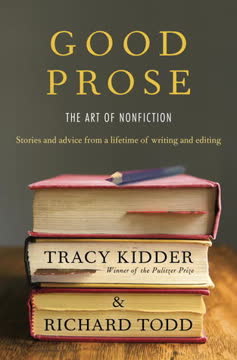
Good Prose by Tracy Kidder and Richard Todd is a well-regarded reflection on nonfiction writing based on their forty-year collaboration. Rather than a traditional how-to guide, it's a conversation between writer and editor exploring narrative structure, point of view, memoirs, essays, and the editing process. Reviewers appreciated the intimate look at their professional relationship and practical wisdom, though some found it too high-level, overly philosophical, or lacking diverse examples. Most valued the emphasis on clarity, revelation, and the relationship between facts and truth in nonfiction.
Similar Books