

Key Takeaways
Track hidden financial rules, not election theater, to find where power lies.
Politics as diversion. Taibbi opens with Sarah Palin's 2008 convention speech, which rallied supporters around an embattled cultural identity while the financial system was nearing collapse. He argues that elections increasingly function as team contests, where voters celebrate their side's victory but rarely gain control over the economic decisions shaping daily life. The Tea Party, in his account, channeled genuine anger away from banks and toward cultural enemies.
Follow the money. After the crisis, the top 1 percent's share of national wealth rose from 34.6 percent in 2007 to more than 37 percent in 2009, while median household net worth fell from $102,500 to $65,400. Taibbi's point is that partisan spectacle can conceal a shared economic divide that cuts across party lines.
What's striking is the contrast between the emotional clarity of political identity and the technical obscurity of financial policy. Group loyalty can make people feel influential even when the decisions affecting their wages, homes, and savings happen elsewhere. That helps explain why cultural conflict can mobilize more quickly than questions about lending rules. Yet the account risks treating voters as merely manipulated: local frustrations with permits, taxes, and distant mandates can be real, even when political figures redirect them. The useful test is not whether a movement is authentic, but whether its proposed remedies address the institutions benefiting from the problem.
Demand scrutiny when public rescue follows private risk-taking.
A selective safety net. Taibbi portrays Alan Greenspan as preaching market discipline while using the Federal Reserve's power to ease credit and stabilize Wall Street. After the technology-stock bubble burst, Greenspan cut interest rates repeatedly, eventually bringing them to 1 percent. The book argues that these rescues helped inflate the next speculative boom rather than forcing investors to absorb their losses.
An expectation of rescue. The term Greenspan put describes investors' belief that the Fed would step in when markets fell, much as an insurance contract limits a buyer's losses. Greenspan also resisted stronger oversight of derivatives and supported financial deregulation, while publicly promoting adjustable-rate mortgages shortly before a long series of rate increases. Taibbi sees this combination as public protection for powerful firms and private exposure for households.
The central issue is not whether central banks should ever intervene. A sudden freeze in credit can damage businesses and households far beyond the original speculators, so emergency lending can prevent a wider collapse. The harder question is who bears the cost and what behavior the rescue encourages. In economics, this is called moral hazard: protection from losses can make risk-taking more attractive. A credible safety net therefore needs limits, transparency, and consequences for decision-makers. The book is most persuasive when it traces how repeated rescues altered incentives, rather than treating one official as the sole cause of a system-wide failure.
Follow a mortgage from broker commission to taxpayer bailout.
One family's warning. Boston sheriff's deputy Eljon Williams says his broker, Solomon Edwards, assured him that his new mortgage was fixed-rate. After Williams's wife became ill, the family received notice that the loan was adjustable and its payment would rise. Edwards had collected commissions and disappeared. The episode introduces a wider system in which brokers earned more by placing borrowers in expensive, risky loans, even when safer financing was available.
Risk passed onward. Securitization pooled mortgages and sold investors claims on their future payments. Banks divided those pools into tranches, or layers with different payment priority and risk, then used collateralized debt obligations to repackage them. Taibbi describes loans with scant documentation receiving high ratings, while firms bought credit-default swaps as protection. When the mortgage market collapsed, the risk reached institutions such as AIG, whose rescue shifted enormous losses onto the public.
This chain is a vivid example of how separating a decision from its consequences can corrode judgment. A broker who collects a fee at closing has little incentive to care whether a borrower can pay years later; a bank that sells a loan onward may have even less. In organizational economics, these are principal-agent problems: the people rewarded for a transaction are not necessarily the people exposed to its failure. The account's criminal framing captures real misconduct, but the deeper lesson is structural. Better disclosure and enforcement matter, yet incentives also change when originators retain some responsibility for the loans they create.
Do not mistake speculative demand for a shortage of oil.
A new betting table. Commodity futures were designed partly to help producers and buyers manage price uncertainty. Taibbi argues that financial firms weakened position limits and marketed commodity indexes to large investors who were betting on rising prices, not buying fuel or food for use. Money invested in commodity indexes rose from $13 billion in 2003 to $317 billion by July 2008.
Prices reach households. Oil climbed to about $149 a barrel in July 2008, then fell to $33 by December. Taibbi points to data showing that, in one 2008 quarter, oil supply increased while demand decreased, challenging the explanation that scarcity alone caused the price spike. He argues that speculative flows amplified the surge, raising costs for people such as students, workers, and small-business owners. The same period brought sharp increases in food prices.
The chapter usefully asks readers to distinguish the price of a necessity from the physical availability of that necessity. Financial markets can influence prices through expectations, trading flows, and the way futures prices inform commercial decisions. But the causal case is more complex than a simple claim that investors bought contracts and directly made gasoline scarce. Oil prices also respond to geopolitical risk, currency movements, production capacity, and expectations about future demand. The strongest takeaway is therefore diagnostic: when prices jump, ask which evidence supports a supply shortage and which supports financial amplification. That question is more useful than accepting either a political slogan or a single-cause explanation.
Refuse 75-year asset leases as quick fixes for annual budget gaps.
Cash now, control later. Taibbi describes cash-strapped governments leasing public infrastructure to private investors, including foreign sovereign wealth funds. Chicago's 2008 parking-meter deal brought the city about $1.16 billion in exchange for control of its meters for 75 years. City council members had only days to review the agreement, and later estimates cited by Taibbi suggested the city had undervalued the revenue stream.
A lasting tradeoff. The contract restricted the city's ability to change meter hours, close streets, or remove meters without compensating the company. Taibbi connects such deals to a broader cycle: high energy costs and weak revenues strain public budgets, then officials trade long-term income and control for immediate cash. A sovereign wealth fund is a state-owned investment pool, often financed by oil or other national revenues, that invests assets to earn returns.
A lease is not automatically a giveaway. Private operators can bring capital and expertise, and governments sometimes need both. The crucial questions are whether the public received a fair valuation, whether future costs were modeled, and whether the contract preserves enough flexibility to serve residents. Chicago's rushed review illustrates why process matters as much as the headline payment. A one-time sum can look like fiscal relief while quietly removing a dependable revenue source. Long-term contracts deserve independent appraisal, transparent ownership disclosures, and public deliberation before officials treat them as emergency budget patches.
Judge health reform by changed power, not its label.
Reform without simplification. At Bayonne Medical Center, administrators described spending much of their time contesting insurance denials, including one case where delaying surgery was medically necessary because a patient took blood-thinning medication. A 2003 study cited in the book estimated that administration accounted for 31 percent of U.S. health spending, compared with 16.7 percent in Canada. Taibbi links this paperwork burden to a fragmented system of competing insurers.
The exemption stays. The McCarran-Ferguson Act gives states primary authority over insurance and exempts the industry from some federal antitrust rules when state regulation applies. Taibbi criticizes the 2010 health reform effort for requiring people to buy private coverage while abandoning key promises and failing to repeal this exemption in the final bill. He sees the result as a major expansion of insurance markets without a matching increase in public bargaining power.
The chapter highlights a distinction often lost in policy debates: extending coverage is not the same as lowering costs or improving care. A system can insure more people yet preserve administrative waste and concentrated market power. At the same time, private insurers are not the only source of inefficiency, and the book's sharply adversarial portrait can flatten variation among providers and plans. The practical measure of reform is what changes for patients and clinicians: fewer needless billing barriers, clearer accountability, and stronger ability to challenge unfair practices. Labels such as public, private, or market-based matter less than the actual distribution of leverage.
Test Wall Street's genius claims against its public backstop.
A reputation under examination. Taibbi uses Goldman Sachs as a case study in how a celebrated financial firm profited from successive bubbles. During the internet boom, the bank underwrote companies with weak earnings and faced allegations of practices that inflated IPO prices. In the mortgage boom, it sold mortgage-linked investments while also taking positions that would benefit if the market fell. The book presents these episodes as evidence that expertise and conflicts of interest can coexist.
The backstop matters. When the crisis hit, government support reached firms across Wall Street, including through the AIG rescue, which paid claims owed to major counterparties. Taibbi also notes that Goldman reported paying $14 million in U.S. taxes in 2008 on more than $2 billion in profit, attributing the low bill to the location of its earnings. The larger question is whether private gains depended on public protection.
Goldman works here as both a specific institution and a symbol of finance's political reach. That makes the chapter memorable, but it also risks letting one firm stand in for an industry whose failures involved many lenders, regulators, rating agencies, and investors. The most powerful scrutiny focuses on verifiable mechanisms: who knew what, who bore the risk, and how public assistance was distributed. A low tax bill or a bailout alone does not prove illegal conduct, and the chapter sometimes moves quickly from evidence to accusation. Its enduring contribution is to challenge the assumption that large profits automatically demonstrate social value or superior judgment.
Demand plain-language disclosure before complex rules allocate public risk.
Complexity hides decisions. Taibbi recalls covering the 2008 presidential campaign while the financial crisis was unfolding, yet the press spent far more time on campaign theater than on the lending practices threatening the economy. The crisis involved instruments such as derivatives, mortgage-backed securities, and credit-default swaps, which were difficult for most voters to evaluate and often poorly explained in public debate.
Expertise needs oversight. The book argues that this knowledge gap lets financial firms and lobbyists shape rules that affect mortgages, pensions, commodity prices, and public budgets. After the crash, decisions about bank rescues and mergers were made through hurried negotiations among officials and financial institutions, while the public received limited information. Taibbi's answer is not to ignore technical detail, but to treat the rules governing finance as political choices that deserve explanation and scrutiny.
Modern regulation cannot be made fully simple: instruments that distribute risk across institutions require specialized knowledge, and a slogan cannot replace careful analysis. But technical complexity becomes a democratic problem when only the regulated firms can reliably explain the rules, or when emergency decisions escape public review. This resembles information asymmetry in science and technology policy: experts are indispensable, yet expertise must remain contestable. Plain-language summaries, disclosed conflicts, accessible records, and independent oversight can help bridge that gap. The goal is not to make every citizen a derivatives trader; it is to make the public consequences of financial choices legible.
Analysis
Griftopia is a political-economic investigation built around a central paradox: the public hears that markets should discipline everyone, while powerful financial institutions repeatedly receive state support when their bets fail. Its chapters turn that thesis into a sequence of mechanisms. Cheap credit encourages speculation; securitization moves loans away from their originators; ratings and derivatives obscure risk; commodity indexes connect financial flows to household costs; and fiscal pressure can turn public assets into tradable revenue streams. The book's narrative strength lies in showing how abstract rules reach ordinary lives, from a family facing an adjustable mortgage to workers paying more to reach school or jobs.
Its most valuable contribution is not the claim that every crisis has one villain. It is the insistence that institutional design distributes risk and reward, often invisibly. The same transaction can be described as innovation by its seller and as a public liability when it fails. This is a powerful lens for evaluating bailouts, privatization, and reform legislation.
The argument is also prosecutorial. Taibbi's vivid portraits and moral certainty keep complex material readable, but at times the narrative compresses contested causal questions into a single story of deliberate predation. The account of commodity speculation, for example, makes a case for financial amplification, but supply, geopolitical expectations, currency movements, and market structure also shape oil prices. Likewise, Greenspan mattered, but institutions and incentives cannot be reduced to one personality. Readers should distinguish documented transactions, reported testimony, and the author's interpretation of intent.
The book appeared in 2010, close to the financial crisis, so its statistics, predictions, and policy judgments belong to that moment. Its durable insight is methodological: follow the contract, the incentive, and the ultimate bearer of loss. When a supposedly private failure requires public rescue, ask who designed the rules, who profited before the collapse, and who had a voice while those rules were made.
Review Summary
Griftopia is praised as an eye-opening, insightful critique of America's financial system. Taibbi's gonzo journalism style and clear explanations of complex financial concepts are lauded. Readers appreciate his non-partisan approach, exposing corruption on both sides of the political aisle. The book is described as infuriating yet essential reading, detailing how Wall Street and government collusion has led to economic crises and growing inequality. Some reviewers note the occasional use of crude language but overall find the book compelling and well-researched.
People Also Read





Glossary
Grifter Archipelago
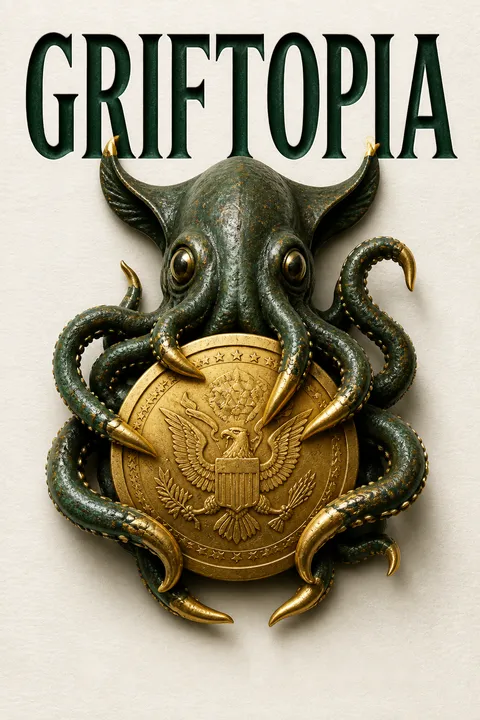
Hidden financial power networkTaibbi's term for the intertwined financial firms, political officials, regulators, and rules that shape economic life largely outside ordinary public attention. The image emphasizes that power is distributed across many connected institutions rather than held in one visible center. Elections remain prominent, but the consequential decisions often occur through technical policy, private contracts, and regulatory processes.
Greenspan put
Expected Federal Reserve rescueA market belief that the Federal Reserve would cut interest rates or otherwise support financial markets when asset prices fell sharply. The expectation resembled insurance against losses, encouraging investors to take risks because they thought public intervention would limit the damage. The term describes a perceived policy commitment, not a formal contract or guaranteed rescue.
Securitization
Loans packaged for investorsA financing process in which loans, such as mortgages, are pooled and converted into securities that investors can buy. The lender receives cash by selling claims on future borrower payments instead of holding each loan until repayment. In the book's account, this process helped lenders issue more mortgages while weakening their incentive to ensure borrowers could repay.
Collateralized debt obligation
Tranche-based debt securityA structured financial security backed by a pool of debts, such as mortgages, whose cash flows are divided into layers called tranches. Senior tranches receive payments first and are considered less risky, while lower tranches absorb losses earlier and promise higher returns. Taibbi describes banks repackaging lower-rated tranches into new securities that could receive high ratings.
Credit default swap
Contract transferring credit riskA derivative contract in which one party pays premiums to another in exchange for compensation if a borrower or debt security experiences a specified credit event. It can function as a hedge when the buyer has exposure to the debt, but it can also be used to speculate without owning the underlying bond. The book emphasizes that sellers could take on large obligations without adequate reserves.
Commodity index investing
Long bets across commodity futuresAn investment strategy that tracks an index of commodity futures, such as contracts for oil, wheat, or metals. Investors typically roll positions by selling contracts nearing expiration and buying later-dated ones, rather than taking delivery of the commodities. Taibbi argues that large long-only investments added upward pressure to commodity prices, though their precise effect relative to other market forces is disputed.
Sovereign wealth fund
State-owned investment poolAn investment fund owned or controlled by a national government, often financed by foreign-exchange reserves or revenues from oil and other resources. Unlike a central bank reserve held mainly for monetary stability, such a fund may seek long-term investment returns across global markets. Taibbi examines the role of these funds in buying stakes in infrastructure and other assets.
McCarran-Ferguson Act
State primacy over insuranceA 1945 U.S. law that established state regulation as the primary framework for the insurance business and limited the application of federal antitrust laws when insurance is regulated by state law. Taibbi argues that this arrangement allowed insurance companies to avoid some federal competition oversight. The law's scope and effects are central to his criticism of health reform.
Option ARM
Mortgage with payment choicesAn adjustable-rate mortgage that gives borrowers options for monthly payments, including a minimum payment that may be less than the interest accruing on the loan. When payments do not cover interest, the unpaid amount can be added to principal, increasing the debt through negative amortization. Taibbi describes brokers and lenders using these loans to expand borrowing while earning fees.
FAQ
What's Griftopia about?
- Financial Corruption: Griftopia explores systemic corruption in American politics and finance, focusing on the events leading up to the 2008 financial crisis. Matt Taibbi argues that a "grifter class" exploits the system for personal gain.
- Housing Bubble Impact: The book details how predatory lending and financial institutions inflated the housing bubble, causing devastating effects on ordinary citizens.
- Political Critique: Taibbi critiques both major political parties for enabling the financial crisis, suggesting that real issues are obscured by sensationalism.
Why should I read Griftopia?
- Insightful Analysis: Taibbi offers a sharp, critical analysis of the financial system, making complex topics accessible and engaging through humor and serious commentary.
- Real-Life Examples: The book includes compelling narratives of individuals affected by the financial crisis, personalizing broader economic issues.
- Understanding Current Events: It equips readers with a better understanding of financial mechanisms and encourages critical thinking about political and economic systems.
What are the key takeaways of Griftopia?
- Grifter Class: Taibbi introduces the concept of a "grifter class" that thrives on deception within financial and political systems, leading to economic inequality.
- Systemic Failures: The financial crisis resulted from systemic failures in regulatory oversight, allowing rampant fraud and abuse.
- Cultural Commentary: Taibbi critiques American political culture, suggesting elections have become entertainment rather than a means for real change.
What are the best quotes from Griftopia and what do they mean?
- Performative Politics: “Here’s the big difference between America and the third world: in America, our leaders put on a hell of a show for us voters.” This highlights the performative nature of American politics, distracting from corruption and inequality.
- Exploitation Parallel: “The engine for looting the old ghetto neighborhoods was the drug trade, which served two purposes with brutal efficiency.” Taibbi parallels the drug trade with financial practices exploiting vulnerable populations.
- Tea Party Complexity: “The Tea Party is not a single homogenous entity. It’s really many things at once.” This reflects Taibbi's nuanced view of the Tea Party, acknowledging its complexity while critiquing its role in diverting public anger.
How does Matt Taibbi describe the role of Alan Greenspan in Griftopia?
- Key Player: Taibbi portrays Greenspan as pivotal in the financial crisis, with policies contributing to the housing bubble.
- Regulatory Failures: Greenspan consistently failed to implement necessary regulations, prioritizing Wall Street interests over public well-being.
- Destructive Legacy: Greenspan's policies led to widespread financial ruin, exemplifying the disconnect between financial elites and ordinary citizens.
What is the "Grifter Archipelago" in Griftopia?
- Metaphor for Corruption: The "Grifter Archipelago" describes a network of individuals and institutions engaging in corrupt practices.
- Political and Financial Networks: It spans political and financial realms, with collusion to maintain power and wealth.
- Societal Impact: This culture perpetuates inequality and undermines trust in institutions, contributing to ongoing economic struggles.
How does Griftopia address the Tea Party movement?
- Anti-Intellectualism Critique: Taibbi critiques the Tea Party for embracing anti-intellectualism, allowing manipulation by elites.
- Distraction from Real Issues: The movement serves as a distraction from economic inequality and corporate greed.
- Manufactured Outrage: Taibbi describes it as a manufactured movement, channeling public anger away from Wall Street.
What are the implications of the mortgage crisis discussed in Griftopia?
- Financial Ruin: The crisis led to the loss of homes and savings for millions, highlighting the human cost of financial greed.
- Systemic Inequality: It exacerbated economic inequalities, disproportionately affecting low-income and minority communities.
- Need for Reform: Taibbi calls for significant financial system reforms to prevent future crises.
How does Taibbi use personal stories in Griftopia?
- Humanizing the Crisis: Personal stories, like Eljon Williams', humanize financial corruption and economic collapse.
- Broader Themes: These stories illustrate themes of exploitation and injustice within the financial system.
- Engaging the Reader: Personal anecdotes make the book engaging, encouraging reflection on economic issues.
What is the significance of "bubble economics" in Griftopia?
- Definition: "Bubble economics" refers to markets driven by speculation rather than real growth, leading to financial crises.
- Creation Mechanisms: Bubbles are created through reckless lending, speculative investment, and regulatory failures.
- Societal Consequences: The bursting of bubbles results in economic hardship, emphasizing the need for accountability and reform.
How does Matt Taibbi describe the role of Goldman Sachs in the financial crisis in Griftopia?
- Central Player: Goldman Sachs was central in speculative practices leading to the crisis, inflating asset prices.
- Market Manipulation: The bank manipulated markets to its advantage, often at clients' expense.
- Political Connections: Taibbi emphasizes Goldman’s ties to political leaders, securing favorable treatment during bailouts.
What specific methods did Goldman Sachs use to profit during the crisis according to Griftopia?
- Laddering and Spinning: Goldman manipulated IPO prices and offered shares to executives for future business.
- Short Selling: The bank profited by short selling mortgage-backed securities, betting against products it sold.
- Regulatory Loopholes: Goldman exploited loopholes to engage in risky trading without oversight.
About the Author
Other books by Matt Taibbi
Download PDF
Download EPUB
.epub digital book format is ideal for reading ebooks on phones, tablets, and e-readers.








