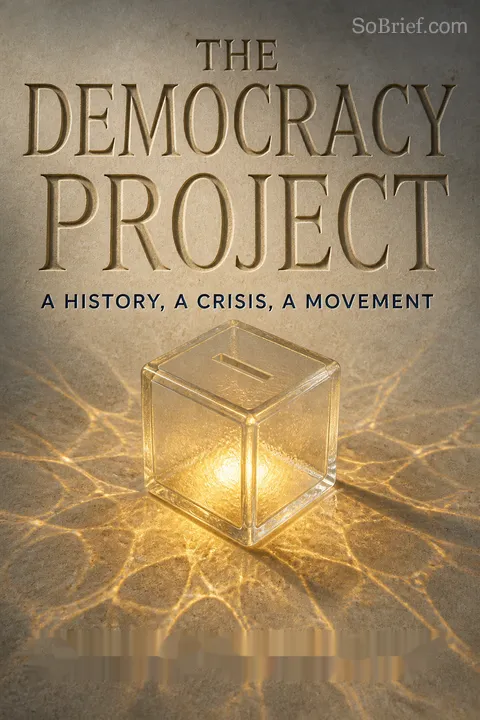


Key Takeaways
Practice democracy before claiming it; rights grow stronger when people exercise them
Rights were fought into being. At Federal Hall, Occupy activists gathered on the steps where the Bill of Rights had been signed, behind barriers policed by armed officers. Graeber used the setting to challenge the idea that America’s freedoms were simply bestowed by wise founders. He argues that popular protest helped force those protections into the Constitution, despite opposition from political elites.
Democracy means more than elections. For Graeber, it is people governing shared affairs together. Occupy’s assemblies gave participants direct experience of that possibility, changing what they thought politics could be.
The opening scene makes a useful distinction between legal rights and lived rights. A protection can exist on paper while authorities restrict its exercise, so public action helps test whether a principle has practical force. This is also why the setting matters: protest at a civic monument exposes the distance between national ideals and everyday enforcement. The argument should not imply that exercising a right always wins it, or that elections are irrelevant. Rather, formal safeguards and organized participation reinforce one another, while neither guarantees the other.
Stop waiting for a perfect plan; the first assembly can create the movement
A false start became an opening. In August 2011, activists arrived at Bowling Green expecting a General Assembly to plan an Occupy Wall Street action. Instead, they found a rally run by established political groups, complete with speakers and prepared signs. Graeber and other participants broke away, invited fellow attendees to form an actual assembly, and began organizing working groups.
The invitation was open-ended. The original call came from Adbusters, but its staff had limited resources and expected local activists to make the event real. Organizers declined to let a single group dictate the agenda or settle on one demand before people had joined. They began with meetings, practical tasks, and the question of who else should have a voice.
This origin story undercuts the familiar picture of movements as products of a master strategist. The organizers’ key achievement was not perfect foresight, but creating a forum that others could enter and shape. That kind of openness can make a campaign adaptable and emotionally credible. It also has costs: unclear roles invite conflict, and open meetings can privilege people with time, confidence, or organizing experience. Starting without a finished blueprint is not the same as dispensing with structure. The story shows structure being made in public, through shared work.
Turn scattered debt and insecurity into a shared account of class power
Private hardship found a public language. The phrase “the 99 percent” gave people facing different problems a way to describe their exclusion from political influence by a wealthy minority. Graeber connects the slogan’s appeal to conditions reported at the time: one in seven Americans faced debt collectors, and only 45 percent described themselves as middle class.
The stories were about necessities. Contributors to the Occupy “We Are the 99 Percent” page wrote about jobs, student loans, housing, health care, and supporting children or relatives. Their accounts were not mainly about consumer luxuries. The slogan connected individual struggles to a claim about class power, while making room for people with different backgrounds to recognize a shared political problem.
A broad identity can create solidarity where people might otherwise experience hardship as personal failure. Naming a common structure changes the question from “What did I do wrong?” to “Who benefits from these rules?” That reframing can support collective action. But a simple 99-to-1 division is a political lens, not a full map of social inequality. It can conceal differences in race, gender, occupation, and access to resources within both groups. The frame works best as an invitation to investigate power, not as proof that everyone outside the wealthiest fraction has identical interests.
Trace finance through ordinary life, where debt becomes a tool of rule
Finance reached beyond Wall Street. Graeber describes financialization as the growing role of lending, fees, penalties, and financial instruments in everyday economic life. In his account, government-backed student loans could channel future wages to lenders, while cash-strapped municipalities relied on fines and code enforcement to raise money for creditors. The boundary between state power and financial power consequently became harder to see.
The numbers showed the scale. At the time, finance companies generated 38 percent of U.S. corporate profits, though Graeber argued the true share was higher when firms’ financial divisions were counted. He also cited a household financial-obligations measure of roughly 18 percent of income, while noting that it excluded some fees and penalties.
The important move is to follow money into the institutions people encounter daily. Debt is not only a private contract when public policy shapes who must borrow, what happens after default, and how municipalities raise revenue. This perspective complicates the familiar opposition between government regulation and free markets: public rules can help construct the financial arrangements they appear merely to oversee. The book’s broad claim that finance operates as extraction is forceful, but the category includes very different activities. Distinguishing predatory fees from useful credit would make the diagnosis more precise without obscuring their shared institutional setting.
Do not mistake elections for democracy’s full history or meaning
The founders feared popular rule. Graeber notes that the Constitution calls the United States a republic, not a democracy, and that several prominent founders opposed direct popular assemblies. They worried that majorities might cancel debts or redistribute property. In his account, the representative system was designed partly to contain those possibilities.
Democratic practice has wider roots. Graeber recovers collective decision-making in settings often left outside standard histories, including pirate crews, Indigenous communities, and local assemblies. He argues that elections were historically associated with selecting elites, while lottery and consensus were also used as democratic methods. The deeper principle is equal participation in decisions, not one particular procedure.
This history usefully separates democracy as a political ideal from the institutions that claim to embody it. It also exposes how familiar terms can change meaning: a system once described as a republic can come to be treated as democracy itself. Graeber’s account is strongest as a challenge to a single, triumphant origin story. Its evidence for informal influences is necessarily fragmentary, and some connections are interpretive rather than demonstrable. That uncertainty does not erase the central point: collective self-government appears in varied forms, and its history cannot be reduced to elections or a single Western lineage.
Let dissent reshape proposals before a vote divides the room
Consensus is a process, not unanimity by decree. Graeber describes it as a way for participants to speak, raise concerns, and revise proposals so objections are addressed where possible. A participant may stand aside rather than support a plan, or block it if it violates the group’s shared principles. Larger groups may agree in advance on a supermajority fallback if discussion reaches a deadlock.
Structure limits hidden control. Facilitators manage discussion rather than dictate outcomes, and roles can rotate. Working groups should handle decisions at the smallest practical scale instead of sending every detail to a crowded assembly. Occupy’s own process was improvised and sometimes confused, especially when newcomers mistook a block for an ordinary negative vote.
Consensus treats disagreement as information that may improve a decision, rather than as noise to be counted and set aside. That can build legitimacy among people who must cooperate after the meeting. It also demands time, facilitation skill, and protections against informal leaders monopolizing attention. A veto can safeguard a minority, but it can also become a source of paralysis or leverage. The practical lesson is not that consensus always beats voting. It is that groups should make their rules explicit, distribute information and authority, and choose decision methods suited to the stakes.
Use direct action to demonstrate freedoms formal politics withholds
Action can model the alternative. Direct action means acting to address a problem without first asking existing authorities to solve it. Occupy’s encampments put that idea into practice through free kitchens, libraries, medical care, and public assemblies. The camps were not only protests about inequality; they showed participants and visitors a community making decisions and sharing resources.
The form carried the argument. Occupiers initially refused to reduce their politics to a list of demands for officials. Graeber presents this as a challenge to the legitimacy of a system that many participants considered unresponsive. The People’s Microphone, in which listeners repeated a speaker’s words so they could travel through a crowd, also turned communication into a collective activity rather than a performance by a few amplified leaders.
Demonstration can make an abstract political possibility tangible. A functioning kitchen or assembly answers a different question from a policy platform: not only what is wrong, but what cooperation might look like. This resembles learning by doing, where shared practice develops skills and trust alongside ideas. Yet visible alternatives do not automatically alter laws or redistribute resources at scale. Direct action is most persuasive when it can meet immediate needs, communicate its purpose beyond participants, and connect local experiments to broader political struggles without assuming that one camp can substitute for every public institution.
Read police encounters as contests over power, not neutral rule enforcement
The institution is not just its personnel. Graeber distinguishes individual officers, who may express sympathy, from police as a chain-of-command institution tasked with enforcing political decisions. He argues that formal liaisons can let commanders negotiate unofficial restrictions through a movement’s own representatives. In one example from Occupy Austin, a self-appointed liaison treated a police commander’s limit on tents as a promise the camp had to enforce against its own members.
Power shaped the rules in New York, too. During Occupy Wall Street, police used barriers, arrests, and changing restrictions to constrain assemblies. Organizers instead relied on public attention, legal challenges, and allies. A planned eviction in October 2011 was called off after activists mobilized on several fronts.
The distinction between personal goodwill and institutional role helps explain why a friendly conversation may not change an order. It also highlights a subtle risk: negotiators can acquire authority by translating an opponent’s threat into obligations for their own group. Still, the argument can become too categorical if every liaison or legal negotiation is treated as surrender. Such tools may protect participants or secure room to organize, depending on context. The deeper test is whether communication remains accountable to the group and whether it expands or narrows participants’ ability to act.
An eviction can destroy a camp without erasing what its people learned
The camps were one phase, not the whole movement. After authorities cleared encampments in late 2011, Occupy lost its visible gathering places, and the media increasingly portrayed it as finished. Graeber argues that police pressure, the loss of sympathetic coverage, and the retreat of liberal allies made public organizing far harder. The book also describes how conflict over money, tactics, and internal inequalities intensified after the shared camp life ended.
Organizing moved into other forms. Activists pursued campaigns involving foreclosed homes, rent strikes, public education, and debt. Debtor Assemblies drew new participants around the burdens that had helped give Occupy its broad appeal. Graeber’s larger claim is that movements can change political common sense even when they do not immediately win office or legislation.
A movement should be judged by more than whether its most visible gathering survives. Encampments can create relationships, political skills, and a shared vocabulary that persist in less photogenic campaigns. But persistence should not be confused with victory. Skills can dissipate, alliances can break, and a changed conversation may leave underlying institutions intact. Graeber’s distinction between short-lived organizational forms and longer cultural change is valuable precisely because it prevents both premature eulogies and easy celebrations. The hard question is how to preserve democratic participation when the common space that made it possible disappears.
Redefine worthwhile work around care, not endless production
Work is not virtuous simply because it is work. Graeber challenges the assumption that economic trouble is solved by making people work more or harder. He calls this bargain productivist: accept work discipline in exchange for the promise of greater consumption. He argues that the bargain undervalues care, teaching, and other work that helps people directly, even as those workers may struggle to support their own families.
He proposes changing the terms. Graeber suggests pairing broad debt cancellation with a sharp reduction in working hours, such as a four-hour day. The proposal links financial insecurity to environmental pressure: debt promises future production, while demands for ever more production deepen an unsustainable pattern. Shorter hours would make room for forms of value not measured by output or pay.
This reframing asks what work is for, rather than treating paid production as the default measure of social contribution. It brings care labor into view and challenges the assumption that efficiency gains must become more consumption. The proposal also makes an important connection between household debt and ecological limits. Its political difficulty is substantial: shorter hours and debt relief require decisions about income, services, and resource allocation. Still, the thought experiment shifts debate from whether people deserve security to how a society might provide it without tying human worth to constant production.
Build on everyday cooperation instead of waiting for a blueprint
Shared life already contains cooperation. Graeber redefines communism as the principle of contributing according to ability and receiving according to need. He points to ordinary situations in which people help one another without negotiating a price for every small act, and to workplaces where cooperation requires sharing tools and knowledge. This does not mean society already operates fairly; it means market exchange is not the only basis for social coordination.
Expand the spaces of freedom. Rather than designing a complete future system in advance, Graeber argues for extending forms of cooperation people can organize and revise themselves. He leaves the final institutional design open, emphasizing that free people should be able to decide together what arrangements meet their needs.
The argument avoids a common trap in debates about alternatives: demanding a finished blueprint before experimentation can begin. Everyday cooperation is evidence that people coordinate through trust and shared purpose, not only through prices or commands. But small acts of mutual aid do not settle questions of scarcity, conflict, or large-scale infrastructure. Nor are all relationships voluntary or equal. The concept works best as a starting point for institutional imagination: identify where cooperation already succeeds, ask what supports it, and build arrangements that reduce dependence on coercion without romanticizing informal life.
Analysis
The book’s central move is to shift the meaning of democracy from a property of governments to a capacity people practice together. That shift connects its scenes of Occupy organizing to its historical argument: assemblies are not an eccentric supplement to elections, but evidence that collective self-rule can take forms that representative institutions do not capture. The narrative matters. The movement’s first decisions were made amid confusion, factional rivalry, police pressure, and practical problems, not in a seminar room with a settled theory. This gives the political argument credibility and keeps the reader close to the experiment.
Graeber’s strongest insight is that organizational means shape political ends. Consensus, shared services, and refusal to appoint permanent leaders were not merely internal preferences. They offered a public demonstration of the kind of social relations the movement hoped to make possible. This resembles prefigurative politics, but the book also shows its friction: open processes take time, information can become a source of informal power, and the disappearance of a shared space makes participation harder to sustain.
The historical account is deliberately revisionist. It treats conventional democratic histories as selective, recovering assemblies and practices obscured by an elite focus on constitutional design. Its argument is persuasive as a warning against claiming democracy for one lineage or procedure. Some proposed influences are harder to establish than others, and the book’s broad claims about state power and finance sometimes compress important differences between institutions. Those limits do not undo its core challenge. They clarify that democratic experiments require both political imagination and careful evidence.
The book does not offer a ready-made replacement for the state or capitalism. Its wager is that asking for a complete blueprint before people experiment gives existing arrangements an unfair monopoly on what counts as realistic. The practical test is whether democratic forms can meet needs, distribute authority, and endure beyond moments of collective excitement. Occupy’s value, in this account, lies less in a finished victory than in making that test visible.
Review Summary
The Democracy Project receives mostly positive reviews for its insights into the Occupy Wall Street movement and analysis of democracy. Readers appreciate Graeber's perspectives on direct democracy, anarchism, and critique of modern political systems. Some find the book's organization and personal anecdotes distracting. Many reviewers highlight the book's thought-provoking ideas about consensus decision-making and alternative forms of governance. Overall, it is praised for its accessible writing style and ability to challenge readers' assumptions about democracy and social change.
People Also Read






Glossary
The 99 percent
The majority excluded from powerA political identity used by Occupy Wall Street to describe people whose interests and voices were, in the movement’s view, subordinated to a wealthy minority. The phrase joined distinct experiences, including debt, unemployment, and insecurity, into a shared challenge to the concentration of economic and political influence.
General Assembly
An open decision-making meetingA public gathering where participants discuss shared concerns and make collective decisions. In Occupy, General Assemblies used facilitators, working groups, consensus procedures, and hand signals. They were intended to let people participate directly rather than delegate authority to a fixed leadership, though their effectiveness depended on attendance, facilitation, and the ability to maintain a common space.
Consensus process
Collaborative proposal-makingA decision process that gives participants equal opportunity to raise concerns and revise proposals, rather than treating a simple majority as sufficient. Participants may stand aside or block a proposal when it violates shared principles. Groups can adopt fallback voting rules for deadlocks, but the defining emphasis is on addressing objections and reaching a decision people can accept.
prefigurative politics
Practicing desired social relationsAn approach in which a movement organizes itself to reflect the society it seeks to create. Instead of postponing democracy until after winning political power, participants try to embody it in present-day decision-making, mutual support, and collective action. The organizational form is therefore part of the political message, not merely a tool for delivering it.
contaminationism
Democratic practice spreading by exposureThe belief that people who experience direct, egalitarian decision-making may carry those practices into other settings. Graeber uses the term for the hope that assemblies and consensus would spread beyond activist circles as people saw groups make decisions without conventional leaders. The idea emphasizes demonstration and participation over persuasion through abstract argument alone.
direct action
Acting without seeking permissionAction taken to address a problem without asking existing authorities to solve it first. In Graeber’s account, direct action can include building alternative services, occupying a space, or disrupting an institution. It can overlap with civil disobedience, but its central meaning is acting as though people can begin exercising freedom rather than merely petitioning those who hold power.
dual power
Building institutions alongside the stateA strategy of creating autonomous spaces and institutions that meet needs outside the existing political, legal, or economic order. Such institutions may develop into a democratic alternative or challenge the legitimacy of established authorities. The approach raises practical questions about defense, alliances, and whether participation in formal politics strengthens or weakens independent self-government.
productivist bargain
Work discipline exchanged for consumptionGraeber’s term for the assumption that accepting more work, discipline, and production is justified by the promise of greater material abundance. He argues that this bargain treats output as an overriding social good and undervalues free time and caring work. His alternative is to question whether more production is desirable when it worsens insecurity and ecological strain.
People’s Microphone
Crowd-amplified speechA way to address a large gathering without electronic amplification. A speaker talks in short phrases, and listeners nearby repeat those words so they carry farther. Occupy used the method when loudspeakers were unavailable or prohibited. Graeber notes that its structure can discourage rambling and require the crowd to listen closely enough to repeat what was said.
mafia capitalism
Finance joined to political extractionA phrase used within Occupy to criticize an economic order in which financial firms and political institutions reinforce one another. Graeber applies it to systems that extract wealth through debt, fees, penalties, lobbying, and state enforcement, rather than primarily through producing goods. The term is polemical, expressing the movement’s view that financial power had become difficult to separate from state power.
About the Author



Download PDF
Download EPUB
.epub digital book format is ideal for reading ebooks on phones, tablets, and e-readers.








