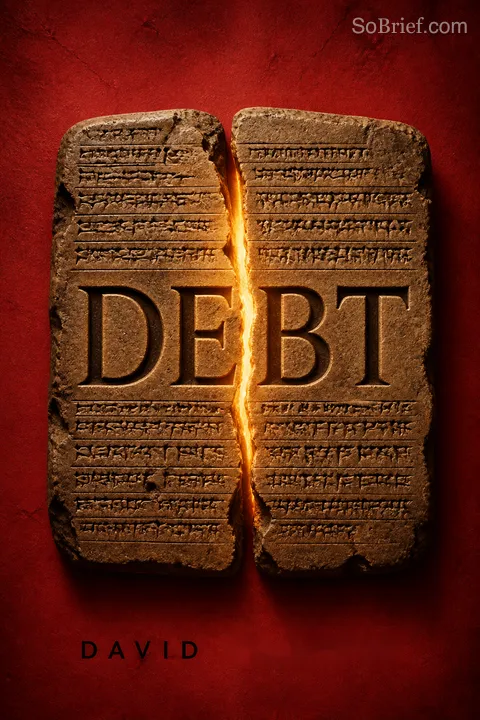


Key Takeaways
Question the morality hidden inside the command to repay
A moral rule with teeth. “Pay what you owe” sounds like a neutral lesson in responsibility. Graeber argues that it can also disguise who chose the loan, who benefited, and who bears the cost when repayment is enforced. In the 1980s and 1990s, the IMF required indebted countries to cut public services and food supports in return for refinancing. In Madagascar, austerity contributed to cuts in a mosquito-monitoring program; the author reports that a malaria outbreak then killed about 10,000 people.
Power decides the burden. The book contrasts those policies with the rescue of banks after the 2008 financial crisis, while struggling mortgage holders received little relief. Its challenge is not that every debt is unjust, but that repayment cannot be judged apart from its origins and consequences.
The key distinction is between keeping a promise and treating every written obligation as morally absolute. A loan involves choices by both borrower and lender, so responsibility cannot sensibly fall on the weaker party alone. This is especially important when public policy translates a government’s failure into reduced food, health care, or education for ordinary people. The argument is strongest when it exposes that transfer of costs. Its useful limit is that debt relief also requires choices about who absorbs losses, including people whose savings depend on financial institutions.
Money began as credit, not barter between neighbors
The textbook village is imaginary. Economics texts often explain money by picturing neighbors who cannot trade because each wants something the other lacks. Anthropologist Caroline Humphrey’s survey, cited by Graeber, found no documented society built on barter that then invented money. Barter does occur, but usually between strangers or groups without established trust, and can carry tension or even the threat of violence.
Accounts came first. Some of the earliest written records, from Mesopotamia around 3500 BC, track debts, rations, rents, and obligations in units such as silver and barley. People could settle an account in goods without handing over silver. Coins appeared much later. Graeber’s historical sequence is therefore credit and accounting, then coinage, with barter often emerging when people familiar with money lack cash.
This revision changes the question from “How did people solve the inconvenience of barter?” to “What relationships made promises credible?” That shift makes economic history more attentive to institutions and social trust, rather than treating markets as the natural starting point. It also highlights how teaching a hypothetical as history can narrow public debate. The argument need not mean barter was rare everywhere or that credit always came first in every setting. Its force lies in challenging a universal origin story that the evidence does not support.
Follow the force behind the ledger that makes debts collectible
Money can be a public rule. Chartalism is the theory that money’s value depends substantially on a state’s authority to define it and accept it for taxes. A ruler who pays soldiers in a currency and then demands that households pay taxes in the same currency creates a reason to earn and use it. Markets can grow around that requirement.
The tax can be a weapon. In colonial Madagascar, French authorities imposed a head tax payable in newly issued currency. Farmers often had to sell crops after harvest, when prices were low, then borrow later when food cost more. Graeber describes this policy as a way to push people toward wage labor and plantation crops. The currency was not simply a convenient tool; coercive policy helped make it necessary.
The account usefully separates the existence of money from the legitimacy of the institutions that issue and enforce it. Shared currency can make coordination easier, while taxation can fund services or impose a labor regime. Those effects should not be collapsed into one verdict. The Malagasy example makes the distributional question concrete: who gains access to the new market, and who must enter it under pressure? That question remains essential whenever monetary policy is presented as merely technical rather than as a choice about power.
Name the relationship before calling it an exchange
Three moral logics coexist. Graeber distinguishes communism, hierarchy, and exchange as principles of everyday economic life. His use of “communism” means sharing according to people’s abilities and needs, such as coworkers handing one another tools without negotiating a price. Hierarchy organizes obligations through rank, custom, and precedent, as when a subordinate is expected to provide a customary service. Exchange seeks equivalence: each side gives something judged comparable, allowing the relationship to end.
One transaction can shift. A family may share food without keeping accounts, owe deference to an elder, and haggle over a sale. These are not separate kinds of society. They are different rules people apply in different relationships, often without noticing the switch.
This map helps explain why a single economic act can feel generous, obligatory, or insulting depending on the relationship. It also resists the habit of treating self-interest as the hidden motive behind every transfer. The framework’s strength is its ordinary scale: sharing a tool is easier to recognize than an abstract economic system. A caution is that the categories are analytic lenses, not sealed boxes. Real relationships often combine mutual aid, rank, and bargaining, so the question is which logic is dominant and who can change it.
Treat debt as a priced, unfinished exchange, not every obligation
Debt has a special feature. It turns an obligation into a precisely measured sum. A favor to a friend depends on that person and the relationship; a loan of a specified amount can be transferred, recorded, and enforced by someone who never met the borrower. Graeber defines debt as an exchange that has not yet been completed: the parties are treated as equals in principle, but unequal while repayment is outstanding.
The contract suspends equality. A wage agreement, for example, begins as a contract between legally equal people, yet gives the employer authority over the worker during the agreed hours. The debt relationship likewise carries an expectation that equality can be restored by payment. When repayment becomes impossible, the gap can be framed as the debtor’s personal failure.
The definition offers a practical test: can the obligation be quantified, transferred, and declared settled? If not, calling it a debt may obscure what kind of care, loyalty, or duty is actually involved. The analysis also clarifies why default feels morally charged: it threatens an imagined return to equality. Still, formal equality at the moment of contract does not guarantee equal bargaining power. Assessing a debt therefore requires attention both to the promise and to the conditions under which it was made.
Violence makes people interchangeable by severing their relationships
People are more than units. In a human economy, Graeber’s term for a system focused on creating and rearranging relationships between people, money often marks obligations involving marriage, injury, or death rather than ordinary shopping. A social currency is a valued object used to recognize or alter such relationships. Among the Lele, raffia cloth helped mark important family and community obligations, while certain claims over women could be transferred as compensation for a death.
Force changes the terms. The Atlantic slave trade pushed these processes toward their most brutal form. Traders and intermediaries used credit, debt claims, and armed capture to remove people from families and communities, making them saleable. The point is not that all social currencies were benign. The Lele system itself subordinated women. Rather, violence made it possible to treat people as detachable assets.
The distinction between a token that acknowledges a relationship and a price that claims to replace a person is morally important. It also helps reveal why markets that treat all objects as interchangeable depend on social conditions that make some people easier to detach from their ties. Graeber’s examples should not romanticize small-scale societies: shared obligations can conceal severe gender hierarchies. The broader insight survives that caution. When assessing a market, ask not only what is exchanged, but whose relationships and choices must be overridden to make the exchange possible.
Honor and freedom were shaped by who could dominate whom
Honor could be counted. In early medieval Ireland, legal codes assigned people an “honor price,” a payment owed for insulting or injuring their standing. A king’s honor could be measured in cumals, units associated with enslaved women. This exposes a troubling logic: the ability to degrade another person could itself reinforce the status of the powerful. Equiano’s life presents another side of the problem. After being enslaved, he sought respectability within a society whose standards had stripped him of dignity.
Property shaped liberty. Roman law developed an idea of absolute private ownership in a society where enslaved people were legally treated as things. Graeber traces a lasting shift in the language of freedom, from belonging to a community and forming relationships toward the power to do as one wishes with what one owns. Wage labor preserves part of that tension.
This history makes familiar ideas of autonomy less innocent without requiring their rejection. Personal rights can protect people from domination, yet describing freedom as ownership of oneself can also reproduce the master-and-property model the book criticizes. The distinction worth preserving is between protection from coercion and absolute control. The Irish example is especially revealing because it makes honor measurable, but it should not be mistaken for a universal template. Honor, status, and gender operate differently across societies even when they share a concern with dignity.
War made coins common, while religious institutions rebuilt credit
Coinage followed armies. Graeber calls 800 BC to 600 AD the Axial Age, a period of major philosophical and religious change that also saw coinage emerge in the Aegean, India, and China. War and professional armies spread precious metal into everyday transactions. Coins were portable, transferable, and useful when dealing with soldiers or strangers who could not be trusted to repay a promise.
Credit returned with empire’s decline. After about 600 AD, coins receded across much of Eurasia as large military states weakened. Credit systems again became prominent. Buddhist monasteries in India and China used endowments to lend money and fund religious work; Islamic commercial networks relied on checks, partnerships, and reputations while Islamic law prohibited usury. The book presents history as alternating, broadly, between metal money and credit money.
The cycle is a striking corrective to the idea that societies move in one direction from primitive exchange toward ever more sophisticated cash. It ties monetary form to political conditions: bullion travels well in violent settings, while credit depends on networks that can sustain trust. The pattern is suggestive, not a clockwork law. Regional histories differ, and monetary forms often coexist. Its value is as a comparative question: what kinds of institutions protect promises, and what pressures make people prefer portable metal to social trust?
Modern capitalism made growth a duty and insecurity a business model
Finance preceded the factory. Public debt, banks, and financial instruments developed before industrial wage labor became the familiar image of capitalism. European expansion joined state borrowing, war, slavery, and colonial extraction. Workers, too, were often bound through debt, delayed wages, company stores, or contracts that limited their ability to leave. The book argues that regular, freely chosen wage labor was never the system’s universal foundation.
Credit filled the wage gap. After 1971, when the dollar was no longer convertible to gold, global finance expanded around credit rather than bullion. From the late 1970s, wages stagnated while household borrowing grew. Home loans and credit cards were promoted as ways to share in prosperity, but could leave families responsible for necessities at punishing rates. In 2008, banks were rescued on a vast scale while many ordinary borrowers were not.
The argument connects household finance to political choices instead of treating personal debt as a private budgeting flaw. It also reveals how expanding credit can temporarily mask stagnant incomes while shifting risk onto borrowers. The claim that capitalism depends on coercion is powerful, but the historical examples do not make every wage contract equivalent to slavery. The useful comparison is narrower: both can involve dependence and limited bargaining power. That distinction preserves the book’s critique without erasing differences in legal status, mobility, and degree of control.
A debt amnesty is a democratic choice, not a moral failure
Clean slates have precedent. Mesopotamian rulers periodically canceled certain consumer debts, freed people held in debt bondage, and restored land, trying to prevent households from collapsing into permanent dependency. These “clean slates” did not erase every commercial obligation. They recognized that a debt system could become socially destructive if left untouched. The biblical Jubilee tradition made debt cancellation and release from bondage a recurring moral principle.
The book’s proposal is explicit. Graeber calls for a modern Jubilee covering international and consumer debt. The 2008 crisis supplies his immediate contrast: governments found enormous resources to rescue financial institutions, while many households with unaffordable mortgages remained exposed to foreclosure. A debt amnesty would assert that money and contracts are human arrangements, open to democratic revision, rather than timeless commands.
The proposal follows logically from the book’s history: if debts are institutions, societies can revise them when their effects become intolerable. A Jubilee would also force public discussion of who receives protection and who is expected to absorb losses. Cancellation is not costless, and a durable policy would need to distinguish predatory lending from obligations tied to ordinary savings or shared funds. That complexity does not invalidate the proposal. It makes the political question sharper: why are some debts treated as negotiable while others are treated as sacred?
Analysis
Debt is the book’s lever for making familiar economic language strange again. A loan is not simply a number: it is a relationship that becomes portable when quantified, and enforceable when institutions or force stand behind it. This perspective explains why the command to repay can feel self-evident even when the original loan was reckless, coercive, or contracted by someone who never bore its cost. It also links domestic etiquette, legal freedom, colonial extraction, and global finance without pretending they are identical.
The strongest achievement is methodological. Graeber makes anthropology and monetary history challenge a story economists often treat as common sense: barter came first, money solved its inconvenience, and credit followed. His alternative makes trust, taxation, war, and social obligation visible in the origins of money. The three moral logics, sharing, hierarchy, and exchange, then give readers a way to notice how economic relationships actually work instead of forcing all of them into market categories.
The argument is most persuasive as a critique of inevitability, not as a single master explanation. Credit does not always mean solidarity, states do not always create markets for the same reason, and debt relief can redistribute costs to people who are not powerful creditors. Likewise, the claim that market abstraction is founded in violence is illuminating, but risks making every impersonal transaction appear equally coercive. The book’s own distinctions help avoid that overreach: a negotiated exchange between parties with real alternatives differs from a contract backed by hunger, imprisonment, or military threat.
Its practical implication is not to abolish promises. It is to stop treating a specific financial promise as the only recognizable form of obligation. Human communities depend on care, cooperation, and shared institutions that cannot be settled like accounts. A sound public morality must decide which promises deserve enforcement, under what conditions, and when preserving the relationship matters more than collecting the balance.
Review Summary
Debt: The First 5,000 Years is praised as a thought-provoking and eye-opening exploration of debt's role in human history. Graeber challenges conventional economic theories, arguing that credit systems predated barter and coinage. He examines how debt has shaped societies, religions, and power structures. While some readers found parts difficult to follow, many lauded Graeber's anthropological perspective and radical ideas. The book is seen as a profound critique of capitalism and a call to reimagine economic systems. Critics noted occasional factual errors and exaggerations but still found the work compelling and original.
People Also Read






Glossary
Myth of Barter
Imaginary origin storyThe conventional account that people once traded goods directly, found barter inconvenient, and invented money to make exchange easier. Graeber argues that no society based on pure barter has been documented. In his account, barter generally occurs between strangers or in conditions where people familiar with money lack cash, while credit and accounting systems existed long before coinage.
Credit Theory of Money
Money as recorded debtA theory that treats money primarily as an accounting measure and a transferable promise, rather than as a valuable commodity. A coin, paper note, or bank entry can function as money because people and institutions accept it to settle obligations. The theory emphasizes that monetary value depends on relationships of trust and systems that recognize and enforce debts.
Chartalism
State-defined moneyA theory of money associated with the role of government in establishing units of account and defining acceptable payment. In this view, a state can create demand for a currency by requiring taxes or other public obligations to be paid in it. The currency need not be made from precious metal, provided the relevant institutions accept it.
human economies
Economies organizing relationshipsGraeber’s term for economic systems primarily concerned with creating, maintaining, or rearranging relationships between people, rather than accumulating wealth or buying ordinary goods. Money in such systems may mark marriage arrangements, compensation for injury, or obligations between groups. The term does not claim these societies are more humane; it describes what their economic practices chiefly organize.
social currencies
Tokens marking social obligationsValuables used mainly to establish or alter relationships between people, rather than to purchase everyday goods. Examples discussed in the book include wampum, cattle, cloth, shells, and other locally significant objects. Such currencies can mark marriage, compensation, alliance, or status. Their value lies in social recognition and use, not simply in material usefulness.
baseline communism
Ordinary need-based sharingGraeber’s name for the everyday assumption that people who are not enemies should help when the need is serious enough or the cost manageable. It includes small acts such as giving directions, sharing a basic resource, or helping in an emergency. It is not a complete economic system, but a recurring form of cooperation that supports social life.
primordial-debt theory
Life as debt to societyA theory that interprets human existence as creating an original debt to society, ancestors, or the powers that sustain life. It links taxation and money to the state’s supposed role in representing that debt. Graeber treats the theory as an influential modern myth: it can turn social dependence into a claim that governments possess authority over citizens’ lives.
clean slate
Periodic debt cancellationA political declaration, documented in ancient Mesopotamia and later societies, that canceled certain personal debts and could release debt-bound people or restore land. The measures generally targeted consumer debts rather than commercial loans. In the book, clean slates show that debt cancellation has historically been treated as a tool for preventing social breakdown, not merely as an exceptional act of generosity.
FAQ
What's Debt: The First 5,000 Years about?
- Exploration of Debt's History: The book examines the history of debt over five millennia, challenging conventional economic narratives. It argues that debt is not merely a financial concept but a moral and social one that has shaped human relationships and societies.
- Interconnection of Money and Debt: Graeber posits that money and debt emerged simultaneously, with debt being a fundamental aspect of economic life. He critiques the myth of barter as the precursor to money, emphasizing that credit systems predate coinage.
- Moral Implications of Debt: The author delves into the moral confusion surrounding debt, illustrating how it has been used to justify exploitation and inequality throughout history. He highlights the tension between the moral obligation to repay debts and the often exploitative nature of lending.
Why should I read Debt: The First 5,000 Years?
- Challenging Conventional Wisdom: Graeber's work invites readers to rethink their understanding of economics, particularly the role of debt in society. It provides a critical perspective on how financial systems operate and their impact on human lives.
- Rich Historical Context: The book is filled with historical examples and anecdotes that illustrate the evolution of debt and its implications across different cultures and eras. This makes it not only informative but also engaging and thought-provoking.
- Relevance to Modern Issues: The themes explored in the book resonate with contemporary discussions about economic inequality, financial crises, and the morality of debt. Understanding these historical contexts can provide insights into current economic challenges.
What are the key takeaways of Debt: The First 5,000 Years?
- Debt as a Social Construct: Graeber emphasizes that debt is not just a financial obligation but a social and moral one that shapes human relationships. This perspective challenges the notion that debt is purely an economic transaction.
- Historical Patterns of Debt: The book outlines recurring themes in the history of debt, such as debt forgiveness and the moral outrage against creditors. Graeber illustrates how societies have historically responded to debt crises through revolts and calls for debt cancellation.
- Interplay of Power and Debt: Graeber discusses how debt has been used as a tool of power, often to oppress the vulnerable. He highlights the moral implications of debt and how it can perpetuate inequality and social injustice.
What are the best quotes from Debt: The First 5,000 Years and what do they mean?
- Debt and Power Dynamics: “If you owe the bank a hundred thousand dollars, the bank owns you. If you owe the bank a hundred million dollars, you own the bank.” This quote encapsulates the paradox of debt, illustrating how the scale of debt can shift power dynamics.
- Challenging Debt Morality: “The remarkable thing about the statement ‘one has to pay one’s debts’ is that even according to standard economic theory, it isn’t true.” Graeber challenges the moral absolutism surrounding debt repayment, arguing that economic systems are built on risk and that debts can be unjust.
- Historical Continuity: “Arguments about debt have been going on for at least five thousand years.” This statement underscores the long-standing nature of debt-related conflicts throughout history.
How does David Graeber define debt in Debt: The First 5,000 Years?
- Debt as a Moral Obligation: Graeber defines debt not just as a financial obligation but as a moral one that carries social implications. This definition emphasizes the ethical dimensions of borrowing and lending.
- Debt and Social Relationships: He argues that debt creates a relationship between individuals that can lead to feelings of guilt, shame, or obligation. This relational aspect of debt is crucial to understanding its impact on society.
- Historical Context of Debt: The author traces the evolution of debt through history, showing how it has been used to justify social hierarchies and inequalities. This historical perspective enriches the understanding of debt as a complex social phenomenon.
What is the Myth of Barter discussed in Debt: The First 5,000 Years?
- Barter as a Foundational Myth: Graeber critiques the traditional economic narrative that barter was the original form of trade before money. He argues that this myth oversimplifies the complexities of human economic interactions.
- Lack of Evidence for Pure Barter: The book points out that anthropological evidence shows no society has ever existed solely on barter. Instead, most transactions historically involved credit systems and social obligations.
- Implications for Understanding Money: By debunking the myth of barter, Graeber sets the stage for understanding money as a social construct deeply intertwined with debt. This perspective shifts the focus from mere transactions to the relationships and obligations that underpin economic life.
How does Debt: The First 5,000 Years relate to modern financial crises?
- Historical Patterns Repeating: Graeber draws connections between historical debt crises and contemporary financial issues, suggesting that the same patterns of exploitation and moral outrage recur. This historical lens provides insight into current economic challenges.
- Critique of Neoliberal Policies: The book critiques neoliberal economic policies that prioritize debt repayment over social welfare, arguing that these policies exacerbate inequality. Graeber calls for a rethinking of economic priorities to address the needs of the most vulnerable.
- Moral Implications of Debt: Graeber emphasizes the moral dimensions of debt in the context of financial crises, arguing that the suffering caused by debt should not be normalized. He advocates for a more humane approach to economic relations that prioritizes social justice.
What role does the International Monetary Fund (IMF) play in the context of debt according to Debt: The First 5,000 Years?
- Debt Enforcer Role: Graeber describes the IMF as a global institution that acts as a debt enforcer, imposing conditions on countries in exchange for financial assistance. This role often leads to austerity measures that harm vulnerable populations.
- Structural Adjustment Policies: The book discusses how the IMF's structural adjustment policies have historically required countries to cut social services, leading to increased poverty and inequality. These policies are framed as necessary for economic stability but often have devastating social consequences.
- Calls for Debt Amnesty: Graeber advocates for debt amnesty, drawing parallels to the biblical Jubilee, where debts were forgiven. He argues that the current debt system perpetuates cycles of poverty and that a reevaluation of debt obligations is necessary for social justice.
How does Graeber address the relationship between debt and violence in Debt: The First 5,000 Years?
- Debt as a Tool of Power: Graeber discusses how debt has historically been used as a tool of power and control, often leading to violence against those unable to repay. This relationship highlights the coercive nature of debt.
- Moral Hazard and Responsibility: The book examines the concept of moral hazard, where lenders take on excessive risks because they believe they will be bailed out. This dynamic can lead to reckless lending practices that have real-world consequences for individuals and communities.
- Historical Examples of Violence: Graeber provides historical examples of how debt has led to violence, such as debt peonage and the exploitation of vulnerable populations. He argues that understanding this relationship is crucial for addressing contemporary issues of economic injustice.
How does Graeber's view of debt differ from traditional economic theories in Debt: The First 5,000 Years?
- Debt as Central to Economics: Unlike traditional economic theories that often view debt as a secondary concern, Graeber positions debt as central to understanding economic systems. He argues that debt relationships are foundational to social and economic interactions.
- Critique of Barter Theory: Graeber challenges the barter theory of money's origins, asserting that debt and credit systems predate coinage. This perspective shifts the focus from market transactions to the social relationships that underpin economic activity.
- Emphasis on Social Context: Graeber emphasizes the social context of debt, arguing that economic transactions cannot be understood in isolation from cultural and historical factors. This approach encourages a more holistic understanding of economic behavior.
What solutions does Graeber propose for addressing debt issues in Debt: The First 5,000 Years?
- Debt Cancellation: Graeber advocates for debt cancellation as a means to alleviate economic inequality and social injustice. He argues that societies should consider implementing policies that forgive debts, particularly for marginalized communities.
- Alternative Economic Models: He suggests exploring alternative economic models that prioritize social welfare and community well-being over profit. This could involve rethinking how resources are allocated and how economic relationships are structured.
- Reevaluation of Value Systems: Graeber calls for a reevaluation of societal values surrounding debt and money, encouraging a shift toward recognizing the importance of human relationships. This perspective promotes a more equitable and just economic system.
About the Author


Download PDF
Download EPUB
.epub digital book format is ideal for reading ebooks on phones, tablets, and e-readers.








