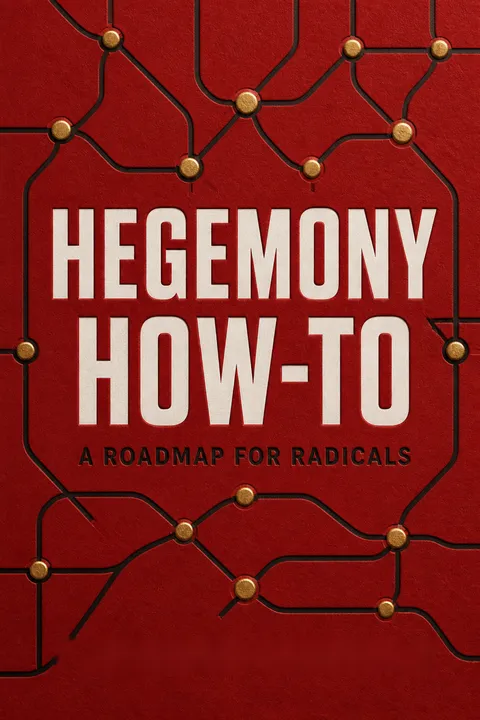


Key Takeaways
Turn moral conviction into an organized force capable of changing outcomes
Conviction opens the door. Smucker’s political education began in rural Mennonite Pennsylvania. At 17, he challenged his school’s assumptions about poverty and injustice, expecting rejection. Instead, students and teachers responded, and about 70 students joined an educational project. He learned that values opposing the status quo can exist quietly within ordinary communities. The task is not simply to denounce society, but to find and activate those values.
Seattle showed another possibility. In 1999, roughly 10,000 protesters blocked the World Trade Organization meetings, joined by unions and local residents. The meeting collapsed, and public attention turned toward global trade and inequality. For Smucker, this was a glimpse of collective potency. But moral clarity and protest alone do not reliably change policy. Understanding what is wrong with a system differs from knowing how to build the power to change it.
The distinction between diagnosing harm and organizing a response is crucial because expertise does not automatically confer political capacity. A person can understand a problem deeply yet lack a route to influence the institutions sustaining it. Smucker’s school story also complicates the familiar image of social change as a lone dissenter confronting a uniformly hostile public. Still, receptive values are not the same as durable commitment. Organizers need ways to turn initial agreement into relationships, skills, and coordinated action.
Stop treating activism as a separate identity from everyday civic life
A label can narrow the doorway. Smucker argues that activism, in its current meaning, became common in the 1960s and grew more familiar in the 1980s and 1990s. Earlier political labels, such as abolitionist or unionist, identified a particular cause or movement. Activist can instead mark a generic kind of person, separate from everyone else. People who support a cause may decide that joining is not for them because they do not identify with that type.
Organizing starts where people already are. A movement that depends only on self-selecting individuals responding to flyers will struggle to grow. The civil rights movement drew strength from existing institutions, including Black churches, historically Black colleges, and the NAACP. Smucker’s point is not that the label alone causes isolation. It is that a special activist identity can make collective action seem like an extracurricular subculture rather than a shared civic responsibility.
Labels are not merely decorative. They influence who feels invited, who expects to belong, and which behaviors seem normal. This resembles a broader organizational challenge: movements need a recognizable identity to coordinate participants, yet an identity that feels too specialized can repel sympathetic outsiders. Abandoning a label will not by itself dissolve those boundaries. The more demanding test is whether people can participate through roles they already hold, such as worker, neighbor, congregant, or parent.
Build belonging without letting the group become its own purpose
Groups meet real human needs. Smucker calls a group’s internal culture, relationships, rituals, and motivations its life of the group. Such life can make isolated people feel understood and help them sustain difficult work. Iraq Veterans Against the War, for instance, gave veterans a place to compare experiences and recognize that their doubts about the war were shared, not private failures.
Belonging can turn inward. Strong cohesion also makes a group’s language and habits less familiar to outsiders. Smucker calls the resulting tension the political identity paradox: cohesion helps a core make sacrifices, but can also create barriers to allies. In Occupy, rituals and debates sometimes became more central than political goals. The answer is not to suppress community. It is to distinguish the group’s internal benefits from what it accomplishes beyond itself, and to deliberately build bridges outward.
This argument treats emotional support as part of political infrastructure, not a distraction from it. People are more likely to endure conflict when they trust and care for one another. Yet cohesion can become a closed feedback loop: members reward one another for fluency in the group’s culture, while the intended public becomes an abstraction. The practical question is whether a group’s rituals renew its capacity to act, or mainly confirm that it is distinct from the people it hopes to reach.
Let a potent symbol recruit people beyond its original performers
Occupy’s symbol traveled farther than its camp. The occupation of Zuccotti Park in 2011 became a vivid sign of defiance toward Wall Street. The phrase 99% gave people with different concerns a shared way to describe economic inequality and political influence. Smucker calls a symbol whose meaning can hold several groups’ hopes a floating signifier. Its ambiguity helped people identify with Occupy without living in the park or sharing every belief of its most active participants.
Symbols need a path into action. Occupy attracted unions, community organizations, and public attention, but some participants resisted support from figures such as civil rights leader John Lewis. Smucker sees this as a costly attempt to guard the movement’s identity. The occupation was a powerful opening, not a permanent strategy. Movements need new actions and invitations when a successful tactic loses force.
A flexible symbol can coordinate people before they agree on every detail. That is a political advantage, not necessarily a defect: broad coalitions often begin with a shared diagnosis and develop more precise commitments through action. But ambiguity can conceal real disagreements about priorities and representation. A movement should not confuse a symbol’s popularity with an organized mandate. The challenge is to preserve its reach while creating fair ways for distinct constituencies to shape what the symbol means in practice.
Learn to wield power responsibly instead of surrendering it to elites
Power is a capacity, not a moral verdict. Smucker uses hegemony to mean leadership or predominant influence within a political sphere. A hegemonic order makes its particular values feel like common sense. He argues that people seeking social justice should challenge the content of an unjust order, not reject influence itself. Otherwise, elites retain the ability to shape policy and public understanding without a serious counterforce.
Responsibility includes consequences. Max Weber’s ethic of responsibility asks political actors to consider the likely effects of their actions, rather than judging an action only by the purity of its intent. Organizing against a war, for example, requires more than making a moral appeal. It requires building enough collective pressure to affect decision-makers. This is not a defense of any means necessary. It is a demand to take responsibility for whether an action can help reduce harm.
The distinction between power as a capacity and power as domination helps clarify a debate that often collapses into slogans. Institutions can concentrate authority, but they can also be used to deliver protections and redistribute resources. The hard question is not simply whether to exercise power, but how to constrain it, share it, and remain answerable to those affected. Without those safeguards, a movement can reproduce the hierarchy it opposed. Without any capacity to act, however, its moral commitments may remain only expressive.
Grow by activating existing communities, not only recruiting individuals
Move allies one step closer. The spectrum of allies is a tool for identifying groups and institutions that can shift the balance of a campaign. It distinguishes active supporters from passive supporters, neutrals, passive opponents, and active opponents. A campaign need not convert its fiercest critics. Often the more practical goal is to move sympathetic people from passive support into action, or to make neutral groups more open to the cause.
Existing networks carry capacity. Civil rights organizers expanded their reach by activating churches, students, and other established communities. Their members, relationships, meeting spaces, and resources could then support movement goals. This is bloc recruitment: engaging a whole group or institution rather than building from scratch, one individual at a time. Occupy often had potential allies ready to act, but its core sometimes treated outside organizations as co-opters instead of partners.
The framework shifts attention from persuasion alone to the social arrangements that make participation possible. A sympathetic person may remain inactive because there is no trusted invitation, shared meeting place, or role that fits their community. Existing institutions can provide these supports at scale. They can also carry internal exclusions or conflicting interests, so partnership is not automatically virtuous. Effective organizers need to understand who speaks for a group, whose labor is being requested, and how the collaboration will share decisions.
Give newcomers concrete roles they can sustain and expand
A meeting is not an on-ramp. In Lancaster, Smucker helped form a peace coalition after a public meeting drew more than 200 people. Simply inviting newcomers to another general meeting did not keep many involved. The group improved retention by meeting people one-on-one, learning their interests and availability, and matching them with defined tasks. One volunteer who disliked meetings organized two annual rummage sales, raising thousands of dollars for the coalition.
Make commitment manageable. A useful role can be modest, ongoing, and connected to a larger purpose. The coalition learned to avoid giving eager volunteers unsustainable workloads, and sometimes encouraged people to do less so they could stay involved. The group eventually grew to about 500 members and organized large public events. Leadership here means creating ways for more people to contribute, not carrying every task personally.
This is an important correction to the assumption that dedication is best measured by hours given or dramatic sacrifice. Reliable, limited commitments can be more valuable to an organization than bursts of overwork followed by burnout. Clear roles also make collective effort legible: people can see what their contribution enables. The approach requires care, however. Task design should not reduce participants to labor. Members need room to influence priorities and develop skills, not merely to execute a plan handed down by a core.
Enter people's stories through shared values, not frontal attacks
Begin with what already matters. Narrative insurgency is an approach to persuasion that studies another person’s worldview, finds points of connection, and builds from them. If a religious person opposes climate action, a direct attack on their beliefs may make them defend the whole worldview. A more promising opening could connect environmental care to their existing belief that people have a duty to protect creation.
Make the messenger easier to hear. Smucker’s Lancaster coalition avoided presenting itself only as a protest group. It used familiar community language, held a public town hall, and put veterans and military families forward in antiwar work. These choices helped people participate without first adopting an activist identity. The point is not to disguise a cause or flatter every audience. It is to communicate through recognizable values, while choosing carefully when direct confrontation is necessary.
Persuasion is more likely when people can connect a new proposal to commitments they already recognize as their own. This is not the same as pretending that deep disagreements do not exist. It is a sequencing choice: establish trust and shared ground before asking someone to revise a cherished belief. The danger is strategic accommodation that leaves harmful assumptions untouched. A strong approach uses common ground as a starting point, while retaining a clear account of what must change.
Frame an inclusive "we" that can unite different groups against power
Politics begins with a shared subject. Smucker argues that political action depends on people seeing themselves as part of a group with common concerns. That group may be local and familiar, or a large imagined community such as a class or a nation. A political narrative helps make the larger group feel real by naming shared interests, protagonists, and threats. The 99% frame, for example, connected economic inequality to a broad public rather than a small activist circle.
Build on identities people already inhabit. The United Farm Workers, under Cesar Chavez, connected labor organizing with workers’ existing cultural and community ties rather than asking them to adopt an unfamiliar identity first. But a broad frame can hide differences within the group. A useful common identity must make solidarity possible without implying that every member has the same experience or power.
Collective identity is not merely a slogan placed on top of an existing coalition. It helps determine which grievances become visible and which connections feel politically meaningful. That makes inclusive language consequential, but also ethically demanding. A broad category can generate solidarity while flattening disparities within it. Movements need both a shared public story and mechanisms for groups facing distinct harms to name those differences. Unity is most durable when it is built through negotiation, not presumed from a single label.
Make visionary experiments support strategy, not substitute for it
A better model is not yet a route to change. Prefigurative politics means trying to embody a desired society in present-day practices. Occupy’s encampment offered shared food, a library, and highly participatory assemblies. These practices could inspire people and demonstrate values. But when process and atmosphere became substitutes for clear goals, a strategy for influencing the wider political system remained weak.
Pair participation with accountability. Occupy’s General Assemblies were public demonstrations of democratic involvement, yet long, cumbersome meetings often failed to make practical decisions. Leadership still existed, but much of it operated informally and backstage. Smucker argues for many leaders, not the fiction that no leaders exist. A strategic group can preserve participatory values while setting goals, assigning responsibilities, and making decisions that can be explained and challenged.
Political experiments matter because they let people experience alternatives rather than merely hear about them. They can also develop skills and trust that conventional institutions neglect. Their limitation appears when a protected space becomes the measure of success, while decisions affecting people outside it remain unchanged. Conversely, efficiency without participation can concentrate authority in a small core. The design challenge is to make democratic practice consequential: accessible enough to invite newcomers, structured enough to act, and transparent enough to hold leaders accountable.
Analysis
Smucker’s central argument is that progressive movements need to join two forms of work that are often separated: making a compelling case about what is wrong, and building the organized capacity to alter it. His account of Occupy gives the argument its tension. The movement achieved striking symbolic reach, giving economic inequality a popular frame, but its visible success did not automatically become durable institutional leverage. The distinction between a movement’s public image and its internal operations is especially useful: leaderlessness can be a powerful performance of democratic possibility while masking informal authority and weak decision procedures.
The book’s strongest practical insight is that growth is relational. People rarely enter collective action through abstract agreement alone. They need trusted connections, existing communities, plausible reasons to believe their effort matters, and roles that fit their lives. This makes recruitment less like broadcasting a message and more like building a bridge from familiar identities and institutions into coordinated action. It also explains why ordinary tasks, good facilitation, and careful communication can matter as much as spectacular protest. The analysis carries a real tension. Broad frames such as the 99% can unite people across difference, but they can also blur unequal experiences within the coalition. Similarly, aspiring to hegemony may allow movements to shape policy, yet the language of prevailing influence risks making domination seem like an unavoidable political norm. Smucker recognizes that forms and contents interact, but the practical answer requires institutions that distribute power internally, protect dissent, and keep leaders accountable.
The resulting lesson is not that movements should become conventional or moderate. It is that radical intent needs strategic competence. Participatory culture, moral critique, and symbolic action can all strengthen a campaign, but none is a substitute for a theory of change, a social base, and the capacity to make gains durable. The book is most persuasive when it treats organizing as both a craft and a moral responsibility, rather than as a technical add-on to protest.
People Also Read










Glossary
Articulation
Forming a political alignmentA process that joins groups, ideas, symbols, actions, and shared interests into a political alignment. It includes rhetoric, but is not limited to words. Campaigns, institutions, material conditions, and collective action can also help people recognize a common identity and act together.
Floating signifier
A flexible coalition symbolA symbol whose meaning remains open enough for different groups to see their hopes or values in it. It can help bring a broad political alignment into view. The symbol is not meaningless, but its flexible meaning allows it to connect people who do not share every belief or goal.
Life of the group
A group’s internal motivationsThe internal culture, relationships, rituals, and motivational patterns of a political group. It can provide community, belonging, and the solidarity needed for demanding work. It can also become self-referential, especially when maintaining the group’s identity takes priority over achieving change beyond the group.
Political identity paradox
Cohesion can isolateThe dilemma that political groups need strong internal identity to motivate commitment, yet strong cohesion can create barriers between the group and potential allies. A group that bonds without building bridges may become isolated and unable to assemble the broader power required for its aims.
Ethic of responsibility
Account for likely consequencesMax Weber’s term for an approach to political action that considers foreseeable consequences. It does not require certainty or abandon moral commitments. It asks people to make their best judgment about how actions may affect a complex situation, rather than treating righteous intent as sufficient regardless of outcome.
Spectrum of allies
Map potential shifts in supportA campaign-planning tool that sorts groups and institutions by their relationship to a cause, from active allies through passive allies and neutrals to passive and active opponents. It helps organizers identify achievable shifts, especially turning sympathetic but inactive people into participants, rather than relying on converting committed opponents.
Bloc recruitment
Mobilize whole communitiesA way of expanding a movement by activating existing groups, institutions, or social blocs, rather than recruiting isolated individuals one by one. When a community identifies with a movement, its relationships, meeting places, members, and resources can contribute to collective action.
Narrative insurgency
Build from shared beliefsA method of persuasion that first examines another person’s worldview, then identifies beliefs compatible with a desired change. Organizers use those points of connection to encourage new interpretations from within the existing narrative, rather than attacking the entire worldview at the outset.
Hegemony
Predominant political influenceLeadership or predominant influence exercised by a group within a political sphere. Hegemony involves more than coercion: it also relies on shaping ideas that seem like common sense. Smucker treats it as a form that can carry different political contents, not as an inherently good or bad agenda.
Symbolic contest and institutional contest
Meaning and power strugglesThe symbolic contest concerns narratives, symbols, public meaning, and common sense. The institutional contest concerns the capacity to shape organizations, laws, policies, wealth, and power relationships. Smucker distinguishes them for analysis, while arguing that they operate together in real political struggles.
Prefigurative politics
Model desired values nowAn approach that tries to embody a desired future society in present-day actions and relationships. Smucker values participatory and communal experiments, but warns that they cannot replace strategy for changing institutions and power beyond the group. In his analysis, prefiguration is most useful when it supports, rather than substitutes for, political organizing.
Download PDF
Download EPUB
.epub digital book format is ideal for reading ebooks on phones, tablets, and e-readers.








