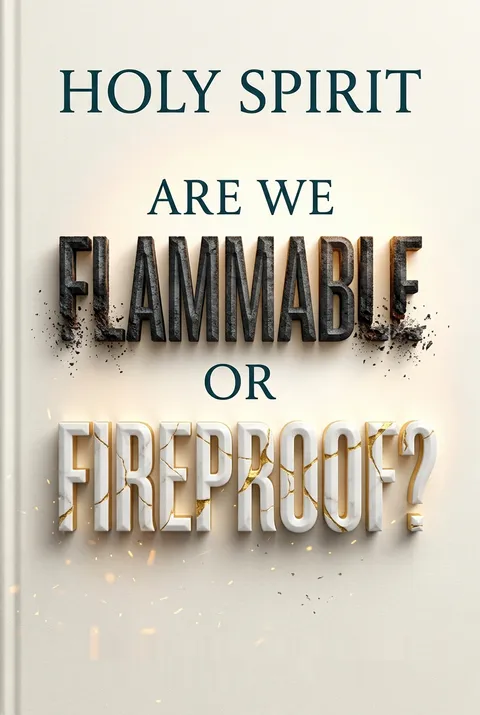


Key Takeaways
Choose to be spiritually combustible, not untouched by the work you profess.
The fireproof question. Bonnke opens with a meeting where he says the Holy Spirit moved among the crowd, but a few people watched without joining in. The scene gives the book its central image: a believer can remain unmoved by the faith they claim, or become receptive to its transforming force. For Bonnke, being spiritually aflame means more than having an intense moment. It means becoming available to God and carrying the Gospel into ordinary life.
Feeling should bear fruit. The book celebrates visible enthusiasm, but its deeper test is whether faith produces courage, service, and witness. A private spiritual experience that never affects how someone treats others or serves them falls short of Bonnke's vision.
What's striking is how the opening image turns a theological question into a question of responsiveness. The metaphor can help readers notice when habit or caution has hardened into disengagement. Yet visible emotion is an unreliable measure of sincerity: some people are expressive, while others are quiet and deeply committed. A useful extension is to judge the fire by its effects, such as compassion, courage, and sustained service, rather than by volume or spectacle. That keeps the metaphor vivid without making one style of worship the only credible one.
Treat spiritual power as equipment for witness, not a private trophy.
Power has a destination. Bonnke reads the disciples' story as a change from fear to public witness. In the Gospel account, Jesus commissions followers who have struggled to believe; in Acts, the Spirit comes at Pentecost, and those same followers speak boldly. Bonnke calls this empowering experience the baptism in the Holy Spirit, distinct from conversion and directed toward Christian service.
Pentecost sends people outward. Peter's sermon in Jerusalem is followed, in Acts, by about 3,000 people joining the community. Bonnke takes that sequence as a pattern: empowerment is not mainly for personal excitement or status, but to help believers proclaim the Gospel. He also sees signs and miracles as accompanying that mission, not as the mission's ultimate point.
The mission-centered reading gives spiritual experience a public purpose. It resembles a broader principle in social psychology: abilities often acquire meaning through the roles and communities in which they are used. Here, the claimed gift is oriented toward communication and service rather than prestige. The account is theological interpretation, not independent evidence that every reported sign occurred as described. Still, the distinction between power for self-display and power for service is ethically useful, even for readers who do not share Bonnke's Pentecostal beliefs.
Receive the Spirit as help for weakness, not payment for spiritual perfection.
Need, not achievement. Bonnke argues that the Holy Spirit is God's gift to people who need help, not a prize reserved for believers who have reached moral perfection. He points to the disciples' failures and to the promise of the Spirit as evidence that weakness does not disqualify someone from being equipped for service. In his account, receiving the gift rests on repentance and faith in Jesus, not on earning spiritual merit.
Grace is not permission. The book does not say that conduct is irrelevant. Bonnke urges believers to pursue holiness, but rejects the idea that evangelism must wait until Christians become flawless. His concern is practical: if only perfect people could serve, the work of reaching others would never begin.
This argument joins grace to agency: people need not wait until they feel fully repaired before taking responsibility. That can counter perfectionism, which often disguises fear as preparation. At the same time, being imperfect should not excuse harmful conduct, especially when religious authority is involved. A strong reading holds both ideas together: service is not a medal for moral achievement, and communities still need accountability. The book's emphasis on dependence rather than self-sufficiency can support that balance when humility remains part of the practice.
Trust the Spirit's presence when emotion gives you no proof.
Presence is not a mood. Bonnke insists that the Holy Spirit does not arrive only during dramatic services or disappear when believers feel spiritually flat. He compares spiritual capacity to electrical current in a wire: its presence is not necessarily visible, but its effect becomes apparent when a device is used. He likewise describes the Spirit as continuously present and available, rather than as a resource that must be repeatedly summoned.
Act without chasing sensation. Bonnke recounts hearing of a preacher who delayed speaking because he could not feel anointing. His response is that the preacher should trust the promise of God's presence and proceed. In the book's logic, faithfulness in action matters more than waiting for a particular emotional state.
The distinction between conviction and feeling can help prevent emotional swings from dictating every decision. It also resembles the difference between a capacity and its conscious sensation: a person may be able to act without first feeling confident. But the idea should not be used to dismiss distress, exhaustion, or the need for support. Trust in divine presence can coexist with honest attention to mental and physical limits. The most constructive version encourages action without demanding that people pretend to feel fine.
Keep the cross at the center when expecting signs and wonders.
The message comes first. Bonnke argues that the Holy Spirit's power is inseparable from the Gospel of Jesus' death and resurrection. He rejects techniques, manipulation, or spectacle as substitutes for proclaiming that message. In his account, miracles matter because they serve the work of redemption, not because marvels are impressive in themselves.
Power confirms, it does not advertise personality. Bonnke reads the apostolic pattern as proclamation followed by signs that support the message. The preacher is not the source of power, and a display that draws attention away from Christ misses the point. The cross also gives the book's evangelism a clear aim: salvation and restoration, rather than merely producing extraordinary events.
This hierarchy offers a meaningful check on religious celebrity. When a tradition treats extraordinary claims as proof of a leader's importance, the focus can shift from the message to the performer. Bonnke's insistence that signs serve the Gospel pushes in the opposite direction. The approach still leaves difficult questions about how claims of healing or supernatural intervention should be verified and how disappointed people should be cared for. Keeping the cross central can guide the purpose of ministry, but it does not by itself settle those questions.
Treat tongues as Bonnke's expected sign of Spirit baptism, not universal consensus.
A visible sign. Bonnke regards speaking in tongues as a tangible indication that a believer has received the baptism in the Holy Spirit. He points to the accounts in Acts of people speaking in tongues after the Spirit comes, including Pentecost and the episode at Cornelius's home. For him, tongues are more than a private reassurance: they can serve prayer, praise, and spiritual speech.
A distinctive interpretation. Bonnke connects tongues with the prophetic promise that the Spirit would be poured out broadly, across social groups and nations. He presents this sign as a continuing feature of Christian life, not a practice limited to the first disciples. This is a central Pentecostal claim in the book, rather than a position shared by every Christian tradition.
The book treats a disputed biblical interpretation as a practical marker of experience. Naming that disagreement helps readers distinguish Bonnke's theological commitments from a neutral description of all Christianity. Other Christian traditions interpret the passages differently, including whether tongues are required evidence of Spirit baptism. That difference need not erase the book's emphasis on prayer or cross-cultural belonging. It does mean that readers should examine how each tradition reads Acts and how its account of spiritual experience shapes inclusion, authority, and expectations.
Build your distinct calling, then use its gifts for the whole church.
No borrowed identity. Bonnke argues that believers should not try to become copies of a famous preacher or imitate another person's spiritual style. He imagines each of the 120 people at Pentecost receiving an individual flame, a picture of an assignment suited to that person. The point is not that every believer works alone, but that shared faith does not require identical roles.
Different gifts, shared purpose. Drawing on Paul's image of the church as a body, Bonnke describes spiritual gifts as varied capacities that benefit the community. He distinguishes these gifts from natural talents, while allowing that both can contribute to service. In this model, unity is cooperation across differences, not sameness of personality, practice, or ministry.
The emphasis on distinct contribution resists a common organizational trap: mistaking coordination for uniformity. A body or ensemble works because its parts perform different functions while remaining responsible to a shared purpose. The image also counters status competition, since a role's value is not measured only by visibility. At the same time, claims about a unique calling can become difficult to question if treated as unquestionable revelation. Healthy communities need room for personal conviction, shared discernment, and feedback about whether a gift genuinely serves others.
Give spiritual gifts freely, while accepting the cost of putting them to work.
A gift is not a purchase. Bonnke uses Simon the Sorcerer's offer of money for spiritual power to argue that God's gifts cannot be bought or earned. The giver's generosity is not a commercial exchange. Yet receiving a gift does not mean its use costs nothing: serving may require travel, effort, discomfort, and a willingness to risk one's reputation.
Use what is given. Bonnke compares a spiritual gift to a carpenter's tools. A complete kit is useless unless someone takes it to the job and works. The book's instruction is to use gifts in ministry and give freely, rather than treating them as badges of rank or possessions to hoard. The gift is freely received; the work it enables still asks for commitment.
This distinction separates access from responsibility. A capability may be freely given, while exercising it still requires time, effort, and accountability. That idea appears in many forms of volunteer work and public service, where motivation cannot be reduced to compensation. The analogy also raises an important safeguard: commitment should not be confused with unlimited sacrifice. Religious communities can honor generosity while protecting people from coercion, burnout, or leaders who use the language of calling to demand unpaid labor without scrutiny.
Leave the sanctuary; the people Bonnke hopes to reach are outside it.
Go where people are. Bonnke tells of a young man who wanted to preach but lacked access to a church pulpit. He points him toward street corners, where ordinary people can hear the message. The lesson is not to wait for an ideal platform. The Great Commission, as Bonnke reads it, requires believers to go beyond the congregation and meet people in their actual communities.
The harvest is wider than one circle. Pentecost's visitors came from many regions and heard the disciples in languages they understood. Bonnke sees this as a sign that Christian witness is meant to cross cultural and geographic boundaries. The church's gathering matters, but it should prepare people to serve beyond its walls, not become the only place where faith is practiced.
The street-corner image is an effective reminder that institutions can mistake their own activities for their mission. It also turns a large global commission into a local question: where do the people being served already gather? Cross-cultural outreach works best when it involves listening and learning, not simply exporting one group's assumptions. The book's urgency is aimed at proclamation, but an outward-facing practice can also include practical care and dialogue. That broader posture helps keep mission relational rather than merely a performance of religious certainty.
Analysis
Bonnke's book is both a Pentecostal theological argument and a call to action. Its organizing story is a movement from the disciples' fear and doubt to public witness after Pentecost. The narrative lets Bonnke present the baptism in the Holy Spirit as the hinge between a commission people cannot carry out alone and a mission empowered from beyond themselves. The fire metaphor gives the argument emotional unity: the Spirit is not a decorative belief, but a transforming presence meant to make believers active witnesses.
The strongest practical thread is that empowerment is oriented outward. Gifts are for service, signs are meant to support the Gospel, and the church is not supposed to contain the work it gathers to prepare. Bonnke also offers a generous account of access: spiritual power is given to the weak, not earned by the already exemplary. These ideas make the book more than an appeal to religious excitement. They connect spiritual experience to purpose, community, and action.
The book's distinctive strength is also its interpretive risk. Bonnke presents a particular Pentecostal reading of Acts as the expected pattern for believers today, especially regarding tongues and visible manifestations. Christians disagree about whether these signs are normative, and the book's testimonies do not independently establish the truth of every supernatural claim. Its language can also make emotional expressiveness sound like a more reliable sign of faith than it is. Readers can take the central challenge seriously while distinguishing theological conviction from universal fact: Does belief produce service, courage, and care? That question travels beyond the doctrinal boundaries of the book.
Review Summary
Holy Spirit: Are We Flammable or Fireproof receives high praise from readers, with an average rating of 4.51/5. Reviewers commend Bonnke's clear explanations of the Holy Spirit's role and power in believers' lives. Many find the book inspiring, highlighting its emphasis on the Holy Spirit's constant presence and accessibility. Readers appreciate Bonnke's personal insights from his ministry experience and the book's practical approach to understanding and receiving the Holy Spirit's gifts. Some note the book's potential for life-changing impact, while a few critics find it repetitive or simplistic.
People Also Read




Glossary
Baptism in the Holy Spirit
Empowerment for Christian witnessIn Bonnke's theology, this is an empowering experience of the Holy Spirit, distinct from conversion or being born again. He describes it as an immersion in the Spirit that equips believers for witness and ministry. He associates it with spiritual gifts and, in particular, speaking in tongues. Other Christian traditions understand this experience and its signs differently.
Paraclete
Helper and companionA New Testament title for the Holy Spirit, often translated as Helper or Comforter. Bonnke explains the term as one who comes alongside a person to assist and accompany them. He uses it to connect the Spirit's presence with Jesus' role as helper to the disciples, and with the Spirit's continuing support for Christian life and mission.
dunamis
Power for actionA Greek term Bonnke associates with the power promised in Acts 1:8. He describes it as capacity available for action, rather than a feeling that must be constantly noticed. In his account, the Spirit's power becomes evident when believers act in service and witness. The term is not a claim that every person will experience identical results.
utterance
Spirit-enabled speechBonnke uses this biblical term for speech enabled by the Holy Spirit, especially the speech in tongues described at Pentecost. He also connects Spirit-given speech with praise, prayer, prophecy, and preaching. The term emphasizes divine enabling in his interpretation, rather than presenting the speaker as the independent source of the message.
On-going Pentecost
Continuing Spirit activityBonnke's term for the continuing activity of the Holy Spirit that began at Pentecost. He rejects the idea that Pentecost was a closed historical episode and argues that its empowering work remains available to the church. In this view, the Spirit continues to guide, renew, and equip believers for witness across generations.
FAQ
1. What is "Holy Spirit: Are We Flammable or Fireproof?" by Reinhard Bonnke about?
- Explores the Holy Spirit’s Role: The book examines the person, power, and purpose of the Holy Spirit in the life of a believer and the Church.
- Focus on Empowerment: Bonnke emphasizes the necessity of the baptism in the Holy Spirit for living a victorious Christian life and fulfilling the Great Commission.
- Practical and Theological Insights: It combines biblical teaching, personal stories, and practical advice on how to receive and walk in the power of the Holy Spirit.
- Challenge to the Reader: The central question—are you flammable (open to the Spirit’s fire) or fireproof (resistant to it)?—invites readers to self-examination and action.
2. Why should I read "Holy Spirit: Are We Flammable or Fireproof?" by Reinhard Bonnke?
- Ignite Spiritual Passion: The book is designed to stir up a hunger for more of God and a deeper experience with the Holy Spirit.
- Biblical Foundation: It provides a strong scriptural basis for understanding the Holy Spirit’s work, making it valuable for both new and mature Christians.
- Practical Application: Bonnke offers clear steps and encouragement for receiving the baptism in the Holy Spirit and living a Spirit-empowered life.
- Inspiration for Ministry: Readers are motivated to move beyond passive Christianity and become active, bold witnesses for Christ.
3. What are the key takeaways from "Holy Spirit: Are We Flammable or Fireproof?" by Reinhard Bonnke?
- Supernatural Christianity is Normal: Christianity without the supernatural is incomplete; the Holy Spirit’s power is essential, not optional.
- Baptism in the Holy Spirit: Every believer is called to receive the baptism in the Holy Spirit, which brings empowerment, boldness, and spiritual gifts.
- God Uses the Willing: God’s power is available to all, regardless of background or weakness; what matters is surrender and faith.
- The Church’s Mission: The Holy Spirit equips the Church to fulfill its mission of evangelism, healing, and transformation in the world.
4. How does Reinhard Bonnke define the baptism in the Holy Spirit in "Holy Spirit: Are We Flammable or Fireproof?"?
- Total Immersion: Baptism in the Holy Spirit is a complete immersion—spirit, soul, and body—into the Spirit’s presence and power.
- Ongoing Experience: Unlike water baptism, it is not a one-time event but an ongoing, life-transforming relationship with the Holy Spirit.
- Empowerment for Service: The primary purpose is to empower believers to be effective witnesses and to operate in spiritual gifts.
- Accompanied by Signs: Speaking in tongues is presented as a physical and spiritual sign of this baptism, but the focus is on the resulting power and fruit.
5. What practical steps does "Holy Spirit: Are We Flammable or Fireproof?" by Reinhard Bonnke give for receiving the baptism in the Holy Spirit?
- Repentance and Faith: The two conditions are repentance from sin and faith in Jesus Christ as Lord and Savior.
- Ask and Receive: Believers are encouraged to ask boldly, believing that Jesus is eager to baptize them in the Holy Spirit.
- No Need to Wait: Unlike the first disciples, modern believers do not need to “tarry” or wait; the Holy Spirit is already available.
- Expect the Evidence: Open your mouth in praise and expect the Spirit to give utterance, often resulting in speaking in tongues.
6. What is the difference between being "flammable" and "fireproof" according to Reinhard Bonnke in "Holy Spirit: Are We Flammable or Fireproof?"?
- Flammable Christians: Those who are open, receptive, and eager for the Holy Spirit’s fire, allowing God to work powerfully through them.
- Fireproof Christians: Those who resist or are indifferent to the Holy Spirit, remaining unchanged even when God’s presence is manifest.
- Personal Challenge: Bonnke urges readers to examine their own hearts and choose to be flammable, not resistant, to God’s Spirit.
- Impact on Ministry: Only flammable Christians can ignite revival and transformation in their lives and communities.
7. How does "Holy Spirit: Are We Flammable or Fireproof?" by Reinhard Bonnke explain the relationship between the Holy Spirit and the Church?
- The Church’s Power Source: The Holy Spirit is the life and power of the Church; without Him, the Church is powerless and ineffective.
- Diversity and Unity: The Spirit gives diverse gifts and ministries, creating a symphony of service rather than uniformity.
- Permanent Presence: The Holy Spirit abides with the Church permanently, not as a visitor but as the essential resident.
- Mission Focus: The Spirit’s presence is for the purpose of evangelism, healing, and building God’s Kingdom on earth.
8. What are the main biblical foundations for the Holy Spirit’s work as presented in "Holy Spirit: Are We Flammable or Fireproof?" by Reinhard Bonnke?
- Old and New Testament Examples: The book draws from Moses, Joel, John the Baptist, Jesus, and the apostles to show the continuity of the Spirit’s work.
- Acts 2 and Pentecost: The Day of Pentecost is highlighted as the fulfillment of God’s promise to pour out His Spirit on all flesh.
- Universal Promise: The baptism in the Holy Spirit is for all believers, not just a select few or the early Church.
- Scripture Validates Experience: Bonnke insists that all spiritual experiences must be grounded in and validated by the Bible.
9. What does "Holy Spirit: Are We Flammable or Fireproof?" by Reinhard Bonnke teach about spiritual gifts and their purpose?
- Gifts Are Tools, Not Trophies: Spiritual gifts are given for service, not for personal status or display.
- Freely Given, Not Earned: The gifts of the Spirit are not rewards for holiness but are received by grace through faith.
- Diversity of Gifts: The Holy Spirit distributes different gifts as needed for the mission and health of the Church.
- Empowerment for Ministry: The gifts are meant to build up the Church, reach the lost, and demonstrate God’s power.
10. How does "Holy Spirit: Are We Flammable or Fireproof?" by Reinhard Bonnke address the role of faith and feelings in experiencing the Holy Spirit?
- Faith Over Feelings: Spiritual power is not measured by feelings; faith in God’s Word is the key to receiving and operating in the Spirit.
- Power Is Latent Until Used: Like electricity in a wire, the Spirit’s power is present even when not felt, and is activated by action and obedience.
- Don’t Wait for Sensations: Believers are encouraged to act on God’s promises regardless of emotional experience.
- Assurance of Presence: The Holy Spirit abides with believers always, whether or not they feel His presence at any given moment.
11. What are some of the most impactful quotes from "Holy Spirit: Are We Flammable or Fireproof?" by Reinhard Bonnke, and what do they mean?
- “Christianity is either supernatural or nothing at all.” – Emphasizes that the Christian faith is defined by the presence and power of the Holy Spirit.
- “If you have a head, God has a flame for you.” – Stresses the universal availability of the Holy Spirit’s baptism for every believer.
- “The less Holy Spirit operation we have, the more cake and coffee we need to keep the church going.” – Highlights the futility of human efforts without the Spirit’s power.
- “God only has gifts; He has nothing for sale.” – Reminds readers that the Holy Spirit and His gifts are given freely, not earned or bought.
12. How does "Holy Spirit: Are We Flammable or Fireproof?" by Reinhard Bonnke encourage believers to live out their faith in the world?
- Be Bold and Active: The book calls believers to step out in faith, preach the Gospel, and expect signs and wonders to follow.
- Live as Fire Starters: Christians are urged to be “firelighters,” igniting spiritual passion and transformation wherever they go.
- Partner with the Holy Spirit: Rather than relying on human strength, believers are to depend on the Spirit’s power for every aspect of life and ministry.
- Ongoing Mission: The Acts of the Apostles continue today through Spirit-filled believers who are willing to be used by God.
Download PDF
Download EPUB
.epub digital book format is ideal for reading ebooks on phones, tablets, and e-readers.








