

Key Takeaways
Build a life worthy of affection, not merely one that attracts applause
Two desires shape us. Adam Smith argues that people want to be loved, meaning respected, welcomed, and valued, but also to be lovely, meaning genuinely worthy of that regard. Happiness comes not simply from receiving praise, but from believing that the praise fits the person one really is. A dishonest reputation cannot satisfy for long: the fraudster Bernard Madoff could be admired publicly while knowing his success rested on deception. The gap between public approval and private knowledge makes admiration feel counterfeit.
Character makes affection real. The point is not to perform goodness as a strategy for winning approval. A spouse who helps only to collect an equal favor is keeping accounts, not expressing care. Smith’s ideal is a match between conduct and reputation, even when nobody is watching and praise never arrives.
What's striking is how this account joins social belonging to integrity. It avoids the false choice between inner virtue and other people's opinions: relationships matter, but approval is nourishing only when it reflects real conduct. This resembles the distinction between reputation and character in modern moral psychology, where public image can diverge sharply from private standards. The caution is that communities can praise conformity, not goodness. A person should therefore ask not only whether others approve, but whether an impartial observer could explain why the conduct deserves approval.
Borrow an outside perspective before your self-interest writes the verdict
Self-concern distorts scale. Smith asks readers to compare a distant catastrophe killing millions with the loss of one's own little finger. People may feel more immediate distress about the finger, yet still recoil from the idea of allowing mass death to preserve it. The example separates what grabs attention from what seems morally acceptable. Feeling more for oneself does not automatically settle what one ought to do.
Imagine a fair witness. Smith's impartial spectator is an imagined observer who considers a choice without being swept along by the chooser's immediate passions. Roberts suggests using this perspective in ordinary moments: notice when a conversation becomes a monologue, or when embarrassment turns a minor scheduling mistake into anger at a spouse. Asking how the scene looks from outside can interrupt self-importance and make a better response possible.
The imagined witness works like a mental change of scale. Social psychology often describes perspective-taking as a way to reduce egocentric bias, although imagining another viewpoint does not guarantee accuracy. The advantage here is practical: the observer is not asked to feel as much as the person in the moment, but to judge more steadily. The method is strongest when the question is concrete, such as whether a reaction is proportionate or whether another person is being treated fairly. It is weaker when the imagined judge merely repeats the user's existing prejudices.
Review your choices later, when desire can no longer edit the evidence
Timing changes judgment. Smith argues that strong passions can bend conscience while a decision is unfolding. Once the emotion fades, a person can assess the act more calmly, but self-deception often remains: it is painful to see oneself as selfish, so memory and interpretation quietly soften the verdict. A person may even describe a self-serving choice as a sacrifice for someone else.
Build resistance to self-excuse. Roberts recounts Joan Baez staying in Europe after her brother-in-law Richard Fariña died. She reassured her sister that Fariña would have wanted her to continue touring. The book does not claim certainty about Baez's motive; the episode shows how easily a personally convenient choice can acquire a noble explanation. Smith's remedy includes learning moral expectations from others and seeking honest outside counsel, rather than trusting self-assessment alone.
This is a useful account of motivated reasoning: people do not merely make biased choices, they often construct a coherent story that makes those choices feel principled. Contemporary decision science similarly distinguishes the decision from the explanation produced afterward. The practical implication is to preserve evidence before rationalization takes over: write down what mattered, what was sacrificed, and who benefited. Still, retrospective review can become self-punishment rather than learning. The aim is correction, not a permanent prosecution of the self.
Choose present meaning over a future payoff that keeps moving farther away
More wealth can postpone contentment. Roberts contrasts two possible lives for Peter Buffett, son of investor Warren Buffett. At nineteen, Peter sold company stock worth about $90,000 to pursue music. Had he kept it, the shares would have been worth roughly $100 million by 2014. His music career became successful, and he reported no regret. The comparison forces a better question than which path earns more: what kind of day-to-day life is worth living?
Beware the deferred reward. Smith retells the ancient story of King Pyrrhus, who plans conquest after conquest before finally retiring to enjoy himself. His adviser asks why he cannot enjoy life now. Roberts applies the same logic to a friend who continually delays quitting a stressful job until after the next deal or bonus. New gadgets and upgrades offer a smaller version of the same promise, often fading into ordinary possessions once acquired.
The chapter anticipates the idea of adapting to improvements: a larger house or newer device can quickly become the new baseline, leaving desire intact. Its most useful move is to evaluate ambition by the life it requires, not only the reward it promises. Yet the Buffett example is not a universal argument against wealth. Financial security can expand choice, and some people find meaning in demanding work. The sharper test is whether the next prize serves a chosen life or keeps replacing it.
Prefer quiet respect for good character to the addictive spotlight of status
Attention is a powerful bait. Smith observes that society often pays more notice to the rich and famous than to the wise and virtuous. Roberts illustrates the pull with Ted Williams's distinctive car: when a friend borrowed it, several police officers gathered simply for the thrill of sitting inside a celebrity's vehicle. Fame lends ordinary objects an aura because people enjoy feeling close to someone widely admired.
Admiration has a price. Smith warns that prominence brings labor, anxiety, scrutiny, and less privacy, yet the attention can make those costs seem worthwhile. Public applause may also become difficult to give up. Roberts contrasts the glitter of celebrity and power with the less visible esteem earned through wisdom and virtue. The latter attracts fewer spectators, but it offers a more honest form of being valued, one less dependent on staying famous or outperforming rivals.
Status is socially contagious: attention itself becomes evidence that someone matters, so admiration attracts further admiration. That dynamic helps explain why celebrity can command interest beyond any practical achievement. Smith's alternative is not obscurity for its own sake, but a different audience and standard: people who know enough to judge conduct rather than rank. The limitation is that public recognition can also reward genuinely valuable work. The distinction is not fame versus virtue, but whether visibility serves the work or becomes the work.
Tune your emotional response to the closeness and needs of the person beside you
Social feeling has a volume. Smith calls proper conduct propriety: responding in a way others can understand and participate in. Roberts describes this as emotional calibration. A grieving person may temper their distress around strangers, whose sympathy is limited, but share more freely with close friends. The listener cannot feel the loss identically, yet attentive company can still bring some relief.
Joy and sorrow travel differently. Smith argues that people often share small pleasures readily, while great success can provoke envy and great grief can exceed what others can feel. This helps explain why a person might celebrate a friend's everyday good news but struggle to match their elation at sudden wealth. Propriety is not emotional fakery. It is sensitivity to relationship, context, and what the other person can receive, while still making an effort to meet them with care.
The musical idea of emotional calibration captures a real interpersonal skill: effective support requires neither matching every feeling nor remaining detached. Research on supportive communication likewise suggests that acknowledgment often helps more than rushing to solve another person's problem. Smith's account also clarifies why consolation can feel inadequate: the listener's imagined understanding is never the sufferer's actual experience. Calibration should not become a demand that distressed people hide their feelings for others' comfort. The burden of adjustment belongs to both speaker and listener.
Keep rules against harming others firm, and treat helping as a judgment call
Virtue has three parts. Smith's central virtues are prudence, justice, and beneficence. Prudence means taking wise care of one's health, resources, and reputation. Justice means refraining from injuring others. Beneficence means actively doing good. The first protects the self, the second sets a boundary against harm, and the third asks how to help.
Different duties need different rules. Smith treats justice as comparatively precise: do not steal, betray a promise, or harm someone for private advantage. He warns that exceptions can become excuses, as when a thief tells himself the victim will never notice. Beneficence is less mechanical. Whether to give money to a person asking on the street, and how much, depends on circumstances that no single rule can settle. Roberts suggests using personal commitments, such as giving a child full attention when asked, to counter the easy drift toward self-interest.
The distinction resembles the difference between guardrails and goals. Clear prohibitions can prevent rationalization, while generous action requires context-sensitive judgment because needs and consequences vary. This is a compelling reason not to turn every moral question into a checklist. At the same time, firm rules can be too blunt when obligations conflict, and flexible generosity can become inconsistent or paternalistic. A sound practice combines reliable boundaries with reflection about the recipient's actual needs, rather than assuming that good intentions alone define good help.
Strengthen trust through small choices that others can safely imitate
Order can arise without a designer. Roberts uses language to explain emergent order, a pattern formed by countless individual choices without a central planner. Nobody held a vote to make the company name Google a verb; ordinary speakers adopted a useful word until it became common. Social norms develop in a similar way. Approval and disapproval teach people which actions earn trust and which invite rejection.
Everyday conduct reinforces the pattern. Roberts describes renting a cabin on the California coast under an informal arrangement: the owner left it unlocked and trusted the guests to leave cash inside. Such reliance works only when people usually honor it. Keeping a promise, refusing to spread harmful gossip, or declining to reward a cruel joke may seem minor, but each action supports expectations that make cooperation easier for others too.
Emergent order helps explain why social life can be coordinated without a committee specifying every rule. Norms are sustained by repeated signals, including praise, refusal, imitation, and exclusion. That makes everyday behavior politically relevant without making every private act a grand gesture. The caution is that emergent norms are not automatically fair or wise: harmful conventions can also reproduce themselves. The task is therefore not simply to preserve whatever has emerged, but to notice which patterns protect trust and which silence or exploit people.
Before imposing a cure, ask how people will respond to the intervention
People are not chess pieces. Smith's man of system is a reformer who imagines society can be rearranged from above like objects on a board. The mistake is ignoring that people have their own motives and will react to rules in ways planners cannot fully control. Roberts applies this warning to the war on drugs: restricting supply did not erase demand, while illegal profits, violence, and corruption created further harms.
Look for indirect paths to change. Roberts contrasts prohibition with the decline in U.S. tobacco use during the second half of the twentieth century. Consumption per person fell by about half while smoking remained legal, as cultural disapproval, medical evidence, taxes, and public restrictions changed behavior. This does not prove that legislation never works. It shows why policy should be judged by outcomes and side effects, not by the moral appeal of its stated goal.
This is a warning about feedback, not a claim that government action is always futile. Systems thinking asks how rules alter incentives, where activity may move, and who bears the unintended costs. That is especially useful when a policy targets behavior that remains attractive to many people. The smoking comparison also shows that norms and formal rules can reinforce one another rather than compete. The hard question is empirical: which mix reduces harm, for whom, and at what cost? Good intentions cannot answer it.
Reserve intimacy for relationships, while relying on strangers for modern abundance
Smith studied two different worlds. The Theory of Moral Sentiments focuses on face-to-face life among family, friends, and neighbors, where affection and concern shape conduct. The Wealth of Nations focuses more on exchange among strangers, where specialization and mutual advantage coordinate work. Roberts argues that this difference explains why one book stresses sympathy while the other examines self-interest. The books address distinct settings, not contradictory versions of human nature.
Prosperity depends on distant cooperation. No small group can produce everything it uses. Specialization lets people concentrate on particular tasks and exchange what they make for what others produce. A pencil, Roberts notes through Leonard Read's example, depends on many contributors who may never meet. Commercial cooperation need not resemble family love to be valuable. Its institutions, incentives, and trust let strangers improve one another's lives at enormous scale.
This reconciliation resists two tempting errors: expecting markets to behave like families, and assuming that market exchange exhausts human motives. Different relationships call for different moral expectations. The distinction also explains why impersonal cooperation can be humane in effect without requiring personal affection between every producer and consumer. Still, distance can obscure exploitation as readily as it enables specialization. The practical challenge is to preserve the gains from broad exchange while maintaining standards, accountability, and close relationships that give life its texture.
Analysis
Roberts's central achievement is to connect Smith's moral psychology to economic coordination without reducing either to a slogan about selfishness. People care disproportionately about themselves, yet they also want to deserve respect. The imagined impartial spectator helps bridge that gap: it converts social judgment into an internal check, though imperfectly, because self-interest can bend both action and memory. This is why the book's advice depends less on heroic altruism than on habits of attention, reliable rules against injustice, and the willingness to hear criticism.
The account of happiness follows the same structure. Wealth and fame attract attention, but attention is not equivalent to the authentic esteem people seek. The Peter Buffett story makes this tangible by setting a successful musical life against a spectacular financial opportunity. Its value is not that one choice is universally superior. It reveals that income is a means whose worth depends on the life it enables, while ambition can make its own finish line recede.
The social and political argument extends this modesty outward. Moral norms and prosperity both arise from dispersed interactions that no individual fully directs. Small acts matter because they participate in patterns, while grand plans deserve scrutiny because people adapt to them. Yet emergence is not automatically moral, and restraint is not automatically wisdom. A culture can normalize injustice; a carefully designed policy can sometimes correct it. The book is strongest when it asks readers to consider incentives, feedback, and unintended effects, rather than treating either personal virtue or centralized reform as a complete solution.
The lasting practical message is a division of moral labor: use intimate relationships for care, ordinary social judgment to reinforce decency, and institutions to enable cooperation among strangers. That arrangement asks for humility in self-assessment and in social engineering alike. It neither romanticizes human nature nor gives up on it. It trusts that people can build better norms, provided they remember that they are participants in the system, not spectators above it.
Review Summary
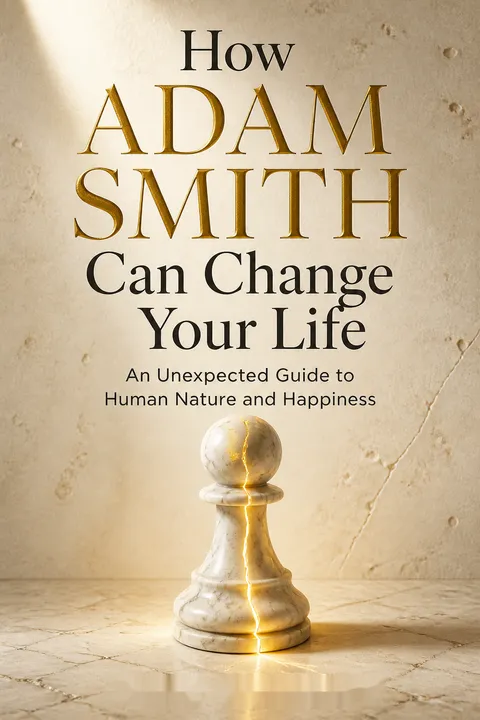
How Adam Smith Can Change Your Life by Russ Roberts explores Adam Smith's lesser-known work, "The Theory of Moral Sentiments." The book presents Smith's ideas on happiness, virtue, and human behavior in an accessible way. Many readers found it insightful and relevant to modern life, appreciating Roberts' interpretation of Smith's philosophy. While some felt the content was repetitive or oversimplified, others praised its ability to make complex ideas digestible. The book challenges common perceptions of Smith, focusing on his moral philosophy rather than economics.
People Also Read









Glossary
impartial spectator
Imagined fair-minded judgeAdam Smith's imagined observer who considers a person's conduct without being caught up in that person's immediate passions or private advantage. By picturing how such an observer would judge an action, a person can correct self-centered perception and assess whether the action is fair, proportionate, or harmful. It functions as an inward moral check, though self-interest can distort it.
loveliness
Deserving others' esteemSmith's specialized sense of being worthy of love, respect, and praise. Loveliness is not physical attractiveness or mere popularity. It describes a character whose actual conduct merits the approval it receives. Smith distinguishes it from simply being loved: lasting satisfaction depends on believing that others value the real person, not a false reputation.
propriety
Fitting social responseFor Smith, propriety means responding appropriately to a situation and to the people involved. It includes matching one's emotional expression to what others can understand and share, while respecting social expectations. The standard changes with context and closeness: people generally reveal more to intimates than to strangers, and a fitting response helps interactions proceed with trust and ease.
prudence
Wise care of oneselfSmith's virtue of taking thoughtful care of one's health, resources, reputation, and future. It combines the ability to foresee consequences with self-command, the capacity to forgo immediate pleasure or endure discomfort for a greater later benefit. Prudence is not merely caution or financial thrift; it also involves honesty, discretion, dependable conduct, and independence.
beneficence
Active effort to do goodSmith's virtue of helping and benefiting other people, through such qualities as generosity, charity, gratitude, friendship, and hospitality. Unlike justice, beneficence has no precise set of rules that settles every case. What help is appropriate depends on relationships, needs, and circumstances, so the virtue requires judgment rather than mechanical compliance.
man of system
Planner imposing social designSmith's term for a reformer or leader who imagines society can be reorganized according to a comprehensive plan. The man of system treats people as if they were passive objects, overlooking their independent motives and the consequences of their responses. Smith warns that a plan can fail or create disorder when it conflicts with how people actually act.
emergent order
Unplanned pattern from interactionA social pattern that develops through many individual actions without being deliberately designed or controlled by any one participant. Roberts uses the evolution of language as an example: speakers collectively establish common usage without voting on each word. Similar processes shape conventions, trust, and other forms of social coordination, though an unplanned outcome is not necessarily fair or beneficial.
Chessboard Fallacy
Ignoring people's independent motivesRoberts's label for attempts to direct society as if people were pieces moved by a planner. The fallacy is assuming that a policy will produce its intended result without considering how people will adapt, evade, resist, or exploit the new incentives. Such responses can undermine the goal and create side effects that the original plan did not anticipate.
FAQ
What's "How Adam Smith Can Change Your Life" about?
- Exploration of Adam Smith's Ideas: The book delves into Adam Smith's lesser-known work, "The Theory of Moral Sentiments," exploring its insights on human nature and happiness.
- Modern Relevance: Russ Roberts interprets Smith's ideas to show how they can be applied to modern life, offering guidance on living a fulfilling and virtuous life.
- Combination of Economics and Philosophy: It combines elements of psychology, philosophy, and behavioral economics to address questions about morality, happiness, and the good life.
- Practical Advice: The book provides practical advice on how to be happy, know oneself, and make the world a better place.
Why should I read "How Adam Smith Can Change Your Life"?
- Timeless Wisdom: The book offers timeless wisdom from Adam Smith, making it relevant for anyone interested in personal development and understanding human behavior.
- Practical Application: It provides practical advice on how to apply Smith's insights to everyday life, helping readers improve their relationships and personal well-being.
- Unique Perspective: Russ Roberts presents a unique perspective by connecting economic principles with moral philosophy, offering a holistic view of life.
- Engaging Writing: The book is written in an engaging and accessible style, making complex ideas easy to understand and apply.
What are the key takeaways of "How Adam Smith Can Change Your Life"?
- Desire to Be Loved and Lovely: Smith argues that people naturally desire to be loved and to be worthy of love, which is central to achieving happiness.
- Self-Interest vs. Selfishness: The book distinguishes between self-interest, which can lead to positive outcomes, and selfishness, which is detrimental.
- Role of the Impartial Spectator: Smith introduces the concept of the impartial spectator, an internal guide that helps individuals judge their actions and strive for virtue.
- Importance of Propriety and Virtue: Acting with propriety and cultivating virtues like prudence, justice, and beneficence are essential for personal fulfillment and societal harmony.
How does Russ Roberts interpret Adam Smith's ideas for modern readers?
- Practical Examples: Roberts uses practical examples and anecdotes to illustrate how Smith's ideas can be applied to contemporary life.
- Focus on Happiness and Virtue: He emphasizes the importance of happiness and virtue, encouraging readers to focus on being lovely rather than just being loved.
- Integration of Economics and Philosophy: Roberts integrates economic principles with moral philosophy, showing how they can guide personal and societal decisions.
- Accessible Language: The book is written in an accessible language, making Smith's complex ideas understandable and relatable for modern readers.
What is the "impartial spectator" and its significance in the book?
- Internal Moral Guide: The impartial spectator is an internal figure that represents an objective observer, helping individuals judge the morality of their actions.
- Encourages Self-Reflection: It encourages self-reflection and mindfulness, allowing individuals to step outside themselves and view their actions from an unbiased perspective.
- Promotes Virtue: By considering the impartial spectator's judgment, individuals are motivated to act virtuously and align their actions with societal norms.
- Foundation for Moral Behavior: The concept serves as a foundation for moral behavior, guiding individuals to balance self-interest with the well-being of others.
How does "How Adam Smith Can Change Your Life" address the pursuit of happiness?
- Beyond Material Wealth: The book argues that true happiness is not found in material wealth or fame but in being loved and lovely.
- Focus on Relationships: It emphasizes the importance of relationships and being worthy of love, which leads to genuine happiness and fulfillment.
- Role of Virtue: Cultivating virtues like prudence, justice, and beneficence is essential for achieving happiness and living a meaningful life.
- Self-Knowledge and Contentment: Understanding oneself and being content with one's lot are crucial components of happiness, as highlighted by Smith's insights.
What are the best quotes from "How Adam Smith Can Change Your Life" and what do they mean?
- "Man naturally desires, not only to be loved, but to be lovely." This quote encapsulates Smith's belief that people seek both affection and the worthiness of that affection, which is central to happiness.
- "The impartial spectator is the voice inside our head that reminds us that pure self-interest is grotesque." It highlights the role of the impartial spectator in guiding moral behavior and balancing self-interest with societal norms.
- "The great source of both the misery and disorders of human life, seems to arise from over-rating the difference between one permanent situation and another." This quote warns against the pursuit of material wealth and status, emphasizing the importance of contentment and virtue.
- "In ease of body and peace of mind, all the different ranks of life are nearly upon a level." It suggests that true happiness and security are not dependent on wealth or status but on one's inner state and relationships.
How does the book differentiate between self-interest and selfishness?
- Self-Interest as Positive: Self-interest is seen as a natural and positive force that can lead to beneficial outcomes for individuals and society.
- Selfishness as Negative: Selfishness, on the other hand, is viewed as detrimental, leading to harm and discord in relationships and society.
- Role of the Impartial Spectator: The impartial spectator helps individuals distinguish between self-interest and selfishness, guiding them to act in ways that are beneficial to both themselves and others.
- Balance and Harmony: The book emphasizes the importance of balancing self-interest with the well-being of others, promoting harmony and virtue.
What role does virtue play in achieving happiness according to the book?
- Foundation of Happiness: Virtue is seen as the foundation of true happiness, as it leads to being loved and lovely.
- Key Virtues: The book highlights key virtues such as prudence, justice, and beneficence, which are essential for personal fulfillment and societal harmony.
- Cultivation of Virtue: Cultivating virtue involves self-reflection, mindfulness, and aligning one's actions with societal norms and the impartial spectator's judgment.
- Virtue and Relationships: Virtuous behavior enhances relationships, leading to deeper connections and greater happiness.
How does "How Adam Smith Can Change Your Life" address the concept of self-deception?
- Common Human Flaw: Self-deception is presented as a common human flaw that prevents individuals from seeing themselves clearly and acting virtuously.
- Role of the Impartial Spectator: The impartial spectator helps individuals overcome self-deception by providing an objective perspective on their actions.
- Impact on Happiness: Self-deception can hinder happiness by creating a disconnect between one's inner self and outer actions, leading to inauthenticity.
- Encouragement of Self-Knowledge: The book encourages self-knowledge and honesty as means to overcome self-deception and achieve true happiness.
How does the book suggest we can make the world a better place?
- Small Actions Matter: The book emphasizes that small, everyday actions can have a significant impact on creating a more civilized and harmonious society.
- Role of Social Feedback: Social feedback, through approval and disapproval, plays a crucial role in shaping behavior and promoting virtue.
- Trust and Honesty: Building trust and acting with honesty and integrity are essential for creating a better world and fostering positive relationships.
- Focus on Personal Virtue: By focusing on personal virtue and being a good friend, family member, and citizen, individuals can contribute to a better world.
What is the "Chessboard Fallacy" and its relevance in the book?
- Concept of the Chessboard Fallacy: The Chessboard Fallacy refers to the mistaken belief that society can be easily manipulated and controlled like pieces on a chessboard.
- Critique of Central Planning: The book critiques central planning and the imposition of top-down solutions, highlighting the complexity and unpredictability of human behavior.
- Importance of Individual Freedom: It emphasizes the importance of individual freedom and the natural movements of people, which cannot be easily directed or controlled.
- Relevance to Policy and Governance: The Chessboard Fallacy serves as a warning against overreaching policies and governance that ignore the natural desires and behaviors of individuals.
About the Author
Other books by Russell "Russ" Roberts

Download PDF
Download EPUB
.epub digital book format is ideal for reading ebooks on phones, tablets, and e-readers.








