

Key Takeaways
Use a crisis to reassess your assets, not to romanticize suffering.
A turning point, not a gift. Maria Brito traces creativity through her grandfather Enrique, who moved from medicine into banking after an accident, then rebuilt his life after a kidnapping cost the family its wealth. He started a printing business and kept adapting. During the pandemic, Brito found a video of his release and began writing this book. His example frames crisis as a moment that demands a decision, not as something that automatically makes people more creative. The book also points to artistic movements and new public programs that emerged after major upheavals.
Start with what remains. Brito’s practical advice is to inventory skills, relationships, knowledge, and resources, then look for needs the crisis created or made newly visible. The goal is to use what is available to address a real problem, rather than waiting for circumstances to improve.
The distinction between crisis as catalyst and crisis as cure matters. Disruption can loosen routines and expose needs, but adversity can also consume the attention and security required to experiment. Enrique’s story is powerful because it shows adaptation after hardship, not a claim that hardship is necessary. The useful question is not whether a crisis is secretly good, but what capacities and support remain available. That framing preserves agency without blaming people who cannot turn every loss into an opportunity.
Treat creativity as a trainable practice, not an inherited identity.
Creativity is something people do. Brito challenges the idea that it belongs only to artists or arrives as a rare flash. She cites a study by George Land and Beth Jarman: in their reported test, 98 percent of five-year-olds scored at the highest creativity level, compared with 2 percent of adults tested. The figures support her argument that habits and education can suppress imaginative behavior, though they should not be mistaken for a universal measure of creative potential.
Work invites the breakthrough. Georges Braque did not invent collage in a moment detached from practice. Years of trying different styles and working through problems prepared him to use imitation wood wallpaper in a drawing. Brito also describes artists such as Picasso as disciplined workers. A study she discusses found that a new habit took an average of 66 days to feel automatic, not a fixed number that applies to everyone.
The strongest implication is that creative identity need not be settled early. Repeated practice gives people more material to combine, and it makes experimentation less intimidating. Still, test scores and famous artists cannot tell the whole story: a narrow test may reward certain forms of novelty, while schools and workplaces differ in how much room they allow. The practical case does not depend on proving that everyone can become a genius. It is enough that deliberate practice can help more people generate and execute ideas.
Build a bold vision, then design the structure that can carry it.
Ambition needs scaffolding. A creative vision is a clear picture of a future that does not yet exist. Brito pairs Michelangelo’s work on the Sistine Chapel with Christo and Jeanne-Claude’s The Gates, an installation of 7,503 saffron-colored fabric panels across 23 miles of Central Park paths. The artists pursued the project for 26 years, securing approval, designing structures, raising money, and coordinating hundreds of workers. Their scale came from imagination, but the idea became real through detailed planning and persistence.
Keep ownership of the idea. Brito also emphasizes autonomy: the ability to direct one’s work and challenge conventions rather than accept them automatically. Her examples include Artemisia Gentileschi, who pursued an independent career in a world that restricted women artists, and Ai Weiwei, who used art to expose official silence. A vision map, with goals, subgoals, obstacles, and next steps, turns ambition into a workable plan.
The pairing of imagination and logistics is especially useful for projects that seem too large to begin. A vision supplies direction; a plan makes the next action visible. Yet boldness is not a license to ignore reality or other people. Steve Jobs’s forceful vision could inspire teams, but a leader’s certainty can also become pressure that silences valid objections. Creative autonomy works best with mechanisms for feedback, clear responsibilities, and permission to revise the route without abandoning the destination.
Find the right problem by observing people before prescribing solutions.
Search before solving. Brito uses the term problem finder for someone who investigates what is worth addressing instead of rushing toward a familiar answer. In a study of art students, researcher Mihaly Csikszentmihalyi found that students who explored and reshaped their still-life arrangements produced work judged more original than students who settled quickly on a plan. The study suggests that curiosity about the problem can matter as much as skill at solving it.
Study real needs. Brian Chesky and Joe Gebbia began Airbnb by renting air mattresses in their apartment to visitors attending a design conference in San Francisco. They questioned their guests about the experience and learned what made it valuable, including affordability, a personal welcome, and company. Brito connects this kind of inquiry with empathy, the effort to understand another person’s perspective. Ask about specific experiences and frustrations, rather than fishing for approval of a proposed idea.
This approach anticipates a central discipline of good design: investigate the user’s actual circumstances before committing to a solution. It can reveal needs that customers have not framed as product requests. The caution is that empathy is not mind-reading, and a handful of enthusiastic early users may not represent a wider market. Observation and interviews are best treated as ways to form better hypotheses, followed by small tests that show whether the proposed answer helps beyond the first conversation.
Use personal truth as creative material, while keeping healthy boundaries.
Specific experience gives work a point of view. Brito argues that authenticity can make ideas more distinctive because no one else has exactly the same history or perspective. She tells the story of Swoon, the artist name of Caledonia Curry. After years of avoiding the shame and pain of growing up with parents affected by addiction, Swoon made work that faced her family’s story, including her mother’s illness and death. The shift helped her create Submerged Motherlands, an installation that joined personal memory with larger themes of care and loss.
Honesty is not oversharing. Brito also describes Iraqi artist Serwan Baran, who began painting scenes of war after years of avoiding the subject. In both cases, confronting difficult material gave the work emotional force. A study cited in the book found that teams able to express emotions and differing opinions generated and evaluated a wider range of ideas. The useful aim is relevant honesty, not disclosure without purpose or consent.
Authenticity is most productive when it deepens the work rather than turning private pain into a performance demanded by an audience. Swoon’s example shows how a personal story can become an artistic and community resource, but it does not imply that everyone must make trauma public to create well. In workplaces, emotional safety also depends on power: inviting candor is not enough if disagreement carries a penalty. Boundaries and trust make openness usable rather than merely exposed.
Make room for intuition, then let evidence test the hunch.
Quiet helps ideas connect. Brito recommends solitude, attention, and deliberate daydreaming as ways to let observations settle and recombine. Georgia O’Keeffe protected time alone while developing abstract work that differed sharply from her earlier paintings. Bill Gates’s private Think Weeks, spent reading and thinking away from daily demands, offer a business parallel. Brito calls the pause between working on a problem and returning to it the incubation effect: distance can help a fresh approach emerge.
A hunch is a lead, not a verdict. Brito recounts remembering a Paris art dealer while trying to sell a client’s painting; the connection helped produce a buyer. She also argues for balancing intuition with rational thought. A study of managers she cites found that combined intuitive and analytical approaches performed better than relying only on either one. Record the impression, ask what it might mean, and check it against experience, facts, and consequences.
The practical strength here is not the claim that intuition is always right. It is the suggestion that judgment can draw on information a person has absorbed without being able to articulate every step. Quiet can make that pattern recognition easier to notice. But intuition is also vulnerable to fear, bias, and wishful thinking. Treating it as a source of questions, then testing those questions with evidence, retains its speed without mistaking confidence for accuracy.
Recombine familiar elements until the result feels both useful and new.
Use a small toolkit. Brito’s methods offer different ways to reshape what is already known. Deconstruction breaks an idea into parts so its assumptions can be inspected. Aggregation combines elements into a richer whole. Repetition develops a recognizable motif or message, as Monet did across his many Water Lily paintings. Creative tension pairs opposites, while cross-pollination brings ideas from different fields together, as Gustav Klimt did by blending art, biology, and decorative forms.
Make ideas tangible. Brito favors sketching, diagrams, and handwritten notes during early thinking. Leonardo da Vinci’s notebooks held observations, drawings, and plans that helped him develop ideas before making finished work. The methods can be combined: take apart a service, identify what customers value, pair it with a surprising element, then test a repeatable version. The point is not novelty for its own sake, but a new arrangement that gives people a reason to care.
This toolkit makes originality less mysterious. Many valuable ideas are not created from nothing; they emerge when familiar parts are separated, recombined, or presented in a new context. That view also gives teams a practical way to brainstorm beyond vague demands to be innovative. The constraint is coherence: combinations can become clutter, repetition can become stale, and borrowed ideas can lose meaning outside their source. A useful test is whether the new arrangement solves a recognizable need or changes how people experience it.
Take informed risks, improvise from skill, and learn from the result.
Preparation makes improvisation possible. Brito compares creative work to jazz: structure and practice provide a foundation for responding to the unexpected. Jackson Pollock’s spontaneous-looking paintings followed years of working with materials. In business, the improv technique called yes, and means accepting an offer as a starting point and adding a constructive next step, rather than shutting the exchange down immediately.
A failure can be unfinished information. Barbara Corcoran spent her company’s $71,000 profit making real estate videos that nobody wanted. She later adapted the idea to the emerging internet, where listing photos helped attract buyers. Brito’s lesson is to examine who judged an idea unsuccessful, what assumptions failed, and whether the concept needs revision. Risks still have costs, so experiments can begin at a scale that leaves room to recover.
Failure becomes valuable only when someone can inspect it and make a different decision. Corcoran’s case illustrates that the underlying insight, helping buyers see homes remotely, survived a poor format and found a better channel. That is not proof that every failed project deserves another round. Sunk costs can disguise themselves as persistence. A useful review separates the goal from the method, then asks whether new evidence justifies continuing, changing course, or stopping.
Collaborate where your skills end, and make the shared terms explicit.
Different strengths create leverage. Donatello, skilled in marble, partnered with bronze expert Michelozzo on major commissions. Their agreement divided credit and profits, allowing each to contribute what the other lacked. Brito presents collaboration as more than outsourcing: it can change the work itself. Robert Rauschenberg’s projects with choreographer Merce Cunningham brought dance, music, costumes, and sets together in ways no participant could have produced alone.
Make trust operational. Partnerships also require clear expectations. Brito advises defining each person’s role, contribution, credit, and compensation before committing. Her own collaborations with artists produced limited-edition products, but the complexity of manufacturing and late payments eventually led her to stop that part of her business. Collaboration can expand reach and capability, but it does not erase practical costs. Choose partners whose skills differ from yours, and agree on how decisions and rewards will be handled.
The chapter’s strongest insight is that collaboration is a creative method, not merely a staffing choice. Different expertise can expose assumptions and produce possibilities that a single person would not see. Yet the excitement of a shared project can obscure unequal labor or control. Written agreements are not a bureaucratic distraction from creativity; they protect the conditions that let partners take creative risks. The best collaboration makes the work larger while making each contribution legible.
Read weak signals in the present, and pivot without losing your core.
The future leaves clues. Brito argues that future-oriented creators pay close attention to small changes, connect signals across fields, and ask what human need those changes serve. Artist Nam June Paik explored interactive television and networked communication decades before such technologies became commonplace. The founders of Google combined search, data analysis, and advertising after noticing how existing tools handled links and information.
Change the use, not always the identity. A pivot is a change in direction when a business or project stops working, loses distinction, or no longer fits its purpose. Play-Doh began as wallpaper-cleaning putty; when that market faded, its makers adapted the material into a children’s modeling compound. Brito advises taking stock of what already works, listening to customers, and changing in stages when possible. The aim is to evolve in response to evidence, not chase every passing novelty.
This is a grounded version of future thinking: not prophecy, but attention to patterns that may signal a changing need. Paik and Google make the point vividly, while Play-Doh shows how a useful pivot can preserve existing materials and know-how. Prediction remains uncertain, and hindsight makes successful innovators look more prescient than they may have felt at the time. Small experiments, diverse sources of information, and a clear sense of the organization’s strengths can reduce the cost of being wrong.
Analysis
Brito’s central claim is that creativity is a learnable capacity expressed through action: noticing, imagining, testing, and executing. The book’s organizing contrast is not between artists and businesspeople, but between people who accept inherited limits and those who build habits that let them question, recombine, and adapt. Art history supplies more than colorful illustrations. It demonstrates that creative work has always involved borrowing, discipline, materials, patrons, collaborators, and markets. Brito’s own career change and her grandfather’s repeated reinventions give this argument a personal narrative: creativity is not a personality label but a resource exercised under changing conditions.
The book is most useful when it converts inspiration into practices. Its emphasis on problem finding, observation, solitude, handwritten exploration, and complementary collaboration helps explain how ideas become more than declarations. Its tools also work together. Curiosity gathers material; silence allows it to settle; deconstruction reveals components; recombination generates possibilities; testing and revision bring an idea into contact with reality. This is a more credible account of creativity than the lone-genius myth.
Some claims require restraint. The cited childhood creativity scores and habit-formation average are not universal laws, and dramatic stories of famous innovators can conceal luck, privilege, collaborators, and failed attempts that never entered the record. Likewise, adversity sometimes produces growth, but it can also damage the conditions needed for creative work. The strongest version of Brito’s argument does not promise that anyone can become a celebrated artist or entrepreneur. It says people can improve their capacity to generate useful ideas by practicing specific behaviors, and can often find new directions by combining what they know with what they notice. Its real promise is not guaranteed success, but greater agency: a practical way to respond when old methods stop working.
Review Summary
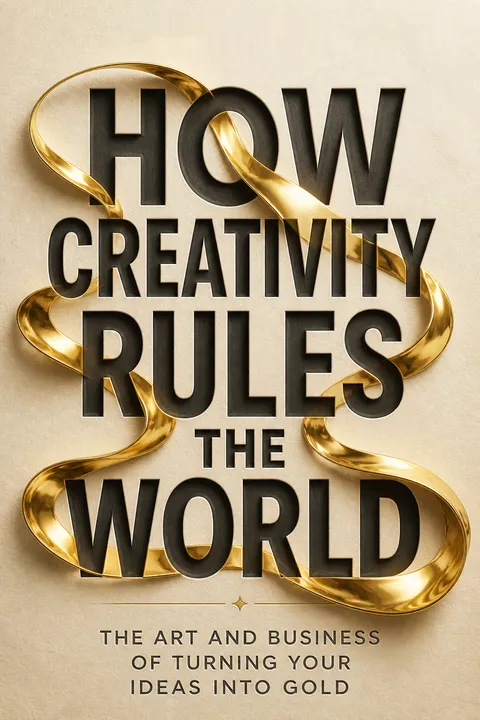
How Creativity Rules the World receives mostly positive reviews, with readers praising its inspiring content, practical exercises, and unique perspective on creativity in business and art. Many appreciate the author's personal anecdotes and historical examples. Some criticize the book for being too focused on visual arts or entrepreneurship, while others find it lacking cohesion. Overall, reviewers commend the book's ability to challenge misconceptions about creativity and provide actionable strategies for cultivating creative thinking.
People Also Read




Glossary
Creativity
Making relevant new ideasBrito defines creativity as using existing information and ideas to produce something relevant and new. It is not limited to artistic skill or a sudden flash of inspiration. In her account, creativity combines habits of attention, curiosity, imagination, and action, and can be developed in business, science, art, and everyday problem solving.
Innovation
Creative ideas put to useInnovation is the application of creative thinking to an existing product or service, or the combination of existing elements into something original that provides value. Brito distinguishes it from creativity more broadly: an idea becomes innovation when it offers a novel response to a meaningful problem for a group of people.
Problem finder
Identifies the right questionA problem finder explores what the real problem is before committing to a solution. Brito contrasts this approach with moving quickly toward a familiar answer. It involves questioning assumptions, gathering observations, and remaining open to revising the problem itself. The approach can reveal opportunities that routine problem solving overlooks.
Incubation
A pause that renews thinkingBrito uses incubation for a deliberate break from a problem before returning to it with a fresh perspective. The pause can last from a short interval to much longer. It is not simply avoidance: the person has already engaged with the issue, then allows attention to loosen so previously gathered information can be reconsidered.
Reality distortion field
Confidence in an unlikely visionThe phrase describes Steve Jobs’s ability to persuade people to pursue goals that seemed implausible or unreasonable. In Brito’s account, this forceful belief helped him imagine products and possibilities beyond current expectations. It can motivate teams, but confidence becomes risky if it suppresses evidence, dissent, or the limits of others.
yes, and
Accept and build on an offerThe yes, and technique, adapted from improvisational theater for business, treats another person’s idea or request as an offer to develop. Rather than rejecting it immediately, a person acknowledges the premise and adds a constructive next step. The response keeps discussion open while clarifying what can realistically be done.
Deconstruction
Break an idea into partsDeconstruction is the practice of separating a product, service, or problem into its component elements so each can be examined. The aim is to identify assumptions, causes, and useful features that may be hidden by the whole. Those parts can then be modified or recombined to develop a different solution.
Aggregation
Combine elements into a wholeAggregation brings different components together to create an integrated experience, product, or service. Brito argues that the combined result can offer more meaning or value than the individual parts alone. Effective aggregation requires a coherent purpose and an understanding of how customers will experience the combination.
Cross-pollination
Blend ideas across disciplinesCross-pollination combines knowledge, techniques, or perspectives from different fields. Brito uses artists who draw on science, technology, or other disciplines to show how unfamiliar material can open new creative directions. The practice depends on curiosity and a willingness to work with people whose expertise differs from one’s own.
Creative tension
Use contrast to generate ideasCreative tension arises when contrasting elements are placed in relation to each other, such as old and new, familiar and surprising, or abstract and concrete. The difference creates energy and can make a work or product more memorable. The challenge is to balance the opposites so they produce meaning rather than confusion.
Download PDF
Download EPUB
.epub digital book format is ideal for reading ebooks on phones, tablets, and e-readers.








