

Key Takeaways
Make every failed venture leave you richer in skills, contacts, or judgment.
Failure can pay forward. Adams’s early ventures included a tennis accessory, computer games, a restaurant, and fortified burritos. Most lost money or fizzled, but each left something usable: technical knowledge, business experience, or a clearer sense of what he could execute. His sixteen years in banking and telecommunications eventually supplied both the workplace material and business skills behind Dilbert.
A more dramatic failure helped redirect his life. After a disastrous accounting interview, his car died in a freezing Catskills winter. A passing salesman rescued him, and Adams later traded the car for a one-way ticket to California. The episode did not make failure pleasant. It turned a bad day into a decision that changed his surroundings and opportunities.
The useful distinction is not between people who fail and people who succeed. It is between failures that produce information and failures that simply repeat. Adams’s story makes experimentation feel less like a verdict on personal worth and more like a way to collect skills, contacts, and evidence. That framing can lower the emotional cost of trying. Still, failure is not automatically educational: repeated losses can drain money and health. Its value depends on noticing what happened, changing the next attempt, and knowing when the lesson has been learned.
Build repeatable routines that count as progress before the prize arrives.
Systems reward participation. Adams distinguishes a goal, a future result that is either reached or missed, from a system, a recurring practice expected to improve life over time. A goal of losing weight can make every day before the target feel like failure. A routine of eating well offers a sense of completion whenever it is followed, regardless of the scale.
On his first flight to California, a company executive told him to keep looking for a better job even after finding one. The executive’s career had grown through a series of moves, each adding experience. Adams applied the same logic to entrepreneurship: repeatedly create things that can be reproduced at scale, rather than waiting for one perfect idea to succeed.
The system-first approach is powerful because it shifts attention toward actions a person can actually repeat. It also makes setbacks less likely to erase motivation. But routines need feedback. A person can faithfully follow a system that no longer works, or mistake activity for progress. The strongest version of Adams’s idea pairs a durable practice with regular evidence that the practice is improving health, skill, income, or opportunity. The routine supplies continuity; feedback keeps it honest.
Use energy, not ambition, to decide how your day should work.
Energy connects competing priorities. Adams’s Energy Metric means judging choices by whether they create or drain mental and physical vitality over time. He treats sleep, exercise, food, stress, and engaging projects as inputs, not separate self-improvement chores. Shopping drains his energy, while blogging and side ventures raise it, so his best choices depend partly on his own response rather than a universal ranking of activities.
He also schedules work around his mental state. Mornings suit creative comic writing, exercise fits around midday, and routine drawing works better later. When a corporate job limited his schedule, he woke before dawn to work on cartoons. The aim is not constant excitement. It is to match tasks, time, and available energy so fewer important hours are spent fighting the wrong conditions.
Energy is a practical organizing idea because it captures costs that calendars and to-do lists often hide. A task can be brief yet leave someone depleted for the rest of the day; another can feel like work while improving mood and focus. The metric is also personal, which makes observation essential. Immediate pleasure can masquerade as lasting energy, while necessary effort can feel draining at first. A useful test is whether a choice supports capacity across the day and across time, not merely whether it feels good in the moment.
Combine ordinary strengths until the bundle becomes hard to copy.
Skills gain value in combination. Adams’s Success Formula is his deliberately simple claim that each useful skill can substantially improve a person’s odds. He is not arguing that everyone should become exceptional at one thing. He argues that several complementary abilities can make a person unusually valuable: competent writing, business knowledge, humor, and comfort with technology, for instance.
Dilbert grew from that kind of combination. Adams describes himself as an unremarkable artist and writer, but he had years of corporate experience and learned about the Internet early. Business knowledge supplied the comic’s subject matter; direct reader feedback helped him focus it on office life; online distribution widened its audience. He also recommends developing practical skills such as public speaking, conversation, basic accounting, design, and psychology.
The distinctive insight is about complementarity, not simply collecting credentials. A skill becomes more valuable when it lets another skill reach a new audience or solve a different problem. This favors broad learning and makes it easier to pivot when one field changes. Yet the claim that each skill doubles success odds is a motivational simplification, not a measured law. Skills differ in usefulness, and combinations only matter when they answer real needs. The practical question is therefore not how many abilities someone has, but which abilities reinforce one another in a chosen context.
Test for real demand early, then quit ideas nobody acts on.
Behavior beats polite feedback. Adams looks for an early sign that an idea has an audience, even if the first version is rough. He calls this elusive appeal the x factor: a quality that makes some people enthusiastic enough to act. When Dilbert first appeared, most readers were unimpressed, but a small group cared intensely. Later, reader responses showed that the office strips were the ones people preferred, so Adams changed the comic’s focus.
His rule of thumb is that promising products can begin imperfectly, while ideas that attract no interest may not be worth rescuing through endless effort. He recommends watching what people do, such as sharing or displaying a comic, rather than relying on compliments from friends and family. Childhood obsessions and willingness to risk embarrassment can also offer clues about where practice may feel natural.
This is a useful antidote to the common belief that persistence alone can turn any idea into a success. Early customer behavior can reveal whether an idea solves a problem or creates genuine attachment. The principle is especially useful when testing is cheap and reversible. But an initially quiet response can also reflect poor distribution, an unclear presentation, or the wrong audience. One weak test should not decide everything. Look for repeated signals, make a small adjustment when the evidence points to one, and distinguish a flawed first version from a lack of demand.
Change your cues and social role to change your behavior.
People respond to inputs. Adams treats attitude and behavior as partly programmable through the body, surroundings, and social setting. He describes smiling, posture, exercise clothes, and a confident persona as cues that can alter how a person feels and acts. During a public-speaking course, an instructor praised a frightened student for her courage rather than judging her halting speech. She returned the next week and tried again.
Adams also learned that conversation is a skill, not an innate gift. Asking questions about another person’s work, interests, and experiences gives both people a path out of awkward silence. His term Association Programming refers to deliberately spending time with people whose habits or attitudes represent qualities a person wants to develop. The environment can make a desired behavior feel more ordinary and accessible.
The section treats social confidence as something built through practice and context, rather than a fixed personality trait. That is a humane and useful shift: a small cue can help someone begin before confidence arrives. Praise also changes the meaning of a difficult moment, making continued effort seem possible. The approach has limits, though. Acting confident cannot remove every structural barrier, and praise works best when it recognizes something real rather than offering empty reassurance. Social cues can open a door, but they do not substitute for skill, safety, or genuine connection.
Make health convenient enough that willpower barely enters the room.
Reduce the daily friction. Adams connects happiness and productivity to physical condition, schedule control, and a sense of progress. His practical fitness rule is to be active every day, choosing movement that does not leave him dreading the next session. When he feels too tired to exercise, he puts on workout clothes and gives himself permission to leave. Often the cue changes his mood; if it does not, he goes home without treating the day as a failure.
His diet approach also favors convenience over constant restraint. He keeps ready-to-eat foods such as fruit, nuts, and prepared vegetables available, so the easy choice is often the one he prefers. He advises observing how particular foods affect energy and mood, while acknowledging that people differ. Flexible schedules, sleep, exercise, diet, imagination, and routines all contribute to his account of happiness.
This advice is strongest when understood as environment design rather than a universal menu or workout prescription. Preparing food and making movement easy reduces the number of moments that demand self-control. The approach also leaves room for ordinary variation, which can make routines sustainable. Its health claims deserve caution: personal observations cannot establish what diet or exercise is safe for everyone, and low energy can have causes beyond lifestyle. The durable lesson is to make healthy choices easier to repeat, while seeking qualified guidance for medical questions.
Stack attempts, timing, and optimism to give luck more chances.
Luck has an address. Adams argues that chance cannot be controlled, but a person can choose activities that create more opportunities for it to matter. Dilbert benefited from a sympathetic editor, an engineer who helped persuade a newspaper to run it, a new salesperson who believed in the strip, and a cultural moment when office life and technology became prominent. Adams had kept creating, learning, and looking for audiences before those pieces aligned.
He also describes affirmations: repeatedly stating and imagining a desired outcome. His own apparent successes included becoming a cartoonist and a bestselling author, but he does not claim proof that affirmations changed external events. Focus, confidence, selective memory, optimism, and chance could explain the results. Their practical value, if any, may be that they keep a person energized and alert to opportunities while the actual work continues.
The luck argument is more persuasive as a strategy for increasing exposure than as a claim that optimism bends reality. Repeated attempts create more possible encounters with collaborators, customers, and timely openings. A vivid future can also make present effort easier to sustain. The danger is confusing a memorable success story with a reliable probability estimate. Affirmations may support focus, but they cannot guarantee an outcome. Their safest use is as motivation for action, not as a substitute for evidence, preparation, or risk assessment.
Treat expert certainty as evidence, not a final verdict.
Keep the inquiry moving. Adams proposes checking difficult claims against several imperfect filters: personal experience, other people’s experience, experts, scientific studies, common sense, and patterns. None is reliable alone. Looking for consistent support across more than one can improve judgment without creating certainty.
His voice disorder put this approach under pressure. After doctors diagnosed spasmodic dysphonia and told him there was no cure, he connected it to an earlier hand condition, searched for the term voice dystonia, and found a specialist who confirmed the diagnosis. After years of unsuccessful approaches, he consulted another surgeon whose operation rerouted nerves in the neck. He reported that his voice began returning about three and a half months later. This was his experience, not a general medical recommendation.
The story shows how naming a problem can make new questions possible, and how a patient’s persistence can complement medical expertise. Adams does not need to portray doctors as foolish for the search to matter: specialists know a great deal, yet rare or evolving conditions can leave uncertainty. The proper response is neither blind deference nor reflexive distrust. It is informed questioning, second opinions when appropriate, and careful weighing of risks. A personal recovery can offer hope, but it cannot establish that the same intervention is right for another person.
Analysis
The book’s most durable contribution is not a formula for success, but a method for keeping agency under uncertainty. Adams links three levels that advice books often separate: the daily body, the repeated work routine, and the larger field of opportunity. Food and exercise affect how much effort feels available; systems determine whether effort continues; skill combinations and repeated attempts widen the number of ways success might arrive. The voice-disorder narrative gives this model emotional weight. It is one thing to celebrate failure while pursuing comics. It is another to keep investigating when isolation and a condition described as incurable have narrowed ordinary life.
The same narrative also exposes the model’s limits. Success stories are selected after the fact. Dilbert’s lucky gatekeepers and favorable timing are memorable precisely because many equally persistent creators never receive comparable openings. Adams recognizes uncertainty, but some of his rules, especially the claim that every skill doubles success odds, function better as behavioral prompts than as empirical laws. Likewise, personal diet experiments can generate useful hypotheses, but they cannot safely replace medical or nutritional evidence.
A modern reading can preserve the book’s practical optimism while strengthening its epistemology. Treat systems as experiments: choose repeatable actions, define what evidence would count as improvement, and revise when results disappoint. Treat affirmations as attention management rather than supernatural causation. Treat failure as useful only when it changes the next attempt. This turns the book’s playful anti-expertise stance into a more careful principle: no single authority, anecdote, or intuition deserves the whole decision. The best route is often to combine lived experience with outside evidence, remain alert to selection effects, and prefer low-cost tests before high-cost commitments. Adams’s deepest argument is that luck is not conquered. A person can become more prepared to meet it.
Review Summary
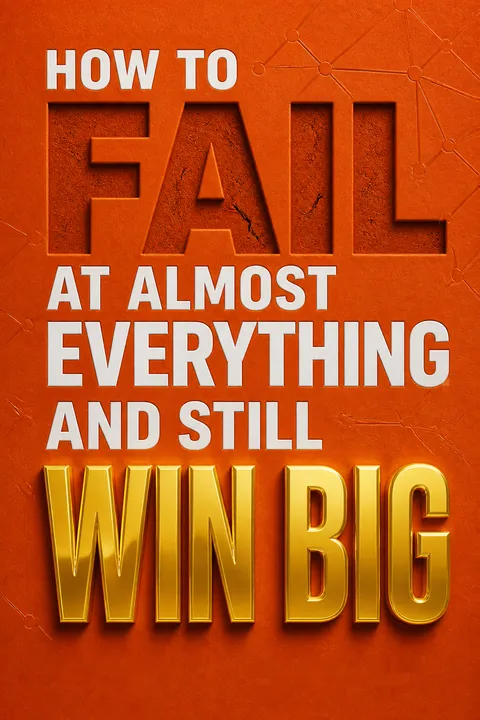
How to Fail at Almost Everything and Still Win Big receives mixed reviews. Many praise Adams' practical advice on success, systems over goals, and energy management. Readers appreciate his humor and personal anecdotes. Some find the diet and affirmation sections less valuable. Critics dislike his views on diversity and selfishness. The book is seen as part memoir, part self-help, offering unique perspectives on failure and success. While some find it repetitive or basic, others consider it insightful and motivating.
People Also Read





Glossary
System
repeatable path toward improvementAdams uses system for a recurring practice expected to improve a person’s life over time, rather than a single future result. Eating in a way that supports health or continually seeking better work counts as a system. The idea is to make progress measurable through repeated action, not only through reaching a distant target.
Energy Metric
personal vitality as a guideThe Energy Metric is Adams’s way of judging choices by their effect on a person’s mental and physical vitality. It includes obvious factors such as sleep, food, exercise, and stress, as well as work, relationships, and projects that create enthusiasm. The metric is personal and is meant to help weigh competing priorities over time.
Success Formula
value from combined skillsThe Success Formula is Adams’s heuristic that acquiring useful skills can substantially improve a person’s odds of succeeding. Its core idea is that several complementary abilities, each at a good but not exceptional level, may be more valuable than one isolated strength. The claim that every skill doubles the odds is a simplifying motivational device, not a literal calculation.
x factor
early audience enthusiasmThe x factor is Adams’s label for the hard-to-measure quality that makes some customers or audience members respond unusually strongly to an idea, even if its first version has obvious flaws. He advises looking for actions such as sharing, recommending, or displaying a product, rather than relying only on compliments or conventional measures of quality.
Affirmations
repeated outcome visualizationAffirmations are repeated statements about a desired result, often paired with imagining that result. Adams recounts experiences he associates with affirmations but does not establish that they cause external events. He considers focus, optimism, increased attention to opportunities, selective memory, and coincidence among possible explanations for their apparent effects.
Association Programming
influence through social surroundingsAssociation Programming is Adams’s term for using proximity to people and settings to influence one’s habits, energy, or expectations. He argues that spending time around people who embody a desired behavior can make it seem more normal and easier to adopt. The proposed mechanism may include imitation, encouragement, shared activities, or access to useful knowledge.
Confusopoly
confusing offers that block comparisonConfusopoly is Adams’s term for a market in which sellers make competing prices or plans difficult to compare. He uses mobile phone pricing as an example: when customers cannot easily understand the differences, they may decide with limited information and then rationalize their choice. The term describes confusion as a deliberate commercial advantage.
Fleshy Bag of Magic
body treated as unknowableFleshy Bag of Magic is Adams’s humorous label for viewing the body as mysterious and disconnected from everyday inputs. He contrasts it with treating the body as a system whose energy and mood can sometimes be observed in relation to food, sleep, and activity. The phrase encourages experimentation, though it does not establish that every bodily response is simple or predictable.
FAQ
What's How to Fail at Almost Everything and Still Win Big about?
- Personal Journey of Success: The book details Scott Adams' path from numerous failures to success as the creator of Dilbert. It highlights the importance of learning from failures rather than relying solely on talent.
- Systems Over Goals: Adams advocates for focusing on systems rather than specific goals, as systems promote continuous improvement and adaptability.
- Humor and Insights: Infused with humor and personal anecdotes, the book provides valuable insights into achieving personal and professional success.
Why should I read How to Fail at Almost Everything and Still Win Big?
- Unique Perspective on Failure: Adams offers a refreshing take on failure, viewing it as a necessary part of the journey to success and encouraging readers to embrace it as a learning opportunity.
- Practical Advice: The book provides actionable advice on managing personal energy, recognizing talents, and understanding the importance of systems, applicable to various life aspects.
- Engaging Writing Style: Adams' humorous and relatable writing style makes complex ideas accessible and enjoyable, ensuring readers are entertained while learning valuable lessons.
What are the key takeaways of How to Fail at Almost Everything and Still Win Big?
- Embrace Failure: Adams emphasizes that failure is a stepping stone to success, stating that everything desired in life is found within failures.
- Focus on Energy: Managing personal energy is crucial for success, with Adams suggesting that tracking personal energy is the most important metric.
- Systems Over Goals: Adams argues that systems are more effective than goals for achieving success, advocating for continuous improvement.
What are the best quotes from How to Fail at Almost Everything and Still Win Big and what do they mean?
- "Goals are for losers.": This quote reflects Adams' belief that setting specific goals can lead to failure if not achieved, advocating for systems that allow ongoing progress.
- "The most important metric to track is your personal energy.": Emphasizes maintaining high energy levels as crucial for success, improving productivity and happiness.
- "Everything you want out of life is in that huge, bubbling vat of failure.": Highlights that success is often hidden within failures, encouraging learning from them to uncover desired outcomes.
How does Scott Adams define success in How to Fail at Almost Everything and Still Win Big?
- Success as a Process: Adams views success as a continuous process of improvement and learning, often resulting from managing opportunities and being open to luck.
- Skill Acquisition: Suggests that acquiring diverse skills increases the odds of success, with each new skill doubling those odds.
- Embracing Failure: Believes success is intertwined with failure, viewing failures as valuable experiences contributing to overall success.
What is the energy metric mentioned in How to Fail at Almost Everything and Still Win Big?
- Personal Energy Focus: Prioritizes activities that boost personal energy, enhancing performance in all life areas.
- Components of Energy: Includes proper nutrition, exercise, sleep, and engaging in exciting activities, with Adams noting improved work quality when energy is right.
- Long-term Benefits: Focusing on energy creates a positive feedback loop, improving personal and professional life aspects, maintaining motivation and enthusiasm.
What is the selfishness illusion discussed in How to Fail at Almost Everything and Still Win Big?
- Selfishness as a Strategy: Adams argues that constructive selfishness is necessary for personal success, suggesting it prevents being a burden on society.
- Long-term Generosity: Taking care of personal needs first allows for greater generosity and effectiveness in helping others later.
- Balancing Needs: Highlights balancing personal needs with others', suggesting enlightened selfishness benefits society as a whole.
What does Scott Adams say about passion in How to Fail at Almost Everything and Still Win Big?
- Passion is Overrated: Adams argues that following passion can lead to irrational decisions and failures, suggesting it is not a reliable success indicator.
- Focus on Skills: Emphasizes acquiring skills over passion, as skills are more valuable for achieving long-term goals.
- Success Through Execution: Points out that successful ventures often result from execution rather than passion alone, encouraging focus on practical steps and systems.
How does Scott Adams suggest one should recognize their talents?
- Childhood Interests: Suggests looking at childhood obsessions to identify potential talents, as early interests may indicate future areas of excellence.
- Risk Tolerance: Emphasizes that comfort with risk in certain areas may signal talent, indicating a natural inclination toward those skills.
- Experimentation: Encourages trying various activities to discover unique talents and strengths through experimentation.
What does Scott Adams say about the role of luck in success?
- Luck is Essential: Adams argues that luck plays a significant role in success, often more than hard work or talent, with being in the right place at the right time leading to opportunities.
- Create Opportunities for Luck: Suggests trying new things and expanding skill sets to increase the chances of luck finding you.
- Perspective on Failure: Views failure as a necessary step toward success, often leading to lucky breaks, encouraging seeing failures as part of the process.
How does Scott Adams recommend managing your diet for better health?
- Focus on Energy Levels: Suggests paying attention to how foods affect energy, making informed choices for overall well-being.
- Remove Temptations: Advises keeping unhealthy foods out of the home to reduce temptation, stocking up on convenient, healthy options.
- Experiment with Preferences: Encourages experimenting with food preferences to reprogram cravings, gradually shifting towards healthier options.
What is the significance of the affirmation "I, Scott Adams, will speak perfectly" in How to Fail at Almost Everything and Still Win Big?
- Personal Journey: Represents Adams' struggle with spasmodic dysphonia and his desire to regain his voice, symbolizing hope and determination.
- Power of Affirmations: Illustrates the potential impact of positive thinking and focus on achieving goals, shaping mindset and influencing outcomes.
- Resilience in Adversity: Reflects Adams' resilience in facing challenges, emphasizing maintaining a positive outlook even in bleak circumstances.
About the Author



Download PDF
Download EPUB
.epub digital book format is ideal for reading ebooks on phones, tablets, and e-readers.








