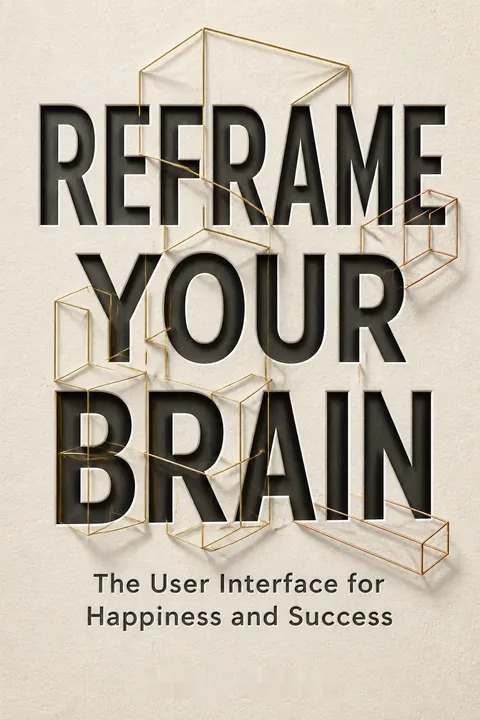


Key Takeaways
Change the definition of success, and an irritating task can become rewarding.
A new measure changes the day. Adams once judged a dog walk by how far his reluctant dog moved. After learning that sniffing was stimulating for the dog, he recast the outing as a successful sniffing expedition. The dog enjoyed it, and Adams stopped feeling that the walk had failed. He then turned the standing and waiting into time to practice breathing and posture. The circumstances barely changed; the interpretation did.
A reframe is a new way of interpreting a situation that changes how it feels or what action seems possible. The book's central proposal is practical: test alternative interpretations, keep the ones that help, and discard the ones that do not. Reframing a queue as breathing time, for instance, can make an unavoidable wait feel less wasted.
What's striking is the shift from demanding that reality change to changing the task's success criterion. That resembles cognitive reappraisal, a psychological strategy in which people reinterpret an event to alter its emotional impact. The dog story makes the move concrete: success becomes meeting the dog's need, not forcing a human preference onto the walk. The useful test is whether the new frame improves behavior or experience without concealing a real problem. Recasting an unsafe situation as harmless would be denial, not flexibility. A frame earns its keep when it helps someone respond more effectively to what is actually happening.
Repeat useful thoughts until they become easier to reach, not because they are facts.
Attention makes ideas sticky. Adams argues that focus and repetition can make a thought influence habits, with emotion sometimes strengthening the effect. He illustrates this with his personal decision to think of alcohol as harmful rather than as an ordinary beverage. Repeating that phrase helped him lose interest in drinking. He also describes using an imagined sneeze to interrupt a sneeze that is just beginning, though this is presented as an anecdote, not established treatment.
His test for a reframe is usefulness, not literal accuracy. That can help loosen an unhelpful automatic response, but it does not make a false claim true. The distinction matters: a phrase may change a person's attention or motivation while leaving the external facts unchanged. Adams also distinguishes ordinary habits from addiction, which may require professional support rather than a slogan.
The insight has a strong behavioral core: repeated cues can make certain interpretations more accessible, much as practice makes a skill easier to retrieve. Its strength is also its hazard. A memorable phrase can guide attention, but repetition can reinforce a mistaken belief as readily as a helpful one. The safest use is to treat a reframe as a trial prompt, then check whether it improves choices and remains compatible with evidence. This is especially important around substance use, anxiety, and physical symptoms. A useful mental shortcut can support change, but it should not be confused with a diagnosis or a proven intervention.
Build systems that create options, not goals that dictate one destination.
Prepare for more than one win. Adams defines a system as repeated activity that improves future options. A goal points toward a specific result, such as losing a set amount of weight; a system might be regular activity and ongoing learning about food. The system offers daily actions to complete even before the distant result arrives. It can also adapt if circumstances change.
A related idea is a Talent Stack: a combination of useful skills that reinforce one another. Adams pairs writing, drawing, humor, business experience, and public speaking to show how a bundle can open several paths rather than depend on a single specialty. A plumber who adds business skills, for example, might be able to build a company or pursue related work. The aim is not to collect skills at random, but to combine interests and abilities into flexible value.
This approach fits a world where career paths and personal priorities can shift faster than long-range plans anticipate. In decision theory, flexibility has value because it preserves the ability to respond when new information arrives. Systems can also make progress visible before an outcome is fully controllable. Still, goals are not useless: a clear target can coordinate effort when the destination is stable, as in preparing for a particular exam. The stronger distinction is between goals as direction and systems as the engine. A broad skill portfolio helps most when the skills genuinely complement one another, not when accumulation becomes its own hobby.
Treat failed attempts as information, and embarrassment as the entry fee.
A miss can teach the next move. Adams says he cannot reliably predict which projects will succeed, so he tries many. He estimates that perhaps one in ten attempts works well enough to justify the process. His own path included early Dilbert strips that attracted little newspaper interest, followed by years of promotion alongside a day job. He also describes becoming a professional speaker despite a disastrous first performance. In each case, action supplied information that planning alone could not.
The same logic applies to creativity. Adams advises starting with rough material, then editing, rather than waiting for a polished idea to appear. He also treats low-stakes embarrassment as practice: an awkward attempt may sting, but it can build tolerance and sometimes reveal an opportunity. The key qualification is cost. Test small when a mistake is cheap; research carefully when the downside is serious.
The emphasis on experimentation counters a common planning trap: people often seek certainty where only feedback can provide it. This resembles the logic of a low-cost prototype, where an early imperfect version tests demand before substantial investment. Reframing embarrassment can also reduce avoidance, but it should not turn recklessness into a virtue. Public failure is not equally affordable for everyone, and repeated rejection can carry real costs. A sound version of the advice asks two questions: what can the attempt teach, and what is the maximum downside? Courage is most useful when paired with a limit on avoidable harm.
Schedule demanding work around energy, not merely available hours.
Match the task to your state. Adams says he wrote nearly all of roughly 11,000 comic strips before 9 a.m., when he found creative writing easiest. Drawing suited him better later in the day, when he felt more relaxed. His principle is to place work where personal energy fits the task, rather than assuming every hour is interchangeable.
That approach depends on having some control over a schedule, which many workers and caregivers do not. Where flexibility exists, observe when concentration, physical energy, or patience tends to be strongest, then protect that period for work that benefits from it. Adams also argues that low-priority tasks can often wait. This is a useful challenge to the belief that every open task deserves immediate attention, though obligations with real deadlines still need to be handled.
The idea recognizes that time is a container, not a measure of readiness. Work design benefits when demanding tasks align with a person's alertness and the task's cognitive demands. This can reduce wasted effort without requiring a more elaborate productivity system. The limitation is structural: workers often cannot choose when meetings, shifts, or caregiving occur. Energy management should therefore be treated as a margin to optimize, not a personal failing when schedules are imposed. A small adjustment, such as reserving a short high-focus window, may be more realistic than redesigning an entire day.
Give difficult feelings a new frame, but never confuse reframing with treatment.
Change the mental channel. Adams offers several ways to interrupt distressing thought loops: become curious about what will happen instead of rehearsing disaster, focus on what can be controlled, or fill attention with an absorbing activity. He calls the last approach Mental Shelf Space: new thoughts and experiences occupy attention that might otherwise be consumed by rumination. Learning drums is his example of an activity demanding enough to crowd out competing thoughts.
He also suggests viewing old memories as belonging to the past rather than as events occurring now. This may help some people regain perspective, but it should not be used to deny that trauma happened or that its effects are real. These reframes are self-help prompts, not established cures. Persistent anxiety, trauma symptoms, obsessive-compulsive disorder, or suicidal thoughts call for qualified professional support.
The strongest element here is attentional redirection: trying to force a thought away can keep it central, while a demanding activity can give attention somewhere else to go. That is a practical distinction between suppression and engagement. Yet the book sometimes treats intense psychological problems as if a phrase could be broadly tested without risk. Reframing can complement care, but it cannot establish what a symptom means or replace treatment. In particular, telling a person that the past is unreal could feel invalidating. A safer interpretation is that a memory is not the present event, while its effects deserve recognition and support.
Replace mind-reading with curiosity, boundaries, and useful social behavior.
Make interaction easier for others. Adams argues that people are poor at guessing one another's motives. In conversation, he recommends asking straightforward questions, listening, and showing interest rather than performing for approval or rushing to give advice. At a gathering, a simple introduction and a question can help both strangers escape the awkwardness of not knowing how to begin.
He also draws a firm line around relationships he considers toxic, advising distance rather than endless attempts to fix the other person. His workplace story points to another distinction: some complainers mainly want to feel heard, while others need an actual solution. The practical lesson is to diagnose the need before responding. Kindness can also compound socially: Adams remembers brief advice and generosity that shaped his career decades later, and he describes passing that help onward.
These suggestions work because they reduce the social burden of improvisation. Open questions and attentive listening give a conversation structure without requiring a dazzling personality. The reminder not to infer hidden motives is equally valuable, since the same behavior can arise from different priorities. Boundaries are the counterweight: curiosity does not require tolerating repeated harm. The book's sharper claims about toxic people being unable to change are too absolute to apply universally. A more reliable rule is to judge patterns, communicate limits, and seek distance when the relationship remains unsafe or damaging.
Build career value through useful skills, relationships, and visible initiative.
Make your contribution legible. Adams recasts a career as something an employee must actively improve, not merely a list of duties assigned by a boss. He recommends choosing projects that build skills, demonstrate ability, or connect a worker to helpful colleagues. In his banking job, he created a visual timeline of computer lease expirations, a task beyond his formal duties that helped managers plan spending and gained senior attention.
He also emphasizes reciprocity, dependability, networking, and learning marketable skills. These are ways to turn effort and character into future options. His advice to stay visibly late reflects a less attractive side of workplace life: appearing hardworking can affect how people are evaluated, even when hours are not the best measure of contribution. The aim should be demonstrable value, not empty performance or loyalty to an employer at the expense of one's own development.
The career advice combines human capital, social capital, and signaling. Skill creates capacity, relationships carry information about opportunities, and visible initiative helps others notice what a worker can do. The lease timeline story shows how a useful artifact can make competence concrete. But visibility can reward presenteeism and favor employees with more schedule freedom. A healthier application is to document outcomes, seek projects with learning value, and build relationships without treating every interaction as a transaction. Self-advocacy is not cynicism; it is a way to avoid letting an organization define the full value of a person's work.
Use food, movement, sleep, and surroundings as levers for motivation.
The mind is not isolated. Adams treats the brain, body, and physical setting as parts of one working system. For eating, he separates food that serves as fuel from food sought as entertainment, and reframes overeating as partly a knowledge and convenience problem rather than simply a failure of will. His suggested system includes keeping tempting foods out of the home, learning to prepare healthy meals, and tracking weight.
For exercise, he recommends starting with activity a person is willing to repeat rather than searching endlessly for the ideal workout. He also notices that poor sleep can resemble hunger, and that a pleasant or organized space can improve his mood. These are practical experiments, not universal prescriptions. Food needs and exercise capacity differ, and weight tracking or dietary rules may be inappropriate for some people. Adapt the method to health needs and professional guidance.
The environment-first approach is a useful corrective to explanations that place every behavior inside individual willpower. Convenience, cues, sleep, and social surroundings shape what choices are easy to make. Small changes to those conditions can reduce the number of decisions that require effort. The book's fuel-versus-entertainment distinction may help some readers pause, but food is also pleasure, culture, and care, not merely a productivity input. Likewise, weighing daily is not suitable for everyone. The broader principle is more robust than any specific tactic: arrange surroundings to support sustainable health rather than relying on constant self-denial.
Judge worldviews by what they predict, while staying alert to self-serving stories.
A useful map is not the territory. Adams argues that people often rationalize choices after making them and can interpret the same event through different subjective stories. He describes disagreement as two people watching different imagined movies on a shared screen. His proposed response is to focus less on forcing agreement and more on asking which interpretation helps predict what happens next.
He also points to persuasion tools such as repetition, simplicity, novelty, fear, and vivid images. These can shape what people notice and remember, including in politics and advertising. His model is deliberately skeptical of claims that people are consistently rational, but that skepticism should not become a reason to ignore evidence. A prediction that works once may be luck; a useful worldview needs repeated checks against observable outcomes and willingness to revise when it fails.
The book is most intellectually interesting when it treats beliefs as tools whose value can be assessed by consequences, rather than as transparent windows onto reality. That stance has affinities with pragmatism and scientific model testing: a model earns confidence by making risky predictions that survive observation. But prediction alone is not enough if the model is vague or unfalsifiable. Persuasion techniques can also explain why a message feels compelling without showing that it is true. Skepticism is most productive when applied symmetrically, including to one's own favored reframes, and paired with evidence that could prove them wrong.
Analysis
The book is best understood as a field guide to changing the interpretation that sits between an event and a response. Its many short reframes, stories, and topic-specific suggestions can appear like a grab bag, but a consistent method holds them together: notice a costly default interpretation, try a more useful alternative, repeat it if it sticks, and judge it by its effects. The opening dog-walk story is the cleanest demonstration. A change in the definition of success changes the experience without changing the walk itself.
That method has real explanatory power because attention and expectation influence behavior. A person who sees a setback as a test, a queue as breathing practice, or a rough draft as material to revise may act where a more discouraging interpretation would produce avoidance. The book also usefully resists the fantasy that motivation must arrive before action. Small experiments can produce information, competence, and sometimes enthusiasm.
Its weakest move is to blur helpful interpretation with factual belief. The claim that a thought need not be true can be liberating when applied to a low-stakes frame, but dangerous when it licenses denial, medical misinformation, or overconfidence about other people's motives. Some proposals about trauma, OCD, addiction, health, and human rationality are presented with more certainty than the evidence in the text warrants. Reframing is not a substitute for professional care, and anecdotes cannot establish a cure.
A disciplined reader can preserve the book's strongest idea by treating reframes as hypotheses rather than commandments. Ask whether a phrase changes attention, emotion, or behavior; then ask whether the change is beneficial, safe, and consistent with evidence. This keeps the author's experimental spirit while adding an essential safeguard: a frame should make reality easier to engage, not easier to evade. The best reframes expand agency without shrinking curiosity or accountability.
Review Summary
Reframe Your Brain by Scott Adams offers techniques for reframing situations to foster positive perspectives and outcomes. Readers found the book practical, thought-provoking, and useful for personal development. Many appreciated Adams' humor and relatable examples. While some felt certain reframes were more effective than others, most agreed the book provides valuable tools for altering perceptions and improving responses to life's challenges. Critics noted the book's self-help nature and questioned the long-term efficacy of some techniques. Overall, readers recommend it for those seeking to enhance their mindset and problem-solving skills.
People Also Read







Glossary
Reframe
A useful alternative interpretationIn Adams's usage, a reframe is a new interpretation of a situation intended to alter how a person feels or responds. It need not be literally true or logically complete to be useful, though its value depends on whether it helps in practice. Reframes are tested individually because a phrase that changes one person's response may have little effect on another.
Talent Stack
Complementary skills combinedA Talent Stack is a set of skills that reinforce one another and create multiple kinds of value. Rather than relying on being exceptional at one ability, a person combines capabilities such as writing, public speaking, business knowledge, and design. The resulting mix can make someone distinctive, adaptable, and useful across different jobs or opportunities.
Mental Shelf Space
Attention redirected from ruminationMental Shelf Space is Adams's idea that unwanted thoughts cannot simply be removed on command, but attention can be occupied by new activities, experiences, and interests. When an absorbing task takes up more of the mind's attention, there may be less room for repetitive worry. The concept emphasizes engagement and replacement rather than direct thought suppression.
Fake because
A reason that feels persuasiveA fake because is Adams's name for an explanation that sounds like a reason and can influence a response even when it is weak, incomplete, or nonsensical. He uses the idea to describe how people may accept a rationale without examining it closely. It can be used as a self-persuasion device, but it should not be mistaken for evidence.
Dopamine Faucet
Small wins reinforce actionThe Dopamine Faucet is Adams's metaphor for the rewarding feeling associated with completing meaningful tasks. He argues that recognizing small completions can make a person feel more motivated to continue. The metaphor supports his preference for repeatable systems, where progress can be experienced regularly, rather than relying only on distant outcomes.
Basket Case Theory
Everyone has hidden difficultiesBasket Case Theory is Adams's informal label for the idea that most people have private anxieties, flaws, or problems that become visible with familiarity. It challenges the assumption that others are effortlessly normal while oneself is uniquely troubled. The concept is intended to reduce shame and unrealistic expectations in relationships.
Pleasure Unit Theory
People seek sufficient daily pleasurePleasure Unit Theory is Adams's proposal that people need a minimum amount of pleasure for life to feel tolerable, and that unmet needs may drive them toward harmful sources of reward. He suggests that safer, satisfying alternatives can support efforts to reduce destructive habits. The book presents this as a useful perspective, not as a validated clinical model.
The Simulation Hypothesis
Reality as a possible simulationThe Simulation Hypothesis is the possibility that perceived reality is generated by an advanced intelligence or computing system. Adams treats it less as a proven account of the universe than as a potentially useful worldview. For him, imagining life as a game can reduce helplessness and encourage people to approach problems as challenges, while the hypothesis itself remains speculative.
Operating system
Default response patternAdams uses operating system as a metaphor for a person's reflexive way of approaching new situations. He contrasts selfishness, revenge, and victimhood with reciprocity, the approach of making oneself useful in expectation that helpful relationships and opportunities may emerge over time. The metaphor describes a default behavioral orientation, not a literal mental mechanism.
Pacing and Leading
Build rapport, then guidePacing and Leading is a persuasion technique Adams describes as first matching another person's behavior or communication style, such as posture, word choice, or rhythm, to build rapport. Once a sense of similarity develops, the persuader gradually guides the interaction. The technique can support connection, but using it to create trust without earning it raises ethical concerns.
FAQ
1. What is "Reframe Your Brain" by Scott Adams about?
- Core Concept: The book teaches readers how to use "reframes"—simple shifts in perspective or language—to reprogram their thinking for greater happiness and success.
- Practical Guide: It offers over 160 specific reframes across areas like success, mental health, social life, physical health, and reality.
- User Interface for the Mind: Adams presents the idea that your brain is programmable, and reframes are the user interface for making those changes.
- Accessible Wisdom: The book distills complex psychological and self-improvement concepts into memorable, actionable phrases and stories.
2. Why should I read "Reframe Your Brain" by Scott Adams?
- Immediate Impact: The reframes are designed to be safe, quick to test, and can often produce noticeable changes in attitude or behavior within minutes.
- Broad Applicability: The book covers reframes for common challenges—work, relationships, anxiety, motivation, creativity, and more—making it relevant to almost everyone.
- No Expertise Needed: You don’t need a background in psychology or self-help; the advice is simple, memorable, and easy to apply.
- Empowering Approach: Adams emphasizes that you can author your own experience, moving from a victim mindset to one of agency and control.
3. What are the key takeaways from "Reframe Your Brain" by Scott Adams?
- Reframes Don’t Need to Be True: The effectiveness of a reframe is measured by whether it works for you, not by its objective truth or logic.
- Focus, Repetition, Emotion: These are the three ingredients for rewiring your brain—reframes stick best when they are repeated, focused on, and emotionally charged.
- Systems Over Goals: Building systems and talent stacks is more effective than setting rigid goals, as systems create ongoing success and flexibility.
- You Are the Author: You can choose your operating system (mindset) and actively reprogram your brain for better outcomes.
4. What is a "reframe" according to Scott Adams, and how does it work?
- Definition: A reframe is a new way of looking at a situation, often by changing the language or perspective, to produce a more useful or empowering response.
- Not About Truth: Reframes don’t have to be factually accurate or logical; their value lies in their practical effect on your thoughts and behaviors.
- Examples: "Alcohol is poison" instead of "Alcohol is a beverage," or "I only need to succeed 10% of the time" instead of "I fail at 90% of what I try."
- Mechanism: By repeating a reframe, especially with focus and emotion, you can create new mental habits and neural pathways.
5. How does Scott Adams suggest you can reprogram your brain using reframes?
- Expose Yourself to Reframes: Simply reading or hearing a reframe can start the process; the ones that resonate will stick and repeat in your mind.
- Focus and Repetition: The more you focus on and repeat a reframe, the more it becomes part of your mental operating system.
- Add Emotion: Pairing a reframe with strong emotion (positive or negative) accelerates the rewiring process.
- Test and Iterate: Not every reframe works for everyone; try several and keep the ones that feel effective for you.
6. What are some of the most powerful success reframes in "Reframe Your Brain"?
- Odds of Success: "Maybe I’m bad at estimating the odds" instead of "My odds of success are low," encouraging you to try more things.
- Systems vs. Goals: "Systems are better than goals," focusing on daily habits that create options rather than fixed endpoints.
- Talent Stack: "Acquire skills that work well together and make you rare and flexible at the same time," rather than just being excellent at one thing.
- Manage Energy, Not Time: "Manage your energy" instead of "Manage your time," optimizing for when you’re most effective.
7. How does "Reframe Your Brain" by Scott Adams address mental health and anxiety?
- Reframes for Anxiety: Offers reframes like "I’m curious what will happen" instead of "I worry something will go wrong," and "History doesn’t exist" to break negative thought loops.
- Crowding Out Negativity: Suggests you can’t subtract negative thoughts, but you can crowd them out with positive or engaging activities.
- Control and Acceptance: Encourages focusing on what you can control and accepting outcomes, reducing unnecessary worry.
- Practical Tools: Includes reframes for handling criticism, social anxiety, and even past traumas, emphasizing that your feelings are often a choice.
8. What is the "Talent Stack" concept in "Reframe Your Brain," and why is it important?
- Definition: A talent stack is a unique combination of complementary skills that, together, make you rare and valuable.
- Flexibility Over Specialization: Instead of being the best at one thing, you become highly employable and adaptable by stacking multiple skills.
- Examples: Combining public speaking, writing, and technical skills can open more doors than excelling at just one.
- Career and Life Benefits: Building a talent stack increases your options, resilience, and ability to seize unexpected opportunities.
9. How does Scott Adams use reframes to improve social life and relationships?
- Becoming a Better Version: "Become a better version of yourself" instead of "Be yourself," focusing on growth and self-improvement.
- Handling Criticism and Compliments: Reframes criticism as a "mascot" or a "chemical reaction in someone else’s brain," and encourages giving compliments as almost a moral duty.
- Social Confidence: "Confidence is something you learn," and "Everyone enjoys talking to people who show interest in them," making social interactions less intimidating.
- Dealing with Toxic People: "This person is toxic. I must escape now," rather than trying to outmatch a "strong personality."
10. What are some of the best physical health and habit reframes in "Reframe Your Brain"?
- Food as Fuel or Entertainment: "Some food is fuel. Some food is entertainment," helping you make healthier eating choices.
- Overeating as Knowledge Problem: "Overeating is a knowledge problem," shifting focus from willpower to learning better habits and options.
- Exercise as Habit: "Exercising is easier than not exercising if you turn it into a habit," making fitness sustainable.
- Sleep and Energy: "I didn’t work hard enough" reframes sleep issues as a sign to be more active, not just a sleep problem.
11. How does "Reframe Your Brain" by Scott Adams approach the concept of reality and perception?
- Subjective Reality: Suggests that much of what we experience is subjective, and that we can author our own reality through reframes.
- Simulation Hypothesis: Presents the idea that we might be living in a simulation, and acting as if you can author your reality can be empowering and effective.
- Predictive Value Over Truth: "The best worldview is one that predicts the best," focusing on what works rather than what’s objectively true.
- Two Movies, One Screen: Recognizes that people can see the same events completely differently, reducing frustration in disagreements.
12. What are the most memorable quotes from "Reframe Your Brain" by Scott Adams, and what do they mean?
- "Alcohol is poison." – A simple reframe that helped many readers quit drinking by changing their mental association with alcohol.
- "Reframes don’t need to be true. They don’t even need to be logical. They only need to work." – Emphasizes the practical, results-oriented nature of reframing.
- "You are the author of your experience." – Encourages readers to take control and actively shape their reality.
- "Creativity is allowing yourself to make mistakes. Art is knowing which ones to keep." – A reframe that gives permission to experiment and learn from errors.
- "There are no small acts of kindness." – Reminds readers that even minor positive actions can have lasting, unpredictable effects.
About the Author


Download PDF
Download EPUB
.epub digital book format is ideal for reading ebooks on phones, tablets, and e-readers.








