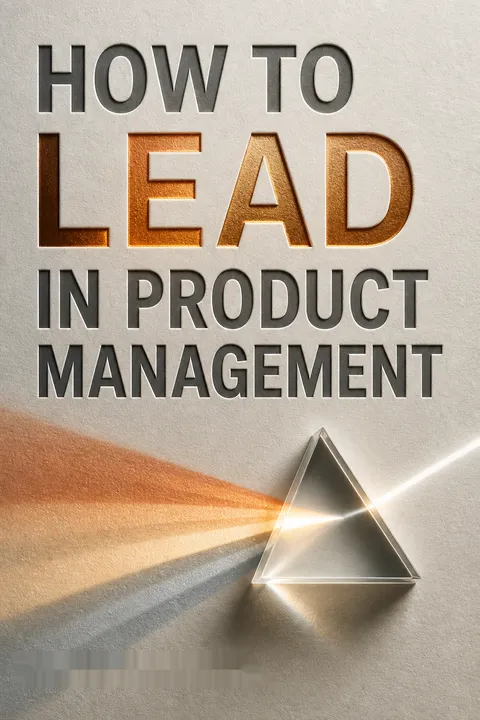


Key Takeaways
Lead through trust when your title cannot make people comply
Influence starts with listening. Product leaders rarely control the people they depend on. They cannot assign work or reward colleagues, yet they must align designers, developers, sales, marketing, and other stakeholders while also contributing to product decisions themselves. The book’s Behavioural Change Stairway Model describes a route to influence: listen actively, understand the other person’s perspective, build trust, and only then try to influence action. The author connects this sequence to FBI hostage negotiation, where understanding a person is more useful than trying to overpower them.
Care is a working skill. Empathy means taking another person’s feelings and needs seriously, not agreeing with every idea or avoiding difficult feedback. Product expertise and a senior management sponsor also matter: goodwill cannot compensate for weak judgment or a role the organization does not recognize.
The argument recasts authority as a relationship rather than a job title. That is especially useful in matrix organizations, where work depends on cooperation across reporting lines. Trust can make disagreement safer, which improves the information available for decisions. Still, relational skill cannot repair every structural problem. If a product leader lacks decision rights, staffing support, or access to executives, the organization must address those constraints rather than expecting empathy to carry the whole burden.
Match your leadership style to the team's readiness and the situation
There is no universal style. A new team that has never refined a product backlog may need clear instructions and examples. A cohesive, experienced team may do better with delegated decisions and room to experiment. The same leader may need to inspire a group at a product launch, coach it through a learning gap, or be more directive when agreed commitments repeatedly go unmet.
Adapt without abandoning standards. Product leaders should notice the group’s experience, trust, and cohesion, as well as the organization’s culture and current pressures. Ask people whether the guidance is helping, and use retrospectives to adjust. Empathy does not mean excusing repeated failures. It means hearing the reasons, stating the effect plainly, and holding people accountable without blame or intimidation.
This resembles situational leadership: support and direction change with a team’s capability and context. Its strength is that it treats leadership as a response to real conditions, not a fixed personality type. The risk is that frequent shifts can feel unpredictable. A leader can reduce that risk by keeping principles stable, such as respect, transparency, and clear accountability, while explaining why the amount of direction is changing.
Build a stable product community instead of managing stakeholders one by one
Turn contacts into collaborators. One-to-one persuasion makes the product person a go-between and hides disagreements between stakeholders. A more durable approach is to form a stable group that sets goals, reviews strategy, and learns to work together. The power-interest grid helps decide whom to involve: high-power, high-interest players are close partners; high-interest, low-power subjects can be allies; high-power, low-interest context setters need consultation; and the less involved crowd generally needs updates.
Give teams real ownership. The development team should have the skills to build and test the product, remain stable long enough to develop trust, and help shape solutions rather than merely receive detailed instructions. A Scrum Master supports process, collaboration, and team self-organization. That role should not quietly become backlog management or team supervision, which belong elsewhere.
The shift from individual stakeholder management to a community changes the quality of the information people share. Shared discussion makes trade-offs visible and reduces the chance that a private promise undermines a public decision. The grid is a useful starting map, not a permanent label: interest and influence can change with a product decision. Stable groups also require deliberate inclusion, especially when remote work, turnover, or unequal seniority makes some voices easier to miss.
Connect every sprint to user value, business viability, and an ethical vision
Link purpose to delivery. The book connects four levels of product goals: an inspiring vision, measurable user and business goals, nearer-term product goals, and short sprint goals. The vision offers direction without prescribing a particular solution. User and business goals describe the value sought; product goals translate that strategy into benefits over roughly two to six months; sprint goals focus the next one to four weeks. Progress at the tactical level should also update higher-level assumptions.
Start with the user, then test the business. A product must create enough business value to remain viable, but a business model that harms users is not a sound success. The book warns that engagement tactics used to sell advertising or collect data can undermine well-being. Goals should be shared, measurable where possible, realistic, and ethical, not targets that drive teams into chronic overtime or reward harmful design.
The linked goals work like a feedback system: strategy gives local work direction, while user evidence can correct strategy. This is stronger than treating a roadmap as a fixed promise. The caution is that measurable targets can become substitutes for the outcomes they are meant to represent. A team can improve a metric while degrading the user experience. Combining quantitative indicators with user research and explicit ethical review helps expose that gap.
Listen beneath requests before answering, persuading, or saying no
Hear more than the words. Effective listening attends to facts, feelings, and needs. A stakeholder asking for a feature may be worried about a sales commitment; a developer resisting ownership may fear being punished for initiative. Open questions, paraphrasing, and patient silence help uncover what is behind the request. The book contrasts this with selective listening, where someone hears mainly what confirms an opinion already formed.
Speak with care and clarity. Its Right Speech guidance asks whether a message is well-intended, true, useful, kind, and timely. Saying no can still be direct: acknowledge the request, explain the constraint, and ask what problem the person is trying to solve. This does not guarantee agreement, but it keeps a rejected proposal from becoming a rejected person.
Listening for motives is a practical way to distinguish a proposed solution from the need it is meant to serve. That distinction creates more options: the requested feature may be impossible now, while the underlying customer or sales concern may have another answer. There is a limit, however. A product leader should not treat every demand as a hidden emotional puzzle. Sometimes the request is simply incompatible with strategy, and a clear, respectful refusal is the most useful response.
Resolve conflict by uncovering needs, not proving who is right
Disagreement is not the enemy. Conflict becomes damaging when people compete to win, assume the other person is wrong, jump straight to analysis, assign blame, or pretend that harmony has been restored. In a product strategy meeting, two people may argue over user retention versus customer acquisition. Their positions differ, but their underlying concerns may include recognition, security, or confidence that the product can succeed.
Use a four-part conversation. Non-violent communication, or NVC, moves through observations, feelings, needs, and requests. Describe what happened without labels, explain the emotion it brought up, identify the need beneath it, then ask for a specific action. Listen to the other person’s account as carefully. If either party will not cooperate, or the issue involves serious misconduct, a mediator, manager, or HR may be needed; dialogue alone is not always enough.
The framework can interrupt the familiar cycle in which accusation produces defensiveness and defensiveness produces counterattack. Naming needs often reveals common ground without requiring either side to pretend that the disagreement was trivial. Yet NVC should not imply equal responsibility in every dispute. Differences in power, harassment, or deliberate misconduct require protection and accountability, not just mutual understanding. The method is best understood as a tool for resolvable conflicts, not a universal remedy.
Choose decision rules before debate, then separate idea generation from judgment
Make authority explicit. A decision rule states who decides and how agreement is recognized. Unanimity seeks active support from everyone; consent means nobody has a serious objection; majority voting is fast but can leave a frustrated minority; the product person can decide after discussion; low-impact choices can be made alone; and decisions can be delegated to better-qualified people. High-impact strategy changes call for broader participation than routine backlog choices.
Give thinking room. For complex decisions, first gather different views, then build shared understanding of people’s concerns, and only then develop or test options. This prevents early criticism from silencing useful ideas. If evidence is insufficient, experiment rather than argue indefinitely. The last responsible moment is the point when delaying a decision has become more costly than keeping options open. It helps balance timely action with learning.
A stated rule exposes power that otherwise hides inside meeting habits, such as treating silence as consent or letting the most senior voice prevail. Separating idea generation from evaluation also protects minority perspectives long enough for the group to understand them. Participation is not automatically wise, though. Unanimity can stall, and group discussion can reinforce conformity. Clear decision ownership, time limits, and reversible experiments keep inclusion from becoming paralysis.
Notice your inner state before it becomes the team's next problem
Awareness creates a pause. Mindfulness here means noticing present thoughts, feelings, and moods without trying to suppress them or treating them as objective facts. The author describes saxophone practice: when tense, he grips the keys too tightly and becomes harshly self-critical; noticing the tension helps him understand why the same exercise feels harder. In a work conversation, noticing anger or anxiety can similarly prevent an impulsive reply.
Review, learn, and reset. A weekly personal retrospective can take about thirty minutes: review what happened, how energy and mood changed, what was learned, and one or two realistic adjustments. Journaling or brief meditation can make patterns easier to see. A growth mindset treats mistakes as information for improvement, while self-compassion makes it possible to acknowledge a mistake, apologize, and learn without defining oneself by the failure.
Self-observation creates a small distance between an emotion and the action it might otherwise trigger. That capacity supports better listening and less reactive decision-making, especially under pressure. The book’s practices are deliberately modest, which makes them more plausible than a promise of constant calm. Still, reflection cannot neutralize a punishing workload or unhealthy culture. Personal awareness is valuable, but it should not turn organizational failures into an individual’s self-improvement assignment.
Protect strategic work and recovery from the tyranny of urgent tasks
Urgency can hide neglect. The Eisenhower Matrix sorts work by urgency and importance. Product incidents and deadlines may demand immediate attention, while discovery, strategy, stakeholder relationships, and skill development are important but less urgent. If those activities are repeatedly displaced, competitors or changing user needs can catch the product off guard. The book recommends protecting regular time for this work, roughly half a day as a rule of thumb.
Make the job sustainable. Choose one meaningful daily outcome, avoid constant task switching, timebox routine email, delegate work that others can own, and take proper breaks. Product people should also avoid carrying Scrum Master responsibilities indefinitely: overwork can crowd out discovery and harm health. Sustainable pace is not a perk reserved for developers. It is a condition for clear judgment, creativity, and reliable leadership.
This is an argument about portfolio management at the level of one person: attention is a scarce resource, and today’s urgent work can consume tomorrow’s strategic capacity. Protected time makes prevention visible on the calendar instead of merely admirable in principle. The caveat is that individual scheduling cannot fix chronic understaffing or a culture that punishes boundaries. Leaders and sponsors must treat capacity as an organizational constraint, not a private productivity puzzle.
Analysis
The book’s central contribution is to treat product leadership as the coordination of people who do not report to one person, rather than as an expanded form of product administration. Its practices form a coherent sequence: build trust, create shared goals, listen for perspectives and needs, choose an explicit decision process, and preserve enough personal capacity to keep doing this work well. The product leader is neither a command-giver nor a passive facilitator. The role combines direction, expertise, negotiation, and restraint.
That combination is especially relevant in agile work. Team autonomy can be mistaken for leaderlessness, while product ownership can be mistaken for permission to dictate implementation. Pichler draws a useful boundary: the product person guides value and priorities, while the development team owns how work is carried out. The boundary is not always clean, but making it discussable is better than letting authority emerge through interruption, private deals, or informal status.
The strongest practical insight is that collaboration requires structure. Empathy by itself does not align a group. Goals, stable membership, meeting facilitation, role clarity, and decision rules turn good intentions into repeatable ways of working. Likewise, conflict is not productive merely because people disagree; it becomes useful when participants can surface assumptions and remain accountable to shared outcomes.
The approach also has limits. It assumes that many disagreements can be addressed through good-faith conversation, although organizations sometimes contain entrenched power imbalances or incentives that reward harmful behavior. The book acknowledges escalation for serious or unresolved problems, but readers should keep that boundary central. Communication skill cannot substitute for authority, staffing, or protection from misconduct.
Ultimately, the book presents leadership as a feedback loop between product and people. User evidence informs strategy, strategy frames team work, and team experience revises plans. The leader’s task is to keep that loop honest, humane, and sustainable, not to make every decision alone or make every stakeholder happy.
Review Summary
How to Lead in Product Management receives generally positive reviews, with readers praising its practical advice on soft skills and leadership in product management. Many find it valuable for both new and experienced product managers, highlighting its focus on interpersonal skills, stakeholder alignment, and team guidance. Some reviewers note that parts of the content may be familiar to those who have read the author's previous works. While most appreciate the book's mix of theory and practical tips, a few felt it could have delved deeper into certain topics.
People Also Read






Glossary
Behavioural Change Stairway Model
A route from listening to influenceA sequence for influencing another person that begins with active listening, develops empathy and rapport, and only then attempts influence and behavioral change. The central point is that persuasion is more likely to work when the other person first feels understood and trusts the relationship. The sequence is presented as gradual, not as a set of steps to skip.
Power-interest grid
A map for stakeholder involvementA stakeholder analysis tool that groups people according to their level of power over a product and their interest in it. High-power, high-interest players are close collaborators; high-interest, lower-power subjects can be allies; high-power, lower-interest context setters should be consulted; and people with lower power and interest generally need information. The map guides engagement rather than fixing people permanently in one category.
Chain of goals
Linked goals from vision to sprintA hierarchy connecting a product vision to user and business goals, product goals, and sprint goals. The vision gives broad direction, strategic goals define the value sought, product goals break that direction into nearer-term outcomes, and sprint goals focus immediate work. Progress and evidence at lower levels can require changes to higher-level goals, so the links need regular review.
Non-violent communication
A needs-centered conflict conversationA framework for addressing conflict through four elements: describe observations without judgment, identify and express feelings, uncover the needs behind them, and make a clear request. The speaker also listens for the other person’s observations, feelings, needs, and requests. Its purpose is to replace blame and demands with understanding and workable agreements, not to guarantee that every disagreement can be resolved.
Right Speech
A guide for careful communicationA Buddhist teaching applied in the book to workplace communication. Before speaking, consider whether the message has a constructive intention, is truthful, is beneficial to the listener, avoids harmful or harsh language, and is being delivered at an appropriate time and through a suitable channel. The guidance does not require avoiding difficult truths; it asks that they be expressed responsibly.
Last responsible moment
The sensible point to decideThe point at which the cost of delaying a decision becomes greater than the benefit of waiting for more information or keeping options open. It helps teams avoid both premature commitment and harmful procrastination. For example, delaying a product strategy change may yield better data, but waiting too long could allow user engagement or market position to deteriorate.
Sustainable pace
Work people can maintainA way of organizing work so that sponsors, developers, users, and product leaders can continue at a steady rate without routinely sacrificing health, quality, or creativity. In practice, it means setting realistic workloads, respecting team capacity, protecting recovery time, and avoiding repeated overtime. The book stresses that the principle applies to product people as well as development teams.
About the Author

Download PDF
Download EPUB
.epub digital book format is ideal for reading ebooks on phones, tablets, and e-readers.








