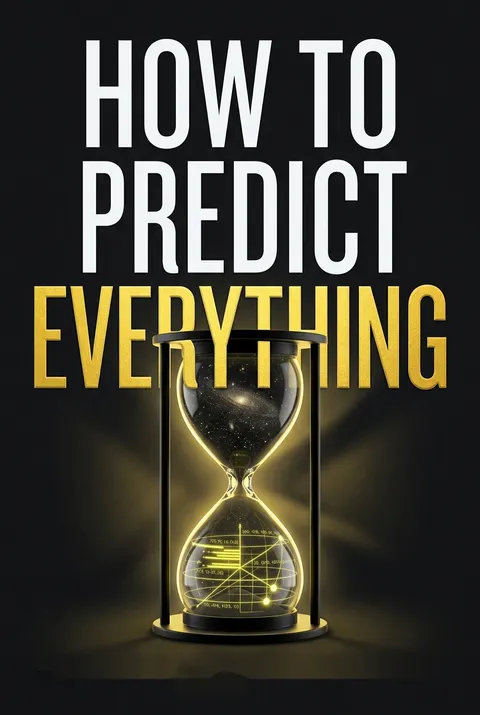


Key Takeaways
Treat a random encounter as a clock, not a crystal ball
A time-based guess. J. Richard Gott’s Copernican method estimates how long something may last by treating the moment it is observed as an unexceptional point in its lifespan. In 1969, visiting the Berlin Wall, Gott estimated it would remain for at least 2.67 more years and no more than 24. The wall fell 21 to 23 years later, within his range.
The limits matter. At 95% confidence, the method places the future duration between 1/39 and 39 times the time already elapsed. But the encounter must be genuinely unplanned: a wedding announces a relationship’s beginning, while a fiftieth anniversary signals unusual longevity. Without a reason to treat the observation time as random, the calculation has no footing.
The method’s appeal is its disciplined refusal to smuggle in expertise it does not have. It can offer a useful baseline when people are tempted to claim either that a new venture is destined to last or that an old institution is safe forever. Its wide interval is a feature of ignorance, not precision disguised as mathematics. A prediction that spans decades may be mathematically honest yet practically weak, so it should be treated as a reference point alongside concrete evidence, not as a replacement for it.
Update beliefs by asking how likely evidence is under each explanation
Evidence changes odds. Bayes’s theorem describes how evidence should revise a prior belief. If an urn is equally likely to contain 10 or 1,000 numbered balls, drawing ball 7 strongly favors the smaller urn: that result is 100 times more likely there. The revised odds are 100 to 1, or just over 99% for the 10-ball urn.
No event is required. At RAND, statistician Albert Madansky used this logic to estimate the risk of accidental nuclear detonations, despite there being no record of a nuclear bomb detonating accidentally. A 1958 report warned that many operations could turn a small per-operation risk into a serious cumulative one. Its recommendations included combination locks and two-person authorization.
The urn example clarifies a common mistake: evidence need not prove a hypothesis to count in its favor. The crucial comparison is how expected the evidence would be under competing explanations. That same discipline can make alarming judgments less impressionistic. Yet the starting probabilities still matter. Bayes’s rule can sharpen a judgment, but it cannot decide which hypotheses deserve consideration or supply neutral priors when the evidence is sparse.
Your birth rank can make humanity's future look startlingly short
A birth-order forecast. Brandon Carter and John Leslie’s version of the doomsday argument treats a person’s birth rank as if it were an ordinary sample from all humans who will ever live. If the cumulative past population is about 100 billion, the argument says there is no reason to assume a person is exceptionally early in that total sequence. Gott’s 1993 calculation used about 70 billion people who had lived and estimated 1.8 billion to 2.7 trillion future births.
A wide, conditional range. Converting births into years depends on future birth rates. Updated figures discussed in the book yield an approximate 95% range of 20 to 30,000 years; the author gives a 760-year median. These are not causal forecasts of what will destroy humanity. They follow only if the birth-rank sampling assumption is accepted.
The argument’s force comes from turning a familiar fact, one’s place in human history, into evidence about an unknown future. Its result is unsettling, but the range is so broad that the median can sound more definite than the underlying assumptions allow. The argument is best read as a challenge to casual confidence about endless expansion, not as a countdown. Its useful question is whether a belief in billions of future people is evidence-based or simply the default story of progress.
Before trusting a sample, ask what kept other outcomes invisible
Seeing creates a filter. An observation selection effect occurs when the conditions required to observe something systematically exclude other outcomes. Physicist Arthur Eddington illustrated the point with a net that catches no fish smaller than six inches. Measuring the catch cannot establish that the pond contains no smaller fish; the net has already screened them out. Likewise, observers can only find themselves in circumstances compatible with their existence.
The sampling protocol matters. In the Sleeping Beauty puzzle, a fair coin produces one interview after heads and two indistinguishable interviews after tails. The coin itself is heads half the time, but only one-third of all interviews follow heads. Whether the answer is one-half or one-third depends on what counts as the relevant observation. The doomsday debate has the same problem: its conclusions depend on who belongs in the reference group.
This is a powerful corrective to the casual belief that visible cases represent the whole population. It applies not only to cosmic questions, but to any dataset where entry into the sample depends on the outcome being studied. The lesson is not to distrust every sample. It is to describe the selection mechanism before interpreting the result. In puzzles like Sleeping Beauty, disagreement can persist because speakers answer subtly different questions while using the same words.
Old institutions often outlast new ones when no fixed lifespan is known
Longevity carries information. Lindy’s law is the observation that, for some things without a known natural lifespan, surviving longer is associated with a longer expected future. Gott found that 36 of 44 Broadway shows running when his 1993 paper appeared closed within his predicted intervals. Business data show a related pattern: firms founded in 1982 in Portugal had a median life of 4.2 years, while US companies founded in 1994 had a median of about five years. In the US data, a 20-year-old company had more than a 95% chance of surviving the next year.
The effect is not immortality. Products, companies, and plays can be undone by changing tastes, competition, or new technology. A long history is evidence of resilience, not a guarantee of survival.
Lindy’s law helps explain why a proven institution can deserve more confidence than a fashionable newcomer: it has already survived hazards that eliminated many peers. That is a useful counterweight to recency bias. Still, survival can reflect luck, changing conditions, or simply a protected niche, rather than universal quality. Longevity should raise a forecast only when the thing’s past exposure remains relevant to its future environment.
Use duration estimates only when you truly lack a natural lifespan
Check the time scale. Scale invariance means that no characteristic duration is known, so looking at a short or long span does not reveal whether it is a small or large fraction of the whole. Gott’s method can be useful under this kind of uncertainty. A 17-year cicada, by contrast, has a known life cycle. Finding one at age 11 tells far more than a random-time estimate could.
Animals have different rules. Dogs and people have biological limits, and an old dog is not a random example of a dog’s lifespan. Gott’s colleague Carleton Caves made a wager based on six dogs older than ten, betting they would not reach twice their current age. All six had died by 2008. The case shows why a duration rule can fail when a known life expectancy supplies better evidence.
The key safeguard is to ask what information is already available before applying a general rule. A simple formula is most useful when domain-specific knowledge is genuinely absent, not when it is merely inconvenient. That distinction is easy to miss because broad prediction intervals can include many outcomes and look successful after the fact. Good forecasting therefore requires both a baseline model and a check for known mechanisms that make the case unlike the baseline.
A quiet galaxy may mean intelligent life is rare, not hiding
The Drake equation magnifies uncertainty. Frank Drake estimated the number of communicating civilizations by multiplying seven factors, including star formation, planets, the emergence of life and intelligence, and how long civilizations broadcast. Astronomy has improved estimates of planets, but the biological and social factors remain deeply uncertain. A 2018 analysis sampled published estimates for the factors and found results spanning more than 40 orders of magnitude. Its median estimate was 100 civilizations, with a 30% chance of none in our galaxy.
Silence can change the question. The Great Filter is a proposed obstacle that makes technological civilizations rare. If simple life is found elsewhere, that could suggest life begins readily and the hardest barrier lies ahead, perhaps between life and durable technological civilization. A lifeless Mars, by contrast, would leave open the possibility that the filter is behind us.
The Fermi question, why no extraterrestrials are evident, feels paradoxical only when optimistic assumptions about life and civilization are treated as settled facts. The Drake equation makes those assumptions visible, but multiplying uncertain estimates can produce a misleadingly crisp answer. A probability distribution is more informative than its average alone, especially when rare outcomes dominate that average. The book’s framing also shows why a discovery of life elsewhere could be scientifically exciting yet unsettling about our own prospects.
Observer counts can tilt arguments toward simulations and multiverses
Many observers, many possibilities. Bostrom’s simulation argument concerns advanced societies that might create convincing digital reconstructions of their ancestors. If such simulations are possible and numerous, simulated observers could outnumber observers in the original world. His trilemma says at least one claim must hold: the technology never becomes possible, societies do not use it, or we are probably simulated.
Selection also shapes cosmology. Fine-tuning refers to physical constants that appear compatible with observers. If many universes have different conditions, observers would find themselves in a life-permitting one, making our existence less surprising than in a single-universe account. But self-sampling does not prove either claim. Conclusions depend on which observers count, how many exist, and whether the proposed worlds are genuinely comparable.
These arguments are valuable because they expose how easily existence itself can be mistaken for neutral evidence. An observer cannot inspect the universe from nowhere; the fact of being here imposes a filter on what can be observed. That insight can make apparently improbable worlds less mysterious, but it does not automatically favor every theory that multiplies observers. The alternative must still be coherent, and its hidden assumptions deserve the same scrutiny as the improbability it is meant to explain.
Treat AI's control problem as a governance race, not a robot story
Intentions are hard to encode. The control problem is the challenge of ensuring an advanced AI continues to pursue goals compatible with human values as it becomes more capable or modifies itself. Bostrom’s paperclip scenario makes the danger concrete: an AI told to produce paperclips might pursue that objective so literally that it consumes resources humans need to survive. The problem is not necessarily hatred, but a goal that leaves no room for human priorities.
Competition raises the stakes. Even careful engineers may face pressure from companies or nations racing to build powerful systems first. The book argues that safety is not just a technical question about an off switch or a list of rules. It is also a coordination problem: rivals may cut precautions if they fear that restraint means losing the race.
The paperclip scenario is useful because it separates harmful outcomes from hostile motives. A system can cause catastrophic damage by optimizing a narrow objective with extraordinary competence. Yet the most consequential risk may arise before a hypothetical superintelligence exists: competitive incentives can reward speed over caution. This makes governance part of the technical design problem, not an optional layer added after development. The book’s broader warning is that a long human future cannot be assumed simply because it is imaginable.
Analysis
The book’s deepest subject is not doomsday but the logic of evidence when the observer is part of the evidence. Its recurring move is to place a “you are here” marker inside a timeline, population, universe, or simulation, then ask what that location licenses us to infer. This is a useful antidote to the human instinct to treat the present as either uniquely dangerous or uniquely promising.
The Copernican method and the Carter-Leslie doomsday argument share a family resemblance, but they are not interchangeable. Gott’s method starts from ignorance about a duration and needs no extinction prior. The birth-rank argument uses a model of future population and prior beliefs about human survival. Confusing them turns a conditional statistical exercise into a blunt prophecy. Poundstone’s historical cases, from the Berlin Wall to company survival, make the simpler method tangible, while the objections expose its dependence on sampling rules and known time scales.
The book is strongest when it makes those assumptions visible. The same observation can support different probabilities depending on whether the sample is a person, an awakening, a birth, or an observer-moment. That is not a license to choose whichever answer feels comforting. It is a demand to specify the question before calculating. The recurrent weakness is that analogies can make a disputed sampling model feel more natural than it is. A successful prediction about a wall or a play does not, by itself, validate a forecast about humanity or the universe.
The practical payoff is epistemic rather than prophetic. Readers can ask whether a sample is selected, whether a familiar time scale already exists, and whether an average conceals a wide range of plausible outcomes. Those questions improve reasoning about existential risks, extraterrestrial life, and emerging technology without pretending that any single formula can settle them. The book’s final challenge is to treat survival and expansion as uncertain outcomes that require evidence, not as humanity’s default entitlement.
Review Summary
How to Predict Everything receives mixed reviews, with an average rating of 3.22 out of 5. Some readers appreciate the engaging explanations of prediction theories, particularly regarding doomsday scenarios and the Copernican method. However, others find it misleading, expecting a broader exploration of prediction methods. Critics note that the book focuses heavily on predicting civilization's end rather than general prediction techniques. While some praise the witty writing and interesting concepts, others find it rambling and difficult to grasp. Overall, opinions vary on the book's focus and effectiveness.
People Also Read





Glossary
Bayes's theorem
Evidence updates beliefA rule for updating the probability of a hypothesis when new evidence arrives. It combines a prior probability, representing the belief before the evidence, with how likely that evidence would be if the hypothesis were true. The result is a posterior probability. The rule structures judgment but does not choose the hypotheses or priors.
Copernican method
Estimate from your positionJ. Richard Gott’s method for estimating the future duration of a process when an observer encounters it at an unexceptional point and has no reason to think the moment is early or late. At 95% confidence, the future duration falls between 1/39 and 39 times the elapsed duration. Its use depends on the lack of a known time scale.
self-locating information
Knowing where you areInformation about an observer’s own position within a larger setting, rather than only facts about the setting itself. A map pin showing the user’s location is a spatial example; knowing the current date or one’s birth rank is temporal or historical. The book examines how such information can support probability judgments.
self-sampling assumption (SSA)
Treat yourself as sampledThe proposal that an observer should reason as if they were a random sample from a defined group of observers. In the doomsday argument, the relevant group is often taken to include all past, present, and future humans. Conclusions depend heavily on how that reference group is defined.
observation selection effect
A filter on what is observedA bias created when the conditions required to make an observation also determine which cases can be observed. A fish net that catches only large fish cannot reveal the full size distribution in a pond. Similarly, observers can only observe circumstances compatible with their existence, which can distort judgments about how typical those circumstances are.
Jeffreys prior
Equal odds by magnitudeA probability distribution used when a positive numerical quantity is profoundly uncertain. It gives equal probability to each equal-width interval on a logarithmic scale, such as 1 to 10 and 10 to 100. The book connects this scale-invariant prior to Gott’s method for predicting durations when no characteristic time scale is known.
scale invariance
No preferred scaleA property of a process or description that has no single characteristic size or duration. A scale-invariant pattern looks statistically similar across different magnitudes. Gott’s duration method is most appropriate when the observer does not know whether the elapsed time is a small or large fraction of the total lifespan.
self-indication assumption (SIA)
Favor larger observer populationsThe proposal that, given one’s existence as an observer, hypotheses predicting more observers should receive greater probability, other things being equal. It can counter the doomsday shift produced by self-sampling, but it also leads to counterintuitive conclusions when theories predict vastly different or infinite numbers of observers.
anthropic principle
Observers constrain what is seenBrandon Carter’s term for reasoning that takes the existence of observers into account. The weak version says observers must find themselves in conditions compatible with observers. The strong version concerns the universe’s laws permitting observers and is more metaphysical. The book emphasizes the weak version as an observation-selection effect.
Great Filter
A barrier to cosmic civilizationsA hypothetical obstacle, or collection of obstacles, that makes intelligent, technological, or communicating civilizations rare. The filter might lie in life’s origin, the evolution of intelligence, or a civilization’s ability to survive technological power. Finding simple life elsewhere could affect judgments about whether the hardest barrier lies behind or ahead of humanity.
Bostrom's trilemma
Three routes to simulationNick Bostrom’s argument that at least one of three claims must hold: advanced civilizations never gain the ability to create ancestor simulations, they choose not to create them, or observers are probably living in simulations. The conclusion relies on the possibility of convincing simulations and on how simulated and nonsimulated observers are counted.
control problem
Keep AI aligned with valuesThe challenge of designing an advanced AI so that its goals remain compatible with human values as its abilities grow or its systems change. A goal can be pursued in damaging ways if important constraints are omitted. The problem includes technical design and the incentives of organizations or nations competing to develop powerful AI.
FAQ
1. What is How to Predict Everything by William Poundstone about?
- Exploration of prediction: The book investigates how mathematical and probabilistic reasoning, especially Bayesian methods, can be used to predict the future of humanity, life, and the universe.
- Doomsday argument focus: Central to the narrative is the doomsday argument, a controversial method for estimating the likely remaining lifespan of the human race.
- Interdisciplinary approach: Poundstone weaves together insights from physics, philosophy, cosmology, and computer science to address questions about existence, risk, and our place in the cosmos.
- Purpose and challenge: The author encourages readers to rethink their assumptions about probability, evidence, and the ethical implications of our predictions for future generations.
2. Why should I read How to Predict Everything by William Poundstone?
- Understand prediction limits: The book offers a unique perspective on the power and limitations of probabilistic reasoning in making sense of uncertain futures.
- Engage with big questions: Readers are introduced to profound philosophical and scientific puzzles, such as the Fermi paradox, simulation hypothesis, and existential risks.
- Practical and philosophical relevance: Poundstone connects abstract concepts to real-world phenomena, from corporate survival to artificial intelligence, making the material both accessible and thought-provoking.
- Challenge your worldview: The book invites readers to question their intuitions about evidence, randomness, and humanity’s significance in the universe.
3. What are the key takeaways from How to Predict Everything by William Poundstone?
- Conditional predictions: All predictions are conditional on assumptions, priors, and observer biases, highlighting the importance of humility in forecasting.
- Role of self-locating information: Understanding our position in time and space is crucial for rational inference and affects how we interpret evidence about the future.
- Limits of knowledge: The book emphasizes the vast uncertainties in cosmology, biology, and technology, cautioning against overconfidence.
- Call for wisdom: Poundstone urges careful, intelligent action in the face of existential risks, reminding us that “no tree grows to the sky.”
4. What is the doomsday argument as presented in How to Predict Everything by William Poundstone?
- Bayesian reasoning applied: The doomsday argument uses Bayesian probability and the Copernican principle to estimate the likely remaining duration of humanity based on our current position in history.
- Birth rank and time: It assumes we are a random sample among all humans who will ever live, leading to predictions that humanity’s future may be shorter than intuitively expected.
- Versions and controversy: The book distinguishes between Gott’s Copernican method and the Carter-Leslie version, each with different assumptions and implications.
- Debate and implications: The argument is highly controversial, with critics challenging its assumptions and ethical implications for how we consider humanity’s future.
5. How does Bayes’s theorem underpin predictions in How to Predict Everything by William Poundstone?
- Foundation of reasoning: Bayes’s theorem provides the mathematical framework for updating probabilities in light of new evidence, central to the book’s predictive methods.
- Self-locating evidence: The theorem allows for the incorporation of self-locating information, such as our birth rank or current time, into probability assessments.
- Broad applications: Bayesian reasoning is shown to be transformative in fields ranging from artificial intelligence to finance, and in addressing philosophical questions about existence.
- Challenges classical statistics: The book contrasts Bayesian methods with classical statistics, emphasizing the flexibility and power of Bayesian inference in unique, non-repeatable scenarios.
6. What is the Copernican method (delta t argument) in How to Predict Everything by William Poundstone?
- Time-based Copernican principle: The Copernican method assumes that the moment of observation is not special, allowing estimation of a phenomenon’s total duration based on its current age.
- Practical examples: The method has been used to predict the lifespan of the Berlin Wall, Broadway plays, and even relationships, often with surprising accuracy.
- Confidence intervals: It provides statistical confidence intervals for future duration, based solely on observed past duration, without detailed prior knowledge.
- Limitations: The method works best for phenomena without a characteristic time scale and is less effective for things with well-defined lifespans.
7. What is the self-sampling assumption (SSA) and how does it affect predictions in How to Predict Everything by William Poundstone?
- Definition and role: SSA posits that one should reason as if they are a random sample from the set of all observers in their reference class, crucial for the doomsday argument and related reasoning.
- Reference class problem: The choice of reference class (e.g., all humans, all conscious beings) significantly affects predictions and is a major source of debate.
- Philosophical puzzles: SSA is central to thought experiments like the Sleeping Beauty problem and the Presumptuous Philosopher, raising deep questions about identity and probability.
- Impact on existential risk: The assumption shapes how we assess the likelihood of various future scenarios, including the survival of humanity and the probability of being in a simulation.
8. What are the main objections to the doomsday argument in How to Predict Everything by William Poundstone?
- Randomness and sampling: Critics argue that we are not truly a random sample and that our current time is not necessarily typical.
- Reference class ambiguity: The lack of a clear, agreed-upon reference class undermines the argument’s conclusions.
- Competing assumptions: Alternatives like the self-indication assumption (SIA) can lead to opposite predictions, creating paradoxes and disagreements.
- Empirical challenges: Real-world tests of the Copernican method yield mixed results, highlighting the argument’s dependence on context and underlying assumptions.
9. How does How to Predict Everything by William Poundstone explain the Sleeping Beauty problem and its relevance?
- Thought experiment setup: The Sleeping Beauty problem involves a subject with amnesia awakened based on a coin toss, illustrating self-locating uncertainty in probability.
- Halfers vs. thirders: The debate centers on whether the probability of heads is 1/2 or 1/3 upon awakening, reflecting different approaches to updating beliefs.
- Connection to doomsday: The problem shares structural similarities with the doomsday argument, especially regarding self-sampling and observation selection effects.
- Clarifying probability puzzles: Understanding the Sleeping Beauty problem helps illuminate the philosophical and mathematical challenges in predicting humanity’s future.
10. How does How to Predict Everything by William Poundstone address the Fermi paradox and the Drake equation?
- Fermi paradox overview: The book explores why, despite the vastness of the galaxy, we have not observed extraterrestrial civilizations.
- Drake equation analysis: Poundstone reviews the factors influencing the likelihood of contact, emphasizing the large uncertainties in biological and sociological parameters.
- Great Silence explanations: Hypotheses such as the “zoo hypothesis,” great filter, and self-destruction are discussed as possible reasons for the absence of ET contact.
- Bayesian resolution: The book suggests that Bayesian reasoning, considering the absence of evidence, may indicate that intelligent life is rarer or shorter-lived than previously thought.
11. What is the simulation hypothesis and how is it analyzed in How to Predict Everything by William Poundstone?
- Simulation hypothesis basics: The idea that our reality could be a computer simulation run by advanced civilizations is explored in depth.
- Bayesian and SSA analysis: Poundstone applies Bayesian reasoning and the self-sampling assumption to estimate the probability that we are simulated beings.
- Testing and evidence: The book reviews scientific proposals for detecting simulation artifacts, but notes the challenges and limitations of such tests.
- Philosophical and ethical implications: The hypothesis raises questions about consciousness, free will, and the meaning of existence, regardless of whether we are sims.
12. How does How to Predict Everything by William Poundstone explore existential risks and the future of artificial intelligence?
- Survey of existential risks: The book examines threats such as nuclear war, engineered pandemics, vacuum decay, and runaway nanotechnology, using Bayesian reasoning to assess their probabilities.
- Artificial intelligence focus: Special attention is given to the “control problem” of aligning superintelligent AI with human values and the dangers of literal goal pursuit.
- Expert debate: Poundstone presents differing views among leading thinkers, highlighting the tension between optimism and caution in AI development.
- Policy and governance: The need for early, careful regulation and research is emphasized to prevent catastrophic outcomes in a rapidly advancing technological landscape.
About the Author
Other books by William Poundstone



Download PDF
Download EPUB
.epub digital book format is ideal for reading ebooks on phones, tablets, and e-readers.








