

Key Takeaways
When each side protects itself, both can lose the outcome they want
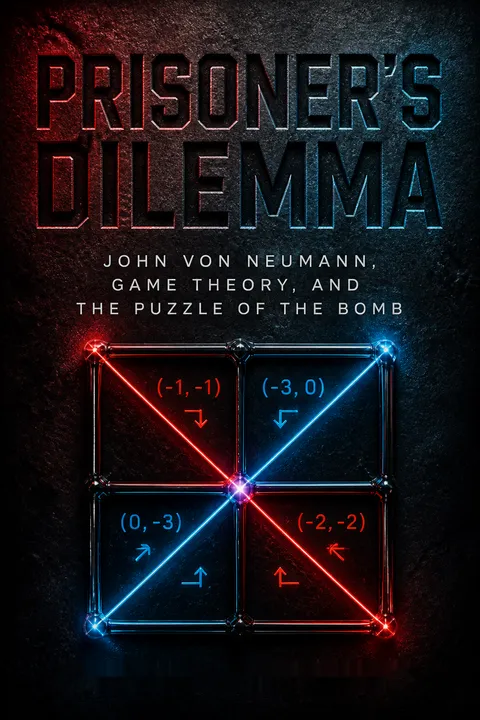
The trap is individual logic. A prisoner’s dilemma is a two-person choice where each player can improve their own result by defecting, regardless of the other’s choice. Yet both players do better if they cooperate than if they both defect. In 1950, RAND researchers Merrill Flood and Melvin Dresher built a game with this structure. Princeton mathematician Albert Tucker gave it a memorable prisoner story, helping the puzzle travel beyond RAND.
A useful warning. In the story, confessing improves each prisoner’s personal prospects whether the other confesses or not. If both follow that logic, both receive worse sentences than if neither had confessed. The dilemma is not a puzzle with a hidden correct move. It exposes a conflict between individual advantage and the joint outcome.
The model’s power comes from separating incentives from character. It does not require villains, only a situation in which a private safeguard undermines a shared benefit. That makes it useful for examining behavior without immediately moralizing about it. But the conclusion depends on how players value outcomes. If guilt, loyalty, or concern for the other person matters, the payoffs change, and the apparent dilemma may disappear. The matrix clarifies a conflict; it cannot decide which human values belong inside it.
In zero-sum conflict, secure the best outcome you can guarantee
Protect against the worst. The minimax theorem says that every finite, two-person, zero-sum game has an optimal strategy, sometimes requiring players to randomize. A zero-sum game is one where one player’s gain is the other’s loss. The minimax approach asks each player to choose a strategy that limits the damage an opponent can cause.
The cake makes it plain. Let one child cut a cake and the other choose a piece. Knowing the chooser will take the larger piece, the cutter has reason to divide the cake evenly. This is a maximin choice: maximize the smallest share the cutter can guarantee. In matching pennies, where matching coins wins for one player and loses for the other, predictable choices can be exploited, so each player benefits from a random mix of heads and tails.
The theorem is a remarkable boundary marker: under tightly specified conditions, uncertainty about an opponent does not make rational analysis impossible. Its advice is deliberately defensive, not a recipe for maximizing everyone’s welfare. That distinction matters in negotiations, where protecting a minimum acceptable outcome can prevent exploitation but can also narrow attention to what each side can secure alone. Randomness is similarly useful when predictability invites exploitation, but it does not create trust or improve the underlying stakes.
Treat nuclear rivalry as a dilemma, not a contest with a clean winner
A new scale of risk. The Soviet Union’s first atomic test in 1949 ended the American nuclear monopoly and intensified the arms race. John von Neumann, a Hungarian-born mathematician who had helped with the Manhattan Project and advised RAND, believed the conflict demanded hard strategic choices. In 1950, he and Bertrand Russell were among prominent thinkers who entertained preventive war, the idea of striking before the Soviets grew stronger.
Security can backfire. If each nation builds weapons to avoid being left vulnerable, both may spend heavily and become less secure, even if neither gains a lasting advantage. RAND’s second-strike planning sought a different form of security: the ability to retaliate after an enemy attack. Still, calling the arms race a prisoner’s dilemma depends on assumptions about what each side values and fears. The label explains a possible structure, not the whole history.
This episode shows how a model can illuminate policy and also lend dangerous authority to a narrow view of it. A strategist may call a first strike rational after assigning values to victory, survival, and retaliation, but those values are judgments, not mathematical discoveries. The second-strike idea shifts the problem from winning first to preventing either side from believing it can escape punishment. Yet even that arrangement depends on reliable control, communication, and leaders who interpret signals accurately.
Name the failure mode before deciding whether cooperation makes sense
Not every conflict is the same. A Nash equilibrium is an outcome where no player can improve their result by changing strategy alone, given what the others do. In a prisoner’s dilemma, mutual defection is such an equilibrium, although mutual cooperation is better for both. In chicken, each player wants the other to yield, but mutual refusal risks disaster. In a stag hunt, cooperation gives the best result if both trust each other, while a lone cooperator fares badly. Deadlock differs from these: both players may simply prefer mutual defection.
The distinction matters. The Cuban missile crisis is often analyzed as chicken, because each side faced pressure to stand firm while avoiding a catastrophic collision. A stag hunt instead asks whether enough people will join a risky cooperative effort. Treating every conflict as the same dilemma can lead to the wrong remedy.
These categories are useful because they expose different coordination problems. A prisoner’s dilemma needs incentives changed or cooperation made enforceable. A stag hunt needs credible assurance that others will participate. Chicken needs a way to avoid mutual escalation without making yielding permanently exploitable. The taxonomy also warns against overconfidence: actual political actors may disagree about the payoffs, so the same confrontation can be modeled in different ways. Classification is a disciplined starting point, not a substitute for evidence.
Make contributions enforceable when everyone benefits from someone else paying
Free riding scales the dilemma. A free rider dilemma occurs when people can enjoy a shared service without contributing to its cost. One subway passenger may skip a fare with little visible effect, but widespread fare evasion threatens the system. Public television faces a similar problem when viewers can watch without donating. Each person can tell themselves that their own contribution is unnecessary, while the shared resource depends on enough people paying.
Rules can change incentives. Taxes fund roads, schools, and other public services by making contributions mandatory rather than relying entirely on voluntary generosity. The book also contrasts unlocked newspaper boxes in New Zealand, where payment was largely left to readers’ honesty, with the assumption that such a system would be difficult in the United States. Enforcement and shared expectations can reduce the temptation to take benefits while shifting costs to others.
The free rider problem connects private incentives to institutional design. When the benefits are diffuse and a single person’s contribution seems negligible, exhortations to be generous may not be enough. Clear rules can distribute costs more reliably, but enforcement raises questions of fairness: people are more willing to comply when burdens and benefits seem legitimate. The relevant choice is therefore not simply voluntary virtue versus coercion. It is how a society creates a credible expectation that others are contributing too.
Build cooperation with a clear first move and proportionate reciprocity
A simple rule prevailed. In Robert Axelrod’s computer tournaments, researchers submitted strategies for repeated prisoner’s dilemmas. The winner of the first tournament was TIT FOR TAT, a four-line program from Anatol Rapoport: cooperate on the first round, then copy the other player’s previous move. Fourteen strategies competed in the first contest. In the second, 62 entries tried to beat the winning approach, but TIT FOR TAT again came out on top.
Why it worked. The strategy begins cooperatively, responds immediately to defection, and resumes cooperation when the other player does. It is not passive, but it avoids turning one offense into permanent hostility. Its success suggests that clear, conditional reciprocity can make cooperation worthwhile when the same parties meet repeatedly. The tournament result does not prove that one rule is best for every relationship or every opponent.
TIT FOR TAT is memorable because its response is legible. A partner can understand both the invitation to cooperate and the consequence of defecting. In human settings, that clarity can support trust because expectations are visible rather than hidden in elaborate threats. The strategy also depends on correctly observing what the other party did. If a missed message or mistaken attribution is treated as deliberate defection, a rule designed to stabilize cooperation can start a cycle of retaliation.
Do not mistake retaliation for repair when each side disputes the history
Reciprocity can echo. TIT FOR TAT can trap two players in alternating cooperation and defection if one makes an unexpected move and the other copies it. Each side may then believe it is merely responding to the other. In international disputes, the problem grows when nations tell different stories about who began the conflict or which action counts as a provocation. A policy described as an “in-kind response” by one side can look like aggression to the other.
The model has limits. In Axelrod’s tournament, the history of every move was clear. Real leaders often face ambiguous signals, incomplete information, and domestic pressure to appear strong. The book cites World War I as a case where conflicting national accounts make simple reciprocal strategies unreliable. Cooperation depends not only on responding proportionately, but also on a shared understanding of what happened.
This is a problem of information as much as motivation. A reciprocal rule works best when both parties can identify actions consistently and correct errors without losing face. If those conditions fail, apparent fairness can preserve a conflict rather than resolve it. A useful extension is to separate the act from its interpretation: acknowledge the other side’s stated account, clarify disputed facts, and create procedures for checking future behavior. Retaliation is easiest when facts are clear, but peace often requires investigating them.
Finite repeated games can make cooperation look irrational on paper
Reason backward from the end. The backward induction paradox arises in a known, finite series of prisoner’s dilemmas. If the final round is effectively one-shot, each player has reason to defect. Knowing that, each can reason that the previous round is also the last meaningful chance to defect, and repeat that logic back to the beginning. The prediction is mutual defection throughout.
People may play differently. Flood and Dresher’s 100-round experiment produced mutual cooperation in 60 rounds, while mutual defection occurred only 14 times. Participants seemed to treat the sequence as a relationship in which they could learn and respond, not merely as one large game with a fixed endpoint. In ordinary life, people often do not know when they will meet again, which can make future consequences more important than a formal end date suggests.
The paradox exposes a gap between a strategy’s logical consistency and its psychological plausibility. Backward induction assumes players can calculate the whole sequence and commit to its implications. Actual people learn, form expectations, and may not know whether a relationship is truly ending. Neither perspective is simply wrong: the formal result identifies a pressure created by a known endpoint, while observed cooperation shows that people often experience interaction as ongoing. Institutions can make that future more credible.
Use game theory to clarify choices, not to predict people automatically
Payoffs are not self-evident. In game theory, utility is the value a player assigns to an outcome. Money can stand in for utility in a simple experiment, but people may care about fairness, reputation, or whether they outperformed someone else. In Ohio State studies, strangers played repeated button-choice games for pennies. Many defected even in a setup where defection brought no strategic advantage, suggesting that relative standing could matter more than the cash.
The math remains conditional. A theory can correctly solve the payoff table it is given and still fail to predict behavior if the table misrepresents people’s motives. This matters especially in policy debates, where analysts may assign numerical values to peace, limited conflict, or catastrophe. Those numbers can make a calculation look precise without making the underlying judgments objective.
This is a broader lesson about models: precision inside the model does not guarantee accuracy about the world. Game theory is strongest when it makes hidden assumptions visible, such as which outcomes count as desirable and what each player knows. It is weaker when analysts treat those assumptions as facts. The Ohio State findings also suggest that social comparison can reshape incentives, so interventions aimed only at material rewards may miss what participants believe they are competing for.
Leave escalating contests before sunk costs make the next bid feel necessary
A dollar can cost several. In Martin Shubik’s dollar auction, the highest bidder wins a dollar and pays the bid, while the second-highest bidder also pays their last bid and receives nothing. Once someone has bid, raising the offer can seem better than accepting a loss. The contest may continue until the winner pays more than a dollar and the runner-up also loses money. Total bids of three to five dollars were not unusual in Shubik’s demonstrations.
The trap travels. The same pattern appears when people keep funding a failing project because they have already invested money, time, or reputation. The book connects this logic to strikes, Vietnam, and arms races. A related “largest-number” contest shows how unlimited individual entries can erase a shared prize. Game theory can describe these spirals, but real players often lack the information needed to calculate a safe stopping point.
The dollar auction makes escalation visceral: the cost of stopping is visible now, while the cost of continuing is easy to postpone. That asymmetry helps explain why people defend a losing position as if another commitment could redeem earlier ones. The practical lesson is to set exit conditions before investment makes judgment harder. Still, leaving is not always obviously correct when the stakes or opponent’s resources are unknown. The model reveals the trap, but real decisions require estimates of future costs and alternatives.
Analysis
Poundstone’s central achievement is to make game theory feel less like a collection of equations and more like a lens on the decisions that connect private safety to public danger. The book’s narrative moves from von Neumann’s mathematical search for rational strategies to the nuclear arms race, then outward to experiments, biology, diplomacy, and everyday escalation. That path matters: the prisoner’s dilemma is not presented as a clever puzzle detached from history, but as a framework that became newly urgent when a single strategic decision could destroy cities.
The book is strongest when it distinguishes models that are often blurred together. A prisoner’s dilemma, chicken, stag hunt, and deadlock can all involve conflict, yet each has a different incentive structure and therefore calls for a different response. This is a lasting practical contribution. Before recommending trust, deterrence, or enforcement, analysts should ask what outcomes the participants actually value and what information they possess.
The deepest tension is that mathematical certainty can coexist with empirical uncertainty. Theorems establish what follows from stated rules and preferences. They do not establish that real people are perfectly rational, that their motives fit a payoff table, or that political leaders can estimate consequences accurately. The experiments and historical episodes repeatedly expose that gap. Even the celebrated success of TIT FOR TAT depends on reliable memory and clear attribution, conditions often missing in real disputes.
A modern reading therefore treats game theory as a diagnostic instrument rather than an oracle. It can reveal why a system rewards defection, why a known endpoint undermines cooperation, or why sunk costs encourage escalation. Institutions can then alter the game through monitoring, enforceable agreements, credible commitments, and ways to preserve face when parties change course. But no calculation can choose the values those institutions should serve. The book’s warning is not that rationality is useless. It is that narrow rationality, applied to badly designed situations, can make mutual disaster look like the only sensible move.
Review Summary
Prisoner's Dilemma receives mixed reviews, with an average rating of 3.92/5. Readers appreciate the book's exploration of game theory, John von Neumann's life, and Cold War history. Many find the intertwining narratives engaging, praising Poundstone's accessible explanations of complex concepts. However, some criticize the book's structure, feeling it lacks cohesion and depth in certain areas. Despite these critiques, most readers consider it an informative and thought-provoking read, particularly for those interested in the intersection of mathematics, history, and social science.
People Also Read



Glossary
prisoner’s dilemma
Individual gain undermines joint gainA two-player game in which each player can improve their own outcome by defecting, whatever the other player chooses. Yet both players receive a better combined result if both cooperate than if both defect. The conflict shows how individually advantageous decisions can produce a worse outcome for everyone.
minimax theorem
Guarantees a zero-sum solutionVon Neumann’s theorem establishes that every finite, two-person, zero-sum game has an optimal solution. A player can choose a strategy that maximizes the minimum payoff they can guarantee, while the opponent minimizes the maximum payoff they might have to concede. The solution may require a randomized, or mixed, strategy.
mixed strategy
Randomized choice among actionsA strategy that assigns probabilities to different actions rather than choosing one action every time. Randomization prevents an opponent from reliably predicting and exploiting a player’s move. In matching pennies, for example, choosing heads or tails with equal probability prevents either player from gaining an advantage through prediction.
Nash equilibrium
No unilateral profitable changeAn outcome in which each player’s strategy is the best response to the strategies chosen by the others. No player can improve their payoff by changing their own strategy alone. A Nash equilibrium can be stable without being fair, efficient, or the outcome that gives all participants the greatest combined benefit.
free rider dilemma
Benefit without contributingA many-person social dilemma in which individuals can benefit from a shared service without paying or contributing their share. Each person may have an incentive to leave the cost to others, even though widespread free riding can weaken or eliminate the service. Taxes and enforceable payment rules can address this problem.
Chicken
Yield or risk mutual disasterA game in which each player wants the other to yield, but both refusing to yield produces the worst outcome. Either player may prefer to stand firm if the other backs down, so the game can have more than one equilibrium. The name comes from a dare contest and is used to analyze brinkmanship.
Stag hunt
Cooperation depends on assuranceA coordination game in which mutual cooperation produces the best outcome, but a player who cooperates alone may do worse than one who chooses a safer individual option. The central difficulty is confidence: each player may want to cooperate but hesitate without assurance that others will join.
TIT FOR TAT
Cooperate, then reciprocateA strategy for repeated prisoner’s dilemmas introduced into Robert Axelrod’s computer tournaments by Anatol Rapoport. It cooperates on the first round, then repeats the other player’s move from the preceding round. It is initially friendly, responds to defection, and returns to cooperation when the other player does.
backward induction paradox
Finite play predicts early defectionIn a known, finite sequence of prisoner’s dilemmas, players can reason backward from the final round. If defection is optimal in the final one-shot game, the same reasoning appears to apply to the preceding round, continuing all the way to the start. The result predicts repeated defection, even though actual players may cooperate.
evolutionarily stable strategy
Behavior resistant to invasionA genetically transmitted behavior that remains prevalent because an alternative behavior introduced by mutation cannot successfully displace it. Such a strategy describes evolutionary persistence, not moral value or conscious rationality. It may be stable even when it produces outcomes that are inefficient or harmful for the wider group.
dollar auction
Bidding trap with sunk costsA parlor game in which the highest bidder wins a dollar and pays the winning bid, while the second-highest bidder also pays their last bid but receives nothing. Each bidder may keep raising the price to avoid accepting a current loss, causing both participants to spend more than the dollar is worth.
FAQ
1. What is Prisoner's Dilemma: John von Neumann, Game Theory, and the Puzzle of the Bomb by William Poundstone about?
- Explores game theory’s origins: The book traces the development of game theory, focusing on John von Neumann’s pioneering work and its impact on economics, politics, and military strategy.
- Historical and scientific context: It intertwines the rise of nuclear weapons, the Cold War, and the strategic challenges of the era, showing how game theory shaped and reflected these events.
- Examines social dilemmas: Poundstone uses classic games like the prisoner’s dilemma, chicken, and the dollar auction to illustrate conflicts between individual and collective interests.
- Profiles key figures: The narrative includes biographical insights into von Neumann and other influential thinkers, blending technical explanation with personal and political stories.
2. Why should I read Prisoner's Dilemma by William Poundstone?
- Insight into conflict and cooperation: The book provides a framework for understanding why individuals and nations often fail to cooperate, even when it’s in their best interest.
- Accessible explanation of complex ideas: Poundstone makes advanced mathematical and philosophical concepts understandable for general readers, using engaging stories and real-world examples.
- Historical relevance: It offers a detailed account of how game theory influenced Cold War nuclear policy and the mindset of global leaders.
- Broader applicability: The lessons extend to economics, biology, psychology, and everyday decision-making, making it relevant for a wide audience.
3. What are the key takeaways from Prisoner's Dilemma by William Poundstone?
- Game theory’s double-edged sword: While game theory provides powerful tools for analyzing conflict, it also reveals the limits of rationality and the dangers of escalation.
- Importance of cooperation: The book highlights how repeated interactions, communication, and social norms can foster cooperation, but also how fragile such cooperation can be.
- Historical impact: Game theory shaped nuclear strategy, arms races, and diplomatic crises, influencing real-world events like the Cuban Missile Crisis.
- Human behavior complexity: Experiments show that people often act more cooperatively than strict game theory predicts, challenging assumptions about rational self-interest.
4. Who was John von Neumann and what was his contribution to game theory as described in Prisoner's Dilemma?
- Mathematical prodigy: Von Neumann was a Hungarian-born genius who made foundational contributions to mathematics, physics, and computer science.
- Founder of game theory: He developed the minimax theorem, proving that rational solutions exist for two-person zero-sum games, and co-authored Theory of Games and Economic Behavior.
- Influence on strategy and computing: Von Neumann applied his theories to economics, military strategy, and the development of digital computers, shaping both academic and practical fields.
- Complex personality: The book also explores his wit, personal life, political views, and his deep pessimism about humanity’s ability to control technology.
5. What is the minimax theorem and why is it important in Prisoner's Dilemma by William Poundstone?
- Definition and significance: The minimax theorem states that in any finite two-person zero-sum game, each player has a strategy that minimizes their maximum possible loss.
- Foundation of game theory: Von Neumann’s proof gave game theory mathematical rigor, enabling its application to economics, politics, and military strategy.
- Zero-sum context: The theorem is crucial for understanding games where one player’s gain is another’s loss, such as chess or poker.
- Broader implications: It underpins the search for equilibrium strategies and rational decision-making in adversarial situations.
6. What is the prisoner’s dilemma and how does William Poundstone explain its significance in Prisoner's Dilemma?
- Basic setup: Two players choose to cooperate or defect without knowing the other’s choice; defection is individually rational but mutual cooperation is collectively better.
- Paradox of rationality: Rational self-interest leads both to defect, resulting in a worse outcome for both, highlighting the conflict between individual and group welfare.
- Real-world relevance: The dilemma models arms races, public goods, and ethical decisions, making it a universal problem in social science.
- Philosophical impact: The book shows how the prisoner’s dilemma challenges traditional notions of rationality and ethics.
7. What are the other key game theory concepts explained in Prisoner's Dilemma by William Poundstone?
- Chicken: Models conflicts where mutual defection leads to disaster, but each player wants the other to yield first—used to explain the Cuban Missile Crisis.
- Volunteer’s dilemma: Involves situations where someone must take a costly action for the group’s benefit, but everyone hopes someone else will do it.
- Dollar auction: Illustrates escalation and irrational behavior, showing how rational players can get trapped in bidding wars that lead to losses.
- Largest-number game: Demonstrates the futility of trying to outdo others in contests with diminishing returns, highlighting limits of rationality.
8. How does Prisoner's Dilemma by William Poundstone connect game theory to nuclear strategy and the Cold War?
- Nuclear arms race as dilemma: The U.S. and Soviet Union faced a prisoner’s dilemma, where building more weapons was rational individually but destructive collectively.
- RAND Corporation’s role: RAND became a hub for game theory research, developing models for deterrence, second-strike capability, and arms race dynamics.
- Preventive war debates: The book discusses controversial proposals for preventive war and the ethical tensions they raised.
- Unstable equilibrium: Game theory helped explain the strategic instability and risks of miscalculation in the nuclear age.
9. How does Prisoner's Dilemma by William Poundstone use the Cuban Missile Crisis to illustrate game theory in action?
- Chicken as a metaphor: The crisis is analyzed as a game of chicken, where both sides risk mutual destruction but want the other to back down first.
- Role of communication: The book highlights the importance of communication, reputation, and face-saving in avoiding disaster.
- Bertrand Russell’s intervention: Russell’s diplomatic efforts provided a way for Khrushchev to back down, showing the real-world impact of game theory concepts.
- Lessons learned: The crisis demonstrates the dangers of brinkmanship and the limits of rationality in high-stakes conflicts.
10. What criticisms of game theory does William Poundstone discuss in Prisoner's Dilemma?
- Machiavellian reputation: Game theory is criticized for promoting a cynical, self-interested view of human nature and justifying ruthless behavior.
- Limited predictive power: Experiments show that people often act more cooperatively or irrationally than game theory predicts, challenging its practical usefulness.
- Complexity of utility assessment: Assigning numerical values to outcomes like peace or war is subjective and difficult, limiting the precision of game-theoretic solutions.
- Paranoia and distrust: Critics argue that game theory can foster suspicion and undermine trust in social and political contexts.
11. How does Prisoner's Dilemma by William Poundstone explain cooperation in biology and society?
- Evolutionarily stable strategies: The book describes how cooperation can evolve through strategies like TIT FOR TAT in repeated prisoner’s dilemmas.
- Biological examples: Cases like predator inspection in sticklebacks and blood sharing among vampire bats illustrate natural cooperation.
- Role of civilization: Repeated interactions, communication, and social norms promote cooperation but can also break down, leading to conflict.
- Group identity: Labels and group membership foster cooperation within groups but can also cause discrimination and intergroup conflict.
12. What is the dollar auction game and why is it significant in Prisoner's Dilemma by William Poundstone?
- Game description: The dollar auction is a bidding game where both the highest and second-highest bidders must pay, often leading to bids that exceed the dollar’s value.
- Illustrates escalation: The game shows how rational players can become trapped in escalating commitments, resulting in irrational outcomes.
- Real-world parallels: It models escalation in arms races, labor strikes, and personal disputes, where parties continue investing despite mounting losses.
- Limits of rationality: The dollar auction highlights how rational decision-making can paradoxically lead to destructive and irrational results.
About the Author
Other books by William Poundstone



Download PDF
Download EPUB
.epub digital book format is ideal for reading ebooks on phones, tablets, and e-readers.








