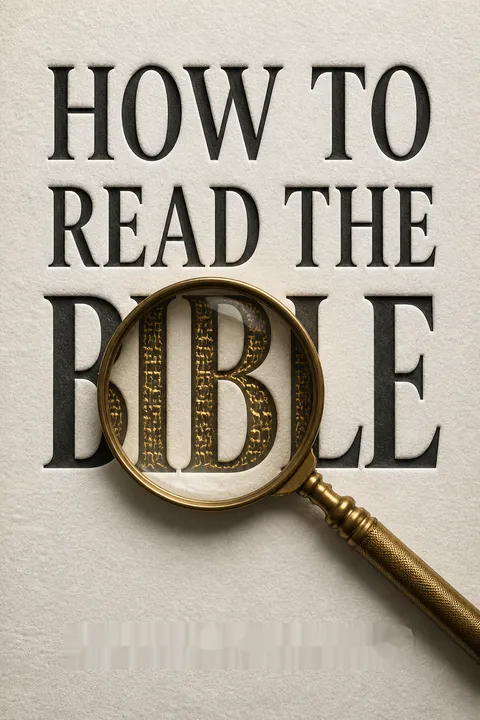


Key Takeaways
Read the Bible through two lenses without pretending they agree
Two ways of reading. Kugel’s central problem is that modern biblical scholarship and ancient interpretation ask different questions of the same words. Scholars reconstruct when texts were written, who may have composed them, and what they meant in their original setting. Ancient interpreters sought divine instruction for their own lives. The two approaches can produce incompatible answers, not merely different emphases.
A public collision. In 1891, Presbyterian scholar Charles Briggs argued that the Bible contained errors, had multiple authors, and could not be read as a straightforward record of miracles and fulfilled predictions. His church tried him for heresy in 1893. Kugel tells this story as a preview of the modern reader’s dilemma: scholarship cannot simply be ignored, but accepting every historical conclusion can unsettle familiar beliefs.
The tension is clearest when the two approaches are treated as different kinds of inquiry. Historical criticism asks how a text came to exist; religious reading asks what authority it has in a community now. Confusion follows when one answer is asked to settle both questions. A historical account may challenge a claim about authorship without deciding whether a community can still find spiritual meaning in the text. But some conflicts are real: a claim that every sentence came directly from Moses cannot be reconciled with a theory of multiple authors.
Notice the assumptions that turn ancient texts into timeless instruction
Four interpretive habits. Kugel calls the ancient readers’ shared expectations the Four Assumptions. They believed Scripture could conceal meaning beneath its wording, addressed readers in every age, contained no errors or contradictions, and came from God. These assumptions encouraged close attention to individual words and unusual repetitions, but also gave interpreters permission to draw conclusions beyond a passage’s plain sense.
A test case. In the story of Abraham and Isaac, ancient interpreters wondered why an all-knowing God needed to test Abraham and why Abraham seemed to mislead his son. They connected the story to Job, proposing that Satan had challenged Abraham’s loyalty, and reread Abraham’s answer so Isaac understood that he might be the sacrifice. The text became a lesson in shared obedience rather than a portrait of a father’s evasion.
What is striking is that interpretive assumptions are often invisible to readers who share them. A text can seem self-explanatory when its audience already expects it to offer present-day guidance, remain internally consistent, and speak with divine authority. The ancient readings are not simply careless errors; they respond to genuine moral and theological difficulties. Their cost is that the interpreter’s beliefs can control the text so completely that historical differences within it disappear.
Ask what a story explained before asking what it teaches
Stories of origins. An etiological narrative is a story that explains why a present-day name, custom, people, or institution exists by locating its origin in the distant past. Modern scholars use this idea to read many Genesis stories differently from ancient interpreters, who usually treated their characters as individuals whose conduct offered moral lessons.
Cain and the Kenites. The name Cain is also the Hebrew name of a southern nomadic tribe, the Kenites. The story’s claim that anyone who kills Cain will face sevenfold revenge may explain a reputation attributed to that tribe. Cain’s exile from farmland into a nomadic life, and his continuing connection to Israel’s God, may likewise account for the Kenites’ relationship to Israel. Later readers instead made Cain the devil’s offspring and the first example of human evil.
The etiological reading shifts attention from private character to collective memory. A story about an ancestor can explain how a community understands its neighbors, its territory, or its customs, even when the narrative never states that purpose outright. That makes the stories historically informative, but not transparent records: an explanation of a group’s reputation may tell more about the storyteller’s perspective than about the group itself. The book’s strongest reading keeps both possibilities in view.
Treat source theories as models, not recovered transcripts
A composite Pentateuch. The Documentary Hypothesis is the theory that the first five books combine multiple sources, often labeled J, E, D, and P, with different vocabularies, concerns, and views of God. Genesis 1 depicts a commanding creator who speaks the world into being; Genesis 2 and 3 show a more personal deity who shapes Adam, walks in the garden, and asks where he is. The flood story also appears to combine versions, including different instructions about how many animals Noah takes.
Evidence, not certainty. Modern scholars use such repetitions, tensions, language, archaeology, and comparison with ancient Near Eastern texts to reconstruct composition. The hypotheses have changed, and some details remain contested. Their force lies in explaining patterns more economically than a single-author account, not in providing a surviving transcript of how the books were assembled.
Source criticism is most persuasive when presented as a disciplined inference rather than a solved mystery. Repeated stories and shifts in vocabulary are evidence, but they do not identify an author with certainty or reveal every stage of editing. This distinction matters because a theory can strongly challenge a traditional account without proving every alternative claim. The book also shows that scholars bring assumptions of their own, especially when they expect religious ideas to develop in a neat sequence.
Preserve a historical kernel without treating Exodus as a transcript
Evidence points both ways. Egyptian records and archaeology have not confirmed the Bible’s account of a mass exodus, forty years of wandering, or a large-scale conquest of Canaan. Yet several details keep some scholars from dismissing every historical connection. Moses, Aaron, and Miriam have plausible Egyptian names; the biblical cities Pithom and Raamses fit Egyptian settings; and one Egyptian text mentions workers called ‘apiru building in Raamses, a term that may relate to Hebrew but is not identical to it.
A smaller memory. Some scholars therefore propose that a limited group escaped Egyptian service and that its experience became the founding story of a larger people. Others emphasize the growth of highland settlements or internal Canaanite change. The evidence does not settle the question. Kugel’s account preserves the possibility of historical memory while showing why the biblical scale and sequence remain doubtful.
This case illustrates why history is not a simple contest between fact and fiction. A national story can preserve a real experience while expanding its scale, joining it to other traditions, and giving it a theological meaning. The clues about Egyptian names and labor are suggestive, not proof; the silence of records is also not proof that nothing happened. The responsible conclusion is calibrated uncertainty, not either total acceptance or confident dismissal.
Do not project later omniscience onto every biblical portrait of God
Two models of God. Kugel uses God of Old for an earlier biblical conception in which God appears in particular places, moves from one location to another, and sometimes seems to learn what has happened. In Genesis, God walks in the garden, asks where Adam is, and says after Abraham’s test that He now knows Abraham’s loyalty. Later biblical writing increasingly presents God as omnipresent, omniscient, and beyond bodily form.
A revealing command. The first commandment tells Israel not to put other gods before its own God. That formulation can reflect monolatry, worship of one deity while acknowledging that other deities exist, rather than full monotheism, the belief that only one God exists. The distinction helps explain why biblical writers could speak of Israel’s God as greater than other gods before denying those gods’ reality.
The key gain is historical precision: the Bible does not always speak with one settled theology of God. Treating every passage as if it already expressed later doctrines can hide genuine changes in religious thought. At the same time, change should not automatically be described as progress from primitive to sophisticated belief. A personal, localized deity and an omnipresent, abstract one answer different religious needs; the texts preserve the shift without resolving it into a single formula.
Read biblical law as worship, not merely ancient regulation
A divine agreement. The covenant at Sinai resembles an ancient suzerain treaty, an agreement in which a powerful ruler recounts his relationship with a subordinate, sets terms of loyalty, and invokes blessings and curses. The Ten Commandments open with God identifying Himself and recalling the exodus, then set out obligations. Scholars compare this form with treaties from the ancient Near East, while debating how direct the influence was.
Daily service. In Israel, law did more than regulate civic life: breaking a commandment was also sin, while keeping it was a way to serve God. The Torah addresses worship and sacrifice, but also wages, honesty, care for the poor, and treatment of neighbors. Interpreters made broad rules usable in daily situations. For example, rabbinic readings understood taking revenge to include refusing a neighbor a tool simply because that neighbor had once refused you.
The treaty comparison clarifies the political shape of the covenant without exhausting its religious meaning. The same command can bind a community and define a relationship with God. The book also highlights a productive tension: a detailed law code can make daily life a form of devotion, yet many biblical rules leave room for judgment and interpretation. The interpreters are not an optional afterthought here; they help turn general commands into practices people can actually follow.
Let a text’s afterlife matter without mistaking it for its origin
Meaning can travel. The Psalms were likely composed largely for worship connected to Israel’s temple, yet they later became prayers recited in homes, synagogues, and churches. Psalm 23 is a vivid example. Its dark valley may originally mean danger rather than death, and dwelling in God’s house may refer to the temple rather than life after death. Still, generations of readers have used it to express hope at funerals.
A song transformed. The Song of Songs appears to be erotic love poetry. Ancient Jewish and Christian interpreters read its lovers as figures for God and Israel, or Christ and the church. That interpretation helped make the song part of Scripture. Kugel’s point is not that original meaning is irrelevant, but that reception is part of a text’s history and can profoundly alter what communities hear in it.
A text’s reception is not a footnote to its life; it is part of the history of how the text functions. Yet reception does not make every interpretation equally plausible. The words, their ancient setting, and the communities that reuse them all constrain meaning in different ways. Separating these layers lets readers say both that a psalm once belonged to temple worship and that it now speaks powerfully in settings its original authors may never have imagined.
Keep scholarship and faith in tension rather than forcing a tidy compromise
No easy rescue. Kugel writes as both an Orthodox Jew who believes in Scripture’s divine inspiration and a scholar who has spent his career studying modern biblical criticism. He does not offer a method that makes the findings disappear. The biblical library contains distinct voices, historical uncertainties, and interpretations that changed its meaning. At the same time, ancient Jewish and Christian readings are not disposable: they shaped worship, law, art, and the way millions understood the Bible.
An honest reading. The book’s answer is less a compromise than a demand to know which question is being asked. Historical scholarship investigates origins and first meanings. Religious communities inherit texts already interpreted and put them to use. Readers may need to hold both accounts in view, while admitting that some traditional claims, such as single Mosaic authorship, conflict directly with scholarly conclusions.
The book’s intellectual integrity comes from refusing a painless synthesis. Historical criticism cannot decide whether a text should remain sacred, and inherited faith cannot erase evidence about composition or context. The two can coexist only when their claims are made explicit and kept at the right level. That distinction is demanding, but it is more durable than pretending scholarship has no consequences or that tradition can answer every historical question.
Analysis
Kugel’s book is difficult to compress because its argument is carried by a repeated encounter with specific biblical passages. The reader sees the same words handled first by ancient interpreters and then by modern scholars. The contrast accumulates: Abraham becomes a moral exemplar and first monotheist in one reading, an ancestor in an etiological tale in another; the flood becomes a warning about sin, while scholarship traces its relationship to Mesopotamian stories. The method makes the stakes concrete rather than leaving the debate at the level of abstract theology.
The book’s central insight is that Scripture is not simply a text with one recoverable meaning. Its meaning emerges from words, historical setting, and the interpretive practices of communities. That claim does not make interpretation arbitrary. Historical evidence can disprove some claims about authorship or setting, while reception history can establish how later readers made a passage function as Scripture. These are different forms of evidence, answering different questions.
A useful distinction follows. Historical criticism asks what a passage likely meant when composed; canonical or religious reading asks what it means within a tradition that has received, organized, and applied it. The distinction can prevent category errors, but it cannot dissolve every contradiction. A reader cannot simultaneously affirm that Moses wrote every word of the Pentateuch and that it was assembled from sources across centuries, unless the claim about authorship is redefined.
Kugel’s own solution is deliberately incomplete. He argues that ancient interpretation is not an embarrassing layer to scrape away, because it helped create the Bible as a living religious library. Yet modern scholarship is also part of the Bible’s history and cannot honestly be ignored. The result is a demanding model of reading: know the text’s origins, know its interpretive afterlife, and resist pretending that either history or faith can fully absorb the other.
Review Summary
How to Read the Bible is highly praised for its comprehensive and insightful approach to biblical scholarship. Readers appreciate Kugel's exploration of ancient and modern interpretations, his clear writing style, and his ability to make complex topics accessible. Many find the book intellectually stimulating and perspective-changing. While some struggle with reconciling faith and scholarship, most reviewers recommend it as an essential read for anyone interested in understanding the Bible's historical context and interpretive traditions. The book's length and depth are noted, but generally seen as worthwhile.
People Also Read







Glossary
Four Assumptions
Ancient reading expectationsKugel’s name for four expectations shared by many ancient interpreters: Scripture is often cryptic, speaks to readers in every age, contains no errors or contradictions, and comes from God. These expectations shaped interpretations of stories, laws, and prophecies, encouraging readers to find hidden meanings and present-day instruction even when the text’s plain sense seemed difficult.
Midrash
Jewish scriptural interpretationA body of Jewish interpretation that developed around biblical texts, especially from the late biblical period onward. Midrash often reads closely and creatively, treating unusual wording, repetition, or gaps as clues to meanings not stated directly. Its interpretations became influential in Jewish religious life and, in some cases, changed how later readers understood the biblical passage itself.
Documentary Hypothesis
Multiple-source theoryA scholarly theory that the Pentateuch was assembled from several sources, commonly designated J, E, D, and P, rather than written as one continuous work by Moses. Scholars infer these sources from recurring differences in vocabulary, style, narrative, and theology. The specific reconstruction has changed and remains debated, while the broader idea of multiple composition has wide acceptance among biblical scholars.
Etiological narrative
Story explaining present originsA narrative that explains a current name, custom, people, place, or institution by describing an event in the distant past. In Kugel’s discussion, modern scholars use the concept to interpret many Genesis stories, such as Cain’s connection to the Kenites or Jacob’s association with Edom and Israel. Such stories may reveal how a community understood itself and its neighbors.
Deuteronomistic History
Deuteronomy-shaped historical narrativeA scholarly term for the historical account running from Deuteronomy through Joshua, Judges, Samuel, and Kings, shaped by ideas and language associated with Deuteronomy. Martin Noth proposed that a historian assembled older materials into a narrative extending from Moses to the Babylonian exile. Scholars have since debated its stages, authors, and editorial history.
Monolatry
Worship of one acknowledged godThe practice of worshiping one deity while recognizing that other deities may exist. Kugel distinguishes it from monotheism, which asserts that only one God exists. The distinction matters for passages such as the first commandment, which prohibits placing other gods before Israel’s God without explicitly denying their existence.
Sitz im Leben
Text’s social settingA German scholarly term meaning the setting or use of a text in ordinary social and religious life. Hermann Gunkel used it to ask why a biblical composition was created and what occasion or practice it served. The idea helped scholars connect psalms, stories, and other writings to worship, community customs, or everyday needs.
God of Old
Earlier biblical God-modelKugel’s shorthand for an earlier way some biblical texts portray God: as a being with a particular location and bodily presence who moves between places and may not automatically know everything. This differs from the later conception of God as omnipresent, omniscient, and beyond physical form. The term describes a historical difference in the texts, not a claim that one model is simply inferior.
Suzerain treaty
Ruler and vassal agreementAn ancient Near Eastern treaty in which a dominant ruler sets terms for a subordinate ruler or people. Such agreements could include the ruler’s self-identification, a review of past relations, loyalty demands, public reading, witnesses, and blessings or curses. Scholars compare this form with biblical covenants, particularly the presentation of God’s covenant with Israel.
FAQ
What is How to Read the Bible: A Guide to Scripture, Then and Now by James L. Kugel about?
- Comprehensive exploration of the Hebrew Bible: The book provides a chapter-by-chapter tour of the Hebrew Bible, covering its major figures, events, laws, prophecies, and wisdom literature.
- Contrasts ancient and modern readings: Kugel examines how ancient interpreters and modern scholars approach the Bible differently, highlighting the tension between faith-based and critical perspectives.
- Focus on interpretive history: The book explains how the Bible’s meaning has evolved through centuries of interpretation, making it both a sacred text and a living tradition.
- Addresses central dilemmas: Kugel grapples with whether modern scholarship undermines the Bible’s authority or if its message can be preserved in light of new findings.
Why should I read How to Read the Bible by James L. Kugel?
- Bridges faith and scholarship: Kugel, both an Orthodox Jew and a scholar, presents modern biblical criticism alongside traditional interpretations, helping readers understand both perspectives.
- Accessible yet rigorous: The book is written for both general readers and specialists, explaining complex scholarship in a clear, engaging style.
- Addresses contemporary challenges: It confronts the tension between traditional faith and modern critical findings, offering tools for honest and thoughtful engagement with Scripture.
- Enriches understanding of Scripture: Readers gain a deeper appreciation for the Bible’s complexity, history, and ongoing significance in religious and cultural life.
What are the key takeaways from How to Read the Bible by James L. Kugel?
- Bible as a layered text: The Hebrew Bible is a complex anthology shaped by multiple authors, editors, and centuries of interpretation.
- Interpretation shapes meaning: Ancient and modern readings have profoundly influenced how the Bible is understood, making interpretation central to its authority.
- Tension between tradition and criticism: The book highlights the ongoing struggle to reconcile faith-based readings with historical-critical scholarship.
- Dynamic, evolving text: The meaning of the Bible has changed over time, inviting readers to engage with it as both a historical document and a living tradition.
What are the "Four Assumptions" of ancient biblical interpreters according to James L. Kugel?
- Divine origin of the text: Ancient interpreters believed the Bible was the direct word of God, perfect and authoritative.
- Cryptic and layered meaning: They assumed the Bible’s words concealed deeper, hidden meanings that required skilled interpretation.
- Unity and coherence: Despite contradictions, the text was seen as harmonious and consistent, with any discrepancies resolved through interpretation.
- Timeless relevance: The Bible was understood as speaking directly to all generations, not just its original audience.
How does James L. Kugel describe the difference between ancient and modern biblical scholarship in How to Read the Bible?
- Ancient reverence and allegory: Ancient interpreters approached the Bible as a sacred, divinely inspired text, often reading it allegorically or typologically.
- Modern critical analysis: Modern scholars treat the Bible as a historical document, analyzing its sources, composition, and cultural context.
- Impact on understanding: This shift reveals the Bible as a product of multiple authors and editors, challenging the idea of a single, seamless revelation.
- Ongoing tension: Kugel explores how these differing approaches continue to shape religious communities and individual faith.
What is the Documentary Hypothesis and how is it presented in How to Read the Bible by James L. Kugel?
- Multiple authorship theory: The Documentary Hypothesis posits that the Pentateuch is a compilation of several sources (J, E, P, D, H), not solely authored by Moses.
- Historical development: Kugel explains how this theory reflects the evolution of Israelite religion from polytheism to monotheism, with each source representing different theological perspectives.
- Scholarly consensus and debate: While widely accepted, the hypothesis has been modified and debated, especially regarding the dating and relationship of priestly sources.
- Implications for faith: The theory challenges traditional views of biblical authorship and raises questions about the nature of Scripture.
How does How to Read the Bible by James L. Kugel explain the significance of the covenant theme?
- Central biblical concept: Covenant represents the foundational relationship between God and Israel, shaping biblical theology and identity.
- Ancient treaty parallels: Kugel shows how biblical covenants resemble ancient Near Eastern treaties, with unique theological claims of divine authorship.
- Types of covenants: The book distinguishes between conditional covenants (like Sinai) and unconditional ones (like the Davidic covenant), each with different implications.
- Scholarly debates: Kugel discusses how the development and dating of covenant texts influenced Israel’s religious and political history.
What are the main differences between the ancient interpreters’ and modern scholars’ approaches to the Bible in Kugel’s analysis?
- Ancient interpreters’ approach: They read the Bible as a divinely inspired, cryptic text with no contradictions, seeking hidden meanings and moral lessons.
- Modern scholarly approach: Scholars analyze the Bible historically and critically, focusing on its sources, context, and development, often challenging traditional beliefs.
- Incompatibility and coexistence: Kugel notes that these approaches are fundamentally incompatible but both remain influential, creating ongoing tension.
- Impact on interpretation: Each approach leads to different understandings of biblical stories, laws, and theology.
How does James L. Kugel analyze the story of Adam and Eve in How to Read the Bible?
- Two creation accounts: Kugel highlights the differences between Genesis 1 and Genesis 2–3, reflecting distinct sources and theological emphases.
- Ancient interpretation: Early interpreters introduced concepts like the "Fall of Man" and original sin, reading the story as an explanation for human mortality and sinfulness.
- Modern scholarly view: Scholars see the story as reflecting societal changes and containing folkloric motifs, rather than literal history or doctrine.
- Significance for theology: The story’s interpretation has shaped key doctrines in both Judaism and Christianity.
What is the significance of the Exodus narrative and Moses’ role according to How to Read the Bible by James L. Kugel?
- Foundational event: The Exodus is presented as the defining moment for Israel’s identity, covenant, and worship.
- Moses as central figure: Moses is depicted as prophet, lawgiver, and leader, with a complex character and unique relationship with God.
- Historical challenges: Kugel discusses the lack of direct archaeological evidence and the influence of Egyptian and Near Eastern contexts on the narrative.
- Multiple sources and meanings: The Exodus story is shown to be a composite of different sources, each with its own theological emphasis.
How does How to Read the Bible by James L. Kugel address the role of ancient interpreters in shaping the Bible’s meaning?
- Interpreters as co-creators: Ancient Jewish and Christian interpreters actively transformed the Bible’s meaning through their readings and assumptions.
- Development of interpretive traditions: Their methods, such as midrash and allegory, became integral to religious life and shaped theology, law, and practice.
- Canonization of interpretation: Interpretive traditions became canonical alongside the texts themselves, influencing how Scripture was understood for centuries.
- Ongoing influence: These traditions continue to shape Jewish and Christian engagement with the Bible today.
What insights does James L. Kugel provide about biblical prophecy and the role of prophets in How to Read the Bible?
- Prophets as divine messengers: Prophets are portrayed as God’s messengers, delivering verdicts and judgments rather than mere predictions.
- Historical development: Kugel traces the institutionalization of prophecy in Israel, contrasting it with earlier figures and neighboring cultures.
- Social and political role: Prophets often acted as moral critics and advisors, sometimes opposing kings and serving as a check on power.
- Interpretive evolution: The meaning and function of prophecy evolved over time, influencing both Jewish and Christian traditions.
Download PDF
Download EPUB
.epub digital book format is ideal for reading ebooks on phones, tablets, and e-readers.








