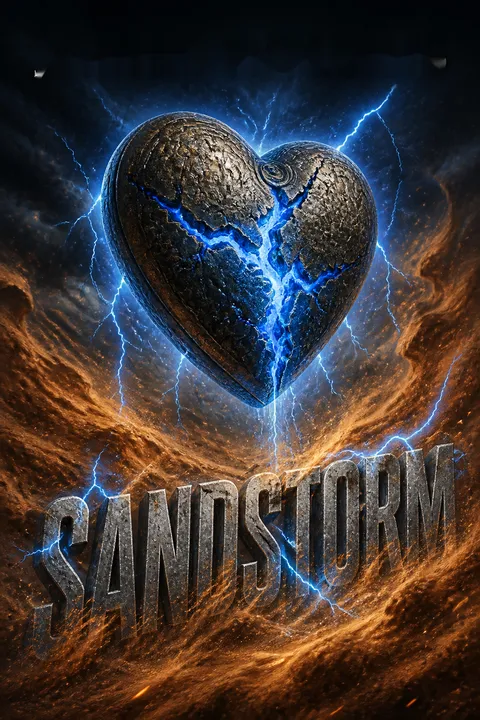


Plot Summary
The Camel Ignites
During a blackout at the British Museum, guard Harry Masterson follows a blue sphere of light into the Kensington Gallery. The sphere settles on a camel-shaped meteorite; the iron glows, the display explodes, and Harry dies in the blast. Nearby, curator Safia al-Maaz wakes from a panic attack to find the museum burning.
In the emergency briefing, she identifies the artifact as an ancient meteorite, not a disguised bomb. Museum owner Kara Kensington arrives, embraces Safia, then watches the footage with an expression that suggests the explosion has answered a question she has carried for years. The gallery and Safia’s life’s work are destroyed, but the glowing iron fragment has exposed a mystery neither woman can ignore.
The opening makes wonder inseparable from damage. A natural phenomenon enters a museum, a place designed to preserve the past, and turns preservation into catastrophe. Harry’s death establishes the physical cost before anyone can frame the event as scientific opportunity. Safia and Kara respond from different kinds of attachment: Safia sees her reconstructed homeland ruined, while Kara recognizes a possible link to her missing father. Their private grief gives the mystery human stakes before its larger implications emerge.
The Hacker's Double Cross
At Foxwoods Casino, DARPA commander Painter Crowe shadows Xin Zhang, a Chinese hacker who stole plasma-weapon research. Painter’s partner, Cassandra Sanchez, has planted a listening device, but Zhang spots the surveillance and escapes with the encrypted computer.
Painter finds Cassandra nearly strangled in Zhang’s room, then stops Zhang’s getaway with an electromagnetic grenade. The pulse disables the car but spares its shielded computer. Painter realizes Cassandra never planted the tracking device and has been working against him; he has her arrested.
Before he can absorb the betrayal, DARPA director Tony Rector summons him to London. Evidence from the museum blast suggests the meteorite may have contained stabilized antimatter, and Painter is ordered to investigate discreetly with a new partner, physicist Coral Novak.
The casino operation establishes that Painter’s expertise cannot protect him from a betrayal inside his own partnership. The encrypted computer, the surveillance bug, and the electromagnetic grenade turn technical knowledge into a chain of uncertain loyalties. Painter’s choice to preserve the stolen research rather than simply kill Zhang reflects his institutional discipline, but Cassandra’s deception makes that discipline vulnerable. The London assignment then connects a personal rupture to a much larger danger: Painter arrives already questioning whom he can trust.
A Heart Spells Ubar
As investigators clear the burned gallery, Kara hires her own forensic team and orders them to recover every piece of the meteorite. Beneath a shattered sandstone statue, Safia discovers a metal heart sealed inside the stone.
Its vessels form ancient South Arabian letters spelling Ubar, the fabled city thought to lie beneath Oman. Frankincense hidden inside the heart points toward the tomb of Nabi Imran in Salalah. Kara wants to pursue the clue because it may explain her father Reginald’s disappearance; Safia resists, still haunted by a bombing in Tel Aviv that killed children during her excavation.
Kara presses Omaha Dunn, Safia’s former fiancé and an experienced field archaeologist, to lead the expedition. Safia initially refuses, but the discovery and Kara’s need for her draw her back toward the field.
The heart converts archaeology from cataloguing into interpretation: its letters, material, and incense make an object behave like a message. Kara’s investment is not simply scholarly, because the collection is also her memorial to a father whose fate remains unresolved. Safia’s hesitation comes from a different wound. Fieldwork once gave her purpose, then became entangled with guilt over a massacre she could not prevent. Their competing motives create the expedition’s emotional tension: one woman hopes to recover the past, while the other fears what the past will demand.
Blood at the Museum
Painter and Coral arrive at the museum under cover as American lightning researchers. Their radiation scanner finds a meteorite fragment whose readings resemble those from the catastrophic Tunguska explosion.
Before they can report their discovery, masked gunmen enter the building, kill head of security Ryan Fleming, and seize Safia, demanding the iron heart. Painter and Coral attack the kidnappers; Coral incapacitates two, while Painter helps Safia escape. A second assailant pursues her onto the museum’s glass roof.
Painter shoots the pane beneath the attacker, sending the gunman falling away, then helps Safia down. The weapon left behind belongs to Cassandra, confirming that Painter’s former partner survived custody and is pursuing the artifact. The attack leaves Safia with a fresh death to blame on her work.
The museum attack destroys the distinction Safia has tried to maintain between professional life and personal safety. Ryan is killed because the search for the artifact has become a contest, and Safia again interprets another person’s death as evidence of her own culpability. Painter’s rescue offers practical protection but not immediate trust; he is part of a secretive operation and has already concealed information. Cassandra’s weapon links the London violence to Painter’s earlier betrayal, turning two separate crises into one pursuit.
A Reunion Under Fire
On the flight to Oman, Painter tries to steady Safia’s panic and guilt, while her reunion with Omaha remains unresolved. In Muscat, Omaha and his younger brother Danny are trapped in a fake taxi and pursued by armed kidnappers.
Danny triggers a side airbag to release the car’s locks, and both brothers escape through a crowded souk. They reach Kara’s estate, where Safia and Omaha meet again after years apart. That night, a carpet viper appears in Safia’s bath. She catches it before it can strike a maid and kills it by whipping its head against the tiled wall.
The household assumes it was an accidental intruder, but Painter suspects someone planted it. The group leaves for Salalah aboard the sultan’s sailing ship, the Shabab Oman, carrying the iron heart and an unexplained threat.
The return to Oman puts Safia between the safety she constructed in London and the homeland she never stopped carrying within her. Her reunion with Omaha awakens affection without repairing the reason they separated: he could not remain beside her after Tel Aviv. The viper tests her ability to act under pressure, while its presence hints that unseen parties already know where the expedition is going. The luxurious ship and the old family estate offer apparent shelter, but both are provisional; danger has followed the group home.
The Shabab Burns
Cassandra’s mercenaries attack the Shabab Oman at night, disable its communications, and board under cover of gunfire. Painter and Kara barricade themselves in a cabin while Omaha, Danny, and Coral search the holds for weapons. The attackers tranquilize Safia and Clay Bishop, then take Safia and the iron heart.
Omaha and Coral use a released Arabian stallion to break the attackers’ firing line; Painter’s group escapes in a launch just before the ship’s mines explode. Cassandra’s force circles the burning wreck, shooting at survivors, but the remaining expedition members hide beneath their overturned boat.
On shore, Omaha confronts Painter for withholding the antimatter investigation. Painter admits that DARPA believes the meteorite’s explosion points to a dangerous source beneath Oman, and that Cassandra is a former colleague working for an unknown organization.
The attack turns the expedition’s luxurious protection into a liability: the ship becomes a sealed battlefield, then a burning landmark that exposes survivors to pursuit. Painter’s secrecy has a concrete consequence. Omaha’s anger is not merely professional suspicion; he believes Painter’s withheld knowledge helped place Safia in danger. Their uneasy alliance begins only after Painter accepts that he needs the archaeologists’ regional knowledge. Cassandra’s success, meanwhile, depends on disciplined planning rather than a simple theft, making the conflict harder to escape.
Two Tombs, One Trail
In Salalah, Cassandra forces Safia to examine the tomb of Nabi Imran, where Reginald Kensington once found the statue that concealed the heart. Safia sets the artifact on the marble headstone and notices that it settles like a compass, pointing inland toward Mount Eitteen and the tomb of Job.
Cassandra takes her there, hoping Safia will reveal the next clue. Meanwhile, Painter tracks the convoy with a stolen vehicle signal and reaches the shrine with Omaha’s group. Safia finds a buried footprint and hoofprint, then locates an ancient prayer room aligned toward Jerusalem.
A metal detector signals inside its sandstone wall. Cassandra forces the search onward, but Painter’s approach and the strange figures moving through the mountain grounds turn the shrine into a contested site.
The first clue depends on Safia’s ability to combine religious history, material evidence, and spatial reasoning. The heart does not provide a map; it gives a direction that only becomes meaningful when placed in the shrine where the statue was found. This makes knowledge a form of agency even while Safia is a prisoner. The parallel arrival of Painter’s group adds urgency, but it does not erase the asymmetry: Cassandra has the weapons and transportation, while Safia controls the interpretation that makes those resources useful.
The Queen Beneath
At Job’s tomb, Safia finds an iron spear bearing a bust of a woman. When rain clears the inscription naming Biliqis, the Queen of Sheba, the bust turns to point northeast. Painter attacks Cassandra’s guards, but Safia is shot and carried away by a mysterious woman accompanied by leopards. She wakes in a hidden mountain cavern, where Kara has also been brought.
There, the elder Lu’lu shows them Reginald Kensington’s body, preserved inside glass since the desert swallowed him. Lu’lu reveals that Safia and Kara share Reginald as their father; Safia’s mother belonged to the Rahim, a secret community of women who claim descent from the Queen of Sheba. The two friends must absorb a new kinship while the Rahim prepare to open Ubar’s gates.
The revelation rearranges the women’s memories without invalidating their lived relationship. Safia and Kara were already sisters in practice; the shared father gives their childhood closeness a new biological explanation and turns Reginald’s disappearance into a family wound they share. The Rahim’s hidden history complicates the idea of a stable inheritance: the past survives through bodies, stories, and guarded rituals, not only through artifacts. Safia’s rescue also shifts her from a captive interpreter to a participant in a lineage that has its own reasons for reaching Ubar.
The False Sixty-Nine
Lu’lu explains that the Rahim have unusual mental influence over animals and perception, and that their lineage may preserve an ancient blessing. Safia and Kara travel with them through hidden passages toward the desert, while Painter’s survivors follow a separate route to Shisur.
At Job’s shrine, Cassandra has extracted a second clue: sixty-nine marks on the spear. Safia lets Cassandra interpret the distance in modern miles, although the artifact belongs to Roman times. The error sends Cassandra six miles beyond the real destination.
Painter and Omaha calculate the ancient measure correctly and identify Shisur, the already-known ruins of Ubar. Safia’s deception buys time, not safety. As a vast sandstorm bears down, the Rahim and the survivors converge on the abandoned oasis, each hoping to reach the buried city first.
Safia’s misdirection is a rare moment when captivity does not dictate the terms of the exchange. She gives Cassandra accurate evidence but lets her apply the wrong historical scale, exploiting the gap between measurement and meaning. The episode also distinguishes kinds of inheritance: Painter brings technical tracking, Omaha supplies regional context, and Safia reads the artifact’s ancient logic. Their knowledge is strongest when combined. The approaching storm compresses that intellectual contest into a race, making delay itself a tactical resource.
The City Under Sand
At Shisur, Safia organizes the Rahim and Painter’s group to search the ruined citadel before the sandstorm arrives. In a chamber beneath the sinkhole, she and Omaha match the iron spear and heart to three walls representing the morning star, sun, and moon.
The exposed iron horns complete a circuit, drawing static electricity into a blue sphere of light. A helicopter attack interrupts their work. The trapped charge detonates, blasting open a glass spiral beneath the ruins and collapsing part of the citadel.
The survivors descend before Cassandra can reach them. Safia later recognizes that the settlement above was deliberately sacrificed to conceal the true gate: the last queen caused the sinkhole to bury the entrance and frighten intruders away.
The chamber’s design makes cultural interpretation physically consequential. The celestial symbols are not decoration; they guide the placement of objects that complete an electrical system. Safia’s insight that the sinkhole was intentional reverses the accepted story of Ubar’s abandonment. A disaster once treated as an external punishment becomes a deliberate act of concealment. Yet opening the gate repeats the danger built into that history: knowledge reveals a way forward, but it also activates forces that the ancient builders took extraordinary pains to contain.
Ubar's Glass Grave
The survivors follow the glass ramp deep beneath the dunes and discover a flooded passage, an underground dhow, and a vast city formed from black glass. Safia recognizes Ubar’s thousand pillars, but the streets are full of people preserved in glass, their bodies frozen in moments of terror.
The city is not a treasure trove but a mass grave. Coral and Danny determine that the lake carries antimatter inside stable water structures, while magnetic iron can disturb that stability and release immense energy.
Their explanation connects the museum explosion, the keys, and Ubar’s destruction. Cassandra’s forces follow through the underground route and begin bombarding the city. Safia’s group abandons the royal barge and climbs toward the palace as the attackers land and the Rahim fight to hold them back.
Ubar’s discovery refuses the usual archaeological bargain in which beauty compensates for loss. The glass city is technically astonishing, but its preservation has trapped the victims’ final gestures rather than rescuing their lives. The scientific explanation makes the city’s splendor and its destruction parts of the same system: the power that enabled extraordinary craft also magnified the consequences of failure. Cassandra’s assault repeats the old pattern of treating the site as a resource to control, while Safia’s group must decide how to protect both the living and the knowledge that brought them there.
A Siege in the Deep
Cassandra’s mercenaries overrun the lower city, and her explosives destroy the dhow and damage the glass shore. Painter escapes captivity on the surface, commandeers an armored tractor, and heads back toward Ubar. Inside, the survivors retreat to the palace while electrical discharges begin melting sections of the city.
The Rahim lose more people as the battlefield grows unstable. Captain al-Haffi arrives with Shahra fighters, revealing that his clan has guarded a separate route into Ubar for generations.
He also confesses that, as a young guide, he recovered Kara from the desert after Reginald disappeared. The two ancient guardian lines unite, but neither force can stop the storm above from feeding energy into the antimatter lake. Coral warns that the cavern may soon discharge on a scale capable of devastating the region.
The siege brings the story’s competing inheritances into contact. The Rahim preserve a maternal line and its hidden gifts; the Shahra preserve a route and a royal obligation. Their alliance is not a sudden convenience but the fulfillment of separate duties established by Ubar’s last queen. At the same time, the storm strips away the illusion that either heritage can simply restore the past. The guardians can recover the city, but they cannot control the forces it contains. Survival now depends on cooperation across traditions and disciplines.
The Sphere's Last Journey
Coral identifies the iron sphere in the palace courtyard as a final safeguard: if released, it could roll into the lake and trigger a controlled discharge. The charged glass makes the route deadly, so Safia uses the Rahim’s ability to alter how others perceive her and walks alone toward the sphere.
She shoves it free, but the electrical shock throws her unconscious. Omaha follows using sand-filled socks as insulation and reaches her while the sphere continues toward the water. Its impact releases the lake’s energy into the ground, draining much of the water and ending the electrical storm.
Cassandra, injured by the collapsing palace, gives Painter the detonator keeping Safia’s implanted explosive inactive, then dies. An earthquake ruptures the underground springs, flooding the damaged city as the survivors escape to the surface.
The climax resolves Safia’s movement from guilt-driven retreat to chosen responsibility. She does not erase the danger by becoming fearless; she acts while recognizing that her decision may cost her life. Omaha’s improvised sand shoes echo the insulation that protects the palace, turning scientific knowledge into an intimate act of rescue. Cassandra’s final handoff is not absolution, but it is a last choice that protects Safia rather than exploiting her. The solution saves the region by releasing Ubar’s power, not by claiming it.
Eden After Ubar
The survivors climb out as the cavern’s lake drains and then refills through a ruptured underground spring. Coral believes the antimatter structures will disperse harmlessly through the wider aquifer.
Lu’lu says the Rahim have lost their unusual gifts, but Safia finds comfort in the family around her rather than in supernatural power. Omaha admits he still loves her and offers to rebuild their relationship; Safia accepts his love while making clear that trust will take time.
She later thanks Painter, who understands that she is choosing Omaha and steps aside without pressing her. The desert basin fills with fresh water, suggesting the return of a greener landscape. Ubar is lost again, but its people have escaped, and the old guardians can live openly.
The resolution replaces possession with continuity. The characters do not save Ubar as an intact monument; they prevent its power from being weaponized and accept the loss of the city. The vanished Rahim gifts reinforce that no inheritance is guaranteed simply because it is ancient. Safia’s decisions about Omaha and Painter are similarly grounded in present trust rather than destiny. The returning water offers possibility, not proof of a restored Eden. What survives is a community capable of choosing what to carry forward.
Epilogue
Months later, Painter prepares to take over Sigma Force after evidence recovered from Cassandra’s laptop exposes DARPA director Tony Rector as the Guild’s leader. Rector dies before he can be arrested, but Painter knows the organization will endure.
A wedding invitation from Kara tells him that Safia and Omaha plan to marry beside Oman’s new lake. Painter hesitates, then opens the office door bearing his new title. His promotion feels less like victory than an obligation to those who trusted him, and the invitation leaves room for a life beyond duty.
The epilogue links institutional repair to private grief without pretending either is complete. Painter’s promotion follows the exposure of a traitor at the top of DARPA, but the Guild’s survival prevents a clean victory. His decision about the wedding invitation is smaller and more revealing: after losing Cassandra and stepping aside for Safia, he must decide whether to remain emotionally present. The new office and the new lake frame two kinds of beginnings, one earned through responsibility and one offered through friendship.
Analysis
Sandstorm makes the past materially dangerous. Its archaeology does not uncover a stable record that can be admired from a safe distance; every artifact is a working part of a system whose principles have been forgotten. The iron objects carry history in their inscriptions, but their meaning becomes clear only when Safia combines language, ritual geography, and close physical observation. Knowledge here is embodied practice.
The novel also treats secrecy as an ambivalent form of care. The Rahim conceal Ubar to prevent its power from being exploited, while the modern agencies hide information to preserve national advantage. These motives can look similar from the outside, but the consequences distinguish them. The Rahim’s secrecy protects a community and a dangerous site; the Guild’s secrecy enables coercion and extraction. Painter’s own concealment occupies the uncertain middle ground, intended as protection but damaging the trust he needs.
Safia’s emotional development turns on responsibility rather than absolution. She has mistaken survival for proof that she deserves blame, especially after the Tel Aviv bombing. In Oman she cannot undo earlier deaths, but she can choose what to do when the next danger arrives. Her final risk is not a cure for trauma. It is evidence that trauma no longer dictates every choice. Omaha’s renewed commitment matters because it acknowledges his earlier withdrawal instead of pretending love alone repairs it. Painter’s decision to step aside likewise makes affection an ethical relation, not a claim of ownership.
Ubar’s destruction and the return of water complete the book’s central exchange: a civilization’s power cannot be separated from the conditions that sustain it. The characters save the present not by possessing the ancient energy source, but by releasing it and accepting the loss of the city. The resulting lake offers renewal without restoring the world to an imagined untouched past. History remains consequential, but it no longer has to be repeated.
Review Summary
Sandstorm received mixed reviews, with an average rating of 3.96 out of 5. Many readers praised its fast-paced action, adventure, and blend of science and history. The book was compared to works by Dan Brown and Michael Crichton, with some likening it to Indiana Jones. Critics found the characters underdeveloped and the plot predictable. Some readers appreciated the scientific elements, while others found them implausible. Overall, fans of action-packed thrillers enjoyed the book, while others found it lacking depth.
People Also Read

Characters
Safia al-Maaz
The desert-born archaeologistSafia is an archaeologist and curator whose scholarship joins careful material observation with deep knowledge of Arabian history, languages, and religious traditions. Orphaned young, she grew up close to Kara Kensington and later built a life in London around the collection they shared. A terrorist bombing during her earlier fieldwork left her with panic attacks and a consuming sense of responsibility for other people’s suffering. Her reluctance to return to excavation is not a lack of courage; it reflects how thoroughly the work has become entangled with grief. Safia is patient, exacting, and capable of acting under pressure, especially when she can turn fear into a concrete task.
Painter Crowe
The field commanderPainter leads Sigma Force, a covert DARPA team that combines scientific expertise with military training. His Pequot heritage and difficult childhood shape his cautious approach to identity and belonging, while years of operations have taught him to study a situation before acting. He is technically gifted, observant, and skilled at adapting ordinary objects into practical tools. Painter’s professional instinct is to protect people by controlling information, a strategy that can also isolate him from allies. His connection to Safia unsettles his usual emotional distance, while his history with Cassandra makes trust and judgment central tests of his command.
Kara Kensington
The searching heiressKara is a wealthy business leader and Safia’s lifelong friend, raised alongside her after Reginald Kensington took Safia into his household. She inherited a formidable corporation and expanded it through sharp financial judgment, but her most personal project is the Arabian antiquities collection begun by her father. Kara’s confidence can shade into control: she organizes people and resources because uncertainty feels intolerable. Her father’s disappearance left that need for control tied to an unresolved question. Beneath her commanding public manner, she is fiercely loyal to Safia and carries a tenderness most visible around horses, family memories, and the people she fears losing.
Omaha Dunn
The stubborn field archaeologistOmaha is an experienced American archaeologist who knows the terrain and history of Arabia and has led difficult expeditions across the region. His confidence, humor, and appetite for action make him effective in danger, but they can also push him toward impulsive decisions. He once planned a life with Safia, yet after her trauma in Tel Aviv he did not know how to remain beside her and gradually withdrew. Their reunion forces him to confront the difference between loving someone and being dependable. Omaha is most useful when he tempers his instinct to charge ahead with the field knowledge and patience that made him a respected scholar.
Cassandra Sanchez
The brilliant former partnerCassandra is a highly trained operative who once worked beside Painter in Sigma Force. She combines patience, technical fluency, and physical discipline, and she understands how institutions and people can be used as instruments. Her guarded manner reflects a history in which vulnerability was dangerous, so she values control and power above trust. Cassandra is not careless or merely cruel; she plans several steps ahead and can recognize competence even in an opponent. Her unresolved attachment to Painter complicates her professional choices, while her capacity for violence makes that emotional history especially volatile.
Coral Novak
The physicist in the fieldCoral is a nuclear physicist and Sigma operative whose intelligence is matched by rigorous preparation and close attention to evidence. Reserved and difficult to read, she prefers a measurable explanation to instinct, yet she adapts quickly when the evidence refuses ordinary categories. Her knowledge of radiation, antimatter, and electrical systems helps the team understand what Ubar’s artifacts are doing. Coral also brings a disciplined combat background, allowing her to move between laboratory reasoning and immediate danger without treating either as an interruption. Her professional partnership with Painter begins cautiously and develops through competence rather than easy familiarity.
Daniel Dunn
The quick-minded younger brotherDanny is Omaha’s younger brother, a gifted paleontologist who moves quickly through academic work but can be scatterbrained in practical crises. He is curious about engineering and science, and his questions help connect the expedition’s archaeological discoveries to Coral’s explanations. His admiration for Omaha carries a younger sibling’s mixture of loyalty and impatience. As danger escalates, Danny proves more resilient than his easygoing manner first suggests.
Clay Bishop
The graduate studentClay is Safia’s graduate student, a bright researcher whose casual clothes and dry humor initially make him seem unprepared for a dangerous expedition. His academic curiosity is real, even when he disguises it behind jokes and music. Clay is frightened by the violence and by the open sea, but he continues to help the people around him. His presence gives Safia a student to protect and gives the expedition a younger observer learning what fieldwork demands.
Lu'lu
The Rahim's elder guideLu’lu is the elder hodja of the Rahim, a hidden community that guards inherited knowledge about Ubar. She speaks with the authority of someone responsible for preserving a fragile line of tradition, and she is willing to reveal only what the moment requires. Her patience can feel withholding, but it reflects the risks of keeping a community safe across generations. Lu’lu guides Safia and Kara toward their history while treating them as people who must make their own choices.
Captain al-Haffi
The desert patrol captainCaptain al-Haffi leads Oman’s Desert Phantoms, an elite border patrol accustomed to operating independently in harsh terrain. He is disciplined, loyal to his men, and conscious of obligations that reach beyond his military role. His knowledge of local tribes and hidden routes makes him a crucial guide, while his reserve reflects the secrecy expected of his community. He carries an old connection to the Kensington family that complicates his duty in the present.
Reginald Kensington
The vanished desert explorerReginald is Kara’s father, a wealthy patron of archaeology and the founder of the Arabian collection at the British Museum. He raised Kara in Oman and welcomed the orphaned Safia into the household, giving both girls a shared childhood. His interest in ancient sites and his journeys into the desert left questions that shaped Kara’s adult life. To those who knew him, he was generous and adventurous, but his private motives remain difficult to separate from the mysteries he pursued.
Sean McKnight
Sigma's founding directorSean McKnight founded Sigma Force to unite scientific intelligence with field operations. A former Navy SEAL with advanced scientific training, he serves as Painter’s mentor and immediate superior. He values disciplined thinking and tends to treat responsibility as a burden to be carried rather than a title to enjoy. His confidence in Painter reflects years of watching him develop from an injured operative into a capable commander.
Tony Rector
DARPA's powerful directorVice Admiral Tony Rector directs DARPA and has the authority to mobilize the agency’s research and covert resources. He is experienced, politically astute, and skilled at making extraordinary decisions sound like ordinary procedure. His concern with technological advantage reflects the agency’s mission, but his influence also makes him a figure others must approach carefully. Rector is one of the few officials able to redirect Sigma’s operations from the highest level.
Ryan Fleming
The museum's watchful chiefRyan Fleming heads security at the British Museum and has earned Kara’s trust through his vigilance and loyalty to the Kensington Gallery. He is protective of Safia and quietly attentive to her, though she is largely absorbed in her work. Fleming’s professional pride is rooted in keeping the collection and its people safe.
Xin Zhang
The pursued hackerXin Zhang, known online as Kaos, is a Chinese computer scientist and skilled cyber-spy pursued by Painter’s team. His polished businessman’s appearance conceals patience and technical ingenuity. Zhang’s ability to recognize surveillance and exploit a weakness forces Painter’s operation into a dangerous improvisation.
John Kane
Cassandra's field lieutenantJohn Kane is a former Australian special forces soldier who commands the mercenary team supporting Cassandra. Physically imposing and experienced in the field, he expects authority to be respected and is wary of being directed by an outsider. His loyalty to his men makes him both a formidable commander and a source of friction.
Harry Masterson
The night-shift guardHarry is a low-ranking British Museum guard who resents his tedious night patrol and worries about losing his job. His curiosity draws him into the dark gallery when he sees an unexplained light, placing an ordinary worker at the threshold of an extraordinary event.
Plot Devices
The Iron Keys
A map built from artifactsThe iron heart, the Queen of Sheba spear, and the concealed bull horns form a sequence of clues leading from sacred sites to Ubar. Their inscriptions and placement rely on South Arabian writing, religious geography, ancient measures, and celestial symbolism. The artifacts also respond to touch and magnetic forces, so solving the riddle activates a physical mechanism rather than merely identifying a location. Their dual role makes them both archaeological evidence and parts of a dangerous machine.
Antimatter Buckyballs
Power hidden inside waterThe novel imagines antimatter contained within stable, hollow water structures called buckyballs. This arrangement lets a vast underground reservoir persist without annihilating itself, while magnetic iron and electrical discharge can disturb the balance and release catastrophic energy. The theory links the museum blast, Ubar’s technology, and the desert’s changing weather. As an explanation, it bridges speculative science and archaeological discovery; as a threat, it makes every attempt to use the ancient devices potentially destructive.
The Rahim Inheritance
A lineage that protects UbarThe Rahim preserve traditions connected to the Queen of Sheba and possess unusual abilities involving animals, perception, and their own bodies. Their history explains why Safia can interact with the keys and why the guardians remained hidden. Coral later proposes a speculative biological explanation involving altered mitochondria and water structures, grounding the miraculous claims in the novel’s science-fiction framework. The lineage is both a source of protection and a burden: its members have kept Ubar secret while paying a personal cost for remaining unseen.
The C4 Transceiver
A tracker turned hostage threatCassandra implants a tracking device between Safia’s shoulders so her team can follow the archaeologist through the desert and underground. She secretly modifies it with a small C4 charge and carries a remote detonator. The device lets Cassandra monitor Safia’s location and threaten her life even when the two are separated. It forces Painter and the others to protect Safia without simply cutting out the implant, making trust and restraint as important as tactical skill.
The Desert Storms
Nature becomes the countdownA London thunderstorm first delivers the ball lightning that activates the meteorite. Later, a vast sandstorm and coastal weather system converge over Oman, building the electrical charge that threatens Ubar. The storm is not just environmental background: it awakens the ancient mechanisms, disrupts communications, hides movement, and eventually overwhelms the glass cavern’s ability to contain the energy. Its changing intensity drives the expedition’s timetable and makes retreat, pursuit, and rescue increasingly dangerous.
Sigma Force Series

About the Author
Other books by James Rollins



Download PDF
Download EPUB
.epub digital book format is ideal for reading ebooks on phones, tablets, and e-readers.








