

Plot Summary
Prologue
In November 1971, Commander Forrest Malone struggles to keep his experimental submarine steady beneath Antarctic ice after its reactor fails. A malfunctioning control system sends the vessel plunging toward the seafloor, where the crew finds enormous stone blocks carved with an unfamiliar script.
Then the batteries overheat, filling the submarine with poisonous fumes. With no safe way out, Forrest thinks of his ten-year-old son, Cotton, and the words he has never managed to say aloud. The scene leaves both the crew and the strange ruins below the ice suspended in the same darkness.
The opening binds a private loss to a public mystery before the reader knows either one. Forrest’s final thought gives the later investigation its emotional pressure: Cotton is not chasing an abstract historical puzzle but the missing human truth inside his father’s death. The carved stones arrive as a second, more unsettling inheritance, suggesting that the navy’s secret mission encountered something beyond its machinery. By placing the discovery beside the submarine’s failing systems, the prologue makes the unknown feel both wondrous and lethal.
The Zugspitze Ambush
Retired Magellan Billet agent Cotton Malone has come to Germany to learn how his father died, and Stephanie Nelle, his former boss, has arranged a favor: a file on the submarine loss. On the summit of the Zugspitze, agent Jessica hands him the envelope and makes clear that Stephanie considers her debt repaid.
During the cable-car descent, a woman named Panya and her armed accomplice demand the file. Malone fights them in the cramped car, sends the accomplice crashing against a support trestle, and escapes by climbing down to the snowy slope. He leaves Panya unconscious, keeps the envelope, and realizes that someone knows what he and Stephanie are investigating.
The attack converts Malone’s private search into an exposed operation. His instinctive response is not simply professional reflex: the narrow cable car presses directly on his dislike of confinement, making the physical danger echo his resistance to being trapped by institutions or old grief. The envelope matters because it carries a version of the past that other people still control. His escape establishes competence, but it does not restore control. Instead, survival leaves him with a sharper question: who benefits from keeping this particular history sealed?
The North Atlantic Lie
The court of inquiry identifies the lost vessel as the secret NR-1A, not the fictional USS Blazek described to the public. It places the submarine under Antarctic ice, admits that the cause of its loss is unknown, and confirms that no rescue was authorized. The navy’s story had hidden both the location and the mission from Forrest’s family.
Malone sees that the official investigation was designed to limit questions, not answer them, and asks Stephanie to find the captain of the ship sent south after the disappearance. Meanwhile, Admiral Langford Ramsey, head of naval intelligence, watches the inquiry’s rediscovery with alarm. The file gives Malone a direction, but also alerts powerful people that he is following it.
The report’s bureaucratic calm makes the deception more disturbing than a simple lie. Its language acknowledges uncertainty while quietly closing off the possibility of meaningful inquiry, turning national security into a shield against accountability. Malone’s anger is personal, but it rests on a concrete breach: the institution that trained him concealed the truth from his family. Ramsey’s attention reveals that the old cover-up is not inert history. Its consequences remain active because someone’s present ambitions depend on the past staying unread.
Two Sisters, Two Books
At Ettal Monastery, Dorothea Lindauer reveals that her father, Dietz Oberhauser, was aboard the lost submarine and gives Malone a medieval manuscript said to have come from Charlemagne’s tomb. Dorothea believes her father pursued the beginnings of civilization, but she treats the claim as a family embarrassment as much as a mystery. Her twin sister, Christl Falk, then seeks Malone separately.
A medieval historian, Christl says their grandfather Hermann found a second manuscript in Einhard’s grave and brought back inscribed stones from Antarctica. The sisters disagree about their family’s past and about what their father died seeking. Their matching inheritance is divided between them, and neither trusts the other to hold it.
The divided manuscripts make the sisters’ conflict structural rather than merely temperamental. Each possesses part of a history that neither can interpret alone, while their family has trained them to compete for authority and inheritance. Dorothea’s practical skepticism protects her from humiliation, but it also keeps her emotionally distant from her father’s purpose. Christl’s scholarship offers a language for the mystery, though belief can make her vulnerable to manipulation. Malone is drawn in because their divided evidence intersects with his own unfinished relationship to his father.
Ramsey Wants the Summit
In Washington, Ramsey is preparing to claim a place on the Joint Chiefs of Staff. His trusted operative, Charlie Smith, can make inconvenient people disappear, while Ramsey cultivates Senator Aatos Kane and studies what will secure his promotion. Edwin Davis, a deputy national security adviser, has a more painful reason to watch him: years earlier in Brussels, Ramsey abused Millicent Senn, the naval officer Davis loved, and she later died under suspicious circumstances.
Davis has carried his guilt and anger ever since. Ramsey now orders Smith to eliminate people connected to the submarine mission, beginning with Admiral David Sylvian. A career built on favors and secrecy begins to overlap with the investigation Malone has reopened.
Ramsey’s ambition is not presented as a sudden appetite for power. It is the organizing principle through which he has learned to treat people, institutions, and secrets as negotiable resources. Davis’s memory of Millicent exposes the human cost beneath that political style, but his long silence also shows how institutional hierarchies can convert witness into complicity. The parallel storylines are now joined by more than the submarine: both men are shaped by what they believe they owe the dead, though one seeks truth and the other seeks insulation.
Alexander Names Ramsey
Stephanie and Davis find retired Captain Zachary Alexander in Jacksonville. Alexander remembers taking the USS Holden south in 1971, where three naval lieutenants went ashore in diving gear and ordered him not to ask questions. One of them was Langford Ramsey.
Alexander insists he never knew about a submarine search, but his account connects Ramsey directly to the secret expedition. Before Stephanie and Davis can learn more, Smith kills Alexander by setting fire to his home and disguising the death as an electrical accident.
Malone, meanwhile, learns that Christl has a second manuscript and that the two sisters’ evidence may be essential. The surviving witnesses are disappearing, and the investigation can no longer rely on official channels.
Alexander’s recollection transforms an archival clue into a living chain of responsibility. The mission was not simply authorized by distant officials; Ramsey personally participated in it. His murder also changes the investigators’ problem from reconstructing events to protecting the few people who can still remember them. The scene makes memory a vulnerable form of evidence. A witness’s ordinary, imperfect recollection may matter more than a classified file, yet it is precisely that human testimony that the killer can erase.
The Throne’s Hidden Rule
Malone travels with Christl to Aachen, where Charlemagne’s chapel supplies the next clue in Einhard’s will. The will points to the new Jerusalem, the throne of Solomon, and Roman design. Christl guides him through the chapel’s geometry and history, while Malone notices that a Nine Men’s Morris board is carved into the emperor’s throne.
They count every twelfth word in the cathedral’s consecration inscription and extract a phrase meaning the brightness of God. It points them toward a monastery in the French Pyrenees. Gunmen break into the chapel, and Malone and Christl kill them while escaping the attack. Their partnership has produced a route forward, but Christl has concealed how much of the riddle she already solved.
The puzzle rewards attention to physical details that centuries of visitors have treated as decoration. A board etched into a throne and a repeated number in a religious inscription become evidence only when Malone combines observation with Christl’s historical knowledge. Their method contrasts with the authorities’ preference for sealed files: meaning emerges through interpretation, not possession alone. Yet the successful partnership remains compromised by withheld information. The clue advances their search while making trust, rather than intelligence, the fragile resource they still lack.
The Assassin at Biltmore
In North Carolina, Smith targets Herbert Rowland, one of the lieutenants who accompanied Ramsey to Antarctica. Stephanie Nelle and Davis interrupt the attempt, but Smith escapes after sabotaging Rowland’s insulin and leaving him in a diabetic coma.
Before Rowland is fully stabilized, he explains that Ramsey returned from a dive carrying a dry logbook from NR-1A. The submarine, therefore, had not simply vanished into deep water. Rowland also identifies Douglas Scofield, a navy researcher who examined carved stones and other Antarctic finds.
Stephanie and Davis reach Scofield at a gathering on the Biltmore Estate, but Smith shoots him during a staged boar hunt. The surviving investigators now know what Ramsey is hiding, but their best expert is dead.
Rowland’s survival supplies a decisive fact, but the manner of its delivery emphasizes how close the truth comes to being extinguished. The dry logbook is a material contradiction to the public account of a submarine lost beyond recovery. Scofield’s murder then shows that expertise is no safer than memory when secrecy is enforced by violence. Stephanie and Davis are not merely chasing a killer; they are trying to preserve a chain of evidence that has been repeatedly broken by institutions and by Smith’s practiced ability to make death look ordinary.
The Abbey’s Buried Alphabet
At the ruined monastery of St. Lestelle in Ossau, Christl and Malone find the next stage of the pursuit. A 1772 drawing reveals a Nine Men’s Morris pattern in the church floor, matching the clue from Aachen. They lift the central stone and uncover a reliquary containing a third manuscript and a letter in Hermann Oberhauser’s handwriting.
The manuscript provides a key for translating the strange script into Latin. Christl has access to the scanned pages of Charlemagne’s book and a translation program, so the clues can finally be read rather than guessed at. Isabel Oberhauser supplies the family’s Antarctic maps and demands that Malone take the sisters, Dorothea’s husband Werner, and Ulrich Henn on the expedition.
The reliquary makes the pursuit a lesson in layered transmission. Charlemagne’s book, Einhard’s will, the chapel, the ruined abbey, and Hermann’s letter all preserve fragments that become useful only in relation to one another. Knowledge survives here not as a single authoritative record but as a chain of objects hidden, copied, and misread. The family’s demand that Malone carry them south complicates his own motive: he is seeking his father, yet his route is now entangled with the Oberhausers’ struggle over history, inheritance, and belief.
The Books Beneath Fort Lee
While Malone’s party heads south, Stephanie and Davis enter a restricted naval warehouse at Fort Lee with help from the president. They find carved stones collected during Operation Highjump and Windmill, then open a refrigerated room holding hundreds of wooden-bound books.
Admiral Byrd’s private diary confirms that his Antarctic expedition discovered chambers covered in carvings and removed the volumes for storage. Stephanie uses Malone’s translation program on a page and confirms that the books contain detailed observations and technical knowledge.
The discovery proves that the government preserved what it had officially forgotten. It also gives the investigators a reason to suspect that Ramsey’s secrecy protects more than his role in the NR-1A mission.
The warehouse turns institutional concealment into a physical archive. The books were neither destroyed nor studied openly; they were kept cold, intact, and inaccessible, preserving the possibility of knowledge while preventing its public use. That contradiction mirrors the novel’s larger conflict between preservation and control. Stephanie’s technical act of scanning a page is modest beside the scale of the find, but it changes the archive from inert property into readable evidence. The same government that buried the discovery can now, through a few people’s choices, begin to examine it.
The City Under Ice
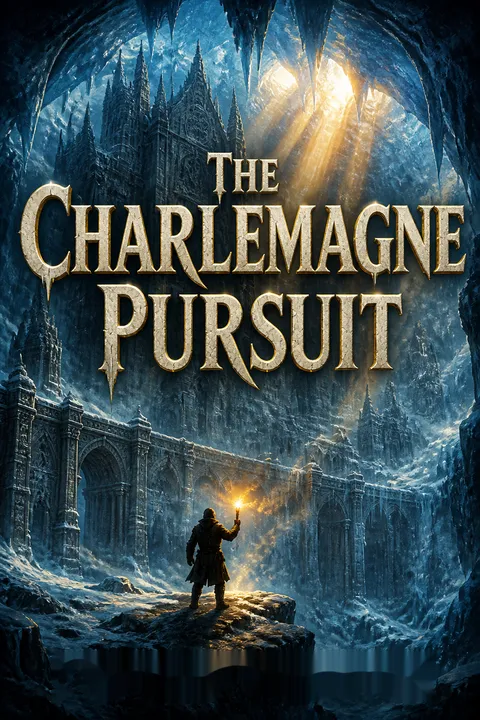
Malone’s group reaches Halvorsen Base, then follows Christl’s maps to a cabin built during Hermann’s 1938 expedition. A symbol carved into the floor matches the emblem on Charlemagne’s manuscript. Beneath the boards, a ladder leads into a blue-lit tunnel that ends at bronze doors set into a mountain. Beyond them lies a city built of polished stone, its streets, homes, bathhouse, and central plaza preserved beneath the Antarctic ice.
Carved columns describe a society governed by advisers and organized around shared laws. Christl recognizes details from Einhard’s account and realizes that her grandfather’s supposedly impossible research was grounded in a real place. Malone’s personal search has reached the world his father went looking for.
The city is the material answer to generations of speculative history, but its preservation does not make it easily knowable. Its architecture and inscriptions survive while its inhabitants, customs, and chronology must be reconstructed from fragments. The discovery also reverses the familiar explorer’s narrative: the visitors are entering a place that once had its own order, rather than claiming an empty wilderness. For Christl, the city vindicates her family’s scholarship; for Malone, it raises the harder question of what happened to the people who found it before him.
The Family Turns Violent
The expedition’s fragile cooperation collapses inside the city. Ulrich Henn kills Werner Lindauer, Dorothea’s estranged husband, then tries to eliminate the remaining witnesses. Christl shoots Henn, but the sisters’ conflict sharpens when each claims the family’s legacy and the right to decide what happens next.
Malone finds the bodies of NR-1A crewmen preserved in the city, including one of the men from the submarine’s manifest. Dorothea confronts Christl with a gun that Malone has secretly unloaded. When Christl threatens to kill her and Malone, Dorothea uses her own weapon to shoot her sister. The search has uncovered the truth, but the family’s long competition has turned discovery into another occasion for destruction.
The ancient city does not heal the Oberhausers; it intensifies the rivalries they brought into it. The sisters inherit a family history that has repeatedly confused certainty with authority, and each tries to make the past validate her own claim. Henn’s violence exposes how completely Isabel’s household has become an apparatus of control, while Malone’s quiet removal of Dorothea’s ammunition briefly interrupts that system. Dorothea’s decision to shoot Christl is not a triumphant resolution. It is the final expression of a rivalry that neither history nor discovery has managed to undo.
The Logbook Tells All
Malone finds his father seated beside the submarine in an ice cavern, preserved with the last pages of his log in his lap. Forrest’s account explains that NR-1A suffered a battery fire, surfaced inside the cavern, and reached the hidden city with the crew and Dietz Oberhauser.
The men lacked enough cold-weather gear and could not open the other exits. Knowing no rescue would come because the crew had agreed to that condition, they chose how to face death.
Forrest wrote that he had spent every day thinking of Cotton and regretted never telling his son plainly how much he loved him. Dorothea, grieving the deaths around her and the loss of her family, leaves the cavern and takes her own life. Malone finally has the truth, but not the reunion he spent his life imagining.
Forrest’s journal replaces the navy’s impersonal account with a sequence of choices made under unbearable conditions. The crew’s deaths were not a simple disappearance: they survived the submarine’s failure, found the city, and then ran out of warmth, time, and possible exits. The father Cotton remembers only in fragments becomes a specific person through his handwriting and concern for his son. That recognition brings comfort without undoing the loss. The emotional resolution depends on accepting that love can be real even when it was poorly expressed and arrived too late to be heard.
Ramsey’s Last Promotion
In the United States, President Danny Daniels uses Diane McCoy to draw Ramsey and Smith into a trap. McCoy first presents herself as Ramsey’s ally, then approaches Smith with proof that Ramsey plans to discard him. Smith accepts her money and shoots Ramsey at the Maryland farmhouse, but the operation breaks down when Smith turns his rifle on McCoy, Stephanie, and Davis.
Stephanie keeps him talking while Davis takes a hidden pistol and shoots him. The confrontation ends Ramsey’s campaign for the Joint Chiefs and exposes his use of Smith to murder Sylvian, Alexander, Scofield, and others. Davis has confronted the man connected to Millicent’s death, but killing Smith cannot recover the years he spent believing that he had failed her.
The political plot resolves through managed deception, an unsettling mirror of Ramsey’s own methods. Daniels does not defeat the admiral by appealing to institutional virtue; he uses the same networks of leverage, access, and misdirection that Ramsey trusted. Davis’s final act is both necessary and psychologically costly, since the killing turns long-held anger into irreversible action. The scene refuses the fantasy that justice automatically heals grief. Ramsey’s network can be dismantled, but Millicent remains dead, and Davis must carry the difference between accountability and restoration.
The Dead Come Home
With Ramsey and Smith gone, the government recovers Forrest Malone and the other NR-1A crewmen, and the navy’s false account becomes public. Cotton refuses a military burial for his father and brings him home to Georgia, where he is laid to rest near his family.
Stephanie, Pam, and Gary attend; seeing his grandfather in the coffin brings Gary face to face with the family loss that shaped Cotton’s life. Cotton has remained angry at the navy, but his mother’s gratitude and pride finally break through his practiced restraint, and he cries.
The Antarctic books continue to yield information about the lost society, while the families of the crew receive the truth and the remains they were denied. The investigation gives them a burial, not the years they lost.
The homecoming resolves the opening’s central absence without pretending that explanation can compensate for decades of grief. Cotton rejects the honors that once defined his father’s service because ceremony, after the cover-up, would feel like the navy claiming a dignity it had failed to provide. The ordinary family burial matters more: his mother, former wife, and son witness the return of a person who had been reduced to a file. Cotton’s tears signal not a simple cure but permission to feel what the family’s silence had kept contained.
A Sound on the Stairs
Several days later, Malone returns to his Copenhagen bookshop and tries to rest after the funeral and the Antarctic expedition. He has accepted the city as home, but the habit of readiness remains: his emergency bag and pistol are still within reach. At 2:34 in the morning, three familiar creaks rise from the wooden stairs below his apartment.
Malone recognizes the sequence as the sound of someone climbing toward him. He takes the loaded Beretta from beneath the bed and moves out of the bedroom to investigate. The novel ends before he sees who has come. The mystery of his father is closed, but the last sound returns him to the dangerous work he believed he had left behind.
The closing beat refuses to let emotional resolution become permanent safety. Cotton has recovered his father’s body and learned what happened, yet his professional instincts survive the retirement he chose to escape danger. The carefully recognizable stair sounds turn domestic architecture into an alarm system, collapsing the distance between his new life as a bookseller and his old life as an agent. The ending is not a denial of the preceding closure; it shows that knowledge can settle one wound while leaving the person who sought it changed, alert, and exposed to whatever comes next.
Analysis
The novel’s central conflict is not simply whether an ancient civilization existed. It is who gets to decide what counts as knowledge, and what institutions do when evidence threatens their preferred story. The navy’s cover-up begins as a defense of a secret weapon and a dangerous mission, but it persists because secrecy benefits particular people. Ramsey turns that inherited concealment into political capital. His private violence is not separate from his career; it is the method by which he tries to secure a public future.
Against him, the book sets several imperfect forms of remembering. Cotton has fragmentary childhood memories, the Oberhausers have divided manuscripts, Rowland has a sealed recollection, and the navy stores books in a freezer without studying them. None offers a complete account alone. Truth emerges through comparison: a report contradicts a public story, a carved game board meets a cathedral inscription, and a father’s log replaces rumor with lived experience. The pursuit therefore treats interpretation as an ethical act. Evidence must be assembled, but the interpreter must also question the motives that shaped its preservation.
The lost city complicates the family’s wish for vindication. It proves that Hermann and Dietz were not simply fantasists, yet discovery does not repair the damage their ideas and family history caused. Christl and Dorothea reach the truth still trapped in the competition their mother cultivated. Their tragedy argues that recovering a past is not the same as resolving it. Cotton’s return to his father offers a quieter counterpoint: he cannot restore the years they lost, but he can finally understand the man behind the official silence. The story’s deepest resolution is not that history becomes clean. It is that people can stop mistaking silence for an answer.
Review Summary
The Charlemagne Pursuit receives mixed reviews, with an average rating of 3.93/5. Readers appreciate Berry's blend of history and fiction, praising the fast-paced action and intriguing plot. Some find the characters well-developed, while others criticize them as two-dimensional. The book's complex storyline, involving Charlemagne, Nazi expeditions, and a lost submarine, captivates many readers. However, some find the multiple plotlines confusing and the villains clichéd. Overall, fans of the Cotton Malone series enjoy the personal nature of this installment, though it may not be the strongest entry.
People Also Read







Characters
Cotton Malone
The reluctant investigatorA former naval officer and Magellan Billet agent, Cotton now runs a rare-book shop in Copenhagen. He is observant, physically capable, and wary of easy explanations, with a book dealer’s eye for provenance and a soldier’s instinct for danger. His search for his father begins in anger at the navy’s silence, but it also reflects a deeper need to distinguish the man he loved from the idealized memory left behind. Cotton often uses dry humor to deflect emotion and prefers to work alone, even when other people’s knowledge is essential. His loyalty is hard to earn but durable once given.
Stephanie Nelle
Cotton’s former directorThe head of the Magellan Billet and Cotton’s longtime friend, Stephanie is a lawyer and intelligence director who balances institutional caution with personal loyalty. She gives Cotton access to the submarine inquiry because she believes he deserves the truth, then finds herself drawn into the danger that follows. Practical and perceptive, she is accustomed to making decisions with incomplete information and to carrying responsibility without much support. Her empathy does not make her soft; it makes her willing to act when rules stop serving justice. Her evolving partnership with Edwin Davis challenges her usual preference for keeping emotional distance from colleagues.
Langford Ramsey
The ambitious intelligence chiefRamsey leads naval intelligence and has spent decades converting military service into influence. Patient, polished, and disciplined in public, he is also highly skilled at reading people as assets or obstacles. His ambition is not impulsive; it rests on carefully cultivated favors, political alliances, and an ability to exploit secrets. Ramsey’s self-command conceals a belief that power justifies its own methods. He is shaped by a career in which loyalty is transactional and history is useful only when controlled. His rise places private misconduct, institutional secrecy, and national ambition in the same moral frame.
Edwin Davis
The grieving White House adviserA deputy national security adviser, Edwin is thoughtful, dryly funny, and more emotionally guarded than his courteous manner suggests. His history with Millicent Senn gives the submarine investigation a personal charge, but he also sees the danger of allowing old grief to dictate present choices. Edwin tends to act alone and distrusts a system he believes protects its own failures. His partnership with Stephanie brings his conviction into contact with someone more practiced at managing risk. He is capable of tenderness, though loss has persuaded him that attachment inevitably leads to pain.
Dorothea Lindauer
The practical Oberhauser heirA Bavarian heiress and one of the twin daughters of Dietz Oberhauser, Dorothea is business-minded, controlled, and accustomed to protecting herself through competence. She regards her family’s fascination with lost civilizations as a threat to its standing, yet cannot dismiss the mystery of her father’s disappearance. Her history with her twin sister Christl is marked by competition and unspoken grievance, while the death of her son Georg has deepened her capacity for anger and isolation. Dorothea’s composure is a defense, not an absence of feeling; beneath it, grief and fear of failure remain difficult to separate.
Christl Falk
The historian of the familyDorothea’s twin sister, Christl studies medieval history and is drawn to the questions her father and grandfather pursued. She is intellectually confident and more willing than Dorothea to entertain evidence that does not fit accepted history. Her scholarship gives her a route into the Charlemagne puzzle, but her faith in the family’s neglected research can also become a source of rigidity. The sisters’ rivalry complicates her desire to honor their father and grandfather. Christl longs to be taken seriously as a thinker in her own right, not merely as the more idealistic half of a divided inheritance.
Isabel Oberhauser
The family’s controlling matriarchThe elderly head of the Oberhauser family, Isabel manages its enormous wealth and tries to prepare her daughters to inherit it. She believes that the family’s history must remain under family control, and she uses secrets, tests, and carefully chosen allies to push her daughters toward her preferred outcome. Her grief for her husband and grandson rarely appears as open tenderness. Instead, it becomes discipline and management. Isabel understands how to influence people, but her conviction that she can direct every relationship blinds her to the damage her methods create.
Forrest Malone
Cotton’s absent fatherA career naval commander, Forrest was the father Cotton remembers through a small store of childhood scenes and through the stories of his shipmates. He is defined by professional discipline, responsibility for his crew, and deep affection that he found difficult to express directly. His final mission places his family life inside a larger story of military secrecy and human endurance. Forrest’s absence has shaped Cotton’s choices for decades, while the limited memories Cotton retains leave him wondering what kind of man his father truly was. His story centers the novel’s question of what duty can demand from a family.
Dietz Oberhauser
The vanished Antarctic seekerThe father of Dorothea and Christl, Dietz joined NR-1A as a specialist in the search for an ancient civilization. He inherited an obsession with his father Hermann’s research and believed the clues in old manuscripts and Antarctic stones pointed toward something real. His daughters remember him through different emotional lenses, and his disappearance leaves both with questions about his judgment, courage, and purpose. Dietz’s willingness to pursue an uncertain theory makes him a link between the Nazi-era expedition and the American naval mission decades later.
Charlie Smith
Ramsey’s hired operativeA meticulous contract killer, Smith studies routines, medical records, and small domestic habits to make deaths appear accidental. He is vain, flippant, and fond of popular entertainment, traits that make his calm professionalism more unsettling. Smith treats murder as skilled work rather than a moral decision, and his long relationship with Ramsey depends on payment and mutual usefulness. He prefers control, preparation, and clean exits. His confidence comes from years of success, but that reliance on being the smartest person in the room leaves him vulnerable when others begin using his own methods against him.
Diane McCoy
The strategic deputy adviserA deputy national security adviser and Edwin Davis’s counterpart, Diane is ambitious, politically alert, and comfortable operating in the gray areas of government. Ramsey underestimates her at first, mistaking her cooperation for dependence. Diane understands that access and information can be used as leverage, and she is willing to take personal risks when she believes a threat reaches national security. Her relationship with the White House is both professional and strategic. She is not simply a subordinate waiting for direction; she has her own calculations and can alter the balance of a political contest.
Danny Daniels
The improvising presidentThe president of the United States, Daniels is famous for a folksy manner that encourages people to underestimate him. Beneath it is a sharp political instinct and a habit of listening for what others are reluctant to say. He gives Stephanie and Edwin room to investigate, then helps arrange the resources Cotton needs to reach Antarctica. Daniels prefers practical improvisation to formal ceremony, though he understands the power of political trade. His presence complicates the distinction between personal loyalty and public responsibility, since his support matters precisely because he can act where others are constrained.
Zachary Alexander
The retired Antarctic captainA former naval commander, Alexander captained the USS Holden during its secret voyage south in 1971. He remembers being ordered to transport three lieutenants and let them conduct their work ashore without questions. Years of resentment toward the navy have made him guarded and combative, but his recollection supplies a crucial link between Ramsey and the Antarctic mission. Alexander represents the ordinary career officer caught inside decisions made at higher levels, then left to live with unanswered questions about why his service was judged insufficient.
Herbert Rowland
The endangered mission witnessOne of the lieutenants who accompanied Ramsey to Antarctica, Rowland is a retired naval officer whose memories have remained sealed by an old order. He is diabetic, enjoys whiskey, and has built a quiet life far from the military. When his past becomes dangerous again, he must decide whether his oath still matters more than telling the truth. His recollections expose what Ramsey brought back from the ice and what the navy chose to hide. Rowland is neither a polished intelligence operative nor a natural witness, which makes the details he remembers feel hard-won.
Douglas Scofield
The silenced researcherAn anthropologist hired by the navy to examine the carved Antarctic stones, Scofield has spent years pursuing theories about ancient navigation and forgotten cultures. He is proud of his research and impatient with people who dismiss it without listening. His mixture of serious scholarship and unconventional interests makes him difficult to classify, even for those who seek his help. Scofield once had access to evidence that could have changed his career, but the project was stopped before he could complete his work. He remains committed to what he saw, despite the professional cost of being unable to prove it publicly.
Werner Lindauer
Dorothea’s estranged husbandDorothea’s husband, Werner has lived for years inside a marriage hollowed by grief after their son Georg died. He appears passive and self-interested, but beneath his reserve is a capacity for decisive action. The Oberhauser family’s wealth and the sisters’ struggle for inheritance draw him into a crisis that forces him to choose whether to remain a bystander or act.
Ulrich Henn
The family’s hard-edged attendantAn East German former military man, Henn serves the Oberhauser family as protector, fixer, and enforcer. He is quiet, disciplined, and difficult to read, presenting himself as a household employee while carrying skills acquired in a more dangerous world. His loyalty to Isabel makes him a powerful presence in the family’s struggle, and his silence allows others to underestimate how much he knows.
Gary Malone
Cotton’s teenage sonCotton’s fifteen-year-old son, Gary spends time with his father and wants to understand the grandfather he never knew. His questions about Forrest’s death help prompt Cotton to reopen the old case. Gary matters to Cotton’s emotional life because he represents both a relationship Cotton wants to protect and a chance to be a more present father than his own was able to be.
Plot Devices
The Charlemagne Pursuit
A chain of historical cluesEinhard’s will directs the search through a sequence of references to Charlemagne, the new Jerusalem, Solomon’s throne, and Roman design. Each clue sends Malone and Christl to a physical site or object: the Aachen chapel, its throne, a repeated word pattern, and the ruined monastery at Ossau. The clues make history function as an active map rather than background. The pursuit also forces the sisters to depend on one another, since books, family papers, and physical evidence have been divided among them.
The NR-1A Cover Story
A past hidden by governmentThe navy publicly invents the USS Blazek and places its loss in the North Atlantic, concealing NR-1A’s Antarctic mission and the decision not to search for survivors. The false report initially appears to be an old bureaucratic failure, but its contradictions drive Cotton’s inquiry and expose the surviving witnesses to danger. A dry logbook, a falsified location, and the absence of a rescue operation become evidence that the official record is designed to protect both the submarine program and the people who controlled it.
The Three Manuscripts
A key to an unreadable worldThe books associated with Charlemagne, Einhard, and Hermann Oberhauser preserve separate parts of the mystery. One holds a coded account, another records the historical connection, and the third supplies the alphabet needed to translate the strange script. Their unusual drawings and marks invite misinterpretation until Christl combines her medieval training with the translation program. The manuscripts are not merely treasure: they show how knowledge can survive while remaining inaccessible, especially when each custodian understands only part of what has been passed down.
The Antarctic Freeze
A natural archive and tombThe continent’s cold preserves wood, paper, buildings, and human remains with extraordinary clarity. This makes the hidden city and the NR-1A crew discoverable long after their deaths, but the same environment makes survival nearly impossible once the submarine fails. The ice therefore serves two opposite roles: it protects evidence from decay and turns the landscape into a trap. Ramsey’s recovered logbook and the preserved books make that contradiction central to both the conspiracy and the eventual recovery of the truth.
Smith’s Quiet Killings
Murder disguised as misfortuneSmith uses medical vulnerabilities, household routines, and small environmental details to make targeted deaths appear natural or accidental. His methods let Ramsey act without creating an obvious trail, while the seemingly ordinary causes of death delay suspicion. The device also reveals how intelligence work can turn intimate knowledge into a weapon: a patient’s medication, an old electrical repair, or a habit before bed becomes part of the murder plan. As Stephanie and Edwin recognize the pattern, the assassinations connect Ramsey’s political ambition to the effort to suppress the Antarctic truth.
Cotton Malone Series













About the Author
Other books by Steve Berry

Download PDF
Download EPUB
.epub digital book format is ideal for reading ebooks on phones, tablets, and e-readers.








