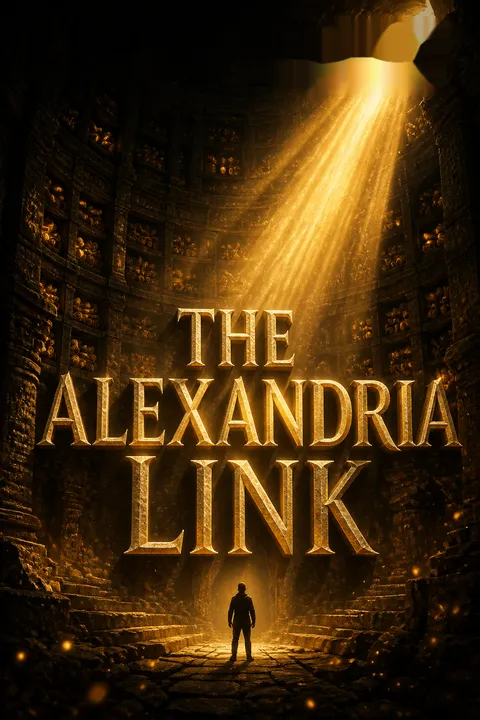


Plot Summary
Prologue
In Palestine in 1948, nineteen-year-old George Haddad fights with the Arab resistance as the war drives families from their homes. A captured stranger calls himself a Guardian, a keeper of knowledge, and says he came to invite George’s father to a hidden library. But George’s father has died by suicide, crushed by his failure to prevent the catastrophe.
The stranger refuses to reveal what the invitation means, even when George threatens him. George shoots him. The Guardian’s last assurance is that another invitee will be chosen. George carries the unanswered words into old age, where they become the beginning of a different life.
The prologue gives the book’s historical mystery a human cost before it becomes an adventure. George’s choice is not presented as a neat origin story: he kills from grief and fury, believing violence is the only language left to him. The Guardian’s calm insistence on knowledge cannot compete with the immediate reality of loss. That imbalance becomes the wound George carries for decades. His later search for the library is therefore not simply scholarly curiosity. It is an attempt to answer the dead man, and to understand whether the violence George trusted was ever necessary.
A Son Taken in Copenhagen
At his Copenhagen bookshop, retired American agent Cotton Malone finds his ex-wife, Pam, frantic after two men abducted their fifteen-year-old son, Gary. The kidnappers ordered her to wait two days before contacting Cotton, then sent him an ultimatum: retrieve the Alexandria Link, which he alone knows how to find, or lose Gary.
Cotton refuses to move on their terms without speaking to his son. Armed men answer by firing incendiary grenades into the shop’s lower floors. Cotton leads Pam across the building’s high stone cornice to the neighboring roof, escaping the flames as his store burns below.
With the deadline already shrinking and no trustworthy account of who is behind the abduction, he takes Pam to his wealthy Danish friend Henrik Thorvaldsen for help.
The kidnapping turns Cotton’s retirement into a test of whether his old discipline can survive a private crisis. His first instinct is to demand proof that Gary is alive, but the kidnappers control the terms and use the bookshop as a demonstration of power. Pam’s delayed warning compounds Cotton’s anger, while the fire makes their conflict physically urgent: neither can afford to settle old scores before acting. The Alexandria Link begins as an opaque name, but Cotton’s refusal to explain it establishes that his silence is not mere stubbornness. He is protecting knowledge that may endanger more than his family.
The Castle Meeting Ends in Blood
At Thorvaldsen’s estate, Cotton learns that the Justice Department’s Magellan Billet has suffered a breach: someone used a valid password to inspect the classified Alexandria Link file. Stephanie Nelle, Cotton’s former supervisor, admits the breach was known but not reported to him.
She sends agent Lee Durant to brief Cotton at Kronborg Castle. Before Durant can explain more, a gunman shoots him inside the castle’s Corner Chamber and leaves Cotton holding an unloaded weapon.
Cotton escapes through the castle with Pam, then follows the killer into Helsingør, hoping the shooter will lead him toward Gary. Meanwhile, senior members of a Vienna-based organization approve giving their operative, Dominick Sabre, broad authority to pursue the Link.
The murder at Kronborg converts bureaucratic secrecy into immediate bodily danger. Cotton has reason to distrust both the kidnappers and his own institution: the Billet withheld the breach, and its attempt to help ends with an agent dead. The public castle offers no sanctuary, only a maze in which every choice can expose him. The Vienna meeting widens the conflict without yet explaining it, showing that the violence is authorized by an organized power rather than an isolated criminal. Cotton’s decision to pursue the gunman is both tactical and personal. He has no reliable channel left, so he makes the killer himself into a source of information.
One Bullet Left
Cotton and Pam follow the Kronborg shooter from Helsingør to a Copenhagen safe house where Gary is being held. Cotton reaches his son through the back yard, but the Dutch kidnapper catches them during their escape and uses Pam as a hostage. Cotton disarms himself to keep her alive and sends Gary toward the captor.
The second gunman then kills the first, revealing that the kidnapping team is disposable. Cotton has kept one round chambered in his Beretta, despite throwing away its magazine, and shoots the surviving kidnapper before he can take Gary. The boy is safe, but the apparent rescue was arranged by Sabre, who wanted Cotton to believe he had won and continue searching for the Link.
Gary’s rescue is a genuine relief, but the victory is contaminated by the realization that Cotton’s enemy choreographed it. Cotton’s willingness to surrender Gary for Pam’s life exposes the hierarchy of his loyalties: the boy is not his biological child, yet no distinction matters to him. His chambered round is a small expression of professional habit, but it becomes the difference between helplessness and action. Sabre’s manipulation also changes the meaning of Cotton’s competence. Each successful choice may be serving someone else’s design, so survival alone cannot tell him whether he has regained control.
Haddad Faces the Past
In London, Cotton finds George Haddad, the Palestinian scholar he hid five years earlier after a bombing in Jerusalem. Haddad explains that a Guardian once invited him to prove himself worthy of entering the Library of Alexandria, where he hoped to examine ancient biblical texts. His research suggests that the Old Testament’s translations may have distorted its original geography and meaning.
The Israelis arrive to kill him before he can reveal more. Haddad shoots one attacker, but another shoots him; Pam is grazed as Cotton pursues the surviving assassin. Cotton returns to the apartment and takes a satchel Haddad hid beneath his bed. It contains maps, notebooks, and a novel that may point toward the Guardian’s test.
Haddad’s return makes the past an active force rather than a decorative mystery. His studies began as an effort to understand scripture, but the political stakes arise because a changed translation could unsettle claims founded on sacred history. His choice to summon Cotton also carries guilt: he is trying to repay the life he took in 1948, even if that debt places others in danger. The attack appears to confirm that knowledge itself is being suppressed by violence. Cotton’s discovery of the satchel gives him a practical route forward, but it also means Haddad’s private burden has become Cotton’s responsibility.
Vienna’s Blue Chair
Cotton’s search runs alongside a struggle among governments and powerful interests. Thorvaldsen tells Stephanie that the Order of the Golden Fleece is a wealthy European cartel governed by five Chairs, led by Austrian industrialist Alfred Hermann, the Blue Chair.
Its operative is Sabre, known within the Order as the Talons of the Eagle. Hermann wants the Library’s contents to challenge Israel’s biblical claim to its land and unsettle Saudi Arabia, then use the resulting instability for profit and influence.
In Washington, Attorney General Brent Green and Deputy National Security Adviser Larry Daley argue over the compromised file and Cotton’s choices. Stephanie distrusts them both, while the Israeli agent Heather Dixon warns her that Haddad remains a target.
The Order’s plan converts scholarship into a commodity. Hermann is not seeking truth for its own sake; he wants knowledge powerful enough to move governments, markets, and alliances. The political subplot mirrors Cotton’s personal dilemma: institutions that claim to protect people may instead treat them as instruments. Stephanie’s suspicion is therefore not simply temperament. She is navigating a system in which even accurate information can be selectively withheld or weaponized. The name of the Blue Chair suggests orderly governance, but the Order’s real stability depends on concealed violence and bargaining power. Its elegant hierarchy is a machine for making private ambition look like policy.
Bainbridge’s Hidden Saint
Haddad’s notes lead Cotton and Pam to Bainbridge Hall, the English estate of Thomas Bainbridge, an eighteenth-century scholar who apparently reached the library and left clues behind. Cotton recognizes the garden monument’s image as a reversed Poussin painting and links its inscription to a puzzle.
Inside, Pam spots a small bronze of Saint Jerome on a table and notices the book beneath it, titled The Epiphany of Saint Jerome. Cotton connects that volume to the novel he took from Haddad. Before they can study it further, three armed intruders enter the manor. A stranger kills two of them, then introduces himself to Cotton as Jimmy McCollum, a treasure hunter also seeking the library.
The manor rewards attention to objects that seem too ordinary to matter. Cotton searches for a grand secret in the portraits, while Pam notices the modest statue and book he overlooks. Their differing habits make them more effective together than either is willing to admit. The clue’s reliance on Saint Jerome also joins the physical hunt to Haddad’s concern with translation and textual authority. McCollum’s arrival complicates the partnership before it begins: he saves Cotton and Pam, yet his easy violence makes gratitude an insufficient basis for trust. The quest is now a contest among people who share a destination but not an ethical purpose.
McCollum Offers the Quest
At the Savoy Hotel, McCollum admits that he has the Guardian’s hero’s quest but cannot solve it alone. He wants the credit and possible reward of finding the library, while Cotton has Haddad’s novel and research. Cotton recognizes that the first clue points to Belém in Portugal, where the River Tejo meets the sea, and to the Jerónimos Monastery, dedicated to Saint Jerome.
McCollum shares the opening lines but withholds the rest until Cotton proves useful. Pam works beside Cotton to research the monastery, and the three agree to travel together. Cotton keeps McCollum close because he holds the missing instructions, though the man’s military skills and willingness to kill make him a dangerous ally.
The alliance is built on reciprocal need, not trust. McCollum controls the quest’s wording; Cotton controls the interpretive skills and Haddad’s research. Pam’s legal-minded caution helps prevent their bargain from becoming a simple transfer of power. The arrangement also reflects the book’s recurring distinction between possessing information and understanding it. McCollum can steal the clue, but he cannot make it meaningful; Cotton can interpret it, but he lacks the whole map. Their cooperation is fragile because each man imagines the other as a temporary tool. The reader is invited to ask whether shared intelligence can restrain a mercenary’s appetite for ownership.
Belém Turns Silver Gold
At Lisbon’s Jerónimos Monastery, Cotton and Pam follow the clue from the dim lower choir toward the bright upper church. The setting sun passes through a rose window, crosses a wooden crucifix, and makes the silver sacrarium appear gold. Its door depicts the Nativity, confirming that the clue’s Bethlehem is Portuguese Belém. A website answers Cotton’s search with GPS coordinates in the southern Sinai.
Before they can leave, Israeli gunmen attack the monastery. McCollum fights them off, but a tracking device reveals that Pam’s expensive watch is broadcasting her location. Cotton throws it away. He then learns that an Israeli-connected lawyer had given Pam the watch, along with other tagged gifts, so the Israelis could follow her movements.
The monastery turns interpretation into a bodily experience: the clue is not merely read, but watched as sunlight alters the sacrarium’s surface. The moment makes the puzzle’s method visible, joining scholarship, architecture, and timing. Yet the discovery is followed by betrayal close to home. Pam’s gift, which seemed to signal a new relationship, has been converted into surveillance. Cotton’s anger is sharpened by the fact that the device helped expose Haddad. The episode does not make Pam foolish so much as show how intimacy creates access. The same trust that sustains family life can be exploited by political actors who understand where people are vulnerable.
Washington’s Borrowed Allies
Stephanie investigates the people circling Cotton and discovers that no faction is straightforward. Cassiopeia Vitt, a resourceful ally sent by Thorvaldsen, saves Stephanie when Dixon points a gun at her on the National Mall.
Thorvaldsen then reveals his membership in the Golden Fleece and explains its influence. Stephanie and Cassiopeia break into Daley’s house and find flash drives hidden inside a hollowed political book. At the National Air and Space Museum, Daley and Dixon explain Haddad’s theory: biblical place-names may fit western Saudi Arabia rather than Palestine, a claim that could provoke both Israel and Saudi Arabia.
As the museum is evacuated, Secret Service agents take Stephanie to meet President Daniels, who wants her to identify the traitor without alerting the conspirators.
Stephanie’s investigation dismantles the comfort of fixed alliances. Dixon first appears to be an enemy, Daley looks like a schemer, and Green presents himself as a cautious institutional ally. Each has access to partial truths, and each uses secrecy as a weapon. Cassiopeia’s rescue gives Stephanie a trustworthy relationship, but it does not simplify the political landscape. The controversy around Haddad’s research is dangerous precisely because it concerns evidence that could be interpreted as a threat to national identity. The president’s use of Stephanie as bait continues that pattern: even cooperation requires her to accept that she is being placed at risk for a larger objective.
A Kabul Plot Takes Shape
At the Golden Fleece Assembly, Thorvaldsen brings Gary to Vienna and overhears Vice President Brent Green discussing a plan with Hermann. They intend to have President Daniels killed during a surprise Afghanistan visit, using missiles arranged through Osama bin Laden’s organization.
Green expects to inherit the vice presidency and then the presidency, while Hermann expects political turmoil to make the Order’s scheme profitable. In Washington, Stephanie meets Daley, who confirms that the vice president’s staff discussed succession and gives her evidence.
Green kills Daley with a car bomb, then tries to kill Stephanie after admitting his role. Dixon, who has been secretly working with Daniels, shoots Green. Daniels cancels his own trip and forces the vice president toward resignation.
The political conspiracy makes the book’s argument about knowledge brutally literal: information is not merely valuable, it determines who may govern and who may die. Green and the vice president treat constitutional succession as a route to personal advancement, while Hermann sees the same event as leverage over foreign policy. Daley’s death demonstrates how quickly a person investigating corruption can be recast as a threat. Dixon’s final intervention reveals that apparent allegiance was itself part of the operation. The president’s response stops the immediate coup, but the solution remains controlled and secretive. Public stability is preserved through a private contest of surveillance, deception, and force.
The Red Serpent’s Path
Cotton, Pam, and McCollum reach the Sinai aboard a military transport arranged through Green. Cotton pushes Pam out of the aircraft with a parachute before she can refuse, a decision that earns him a painful blow after she lands safely.
At the coordinates, they find a ruined square building, fourteen scattered stones, and two openings aligned through its walls. Cotton stacks the stones into a platform and waits for noon. The sun turns the mountain’s red granite into a serpentine path, matching the quest’s clue.
They follow it through a tunnel marked with words from the story of Moses and reach a remote monastery. Cotton identifies the place as the destination, then persuades the gatekeeper that he is Haddad, the invitee named by the quest.
The Sinai sequence strips away the comforts of urban intelligence work. Cotton has to interpret landscape, endure heat, and trust a clue that depends on a precise alignment of time and place. His decision to force Pam into the parachute drop repeats the controlling habits that once strained their marriage, even when he believes he is protecting her. Her anger keeps that cost visible. The route itself links sacred narrative to material geography: a passage associated with Moses becomes a literal path through rock. Cotton’s use of Haddad’s name at the gate shows that the quest is not only about solving symbols. It is also about carrying another person’s unfinished claim.
The Library’s Living Keeper
Inside the monastery, a Guardian admits Cotton after he recounts the route from Belém through the online address to the Sinai. McCollum ignores the warning that only Haddad is invited and forces a second Guardian to lead him onward at gunpoint.
Cotton follows with Pam and discovers that the supposed London killings were staged to keep them moving; George Haddad is alive and now serves as the library’s Librarian. He explains that the Guardians deliberately guided the pursuit because governments and Hermann’s Order were closing in.
Sabre has entered the hidden passages with Haddad under threat. The Guardians have no weapons in the sanctuary, so Cotton must pursue him through a maze of chambers whose doors are marked with the letters from Bainbridge’s monument.
The revelation that Haddad survived does not erase the violence Cotton witnessed; it reclassifies it as a performance designed to steer him. The Guardians’ intervention is ethically uneasy. They have preserved knowledge, but they have also manipulated families, governments, and enemies into converging on their refuge. Their secrecy protects the library while depriving outsiders of agency. Cotton’s discovery of Haddad as Librarian joins his old friend’s academic ambition to the remorse begun in 1948. Meanwhile Sabre has crossed the sanctuary’s boundary by force. The library’s no-weapons rule creates a final test in which Cotton’s judgment, rather than sheer firepower, must carry him forward.
The Reading Room Duel
Cotton follows the monument’s letters through the underground maze and reaches the library’s Reading Room. Sabre is armed and determined to kill everyone there before claiming the collection for himself. Haddad reveals that he created the quest and planted the evidence that drew Sabre into the trap, then walks toward him, accepting the danger as payment for the Guardian he killed as a young man.
Sabre shoots Haddad dead. Cotton fires back but empties his weapon, leaving Sabre free to advance. Pam appears behind Sabre with Haddad’s gun and shoots him several times. Cotton had trusted that she would act when it mattered. The Guardians emerge to mourn Haddad, while Cotton asks to use their communications equipment.
The climax binds three acts of responsibility together. Haddad confronts the consequence of his youthful violence by choosing to face Sabre, but his sacrifice cannot undo the original killing or guarantee the library’s safety. Cotton’s empty gun makes him dependent on trust rather than mastery. Pam’s decision to shoot is especially consequential because she has never fired a weapon before; she acts not as an agent but as a person who chooses to protect someone. The library survives through cooperation among people who have spent much of the story concealing their motives. Its preservation is real, but it is purchased at the cost of Haddad’s life.
A Secret Returns to Silence
The Guardians’ hidden library remains undisclosed after Sabre’s death. President Daniels warns Hermann that the United States knows of the plot against him and secures Thorvaldsen and Gary’s departure from Vienna.
The vice president resigns rather than face public exposure, while the president’s planned Afghanistan trip is altered to prevent the attack. Daniels restores Stephanie to the Magellan Billet and keeps the conspiracy out of public view. Thorvaldsen agrees to fund the Guardians and help preserve their manuscripts.
Back in Copenhagen, Cotton finds workers rebuilding his burned bookshop. Pam apologizes for the years of hurt between them, and they agree to tell Gary the truth about his biological father when the time is right. Cotton accepts that the shop is only property; the family bond is what remains.
The resolution refuses the fantasy that uncovering a secret automatically improves the world. The library’s contents might overturn religious and political claims, but public release could also ignite new violence. Daniels chooses containment, while Thorvaldsen offers the Guardians material support without exposing their location. Cotton’s return to the damaged shop reframes his opening loss: books and buildings can be replaced, but trust must be rebuilt through difficult honesty. Pam’s apology does not restore their marriage, nor does Cotton’s acceptance erase the betrayal. Their agreement to tell Gary the truth offers a more modest form of repair, one based on ending the family’s inherited concealment.
Analysis
The novel’s central wager is that historical interpretation can become a weapon without becoming any less scholarly. Haddad’s hypothesis about the Old Testament’s geography is presented as a claim to be tested, but the actors around it respond as if the claim were already capable of moving borders. Israel fears the loss of a foundational narrative; Saudi Arabia fears the exposure of its sacred geography; Hermann sees a chance to profit from both fears; the vice president sees a route to power. The same evidence can therefore function as research, identity, propaganda, and currency.
Cotton’s plot gives that abstraction an intimate measure. The Alexandria Link matters because it brings the threat to Gary, while Cotton’s refusal to distinguish biological fatherhood from chosen fatherhood complicates the book’s recurring concern with inheritance. The old texts may be inherited, revised, or misread; family bonds may be biological, concealed, or sustained through daily care. In both cases, the novel asks what makes a claim legitimate. Cotton’s answer is less doctrinal than relational: he remains Gary’s father because he acts as one.
The story also refuses to equate information with emancipation. The library preserves works that might correct centuries of error, yet public exposure could produce fresh violence. Its Guardians manipulate the search, and Daniels suppresses the discovery to prevent political escalation. That choice is morally uneasy, but consistent with the book’s distrust of simple revelations. A truth does not arrive outside history; it enters a world already organized around power, fear, and competing needs.
Finally, the emotional resolution depends on admitting rather than erasing injury. Cotton and Pam do not reunite, and neither apology repairs the past. Their agreement to tell Gary the truth is modest but significant: they stop treating concealment as protection. Against the hidden library, the rebuilt bookshop, and the machinery of statecraft, this small act of candor is the most durable form of preservation the novel offers.
Review Summary
The Alexandria Link receives mixed reviews averaging 3.94 stars. Readers praise its thrilling treasure hunt plot involving the lost Library of Alexandria and fast-paced action across multiple countries. Many appreciate the historical intrigue and conspiracy elements. However, several reviewers criticize perceived anti-Semitic content and repeated attacks on religion, particularly regarding mistranslated Old Testament passages suggesting Israel's incorrect location. Common complaints include too many characters, formulaic plotting reminiscent of Dan Brown, short choppy chapters, and underdeveloped storylines. Fans of the Cotton Malone series generally enjoyed it more than casual readers.
People Also Read





Characters
Cotton Malone
Retired agent, relentless fatherCotton Malone is a former Magellan Billet agent who has retired to Copenhagen to run a rare-book shop. He is observant, disciplined, multilingual, and accustomed to making decisions under pressure, but professional competence has not made him emotionally transparent. He loves Gary as his son despite learning that they are not biologically related, and his bond with Pam remains knotted by old betrayals and his own past infidelity. Books appeal to his patient, analytical side; danger activates the instincts he thought he had left behind. Cotton’s central tension is not whether he can act, but whether he can keep his protective instincts from becoming another form of control.
Pam Malone
Lawyer, wounded co-parentPam is Cotton’s former wife, a successful trial lawyer, and Gary’s biological mother. She is intelligent, forceful, and accustomed to protecting herself through anger and self-reliance. Her childhood taught her that love and security can vanish without warning, while Cotton’s infidelity confirmed her suspicion that dependence invites hurt. She kept Gary’s parentage from Cotton for years, a choice that damages their already fragile relationship. Under pressure, Pam’s legal mind helps her decode clues and challenge assumptions, though fear can make her act impulsively. Her most important relationships are with Gary, whom she protects fiercely, and Cotton, with whom she is trying to replace accusation with honesty.
Gary Malone
Teenage son, quick observerGary is fifteen, raised by Pam and Cotton, and deeply attached to both despite their divorce. He is thoughtful, curious about history, and more composed under pressure than adults expect from him. Summers with Cotton in Denmark have given him a close relationship with his father and with Henrik Thorvaldsen. Gary can read emotional tensions around him and is not easily persuaded by comforting explanations. His loyalty is not passive: when people he cares about are threatened, he is willing to act. The adults’ secrecy places him in the middle of questions about family, trust, and the difference between biological connection and lived commitment.
George Haddad
Palestinian scholar, keeper of questionsGeorge Haddad is an elderly Palestinian biblical scholar whose life has been shaped by the 1948 war and by his study of ancient scripture. As a young fighter, he believed force could defend his people; later, scholarship and Christianity gave him a different way to approach the violence he had witnessed and committed. He is patient, intellectually exacting, and capable of keeping dangerous conclusions to himself for years. His friendship with Cotton rests on books and mutual respect rather than shared politics. Haddad’s research asks whether translations have altered the Old Testament’s geography, and his work makes him a bridge between ancient texts and present conflict.
Dominick Sabre
Mercenary, hungry opportunistDominick Sabre is an American operative employed by the Order of the Golden Fleece and known to Cotton as Jimmy McCollum. He is trained, adaptable, and skilled at reading the people he manipulates. His childhood was marked by instability, and he has learned to treat opportunity as something to seize before it disappears. Sabre wants more than wages: he covets authority, wealth, and the chance to shape events for himself. He can imitate friendliness when it serves a purpose, but he prefers solitude and regards loyalty as a transaction. His partnership with Cotton is built on useful knowledge, unequal trust, and competing ideas of who deserves to control the past.
Henrik Thorvaldsen
Danish magnate, steadfast allyHenrik Thorvaldsen is an immensely wealthy Danish businessman and Cotton’s close friend. Physically stooped and emotionally restrained, he often appears to be observing several moves ahead. He values discretion, loyalty, and practical preparation, but his cool manner conceals grief over the death of his son. Gary’s visits have become a source of affection and purpose for him. Henrik knows the world of the Golden Fleece from the inside and understands how influence travels through private relationships. His friendship with Cotton is unusually direct: he offers help without demanding that danger become less complicated first.
Stephanie Nelle
Billet chief, wary strategistStephanie Nelle leads the Magellan Billet, the Justice Department division that once employed Cotton. A seasoned strategist, she is politically alert, impatient with evasions, and willing to take risks when formal channels fail. She distrusts the White House and has reason to believe that colleagues may be withholding crucial information. Her loyalty to Cotton is personal as well as professional, and she feels responsible when his family is endangered by a matter connected to the agency. Stephanie’s sharpness protects her from manipulation, but it can also make cooperation difficult. She relies on experience, favors, and trusted relationships rather than assuming that an official title guarantees integrity.
Cassiopeia Vitt
Wealthy ally, capable operatorCassiopeia Vitt is a multilingual businesswoman with expertise in engineering and medieval history. She inherited control of a multinational enterprise, though her interests extend beyond corporate leadership to humanitarian work. Intelligent, physically capable, and difficult to intimidate, she assists Stephanie because she trusts Henrik and has a personal history with Stephanie’s late husband. Cassiopeia does not confuse wealth with safety or education with wisdom. She is willing to enter dangerous situations, but she challenges Stephanie when the plan seems reckless. Her steady competence gives Stephanie a partner who can act quickly without simply echoing her judgments.
Alfred Hermann
Golden Fleece leader, calculating patronAlfred Hermann is an Austrian industrialist and the Blue Chair of the Order of the Golden Fleece. He is disciplined, politically sophisticated, and fascinated by the power of preserved knowledge. His interest in the Library of Alexandria is inseparable from his belief that information can be converted into leverage. Hermann thinks in long plans, treats personal relationships as strategic variables, and expects others to value results over sentiment. He is also a father whose relationship with his daughter is marked by distance and control. His polished authority conceals a worldview in which history, religion, and economics are instruments to be managed.
President Danny Daniels
President, pragmatic counterplayerDanny Daniels is a two-term American president with an easy public manner and a sharp appetite for political detail. He knows the value of appearances but is not as simple or uninformed as his opponents assume. Daniels values Israel as an ally and is wary of officials who pursue private agendas inside his administration. He treats Stephanie as a difficult but effective investigator and understands that she may be more useful when she has freedom to act. His folksy humor helps him manage tense encounters, though behind it sits a hard calculation about power, security, and what can be safely made public.
Larry Daley
White House fixer, political dealerLarry Daley is the deputy national security adviser, an experienced political operator who understands how favors, money, and access move through Washington. He is ambitious and comfortable working in the shadows, which makes him easy to distrust. Daley keeps meticulous records and knows that small pieces of information can become powerful when assembled. His relationship with Stephanie is adversarial, but he recognizes her ability to investigate people the administration would rather leave alone. Beneath his polished confidence is a man who has spent years trying to remain useful to more powerful figures while preserving enough knowledge to protect himself.
Heather Dixon
Israeli agent, guarded allyHeather Dixon is an Israeli intelligence officer attached to the Washington mission. Stylish, disciplined, and politically alert, she has worked with Stephanie both cooperatively and in opposition. Dixon believes that Israel’s security cannot depend on other governments’ goodwill, a conviction that shapes her blunt view of threats and historical claims. She is willing to make hard choices and expects others to understand that intelligence work rarely permits clean moral categories. Her connection to Stephanie is real enough to complicate their confrontations, but neither woman assumes friendship will outweigh national interests.
Brent Green
Attorney general, reserved insiderBrent Green is the United States attorney general, a serious New England lawyer known for his conservative religious beliefs and controlled public manner. He has spent years defending an administration whose politics he does not always admire. Green is private, deliberate, and difficult to read, qualities that make him a potentially useful confidant and a source of suspicion. He approaches Stephanie with a mixture of concern and caution, while his position gives him access to information she cannot easily obtain. His insistence on procedure contrasts with Stephanie’s preference for direct action, but both understand that official systems can be used for purposes beyond their stated mission.
The Vice President
Ambitious political heirThe unnamed vice president is an experienced politician who wants the presidency and cultivates relationships with wealthy business interests and Arab leaders. He presents himself as a loyal member of the administration while privately pursuing a different direction in foreign policy. He is confident in his ability to use constitutional procedures and political alliances to advance himself. The vice president’s ambition is not unusual in Washington, but his willingness to treat national security as a route to personal power distinguishes him. He represents a form of political calculation that can sound reasonable until its human costs become explicit.
Margarete Hermann
Heir to an empireMargarete is Alfred Hermann’s daughter and expected successor to a vast family fortune. She is forceful, observant, and interested in the Golden Fleece, but her confidence sometimes outruns her judgment. Her father’s standards have shaped her ambition, while his emotional distance has left their relationship brittle. She notices Sabre’s independence and worries that he may become difficult to control. Margarete wants power in her own right, not merely the comfort of inheritance, and she is still learning how to distinguish genuine authority from proximity to it.
Jesper
Thorvaldsen’s trusted stewardJesper manages Thorvaldsen’s household with calm efficiency, even when the hour is late or danger has arrived at the door. He is loyal to his employer and accustomed to unusual requests, which makes him a quiet part of the support structure around Cotton and Gary.
Adam
Guardian, watchful guideAdam is a Guardian who helps protect the hidden library and has experience moving between the secretive world of the Guardians and the modern intelligence services. He is controlled, pragmatic, and committed to preserving the collection. His work requires him to manage appearances as carefully as physical threats, and he believes the library’s survival matters more than receiving recognition for protecting it.
Eve
Guardian, library stewardEve serves the Guardians as an assistant librarian and helps maintain the hidden collection. She is composed under pressure and understands how fragile the group’s secrecy has become. Her commitment is to the library and to the people who have spent generations protecting it, even as changing technology and outside interest make that task increasingly difficult.
Plot Devices
The Alexandria Link
A secret that draws fireThe Alexandria Link is the classified file that connects Cotton to George Haddad and to the location he concealed five years earlier. A breach exposes the file to actors who do not share a motive: the Israelis want Haddad silenced, Hermann’s Order wants the library’s knowledge as political leverage, and officials in Washington see possible policy consequences. The name becomes the kidnappers’ demand, forcing Cotton to act before he knows what the Link contains. Its main function is to turn a past operation into a present hostage crisis, while keeping the central question open: what could be so valuable that governments and private powers would risk lives to obtain it?
The Hero’s Quest
A trail made of interpretationThe Guardians’ quest is a sequence of clues that tests historical knowledge, observation, and practical reasoning. Cotton and Pam trace the Saint Jerome reference to Lisbon, read the sun’s movement through the Jerónimos Monastery, and use an online address to reach coordinates in the Sinai. At the final site, the letters from Thomas Bainbridge’s monument become directions through underground passages. The clues are designed to be solvable by an invitee but difficult to interpret without context. The quest also gives Sabre a way to exploit Cotton’s intelligence: he has stolen the instructions but needs Cotton to understand them. Its final purpose is to lead the invited scholar to the Guardians’ refuge.
The Bainbridge Monument
A stone key to the mazeThe marble arbor at Bainbridge Hall reproduces a reversed Poussin painting and carries a cluster of Roman letters. Public interpreters treat the inscription as a code, but George Haddad recognizes that it functions as a map. The image of shepherds studying a tomb echoes the language of the quest, while a nearby book about Saint Jerome provides the next intellectual connection. Later, the letters guide Cotton through the doors of the library’s underground maze. The monument’s importance lies in its delayed intelligibility: it looks like a decorative puzzle until Cotton reaches the place where its letter sequence can be used. It rewards memory, context, and attention to apparently minor details.
Pam’s Tagged Gifts
Intimacy turned into surveillanceAn Israeli-connected lawyer gives Pam an expensive watch and other gifts fitted with tracking devices. The watch follows her to the Sinai monastery and allows an Israeli team to find Cotton’s group. The device is effective because Pam has no reason to regard a personal gift as operational equipment, and because Cotton’s concern for her keeps her close to the search. Discovering the tracker forces Cotton to reconsider who has been monitoring them and confirms that Pam’s new relationship was shaped by intelligence work. The gifts transform affection into an access point, showing how espionage can infiltrate ordinary attachments without requiring the target to know that a compromise has occurred.
The Golden Fleece
Wealth organized as influenceThe fictional Order of the Golden Fleece is a European cartel governed by five Chairs and a membership of financiers and industrialists. Its structure allows the organization to fund political influence, employ Sabre, and pursue long-term plans without exposing individual members. Hermann’s ambition is to use discoveries from the Library of Alexandria to unsettle Israel and Saudi Arabia, then convert that upheaval into economic advantage. The Order makes the story’s archaeological mystery part of a modern power struggle: knowledge is valuable not only for what it says, but for who can control its release. Its formal rituals and elaborate hierarchy conceal a practical organization built around money, leverage, and plausible deniability.
Cotton Malone Series








About the Author
Other books by Steve Berry

Download PDF
Download EPUB
.epub digital book format is ideal for reading ebooks on phones, tablets, and e-readers.








