

Plot Summary
Prologue
In Babylon, Alexander the Great grieves the death of Hephaestion, his closest companion and lover. Believing his physician Glaucias could have saved him with a scarce medicinal draught, Alexander condemns the terrified man to die between two bent trees.
His grief has already driven him to slaughter a people in Hephaestion's name; now he turns a healer's failure into a public execution. When the trees tear Glaucias apart, Alexander leads his soldiers in a cry of remembrance, then admits to himself that the same fever is returning. Rather than fear it, he welcomes it.
The prologue sets the novel's central danger in miniature: love and grief become excuses for power to punish. Alexander's command of armies cannot restore Hephaestion, so he converts helplessness into a spectacle of control and makes another person pay for a loss he cannot reverse. The draught introduces a more complicated legacy. It might be a cure, but its secrecy already gives it political force. Alexander's final welcome of the fever links the ruler's appetite for glory to his disregard for his own survival, a pattern later characters inherit in very different forms.
The Museum Burns Blue
Retired Justice Department agent Cotton Malone is cycling through Copenhagen when an open door draws him into a Greco-Roman museum. A blow to the head leaves him trapped inside with two roaming machines spraying an acrid liquid. When sparks ignite it, the sprinklers intensify the blaze instead of stopping it.
Outside, Cassiopeia Vitt shoots the window, giving Malone a way out; he recognizes bags of the same fuel and drags her toward the canal before a fireball consumes the building. Firefighters discover that seawater, unlike fresh water, can smother the flames. Cassiopeia admits she expected the museum to burn, but withholds why. The night has already ended Malone's quiet retirement and pulled him back into her dangerous work.
The opening turns an accidental act of vigilance into a forced return to danger. Malone enters because an open museum door violates the habits of a former agent, while Cassiopeia's rescue reveals that she has been tracking the threat before he even understood it. Their contrasting knowledge creates the scene's suspense: he can interpret the fire's mechanics, but she knows enough to anticipate the attack. The liquid's resistance to ordinary firefighting also signals that this is not standard arson. The fire becomes an instrument that erases evidence while punishing anyone who happens to be nearby.
Eight Coins, One Message
At Cotton's bookshop, Cassiopeia and her friend Henrik Thorvaldsen explain that the Copenhagen museum displayed a copy of an elephant medallion, one of eight known coins commemorating Alexander's encounter with war elephants.
Thieves have already stolen four from European collections, concealing each robbery with a Greek-fire blaze. Thorvaldsen reveals that he bought the museum, removed the originals, and let the attackers destroy the empty displays. He and Cassiopeia had been waiting for the thieves to come.
The genuine Copenhagen coin carries tiny Greek letters, ZH, and Thorvaldsen has added a phone number to lure its taker into contact. When the thief calls, the group arranges a meeting, turning the stolen coin into a lead they can follow.
The medallion shifts the story from survival to investigation, but its importance is not monetary. A nearly overlooked object becomes a message system, and the museum's apparent destruction is revealed as an intentional decoy. Thorvaldsen's willingness to sacrifice a building and its contents makes his friendship tangible, while Cassiopeia's secrecy keeps the team from feeling fully secure. The tiny letters perform the novel's recurring trick: history appears inert until someone learns how to read its hidden marks. Objects in this story do not merely preserve the past; they recruit the living into its unfinished conflicts.
The Minister's Blood Game
In Samarkand, Supreme Minister Irina Zovastina rides into a brutal game of buzkashi on her horse, Bucephalas. When a gunman waits along the field, she keeps charging; a palace sharpshooter shoots him before he can fire, and she rides over his body.
The attempted assassination confirms how exposed her power remains, despite her unification of six former republics into the Central Asian Federation. Zovastina also confronts Colonel Enver, a political opponent whom a lethal virus has nearly killed.
She reveals that she arranged his infection and cure to demonstrate her reach, then offers him a place in her government. Enver joins her because he shares her fear of threats from neighboring states. Zovastina turns survival into recruitment, and coercion into a method of rule.
Zovastina's public courage and private manipulation are deliberately made inseparable. She faces a gunman without retreating, but her safety depends on a concealed sharpshooter; she presents daring as personal virtue while relying on systems of control. Her treatment of Enver makes the same point more starkly. She can spare an opponent, but only after making his vulnerability unmistakable. The scene complicates the language of reform: roads, schools, and political unity may improve people's lives, yet the ruler treats dissent as a problem to manage through infection and fear. Her heroism is real, but so is its cost to anyone beneath her authority.
A Body Hidden Twice
At the coastal house where the group prepares for the medallion exchange, Cassiopeia and Thorvaldsen explain what Ely Lund, her historian friend, found in a medieval manuscript. X-ray fluorescence revealed writing beneath later text, including an account attributed to a witness close to Alexander's court.
It describes the king's secret medicinal draught, his order to bury himself beside Hephaestion, and the substitution of another corpse before the public funeral procession left Babylon.
Years later, Ptolemy learned that the body revered in Egypt was not Alexander's and gave a historian an enigmatic riddle, along with an elephant medallion. Ely died after sharing his discovery with Zovastina, whose obsession with Alexander makes his death suspect. The lost tomb is no longer merely a legend; the manuscript supplies a route toward it.
The manuscript destabilizes the authority of familiar history without asking the reader to accept every old account as truth. A physical technology exposes what a later culture tried to erase, making historical knowledge an act of recovery rather than passive inheritance. Yet the recovered narrative also carries grief and motive: Alexander's secret burial joins him to Hephaestion, while Ely's death binds Cassiopeia to the investigation. The double burial gives the plot its investigative engine, but it also turns concealment into a kind of protection. Alexander wanted to escape the generals' struggle over his body, and later seekers risk repeating that struggle under new banners.
The Danish Bait
Viktor Tomas arrives at Thorvaldsen's house to inspect the Copenhagen medallion, carrying no visible weapon but plenty of practiced misdirection. Malone watches him palm the genuine coin and leave a convincing forgery in its case.
The theft confirms that the visitors are after more than collectible art, while Thorvaldsen's decision to let Viktor go allows the team to preserve the encounter as evidence. Cassiopeia, watching from outside, spots Viktor's partner slashing the car tires.
Malone and Thorvaldsen escape by boat, and Cassiopeia reaches them moments before the house erupts in Greek fire. Their planted cameras record the thieves leaving, and the destruction wipes away much of the evidence. The bait has worked, but Viktor now has the real medallion and knows his opponents are prepared.
The meeting is a contest of attention. Viktor wins the coin by directing the others' eyes toward the performance of examination; Malone recognizes the sleight of hand but chooses not to expose it. That restraint is not passivity. The heroes trade immediate possession for information, accepting a controlled loss to learn how the enemy operates. The cut tires and burning house show how quickly such calculations can become lethal. Cassiopeia's intervention saves the group, yet her decision to keep important facts to herself strains the trust she needs from Malone. Cooperation here is tactical before it is intimate.
Amsterdam's Bloody Bridge
At Cassiopeia's request, Magellan Billet director Stephanie Nelle meets Dutch collector Klaus Dyhr to buy another elephant medallion. Two armed men seize it in the café, and Stephanie follows with Secret Service agents.
On a bridge, the agents kill both thieves in a gunfight; one falls into a canal, where an agent retrieves the coin. Dutch police arrest Stephanie beside the bodies, but President Danny Daniels secures her release through diplomatic pressure.
Deputy national security adviser Edwin Davis then tells her the dead men served Zovastina's guard and that Naomi Johns, an American agent observing Enrico Vincenti, has disappeared. The administration has also linked Zovastina to stolen animals and a cache of zoonotic pathogens. Stephanie's favor for Cassiopeia has become an entry point into a biological threat.
The bridge sequence makes private favors collide with state power. Stephanie's choice to help Cassiopeia is personal, but her weapons and government connections make its consequences international. The deaths of the two thieves solve the immediate retrieval problem while making the danger impossible to dismiss as antiquarian crime. Daniels and Davis widen the lens from one coin to pathogens, stolen animals, and a missing agent. This expansion also tests Stephanie's professional identity: she is no longer simply gathering information for a president but confronting a threat whose political usefulness has kept it hidden. The recovered coin does not restore control; it increases the number of people watching.
Vincenti's Private War
Enrico Vincenti, an American-born pharmaceutical magnate who has reinvented himself as a Venetian power broker, learns that Zovastina is collecting the medallions. He has already killed Naomi Johns, the agent assigned to watch him, and concealed her body in a coffin with a Florentine contractor.
The Venetian League's Council of Ten, which publicly disciplines a hired thief for betrayal, is itself divided by Vincenti's ambitions. He secretly changes an assignment, sacrifices the contractor, and plans to use his influence over Zovastina for his own purposes.
Meanwhile, he monitors her movements, including visits to Karyn Walde, the former lover she keeps alive despite their bitter estrangement. The killing of Naomi removes a witness, but it also brings Washington directly into Vincenti's affairs.
Vincenti's polished public identity masks a politics of selective loyalty. The League condemns a contractor for treachery while its leader manipulates the same rules for personal advantage, showing that institutional morality can be little more than a weapon aimed downward. His murder of Naomi is practical, but it also draws a boundary around his secrets: anyone who might make him answerable becomes disposable. Karyn complicates that picture. Vincenti notices Zovastina's attachment because intimacy is one of the few vulnerabilities that can be converted into leverage. In this world, private affection is not outside politics; it is one of politics' most valuable pressure points.
The Saint's Missing Body
In Samarkand, Zovastina bargains with papal nuncio Colin Michener for permission to examine St. Mark's tomb in Venice. She suspects the relic may be Alexander's body, since the remains of Alexander vanished from Alexandria around the time St. Mark's appeared there.
In exchange for access, she promises the Catholic Church permission to work in the Federation, with limits on new buildings. At the same time, Cotton and Cassiopeia travel to Torcello, where the final European medallion sits in a small museum.
Viktor and his partner inspect the coin and map the route to it, while Cotton and Cassiopeia watch from the bell tower. The two investigations converge on Venice: Zovastina wants the tomb, while the Americans and Cassiopeia try to stay ahead of the thieves.
Zovastina's bargain with the Church reveals how readily she treats belief as a political instrument. She does not approach the relic as sacred, but as evidence that might advance her own quest; the Church, in turn, exchanges access for the possibility of religious expansion. The Torcello strand gives that high-level negotiation a physical counterpart. A remote island, a modest museum, and one unguarded coin sit within reach of the same competing plans. Venice becomes more than a setting: it is a city built from the traffic of relics, commerce, and appropriation, making it the natural place for characters to confuse possession with understanding.
Torcello's Last Coin
After dark, Viktor and his partner force their way into the Torcello museum, take the medallion, and spread Greek fire for another staged blaze. Cassiopeia bars the doors from outside, then shoots through a window and sends burning arrows into the building. The fire consumes the robotic machine and kills Viktor's partner, Rafael, but Viktor escapes through a weakened window and makes for his boat.
Cassiopeia follows him alone and confronts him aboard. She accuses him of killing Ely, and Viktor confirms he was present when Ely's house burned. When he kicks Cassiopeia into the lagoon, Cotton and Stephanie find her in the water and pull her aboard. She has not secured the last coin, and Viktor is heading for St. Mark's Basilica.
Cassiopeia's grief crosses into action before she has reliable knowledge. She uses the thieves' own weapon against them, but the fire does not distinguish between justice and revenge; it kills Rafael and leaves Viktor free to continue the mission. Her pursuit of Viktor is emotionally intelligible and strategically dangerous. Malone's rescue interrupts the private reckoning without resolving it, a pattern that recurs whenever her need for certainty outruns the available evidence. The sequence refuses to make violence cleansing. Cassiopeia survives, but the answers she seeks remain entangled with the person she believes responsible.
Bones Beneath the Altar
At St. Mark's Basilica, Zovastina watches priests lift the sarcophagus lid and finds only bones, ash, and a small wooden box, not the intact mummy she expected. Henrik Thorvaldsen confronts her with the possibility that the relic is not St. Mark's, while Cotton, Stephanie, and their allies examine a heart scarab found with the remains in 1835.
Its carved phoenix matches a clue in Ptolemy's riddle. Malone breaks the scarab and discovers a tightly coiled strip of gold foil hidden inside. Wrapped around a candle the size of an elephant medallion, the strip decodes into the Greek word for ladder. Zovastina leaves with Cassiopeia as a hostage, believing her search has failed; the others now have a new destination.
The empty sarcophagus is a failure that generates better evidence. Zovastina expects a body to resolve the mystery, but the absence of one forces attention onto a smaller object that the Church had preserved without understanding its role. Malone's willingness to break the scarab turns interpretation into risk: the clue can be read only by destroying its container. The candle and gold strip make the ancient cipher tactile, bringing a modern investigator's practical habits into contact with an old political message. The discovery also establishes an asymmetry. Zovastina leaves with a hostage, but the others leave with the means to continue the search.
The Cure in Samarkand
While Zovastina is in Venice, Vincenti abducts Karyn from the house where Zovastina has been nursing her through AIDS. At his mountain estate, he injects her with a treatment made from archaea bacteria and explains that it can destroy HIV.
He has kept the cure secret for years, allowing the epidemic and its market for drugs and medical supplies to grow. He intends to use Karyn's recovery against Zovastina, whose rule depends on her relationship remaining hidden.
When Zovastina returns and reaches the estate, she confronts Vincenti and Karyn. Karyn tells her that Vincenti has cured her; Zovastina shoots Karyn and then Vincenti. She seizes his computers and orders Grant Lyndsey, the scientist who knows the research, brought under her control.
The cure arrives with an ethical wound attached. Vincenti has found a treatment that could save millions, but he has treated suffering as a market-building interval and patients as data. His choice to help Karyn does not erase that history; it gives him a possible instrument against Zovastina. Her response exposes another failure of possession. She cannot distinguish saving Karyn from controlling her, and when Karyn names that distinction, Zovastina answers with violence. The scientific breakthrough therefore does not arrive as uncomplicated hope. It enters a contest among people who have each learned to make another person's body serve a larger ambition.
A Cabin Still Occupied
The decoded word directs Stephanie Nelle and Thorvaldsen toward Ely's remote cabin in the Pamirs. They find Ely alive, hidden there after a political rival's assassin attacked him; Viktor had killed the attacker and Zovastina had concealed Ely, ostensibly for his protection. Ely explains that Zovastina questioned him about the riddle and Alexander's tomb, but he had not known she was using his discoveries to pursue a wider plan.
When a guard arrives and shoots the tires on their car, Stephanie and Thorvaldsen escape the cabin with Ely's help. Stephanie kills the guard as he raises his rifle. Ely identifies the mountain's old name, Klimax, and its local name, Arima, giving the team a location to investigate.
Ely's survival reverses Cassiopeia's grief but does not make the preceding months harmless. He has been protected and confined by the same ruler, a distinction he could not recognize from inside the cabin. His discovery therefore complicates the meaning of rescue: safety without informed consent can become a gentler form of captivity. Stephanie's first killing gives the scene a different emotional cost. She has worked through years of intelligence operations, yet taking a life changes her understanding of what fieldwork demands. The mountain's paired names provide a clue, but its meaning emerges only because history, geography, and personal testimony are read together.
The Trees and the Goats
Zovastina brings Cassiopeia to the clearing where she has previously executed enemies between two bent trees, hoping to force information from her. Cotton reaches the site with Viktor, who releases a herd of goats into the clearing as a distraction.
Malone shoots one guard, Viktor shoots another, and they free Cassiopeia before the trees can tear her apart. Viktor then reveals that he has been working with American intelligence, though his loyalties remain uncertain.
At the same time, Thorvaldsen tells Zovastina that she plans to spread engineered zoonoses through Iran, Afghanistan, and Pakistan, then enter as a rescuer after mass deaths. Cassiopeia has been taken as leverage, but the rescue gives the group a chance to reach Arima before Zovastina can secure the mountain.
The clearing turns the novel's opening image into an immediate threat: the ruler who reenacts Alexander's execution is about to make another captive bear the cost of her own fear. The goats, usually background to the landscape, become an improvised countermeasure, a reminder that rescue often depends on what is available rather than what is ideal. Viktor's assistance offers relief but not certainty; a covert informant cannot be understood through a simple label of ally or enemy. Meanwhile, the biological plan reveals the scale of Zovastina's historical fantasy. She does not merely admire Alexander's conquests; she intends to reproduce their map through disease.
Arima Opens Below
Malone, Cassiopeia, and Viktor reach the tunnels beneath Vincenti's estate and find two lit pools marked with the letters Z and H. The tawny pool conceals an underwater passage into chambers decorated with ancient paintings and two sarcophagi: Alexander lies beside Hephaestion.
Zovastina arrives and sees the tomb, while the green pool offers the living bacteria that can destroy HIV. Above them, she has already killed Karyn and Vincenti, taken Lyndsey and the research computers, and ordered Greek-fire machines to burn the mansion.
Stephanie, Thorvaldsen, Ely, and Lyndsey are trapped inside. Malone and Cassiopeia escape the tomb's flooded passage, but the house is becoming an inferno and Zovastina is leaving with the knowledge and resources to continue her campaign.
The mountain gives the novel's history a physical answer: Alexander's hidden grave is real, and his wish to rest beside Hephaestion has survived the centuries. Yet the discovery is not a final solution. The same site holds a living cure, and the ruler who reaches it wants both the symbolic authority of Alexander and the biological means to conquer. Above ground, Greek fire turns the mansion into an extension of that logic, erasing evidence and endangering captives. The buried chamber and burning house place preservation against destruction, but neither is morally simple. The heroes must leave the tomb's wonder behind to save living people and prevent its knowledge from being monopolized.
The Helicopter Becomes Fire
Viktor reveals that he has been playing both sides: Zovastina knew of his American connection and used him to feed Washington selective information. He now helps Cassiopeia set off Greek-fire machines hidden aboard the helicopter carrying Zovastina away.
Cassiopeia presses the detonator despite the risk to Malone and Ely, who are still inside the burning estate. The helicopter erupts in a fireball, killing Zovastina before she can launch her biological campaign. Viktor helps the others while the mansion catches fire.
Malone and Ely escape through a shattered library window, carrying the flash drive with Vincenti's cure research. The surviving group secures the estate, the research, and the knowledge of Alexander's tomb, but the operation has cost lives on every side.
The climax resolves the contest through a choice rather than a clean tactical victory. Cassiopeia risks killing the people she wants to save because waiting would let Zovastina escape with the means to continue her war. Viktor's double role clarifies that information itself has been weaponized throughout the story; even the Americans received a version of events chosen by their asset's other handler. The fireball destroys the ruler and her immediate plan, but it does not purify the institutions or motives that produced them. Malone and Ely surviving with the flash drive matters because the cure's future depends on knowledge leaving the hands of those who treated it as leverage.
A Walk in Copenhagen
With Zovastina dead, American forces secure the estate and the Federation's biological stockpiles are destroyed under international supervision. Scientists verify the bacteria's effectiveness, and the United States prepares to distribute the cure at minimal cost.
Ely returns to archaeological work, excavating Alexander's tomb with cooperation from the new Federation government. Six weeks later in Copenhagen, Thorvaldsen gives Malone the deed to the coastal property destroyed in the opening fire, inviting him to rebuild there.
Cassiopeia arrives at the café, now cured alongside Ely, and asks Malone to walk with her. He begins to ask about her and Ely, then stops when she makes clear she wants the present, not an interrogation. Malone joins her, leaving their future open.
The resolution deliberately moves from geopolitical consequence to a small choice between two people. The cure becomes public rather than private property, and the tomb becomes a site for study rather than a trophy for a new ruler. Neither outcome repairs the dead, including Naomi, Rafael, Karyn, or the people Zovastina intended to kill. Malone's final restraint is therefore meaningful: he does not demand that Cassiopeia account for her feelings or define her relationship with Ely before walking beside her. The book closes by replacing the pursuit of a grand historical legacy with a modest act of companionship, something less spectacular but less likely to consume the people who seek it.
Analysis
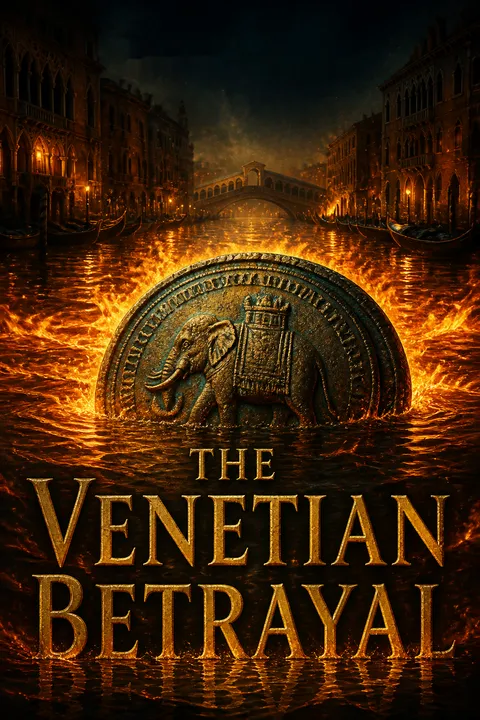
The Venetian Betrayal builds its thriller plot around competing attempts to turn the past into authority. Alexander's body, the elephant medallions, and Ptolemy's riddle are not merely historical curiosities. They are instruments through which modern characters try to justify power, claim inheritance, or discover a remedy. Zovastina sees Alexander as a model for conquering and unifying territories; Vincenti sees scientific discovery as a route to wealth and reputation; Malone and Cassiopeia seek evidence that can answer immediate human needs. The same history therefore produces radically different moral outcomes depending on who interprets it and for what purpose.
The novel's most pointed conflict is between care and possession. Zovastina builds a federation and improves living conditions, but she treats political opponents as bodies to infect or remove. Her love for Karyn is genuine, yet she cannot separate care from control. Vincenti finds a cure that could change countless lives, then withholds it because the epidemic enriches his company. Their crimes are not opposites so much as variations on the same premise: other people's lives may be managed for a supposedly greater end. The cure matters because it offers an alternative, but its existence alone cannot guarantee humane distribution.
The story also treats intimacy as a source of both courage and exposure. Cassiopeia's grief for Ely pushes her into danger, while her shared illness gives them a bond that is not reducible to romance. Malone's impulse to protect her clashes with her need to act for herself. Their final walk matters because he accepts companionship without demanding that she resolve her history for him. The book's emotional closure is deliberately smaller than its geopolitical crisis.
Finally, the ancient and modern plots mirror each other without declaring them identical. Alexander's empire broke apart after his death; Zovastina imagines that she can reverse its direction through engineered disease. Both rulers pursue a durable legacy, but the novel measures greatness less by territory than by what a person does with vulnerability. The hidden tomb preserves love and the spring preserves life, while the political projects built around them threaten both. The lasting lesson is that knowledge can liberate, but only when it is shared rather than held as leverage.
Review Summary
The Venetian Betrayal receives mixed reviews, with an average rating of 3.97 out of 5. Readers appreciate Berry's blend of history and fiction, particularly the Alexander the Great storyline. Some praise the fast-paced action and intricate plot, while others find it overly complicated or slow at times. Characters like Cotton Malone and Cassiopeia Vitt are generally well-received. Critics note the book's similarity to Dan Brown's works and occasional lack of character depth. Overall, it's considered an entertaining thriller with historical elements.
Characters
Cotton Malone
Retired agent, reluctant anchorCotton Malone is a former Justice Department operative who has retired to Copenhagen to run a rare-book shop. His training remains active beneath his bookseller's life: he notices suspicious details, reads physical evidence, and improvises when a plan collapses. He favors direct questions and dry humor, partly as tools for control and partly as ways to keep emotion at a distance. His friendship with Henrik Thorvaldsen repeatedly draws him into danger, while his attraction to Cassiopeia is complicated by her guardedness and her history with Ely Lund. Malone's central tension is not whether he can still act, but whether he can care about people without pretending their risks are merely professional.
Cassiopeia Vitt
Historian, fiercely guarded allyCassiopeia Vitt is a Spanish Muslim engineer and historian living in southern France. She brings technical skill, historical knowledge, and physical nerve to the search for Alexander's tomb. She rarely explains what she feels, preferring to turn private pain into action; her grief over Ely makes her both determined and vulnerable to manipulation. Her bond with Malone includes trust, attraction, and mutual resistance to emotional disclosure, while her attachment to Ely gives her search a personal center. Cassiopeia is not simply fearless. She knows what illness and loss can take from a person, and her control is a practiced defense against a future she cannot fully predict.
Irina Zovastina
Federation's iron rulerIrina Zovastina is the Supreme Minister who united six former Soviet republics into the Central Asian Federation. A disciplined politician with a deep interest in Alexander the Great and Homer, she sees history as both inheritance and instruction. She can point to economic growth, infrastructure, and greater regional unity as evidence of her success, yet she treats opposition as a threat to be neutralized. Her solitary childhood and carefully managed public image help explain her need for control, but do not excuse the violence she permits. Zovastina's attraction to heroic models offers her a language for ambition and sacrifice, while her relationship with Karyn exposes the emotional dependence she tries to deny.
Enrico Vincenti
Pharmaceutical kingmakerEnrico Vincenti is an American-born virologist who has built a European pharmaceutical empire and adopted a Venetian identity. He understands both laboratory science and the leverage of money, information, and secrecy. His polished manner conceals a willingness to manipulate colleagues, silence witnesses, and treat human suffering as a problem of timing and profit. Vincenti is not simply greedy: he wants historical recognition as a scientist, and that desire makes him capable of withholding a life-saving discovery until it serves his interests. His uneasy alliance with Zovastina rests on mutual need rather than trust, and he regards every partner as a possible competitor.
Henrik Thorvaldsen
Wealthy, stubborn protectorHenrik Thorvaldsen is a wealthy Danish businessman and Cotton's close friend. His crooked spine and quiet manner can make him seem physically diminished, but he is persistent, connected, and willing to spend his fortune to protect people and causes he values. His son Cai's death remains a private source of grief, and his friendship with Ely Lund links that loss to the central investigation. Thorvaldsen rarely gives a full explanation before acting, which frustrates Malone but also makes him an effective strategist. His loyalty is practical: he buys a museum to protect artifacts, arranges a boat when danger is expected, and keeps moving even when age and pain make movement costly.
Stephanie Nelle
Magellan Billet directorStephanie Nelle leads the Magellan Billet, an international Justice Department unit, and is accustomed to measuring risk before allowing personal feelings to interfere. Her friendship with Cassiopeia brings her into the medallion investigation, while her work for President Daniels places her between government secrecy and field realities. She is a capable investigator who can adapt under pressure, but the violence in Venice and the Pamirs forces her to confront the human consequence of decisions she once treated as professional necessities. Stephanie's directness can sound like impatience, yet it also reflects a serious obligation to the agents and allies whose lives are shaped by her choices.
Ely Lund
Historian of hidden textsEly Lund is a Danish scholar of Greek antiquity who works at Samarkand's cultural museum. His research into reused manuscripts gives him access to histories that ordinary scholarship has lost, including the account of Alexander's hidden burial. He is thoughtful, curious, and emotionally generous, a contrast to the guardedness of both Cassiopeia and Malone. His relationship with Cassiopeia grows from intellectual companionship into love, and their shared illness gives their bond an intimacy shaped by practical knowledge of mortality. Ely's trust in Zovastina is grounded in her apparent support for scholarship, which leaves him slow to recognize how easily intellectual curiosity can be recruited into political ambition.
Viktor Tomas
Guard with divided loyaltiesViktor Tomas leads Zovastina's Sacred Band and directs the hunt for the elephant medallions. A disciplined operative with a talent for deception, he often favors careful preparation over force. His partnership with Rafael gives him a rare personal attachment within a violent organization, while his service to Zovastina places him under constant pressure to anticipate her expectations. Viktor's ability to operate between competing powers makes him useful and dangerous in equal measure. He understands that survival in the Federation depends on reading what people want before they say it, but that skill also leaves him with few relationships based on uncomplicated trust.
Karyn Walde
Zovastina's estranged loverKaryn Walde was once Zovastina's secretary and lover. Their relationship was shaped by attraction, unequal power, and Karyn's refusal to be treated as property. After years apart, she returns to Samarkand seriously ill and dependent on care from the woman she still resents. Karyn's bitterness is not mere cruelty; it protects a selfhood she fears Zovastina will absorb. She understands the ruler's emotional weaknesses unusually well and can name the difference between being helped and being controlled. Her experience makes her a sharp judge of intimate power, even when illness leaves her physically vulnerable.
Edwin Davis
White House strategistEdwin Davis is the deputy national security adviser to President Daniels. A career diplomat with strong organizational instincts, he speaks mildly while arranging consequential interventions. He understands that official action can expose sources and trigger political fallout, so he often prefers indirect pressure and carefully chosen intermediaries. His decisions bring Malone, Stephanie, and Thorvaldsen into the same operation, sometimes without giving them the full picture. Davis sees secrecy as a practical necessity, but the people he recruits experience it as manipulation. His role tests the difference between protecting a mission and respecting the judgment of those asked to carry it out.
Grant Lyndsey
Scientist holding the dataGrant Lyndsey is the chief scientist at Vincenti's laboratory in China. He supervises biological trials and understands how the research is conducted, but he is also drawn to professional recognition and financial reward. His collaboration with Vincenti gives him access to extraordinary science while tying him to work carried out without meaningful consent. Under pressure, Lyndsey tries to preserve himself by offering information to whoever seems most likely to protect him. His technical knowledge makes him valuable, but his shifting explanations reveal how little moral commitment accompanies his expertise.
Colin Michener
Vatican's careful envoyMonsignor Colin Michener is the papal nuncio who negotiates with Zovastina over the Church's access to the Federation and her visit to St. Mark's Basilica. He is diplomatic without being passive, using religious authority and carefully timed information to influence events. Michener understands that faith can be a source of comfort, but also that institutions protect their interests through compromise. His willingness to cooperate with American officials reflects a belief that diplomacy sometimes requires uncomfortable alliances. He remains measured when those around him turn volatile, though his calm does not prevent him from placing others in danger.
Rafael
Viktor's field partnerRafael is an Italian member of Zovastina's Sacred Band and Viktor's partner on the European thefts. Energetic and eager to prove himself, he sometimes acts before a situation is fully understood. His curiosity about Zovastina's ambitions reveals that he is not merely an obedient guard; he is trying to understand the cause behind his dangerous work. Viktor's patience with him suggests an affection unusual within the minister's tightly controlled security force.
Naomi Johns
American field investigatorNaomi Johns is a former Magellan Billet agent temporarily assigned to observe Vincenti for the White House. Stephanie knows her as a reliable colleague who has previously handled difficult investigations. Naomi's quiet surveillance work places her close to the Venetian League's hidden operations, even though her assignment is intended to be low risk.
Alexander the Great
Conqueror behind the riddleAlexander is the ancient Macedonian king whose conquests and contested legacy drive the modern investigation. He is remembered as a brilliant commander, a violent empire builder, and a devoted student of Homer. The historical accounts surrounding his death and burial are fragmentary, allowing later generations to turn him into whatever kind of hero their ambitions require. In this story, the contrast between his political legend and his private attachments makes him more than a symbol of conquest.
Hephaestion
Alexander's closest companionHephaestion is Alexander's closest friend, confidant, and lover. His death in Babylon shapes the opening events and influences the secret history of Alexander's burial. His bond with the king gives emotional weight to the story's repeated question of whether love protects people or makes them vulnerable to power.
Glaucias
Alexander's royal physicianGlaucias is Alexander's physician, charged with treating the king and those closest to him. He knows about the medicinal draught and the fever that has already threatened Alexander. His role in the prologue reveals how royal authority can turn medical uncertainty into a demand for someone to blame.
Ptolemy
General who guards a secretPtolemy is one of Alexander's generals, a shrewd political survivor who claims Egypt after the king's death. He understands that Alexander's body carries enormous symbolic value and leaves a riddle connected to the elephant medallions. His actions make him a distant architect of the modern search.
Plot Devices
Elephant medallions
Ancient coins as cluesThe scarce decadrachms show Alexander battling war elephants and carry tiny engraved marks. Zovastina sends Viktor and other guards to steal them, while Cassiopeia, Thorvaldsen, and Malone use the thefts to trace her plans. The letters ZH and an unusual symbol connect the coins to Ptolemy's riddle. The coins are valuable less as collectibles than as physical keys in a historical cipher.
The hidden palimpsest
History recovered beneath inkX-ray fluorescence reveals writing that medieval scribes scraped away and covered with later text. Ely uses the technology to uncover an account of Alexander's illness, secret burial, and Ptolemy's riddle. The recovered writing gives the modern characters a reason to connect the medallions, St. Mark's remains, and the Pamir mountains. It also shows how new tools can expose the history that political or material reuse has concealed.
Greek fire machines
Arson that erases evidenceSmall self-propelled machines spread a volatile incendiary liquid and destroy themselves in intense heat. The liquid ignites in contact with sparks, and ordinary water worsens its flames; seawater can stop it. Viktor's teams use the machines to disguise coin thefts and destroy traces of their presence. Later, Zovastina deploys them inside Vincenti's estate, turning the same method into a threat to the investigators and the scientific evidence they seek.
Ptolemy's riddle
A route encoded in relicsPtolemy's instructions link a golden illusion, a heart, a phoenix, a measure of life, and a ladder. Malone interprets the heart and phoenix through a scarab found with the remains at St. Mark's. Breaking the amulet reveals gold foil, which he wraps around a candle sized to a medallion and deciphers as a Greek word meaning ladder. That word leads the group toward the mountain called Klimax and Arima.
The medicinal bacteria
Cure and biological countermeasureVincenti discovers archaea in a mountain spring and learns that the organisms can destroy HIV. He later adapts them for treatment and uses related research to produce countermeasures for Zovastina's zoonotic weapons. The green pool beneath Arima holds the living source, while the flash drive contains Vincenti's research. The cure's discovery creates a moral conflict because Vincenti concealed it for profit and Zovastina seeks to control both the pathogens and their remedy.
Cotton Malone Series











About the Author
Other books by Steve Berry

Download PDF
Download EPUB
.epub digital book format is ideal for reading ebooks on phones, tablets, and e-readers.








